Where to buy
Check the latest price, availability and delivery on Amazon. Orders are placed on Amazon. We may earn a commission from qualifying purchases.
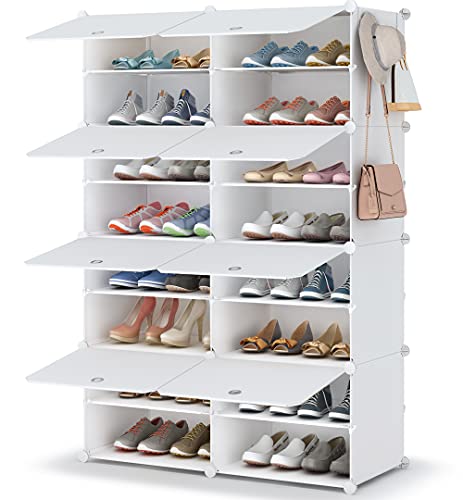
- Best closed-door capacity: HOMIDEC 8-Tier Cube Shoe Cabinet (2 by 8) — Check on Amazon
- VTRIN 10-Tier Narrow Shoe Rack with Dustproof Cover — Check on Amazon
- Kuject X-Large Clear Shoe Storage Boxes, 12-Pack — Check on Amazon
- Whitmor 24-Pocket Over-the-Door Shoe Organizer (Clear) — Check on Amazon
- Simple Houseware 3-Tier Stackable Shoe Rack, Bronze — Check on Amazon
- Prose-only: slimmest wooden tower: Furinno Compact Vertical Shoe Tower, 8-Tier (24142) — described in full below; no link in this guide (see the review for why)
Read the full guide ↓
Disclosure: As an Amazon Associate, dailyhomedecorating.com earns from qualifying purchases. Links to Amazon on this page are affiliate links; they cost you nothing extra. Listing details such as price and availability change often, so check the current Amazon listing before you buy.
A family’s shoe problem is not a smaller version of a single person’s — it is a different problem entirely, and the best shoe cabinet for families under $50 has to solve the family version: four or five people, each with daily shoes, school shoes, sports shoes and seasonal boots, all arriving at the same square metre of hallway at the same wet moment. Multiply an average collection across a household and you are organising thirty to fifty pairs, in sizes from toddler to adult, with the smallest owners constitutionally incapable of putting anything back neatly. Any storage that requires care, sequencing or gentle handling will be defeated by Thursday. Family shoe storage has to be fast to use, hard to break, easy to clean and big enough that ‘full’ is not its permanent state.
The budget makes it harder and simpler at once. Harder, because at under $50 there is no wooden cabinet with doors that will swallow a family’s collection — the closed storage in this tier is fabric towers, modular cube grids and lidded boxes, as we explain honestly throughout. Simpler, because family use exposes exactly which of those designs earn their keep: cubes that can be assigned per person, covers that survive being yanked, boxes that contain one child’s entire shoe wardrobe in a single grabbable unit. What families should not buy is anything precious. Mud is coming. Paint from school is coming. A tower will be climbed, a door will be swung, a box will be sat on. The picks below were chosen for that reality, not for a showroom.
Our short answer for most families is the HOMIDEC cube grid: the highest capacity here, a door per cube, and — the decisive trick — cubes you can assign, one or two per person, so every family member owns a visible, closable piece of the system. The VTRIN covered tower is the pick for narrow halls where the grid will not fit, and the Kuject boxes are the pick for families who would rather give each child a portable box than referee a shared cabinet. The Whitmor door organizer quietly solves the toddler-shoe overflow better than anything else here, and the Simple Houseware rack handles the wet-boot season that destroys lesser shelves. The Furinno tower appears prose-only, as the narrow-gap wild card for hallways with one awkward foot of spare width.
A note on what family-proof means in this tier: it does not mean indestructible, because nothing under $50 is. It means failures are graceful and cheap. A cube panel that cracks is one panel in a grid that still stands. A box that splits is one box of twelve. A cover that tears after two school years of service has still done its job at a cost per year no wooden cabinet can match. Families should buy this tier the way they buy children’s shoes — correctly sized for now, honestly priced, and expected to be outgrown or worn out on a schedule that is planned rather than resented. Judged that way, these are not the cheap versions of family storage. They are the appropriate technology for it.
In this guide
Quick Picks
Short on time? This table matches each design to the job it does best in this price tier. Every linked pick was checked against the under-$50 ceiling at the time of writing — confirm the current listing before you buy, because budget storage prices move often.
| Buyer type | Pick | Why it stands out | Link |
|---|---|---|---|
| Best closed-door capacity | HOMIDEC 8-Tier Cube Shoe Cabinet (2 by 8) | A reconfigurable cube grid with a door on every cube, the closest thing in this tier to a real cabinet with doors | Check on Amazon |
| Best true cabinet-style pick | VTRIN 10-Tier Narrow Shoe Rack with Dustproof Cover | Tall, narrow tower fully wrapped in a non-woven dust cover, so shoes disappear behind fabric instead of sitting on open display | Check on Amazon |
| Best see-everything storage | Kuject X-Large Clear Shoe Storage Boxes, 12-Pack | Twelve individual clear stackable boxes with lids, so every pair stays visible, dust-free and separately grabbable | Check on Amazon |
| Best zero-floor-space option | Whitmor 24-Pocket Over-the-Door Shoe Organizer (Clear) | Twenty-four clear pockets that hang on the back of a door, using space no floor-standing cabinet can touch | Check on Amazon |
| Best open metal rack | Simple Houseware 3-Tier Stackable Shoe Rack, Bronze | A sturdy bronze-finish wire-grid rack that stacks, so you start with three tiers and add height only if you need it | Check on Amazon |
| Prose-only: slimmest wooden tower | Furinno Compact Vertical Shoe Tower, 8-Tier (24142) | An eight-tier composite-wood tower only about a foot square, the narrowest furniture-style footprint in this guide | No link — see review |
How we chose the best shoe cabinet for families under $50
Family judging starts with capacity per dollar, but not the maker’s fantasy number — we recalculated every pick for mixed-size reality: adult trainers count double against toddler shoes, boots count double against everything, and any design whose usable family capacity fell under roughly twenty mixed pairs had to justify itself another way, as the door organizer does with zero floor space. Second came assignability: can the storage be divided so each person has a place that is theirs? Systems children can identify as ‘mine’ get used; communal shoe soup does not. Third came survivability — wipeable surfaces, replaceable logic, nothing that a kicked connector or a swung door turns into a write-off.
As with every guide on this site, linked picks are only those with a verified listing identity and a price sighted inside the tier at the time of writing; the Furinno tower, which we could not price-verify in tier, is described prose-only rather than linked on trust. We also screened candidates against public recall listings and excluded anything with an open safety recall — non-negotiable in a guide aimed at homes with children, where tall storage must also pass the anchoring advice in the how-to-choose section.
We also gave every pick a chaos rating in our notes — how it behaves on the worst morning, not the best — and it shaped the ranking more than any specification. The grid leads because its doors close on chaos and restore order visually in one gesture; the door organizer ranks above its capacity because it is the only system a small child can operate at full speed, at their own height, without an adult’s help or an adult’s patience.
A closing note on evidence. Every linked pick in this guide was verified as a real, identifiable listing with a price sighted inside the tier during research, and the companion sources file shows the working. Where a familiar family-storage name could not be verified that way, it appears without a link and with the reason stated in its review, because a family buying on a budget deserves sourcing it can check more than it deserves one more blue link. Capacities throughout are given as maker ratings tempered by the mixed-size arithmetic explained in the reviews — adult shoes, children’s shoes and boots counted as what they are rather than as interchangeable units. If your household’s count differs from our assumptions, trust your count: the designs were ranked for how they behave under family load, and that behaviour scales predictably once you know your real number of pairs, sizes and wet-weather days.
Detailed reviews
Each pick below is judged on who it suits, what it does well, where it honestly falls short, and the simplest choose-or-skip test we can give you.
HOMIDEC 8-Tier Cube Shoe Cabinet (2 by 8)
The HOMIDEC is a modular cube system: polypropylene panels, a metal wire frame and ABS connectors that click together into a two-wide, eight-high grid measuring about 12.4 inches deep, 33.1 inches wide and 49.2 inches high. Each cube gets its own door, so this is the one design in this roundup that genuinely closes like a cabinet rather than hiding shoes behind a shared fabric flap. The maker rates the full grid for up to thirty-two pairs and each cube for about eleven pounds, and because it is modular you can build it as one tall block, two shorter blocks side by side, or an L-shape around a corner. At roughly seventeen pounds it is light enough to reposition after assembly, which matters when you inevitably build it in the wrong room first.
Who it suits: families of four or more with a stretch of wall to give, and parents who have learned that assigned storage beats shared storage. Two cubes per person — daily pair below, everything else above — turns the morning hunt into each child checking their own doors.
Pros: the biggest verified capacity in this guide; doors keep the visual chaos of fifty pairs behind panels; cubes reassign as children grow — today’s toddler cubes become tomorrow’s teen cubes without buying anything. Panels wipe clean of mud and marker. Honest limitation: it is the longest build here, and small children will treat the doors as toys for the first week; per-cube weight limits mean adult boots live in the bottom row. Choose it if you have the wall and want a system, not a pile. Skip it if your hallway is narrow — look at the tower instead.
One routine makes the grid work for families: the Sunday reset. Five minutes, once a week, everyone returns their pairs to their own cubes, boots get knocked off over the doorstep tray, and anything that has migrated to the floor gets rehomed or honestly declared outgrown. The grid supports the routine because every cube has an owner and a door — drift is visible the moment a door will not close. Families who run the reset find the system looks after itself the other six days; families who skip it discover that even the best cabinet is, in the end, a suggestion. Build the habit when the cabinet is new and exciting, and it will still be working when the novelty is gone.
VTRIN 10-Tier Narrow Shoe Rack with Dustproof Cover
The VTRIN is a ten-tier vertical tower built from metal tubes, plastic connectors and non-woven fabric shelves, finished with a full dustproof cover that closes the front. The maker rates it for twenty to twenty-two pairs, which in practice means roughly two pairs of average shoes per tier if you angle them, or one pair of chunky trainers per tier with room to breathe. Because the footprint is narrow and the height does the work, it behaves like the budget end of a shoe cabinet: a closed, dust-shielded column rather than an open rack. Assembly is tool-free push-together work, and the cover lifts away so you can reach lower tiers without dismantling anything.
Who it suits: families in flats and narrow houses where the cube grid physically cannot go, and households whose shoe mountain is tall rather than wide. Ten tiers in a slim column can hold the daily rotation of a whole family beside the door.
Pros: the cover ends the visual argument — fifty pairs behind fabric look like no pairs; the narrow footprint survives hallways where children, bags and a dog all pass at once. Honest limitation: a shared cover means the whole family’s shoes live behind one opening, so there is no per-person assignment; fabric shelves under a family’s heaviest boots will flex, so boots go low and light shoes go high. Children also need the cover lifted for them at first. Choose it if width is your constraint. Skip it if assignability is the feature that will save your mornings.
Families get the most from the tower by zoning it vertically: adults’ daily pairs at the comfortable middle heights, children’s pairs on the low tiers they can reach without climbing, and the top tiers reserved for light, occasional shoes. Write the zones on a strip of tape inside the cover for the first month — it sounds excessive until the first school morning runs on rails because a six-year-old can complete the whole shoe routine alone. The cover will be opened and closed dozens of times a day in a family home; treat it gently at the seams, and consider it a consumable with a long life rather than a fitting with an infinite one.
Kuject X-Large Clear Shoe Storage Boxes, 12-Pack
The Kuject set skips the shared frame entirely: you get twelve individual X-Large clear plastic boxes, each with its own lid, that stack into whatever wall of storage your space allows. The X-Large sizing is the point — these are the boxes in this price class aimed at bigger trainers and boots rather than only flats and sandals, and the clear walls mean you identify a pair at a glance instead of opening doors in sequence. There is no frame to wobble and no cover to lift; the trade-off is twelve separate lids to handle and a footprint that grows one box at a time. Stacked in a closet they read as a transparent shoe cabinet; spread under a bed they disappear completely.
Who it suits: families who organise by person rather than by place: one box per child per shoe type, stacked in a closet, labelled if you are that family, memorised if you are not. Boxes also travel — the sleepover pair, the sports pair — without unpacking a cabinet.
Pros: each child’s shoes are contained, visible and grabbable as a unit; a damaged box is one box, not a broken cabinet; clear walls let a child find their own shoes without reading or asking. Honest limitation: twelve boxes is twelve pairs — a big family will want two sets, which is still in tier but worth planning; and a stack of boxes in a hallway will be climbed, so keep family stacks in a closet, low and wide. Choose it if per-person boxes fit how your household actually behaves. Skip it if you need one big hallway unit.
The box system’s family superpower shows up twice a year, at the season change. Summer boxes and winter boxes swap places between the closet stack and the high shelf in minutes, and outgrown shoes reveal themselves during the swap instead of festering in a cabinet’s dark corners. Label the short end of each box with a name and a size — a strip of masking tape is enough — and children can manage their own rotation, including the ceremonial passing-down of a box to a younger sibling. Few storage systems make growth this visible, or this easy to act on, and for families that visibility is worth more than any door or cover.
Whitmor 24-Pocket Over-the-Door Shoe Organizer (Clear)
The Whitmor is the veteran of this list: twenty-four clear pockets on a hanging panel that hooks over a standard door, from a US storage brand that has sold this pattern for years (model 6046-13). Each pocket swallows one shoe, so a pair takes two pockets, and the clear fronts keep everything visible. It is not a cabinet and does not pretend to be — there are no doors, no frame and no floor footprint at all. What it offers instead is instant, tool-free capacity in the one place every home has spare volume: the back of a closet, bedroom or laundry door. The pockets suit flats, sandals, trainers and children’s shoes best; tall boots and very wide high-tops are the honest exception.
Who it suits: the overflow problem every family recognises: the small shoes. Toddler and primary-school shoes fit these pockets perfectly, and a door of them at child height is storage a four-year-old can genuinely operate alone — the only pick here of which that is true.
Pros: zero floor space in homes that have none to spare; clear pockets make choosing shoes a point, not a search; it costs the least here, so it pairs happily with one other pick as a two-part system. Honest limitation: adult boots and wide trainers need not apply, and a door loaded with shoes gets heavy — check hinges and teach door-closing accordingly. Choose it if small shoes are your overflow. Skip it if your children are all teenagers with adult-size feet.
On a family door, arrange the Whitmor by height of owner, not by shoe type: the smallest person’s pockets at the bottom, within their reach and their sightline, adults’ pairs above. A child who can see, reach and operate their own storage will use it; a child who needs a stool and a parent will use the floor. The clear pockets also quietly teach the pairing habit — two adjacent pockets, two matching shoes — in a way a communal rack never does. Keep the very bottom row for the current favourite pair and you have built a morning routine a four-year-old can win at, which is the highest praise family storage can earn.
Simple Houseware 3-Tier Stackable Shoe Rack, Bronze
The Simple Houseware is the traditionalist’s pick: a three-tier metal rack with wired-grid shelves in a bronze finish, rated by the maker for around nine pairs across its three levels. Its party trick is stacking — the frame is designed so a second unit locks on top, turning a low entryway rack into a six-tier tower without buying a different product. The open grid lets wet soles drip and dry instead of stewing inside a closed box, and the metal frame shrugs off the kicks and vacuum bumps that slowly destroy fabric shelves. There is no cover and no door, so what you gain in airflow and durability you give back in dust and visibility.
Who it suits: families in wet climates and sports seasons, where shoes arrive soaked and muddy and the correct storage is the one that lets them drip, dry and be hosed down in spring. Put it by the back door and let the closed storage by the front door stay clean.
Pros: metal grid shelves do not sag under a family’s worth of boots, do not absorb smells, and clean with a wipe or a rinse; stacking a second unit doubles it when the season demands. Honest limitation: completely open — no dust protection, no hiding, and wet shoes drip onto whatever is beneath, so pair it with a tray or mat. Choose it if your shoe problem is weather. Skip it if your problem is tidiness — this solves the opposite one.
The rack earns its place in a family system as the wet-dry boundary. House rule: shoes cross into closed storage only when dry, and until then they live on the grid over its tray, where mud dries, flakes and gets swept rather than smeared through a cabinet. In sports seasons the rack absorbs the overflow that would otherwise break the main system’s capacity — boots after matches, trainers after training — and returns them to circulation once clean. It is the least glamorous pick in this guide and, in a wet-climate family home, very possibly the most used piece of furniture in the hallway by December.
Furinno Compact Vertical Shoe Tower, 8-Tier (24142)
The Furinno 24142 is the outlier here: instead of tubes and fabric it is a vertical tower of CARB-grade composite wood panels, eight tiers tall, measuring roughly 12.1 by 12.6 by 46.8 inches — barely wider than a single pair of shoes. The maker positions it for around seven to eight pairs stored vertically, one per tier, with a forty-pound overall weight capacity and a one-year warranty against manufacturer defects. It looks more like furniture than any fabric tower, which is exactly its appeal in a visible hallway. We list it without a link because we could not confirm a current US Amazon price for this model inside the under-$50 tier at the time of writing; if you see it within budget, it is the pick for a narrow gap that no rack or cube grid can fit.
Who it suits: the family hallway with exactly one narrow, useless gap — beside a radiator, between door frame and wall — where a foot-wide tower turns dead space into seven or eight pairs of storage, most naturally the adults’ daily pairs while children’s shoes live elsewhere.
Pros: composite-wood panels read as furniture in a visible hall, and the one-pair-per-tier discipline suits a curated daily rotation. Honest limitation: capacity is the smallest here, it is open storage with no dust protection, and we could not verify a current in-tier US price for this model, so it carries no link in this guide. Choose it if you find it within budget and have the perfect gap. Skip it if it would be your only family storage — it cannot carry that load.
In a family hallway the Furinno works best with a strict constitution: it is the adults’ daily-pair tower, nothing else. Two pairs each for two adults, perhaps a guest pair in the last tier, and a house rule that children’s shoes, sports shoes and seasonal shoes live in their own systems elsewhere. That discipline plays to its strengths — a calm, furniture-looking column that never overflows because it is not allowed to — and protects its weakness, which is capacity. Ask it to be the family’s only storage and it fails by Friday; ask it to be the tidy tip of a larger system and it is the best-looking thing in this guide.
No Amazon link for this pick in this guide — see the sourcing note in the review above. Judge any listing you find against the same checks we applied to the linked picks.
Comparison table
Use this table to shortlist by the one question that matters most at this price: how closed do you need the storage to be? Everything else — capacity, footprint, effort — flows from that answer.
| Pick | Closure | Capacity | Footprint | Main trade-off |
|---|---|---|---|---|
| HOMIDEC 8-Tier Cube Shoe Cabinet (2 by 8) | Closed (door per cube) | Up to 32 pairs (maker rating) | 33 in wide, 49 in tall | Longest assembly in the group |
| VTRIN 10-Tier Narrow Shoe Rack with Dustproof Cover | Closed (fabric cover) | 20–22 pairs (maker rating) | Very narrow, tall | Fabric shelves can sag under heavy boots |
| Kuject X-Large Clear Shoe Storage Boxes, 12-Pack | Closed (lid per box) | 12 pairs, one per box | Flexible — stack anywhere | Twelve lids to open and close |
| Whitmor 24-Pocket Over-the-Door Shoe Organizer (Clear) | Open pockets | 12 pairs (24 pockets) | Zero floor space | Not suited to tall boots |
| Simple Houseware 3-Tier Stackable Shoe Rack, Bronze | Open rack | Around 9 pairs per unit | Low, wide, stackable | No dust protection at all |
| Furinno Compact Vertical Shoe Tower, 8-Tier (24142) | Open tower | Around 7–8 pairs | About 12 in square | One pair per tier only |
Running a family shoe system that survives the school year
The cabinet is hardware; what follows is the software. These are the operating rules that separate family systems still working in June from those abandoned by October half-term.
Zones, labels and the two-minute rule
Assign every storage zone an owner and, for younger children, a picture or initial — not as decoration, but because a system a five-year-old cannot read is a system a five-year-old cannot run. Then apply the two-minute rule to the whole entry routine: if putting a child’s shoes away takes longer than two minutes of effort, the system is too complicated and the floor will win. Pockets at child height, cubes at the bottom row, boxes with their name on — every pick in this guide can be arranged to pass the two-minute test, and every arrangement that fails it fails entirely, whatever its capacity.
The growth protocol
Children’s feet are a logistics problem disguised as biology. Build two habits into the system from the start. First, a measuring rhythm — feet checked at each season change, at the same moment the storage gets its seasonal reset — so outgrown shoes leave before they consume space meant for current pairs. Second, an exit route: a bag or box by the cabinet where outgrown pairs go immediately, bound for a sibling, a friend or donation. Family shoe storage fails by accumulation more than by any other mechanism; the exit route is the difference between a system and a museum of feet your children used to have.
Guests, grandparents and the surge problem
Family systems are sized for the household and stressed by everyone else: birthday parties with twelve small visitors, grandparents staying for a week, the team back to yours after a match. Do not size the cabinet for the surge — size a surge answer instead. A folding tray, a spare door organizer on the utility door, one deliberately empty cube: any of these absorbs a surge for a day without permanently taxing the system. The families whose hallways survive parties are not the ones with the biggest cabinets; they are the ones who decided in advance where the extra shoes go, so the decision never has to be made in a doorway full of guests.
How to choose the best shoe cabinet for families under $50
Assign before you buy
Decide the division of storage on paper first: how many pairs per person actually need to live by the door, versus in bedrooms or a closet? Most families discover the hallway only needs daily pairs — perhaps three per person — while the full collection belongs elsewhere. That single decision halves the capacity you need at the door and tells you whether you are buying one family unit or a door unit plus overflow. Then match the design to the division: cubes and boxes assign naturally; towers and racks are communal and suit households happy to share one space.
Plan for the worst week, not the average day
Family shoe storage fails in the worst week: rain every day, two sports fixtures, grandparents visiting with their own shoes. If your system only works when every pair is in its place, it does not work. Leave a deliberate overflow answer — a door organizer, a tray under the rack, one empty cube — so the system bends instead of breaking, and the hallway survives the week that would otherwise retrain everyone into floor-pile habits.
Anchor it like children live there, because they do
Any tall unit in a family home will eventually be pulled, leaned on or climbed. Fix tall towers and grids to the wall with the included kit or a furniture strap, load heavy pairs at the bottom, and keep climbing incentives — favourite shoes, anything shiny — off the top tiers. A two-minute anchoring job is the cheapest safety device in this entire guide.
Buy for the family you will have in two years
Family storage should be bought one size of life ahead. Toddlers become schoolchildren with sports kits; schoolchildren become teenagers with adult-size feet and opinions. Modular and divisible systems absorb that growth by reassignment — cubes change owners, boxes change contents, a second tower joins the first — while a single fixed unit sized exactly for today becomes the bottleneck of 2028. When two picks otherwise tie, choose the one that can be in two places, change shape, or be joined by a twin. In family storage, adaptability is not a feature on the box. It is the difference between buying once and buying every September.
Common mistakes
- Buying for the photo, not the headcount. Count every pair that needs a home, in real sizes, then add a season’s growth for children’s feet. A cabinet that is full on delivery day is a floor pile by half-term.
- One communal pile with extra steps. Storage children cannot assign to themselves does not get used. If nobody owns a shelf, nobody maintains it — choose cubes, boxes or zones over one shared opening wherever you can.
- Putting the system where shoes are not. Shoes are shed at the door the family actually uses, which is often the back or side door. A beautiful cabinet at the front door and a mountain at the back door is a system installed in the wrong house plan.
- Forgetting the wet layer. Closed storage plus wet shoes equals smell. Give wet pairs an open, drip-friendly staging spot — the metal rack, a tray, one open cube — and move them into closed storage when dry.
- Skipping the anchor because it feels sturdy. Light furniture feels stable empty and behaves differently loaded and climbed. Anchor tall units the day they are built, not after the first wobble.
- Letting the system start unfair. If the tallest child claims the best zones on day one and the smallest gets the leftovers, the system begins life resented. Assign zones deliberately at the loading ceremony — best reach for the youngest, not the fastest — and fairness becomes part of the furniture.
Setting up the system: a one-afternoon family protocol
The build is the easy half. This protocol turns the built unit into a working family system in the same afternoon, while enthusiasm is at its peak.
Step one: the great shoe census (30 minutes)
Every pair in the house comes to one room. Every pair is tried, owned or released: outgrown and unworn pairs leave via the exit bag the same day, not into a cupboard to be re-decided later. The census almost always shrinks the collection by a quarter, which is capacity you did not have to buy.
Step two: zones on paper (10 minutes)
Sketch the unit, assign every zone an owner and a purpose, and only then load a single shoe. Loading first and organising later guarantees the confident children fill the best zones and the system starts life unfair — a small thing that corrodes it for months.
Step three: the loading ceremony (20 minutes)
Everyone loads their own zones, with the house rules stated once, out loud: heavy low, daily pairs at your own reach height, wet shoes to the rack until dry, one empty zone left empty on purpose. Children who load their own storage own it in a way no assigned system achieves, and the ceremony is the cheapest training the system will ever get.
Step four: the first reset, scheduled
Put the weekly five-minute reset in the family calendar before the afternoon ends — same time as another fixed routine, so it inherits the habit. Systems do not fail dramatically; they drift. The reset is the anti-drift device, and scheduling it is the whole secret.
Final recommendation
For most families, build the HOMIDEC grid and assign it ruthlessly: a door per person per purpose, heavy boots along the bottom, one cube left empty on purpose for the worst week. If your hallway will not take the grid’s width, the VTRIN tower hides the same mountain in a fraction of the floor space, and if your household thinks in per-person units, the Kuject boxes turn shoe storage into something each child can carry, stack and own. Add the Whitmor door organizer wherever small shoes overflow, keep the Simple Houseware rack at the wet door, and treat the Furinno as the gap-filler it is. The best family system is not the prettiest one — it is the one still working in February.
And if the system wobbles in its first month, adjust it rather than abandoning it: reassign a zone, move the wet rack, add the door organizer, schedule the reset you skipped. Family systems are tuned, not installed. The cabinet you bought is the hardware; the household that runs it kindly, briefly and every week is the product. Get both halves right and the hallway argument — the oldest argument in family life — quietly ends. Start this weekend: census on Saturday, ceremony on Sunday, and the first reset in the calendar before Monday’s school run puts the system to its first real test.
FAQ
How much shoe storage does a family of four need?
Count daily pairs first: most families keep two to three pairs per person by the door, so eight to twelve pairs at the entry and the rest in bedrooms or a closet. In this tier, that means a tall covered tower or a mid-size cube grid for the door, plus overflow elsewhere, rather than one unit expected to hold every shoe the family owns.
What is the best way to stop children leaving shoes on the floor?
Give each child storage they own and can reach: their own cubes, their own box, or pockets at their height on a door. Systems fail when putting shoes away needs an adult’s height, strength or patience. Low, assigned, openable-by-small-hands storage gets used; a tall shared cabinet mostly gets walked past.
Are cube cabinets safe around toddlers?
Assembled and anchored, yes — and anchoring is the operative word. Fix the grid to the wall, load the bottom cubes with the heaviest pairs, and avoid placing tempting items on top. The individual doors are light and pinch risk is low, but any tall light furniture in a toddler’s home should be treated as a fixing job, not just a building job.
How do we handle wet and muddy shoes with closed storage?
Stage them open first. A metal grid rack or a simple tray by the door lets shoes drip and dry; once dry, they move into the closed cabinet. Sealing wet shoes behind doors or covers traps moisture and smell, and in fabric towers it can leave the shelves smelling of the season. Dry first, store second.
Should each child have their own shoe box?
It is one of the most effective systems in this tier. A clear box per child — or per child per activity — is visible, portable and entirely theirs, which removes both the searching and the arguing. Twelve-box sets divide neatly across two or three children, and replacing one lost or damaged box costs very little.
When should a family skip this tier and spend more?
If you need one furniture-grade piece in a formal hallway, or your collection includes many tall boots that defeat tier heights and cube sizes, the honest answer is that this tier will frustrate you. It excels at high-capacity, practical, closed storage for everyday family footwear — which is most families, most of the year.
How do we stop the cabinet smelling of school shoes?
Dry-first discipline, plus ventilation. Shoes go in dry; once a week the doors or cover stay open during a clean for a full airing; a small open box of baking soda in a spare cube absorbs what discipline misses. The smell problem is a moisture problem wearing a disguise, and it is solved at the door with a tray and a rule, not inside the cabinet with sprays.
Is it worth buying two smaller units instead of one big one?
For many families, yes: one unit at the busy door for daily pairs and one in a bedroom or utility space for the archive splits traffic, shortens queues on school mornings and means no single unit must be family-sized. Two in-tier units also degrade gracefully — if one is damaged, the household still has a working system while it is repaired or replaced.
Related guides
More storage and entryway guides from this site:


