Where to buy
Check the latest price, availability and delivery on Amazon. Orders are placed on Amazon. We may earn a commission from qualifying purchases.
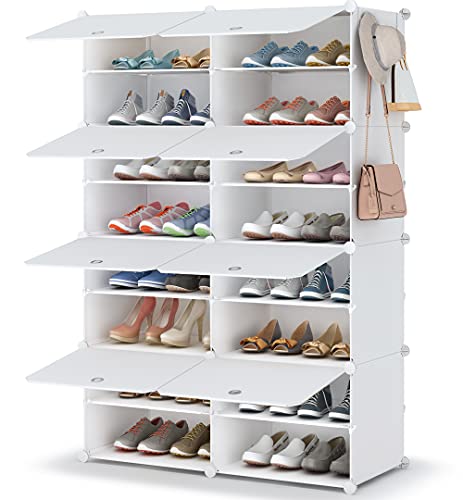
- Best closed-door capacity: HOMIDEC 8-Tier Cube Shoe Cabinet (2 by 8) — Check on Amazon
- Kuject X-Large Clear Shoe Storage Boxes, 12-Pack — Check on Amazon
- VTRIN 10-Tier Narrow Shoe Rack with Dustproof Cover — Check on Amazon
- Simple Houseware 3-Tier Stackable Shoe Rack, Bronze — Check on Amazon
- Prose-only: brand-name covered tower: SONGMICS 10-Tier Shoe Rack with Dustproof Cover (URXJ034BH01) — described in full below; no link in this guide (see the review for why)
- Whitmor 24-Pocket Over-the-Door Shoe Organizer (Clear) — Check on Amazon
Read the full guide ↓
Disclosure: As an Amazon Associate, dailyhomedecorating.com earns from qualifying purchases. Links to Amazon on this page are affiliate links; they cost you nothing extra. Listing details such as price and availability change often, so check the current Amazon listing before you buy.
Modern interiors are unforgiving of shoe storage. The whole point of a contemporary hallway — clean lines, clear floor, nothing visual that does not earn its place — collapses the moment a trainer pile colonises the skirting board, and the best shoe cabinet for modern homes under $50 has to restore that calm without looking like what it costs. That is a genuinely hard brief, because the honest starting point is that this tier contains no solid-wood, soft-close, designer cabinet. What it contains is fabric, polypropylene, clear plastic and wire — materials that read as ‘budget storage’ in their raw state and have to be chosen, placed and styled with intent to sit comfortably in a modern room. This guide is about making that work, and about being honest where it cannot be made to work.
The good news is that modern design plays to this tier’s strengths more than most styles do. Minimalism forgives simple geometry — a clean cube grid, a single dark column, a transparent stack — far more readily than it forgives ornate cheap furniture pretending to be expensive. The worst outcome in a modern home is not a fabric tower; it is a faux-wood cabinet with plastic hinges trying to impersonate joinery. The picks below lean into the honest end of the tier: flat fronts, single colours, no fake grain, nothing pretending. Chosen in black, white or clear and placed with discipline, several of them genuinely disappear — which, in a modern interior, is the highest compliment storage can earn.
Our short answer: the HOMIDEC cube grid in a single disciplined colour is the most architectural option here — a flat-fronted wall of doors that can be built low and wide like a sideboard rather than tall like a tower. The Kuject clear boxes are the minimalist’s alternative, turning a sneaker collection into a deliberate transparent display or vanishing into a closet entirely. The VTRIN tower, in black, is a single vertical shadow-line beside a door — surprisingly at home in contemporary spaces. The Simple Houseware rack in bronze is the one open pick with a finish that reads as a design choice rather than a compromise, and the SONGMICS covered tower appears prose-only for the sourcing reason explained in its review. The Whitmor door organizer closes the list as the invisible option: modern calm, achieved by putting the shoes in another room entirely, behind a door.
A word about photography, because it decides more purchases in this category than any specification. Product images in this tier are rendered or staged in bright, empty, architect-scale rooms that flatter flat-pack storage enormously. Your hallway is smaller, darker and already furnished, and the unit will look exactly as present there as any other object of its size. The designs below were chosen to survive that translation — to look correct at real scale, in real light, next to real skirting boards — rather than to win a product page. Where a pick needs help from placement or lighting to earn its place in a modern room, the review says so, because in this tier the room does half the design work and pretending otherwise sets you up to return a perfectly good cabinet.
In this guide
Quick Picks
Short on time? This table matches each design to the job it does best in this price tier. Every linked pick was checked against the under-$50 ceiling at the time of writing — confirm the current listing before you buy, because budget storage prices move often.
| Buyer type | Pick | Why it stands out | Link |
|---|---|---|---|
| Best closed-door capacity | HOMIDEC 8-Tier Cube Shoe Cabinet (2 by 8) | A reconfigurable cube grid with a door on every cube, the closest thing in this tier to a real cabinet with doors | Check on Amazon |
| Best see-everything storage | Kuject X-Large Clear Shoe Storage Boxes, 12-Pack | Twelve individual clear stackable boxes with lids, so every pair stays visible, dust-free and separately grabbable | Check on Amazon |
| Best true cabinet-style pick | VTRIN 10-Tier Narrow Shoe Rack with Dustproof Cover | Tall, narrow tower fully wrapped in a non-woven dust cover, so shoes disappear behind fabric instead of sitting on open display | Check on Amazon |
| Best open metal rack | Simple Houseware 3-Tier Stackable Shoe Rack, Bronze | A sturdy bronze-finish wire-grid rack that stacks, so you start with three tiers and add height only if you need it | Check on Amazon |
| Prose-only: brand-name covered tower | SONGMICS 10-Tier Shoe Rack with Dustproof Cover (URXJ034BH01) | A ten-tier covered tower from the best-known budget storage brand, holding a claimed twenty pairs behind a dust cover | No link — see review |
| Best zero-floor-space option | Whitmor 24-Pocket Over-the-Door Shoe Organizer (Clear) | Twenty-four clear pockets that hang on the back of a door, using space no floor-standing cabinet can touch | Check on Amazon |
How we chose the best shoe cabinet for modern homes under $50
Modern judging inverts the usual order. We scored visual discipline first: flat or concealable fronts, a single finish, no faux-wood grain, no chrome-and-plastic clutter, and silhouettes that read as one gesture rather than a kit of parts. Only designs that passed that bar were then judged on the usual cabinet tests — how completely they close, verified capacity, assembly forgiveness and whether we could sight a price inside the tier at the time of writing. Anything we could not price-verify in tier appears prose-only, however good it looks; a beautiful dead link helps nobody.
We also applied a placement test: could this design sit in a photographed modern hallway without the eye stopping on it? That test killed more candidates than any other. Multi-colour connectors, visible tube joints in contrasting plastic and busy printed fabrics all failed it, however practical they were. What survived is a short list of designs whose appearance you control — through colour choice, configuration and what you put around them — which is exactly how modern interiors actually work.
A last methodological note: we deliberately included one open rack and one door organizer in a cabinet guide, because modern briefs are sometimes solved by refusing the cabinet entirely. An edited open display or a completely empty hallway can be the most modern answer available at any price; the closed picks had to beat those honest alternatives, not just each other, to rank where they do.
A closing note on taste, since this guide has traded in it heavily. Judgements about what suits a modern home are stated as design reasoning, not as law: flat fronts over faux grain, monochrome over mixed finishes, low and wide over tall and narrow, emptiness protected over surfaces filled. If your modern runs warmer, more eclectic or more maximal than the version assumed here, the underlying method still serves you — choose honest materials, commit to one finish, configure to the architecture, and edit what surrounds the unit. The picks themselves do not change; only the styling brief does, and the reviews mark clearly which picks forgive a busier room (the closed grid, the covered tower) and which demand a quiet one (the open rack, the clear display). Buy for the room you actually keep, and the tier will not embarrass it.
Detailed reviews
Each pick below is judged on who it suits, what it does well, where it honestly falls short, and the simplest choose-or-skip test we can give you.
HOMIDEC 8-Tier Cube Shoe Cabinet (2 by 8)
The HOMIDEC is a modular cube system: polypropylene panels, a metal wire frame and ABS connectors that click together into a two-wide, eight-high grid measuring about 12.4 inches deep, 33.1 inches wide and 49.2 inches high. Each cube gets its own door, so this is the one design in this roundup that genuinely closes like a cabinet rather than hiding shoes behind a shared fabric flap. The maker rates the full grid for up to thirty-two pairs and each cube for about eleven pounds, and because it is modular you can build it as one tall block, two shorter blocks side by side, or an L-shape around a corner. At roughly seventeen pounds it is light enough to reposition after assembly, which matters when you inevitably build it in the wrong room first.
Who it suits: modern homes with a hallway wall to furnish rather than a corner to fill. Built two cubes high and wide instead of eight high, the grid becomes a low, flat-fronted bench-wall of doors — the closest this tier gets to built-in cabinetry, especially in all-white or all-black with nothing stored on top.
Pros: doors on every cube give the flattest, calmest front in this guide; the modular grid sizes itself to your wall exactly, alcoves included; a single-colour build reads as one architectural block. Honest limitation: the panel-and-connector construction shows at close range — seams and connector caps are visible if you inspect, so it convinces at room distance, not at furniture distance. Assembly is also the longest here. Choose it if you will build it low, wide and monochrome. Skip it if your hallway demands a tall narrow unit — the tower does that silhouette better.
Styling the grid is a study in restraint. Choose the panel colour to match the wall and the grid becomes shadow and line rather than object; choose black against a white wall and it becomes a deliberate graphic block — both work, mixing does not. If your build runs long, consider leaving the top row of cubes as general storage with the doors closed on nothing but space: visual breathing room inside the system keeps the whole block feeling calm. Resist handles, labels and decoration; the flat door fronts are the design. At night, under hallway lighting, a well-built monochrome grid throws the same quiet grid-shadow as joinery costing twenty times more, which is as close to a free lunch as this tier offers.
Kuject X-Large Clear Shoe Storage Boxes, 12-Pack
The Kuject set skips the shared frame entirely: you get twelve individual X-Large clear plastic boxes, each with its own lid, that stack into whatever wall of storage your space allows. The X-Large sizing is the point — these are the boxes in this price class aimed at bigger trainers and boots rather than only flats and sandals, and the clear walls mean you identify a pair at a glance instead of opening doors in sequence. There is no frame to wobble and no cover to lift; the trade-off is twelve separate lids to handle and a footprint that grows one box at a time. Stacked in a closet they read as a transparent shoe cabinet; spread under a bed they disappear completely.
Who it suits: two opposite modern tribes equally well — sneaker collectors, for whom a clear stack is a display system and the shoes are the décor, and strict minimalists, who will put the same boxes inside a closet where their transparency is purely functional and their exterior impact is zero.
Pros: nothing in this guide disappears more completely inside a closet, and nothing shows a collection off more deliberately outside one; the strict one-box-one-pair geometry suits modern ordering instincts. Honest limitation: a visible stack is unambiguously storage, not furniture — in an open hallway it reads as organised, never as designed — and twelve lids mean the look depends on your discipline in closing them. Choose it if your shoes live behind a closet door or deserve display. Skip it if the hallway itself must carry the look.
Treat a visible Kuject stack the way a gallery treats shelving: even numbers, flush fronts, consistent orientation, and a collection edited to what deserves display. Sneaker culture already understands this — the clear box wall is its native furniture — but the discipline matters more in a living space than in a closet. Inside a closet, drop the performance entirely and let the boxes be pure function, stacked to the shelf’s exact dimensions. Either way, the transparency is the aesthetic: there is no surface to polish, no finish to match, nothing between the eye and the order itself. In modern terms it is the most honest object in this guide.
VTRIN 10-Tier Narrow Shoe Rack with Dustproof Cover
The VTRIN is a ten-tier vertical tower built from metal tubes, plastic connectors and non-woven fabric shelves, finished with a full dustproof cover that closes the front. The maker rates it for twenty to twenty-two pairs, which in practice means roughly two pairs of average shoes per tier if you angle them, or one pair of chunky trainers per tier with room to breathe. Because the footprint is narrow and the height does the work, it behaves like the budget end of a shoe cabinet: a closed, dust-shielded column rather than an open rack. Assembly is tool-free push-together work, and the cover lifts away so you can reach lower tiers without dismantling anything.
Who it suits: modern flats where the hallway is a passage, not a room, and the only available gesture is vertical. In black, the covered tower is a single dark column — the same visual move as a floor-to-ceiling shadow gap — and it asks for barely more floor than the shoes it holds.
Pros: the cover removes all visual noise of individual shoes in one move; the narrow silhouette suits contemporary architecture’s tight circulation spaces; nothing about it pretends to be wood. Honest limitation: fabric is fabric — the cover’s drape softens the column’s line compared with a rigid front, and a tall narrow unit in a styled space must be anchored and loaded low to stay perfectly upright and plumb. Choose it if you need tall, dark and narrow. Skip it if a rigid, furniture-crisp front is non-negotiable — stay with the cubes.
The tower’s modern credential is its silhouette, so protect it. Place it where the column reads against a plain wall, keep the floor around it empty — no basket, no overflow pair leaning — and load it so the cover hangs straight rather than bulging. A bulging cover is the difference between a shadow line and a sack, and it is entirely a loading decision: heavy pairs low, nothing forced, the cover closing under its own weight. Given that discipline, visitors read the tower as part of the architecture’s vertical rhythm, especially in black-on-dark schemes. It is the rare budget object that improves the more completely you ignore it.
Simple Houseware 3-Tier Stackable Shoe Rack, Bronze
The Simple Houseware is the traditionalist’s pick: a three-tier metal rack with wired-grid shelves in a bronze finish, rated by the maker for around nine pairs across its three levels. Its party trick is stacking — the frame is designed so a second unit locks on top, turning a low entryway rack into a six-tier tower without buying a different product. The open grid lets wet soles drip and dry instead of stewing inside a closed box, and the metal frame shrugs off the kicks and vacuum bumps that slowly destroy fabric shelves. There is no cover and no door, so what you gain in airflow and durability you give back in dust and visibility.
Who it suits: modern homes with an industrial or warm-minimal edge, where one open metal piece is a deliberate accent rather than a failure to hide. The bronze finish is doing real work here — it is the only open rack in this tier whose colour reads as chosen.
Pros: honest materials, a finish that pairs with modern lighting and hardware tones, and a low profile that keeps sightlines open. It also dries wet shoes, which no closed pick does. Honest limitation: open means the shoes are the display, so this only looks intentional with a disciplined rotation — a chaotic heap on a bronze rack is still a chaotic heap. Choose it if your rotation is small, good-looking and worth airing. Skip it if concealment is the brief — that is what the top three picks are for.
The bronze rack asks for one styling commitment: a small, edited rotation. Five or six good pairs, spaced rather than crammed, on a low metal grid reads as a boutique display; fifteen pairs in a heap reads as a jumble sale that happens to be bronze. If your rotation is genuinely small — the capsule-wardrobe household — this is the most elegant pick here, and the only one whose openness is a positive design statement rather than a compromise. Pair it with a plain wall and nothing above it but perhaps a single framed print, and let negative space do what it does in every good modern interior: make the few things present look chosen.
SONGMICS 10-Tier Shoe Rack with Dustproof Cover (URXJ034BH01)
The SONGMICS URXJ034BH01 takes the same tall-tower idea as the VTRIN — ten tiers, metal tube frame, non-woven shelves, a full dustproof cover — and puts the category’s most recognised budget brand behind it, with a stated capacity of twenty pairs covering sneakers and high heels. We are describing it without a purchase link in this guide for a simple reason: at the time of writing we could not confirm a current US Amazon price for this exact model inside the under-$50 tier, and this site does not attach links it cannot stand behind. If you find it listed within budget from a seller you trust, it is a legitimate like-for-like alternative to the VTRIN; judge it on the same tests — cover quality, connector fit and shelf sag under your heaviest pair.
Who it suits: buyers who like the covered-tower concept and prefer the category’s best-known budget brand, in a plain black that suits modern hallways as well as the VTRIN’s does. On paper it is the same move: ten tiers, full dust cover, stated twenty-pair capacity.
Pros: a clean single-colour covered silhouette and typically clear assembly documentation for the tier. Honest limitation: we could not verify a current US Amazon price for this exact model inside the tier when writing, so it is presented without a link — a sourcing limit, not a design verdict. Choose it if you find it listed within budget and prefer the brand. Skip it if listings sit above the ceiling; the linked VTRIN achieves the same silhouette for verified money.
Should you find the SONGMICS in tier, the modern verdict mirrors the VTRIN’s: in plain black, placed as a single column against a calm wall, it disappears into the architecture’s vertical lines; in a busy corner surrounded by clutter, no covered tower can save the composition. Judge listings by the cover’s plainness — avoid printed fabrics and contrasting piping, which date instantly — and by whether the seller is one you trust for a genuine unit. The design lesson generalises: in this tier, modern is a placement and editing achievement first and a purchasing achievement second, and this tower rewards exactly that order of priorities.
No Amazon link for this pick in this guide — see the sourcing note in the review above. Judge any listing you find against the same checks we applied to the linked picks.
Whitmor 24-Pocket Over-the-Door Shoe Organizer (Clear)
The Whitmor is the veteran of this list: twenty-four clear pockets on a hanging panel that hooks over a standard door, from a US storage brand that has sold this pattern for years (model 6046-13). Each pocket swallows one shoe, so a pair takes two pockets, and the clear fronts keep everything visible. It is not a cabinet and does not pretend to be — there are no doors, no frame and no floor footprint at all. What it offers instead is instant, tool-free capacity in the one place every home has spare volume: the back of a closet, bedroom or laundry door. The pockets suit flats, sandals, trainers and children’s shoes best; tall boots and very wide high-tops are the honest exception.
Who it suits: the strictest modern brief of all — a hallway with absolutely nothing in it. Moving the shoes onto the back of a closet or bedroom door keeps the entry architecture completely clean, which for some modern homes is worth more than any cabinet’s looks.
Pros: zero visual impact in the room it serves; clear pockets keep pairs findable in the room it hides in; the cheapest calm in this guide. Honest limitation: the shoes have not vanished, they have moved — the host door’s back becomes busy, pockets suit ordinary shoes rather than boots, and a loaded door gains weight its hinges will notice. Choose it if an empty hallway is the goal. Skip it if you want the storage itself to contribute to the room.
The Whitmor’s modern role is subtraction: it removes the shoe question from the designed room entirely. That is a legitimate — arguably the purest — modern strategy, and it works best when the host door is itself out of the design’s sightline: a closet door inside a bedroom, a laundry door, the inside of a hallway cupboard. What the hallway gains is everything: unbroken walls, clear floor, no storage object competing with the architecture. The cost is borne by a door back nobody photographs. For the strictest interiors in this guide’s audience, that trade is not a compromise at all; it is the plan.
Comparison table
Use this table to shortlist by the one question that matters most at this price: how closed do you need the storage to be? Everything else — capacity, footprint, effort — flows from that answer.
| Pick | Closure | Capacity | Footprint | Main trade-off |
|---|---|---|---|---|
| HOMIDEC 8-Tier Cube Shoe Cabinet (2 by 8) | Closed (door per cube) | Up to 32 pairs (maker rating) | 33 in wide, 49 in tall | Longest assembly in the group |
| Kuject X-Large Clear Shoe Storage Boxes, 12-Pack | Closed (lid per box) | 12 pairs, one per box | Flexible — stack anywhere | Twelve lids to open and close |
| VTRIN 10-Tier Narrow Shoe Rack with Dustproof Cover | Closed (fabric cover) | 20–22 pairs (maker rating) | Very narrow, tall | Fabric shelves can sag under heavy boots |
| Simple Houseware 3-Tier Stackable Shoe Rack, Bronze | Open rack | Around 9 pairs per unit | Low, wide, stackable | No dust protection at all |
| SONGMICS 10-Tier Shoe Rack with Dustproof Cover (URXJ034BH01) | Closed (fabric cover) | 20 pairs (maker rating) | Narrow, tall | No verified in-tier US listing found |
| Whitmor 24-Pocket Over-the-Door Shoe Organizer (Clear) | Open pockets | 12 pairs (24 pockets) | Zero floor space | Not suited to tall boots |
Placement, light and the modern hallway: a short styling field guide
Two modern hallways can contain the identical cabinet and read completely differently. The difference is placement, light and what surrounds the unit — the three variables this section covers.
Placement: earn the sightline
In a modern interior, the first sightline from the front door sets the room’s tone. Storage placed so its closed front is what the sightline meets — flat, monochrome, unadorned — reads as architecture. Storage placed side-on, exposing its depth, connectors and construction, reads as equipment. Where you have a choice, face the room with the front and hide the mechanics against the wall. If the unit must sit in a passage, the covered tower’s soft column is the forgiving option; if it can terminate a wall, the cube grid’s flat plane is the strongest. Either way, leave visible floor around it: modern space is defined as much by the emptiness you protect as by the objects you place.
Light: the cheapest upgrade
Budget materials are unusually honest under light, which cuts both ways. Flat panels and fabric covers look their best in soft, indirect light and their worst under a single harsh ceiling spot, which rakes across every seam. If your hallway lighting is a bare overhead bulb, the most modernising purchase you can make is not a better cabinet but a warmer, diffused light source — and it will flatter everything else in the hall at the same time. Clear boxes, conversely, love light: a lit closet stack has a gallery quality that costs nothing beyond the bulb already there. Judge your shortlisted pick under your hallway’s actual light before committing, ideally at night, when the hall is most itself.
Company: what the unit stands next to
Modern rooms are compositions, and storage is judged by its neighbours. A cube grid beside a plain bench and a single hook rail composes; the same grid beside a patterned runner, a gallery wall and a coat stand dissolves into noise. If your hallway already carries pattern and colour, choose the plainest storage here — black or white, closed, empty-topped — and let it be the quiet element. If your hallway is a blank white box, the bronze rack or a deliberate clear-box display can be the one warm note. The cabinet does not need to be beautiful. It needs to be in tune, and tuning is a decision you make with the whole wall in view.
How to choose the best shoe cabinet for modern homes under $50
Build low and wide, not tall and narrow
The single most effective styling move in this tier is configuration. Cube grids built as long, low blocks read as sideboards and consoles; the same cubes stacked tall read as storage towers. Covered towers should go in the darkest, narrowest spot available, where a vertical column disappears into shadow lines. Clear boxes belong behind a closet door or in a deliberate, evenly stacked display — never in a half-hearted hallway pile. Decide the silhouette from the room’s architecture first, then buy the design that builds it.
One colour, nothing on top
Modern calm is mostly subtraction. Choose a single finish — black against dark walls, white against light ones, clear inside closets — and resist mixing. Then enforce the hardest rule: nothing stored on top of the unit. The moment keys, post and a plant colonise the top surface, a clean block becomes a cluttered shelf with doors. If you need a landing strip for keys, give it its own small tray elsewhere and let the shoe storage stay a pure, closed plane.
Know when to leave the tier
Honesty cuts both ways: if your hallway is a design statement and guests’ first three seconds matter to you, a rigid-fronted wooden cabinet from a higher tier will do something no fabric or panel design here fully can. This tier’s picks achieve calm, concealment and order — genuinely — but they achieve it through discipline and placement, not through materials. Buy them for that bargain with open eyes and they will not disappoint.
Prototype with tape before you purchase
Modern rooms punish proportion errors instantly, so prototype the silhouette before money moves: tape the unit’s outline on the wall and floor, at full size, and live with the ghost for a day. You will learn whether the block should run lower and longer, whether the column crowds the door swing, and whether the wall can carry the visual weight at all — for the price of a roll of tape. Photographers and architects mock up at full scale because the eye believes drawings too easily. In a tier where the room does half the design work, the tape prototype is not caution; it is the design process itself, and it is free.
Common mistakes
- Faux-wood finishes. Printed wood grain on plastic or fabric is the one choice that always reads as cheap in a modern room. Flat black, flat white and clear age far better — honest materials beat imitation ones at every price, and doubly so at this one.
- Storage as the tallest thing in the hall. A towering unit in a low, horizontal modern space fights the architecture. Match the room’s proportions: low and wide in wide halls, a single slim column only where the space is already vertical.
- Visible chaos behind clear doors. Transparent storage is a display decision. If the collection is mismatched and muddy, clear boxes advertise it; choose opaque doors or covers, or put the clear boxes inside a closet where transparency serves finding, not showing.
- Skipping the anchor for the line’s sake. A tall tower that leans two degrees off plumb ruins the clean line you bought it for, quite apart from safety. Anchor it, load the bottom, and the column stays as straight as the architecture around it.
- Over-accessorising the top. A plant, a bowl, a stack of books on top of a budget cabinet does not elevate it — it announces it. Modern storage works by disappearing; let it.
- Matching the storage to everything else budget in the room. A budget cabinet beside other budget pieces compounds; the same cabinet as the room’s only humble object, among calm walls and one or two good pieces, disappears. Modern rooms forgive one compromise gracefully and five compromises never.
The modern hallway edit: what to remove before the cabinet arrives
Modern calm is mostly subtraction, and the week before delivery is the time to do it. This short edit prepares the room so the new storage lands in a composition that flatters it.
Remove one thing per wall
Modern hallways fail by accumulation: the extra hook, the second mat, the leaning frames awaiting hanging. Walk the hall and remove one object from every surface and wall. The cabinet you are adding then replaces visual noise rather than joining it, and its flat closed front becomes the calmest plane in the room by default.
Consolidate the landing strip
Keys, post, sunglasses and chargers need a home that is not the top of the shoe cabinet. Give them one small tray or wall pocket, placed deliberately, before the cabinet arrives — because the first object set on a flat empty top invites the second, and the composition is lost within a week. Decide the cabinet’s top is a surface that stays empty, as a rule of the house, and state it the way you would any other design decision.
Match one tone
Look at the hall’s dominant tones — wall, floor, door — and confirm the cabinet’s colour against the largest of them. If the order is not yet placed, this is the moment to change the colourway; if it is placed, this is the moment to plan the wall’s side of the bargain, even as far as repainting the one wall the unit stands against. A single matched tone is the difference between storage that was chosen and storage that happened.
Final recommendation
For a modern hallway, build the HOMIDEC grid low, wide and in one colour, keep its top surface empty, and you will have something that reads as architecture rather than apparatus. If your shoes live in a closet, skip the hallway problem entirely with the Kuject clear boxes and enjoy a perfectly empty entry. For narrow contemporary flats, the black VTRIN column is the vertical answer, and the bronze Simple Houseware rack is the one open piece that can hold its head up in a styled space. Keep the SONGMICS in mind if you find it in tier, and the Whitmor if your ideal hallway contains nothing at all. Modern, at this price, is not about the object — it is about the discipline around it.
If you take one idea from this guide, let it be that modern was never really about the cabinet. It is about the empty floor the cabinet protects, the plain wall it continues, the top surface it refuses to clutter. Spend the fifty on the design that disappears best in your room, spend the discipline freely around it, and the result will read as what it is: a modern hallway, kept that way on purpose. Tape the outline tonight, look at it in the morning light, and buy only when the ghost of the unit already looks at home on the wall.
FAQ
Can a shoe cabinet under $50 really suit a modern home?
Yes, with the right expectations and placement. Flat-fronted cube grids built low and wide, covered towers in black, and clear boxes inside closets all sit comfortably in contemporary interiors because modern design rewards simple geometry and honest materials. What does not work is imitation — faux-wood finishes and furniture cosplay read as cheap faster in a modern room than anywhere else.
Which colour works best in a modern hallway?
Match the wall, not the floor. White or light panels disappear against light walls; black towers and grids disappear against dark or shadowed walls. Clear storage belongs inside closets or as a deliberate display. The goal is for the storage to read as part of the architecture’s background, and colour-matching the wall is how you get there.
Is open shoe storage ever right for a modern interior?
When it is deliberate. A low metal rack in a considered finish, holding a small, tidy rotation of good-looking shoes, reads as an intentional display — the same logic as open shelving in a kitchen. It fails when it becomes the overflow for a collection that needed doors. Keep the rotation small and the rack earns its openness.
How do I stop budget storage looking cheap?
Configuration, colour discipline and an empty top surface, in that order. Build grids low and wide like furniture, choose one finish and commit, hide clear storage or stack it with geometric precision, and store nothing on top. Most of what reads as expensive in storage is proportion and restraint, both of which are free.
Cube cabinet or covered tower for a modern flat?
Cube cabinet if you have a wall run — its flat doors and furniture-like proportions suit modern rooms best. Covered tower if your only space is a narrow vertical slot beside the door, where its column silhouette matches the architecture. Both conceal completely; the choice is which shape your hallway is already asking for.
When is it worth spending above this tier for looks?
When the hallway is a formal design statement, the storage will be scrutinised at close range, or you need rigid doors that close with furniture precision daily for a decade. This tier achieves calm and concealment through placement and discipline; the next tiers buy materials and joinery. Many modern homes are better served by this tier plus discipline than by mid-tier furniture cosplay.
Should the cabinet match the floor or the wall?
The wall, in almost every case. Storage reads as architecture when it continues the wall’s tone and as furniture when it matches the floor — and at this tier, architecture is the effect that flatters the materials. Floor-matching matters for genuine wooden furniture, whose grain is the point; here, disappearing into the wall is the point.
How many pairs should a modern hallway visibly store?
As few as the household can honestly rotate: the entry collection should be the week’s shoes, with the archive in a closet system. Modern hallways look calm because they are edited, and the edit is a storage decision made elsewhere in the home. If the hallway unit is full to bulging, the answer is a second, hidden system — not a bigger hallway statement.
Related guides
More storage and entryway guides from this site:


