Where to buy
Check the latest price, availability and delivery on Amazon. Orders are placed on Amazon. We may earn a commission from qualifying purchases.
- Best washable system for renters: RUGGABLE Washable Vintage Runner Rug, Sarrah Sage, 2.5 x 10, with Standard Pad — Check Price on Amazon
- Best long-term wool investment: Dash & Albert Shepherd Hand Knotted Wool Rug, Runner 2.5 x 8 Feet, Grey (model DA1862-258) — sold on Amazon through the maker’s own channel, but covered here in prose with no link; search the exact model number on Amazon and check the current price on Amazon.
- Best checked wool: Rugs USA Melrose Checked Wool Runner Rug, 2’6″ x 8′, Brown/Ivory — Check Price on Amazon
- Best long wool runner: SAFAVIEH Natura Collection Runner Rug, 2′ x 10′, Beige (NAT620B) — Check on Amazon
- Best extra-long natural fiber: SAFAVIEH Natural Fiber Collection Runner Rug, 2’6″ x 14′, Maize & Linen (NF141B) — Check on Amazon
- Best value wool at the standard size: SAFAVIEH Chelsea Collection Hand-Hooked Wool Runner Rug, 2’6″ x 8′ (model HK141B-28) — covered here in prose with no link; search the exact model number on Amazon and check the current price on Amazon.
Read the full guide ↓
Disclosure: As an Amazon Associate, dailyhomedecorating.com earns from qualifying purchases. Links to Amazon on this page are affiliate links; they cost you nothing extra. Listing details such as price and availability change often, so check the current Amazon listing before you buy.
A runner is one of the few genuinely renter-safe upgrades an apartment allows: no nails, no adhesive, no permission slip — you unroll it on move-in day and roll it back up on move-out day, and the floor underneath is exactly as you found it. But a $300 budget forces a question homeowners never have to ask, and this guide will not dodge it: should a renter spend serious money on a rug at all? The case against is obvious. A lease might run twelve months, and the hand-knotted wool runner in this guide weighs 18 pounds, needs professional cleaning, and has to be hauled up the stairs at every move. The case for is less obvious but just as real: a runner is the one furnishing that survives apartment-hopping intact. Bought once and carried for years, a hand-knotted rug can be better value over time than repeatedly replacing disposable runners — and it protects your deposit in every unit it lands in, because the traffic lane it covers is the lane a landlord inspects. This guide lays out both sides with the actual products.
Start with what the budget buys, because the tier’s central fact surprises everyone: at the standard runner size — 2’6″ x 8′, the cut this guide considers first — good wool on Amazon does not sit at the top of this budget. We verified a hand-hooked 100% wool runner and a checked wool-and-cotton runner, both positioned well below the top of the tier at the standard size. The upper part of this budget at the standard size is, on the evidence we could verify, largely empty: no hand-tufted wool runner at 2’6″ x 8′ with a pinnable Amazon listing in that upper band turned up in our research, and the designer hooked-wool runners that live above it — Dash & Albert’s Layers and Temple lines, in the maker’s retail channel — start over this budget, not inside it. So this budget in an apartment buys one of three things. It buys a system: a machine-washable two-piece runner at 2.5 x 10 feet with the pad included, positioned near the top of the tier from its maker — the structure that fits rental life best, because it washes in a machine and leaves nothing behind. It buys a construction upgrade: a genuinely hand-knotted wool runner positioned in the upper part of the tier through the maker’s channels, if your renting horizon is long enough to justify it. Or it buys length and leftovers — a 14-foot natural-fiber runner positioned in the lower part of the tier, for the long corridor of a railroad flat. Every pick here is tied to a stated size, and every wool pick needs a pad bought separately — in a rental the pad is both part of the total cost and the layer that keeps the rug from ever marking your landlord’s floor.
Quick Picks
Short on time, or comparing several options at once? Each row below names a renter situation and the product that suits it, with a link to the listing where we could verify one. For linked picks, check price on Amazon; for prose-only picks, search by the exact model number.
| Renter situation | Pick | Why it stands out | Link |
|---|---|---|---|
| Best washable system | RUGGABLE Sarrah Sage Runner, 2.5 x 10, with Standard Pad | The only machine-washable pick; pad included, nothing to install, peels up clean at move-out — check the current price on Amazon | Check Price on Amazon |
| Best long-term investment | Dash & Albert Shepherd Hand Knotted Wool Rug, Runner 2.5 x 8 — Moonlight colorway noted in maker retail channels | Hand-knotted 100% wool that rolls up and moves with you for decades — if your horizon justifies it | Search Amazon by model number DA1862-258 (see review) |
| Best checked wool | Rugs USA Melrose Checked Wool Runner, 2’6″ x 8′ | Hand-tufted wool-and-cotton checkerboard; low 0.43-inch pile clears rental doors you cannot shave down — check the current price on Amazon | Check Price on Amazon |
| Best long wool runner | SAFAVIEH Natura NAT620B Runner, 2′ x 10′ | Handmade wool-blend texture at 10 feet; narrow 2-foot width suits tight apartment corridors — check the current price on Amazon | Check on Amazon |
| Best extra-long natural fiber | SAFAVIEH Natural Fiber NF141B Runner, 2’6″ x 14′ | Fourteen feet of woven sisal for the long entry hall — with a moisture warning for rented hardwoods — check the current price on Amazon | Check on Amazon |
| Best value wool | SAFAVIEH Chelsea HK141B-28 Hand-Hooked Wool Runner, 2’6″ x 8′ | 100% virgin wool, hand-hooked, at the standard size — positioned at the value end of this tier | Search Amazon by model number HK141B-28 (see review) |
How These Picks Were Chosen
The first filter was the one every guide on this site uses: the budget, applied to a named size, with each product’s ASIN verified from independent sources before it earned a link. Every pick here belongs to a specific width and length — a 2’6″ x 8′ standard runner, a 2.5 x 10 washable, a 2′ x 10′ wool blend, a 2’6″ x 14′ sisal — because runner listings love to headline the smallest size in the family and charge for the one in the photograph. Four picks are linked as check-price picks: their ASINs are confirmed on Amazon, so check price on Amazon on the listing itself. Two picks are prose-only. The Shepherd’s listing exists and its ASIN is confirmed, but it is covered without a link; the Chelsea is likewise covered without a link, and you buy it by searching the exact model number. Both are real, current, and central to what this budget means here, so both are here, honestly labeled, without links.
On top of that standard, the apartment lens added three renter-specific filters. The first was the exit test: everything here must leave the unit exactly as it arrived — no adhesive pads that lift floor finish, no tape, no dye transfer, nothing a move-out inspection could find. The second filter was the door test. Renters cannot plane a door that drags, and apartment doors — especially in older buildings with settled frames and layers of paint — often have the tightest clearances in housing. Low piles earned their places here: 0.43 inches on the Melrose, about 3/8 inch on the Chelsea, flat weaves on the sisal and the washable cover. The third filter was the laundry test: a runner’s cleaning plan has to survive a shared laundry room, a laundromat, or no machine access at all. Exactly one pick here can be machine-washed; every wool pick is a vacuum-and-professional-cleaning item, which for a renter means a service call scheduled around a lease, or a rug that travels dirty.
The second standing filter was fiber honesty, checked against spec fields and maker data rather than titles: a title that says “wool” is a claim, not a composition. The Melrose is sold under a wool-and-cotton title while one of its own spec fields says simply “Wool” and its retail copy says hand-tufted wool — we print it as a wool-and-cotton blend and flag the disagreement. The Natura is a wool blend and is printed as one. The Chelsea is 100% virgin wool in both the deal record and the retail construction notes, and is printed as such. The third standing filter was construction honesty: “handmade” can mean hand-knotted, hand-hooked, hand-tufted or hand-loomed — different objects with different lifespans — so each review names the construction its maker actually specifies. We also checked the ceiling above these picks — the same designer maker’s hooked runners, its hand-knotted Numa, and its loom-knotted Brindle Stripe, all positioned above this budget in maker retail channels — so the conclusion about the empty upper band at the standard size rests on the whole market. Two near-misses deserve naming: the SAFAVIEH Chatham CHT735E-211, a hand-tufted pure-wool runner at 2’3″ x 11′ — arguably a strong length-for-value wool buy in this tier, excluded only because its listing could not be pinned either — and the Dash & Albert Karari hand-hooked wool runner in the maker’s retail channel. What we could not find, at any point, was a verifiable Amazon offer in the upper part of this budget for a standard-size wool runner. That gap is the tier’s central fact.
The 6 Best Runner Rugs Under $300 for Apartments
RUGGABLE Washable Vintage Runner Rug, Sarrah Sage, 2.5 x 10, with Standard Pad
Who it suits: The renter whose hallway is also the kitchen run, the dog’s racetrack or the toddler’s highway — and who knows that in a rental, a stain you cannot remove is not just ugly, it is a conversation with your landlord waiting to happen.
This is the one pick designed around rental life rather than adapted to it. What you buy is a system of two pieces: a thin, flatwoven polyester rug cover printed with the Sarrah design — a vintage-look pattern in sage — and a non-slip rug pad that the cover clings to and peels from. The cover alone goes in a washing machine; the pad stays on the floor. Nothing is installed, nothing adheres to the floor itself, and at move-out the whole thing rolls up and leaves the boards exactly as they were. The listing for this pick is the 2.5 x 10 foot runner with the standard pad, and the pad’s inclusion is the renter-relevant point: every other pick here needs a pad bought separately — another object to buy, store and move — while this system is complete as sold. Check the current price on Amazon for the complete system. The maker sells the system as stain-resistant and water-resistant, and the flatwoven cover’s low, tight profile clears the doors renters cannot adjust, slides under a galley kitchen’s work triangle without bunching, and vacuums without a fight. Ten feet covers the long entry run of a railroad flat in a single piece.
The laundry reality deserves one honest paragraph, because it is the whole reason to buy this. A 2.5 x 10 cover is a large load: it needs a full-size, large-capacity machine. If your building’s laundry room runs small washers, or you rely on a laundromat, confirm the drum size before this becomes your cleaning plan. Where the machine access works, the case is decisive: a wool runner’s professional cleaning is a scheduled service and a recurring cost over a lease; this cover’s cleaning is a wash cycle you were already running. For pricing, check price on Amazon: Ruggable’s Amazon listings are handled as check-price listings here — the brand’s Amazon presence is a storefront whose offers rotate — so no static price is printed, and the pick is linked as a check-price pick on its Amazon listing. Read this pick as positioned near the top of this tier for the complete system, with the pad included. The limitations are the system’s own. A flatwoven cover feels like what it is — a printed textile over a pad, thin and firm — and no one will mistake it for wool underfoot. The cover must be smoothed back onto the pad after washing, a few minutes of alignment owners either accept as the trade-off for washability or come to resent. And the vintage print is a print — its distressing is in the artwork, not earned.
- Machine-washable cover: the only pick here that can be washed at home, at the full 2.5 x 10 size (large-capacity machine required).
- Pad included: the non-slip standard pad is part of the system — no separate pad to buy, store or move.
- Zero installation, zero residue: peels up at move-out and leaves rented floors untouched.
Honest limitation: The feel is thin and printed, not plush or fibrous — you are buying a cleaning system, not a textile experience; and Amazon’s offer for it rotates, so check the current price on Amazon before you buy.
Choose it if your hallway will need washing monthly and your building’s machines can take a 10-foot cover. Skip it if underfoot luxury is the point of the purchase — that is the Shepherd — or if your laundry access is a single small washer, which turns this system’s promise into a laundromat trip.

Dash & Albert Shepherd Hand Knotted Wool Rug, Runner 2.5 x 8 Feet, Grey (DA1862-258)
Who it suits: The long-horizon renter — the tenant in year four of a rent-stabilized unit, the serial renter who has stopped expecting to buy — who wants one real rug that will outlast every lease they sign from now on.
The Shepherd is a Dash & Albert design — the rug line of Annie Selke Companies, designed in this case by Marie Flanigan — and its Amazon listing data specifies the things that matter: 100% wool, a knotted weave, handmade construction, and a weight of 18 pounds in the 2’6″ x 8′ runner size. There is no applied backing to delaminate and no latex layer to crumble, because a knotted rug’s pile is tied into its own foundation; it is the longest-lived construction in this guide by a wide margin. For a renter, longevity has a specific meaning: this rug does not belong to the apartment, it belongs to your life. It rolls to a manageable cylinder, rides in any car, and lands in the next hallway unchanged while the sofa gets sold and rebought around it.
Now the other side. Eighteen pounds is also eighteen pounds on the stairs, every move, and professional cleaning — this rug’s only cleaning method — is an expense and a logistics exercise in a small unit with no utility sink. If your leases run twelve months and your life is genuinely unsettled, the rational renter buys the Chelsea, or the washable system, and keeps the rest of the budget unspent. The Shepherd is the right buy only when the rug’s next decade is more predictable than your address. The disclosure defines the pick either way: it is a prose-only pick with deliberately no link, sold on Amazon through Annie Selke Companies, the maker’s own channel, with rotating availability — the recurring condition of designer rugs on Amazon. In qualitative terms it sits at the top end of this tier, as the flagship construction in the guide, in the maker’s Annie Selke retail line, including the Moonlight colorway noted in retail channels. Search Amazon by the exact model number, DA1862-258 for the grey, check the current price on the listing you find, and confirm the size says 2.5 x 8 feet before counting an offer against this budget; the same design sells in room sizes well above this tier. One more renter note: the maker frames this design for low-traffic bedrooms and living spaces as much as hallways, and its dense pile will take a corridor’s traffic — but if your entry eats mud and wet boots weekly, the washable system is the honest tool and this is the wrong one, in a rental most of all, because ground-in dirt in a rug you cannot wash is a problem you carry to every future unit.
- True hand-knotted construction: 100% wool pile tied into its own foundation — no latex backing to fail across a decade of moves.
- 18 lb in the runner size (listing figure): the heaviest, densest feel in this guide — and the best footstep-noise dampening for downstairs neighbors.
- Designer provenance with a signed spec: Dash & Albert by Annie Selke, designed by Marie Flanigan.
Honest limitation: No pinnable Amazon link in this guide — it reaches Amazon through the maker’s channel with rotating availability, so you buy it by model number and check the current price yourself; the retail colorway most often shown differs from the Amazon listing’s grey; and its weight plus professional-cleaning care are real burdens if you move often.
Choose it if your renting horizon is measured in years, your hallway is a settled interior rather than a mud lane, and you want the one runner here built to be carried for decades. Skip it if your lease is short or your next move is unpredictable — the Chelsea delivers real wool now, positioned at the value end of the tier.
No link for this pick, by the verification policy explained above — search the exact model number on Amazon.
Rugs USA Melrose Checked Wool Runner Rug, 2’6″ x 8′, Brown/Ivory
Who it suits: A renter who wants the graphic, farmhouse-modern checkerboard look in a real natural-fiber runner at the standard size — for an entry that needs pattern to hide daily traffic, in a unit where the doors cannot be adjusted to clear anything taller.
The Melrose is the tier’s design pick, and its data sheet is a small lesson in why this guide reads spec fields instead of titles. The Amazon listing — sold under the Rugs USA name, model 200SPCR01A-2608 — titles the rug a wool-and-cotton runner and lists its material field as wool; the maker’s retail copy describes it as hand-tufted wool. The conservative, consistent reading is a hand-tufted wool-and-cotton blend, and that is how it is printed here: natural fiber, genuinely tufted, but not the 100% wool of the Chelsea below. What is not in dispute is the rest of the sheet, and two items on it are renter gold. The pile is low — 0.43 inches in the retailer’s construction data — low enough to sit flat in a traffic lane and clear the painted-shut, slightly sagging doors of older rental stock, which you cannot shave and your landlord will not. The rug weighs about 7 pounds in the runner size: a one-person carry on moving day, up any stairwell. For pricing, check price on Amazon: the Amazon listing’s ASIN is confirmed and the pick is linked as a check-price pick, positioned in the lower-to-middle part of this tier at the standard size in the maker’s own retail channel, varying by colorway — the brown/ivory is the colorway of the Amazon listing here.
The limitations are specific, and the main one doubles in a rental. The Melrose has no slip-resistant backing — the retailer’s construction notes say so plainly — so a rug pad is not optional. Budget for a felt-and-rubber runner pad separately, count the true cost as rug plus pad, and note what the pad does on rented floors: its felt side sits between the rug’s backing and your landlord’s finish, so it is anti-slip layer, cushion, and insurance that nothing abrasive grinds against a floor you do not own. Second, owner reports in the retail channel include ends that curl on some examples — a good pad and a few days of reverse-rolling address it — and a recurring skepticism about the “handmade” label at this level, answered by framing: hand-tufted in this part of the tier buys a tufting gun and a cotton-blend backing, not a loom and a weaver. What it will not do is feel like the Shepherd — at 7 pounds against 18, the difference is in your feet before it is in your eyes.
- Hand-tufted wool-and-cotton blend (title and spec fields read together; flagged in the review).
- Low 0.43-inch pile (retailer construction data): clears doors renters cannot adjust, sits flat in traffic lanes.
- Checkerboard pattern hides hallway traffic; about 7 lb — an easy one-person move; positioned in the lower-to-middle part of the tier by colorway.
Honest limitation: No slip-resistant backing — a pad is a required second purchase — and some owners report curling ends; it is also a blend, not 100% wool, whatever the shortest version of its title implies.
Choose it if the checked look is the point, your doors are tight, and you want natural fiber at the standard size with much of the budget unspent. Skip it if you want 100% wool at this size — that is the Chelsea, positioned lower in the tier — or if you will not buy a pad, in which case buy the Ruggable system instead.

SAFAVIEH Natura Collection Runner Rug, 2′ x 10′, Beige (NAT620B)
Who it suits: A renter with a long, narrow run — a galley kitchen, a corridor between bedrooms in a railroad layout — who wants a handmade, textured natural-fiber surface at 10 feet without paying the designer channel’s idea of what 10 feet should cost.
The Natura line is Safavieh’s handmade texture play: wool-blend yarns worked into dimensional, braided and bouclé-style surfaces that read as craft rather than pattern. The listing data for this pick is specific — model NAT620B-210, a 2′ x 10′ runner in beige, handmade, in a wool blend (the family’s own descriptions put wool together with cotton, and we print it as a blend for the same reason we flagged the Melrose). The 2-foot width is the apartment detail: three inches narrower on each side than the 2’6″ standard, which is a shortfall in a wide hall but exactly right in the narrow corridors of older apartment stock, where a standard runner leaves almost no floor border and reads as wall-to-wall carpet that shrank. Its positioning is the pick’s argument. Check the current price on Amazon: this pick sits in the lower part of this tier for a full 10-foot handmade wool-blend runner, comparable in tier position to the 8-foot Chelsea despite the extra length. That is the length economy of this tier in one line: Safavieh’s handmade lines are positioned by the design, not strictly by the foot, and the longer cuts are routinely the value in the family. The beige colorway is the quiet one in the line — a field of texture rather than a pattern.
The limitations are the handmade ones: slight variations in size and texture from piece to piece, so expect approximately 2′ x 10′ rather than exactly; and wool-blend pile sheds at first, the standard tax on natural-fiber rugs, paid in the first month’s vacuuming. None of that diminishes its role: the longest wool-blend runner we could verify with a linked Amazon listing, positioned so that much of the budget stays unspent.
- Handmade wool-blend texture: dimensional, braided-look surface that reads as craft, not print.
- Positioned in the lower part of this tier for its size — check the current price on Amazon.
- Narrow 2-foot width suits tight apartment corridors; 10-foot length at a standard-size tier position.
Honest limitation: Handmade variation is real — expect slight size and texture differences — and the 2-foot width is too narrow for wide halls; initial shedding is part of the first month.
Choose it if your run is long and narrow and you want texture and natural fiber — check price on Amazon before you buy. Skip it if your hallway is wide — the 2’6″ picks frame a wide hall better — or if you need washability, which no wool pick here offers.

SAFAVIEH Natural Fiber Collection Runner Rug, 2’6″ x 14′, Maize & Linen (NF141B)
Who it suits: A renter with a genuinely long hallway — the 14-foot entry run of a railroad flat or a converted loft that standard runners leave half-bare — who wants a hard-wearing, flat, natural surface, and who will take the moisture warning below seriously.
If the Natura is the length value in wool blend, this is the length value in the whole category. The NF141B is Safavieh’s long-running natural-fiber design: a woven sisal field in maize with a linen border, flat and tight, in a 2’6″ x 14′ runner. Check the current price on Amazon: for a full fourteen feet of runner it sits in the lower part of this tier, which is why it stands out on length alone. Long apartment hallways are where this matters most, because the alternative — two shorter runners with a seam in the middle — looks improvised. Sisal earns its place on its own merits, too. It is the hardest-wearing fiber in this guide, indifferent to traffic lanes, with a flat profile that every door in the unit will clear — no small thing when none of the doors are yours to adjust — and a textured, matte look that suits the organic-modern and coastal interiors runners so often serve.
The renter-specific warning comes first among its limitations, because it is about your deposit, not the rug. Sisal holds moisture. A wet umbrella, a leaking planter, a dog’s water bowl at the hallway’s end — water that reaches this runner can sit in and under it, and moisture held against a landlord’s hardwood is how a runner becomes a refinishing bill. The pad is therefore not optional with this pick: a felt-and-rubber pad is the moisture break between fiber and floor, and spills need blotting immediately, not eventually. The fiber facts follow. Sisal is firm and slightly coarse underfoot — closer to a mat than a rug — so bare feet in a bedroom corridor will vote for wool. Water can watermark the rug itself, and it cannot be wet-cleaned the way wool can; care is vacuuming and prompt spot care. And sisal on hard floors slides, which is the pad’s other job. None of this disqualifies it — it disqualifies it from wet positions. Kept in a dry entry run, on a pad, it covers a 14-foot hall while leaving much of the budget unspent.
- Woven sisal with a linen border: the hardest-wearing, flattest profile in this guide — clears every door in the unit.
- Positioned in the lower part of this tier for a full 14 feet — check the current price on Amazon.
- Textured natural look that hides hallway grit across a long entry run.
Honest limitation: Sisal holds moisture — on rented hardwood, a pad as a moisture break is mandatory, not optional — and the fiber itself is firm, watermark-prone and not wet-cleanable.
Choose it if your hallway is long and dry, your floors are hard, and you want coverage and durability for the length. Skip it if the runner will live anywhere water stands — near a bathroom door, a kitchen sink run or a pet’s bowl — or if it is for bare feet beside a bed, where wool’s softness is worth its premium positioning.
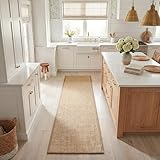
SAFAVIEH Chelsea Collection Hand-Hooked Wool Runner Rug, 2’6″ x 8′ (HK141B-28)
Who it suits: The renter who wants the classic answer at the standard size — a real wool runner, in a French-country floral — and who would like the tier’s research to end with most of the $300 budget still unspent.
The Chelsea is the pick that proves this guide’s headline. Positioned at the value end of this tier, it buys, at the full standard size of 2’6″ x 8′: a hand-hooked runner in 100% premium virgin wool, per both the deal record and the retail construction notes for the design, which add the details the headline leaves out: a pure virgin wool pile, hand-serged binding, a 100% cotton canvas backing, and a pile of about 3/8 inch — soft underfoot, easy to vacuum, and low enough for the doors of older rental stock, which is where 3/8 inch stops being a spec and starts being the reason the door opens. Hand-hooked construction pulls loops of yarn through the backing one by one, which gives the Chelsea its slightly sculptural, looped surface and a durability record that has kept this Safavieh line in production for years; the HK141 design is a floral drawn across the field in olive, sage, blue, red and gold, the French-country end of the runner spectrum, offered in several colorways. The Chelsea’s role is to set the honest baseline: this is what the standard size in real wool looks like at the value end of the tier when a volume maker makes it, and everything positioned above it has to justify itself against it — as the Shepherd does with knotting, weight and decades, and as the Ruggable does with a washing machine.
Why, then, is it prose-only? Because the verification standard for a link was not met for this pick — its exact Amazon listing could not be pinned to the same standard as the linked picks — so by the policy stated above, it carries no link. Search Amazon by the exact model number, HK141B-28, confirm the size reads 2’6″ x 8′ and the design reads HK141, and check the current price on Amazon on the listing you find; in qualitative terms it belongs at the value end of this tier, well below the top of the budget, and the same design in a rug retailer’s channel is positioned noticeably higher, which is the kind of markup to refuse. The rug’s own limitations are the hooked-wool ones, and two have rental edges. Wool sheds early and is a professional-clean item, as with every wool pick here — budget for a pad as well, both to stop the slide and to keep the cotton canvas backing off your landlord’s finish. And the floral is a commitment: right for country, traditional and eclectic halls, wrong for a minimalist one, where the Natura’s texture or the Shepherd’s graphic grey will sit quieter. Judged as what it is, it is the pick most renters reading this guide should probably buy, and the clearest evidence that the $300 in the title is a ceiling, not a target.
- 100% premium virgin wool pile, hand-hooked, with hand-serged binding and a cotton canvas backing (retail construction notes for the design).
- About 3/8-inch pile: soft, vacuum-friendly, and low enough for older rental doors.
- Positioned at the value end of this tier at the full 2’6″ x 8′ standard size — search by model number and check the current price.
Honest limitation: Prose-only — its listing could not be pinned, so you buy it by model number; and hooked loops can snag on pet claws and aggressive vacuum heads.
Choose it if you want real wool at the standard size, the floral suits your place, and keeping much of the budget unspent suits your lease. Skip it if your style is minimal (take the Natura or the Shepherd) or if a snagged loop would ruin your week and your hallway has claws.
No link for this pick, by the verification policy explained above — search the exact model number on Amazon.
Comparison Table
| Pick | Size priced | Construction | Fiber (verified) | Pad | Price basis |
|---|---|---|---|---|---|
| RUGGABLE Sarrah Sage | 2.5 x 10′ | Machine-made flatweave cover + pad system | Polyester cover | Included (standard non-slip pad) | Check price on Amazon — positioned near the top of this tier for the complete system; Amazon offers rotate |
| Dash & Albert Shepherd | 2’6″ x 8′ | Hand-knotted | 100% wool | Thin pad recommended; 18 lb body stays put | Prose-only — positioned at the top end of this tier; search by model number and check the current price |
| Rugs USA Melrose Checked | 2’6″ x 8′ | Hand-tufted | Wool-and-cotton blend (title/spec fields read together) | Required — no slip-resistant backing; pad bought separately | Check price on Amazon — positioned in the lower-to-middle part of this tier by colorway |
| SAFAVIEH Natura NAT620B | 2′ x 10′ | Handmade, textured | Wool blend (wool/cotton family) | Recommended; pad bought separately | Check price on Amazon — positioned in the lower part of this tier |
| SAFAVIEH Natural Fiber NF141B | 2’6″ x 14′ | Woven flatweave | Sisal with linen border | Required as a moisture break on rented hardwood; pad bought separately | Check price on Amazon — positioned in the lower part of this tier |
| SAFAVIEH Chelsea HK141B-28 | 2’6″ x 8′ | Hand-hooked | 100% virgin wool, cotton canvas backing | Recommended; pad bought separately | Prose-only — positioned at the value end of this tier; search by model number and check the current price |
How to Choose the Right Runner Rug Under $300 for an Apartment
Start with your horizon, not the catalog. If you expect to move within a year or two, or your housing is genuinely unsettled, the honest buys are the Chelsea or the washable system — real wool at the value end of the tier, or real washability near the top of it, each fully useful from day one. If you are a settled renter — years in the unit, or renting by choice for the long term — the Shepherd’s case flips: a hand-knotted rug bought once, positioned at the top end of this tier, and carried through successive leases can be better value over time than the disposable runners most renters cycle through, and it is the only pick here whose value survives every move intact. Neither answer is the “renter answer”; your lease pattern is. The construction-first version of this analysis, for owned homes, is in our guide to Best Runner Rug Under $300.
Decide what the $300 is actually buying. The evidence supports three honest shapes for this budget. One: a system — the Ruggable, complete with pad, positioned near the top of the tier — where the money buys a cleaning method rather than a material, and the cleaning method happens to be the one rental life rewards. Two: a construction upgrade — the hand-knotted Shepherd, positioned at the top end of the tier — bought by model number, with the patience its rotating Amazon availability requires. Three: a standard wool runner positioned well below the top of the tier (the Chelsea, the Melrose), plus a proper pad, with much of the budget left unspent — the right answer more often than the budget implies. What the budget does not buy is a top-of-tier hand-tufted wool runner at the standard size with a stable, verifiable offer: that shelf is empty. The same standard-size picks anchor our guide to Best Runner Rug Under $200, for renters whose horizon argues for spending less.
Run the exit test before anything ships. Everything you buy must leave the unit cleanly: no adhesive-backed pads, no rug tape on finished floors, no gripper strips nailed or glued down. Loose-lay only — a rug, a felt-and-rubber pad under it, nothing attached to anything you do not own. Check the pad’s underside as carefully as the rug’s face: cheap rubber backings can discolor some floor finishes over a long tenancy, which is why this guide specifies felt-and-rubber pads, felt side down. Photograph the floor before the runner goes down and after it comes up; it is the cheapest deposit insurance in this guide. The texture-first logic in Best Runner Rug For Small Rooms Under $300 is worth reading alongside this: in a compact apartment the runner is often the largest textile in the home, so buy the surface you will look at most.
Size the runner to the hall, and price the size you sized. The working rules: leave 4 to 6 inches of floor showing on each side of the runner, and 6 to 12 inches at each end; a runner that nearly touches the walls reads as carpet that failed. Apartment corridors run narrow — the Natura’s 2-foot width exists for them — and long, which is why two of this guide’s six picks are 10 and 14 feet. Measure before you fall for a design, because the picks here belong to specific sizes, and stepping a design up or down a size changes its tier position by more than the difference between most of these picks. Then check the doors: a coin stack under the tightest door’s swing tells you the stack height you can afford, and rug plus pad is the real height. The Melrose at 0.43 inches and the Chelsea at about 3/8 inch pass doors a plush wool runner never will, and in a rental you cannot fix the door. For the bedroom end of an apartment, the sizing and softness trade-offs in Best Runner Rug For Bedrooms Under $300 are the relevant ones: bare feet vote for wool pile over sisal every time.
Put the pad, the cleaning and the noise in the budget from the start. Five of these six picks need a pad, bought separately. In an apartment the pad does three jobs: grip, floor protection, and — the one nobody prices — sound. Footsteps on bare hardwood carry to the unit below; a runner alone softens them, a runner on a felt pad softens them properly, and the Shepherd’s 18 pounds of knotted wool is the quietest floor covering in this guide. Cleaning is the other total-cost trap: wool’s cleaning is professional cleaning, a real if infrequent cost, while the washable system’s cleaning is a wash cycle — provided your building’s machines can take the cover. Total cost of ownership across the lease, not the ticket on move-in day, is the comparison this tier rewards. Material honesty runs through all of it, the same standard our guide to Best Runner Rug For Modern Homes Under $300 applies: read spec fields, not titles, because a title’s “wool” may be a blend and a title’s “handmade” may be a tufting gun.
Common Buying Mistakes
Paying top-of-tier money for a value-tier construction. The standard-size hand-tufted wool runner is a lower-to-middle tier object on Amazon, verified repeatedly in this guide’s research. A listing that positions one at the very top of this budget is not selling a better rug; it is selling the same rug to a buyer who did not check. Know the category’s honest tier positions — hooked wool at the value end at 2’6″ x 8′, long handmade or woven natural fiber in the lower part of the tier — and treat any large premium as a markup until a spec sheet proves otherwise.
Buying “wool” that is a blend, and “handmade” that is a gun. Titles compress. The Melrose is a good rug whose title says wool-and-cotton while a spec field says wool and whose copy says hand-tufted wool; all three can be true of a blend made with a tufting gun, and none of them makes it a knotted or 100% wool rug. Read the composition and construction fields, and judge what they say.
Forgetting the pad until the rug slides — or the door will not close. Measure the clearance first — rug plus pad is a stack, and a stack too tall for a tight door leaves you with a door that scrapes. The Ruggable’s included pad, sized to its cover, is part of why its complete-system positioning is more complete than it first looks.
Final Recommendation
For most renters, most of the time, the research says to spend what the Chelsea and the Melrose actually represent: a hand-hooked 100% wool runner positioned at the value end of the tier, or a checked wool-blend positioned in the lower-to-middle part of the tier whose low pile clears the doors you cannot adjust — plus a felt-and-rubber pad, felt side down, bought separately — and keep the rest of the budget against the costs renting actually brings. If your hallway is a working surface — kitchen run, dog corridor, mud-season entry — the Ruggable Sarrah system, positioned near the top of the tier complete with pad, is the spend designed for you: the money buys the washing machine, not the fiber, it installs in minutes, damages nothing, and peels up without a trace when the lease ends — check the current price on Amazon. And if you are the settled, long-horizon renter — furnishing a life rather than a lease term — the Dash & Albert Shepherd is the flagship: hand-knotted 100% wool, 18 dense pounds, positioned at the top end of this tier, bought by model number, and carried from this apartment to every home after it. Need length instead of either? Ten feet of handmade wool blend or 14 feet of woven sisal, both positioned in the lower part of the tier — check price on Amazon — the sisal on a pad, kept dry. The tier’s lesson, translated for renters: on Amazon, $300 for a runner is not a shelf, it is a strategy — and the right strategy is the one that matches how long you will actually live with the rug, not how long the lease says.
Frequently Asked Questions
Should a renter really spend $300 on a rug? Usually not all of it. Real wool at the standard size sits well below the top of this budget, so most renters should buy the Chelsea or the Melrose, add a pad, and keep the change. The full budget makes sense in exactly two cases: the washable system, positioned near the top of the tier, where the premium buys a cleaning method that fits rental life, and the hand-knotted Shepherd, positioned at the top end of the tier, which only pays off if your horizon is years rather than lease terms — because its value is that it leaves with you, every time, for decades. What never makes sense is paying top-of-tier money for a standard hand-tufted runner: that shelf, verified, is empty.
Will a runner rug damage my landlord’s floors or cost me deposit money? Not if it is loose-laid on a proper pad — and it can actively protect the deposit, because the traffic lane a runner covers is where floor finish wears first. The defenses are simple: felt-and-rubber pad with the felt side down, no adhesives ever, spills blotted promptly, and a photograph of the floor before the runner goes down.
What size runner does an apartment hallway actually need? Measure the hall, then subtract: leave roughly 4 to 6 inches of bare floor on each side and 6 to 12 inches at each end. A 3-foot-wide corridor takes a 2′ to 2’3″ runner (the Natura’s width); a 3.5-to-4-foot hall takes the 2’6″ standard (the Chelsea, the Melrose, the Shepherd); long railroad layouts are why this guide includes 10- and 14-foot picks. Then check the tightest door’s clearance with a coin stack and count rug plus pad as one height.