Disclosure: As an Amazon Associate, dailyhomedecorating.com earns from qualifying purchases. Links on this page are affiliate links; they cost you nothing extra. Prices and availability change often, so check the current Amazon listing before you buy.
The best portable sauna asks for no spare room, no electrician and no permanent claim on your floor plan — it asks for a corner, a socket and twenty minutes, and then it folds away until the next session. Portable sauna tents are the democratic end of the sauna world: a fabric cabin, a folding chair, far-infrared heating panels built into the walls, and a ritual that renters, flat-dwellers and the sauna-curious can begin this week instead of after a renovation. Three verified models anchor this guide — the Smartmak full-size tent with its heating foot pad, the ZONEMEL home spa tent with an upgraded chair, and the TopMaster foldable design with its wired controller — and between them they cover the portable category’s real questions: how the heat feels compared with a wooden cabin, how small the tent packs, and how honest the experience is about what it is. This guide frames all of it as comfort, warmth and relaxation, with no medical, detox or weight-loss claims anywhere, because a tent of warm air needs no mythology to justify itself.
Portability is not a compromise to apologise for; it is a different theory of the sauna. A fixed cabin is a room you commit to. A portable tent is a ritual you carry — between flats, between seasons, between a winter of devoted use and a summer in storage. The buyers who thrive with these tents are the ones who choose them for that theory on purpose: the renter whose lease forbids installations, the traveller who works away, the beginner who wants to learn whether sauna is their pleasure before timber is ordered. This guide serves those buyers directly and tells the cabin-dreamers, honestly, where the tent’s limits lie.
Key Takeaways
- The Smartmak is the full-size benchmark: a one-person far-infrared tent with heating foot pad and folding chair included.
- The ZONEMEL offers the same tent format with its own dimensions and an upgraded sauna chair for the session.
- The TopMaster folds flattest of the three, with a wired controller and a stated maximum temperature of 140 degrees Fahrenheit.
- All three are one-person, far-infrared, plug-in designs that set up in minutes and pack away between sessions.
- Portable tents warm the occupant at gentle air temperatures, like infrared cabins, rather than reproducing a traditional cabin’s fierce heat.
- Renters and small homes gain the most: no installation, no permanent footprint, and a sauna that moves house when you do.
In this guide
Quick Picks: Best Portable Sauna at a Glance
| Pick | Format | Included seat | Known for |
|---|---|---|---|
| Smartmak Portable Far Infrared Sauna | Full-size tent | Folding chair | Heating foot pad and complete kit |
| ZONEMEL Portable Infrared Sauna | Full-body tent | Upgraded sauna chair | |
| TopMaster Foldable Infrared Sauna | Foldable tent | Foldable chair | 1050W power, max 140°F, wired controller |
The three tents are cousins rather than rivals from different worlds, so the choice runs on details of fit and furniture. The Smartmak is the complete-kit answer, foot pad and all, for the buyer who wants one box to contain the whole ritual. The ZONEMEL competes on its chair and its stated dimensions, which taller or broader sitters should read carefully. The TopMaster competes on the fold — the quickest pack-away and a simple wired controller — for households where the tent’s stored size matters as much as its heated size. Measure your sitting self, your corner and your cupboard, and the shortlist resolves.
Each model links to its Amazon listing, where dimensions, power and the exact contents can be confirmed before ordering. All three were verified against catalogue data before inclusion, and each carries its official product image beside its review.
How Did We Choose These Portable Saunas?
Portable equipment is judged by portable criteria. Heat delivery came first: far-infrared panels in the tent walls, how completely they surround the seated body, and how the warmth builds across a session — remembering that the head typically stays outside or at the tent’s opening in this format, which changes the sensation completely. Second, the seat: a portable sauna is a chair inside a tent, and the chair’s comfort decides the session more than any specification, so included chairs were weighed as furniture, not accessories. Third, the pack-away truth — folded dimensions, weight, and whether one person can genuinely store and redeploy the tent weekly without the ritual dying of friction. Fourth, controls: their placement, their simplicity, and whether settings can be adjusted from inside without dismantling the experience. Fifth, materials and care, because a fabric cabin that hosts warm, humid air needs to dry, wipe and store cleanly if it is to stay pleasant across seasons.
The honest frame for all five criteria is that a portable tent is not a small wooden cabin and should not be graded as one. It is a personal heat tent with a chair, closer in spirit to a warm cocoon than to a Finnish room. Judged as a cocoon — on enclosure, warmth, comfort and disappearance — the format is genuinely excellent, and the three models here are its well-made representatives.

Smartmak Portable Far Infrared Sauna — the Complete Tent Kit
Badge: Best overall portable sauna
| Spec | Detail |
|---|---|
| Type | Far-infrared sauna tent, full size |
| Capacity | 1 person |
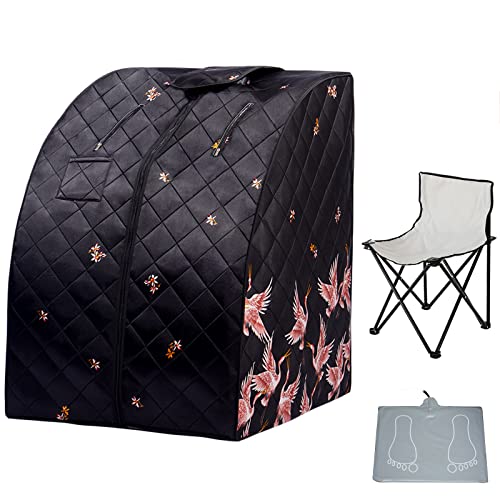
| Included | Folding chair and heating foot pad |
| Colour | Black |
The Smartmak is the tent most buyers picture when the category is mentioned, and its kit is the reason: a full-size one-person tent with far-infrared panels in its walls, a folding chair to sit on, and a heating foot pad underfoot that answers the portable format’s oldest complaint — cold feet beneath a warm body — with simple directness. The session it delivers is the tent archetype: seated, enclosed to the neck in warm fabric, head in the room’s cooler air, reading or listening while the panels do their slow work. For many users that head-out arrangement is not a limitation but the pleasure itself, since the face stays fresh while the body warms, and a book, a phone or a conversation remains possible throughout.
As an ownership proposition, the Smartmak is the low-friction path into sauna life: set up in minutes on any floor, run from an ordinary socket, fold away into its storage footprint when the session ends. Renters keep it in a cupboard, beginners learn their ritual in it, and more than a few cabin owners began exactly here, discovering in a winter of tent sessions that the habit was real before they committed a room to it. That is the highest service a portable product can perform, and this one performs it completely.
Strengths
- Complete kit with chair and heating foot pad in one purchase
- Full-size tent gives a proper seated enclosure
- Sets up and packs away in minutes, anywhere with a socket
Trade-offs
- One person only, and seated-only by design
- Tent warmth is gentler than a wooden cabin’s
- Fabric format needs drying and care between sessions
Best for: beginners, renters and anyone wanting the full kit at once. / Not suited for: couples or traditional-sauna seekers.

ZONEMEL Portable Infrared Sauna — the Chair Upgrade
Badge: Best for seated comfort
| Spec | Detail |
|---|---|
| Type | Portable infrared full-body sauna tent |
| Capacity | 1 person |
| Size | L 27.6 x W 31.5 x H 37.8 inches |
| Included | Heating foot pad and upgraded sauna chair |
The ZONEMEL competes where portable saunas are actually won: the chair. Its upgraded sauna chair acknowledges that a session is twenty to forty minutes of sitting, and that the difference between a ritual kept and a ritual abandoned is often upholstery rather than heat. The tent itself follows the format faithfully — full-body enclosure for one person, far-infrared panels, a heating foot pad — with stated dimensions that let a buyer rehearse the fit honestly: just under thirty-two inches wide and thirty-eight tall, a footprint that slips into a bedroom corner or a bathroom’s dry end and vanishes into storage afterwards.
Sitters of different builds should do the small arithmetic this listing invites, picturing their own seated height and shoulder width inside those numbers, because a tent sauna is worn almost like clothing and fit is personal in a way cabin dimensions never are. For the sitter it fits, the ZONEMEL delivers the complete portable proposition with the session’s furniture taken seriously — the version of the category most likely to still be in weekly use when the season turns.
Strengths
- Upgraded chair treats the session as the sitting it is
- Clearly stated dimensions make fit-checking honest
- Foot pad included for complete warmth
Trade-offs
- Compact dimensions will not suit every body
- Single-occupancy tent like its rivals
- Fabric care is part of ownership
Best for: comfort-first solo users who fit its dimensions gladly. / Not suited for: larger sitters or anyone wanting to stretch out.

TopMaster Foldable Infrared Sauna — the Pack-Away Specialist
Badge: Best for storage and travel
| Spec | Detail |
|---|---|
| Type | Foldable infrared sauna tent |
| Power | 1050W, maximum 140°F |
| Controls | Wired controller |
| Included | Foldable chair |
The TopMaster’s design brief is the fold itself. Where its rivals pack away adequately, this tent is engineered around collapsing — a sauna box that flattens for the cupboard, the car boot or the corner behind a door, then rises again in minutes when the ritual calls. Its 1050W infrared system states a maximum temperature of 140 degrees Fahrenheit, a figure worth reading correctly: portable tents trade in gentle, enveloping warmth rather than cabin fierceness, and 140 at the tent’s heart, with the sitter’s head in room air, is a thoroughly warm session by this format’s honest standards. The wired controller keeps adjustment in the sitter’s hand, where it belongs, without applications or pairing rituals.
This is the tent for the genuinely mobile life — the worker between postings, the student in a small room, the household whose sauna must share its corner with everything else it owns. Its foldable chair completes a kit that understands storage as a feature equal to heat. Buyers whose sauna will live assembled in a dedicated corner may not need its speciality; buyers whose sauna must disappear will find no better answer in the category.
Strengths
- Fold-flat design minimises storage and travel bulk
- Simple wired controller, adjustable from the seat
- Complete kit with foldable chair included
Trade-offs
- Gentle tent temperatures, not cabin heat
- One seated person, like the whole format
- Frequent folding rewards careful handling
Best for: small homes, travellers and storage-first buyers. / Not suited for: buyers wanting a permanent, room-like cabin.
How Do You Run a Good Portable Sauna Session?
Set the tent on a dry, level floor with air around it, let it warm while you change and fill a water bottle, and treat the first sessions as calibration rather than performance. Sit tall enough for the panels to see your back and legs — radiant warmth is line-of-sight, in a tent as in a cabin — with the foot pad doing its quiet work beneath. Begin with shorter sessions at moderate settings and build across the first fortnight toward the length your body finds restorative; the portable format’s gentleness invites frequency, and several shorter sessions a week is the pattern owners actually keep. Hydrate before and after, keep alcohol entirely out of the ritual, and leave the tent immediately if you feel dizzy or unwell. Anyone with a medical condition, a pregnancy or heat-sensitive medication should take their doctor’s view before the first session, tent or cabin alike — the format’s modesty does not exempt it from the household doctrine of heat.
Afterwards, the portable ritual has one extra movement the cabin never asks for: dry the tent. Open it, let the warm fabric air completely before folding, wipe panels as the maker directs, and store it dry. Five minutes of that discipline is the whole difference between a tent that smells of warm cloth for years and one that smells of its own storage by spring.
What Mistakes Do Portable Sauna Buyers Make?
The first is expecting a wooden cabin’s fierceness from a fabric tent and returning a good product for failing at a job it never claimed. The second is ignoring the chair — buying the tent whose seat they will dislike nightly, when the seat is the session. Third, buyers skip the fit rehearsal: seated height, shoulder width and the tent’s stated dimensions belong in the same thought before ordering. Fourth, many fold a warm, damp tent into a cupboard and meet the consequences at the next session. Fifth, some treat the tent as a permanent fixture in a damp bathroom corner, when the format thrives on being aired, moved and stored dry. Each mistake dissolves under the same light as the rest of this guide: know what the instrument is, fit it to your body and your rooms, and keep it dry.
Final Recommendation: Which Portable Sauna Should You Buy?
Buy the Smartmak if you want the category’s complete kit in one box — tent, chair and foot pad, ready for a first winter of discovery. Buy the ZONEMEL if seated comfort is your deciding sense and its dimensions fit your frame. Buy the TopMaster if the fold is the feature — if your sauna must vanish into storage or travel with your life. All three deliver the portable proposition honestly: radiant warmth, seated comfort and a ritual that asks your home for almost nothing. Readers with a room to commit should compare fixed infrared cabins compared and every home sauna type in one guide, while the rest of a comfortable evening waits in blankets for the sofa and bedroom humidifiers for easy breathing.
Tent, Cabin or Neither: Placing the Portable Sauna Honestly
The portable tent sits in a landscape of warmer options and deserves its coordinates stated plainly. Above it in commitment stand the infrared cabins — wooden rooms with benches, doors and a permanent address — which offer space, company and a furniture-grade presence at the cost of the room they occupy. Beside the tent, at an even lower commitment, sit the sauna blankets and steam pods of the wider market, which trade the seated posture for lying down or the panels for steam. The tent’s own territory is the seated, enclosed, head-cool ritual that one person can own outright, store in a cupboard and carry to the next home. Buyers should choose their territory by life rather than by ladder: a tent is not a failed cabin, and a cabin is not a successful tent. They are different answers to different housing, and the households happiest with each are the ones that never confused the questions.
The Renter’s Guide to Sauna Life
Renting has historically meant watching other people own saunas, and the portable tent is the first format that genuinely changes that. It asks the property for nothing — no installation, no circuit, no ventilation project — and it leaves with the tenant, undamaged walls behind it. Three courtesies keep the arrangement landlord-proof: run the tent on a dry floor away from the bathroom’s splash zone, air and store it properly so no damp ever lingers in a corner, and check the lease’s general stance on plug-in heaters as you would for any appliance. Households that move every year or two should weigh the TopMaster’s fold most heavily, students should weigh total stored size, and anyone in a house-share should weigh the tent’s lockable solitude — a private warm room that assembles inside a shared one is a small domestic miracle, and its owners tend to speak of it that way.
Travelling With a Portable Sauna
Portable is a promise with degrees, and honesty about them serves travellers best. These tents travel beautifully by car — to a holiday house, a relative’s spare room, a long work posting — where a familiar ritual in an unfamiliar place is worth the boot space. They travel awkwardly by air, where size and weight argue against them, and not at all for a weekend city break, where a hotel’s own spa is the sensible sauna. Within their true territory, though, they are unmatched: the travelling worker who keeps a tent at a regular base, the family whose holiday cottage gains a sauna for the season, the athlete who takes warmth on the road by car. Choose the TopMaster for this life, keep its bag or box, and dry it before every journey as faithfully as before every storage.
The Head-Out Ritual: What a Tent Session Is Actually Like
Newcomers should picture the session accurately, because the tent’s charm is specific. You sit on the chair inside the zipped tent with your body in the warm enclosure and your head in the room’s air, which produces a sensation no cabin offers: a thoroughly warmed body under a cool, clear head. Reading is comfortable, conversation through the tent is normal, a drink of water is at hand rather than through a hot door. The panels warm the back, sides and legs; the foot pad completes the circuit below. Twenty minutes in, the body is glowing and the mind is unheated and calm, a combination owners describe with surprising loyalty. Anyone whose sauna dream is specifically the enveloping, whole-body fierceness of a Finnish cabin should honour that dream in timber — but anyone whose dream is a warm, private, book-friendly cocoon will find the tent is not the budget version of their wish. It is the wish itself, folded.
Checking the Listing Before the Tent Comes Home
Compare your seated dimensions against the tent’s stated ones, especially in the ZONEMEL’s case, where the maker publishes honest numbers. Confirm what the kit includes — chair, foot pad, controller — since the complete-kit promise is a large part of the category’s value. Check the power and the stated maximum temperature, and read them as this guide does: as the signature of a gentle format, not a deficiency. Look at the folded or stored size against your actual cupboard. Finally, confirm the care instructions you will be living with, because a portable sauna’s lifespan is written in its drying routine more than in its panels.
A Winter With a Tent: How the Habit Settles
October’s tent is a novelty erected on Saturday afternoons. November’s is a discovery — the session after the cold commute, the warm chair while the rain does its worst against the window — and the household starts scheduling around it without noticing. December tests the ritual against the busiest month and the tent passes in the way portable things do: twenty minutes, folded away, no room surrendered to it during the festivities. January is where the format earns its legend, because the darkest weeks are when a personal reservoir of warmth stops being a purchase and becomes a practice. By March the tent has a place — in the corner, in the week, in the household’s account of how winter was survived — and the question for spring is only whether it earns a cabin sibling or remains, contentedly, the whole of the family’s sauna estate. Either answer is a success story, and both begin in a fabric tent that asked for almost nothing.
Safety, in the Portable Format’s Own Terms
The doctrine is the same as every sauna’s, translated for a tent. Build sessions gradually and moderately; hydrate as routine; keep alcohol away from the ritual; leave at once if you feel unwell. Take a doctor’s advice first if you have a medical condition, are pregnant, or take heat-sensitive medication. Supervise any older child’s brief, gentle use absolutely, and keep the tent as adult equipment in spirit. Electrically, use the socket and cable arrangements the maker specifies, keep the tent and its controller dry, and never run it buried under bedding or stored items. Physically, set it on a stable, dry floor with room to exit instantly — the zip is the door, and it should always be operable from inside in one motion. A format this gentle rewards households that respect it, and the respect is repaid in seasons of uneventful warmth.
The Three Tents, Compared on the Variables That Matter
Run the comparison as a tent owner lives it. On kit completeness, the Smartmak and ZONEMEL both include the foot pad that completes the warmth, with the Smartmak presenting itself as the full-size reference and the ZONEMEL answering with its chair. On the seat — the session’s true furniture — the ZONEMEL’s upgraded chair is the deliberate differentiator, and comfort-led buyers should weight it heavily. On disappearance, the TopMaster wins outright: its fold is its identity, and households measuring cupboards rather than corners should start there. On control, the TopMaster’s wired handset is the simplest philosophy, while its rivals follow the same in-hand logic in their own arrangements. Nothing in the comparison touches heat philosophy, because all three share it — far-infrared panels, gentle air, head in the room — and a buyer choosing among them is choosing furniture, fit and fold, which is to say choosing the details of a life rather than a technology.
Guests, Partners and the One-Person Tent
A one-person sauna in a two-person household creates a small etiquette, easily solved. Turns are the classic answer, with the tent’s quick readiness making back-to-back sessions natural — the second sitter inherits a warm tent and a shorter wait. Some households keep a standing order, mornings to one and evenings to the other, and find the solitude is not a ration but a feature each protects for the other. Guests offered a session should be briefed as cabin guests are: moderate first session, water outside, leave whenever, no endurance expected. The tent’s intimacy makes it a surprisingly good gift of hospitality — a private warm quarter-hour in the middle of a visit — and hosts who master the turn-taking discover their one-person sauna serves a whole household, one contented sitter at a time.
Storing the Tent Like You Mean It
Storage is where portable products live or die, so give the tent a system rather than a corner of chaos. It stores fully dry, always, after an airing that lasts longer than feels necessary. It stores with its chair and controller together, in the bag or box it came in where possible, so the kit never separates into three rooms. It stores somewhere temperate and dry — not a damp garage wall, not a steamy bathroom cupboard — because fabric remembers its environment. And it stores with its next session in mind: the household that can raise the tent in five minutes without hunting for parts is the household that will still be using it in its third winter. The TopMaster’s fold makes all of this easiest, but the discipline, more than the design, is what the seasons reward.
A Note on the Claims Around This Category
Portable saunas attract the same exuberant marketing as their wooden relatives, and this guide has held its line throughout: warmth, comfort, relaxation and a ritual worth keeping are the claims made here, and they are enough. Readers who meet grander promises elsewhere — about bodies, weights or cures — should apply the scepticism this site brings to every wellness-adjacent shelf and let documents and doctors, not packaging, arbitrate anything beyond comfort. A tent that keeps its promises is a good product. These three keep theirs, which is the whole of their recommendation.
The First Session, Rehearsed
For the tent still folded in its box, here is the whole of the mystery, rehearsed in advance. Choose the corner and clear it. Raise the tent, set the chair inside, connect the controller, and switch on while you change into the robe or swimwear your household prefers. Pour a glass of water and put it within reach outside the zip. When the panels have warmed the enclosure — a matter of minutes — sit, zip, and settle, foot pad beneath your feet, book or music as you like. Stay while it is pleasant, which the first time may be ten minutes, and let that be enough. Unzip, step into the cool room air with the particular clarity the contrast gives, dry the tent open while you shower, and fold it away only when it is dry. That is the entire technology, and by the third repetition it will take less thought than making tea — which is exactly the state a household ritual should reach.
Three Buyers, Three Tents
The first-time buyer in a rented flat, curious about sauna and forbidden from installing anything, is the Smartmak’s portrait: one box, the complete kit, a ritual running by the weekend and a cupboard that swallows the evidence before the landlord’s inspection. The comfort devotee in a small owned home, who will sit in this chair four evenings a week and knows exactly how much chair quality matters by the second month, is the ZONEMEL’s portrait — provided the tape measure’s conversation about its dimensions ends happily. The mobile professional, the student, the holiday-house household — anyone whose sauna must fold smallest and travel lightest — is the TopMaster’s portrait, its wired simplicity and flat pack built for a life in motion. Recognise your portrait and the order places itself; fail to recognise any of them, and the honest conclusion is that your sauna life probably wants a room, in which case the cabin guides linked throughout this page are the correct next read.
What a Portable Sauna Teaches a Household
Owners of these tents often report an unexpected curriculum. They learn their own heat preferences with a precision cabin shoppers guess at — session length, favourite hour, the value of the foot pad, the chair’s verdict — because the tent’s low stakes invite experiment. They learn whether the ritual itself, stripped of architecture and occasion, is something their life wants weekly, which is the single most valuable fact in sauna buying and the one no showroom can provide. And they learn the portable virtues that apply far beyond saunas: that a thing which stores well gets used, that a ritual with low friction survives busy seasons, and that comfort need not wait for the perfect house. A household that graduates to a cabin carries all three lessons into the purchase and chooses superbly. A household that stays with the tent has lost nothing at all — it has simply discovered that its perfect sauna was portable all along.
The Corner, the Socket and the Cupboard: a Final Checklist
Before ordering, walk the tent’s whole life in your home one last time. The corner: dry, level, near the bathroom or bedroom, with air around the tent and a clear path out of the zip. The socket: the right supply, reachable without stretching cables across walkways, on a circuit that is not already hosting the household’s other heaters. The cupboard: measured against the folded tent, the chair and the controller together, in a dry place you can reach without a ladder and a mood. The body: your seated height and width rehearsed against the stated dimensions. The calendar: three evenings a week you can honestly picture inside it. Five checks, five minutes, and a portable sauna bought on that evidence will not be the purchase that teaches you regret — it will be the one that teaches you how much warmth a household can own without owning a single extra square foot of house.
Evenings, Mornings and the Tent’s Place in the Day
Portable owners divide, roughly, into dawn and dusk congregations, and the tent serves both without modification. The morning session is short and bright: panels on while the kettle boils, fifteen minutes of warmth while the day is planned, a shower, and a departure into the cold with the peculiar armour of someone who has already been warm today. The evening session is the tent’s cathedral hour — lamps low, the household settling, a chapter of a book inside the cocoon and the day’s noise left outside the zip. Households with both congregations under one roof should expect the tent to be the most scheduled object in the home, and should treat that as the success it is: a ritual with a waiting list, in a product that folds into a cupboard, is a small masterpiece of domestic design.
The Tent as a Gift, and Other Social Uses
A portable sauna is an unusually consequential gift — the rare present that installs a ritual rather than occupying a shelf — and it suits the giver who knows the recipient’s housing and habits well: the renter who has mentioned the cold, the new homeowner with a corner and a stressful job, the parent whose evenings deserve a warm institution of their own. Give it with the guide’s wisdom attached: a note about gentle first sessions, drying discipline and the chair’s importance costs nothing and doubles the gift’s value. Households also press tents into social service as the guest-room amenity nobody expects — a session offered to a visiting friend is remembered long after the spare bed is forgotten — which is one more way the smallest sauna in this cluster outearns its footprint.
Frequently Asked Questions
Does a portable sauna feel like a real sauna?
It feels like its own thing: a warm, enclosed cocoon for the body with the head in cooler room air, at gentler temperatures than a traditional cabin. Devotees of fierce, steamy heat should buy that experience in its proper forms. Everyone else — and especially beginners, renters and the frequency-minded — usually finds the tent’s warmth completely satisfying on its own terms, which is why so many owners keep the habit for years and why some graduate to cabins already knowing the ritual suits them.
How long does a portable sauna take to set up?
Minutes. The tents rise from their stored state, the chair unfolds inside, the controller connects, and the panels begin warming while you prepare. The TopMaster’s fold-flat design is the quickest of the three to store and redeploy. The honest total for a session’s overhead — set up, warm up, dry out, pack away — stays small enough that the ritual survives busy weeks, which is the format’s founding promise.
Can two people use a portable sauna together?
No — these are one-person tents, sized and heated for a single seated occupant, and crowding a second person into one would defeat its fit, its heat and its safety margins at once. Couples who want to share the ritual should take turns, as many tent households happily do, or look to the two-person cabins in the infrared guide linked above. The tent’s solitude is, for many owners, precisely its charm: a warm room for one, on demand.
Where can I use a portable sauna?
Anywhere dry and level with a suitable socket: a bedroom corner, a bathroom’s dry zone, a spare room, a home gym. Keep it away from standing water and splashing, give it air while it runs and while it dries, and store it somewhere dry between sessions. Renters should still check their lease’s view of plug-in heating appliances, as they would for any such device, and everyone should follow the specific model’s electrical guidance.
How do I clean a portable sauna tent?
Let it cool and dry completely after each session, wipe the interior and panels with a soft cloth as the manufacturer directs, and never fold it away damp. The chair wipes down like any folding furniture. Occasionally air the whole tent open for an afternoon, the way you would a camping tent after a trip — the format’s outdoor cousins teach the same lesson, and a tent aired is a tent that stays pleasant for seasons.
How much electricity does a portable sauna use?
These are modest appliances by heating standards — the TopMaster states 1050W, in the territory of a small fan heater — and a session is a bounded block of use rather than an all-day draw. A household can estimate its own running cost from the model’s wattage, the session length and the local tariff. In practice, owners find the cost unremarkable next to the ritual’s value, and the tent’s small heated volume is inherently thriftier than heating a room-sized cabin for one person.
Can I use a portable sauna every day?
The format is built for frequency, and many owners settle into several sessions a week, with some enjoying a short daily one. Let comfort govern: build gradually, hydrate, keep sessions moderate, and treat any dizziness or unease as the session’s end. People with medical conditions or heat-sensitive circumstances should agree their pattern with their doctor. The tent rewards the frequent, gentle user over the occasional endurance artist, which is fortunate, since frequent and gentle is also the safest way to enjoy any heat.
Is a portable sauna a good way to try sauna before buying a cabin?
It is the best way the market offers. A season in a tent teaches a household its true pattern — how often, how long, at what hours, and whether the ritual earns a permanent room — at a fraction of a cabin’s commitment, in a product that remains useful afterwards for travel, guests or a second location. Many cabin owners started in tents and speak of them the way cyclists speak of a first bicycle: with complete respect for the machine that taught them the habit.
Where does a portable sauna live in a small apartment between sessions?
The happiest storage spot is dry, out of direct sunlight and close to where the tent is actually used, because a short carry keeps the habit alive. Once the tent has cooled and dried completely, fold it along its existing creases without forcing sharp new bends, coil the power lead loosely, and store the chair folded flat alongside it. A wardrobe end, the space behind a sofa, a tall cupboard shelf or the gap beside a chest of drawers all work well, provided air can circulate a little and nothing heavy rests on the panels. Keep the controller and foot pad in the same place every time, ideally in one labelled bag, so setup never becomes a treasure hunt. Avoid lofts that bake in summer, damp garages and anywhere the fabric would sit folded while still faintly warm or moist. Owners in studio flats often dedicate one consistent corner hook or shelf to the whole kit, and that small act of household organisation is what makes a fold-away sauna feel permanent rather than borrowed.
What cleanup routine keeps the tent fresh after steamy, sweaty sessions?
Treat cleanup as the closing minute of the session itself, not a separate chore. Switch everything off, open the tent wide and let the warm, moist air escape into the room instead of trapping it inside the fabric. Once surfaces have cooled, wipe the interior walls, seat area and floor panel gently with a soft, damp cloth, following the maker’s care guidance for that model, then pat or air-dry every surface thoroughly. Pay particular attention to seams, corners and the area around the chair, where moisture and perspiration linger longest. Leave the tent standing open — or draped open over its chair — until it feels completely dry to the touch, which may take an hour or more in a humid home. Never fold, zip or bag the tent while any part remains damp, since trapped moisture is what creates stale odours and tired fabric over a season. A brief weekly airing, fully open in a ventilated room, completes a routine that keeps each session feeling clean from the moment you step inside.
The portable sauna’s deepest virtue is the one no specification sheet can list: it lowers the distance between wanting warmth and having it to almost nothing. No builder, no circuit, no room surrendered, no season waited out — a box arrives, a tent rises in a corner, and by the weekend the household has a ritual that richer installations spend months reaching. For the renter, the student, the traveller and the curious, that immediacy is not a compromise at all. It is the entire point, delivered in fabric and radiant panels, and it is why this modest category has earned a permanent place in the sauna landscape rather than a footnote in it.
Keep the tent’s small archive — the manual, the care notes, the date of its first session if you are sentimental — with the household’s other appliance papers, and the portable sauna becomes what its best owners make of it: not a gadget passing through, but a piece of the home’s equipment with a history. Homes are built out of exactly such accumulations, and few of them fold this flat or warm this well.
So the choice, in the end, is refreshingly small. Complete kit and the classic full-size tent: Smartmak. The chair taken seriously, in dimensions you have measured against yourself: ZONEMEL. The fold above all, for the home that must reclaim its corner by morning: TopMaster. Whichever rises in your corner first, give it the fortnight of gentle sessions, the drying discipline and the unhurried ritual this guide has described, and the smallest sauna in this entire cluster of guides may turn out to be the one your household talks about most — because it is the one that is always, simply, there when the evening turns cold.
There is a photograph every tent owner eventually takes, usually without planning to: the little black tent glowing faintly in a lamplit corner, chair inside, robe over the door, while the weather does something unreasonable at the window. It is not an impressive photograph. It is better than impressive — it is a picture of a household that solved winter for the price of a corner, and solved it in a way that can move house, lend itself to a friend or fold into a cupboard when spring finally argues its case. Keep the photograph. It will remind you, in some later and larger home, of how much comfort a determined household can fit into the space a tent takes up, and how little of happiness ever depended on square footage.
Order the tent that fits your body, your corner and your cupboard, and let the first cold evening do the rest of the persuading. The Smartmak, the ZONEMEL and the TopMaster each keep the portable promise in a slightly different hand — kit, chair and fold — and a household that chooses among them on those honest grounds will be warm before the week is out, which was, from the first line of this guide, the entire idea.
A last thought for the buyer hesitating between this page and the cabin guides, afraid that choosing the tent means choosing less. Less room, certainly; less permanence, by design; less ritual, not at all. The households who love their tents do not experience them as the small version of anything — they experience them as the right size of a good thing, raised in minutes and folded into the life they actually have. If that sentence sounds like your household, the decision has already been made somewhere below the level of comparison tables, and the only remaining task is the pleasant one: Smartmak, ZONEMEL or TopMaster, corner cleared, kettle on.
And when the tent has served its first winter and the household gathers its verdict, notice what the verdict is never about. It is never about the panels’ specification or the controller’s features. It is about the evenings — the cold ones that ended warm, the book finished in the cocoon, the guest who asked for a second turn. Buy for the evenings, dry the tent like you mean it, and the smallest sauna in this guide will hold its place in the household’s affections against furniture ten times its size.
Fold it dry, store it whole, sit in it often. Those three sentences are the portable sauna’s entire operating manual at the level that decides satisfaction, and everything else in this guide — the panels, the pads, the controllers, the dimensions — exists to serve them. A household that keeps those three promises to its tent will find the tent keeping its one promise in return: warmth, on demand, in any home, in any season, for as long as the ritual is wanted.
The corner is waiting, and so is the cold evening that will make the decision feel obvious in retrospect. Choose the tent that fits, and let this winter be the one your household remembers as the year the sauna came home — not in a lorry, not after a renovation, but in a box one person carried through the door.
One more encouragement for the household still reading at midnight with the heating ticking: every sauna tradition in the world began with somebody deciding that ordinary people, in ordinary homes, deserved a warm room of their own. The barrel builders and the cabin makers answered that decision at one scale; these three tents answer it at yours. Honour the decision at the scale your life allows, and the scale will turn out — as it has for tent owners in flats and farmhouses alike — to have been exactly right all along.
And if the tent becomes the household’s favourite winter institution, let it. Small homes have always produced the most ingenious comforts, because they must, and a warm tent in a lamplit corner — raised in minutes, loved for seasons, folded away without a trace — belongs in that honourable lineage. Smartmak, ZONEMEL or TopMaster: the lineage is the same, and the next chapter is yours to sit in.
Finally, a small promise this guide can actually keep: whichever tent you choose, your first session is less than a week away, in your own home, on your own schedule, with no tradesperson involved at any point. In a world where comfort usually queues behind projects, that immediacy is the portable sauna’s quiet revolution — and it is sitting in a box, fold by fold, waiting for its corner.