Where to buy
Check the latest price, availability and delivery on Amazon. Orders are placed on Amazon. We may earn a commission from qualifying purchases.
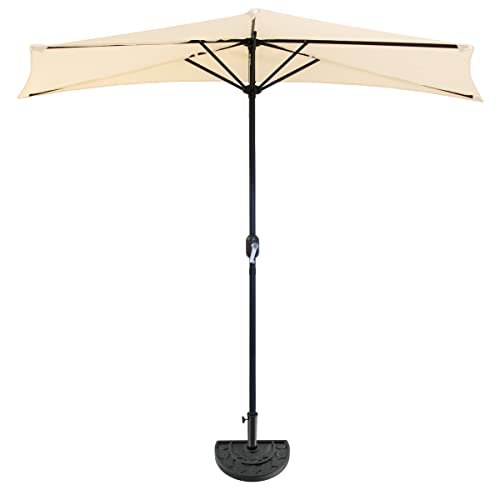
- Best for apartment balconies: Pure Garden 9 ft Half Umbrella with 20lb Weighted Base — Check on Amazon
- C-Hopetree 9 ft Half Round Patio Umbrella with Solar LED Lights — Check on Amazon
- C-Hopetree 9 ft Half Round Patio Umbrella with Tilt — Check on Amazon
- Best Choice Products 7.5ft Solar LED Market Patio Umbrella — Check on Amazon
- Blissun 7.5 ft Solar Umbrella with 18 LED Lights — Check on Amazon
- Abba Patio 7.5FT Lyon Outdoor Patio Umbrella — Check on Amazon
Read the full guide ↓
Disclosure: As an Amazon Associate, dailyhomedecorating.com earns from qualifying purchases. Links to Amazon on this page are affiliate links; they cost you nothing extra. Listing details such as price and availability change often, so check the current Amazon listing before you buy.
Searching for the best patio umbrella for apartments under $75 means solving three problems that house-dwellers never meet. The first is permission: a lease or a condo rulebook may govern what can stand on your balcony, how heavy it can be, and whether anything may overhang the railing — and an umbrella that violates the rules is a deposit problem, not a shade solution. The second is physics at height: wind on a fifth-floor balcony is a different substance from wind in a fenced yard, arriving faster, gusting around the building’s corners, and meeting an umbrella whose fall, if the base fails, has an audience below. The third is storage: an apartment umbrella lives in a closet, a hallway corner or the balcony itself through winter, in a home where every cubic foot already has a job. An umbrella that answers all three — allowed, secure, storable — is the real subject of this guide.
The under-$75 budget is, happily, the apartment sweet spot. It reaches a tier above the basic ground-floor umbrellas: proper 7.5-foot market umbrellas with solar lighting, and — the shape that defines apartment shade — the half umbrella, whose semicircular canopy stands flat against the wall or railing side of a balcony and throws all of its shade inward over your chairs. One pick in this guide goes further and bundles its own weighted base, which matters more than it might sound: on a balcony, the base is the heaviest, bulkiest part of the whole system, and a matched, modest-weight base designed for the umbrella beats a giant general-purpose base you had to haul up the stairs and now cannot store. Where a pick needs a separate base, the review says so plainly and sizes it for balcony reality, where weight must be adequate but also distributed, movable and allowed.
Two apartment rules run through every ranking below, and they are worth stating before any product names. Rule one: nothing gets drilled, clamped to the building, or tied to a railing in a way your lease forbids — every pick here stands in a base on your own floor, fully removable on moving day. Rule two: the umbrella closes when you come inside, every time, without exception. At height, unattended is the only truly dangerous state an umbrella has; a closed, tied canopy on a weighted base is a harmless piece of furniture, while an open one in a midnight gust is a liability in the legal sense as well as the physical one. Hosts and homeowners can be a little casual about that rule. Apartment dwellers, with neighbours below and a lease above, cannot — and the good news is that every pick here cranks closed in seconds, so the discipline costs almost nothing.
One more apartment-specific consideration deserves stating before the picks: delivery and disposal are part of the purchase. An umbrella arrives in a long box that must fit your building’s lift or stairwell turns — all six picks here are single-pole household items that manage standard buildings without drama — and at the end of its life, seasons from now, it must leave the same way. Choosing apartment-scaled equipment is, among other things, choosing never to wrestle an oversized canopy through a fire door while your neighbours watch. The short version: most apartment balconies should start with the Pure Garden half umbrella, the one pick that arrives with its own 20-pound weighted base matched to the job — check price on Amazon. Balconies that get evening use should look at the C-Hopetree half umbrella with solar lights, and larger terraces with a small dining set can step up to the solar market umbrellas from Best Choice Products and Blissun. The reviews below give each pick its honest limits — including where a pick is wrong for high floors or strict buildings — and the sections after them cover balcony rules, base weights and wind in the detail apartment life demands.
In this guide
Quick Picks: the best patio umbrella for apartments under $75
Short on time, or comparing several options at once? Each row below names an apartment situation and the umbrella that suits it, with a link to the listing.
| Apartment situation | Pick | Why it stands out | Link |
|---|---|---|---|
| Best overall for balconies | Pure Garden 9 ft Half Umbrella with Base | Half canopy for the wall side, with a matched 20lb weighted base included — check price on Amazon | Check on Amazon |
| Best for evenings | C-Hopetree 9 ft Half Round Solar Umbrella | The balcony-friendly half shape plus solar LED light, no outlet needed | Check on Amazon |
| Best budget half | C-Hopetree 9 ft Half Round Umbrella | The same wall-side geometry with tilt, at the lowest spend in this guide | Check on Amazon |
| Best for larger terraces | Best Choice Products 7.5ft Solar LED Umbrella | A full round solar market umbrella for a terrace dining set | Check on Amazon |
| Best compact solar | Blissun 7.5 ft Solar Umbrella | 18 rib lights and a manageable 7.5 ft canopy for smaller terraces | Check on Amazon |
| Best simple renter’s pick | Abba Patio 7.5FT Lyon | A plain, tidy crank-and-tilt umbrella that stores slim and moves easily | Check on Amazon |
How the picks were chosen
The series-standard filters came first: each umbrella itself had to sit credibly within the under-$75 band on its current Amazon listing, verified through the Amazon Creators API; each had to crank open and tilt; and each was screened against US CPSC recall records, with any recalled model excluded outright. That screening was applied with particular care to the solar picks, because the category’s known recall involved a lighted umbrella from another maker whose battery overheated — none of the models in this guide is a recalled product. Prices and specifications were taken from the API-verified listings, and where a listing’s claims ran ahead of its construction, the reviews below say so.
Apartment life then added four filters no backyard guide needs. The first was the permission filter: no pick may require drilling, permanent brackets or railing clamps that a typical lease forbids; everything here stands in a base. The second was the base-weight filter, run in both directions — a base must be heavy enough to hold its canopy at balcony height, yet modest and distributed enough for balcony floors, building rules and the human being who has to carry it up the stairs and store it later; this is why the bundled 20-pound base of the lead pick is a headline feature rather than a footnote, and why this guide never recommends the 80-pound bases that backyard guides suggest for freestanding use. The third filter was wind behaviour at height: smaller canopies and half canopies, which present less sail to the wind and sit in the calmer air near the wall, were favoured over large round canopies for typical balconies, with full round umbrellas reserved for larger, lower terraces. The fourth was the moving-day filter: every pick had to break down, carry through a standard doorway and store in a closet corner, because an apartment umbrella that cannot move house with you is a purchase with an expiry date set by your lease.
The resulting six divide cleanly by balcony type: three half umbrellas for the classic wall-side balcony — bundled-base, solar and budget versions of the same smart geometry — and three round umbrellas for apartments blessed with real terraces, where a small dining set needs a centred canopy. If you are unsure which type your home is, measure your balcony’s depth: under about six feet of depth, the half umbrellas will almost always serve you better; deeper terraces can take the round picks and enjoy them.
Detailed reviews
Read the six reviews below with your own balcony in mind — its depth, its floor, its exposure and its rules — because in apartment shade the fit between product and place matters even more than the product’s specification sheet. A technically superior umbrella that breaches your building’s overhang rule is worthless to you; a modest one that complies with everything, stores in your closet and survives your stairwell is the best umbrella in the world for your home. Each review therefore names the balcony it belongs on before it praises anything, and each limitation is stated in apartment terms: what it means for your floor load, your neighbours, your lease and your moving day, not just for your afternoon.
Pure Garden 9 ft Half Umbrella with 20lb Weighted Base — best overall for apartment balconies
Who it suits. The typical apartment dweller with a standard balcony — a slab perhaps four to six feet deep, two chairs and a small table against the railing or the wall, and a lease that allows furniture but not fixtures. If you want one purchase that arrives complete and solves balcony shade without a second order, a base hunt or a hardware-store trip, this is it.
What you get. A 9-foot half umbrella — a semicircular canopy about nine feet wide projecting roughly four and a half feet from the wall — with an easy crank, in a champagne finish, bundled with a 20-pound weighted base sized for it. The bundle is the story: the base question that complicates every other pick in every guide in this series is simply answered, with a weight that suits a balcony — substantial enough to hold a half canopy that sits in the wall’s shelter, light enough to carry upstairs, reposition seasonally and store in a closet. The half shape puts the pole at the wall, the shade over the chairs, and nothing over the railing into the neighbour’s airspace.
Pros. Completeness, first: umbrella and matched base in one box is a genuine apartment luxury, eliminating the mismatch risk between pole diameter and base receiver entirely. The half geometry is the most balcony-efficient shade that exists — full seating shade with zero wasted canopy and a walkway left clear along the railing. The crank is easy from a seated position. And the whole system is renter-clean: nothing drilled, nothing clamped, everything out the door on moving day, base and all, in two trips.
Honest limitation. Twenty pounds of base is matched to a half canopy in a wall’s shelter on a typical balcony — it is not a rating for an exposed high-floor corner balcony in a windy city, where you should add weight, choose the least exposed placement, and be extra strict about closing the umbrella. The champagne colour is handsome but shows city dust; expect a rinse each season. And the half shape commits you to the wall-side layout — if your balcony furniture faces inward around a centred table, a round pick below fits better.
Choose it if you want the complete, permitted, storable answer for a standard balcony. Skip it if your balcony is a high, exposed corner unit — read the wind section below and consider the smaller-canopy round picks with a heavier compact base — or if your terrace is large and centred, where the half shape wastes its talent.
C-Hopetree 9 ft Half Round Patio Umbrella with Solar LED Lights — best for balcony evenings
Who it suits. Apartment dwellers whose balcony is an evening room: the after-work drink, the small dinner, the hour with a book as the city cools. Balconies rarely have a spare outdoor outlet, and running a cable through the sliding door invites both insects and landlord opinions — light that charges itself is the elegant answer.
What you get. The 9-foot half-round format — flat side to the wall, semicircle of shade over the seating by day — with solar LED lights along the canopy and a tilt function. The panel charges through the same daylight the canopy is shading you from, and at dusk the seating gets a soft overhead glow that makes a four-foot-deep balcony feel like a private loggia. It is the only pick in this guide that improves an apartment balcony at both ends of the day.
Pros. The lighting solves a real apartment problem — no outlet, no cord across the threshold, no lamp eating floor space — and aims the light exactly at the chairs and table. Daytime shade performance matches the unlighted half umbrella below. The tilt handles the low western sun that turns west-facing balconies into glare boxes at dinner time, angling the shade band down over the seating. Like all the half picks, it keeps the pole at the wall and the walkway clear, which on a narrow balcony is a daily quality-of-life feature.
Honest limitation. Solar needs sun: a north-facing or building-shadowed balcony will charge weakly and glow dimly, and those balconies should take the plain version and a rechargeable lantern. The base is not included with this one — budget for a compact flat base separately, in the modest weight range this guide recommends for balconies. The LED system will age over seasons, so buy it for the shade first and treat the light as a strong multi-year bonus. And on the highest, windiest floors, the close-when-inside rule applies to this pick with double force.
Choose it if your balcony gets real sun by day and real use by night. Skip it if your balcony lives in shadow — the plain C-Hopetree below is the same shade for less money — or if you need a base included, which is the Pure Garden above.
C-Hopetree 9 ft Half Round Patio Umbrella with Tilt — best budget half umbrella
Who it suits. Renters who want the correct balcony geometry at the lowest sensible spend: students in a first apartment, anyone in a short lease who refuses to over-invest, and owners of second balconies that need shade but not ceremony.
What you get. The same 9-foot half-round canopy and tilt as its solar sibling, without the lights — shade only, done properly. The format’s virtues are all here: pole at the wall, shade over the seats, walkway clear, and a canopy whose sail area is halved by design, which is exactly the temperament a balcony at height wants. For daytime households — the morning-coffee balcony, the laptop-on-the-terrace afternoon — the absence of lighting costs nothing at all.
Pros. Value leads: this is the least expensive route in the guide to genuinely correct apartment shade. The simpler build has fewer components to age, which suits a buy-it-for-this-lease mindset, and the whole thing is light to carry, quick to set up and slim to store — three virtues that compound in apartment life. The tilt works as it should, and the aqua colour option brightens a grey concrete balcony more than any other single object at this price.
Honest limitation. No base is included, so the true first cost is this umbrella plus a compact base — still modest, but budget for both. No lights means evenings end at the porch light’s mercy. And while the half format is wind-calm by balcony standards, it remains a fabric canopy at height: closed when unattended, always, and in genuinely stormy forecasts, brought inside if your balcony is very exposed.
Choose it if your balcony life is daytime and your budget is honest. Skip it if evenings are the point — the solar version above exists for you — or if you want the base in the box.
Best Choice Products 7.5ft Solar LED Market Patio Umbrella — best for larger apartment terraces
Who it suits. Apartment dwellers with a real terrace — ground-floor garden flats, penthouse decks, deep balconies in modern buildings — where a small dining set sits in the middle of the space and a half umbrella against the wall would shade the wall’s chairs and miss the table entirely.
What you get. A full round 7.5-foot market umbrella with six sturdy ribs, push-button tilt, crank lift, a UV-resistant canopy and solar LED lighting built in. The $75 tier shows here: the combination of a name-brand frame, lights and a proper market profile in one umbrella is what the step up from the $50 band buys. Through a terrace table, braced by the table itself, a round canopy behaves beautifully, and at dusk the rib lights turn the dining set into the apartment’s second living room.
Pros. Versatility is the headline — this is the pick that works like a house umbrella while still respecting apartment constraints of size and storage. The established brand brings real support and a long sales history. The solar lighting needs no outlet, which matters on terraces where the outdoor socket, if it exists at all, is already spoken for. The 7.5-foot canopy is the largest round size this guide recommends for apartment use, big enough for four at dinner and modest enough to manage at height.
Honest limitation. A round canopy on a typical narrow balcony is the wrong tool — it wastes shade over the railing and crowds the floor — so this pick is for terraces, and balcony owners should stay with the half umbrellas above. The base is separate, and through-table use still wants a compact base of sensible weight underneath. On upper floors the larger sail area demands the strictest closing discipline in this guide; if your building is a known wind funnel, weigh whether the half format’s calm is worth more than this pick’s coverage.
Choose it if your apartment outdoor space is a terrace with a centred dining set. Skip it if your balcony is narrow — geometry beats features, and the half umbrellas are your picks.
Blissun 7.5 ft Solar Umbrella with 18 LED Lights — best compact solar for terraces
Who it suits. Terrace and deep-balcony owners who want the lit-canopy evening effect in the most manageable package: a smaller household, a two-to-four-person set, and a preference for equipment that one person can handle, store and forgive.
What you get. A 7.5-foot market umbrella with 18 solar LED lights along its ribs, push-button tilt and crank lift. In apartment terms it is the BCP’s close cousin with a slightly lighter footprint and a value tilt: the same day-shade-plus-evening-glow formula, sized for households that will carry it through a doorway twice a year and store it in a closet without resentment. The lights are warm and table-focused, turning a small terrace dinner into an occasion without a single cable.
Pros. The balance of size, light and price is the best in this guide for modest terraces. Handling is genuinely one-person throughout — carry, base, open, close, store. The solar system removes the outlet problem that rules out most terrace lighting. And because the canopy is a standard market size, it can move indoors-to-outdoors across homes: today’s terrace, tomorrow’s small garden, no re-buying.
Honest limitation. Seven and a half feet over a four-person table is a fit, not a surplus — guests at the corners will leave the shade as the sun drops, tilt or no tilt. The base is a separate purchase, as with every round pick here. Solar charging on a shaded terrace will underperform, and the LED system, like all such systems, is a feature with a lifespan measured in seasons. Blissun is an Amazon-native brand, so support runs through the listing rather than a national service network.
Choose it if you want evening light and easy handling on a modest terrace. Skip it if you need the base included or your space is a narrow wall-side balcony — both answers live in the half umbrellas above.
Abba Patio 7.5FT Lyon Outdoor Patio Umbrella — best simple renter’s pick
Who it suits. Renters who want shade with zero complications and zero features to fail: the umbrella as a plain, well-made tool. Also the right pick for a second space — the front balcony that gets morning sun while the back terrace has the main setup.
What you get. A 7.5-foot market umbrella with six sturdy ribs, crank lift and push-button tilt, from a shade-specialist brand, with no lights, no electronics and nothing to charge. On a terrace or a deep balcony it does the one job — shade, adjustable through the day — with the tidy proportions that make Abba’s Lyon the small-space default across this whole series of guides. It stores slimmer than any solar pick and carries lighter, which on moving day is not a detail but a deciding factor.
Pros. Simplicity is durability: with nothing electrical aboard, the Lyon can live on the balcony through the season, rinse clean, and store anywhere dry without a thought for batteries. Its proportions suit apartment scale, its mechanism is the familiar one anyone can operate, and its price leaves budget room for a good compact base and still lands well inside the tier. For households that move often, it is the lowest-regret umbrella in this guide.
Honest limitation. No evening contribution: when the sun drops, the Lyon’s day is done. Its six-rib frame is a calm-weather apartment frame, not a high-floor storm survivor, and the base is separate. On a narrow wall-side balcony the half umbrellas remain the better geometry — the Lyon is for spaces with a centre to shade.
Choose it if you want the simplest, most movable shade in the guide. Skip it if balcony evenings are your main event or your balcony is a narrow strip.
Comparison table
| Pick | Shape / size | Base | Lighting | Best for |
|---|---|---|---|---|
| Pure Garden Half | Half-round, 9 ft wide | 20lb base included | None | Standard balconies, complete kit |
| C-Hopetree Half Solar | Half-round, 9 ft wide | Separate | Solar LED | Balcony evenings |
| C-Hopetree Half | Half-round, 9 ft wide | Separate | None | Budget wall-side shade |
| Best Choice Products 7.5ft Solar | Round, 7.5 ft | Separate | Solar LED | Larger terraces, dining sets |
| Blissun 7.5 ft Solar | Round, 7.5 ft | Separate | 18 solar LED | Compact terraces, easy handling |
| Abba Patio Lyon | Round, 7.5 ft | Separate | None | Simple, movable renter’s shade |
Balcony rules, base weights and wind: the apartment briefing
Read your lease before you read listings. Most leases and condo rules that mention balconies at all care about four things: nothing attached to the structure, nothing overhanging the railing, no excessive weight, and nothing that becomes a hazard to people below. Every pick in this guide was chosen to comply with the ordinary version of those rules — freestanding, floor-based, modest in weight, nothing over the rail. If your building has a specific balcony policy, check it anyway; rules vary, and “the guide said so” is not a defence in a deposit dispute. When in doubt, ask the building manager before the umbrella arrives, not after a neighbour complains.
Base weight on a balcony is a balancing act. Backyard advice says “heavier is better,” and apartment reality adds three limits. The first is structural prudence: balcony floors are rated for distributed loads, and a modest base near the wall — where the slab is strongest — is a very different proposition from a huge base at the railing’s edge; keep bases near the wall or under the table, spread on their full footprint, never concentrated on a stand’s small feet. The second limit is human: you will carry this base up stairs or in a lift, move it to sweep, and store it at lease-end — a base in the 20-to-40-pound range is the apartment workable band, with the Pure Garden’s bundled 20-pounder at the carry-friendly end. The third limit is that a half umbrella in a wall’s shelter simply needs less: its sail is halved and the building breaks the wind, so apartment bases can honestly be lighter than backyard ones — provided the closing discipline below is kept.
Wind at height is the real landlord. Wind speed rises with altitude and accelerates around building corners, so a tenth-floor balcony can meet gusts a garden never sees. The defences, in order of importance: close the umbrella whenever you are not sitting under it — this single habit prevents nearly every balcony umbrella incident; choose half or smaller canopies, which present less sail; place the pole in the wall’s lee rather than at the exposed railing corner; and in forecast storms, bring the umbrella inside entirely — every pick here is light enough that “inside for the weekend” is a two-minute decision, and it is the decision that keeps your deposit, your neighbours and your umbrella all intact.
Winter on a balcony needs a decision too. An apartment umbrella can winter in three places: closed and tied on the balcony under a cover, broken down in a closet, or — the option too many renters discover by default — wherever it fell in the first November storm. Decide in autumn, while the choice is free. A covered umbrella on the balcony is fine in most climates if the base is stable and the canopy fully dry before covering; a closet is kinder in genuinely harsh winters and costs a shelf’s width of space. Either way, a dry canopy is the whole secret — mildew, not cold, is what winter actually does to umbrellas that were put away damp.
Be a good neighbour below. A balcony umbrella drips after rain, and its drip line is your downstairs neighbour’s ceiling. Site the canopy so its edge drips onto your own slab where possible, give it a shake before opening after rain, and never hose it down in place over someone else’s evening. Small courtesies, like closing the umbrella before a windy night rather than letting it creak and bang at 3 a.m., are what separate the balcony the building loves from the one the group chat discusses.
Setting up on a balcony: a renter-safe sequence
Step one: photograph and measure before anything arrives. Measure the balcony’s depth from wall to railing, the width along the wall, the door swing, and the height to any balcony above — low ceilings from the floor above are a real constraint on taller poles in older buildings. Photograph the floor surface: bases sit best on flat concrete or decking tiles, and if your balcony floor is sloped for drainage, as most are, note the direction, because the base belongs on the levelest patch, usually near the wall. These five minutes decide half-versus-round more reliably than any product description.
Step two: place the base first, empty of everything but itself. Set the base where it will live — near the wall for a half umbrella, under the table for a round one — and check the practicalities around it: the door still opens fully, the walkway to the railing is clear, the base does not rock on the drainage slope, and its footprint does not sit in the puddle line where rain collects. If the base rocks, a thin rubber mat beneath it both levels and protects the floor finish — a small deposit-insurance policy in its own right. Only when the base is settled should the pole go in and the canopy go up.
Step three: rehearse the daily routine. Open the umbrella fully, tilt it through its range, and check the canopy’s clearance against the wall, the railing and the ceiling above at every angle — a tilt that kisses the wall will wear the fabric at that point within a season. Then close it, tie it, and time yourself: the routine should take well under a minute, because a routine that takes five minutes is a routine that gets skipped on the exact windy evening it matters. Finally, decide where the closed umbrella stands in a storm forecast — for most apartments, the honest answer is “inside, in the hallway corner” — and make sure that spot exists before the forecast does.
Step four: run the neighbour check. Look over the railing and see where your canopy’s drip line falls, where its shadow lands in the afternoon, and whether its tilt can overhang the rail into the space above your neighbour’s balcony. Adjust a foot in either direction now and most buildings’ unwritten rules are satisfied forever. If your downstairs neighbour is home, a sentence of introduction — “I’ve put a small umbrella up, tell me if it ever drips on you” — buys more shade security than any clause in any lease.
Common mistakes
Copying backyard advice onto a balcony. The 9-foot umbrella on an 80-pound base is a fine backyard answer and a poor apartment one: too much sail for the height, too much base for the floor and the stairwell, and a storage problem with no solution. Apartment shade is its own discipline — this guide exists because the translation is not automatic.
Clamping or tying the umbrella to the railing. It feels secure and it breaches most leases, transfers wind load into a railing that was not built for it, and can damage the very structure your deposit protects. A proper base on your own floor is both the legal and the engineering answer.
Leaving it open “just for the afternoon.” Balcony wind does not schedule itself around your errands. The open, unattended umbrella is behind essentially every balcony-umbrella story that ends with a neighbour, a manager or an insurer. Crank it closed on your way in; it takes seconds.
Ignoring the drip line and the downstairs neighbour. Shade that rains on the balcony below buys complaints that can end your permission to have an umbrella at all. Site thoughtfully, shake off rain before opening, and keep the peace that keeps your shade legal.
Buying for the balcony you wish you had. A round umbrella on a four-foot-deep balcony shades the railing and the street. Measure the depth; if it is under about six feet, the half umbrellas are not a compromise — they are the correct product, and they will shade you better than any round canopy you can squeeze in.
Forgetting the floor above. In stacked apartment buildings your umbrella’s ceiling is someone else’s floor, and a tall pole or an enthusiastically tilted canopy can meet it. Check the full height and tilt arc against the balcony above before the first opening, not during it — and if clearance is genuinely tight, the wall-side half umbrellas, whose tilt stays within their own semicircle, are once again the geometry that behaves.
Final recommendation
For the standard apartment balcony, buy the Pure Garden half umbrella: the right geometry for a wall-side slab, a crank anyone can use, and its own matched 20-pound base in the box, so the whole system is permitted, portable and complete from day one — check price on Amazon. If your balcony evenings matter as much as your afternoons, the C-Hopetree solar half umbrella adds light without cords or outlets. Terrace owners with a centred dining set should take the Best Choice Products or Blissun solar market umbrellas and enjoy the most house-like shade in this guide. Whichever you choose, keep the apartment covenant: nothing attached, base near the wall, closed when you come in. Follow it, and an under-$75 umbrella gives an apartment the thing apartments so often lack — a private outdoor room, entirely within the rules. That room is worth more than its square footage suggests: it is where the morning coffee happens, where the laptop goes on the first warm afternoon, where a small dinner becomes an occasion because it happened outside under your own canopy. Apartment hunting teaches people to count rooms; a good balcony umbrella quietly adds one, for less than the cost of a single month of the rent it improves — and unlike most improvements in a rental, this one packs up and comes with you to the next home.
FAQ
Are patio umbrellas allowed on apartment balconies?
Usually yes, when they are freestanding furniture rather than fixtures — every pick here stands in a base with no drilling or railing attachment. Buildings vary, though: check your lease or condo rules for balcony weight, overhang and appearance clauses before ordering, and ask management if anything is unclear.
How heavy should an umbrella base be on a balcony?
Lighter than backyard advice suggests, because balcony loads, stairwells and storage all argue for moderation — and because half umbrellas in a wall’s shelter need less. A base in the region of 20 to 40 pounds, placed near the wall or under a table, suits the picks in this guide; the Pure Garden’s bundled base is 20 pounds and matched to its canopy. Whatever the weight, closing the umbrella when unattended matters more than any number.
What size umbrella fits a small apartment balcony?
For balconies under about six feet deep, a 9-foot half umbrella is the best fit — it shades a seating line roughly nine feet long while projecting only about four and a half feet from the wall. Deeper terraces can take a 7.5-foot round umbrella through a table. Measure depth before diameter; on balconies, depth is the binding constraint.
Can I leave my balcony umbrella open all summer?
You can leave it on the balcony, but not open and unattended. Wind at height is stronger and less predictable than at ground level, and an open canopy in a night gust endangers the umbrella, your neighbours below and your standing with your landlord. Closed and tied on its base, any pick here can live outside happily; open, it should have you under it.
Do solar umbrella lights need an outlet?
No — the solar picks here charge from a small panel on the canopy and light the ribs after dark, which is precisely why they suit balconies without outdoor sockets. They do need genuine daylight to charge well, so a permanently shadowed balcony will see dimmer results.
What about a corner balcony or a very high floor?
Corner balconies and high floors meet the strongest, least predictable wind, so shrink the sail and raise the discipline: favour the half umbrellas or the smallest round canopy, place the pole in the wall’s lee rather than at the exposed corner, keep the base at the heavier end of the apartment range, and bring the umbrella indoors whenever a storm is forecast. If your balcony regularly defeats hats and napkins, it will defeat an open umbrella too — close it early and often.
Can I use a half umbrella if my chairs face the wall?
Half umbrellas assume seating arranged along or facing away from the wall, with the shade thrown inward over the chairs. If your chairs face the wall itself — an unusual arrangement, usually for a view through the apartment — a round umbrella on a compact base near the railing side may serve better, subject to your building’s overhang rules. Match the shape to where people actually sit, not to the catalogue layout.
Will an umbrella damage my deposit?
Not if it is one of these: freestanding, unclamped and removable without a mark. The deposit risks in this category come from drilling, railing clamps, rust stains from a neglected steel base on pale flooring — put a mat under the base if that worries you — and damage caused by an umbrella that blew loose, which the closing habit prevents.
Related guides
More small-space outdoor guides for apartment living:


