Where to buy
Check the latest price, availability and delivery on Amazon. Orders are placed on Amazon. We may earn a commission from qualifying purchases.
- Best overall for small patios: Abba Patio 7.5FT Lyon Outdoor Patio Umbrella — Check on Amazon
- AMMSUN 6.5 ft Patio Umbrella with Tilt — Check on Amazon
- C-Hopetree 9 ft Half Round Patio Umbrella with Tilt — Check on Amazon
- C-Hopetree 9 ft Half Round Patio Umbrella with Solar LED Lights — Check on Amazon
- Best Choice Products 7.5ft Market Patio Umbrella — Check on Amazon
- ABCCANOPY 7.5FT Scalloped Patio Umbrella — Check on Amazon
Read the full guide ↓
Disclosure: As an Amazon Associate, dailyhomedecorating.com earns from qualifying purchases. Links to Amazon on this page are affiliate links; they cost you nothing extra. Listing details such as price and availability change often, so check the current Amazon listing before you buy.
Finding the best patio umbrella for small patios under $50 is mostly an exercise in refusing to buy the umbrella everyone else buys. The standard advice — get a 9-foot market umbrella, bigger shade is better shade — quietly assumes a patio with room to spare. A small patio has no room to spare. It has a bistro set or a compact four-seat table, a grill that lives closer to the chairs than the manuals recommend, a door swing to respect, and walls, rails or fences on at least two sides that turn a big canopy into a sail pinned in a corner. On a small patio, the right umbrella is the one sized to the furniture and the walls, and the wrong one is a daily low-grade annoyance no matter how well it is made.
The good news is that small patios are where a tight budget stops hurting. The umbrellas that suit compact spaces — 6.5 to 7.5-foot market umbrellas, and the half umbrellas designed to stand flat against a wall — are the least expensive serious shade you can buy, and at under $50 the choice is genuinely wide. Every pick in this guide cranks open, every pick tilts, and two of them are half umbrellas, the small-patio specialist shape that most general guides ignore entirely. A half umbrella deserves a plain explanation: its canopy is a semicircle, flat on one side, so the pole stands flush against a wall, fence or railing while the curved half throws a full semicircle of shade over your chairs. On a narrow patio against the house, it delivers shade that a round umbrella of the same footprint cannot, because none of its canopy is wasted shading the wall. That single geometric insight — spend every square foot of fabric over people, never over brickwork — is the difference between a small patio that feels shaded and one that merely owns an umbrella, and it recurs throughout this guide in different forms: in the bistro umbrella sized exactly to two chairs, in the base chosen to hide under a table, and in the layouts at the end that real small patios, measured honestly, can actually hold.
Two small-patio truths shape the rankings below. The first is that clearance is a specification: a canopy that clips the house wall, the gutter or the railing every time it tilts will be left untilted, then left closed, then left in the garage. Measure the space the canopy will sweep, not just the space the pole will stand in — the sections after the reviews show exactly how. The second truth is about bases. No pick here includes one, and on a small patio the base is not just ballast, it is floor area: a domed base under a bistro table steals the space where feet go, and a base standing in the open steals the walkway. Compact, low-profile or wall-side bases matter here in a way they never do on a big deck, and each review below notes how its umbrella wants to be based.
The short version: most small patios should start with the Abba Patio 7.5FT Lyon, the best-proportioned round umbrella in this class — check price on Amazon. Patios that run along a wall or fence should skip round umbrellas entirely and take a C-Hopetree half umbrella, with or without its solar lights. And the very smallest spaces — the two-chair bistro corner — belong to the AMMSUN 6.5-footer, the tiniest serious umbrella in the guide. The reviews that follow give each pick its honest limits, and the later sections cover measuring, basing and storing shade in a space that forgives nothing — not a wasted inch, not a misjudged angle, and not a base parked where your feet needed to be.
In this guide
Quick Picks: the best patio umbrella for small patios under $50
Short on time, or comparing several options at once? Each row below names a small-patio situation and the umbrella that suits it, with a link to the listing.
| Patio situation | Pick | Why it stands out | Link |
|---|---|---|---|
| Best overall | Abba Patio 7.5FT Lyon | The right proportions for compact spaces: 7.5 ft, crank and tilt — check price on Amazon | Check on Amazon |
| Best for bistro corners | AMMSUN 6.5 ft Patio Umbrella | The smallest footprint here, with tilt and UPF50+ canopy fabric | Check on Amazon |
| Best against a wall | C-Hopetree 9 ft Half Round Umbrella | A half canopy that stands flush to a wall and wastes no shade | Check on Amazon |
| Best wall-side with light | C-Hopetree 9 ft Half Round Solar Umbrella | The half-umbrella shape plus solar LED light for evenings | Check on Amazon |
| Best through-table | Best Choice Products 7.5ft Market Umbrella | An established brand’s tidy 7.5-footer for compact dining sets | Check on Amazon |
| Best style | ABCCANOPY 7.5FT Scalloped Umbrella | A scalloped valance and fiberglass ribs for a finished look | Check on Amazon |
How the picks were chosen
The standard filters came first, as in every guide in this series: the umbrella itself — base always excluded at this price — had to sit credibly inside the under-$50 band on its current Amazon listing, verified through the Amazon Creators API; every pick had to open by crank and offer tilt; and every pick was screened against US CPSC recall records before inclusion, with recalled models excluded outright and unnamed. None of the six umbrellas below carries a recall. For the solar half umbrella, that check was applied with the same care as for any lighted product, given the category’s history with a recalled solar model from another maker.
Small patios then imposed filters of their own. The first was the sweep test: the canopy’s full circle — or semicircle — had to be deployable in a genuinely small footprint, which is why nothing above 7.5 feet in round umbrellas appears here, and why the half umbrellas, whose 9-foot span sounds large but projects only about four and a half feet from the wall, earn their places honestly. Headline diameter misleads on small patios; projection and sweep are the numbers that decide whether an umbrella fits your life. The second filter was one-person handling: on a small patio there is no room for a two-person wrestling match with a heavy frame, so every pick here can be carried, based and opened by one person working in a tight space. The third was storage honesty — where does this umbrella live in winter in a home that, having a small patio, probably has a small garage too? Picks that store slim scored accordingly.
Finally, the six were diversified by geometry rather than ranked as near-duplicates: a best-all-round 7.5-footer, a true bistro-scale 6.5-footer, two half umbrellas for the wall-side patios that dominate small-space living, a brand-backed through-table option, and a style-led scalloped model for patios that are small but meant to be looked at. If your patio’s shape is unusual, one of these geometries is yours; the reviews say which, and what each gives up.
Detailed reviews
A note on how to read the six reviews below: on a small patio, the order of virtues changes. Coverage still matters, but it is coverage of your seats, not of the compass points; weight matters, but as something you will feel every time you shift the umbrella to sweep beneath it; and style matters more than big-yard owners ever believe, because on a small patio the umbrella is never background — it is the ceiling of the room you are sitting in, in your eyeline at all times. Each review therefore leads with the patio shape the umbrella belongs to, and only then with its mechanics. If you recognise your patio in the first line of a review, you have probably found your pick; the pros and limitations that follow are there to confirm the match or talk you out of it honestly.
Abba Patio 7.5FT Lyon Outdoor Patio Umbrella — best overall for small patios
Who it suits. The typical small-patio owner: a compact slab or deck, a two-to-four-person table or a pair of chairs, and a need for real shade that does not turn the whole space into an umbrella with furniture underneath it. If your patio is small but conventionally shaped — roughly square, furniture in the middle — start here.
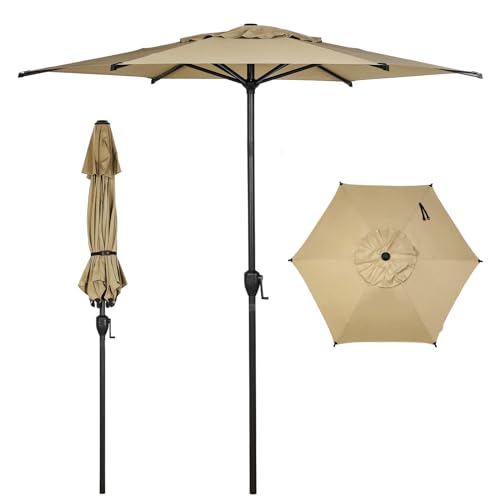
What you get. A 7.5-foot market umbrella with six sturdy ribs, a crank lift and push-button tilt, from a brand that specialises in shade. Seven and a half feet is the small-patio sweet spot for a round canopy: it covers a compact table and its chairs completely, yet its sweep clears most walls and railings, and its sail area stays modest enough that a reasonably weighted base keeps it composed in ordinary breezes. Abba Patio’s finishing — tidy canopy work, clean market profile without a floppy valance — suits patios that are extensions of the living room and get looked at all year.
Pros. Proportion is the whole story and it is a good one: nothing about the Lyon overwhelms a small space, from its canopy diameter to its one-person weight. The crank-and-tilt pair works exactly as a small-patio umbrella must — quickly, in a confined space, without the operator needing to stand back or climb on anything. The smaller canopy also lives an easier mechanical life: less wind load on the tilt joint, less leverage on the pole, less drama in storage. For renters, it is the pick most likely to fit the next patio too.
Honest limitation. The Lyon shades four people at a compact table and no more; if your “small patio” hosts six around a squeezed-in big table, the honest answer is a 9-foot umbrella and a tolerance for crowding, not this one. Its six-rib frame is sized for its canopy and for sheltered small spaces — a small patio that is also a wind tunnel between buildings should be based extra heavily and closed early. The base, as always in this guide, is a separate purchase.
Choose it if your patio is compact and squarish and your table seats up to four. Skip it if your patio is a narrow strip against the house — the half umbrellas below were invented for you — or if your set is a true two-person bistro, where the AMMSUN shades you for less fuss.
AMMSUN 6.5 ft Patio Umbrella — best for bistro corners and the smallest spaces
Who it suits. Owners of genuinely tiny outdoor spaces: the bistro set on a slab the size of a parking space, the two chairs on a narrow deck, the coffee corner outside a garden-level flat. When every other umbrella in a guide still sounds too big, this is the one that fits.
What you get. A 6.5-foot table umbrella with a steel pole, push-button tilt and a UPF50+ canopy. At this size the umbrella stops being patio infrastructure and becomes furniture — light enough to move with one hand, small enough to open where a 7.5-footer’s sweep would kiss the wall, and proportioned so two people sit in real shade rather than in the bright fringe of a bigger canopy centred elsewhere. The UPF50+ fabric rating is a genuine plus at this scale, because on a tiny patio you sit close under the canopy, and fabric protection is doing more of the work than distance and angle.
Pros. Footprint, above all: pole, base and canopy all scale down together, so the whole assembly can live in a corner that no other pick here could use. It is the easiest umbrella in the guide to carry in for winter or to reposition between a morning-coffee spot and an evening-reading spot. The tilt still functions — many umbrellas this small delete it — which matters enormously in tight spaces where you cannot move the furniture to chase shade and must move the shade instead. As a second, satellite umbrella beside a larger main one, it is also superb.
Honest limitation. Six and a half feet shades two people, full stop; a third chair is a spectator. The steel pole and frame are built to a price and a size, so this is a calm-weather, sheltered-corner umbrella — in an exposed spot it should be closed at the first real breeze, and it will not forgive being left open in a storm. Owners of standard four-person sets should read its charm as a warning: it is not your umbrella, however cute the fit looks on paper.
Choose it if your space seats two and every inch is spoken for. Skip it if you seat three or more, or your small patio is an exposed one — take the Lyon and a heavier base.
C-Hopetree 9 ft Half Round Patio Umbrella with Tilt — best against a wall
Who it suits. Anyone whose patio is a strip: the narrow slab along the back of the house, the side-return terrace, the deck that runs wall-to-railing with chairs in a line. If your seating faces outward from a wall, the half umbrella is not a novelty — it is the geometrically correct umbrella, and this is its best budget expression.
What you get. A 9-foot half-round canopy — a semicircle roughly nine feet wide that projects about four and a half feet out from the wall — with a tilt function and a flat side designed to sit flush against the house, fence or railing. The arithmetic is the appeal: a round umbrella in the same spot wastes half its canopy against the wall and pushes its pole four feet into your narrow space, while the half umbrella puts its pole at the wall and spends every inch of fabric over people. The result is a long, even band of shade along the seating line, exactly the shape a strip patio needs.
Pros. Space efficiency that no round umbrella can match in this layout: walkway stays clear, pole stays out of the way, shade lands on chairs. The tilt lets the band of shade be angled down toward the seating as the sun drops, which on a west-facing wall turns an unusable glare hour into the best hour of the day. Setup is one-person easy, and because the canopy’s flat side hugs the wall, the whole assembly reads as intentional architecture rather than equipment. For renters in townhouses with regulation-narrow patios, it is often the only full-size shade that truly fits.
Honest limitation. A half umbrella is a specialist: move it away from the wall and it is half an umbrella, so this purchase commits to the wall-side layout — if you rearrange your patio seasonally, think first. It still needs a base or a secure wall-side stand, and because its pole sits at the wall, the base footprint lands where your chairs’ back legs want to be; a flat-profile base is the right pairing. Wind rolling along a wall can get under the canopy, so the close-when-gusty rule applies with the usual force.
Choose it if your chairs line a wall and your patio is deeper in length than in width. Skip it if your furniture sits in the middle of the space — a round umbrella shades a centred set far better.
C-Hopetree 9 ft Half Round Patio Umbrella with Solar LED Lights — best wall-side pick for evenings
Who it suits. Wall-side patio owners whose outdoor hours are evening hours: the after-work drink on the terrace, the small dinner against the house wall, the reading chair that gets used at dusk in summer. This is the half umbrella with a second job.
What you get. The same 9-foot half-round format as the pick above — flat side to the wall, semicircle of shade over the seating — with solar LED lights added along the canopy and a tilt function for the daytime shift. A small panel charges while the canopy shades you, and at dusk the seating line gets a soft wash of light from above: enough to eat by, to find the steps by, to make a narrow patio feel like a room rather than a ledge. On small patios, where there is rarely a spare outlet, a dry corner for a lantern, or room for a lamp, light that arrives built into the shade is disproportionately valuable.
Pros. Two problems solved by one object in a space that punishes extra objects — that is the entire case, and it is a strong one. The lighting is aimed where small-patio life happens: down at the chairs and the side table. No cords cross the narrow walkway, which on a strip patio is a safety feature as much as a convenience. Daytime performance matches its unlighted sibling, so nothing is traded away for the evening trick.
Honest limitation. Solar charging needs sun: a wall-side patio in permanent building shadow will give you a dim evening and a puzzled owner, so north-facing, deeply shaded strips should take the plain half umbrella and a battery lantern instead. The LED system also adds a component that ages — expect the light to be a multi-season feature rather than a lifetime one, and store the umbrella dry to protect it. As with the plain version, the shape commits you to the wall-side layout.
Choose it if your strip patio gets daytime sun and evening use. Skip it if your wall side lives in shade all day, or if you never sit out after dark — the unlighted C-Hopetree does the same shade job for the same layout.
Best Choice Products 7.5ft Market Patio Umbrella — best through-table pick from an established brand
Who it suits. Small-patio owners with a compact dining set — the table has a centre hole and four chairs — who prefer buying from a known US outdoor brand with real customer service behind the listing.
What you get. A 7.5-foot market umbrella with six sturdy ribs, crank lift, push-button tilt and a UV-resistant canopy, in a clean valance-free profile. Through a table is the most forgiving way to run any umbrella — the table braces the pole, the base hides underneath, feet stay clear — and on a small patio that tidiness is worth even more than usual, because there is no spare floor for a freestanding base to occupy. The BCP’s standard pole diameter fits the centre holes of the compact sets this guide is written for.
Pros. Brand accountability leads: a real company, a real support channel, and a model that has been sold in volume for years. The UV-resistant canopy suits small patios that double as sun traps between walls, where reflected heat and light are fiercer than in an open yard. Fit and finish are tidy, the mechanism is the familiar guest-proof pattern, and the market profile keeps a small space looking uncluttered. Through-table, its six-rib frame is amply supported and composed.
Honest limitation. Through-table is also its constraint: freestanding beside a pair of loungers it is unremarkable, and the Abba Lyon is the better all-rounder at the same size. Six ribs and a small-patio brief mean exposed, gusty locations should look to heavier frames and heavier bases than this guide’s calm-space assumptions. And the separate-base rule still applies — through-table bases can be lighter, but they cannot be skipped.
Choose it if your shade lives through a compact dining table and brand backing matters to you. Skip it if your seating is lounge chairs without a table — the Lyon or a half umbrella will serve the layout better.
ABCCANOPY 7.5FT Scalloped Patio Umbrella — best style for a small patio
Who it suits. Owners of small patios that are meant to be seen: the café-style terrace, the cottage-garden corner, the rental listing photograph. When the patio is tiny, every object in it is a design decision, and this is the umbrella that behaves like one.
What you get. A 7.5-foot table market umbrella with a scalloped valance edge — the gentle wave around the canopy rim that turns a plain umbrella into a café awning’s prettier cousin — over six fiberglass ribs, with push-button tilt and crank lift. Fiberglass ribs are the quiet technical story here: they flex rather than bend in a gust, which suits small patios between buildings where wind arrives in sudden, channelled bursts. The canopy carries UV protection and water resistance for everyday small-patio duty.
Pros. Looks, honestly first: the scalloped edge softens a small space the way curtains soften a window, and the khaki palette sits comfortably with brick, timber and planting. The fiberglass ribs forgive the gusts that snap rigid budget ribs, giving this decorative pick a practical streak. It is a through-table natural, and its finished appearance makes a two-chair set look deliberately styled rather than merely furnished. For hosts of small-space occasions — a birthday tea on the terrace — it photographs beautifully.
Honest limitation. A valance edge catches a little more wind than a clean-cut canopy and flutters audibly in a breeze; light sleepers with the patio outside a bedroom window should know. The style is also a statement — in a starkly modern space it will look like a guest from another decade. And while fiberglass ribs flex well, the overall frame remains a budget small-patio frame: closed in storms, based properly, treated gently.
Choose it if your small patio has a cottage, café or garden-room character. Skip it if your style is minimalist, or your patio is a wind channel where a fluttering valance would slowly drive you mad.
Comparison table
| Pick | Shape / size | Ribs | Lighting | Best for |
|---|---|---|---|---|
| Abba Patio Lyon | Round, 7.5 ft | 6 | None | Most small patios |
| AMMSUN | Round, 6.5 ft | Steel frame | None | Bistro sets, tiniest spaces |
| C-Hopetree Half | Half-round, 9 ft wide | — | None | Wall-side strip patios |
| C-Hopetree Half Solar | Half-round, 9 ft wide | — | Solar LED | Wall-side evenings |
| Best Choice Products 7.5ft | Round, 7.5 ft | 6 | None | Through-table dining sets |
| ABCCANOPY Scalloped | Round, 7.5 ft | 6 fiberglass | None | Styled, café-look patios |
How to choose an umbrella for a small patio
Measure the sweep, not just the spot. Stand where the pole will go and measure in every direction the canopy will occupy when open and tilted — a 7.5-foot canopy needs roughly 3.75 feet of clearance from the pole in all directions, plus more on the side it tilts toward. Check that circle against walls, gutters, railings, the door swing and any overhead lines. If the circle does not fit, the answer is a smaller round umbrella or a half umbrella against the wall — never a bigger umbrella “eased in,” because a canopy that touches a wall wears through at the contact point within a season.
Let the furniture vote first. Count seats honestly. Two seats: the AMMSUN or a half umbrella over a pair of wall-side chairs. Four seats at a compact table: any 7.5-footer here, through the table if it has a centre hole. A line of seats along a wall: half umbrella, no contest. Six seats on a small patio is the only brief this guide cannot fill at 7.5 feet — the honest move is a 9-foot round umbrella, a tolerance for tight quarters, and a base chosen with extra care.
Choose the base for the floor you have. Small patios punish bases twice — once for weight, once for footprint. Through-table setups can use a compact base in the 30-pound region, hidden under the table. Freestanding and half-umbrella setups want flat, low-profile bases that slide partly under furniture and stay out of the walkway; half umbrellas in particular pair well with flat bases tucked against the wall. Whatever the style, do not solve the space problem by under-weighting the base — solve it by choosing a base shape that puts its weight where feet are not.
Plan the tilt arc. On a small patio, tilting moves the canopy into space that may belong to a wall, a railing or a neighbour’s airspace over a low fence. Before buying, mime the tilt: which direction will you angle it at 5 p.m., and what is in that space? Half umbrellas tilt within their semicircle, which is one more reason they behave so well in strips. A tilt you cannot use is a feature you did not buy, whatever the listing says.
Mind the rules and the neighbours. Small patios often come with landlords, HOAs or simply close neighbours whose windows overlook your shade. Nothing in this guide needs drilling or permanent fixing — every pick stands in a base — which keeps them renter-safe by design. Do check any building rules about items overhanging railings before choosing a tilting round umbrella near a boundary; a half umbrella against your own wall almost never raises an eyebrow. And consider the neighbour below or beside you: a canopy that drips onto their space after rain is a small discourtesy that siting — a foot this way or that — usually prevents.
Decide where it sleeps. Small patio, small storage: the umbrella’s winter home is a real constraint. All six picks close down to a slim bundle, but the half umbrellas and the AMMSUN store slimmest of all, and a wall-mounted pair of hooks in a garage or a corner of a storage bench may be all the “storage system” a small-space household needs. Decide before ordering, and the umbrella will never spend a winter becoming a mildewed obstacle in the hallway.
Three small-patio layouts that actually work
The café square. A squarish patio of roughly eight by eight feet, a round or square table for four pushed slightly off-centre toward the shadier corner, and a 7.5-foot umbrella through the table — the Lyon or the Best Choice Products. The off-centre placement is deliberate: it leaves one open corner for the grill or a planter and keeps the door’s swing completely clear, while the umbrella’s shade pool, which is what actually matters, still centres on the diners. A compact base hides under the table, feet have the floor, and the whole arrangement seats four adults in genuine comfort on a footprint that brochures would call a balcony.
The wall-side strip. A patio five feet deep and twelve or more long, chairs in a row facing the garden, and a half umbrella against the house wall — the plain C-Hopetree for daytime households, the solar version for evening ones. This layout turns the strip’s weakness into a rhythm: shade runs the full length of the seating like an awning, the walkway along the railing stays open, and guests can circulate behind the chairs without ducking a pole. Add a narrow console table against the wall under the canopy’s edge for drinks, and the strip entertains six people in a space where a round umbrella would have managed two and an argument.
The bistro corner. The smallest honest layout: two chairs, a 24-inch table, and the AMMSUN 6.5-footer in the corner of a slab, a deck or even a wide landing. The trick is to treat the corner as a destination rather than a leftover — a small outdoor rug under the set, the umbrella angled to cover the morning or evening hour you actually use it, and nothing else competing for the floor. Couples in small homes consistently report this layout gets used more than any grander arrangement, precisely because it asks nothing: two steps from the door, coffee in hand, shade already there. If your patio can only do one thing, let it do this perfectly.
Notice what all three layouts share: the umbrella was chosen after the furniture arrangement, not before; the base was planned as furniture, not discovered as an obstacle; and the door, the walkway and the tilt arc were all walked through in person before anything was ordered. Small patios reward that order of operations more than any other outdoor space, because they offer no spare room in which to hide a planning mistake. Ten minutes with a tape measure and a honest walk-through is the entire secret — the umbrellas in this guide are simply the ones that fit the layouts real small patios actually have.
Common mistakes
Buying the 9-foot bargain anyway. The big umbrella on promotion is the small patio’s classic false economy: it clips the wall, shades the gutter, crowds the chairs and gets left closed. A right-sized 7.5-footer used daily is worth any number of 9-footers sulking in the corner.
Forgetting the door. Patio doors swing, slide and open outward into exactly the space where a new umbrella looks best in the showroom of your imagination. Open the door fully before siting the pole — and if the door is a slider, check the canopy’s tilt arc against the doorway’s head height for the tall people in your life.
Centring the umbrella and orphaning the seats. On small patios the geometric centre of the slab is rarely where the shade is needed. Site the pole for the chairs’ sake — through the table, at the wall behind the chairs — and let the patio’s symmetry look after itself.
Skipping the base because the space “feels sheltered.” Buildings channel wind as often as they block it; the gap between houses is a wind tunnel with a patio in it. Small canopies need less base weight than big ones, but “less” is not “none,” and a tipped umbrella in a confined space has nowhere harmless to fall.
Storing it in the only walkway. A closed umbrella leaned in the patio’s single path becomes a daily obstacle course and gets knocked, bent and resented. Give it hooks, a corner or a bench — a decided home — from day one.
Judging shade at the wrong hour. A small patio’s sun map changes completely between morning and evening, and a wall that shades your chairs at nine may expose them fully at four. Before siting the pole permanently, spend one day noting where the sun actually lands at the hours you use the space — or simply accept a week of experimentation, moving the base a foot at a time until the shade pool and the chairs agree. On a small patio that foot is often the whole difference between an umbrella that works and one that almost works, which in daily life is the same as not working at all.
Final recommendation
For the typical small patio, the Abba Patio Lyon is the buy: correctly sized, calmly styled, easy to live with in a confined space — check price on Amazon — paired with a low-profile base that respects your floor. If your patio runs along a wall, do not compromise with a round umbrella at all: the C-Hopetree half umbrellas exist for your exact geometry, and the solar version adds the evening light that small spaces so rarely have room to arrange any other way. And if your world is a bistro set for two, the little AMMSUN will shade your mornings for seasons. Measure the sweep, let the furniture vote, base it flat and heavy enough — and a small patio stops being a compromise and becomes what it secretly is: the most intimate outdoor room in the house. Small patios concentrate everything — the coffee tastes better two steps from the kitchen, the conversation runs longer in a space that feels enclosed and calm, and a right-sized umbrella is the single object that turns a leftover slab into that room. Buy the umbrella your patio’s geometry asks for, not the one the promotions page is pushing this week, and the smallest space in your home may well become the one you use most.
FAQ
What size umbrella is best for a small patio?
For most small patios, 7.5 feet is the sweet spot for a round canopy over a compact table. Two-person bistro sets are better served by 6.5 feet, and patios arranged along a wall are better served by a 9-foot half umbrella, which projects only about four and a half feet from the wall despite its wide span.
What is a half umbrella, and when does it beat a round one?
A half umbrella has a semicircular canopy with a flat side that stands flush against a wall, fence or railing. It wins whenever seating lines a wall — typical of narrow patios and terraces — because none of its shade is wasted behind the pole and the pole itself stays out of the living space. For furniture centred in the open, a round umbrella is the better shape.
Do small-patio umbrellas include a base?
No — at under $50 every pick here is canopy, pole and mechanism only. Small patios suit compact or flat-profile bases: roughly 30 pounds of ballast through a table is a sensible starting point, with flat bases preferred for freestanding and half-umbrella setups so the base stays out of the walkway.
Can I use a patio umbrella on a very narrow patio?
Yes — narrow is the half umbrella’s home turf. A 9-foot half canopy shades a seating line about nine feet long while projecting only around four and a half feet, so patios barely five feet deep can still host real shade. Measure the tilt arc against the opposite railing before ordering.
Will a small umbrella survive wind between buildings?
Buildings channel gusts, so treat a small patio as breezier than it feels at ground level: choose a properly weighted base, favour flexible fiberglass ribs if your space is a known wind channel, and close the umbrella whenever you go in. No budget umbrella, at any size, is a leave-it-open product.
My small patio is on a rental — can I use these umbrellas?
Yes. Every pick in this guide is freestanding in a weighted base and requires no drilling, brackets or permanent fixing, which makes them suitable for rentals and HOA-governed patios. Keep the receipt and the packaging until you are sure of the fit, and photograph your patio’s measurements on your phone before ordering so returns, if needed, are painless.
Is a half umbrella stable without being fixed to the wall?
Yes, when it is based properly. A half umbrella stands in a base like any other — the flat side simply sits close to the wall rather than being attached to it. Choose a flat-profile base with adequate weight, keep the pole’s flat side flush to the wall so the canopy cannot rotate into the gap, and follow the same close-in-wind discipline as any umbrella.
How do I store an umbrella when storage is tiny too?
Closed and tied, every pick here is a slim bundle. Hang it on wall hooks in a garage or entry, stand it in the corner of a storage bench, or lay it along the top of a wardrobe indoors — anywhere dry. Rinse and fully dry the canopy before storing to prevent mildew.
Related guides
Furnishing the rest of a compact patio? These guides are sized for the same spaces:


