Where to buy
Check the latest price, availability and delivery on Amazon. Orders are placed on Amazon. We may earn a commission from qualifying purchases.
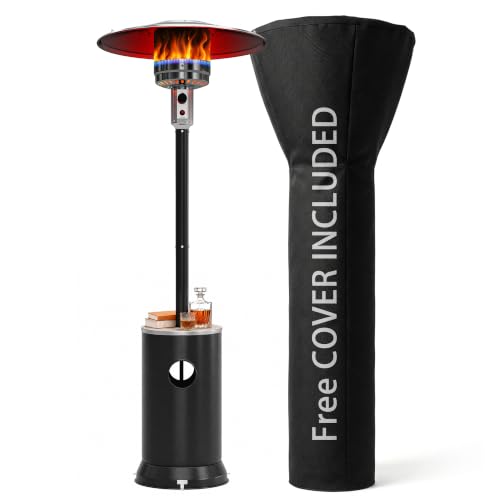
- Best overall for entertaining: PAMAPIC 48,000 BTU Patio Heater with Waterproof Cover — Check on Amazon
- Best for standing receptions: EAST OAK 50,000 BTU Propane Patio Heater with One-Hand Ignition, Grey — Check on Amazon
- Most stable base for busy patios: Sweetcrispy 48,000 BTU Patio Heater with Sandbox Base and Wheels — Check on Amazon
See 3 more Amazon options
- Best proven all-rounder: Amazon Basics 46,000 BTU Outdoor Propane Patio Heater with Wheels, Havana Bronze — Check on Amazon
- Best for the dining table itself: Cuisinart Tabletop Patio Heater, 11,000 BTU (COH-514) — Check on Amazon
- Best for covered dining pergolas: EnerG+ Hanging Infrared Electric Outdoor Heater with LED and Remote — Check on Amazon
Read the full guide ↓
Disclosure: As an Amazon Associate, dailyhomedecorating.com earns from qualifying purchases. Links to Amazon on this page are affiliate links; they cost you nothing extra. Listing details such as price and availability change often, so check the current Amazon listing before you buy.
Entertaining outdoors succeeds or fails in the twenty minutes after sunset, when the temperature drops, the first guests drift toward the kitchen door, and the host discovers whether the evening has a warm center or not. The best patio heater for outdoor entertaining under $150 is therefore not simply the most powerful heater in the budget — it is the one that fits the choreography of a gathering: it lights one-handed while you carry a platter, gives standing guests somewhere to set a glass, keeps a safe, obvious presence that nobody backs into with a plate in each hand, runs a whole evening without a mid-party fuel crisis, and then accepts a cover at midnight without a wrestling match. This guide ranks six heaters by exactly those hosting criteria, across the three scenes that make up most outdoor entertaining: the standing reception around a tower, the seated dinner at one table, and the covered pergola where the ceiling changes the rules.
Notice what the picks share and where they diverge. Four are full-size propane towers in the 46,000–50,000 BTU class, because a gathering of six to twelve people needs that circle of heat and no tabletop or electric bar honestly replaces it in open air. But the towers here were chosen for hosting details, not spec sheets: the PAMAPIC and EAST OAK carry table ledges sized for drinks, the Sweetcrispy variant sits on a sand-filled base that shrugs off the bumps a busy patio delivers, and the Amazon Basics remains the proven, weighted, wheel-it-anywhere benchmark. The Cuisinart tabletop serves the dinner itself — the four to six people actually seated at the table, which is where an evening’s conversation lives. And the EnerG+ hanging infrared covers the pergola and covered-porch hosts, adding light as well as heat, with no flame at all. If your parties are bigger than one warm circle, the honest answer is also in this guide: two heaters, zoned, beat one hero — and the how-to section lays out the pairing.
A host’s safety duty runs through everything below. Guests do not read manuals; they back up laughing into the space behind them, set paper napkins down wherever is flat, and send children across the patio at speed. The heater a host chooses must forgive all of that — weighted or sand-filled base, tip-over shutoff, visible presence, clearances that survive a rearranged seating plan. The safety section is written for hosts specifically; read it before the season’s first invitation, not after the first singed cushion.
In this guide
Quick picks: the best patio heater for outdoor entertaining under $150 at a glance
| Pick | Best for | Output | Hosting feature |
|---|---|---|---|
| PAMAPIC 48,000 BTU Patio Heater | Most hosts | 48,000 BTU | 2-in-1 table ledge; waterproof cover included for between-party storage |
| EAST OAK 50,000 BTU Patio Heater | Standing receptions | 50,000 BTU | One-hand ignition; round table design; strongest output |
| Sweetcrispy 48,000 BTU (Sandbox) | Busy, bump-prone patios | 48,000 BTU | Sand-filled base stability; double-layer stainless burner |
| Amazon Basics 46,000 BTU | Proven flexibility | 46,000 BTU | Water-box base; wheels; one-touch ignition |
| Cuisinart Tabletop (COH-514) | The dinner table | 11,000 BTU | Tabletop format; anti-tilt shutoff; dial control |
| EnerG+ Hanging Infrared | Covered pergola dining | 1,500W electric | Heat plus LED light; remote; no flame |
Short on time? Hosts of standing gatherings buy the EAST OAK or PAMAPIC; hosts of seated dinners add the Cuisinart; hosts under a roof hang the EnerG+. Everyone reads the safety section.
One framing note before the details: every heater here was verified as a real, currently listed model that fits this guide’s under-$150 budget at the time of research, and prices in this category move with the season — which is why this guide prints no prices and asks you to check the current listing instead. What does not move with the season is the fit between a heater and a hosting style, and that fit is what the rest of this page is about.
How these picks were chosen
Hosting imposed filters that a raw power ranking would miss. First, ignition and operation had to be one-person, one-hand friendly wherever possible, because the person running the heater is also carrying food, opening wine and greeting at the gate. Second, guest-proofing: every propane pick has tip-over protection and a base that can be weighted or sand-filled, because a tower at a party lives in a crowd, not in a showroom. Third, the gathering’s geometry: towers were assessed on the size and usability of their warm circle for standing and seated guests, the tabletop on its honesty about serving one table, and the hanging electric on its fit for covered dining where propane towers cannot safely go. Fourth, between-party practicality — a cover included or easily fitted, wheels for the garage shuffle, and burners built to survive being stored and relit twenty times a season.
Verification standards were the same as our other guides: every pick is a real, currently listed model whose identity, output and features were confirmed against manufacturer information and cross-checked through the site’s own Amazon product data, and every brand and model was checked against the U.S. Consumer Product Safety Commission recall record. Products with an open recall on the heater itself were excluded entirely and are not named here. Two fashionable categories were deliberately left out: glass-tube pyramid towers, whose verified listings sit above this budget and whose flame column is more decoration than heat delivery, and unbranded towers whose safety hardware could not be confirmed — at a party, unverifiable safety gear is not a bargain at any price.
Finally, we costed the evening, not just the appliance. A tower at full output burns through a 20 lb tank in roughly nine to ten hours — two generous parties per tank — while the tabletop’s 1 lb cylinders last about two hours each on high, which shapes how a host plans a long dinner. Those running-cost realities are in the reviews, because a heater that quits at nine o’clock is an entertaining failure no spec sheet warns you about.
The picks in detail
1. PAMAPIC 48,000 BTU Patio Heater with Cover — best overall for entertaining
Who it suits: The regular host — monthly dinners, birthday cookouts, the standing-around-the-patio crowd — who wants one tower that serves the party and then protects itself between parties.
The PAMAPIC’s hosting case rests on two features that sound modest and prove decisive. The first is the 2-in-1 table design: a ledge around the pole that holds the glasses and small plates a standing reception generates, keeping them off the ground and out of hands that should be gesturing. The second is the included high-strength waterproof cover. Entertaining heaters live a stop-start life — blazing Saturday, idle for three weeks in the rain — and idle time is when burners corrode and insects move in. A cover in the box means protection starts the first night, not after the first rust spot teaches the lesson. Underneath, the fundamentals are class-standard and correct: a rated 48,000 BTU, a double-layer stainless steel burner (the longevity component on any budget tower), wheels for positioning, and a 20 lb tank in the base. Positioned at the edge of the seating arc, it warms the circle where guests naturally collect.
Pros:
- Table ledge serves the standing reception directly
- Cover included — the between-party protection most hosts never get around to buying
- Double-layer stainless burner; 48,000 BTU; wheels
- Balanced feature set with no hosting-relevant omission
Honest limitation: The cover discipline cuts both ways: it must go on only when the heater is fully cold, which at midnight, after a long evening, requires a host who plans the shutdown fifteen minutes before the last guest leaves. The ledge, meanwhile, is drink-sized, not dinner-sized — set a side table nearby or guests will improvise on the base.
Choose it if you host monthly or more and store the heater outdoors. Skip it if your gatherings are always seated dinners — the Cuisinart serves the table itself better, and the tower money is better spent on the second-heater strategy below.
Check on Amazon — check price on Amazon, and confirm the cover is in the box contents before the party is on the calendar.
2. EAST OAK 50,000 BTU Patio Heater — best for standing receptions
Who it suits: The host of standing gatherings — drinks parties, grill nights, the dozen people who never actually sit down — who needs the widest warm circle in the budget and ignition that works with a tray in the other hand.
At a rated 50,000 BTU, this is the strongest heater in the guide, and standing receptions are where output converts directly into hospitality: a standing guest cannot burrow into a chair’s warmth, so the circle either includes them or they migrate indoors. EAST OAK’s one-hand ignition is the host feature of the year in this category — light the heater while holding the platter, adjust it while holding the tongs. The round table design gives the standing crowd its glass-ledge, and the one-person assembly means the heater can be built the same afternoon it is needed. The grey finish reads modern against evening dress codes and patio furniture alike. For a host, the whole package is about removing friction at the exact moments a party generates it.
Pros:
- 50,000 BTU — the widest warm circle under $150
- One-hand ignition built for hosts mid-task
- Round table ledge for drinks; one-person assembly
- Contemporary grey finish
Honest limitation: Full output is thirsty: hosts who run it flat-out all evening should treat a spare 20 lb tank as party equipment, not an accessory. The table ledge also sits at a height that invites guests to lean — set the house norm early, and keep paper goods off it entirely.
Choose it if your parties stand and mingle. Skip it if your gatherings are small and seated, where its output is surplus and the tabletop’s intimacy wins.
Check on Amazon — check price on Amazon; also listed in black.
3. Sweetcrispy 48,000 BTU Patio Heater (Sandbox Base) — most stable for busy patios
Who it suits: The host whose patio sees traffic — children threading between chairs, a big dog, a cornhole game at the edge — and who wants the tower’s base filled with sand: the heaviest, least sloshy, most forgiving ballast there is.
This variant of Sweetcrispy’s 48,000 BTU tower swaps the water box for a sandbox base. Sand ballast has real hosting virtues: it does not slosh when the tower is tilted onto its wheels, does not need draining before a freeze, and gives the base a planted, low-center feel that shrugs off the casual bumps a party delivers. The heater above it keeps the features that earned the brand its place in our main roundup: a double-layer stainless steel burner for longevity, a round table design for drinks, wheels, and class-standard output that covers a family-plus-friends circle. For a host, stability is not a spec — it is the difference between a heater you relax around and one you monitor all evening.
Pros:
- Sand-filled base: maximum, maintenance-free stability for crowded patios
- Double-layer stainless burner
- 48,000 BTU with a drink ledge and wheels
- No freeze-draining chore, unlike water ballast
Honest limitation: A sand-filled base makes the tower meaningfully heavier to wheel and to carry up any step — position it thoughtfully, because casual repositioning is no longer casual. Sweetcrispy is also a younger brand; documentation and long-term parts support trail the biggest names, so check every part at assembly.
Choose it if your patio is busy and bump-prone. Skip it if you move the heater weekly between spots — choose a water-box model you can empty for transport.
Check on Amazon — check price on Amazon; the water-box variant is also listed if you prefer lighter transport.
4. Amazon Basics 46,000 BTU Patio Heater — best proven all-rounder
Who it suits: The host who values predictability over peak specs: the heater that lights first time, every time, whose cover is easy to find, whose behavior the whole internet has already documented.
For entertaining, the Amazon Basics’ virtues are operational. One-touch piezo ignition that any co-host or older child (supervised, at the host’s judgment) can manage. A water-box base that fills in minutes for ballast and empties for storage. Wheels that genuinely roll, so the heater can serve the dining patio at seven and the lounge corner at nine. Output of 46,000 BTU under a full-size reflector warms the standard circle; the maker rates the reach at up to a 9-foot radius in still air. The tilt auto-shutoff stands guard over the whole arrangement. And when something does wear — a cover, a knob — the model’s long market life means answers and parts are findable, which is the unglamorous definition of a good party appliance: it never becomes the evening’s project.
Pros:
- Proven, documented, predictable — the low-drama host’s tower
- One-touch ignition; water-box ballast; tank chain
- Wheels make mid-evening repositioning realistic
- Tilt auto-shutoff; full-size reflector
Honest limitation: It is the least powerful tower here, and at a big standing party on a cold night the circle’s edge guests will feel it. The powder-coated finish also ages cosmetically if the cover discipline lapses — bronze hides it better than most, but not forever.
Choose it if you host often and hate surprises. Skip it if your parties are large and late-season cold is the norm — the EAST OAK’s output, or two heaters, is the honest answer.
Check on Amazon — check price on Amazon; slate grey is listed separately.
5. Cuisinart Tabletop Patio Heater (COH-514) — best for the dinner table
Who it suits: The dinner host: four to six people, one table, courses that take time. The tower warms the patio; this warms the meal.
Seated diners are stationary, close together, and outdoors for the longest stretch of the evening — the exact audience a tabletop heater serves best. The COH-514 puts 11,000 BTU under a round reflector at the table’s center, rated by Cuisinart for up to 30 square feet: the table, the chairs, the people, and nothing wasted on the empty patio beyond. A rotary dial lets the host tune the flame between courses — up when the main arrives and conversation pauses, down during the long dessert talk. The anti-tilt switch shuts it down if a reaching arm or a bumped table leg knocks it, and the burner screen guard keeps curious fingers and napkins off the hot parts. It runs on a 1 lb cylinder (about two hours on high per the maker), with an optional hose kit for a 20 lb tank when the dinner is a long one. Between parties it stores on a shelf, which no tower can claim.
Pros:
- Heat aimed at the diners, not the yard — the most efficient warmth per guest
- Dial control for course-by-course adjustment
- Anti-tilt shutoff and burner screen guard at elbow height
- Stores on a shelf; sets up in a minute
Honest limitation: One table is the whole territory — guests who drift to a lounge corner leave its warmth behind, so dinner hosts with a two-zone evening should pair it with a tower rather than stretch it. The 1 lb cylinder economics also apply: for weekly long dinners, the 20 lb hose kit stops being optional. And never refill those 1 lb cylinders with an adapter kit — they are not designed or certified for refilling, refilled disposables must not be transported, and the safe routes are fresh cylinders or the hose.
Choose it if your entertaining is dinner-shaped. Skip it if your parties stand, roam, or exceed one table.
Check on Amazon — check price on Amazon; add the maker’s hose kit if your dinners run long.
6. EnerG+ Hanging Infrared Electric Heater — best for covered pergola dining
Who it suits: The host whose table lives under a pergola, porch roof or gazebo — the setting where a tall propane tower’s overhead clearance runs out — and who would like the heater to bring light as well as warmth.
The EnerG+ hangs from a chain at adjustable height above the table and combines a 1,500W infrared element with an LED light, both on a remote the host keeps at the table. Three heat settings step down for mild evenings. For covered entertaining this solves three problems at once: there is no flame and no carbon monoxide to manage under a roof (the clearances in the maker’s manual still apply — read them), there is no floor or table space consumed, and the light turns the heater into part of the evening’s ambiance rather than equipment tolerated at its edge. Guests feel warmth from above like a mild sun, and the host adjusts it without leaving the conversation. It plugs into a standard outlet, so the only infrastructure question is the cord route to the pergola — planned, protected and trip-free.
Pros:
- The covered-dining answer: no flame, no CO, no floor space
- Heat and LED light in one unit, remote-controlled from the table
- Three settings; adjustable hanging height
- Nothing for guests to bump, lean on or back into
Honest limitation: Its warm pool is the table beneath it — a pergola party that spreads to a lounge area needs a second solution for the second zone. The anchor must be real structure, and renters need permission for the ceiling hardware. Radiant heat from above also warms heads most; on the coldest nights, the table still wants the Cuisinart’s close-range help or the party wants blankets on the chairs.
Choose it if your table is roofed. Skip it if your entertaining is open-sky — the towers serve that setting with far more output.
Check on Amazon — check price on Amazon, and verify your ceiling height against the manual’s clearances before ordering.
Side-by-side comparison
| Heater | Scene it serves | Output | Host-critical feature |
|---|---|---|---|
| PAMAPIC 48,000 BTU | Standing + mixed gatherings | 48,000 BTU | Table ledge; cover included |
| EAST OAK 50,000 BTU | Standing receptions | 50,000 BTU | One-hand ignition; widest circle |
| Sweetcrispy 48,000 BTU Sandbox | Busy family parties | 48,000 BTU | Sand-ballast stability |
| Amazon Basics 46,000 BTU | Any, flexibly | 46,000 BTU | Wheels; one-touch ignition; proven |
| Cuisinart COH-514 | Seated dinners | 11,000 BTU | Tabletop aim; dial control; anti-tilt |
| EnerG+ Hanging | Covered pergola dining | 1,500W electric | Overhead heat + LED light; remote |
Match the heater to the scene you actually host. Most two-zone evenings are served by one tower plus one specialist — the tabletop or the hanging unit — rather than by any single product.
Safety: the host’s edition
Your guests are your clearance problem. The manual’s distances — at least 3 feet from combustibles on the sides of a tower, open sky above, the tabletop centered with clear space around it — must survive your party layout, not just your Tuesday layout. Chairs migrate, a bench gets pulled up, someone drapes a jacket over the nearest object. Site the heater so its clearance circle is outside the natural traffic lanes, and re-check it after the furniture settles, before lighting.
Paper is the enemy. Napkins, paper plates, decorations, table runners near the tabletop, a stack of pizza boxes “temporarily” by the tower — parties generate combustibles continuously. Give paper a designated landing zone far from every heater, and keep the tower’s table ledge for glasses and ceramics only.
Carbon monoxide and roofs. Propane towers stay in open air, always: not under the gazebo with the curtains drawn, not in the garage doorway when the rain starts, not under a low porch roof that fails the overhead clearance. If the weather closes in, the covered-space heater is the electric hanging unit — or the party moves inside. There is no host improvisation that makes combustion under a roof safe.
Children and the elderly get explicit thought. Poles and tabletop bodies burn on contact. Brief the children once, cheerfully, at the start (“the heater is a look-don’t-touch”), seat the least mobile guests inside the warm circle but outside arm’s reach of the pole, and never let the heater be the thing a running game circles around. Tip-over shutoffs are the backstop; placement is the strategy.
Fuel, planned like catering. Start the evening with a tank you trust — heft it, or better, keep the spare-tank habit: one in the heater, one in reserve, stored upright outdoors away from the house. Leak-test connections with soapy water when a tank changes. Disposable 1 lb cylinders for the tabletop are bought fresh or exchanged through proper channels; never refilled with adapter kits, which are unsafe with cylinders not designed for refilling and produce cylinders that must not be transported.
Shutdown is a host task, not an afterthought. Heater off when the last guest leaves the patio — not when the host goes to bed. Cool fully before the cover. Tank valve closed. Tabletop unit cold before it goes back on its shelf. Build the fifteen minutes into the evening’s end and the routine keeps itself.
How to choose the best patio heater for outdoor entertaining under $150
Name your scene first. Standing reception, seated dinner, or covered-table gathering — the scene picks the category before any brand is discussed. Mixed evenings (drinks standing, dinner seated, lingering after) are the norm, which is why the two-heater strategy below exists.
Count guests against the circle. One tower honestly serves six to ten standing guests in mild cold, fewer when it is properly cold or breezy. A party of sixteen needs two heat centers or one heat center plus a fire feature people rotate around — see our Best Propane Fire Pit Under $150 guide for the lower-heat, high-ambiance option — and the seating plan should admit it. Our Best Patio Dining Set Under $300 guide helps size the table zone that a tabletop or hanging heater must cover.
Pair deliberately. The classic under-budget pairings: tower (lounge zone) + Cuisinart (dinner table); tower + EnerG+ (open patio + covered pergola); two towers for the big annual party, one of which is the Amazon Basics doing quiet, proven work. Set the zones at least a few paces apart so their circles complement rather than overlap, and light the paths between them — the Best Outdoor String Lights Under $150 are the standard trick — so guests move safely through the dark parts of the patio. Drinks logistics matter too: a cold station in the Best Outdoor Cooler Under $150 at the warm circle’s edge keeps guests circulating through the heat instead of away from it.
Rehearse the evening once. Before the first real party: assemble, leak-test, light, run for twenty minutes, place the chairs, stand where guests will stand, and check the circle, the clearances and the cord or tank positions with a host’s eye. Every hosting failure in the mistakes section below is one this half-hour would have caught. And if your gatherings are really backyard-scale rather than patio-scale, the zoning advice in our Best Patio Heater For Backyards Under $150 guide extends the same logic across a lawn.
Common mistakes hosts make
Lighting the heater when the first guest shivers. Towers take minutes to come up to full effect, and a patio’s furniture and floor hold a little warmth if you start early. Light it twenty minutes before guests step out; pre-heating is the cheapest hospitality there is.
One heater, two zones. The tower parked between the dining table and the lounge chairs warms the gap between them. Commit the heater to one zone and serve the other with the pairing strategy — or with blankets, which guests forgive more readily than a cold seat beside a warm-looking heater that is pointed elsewhere.
The mid-party tank death. It happens at the peak of the evening, every time, to hosts without a spare. Weigh or heft the tank while you prep, keep the reserve tank ready, and know the swap takes two minutes in the dark with the sliding-door or easy-access models — another reason tank access earned its place in these reviews.
Letting the ledge become a shelf. The table ring invites clutter; clutter near a hot pole is how napkins scorch. Glasses and plates only, cleared regularly.
Moving the party under cover without moving the rules. Rain sends everyone under the pergola, and someone suggests wheeling the tower under too. That suggestion is the most dangerous sentence at an outdoor party. Towers stay in the open; the covered zone’s heat is electric or nothing.
Forgetting the heater in the headcount of your attention. A host monitors food, drinks, music and guests. Add one glance per half hour: flame steady, clearances intact, nothing new parked beside the pole. It becomes habit quickly, and it is the habit that makes the whole category safe.
A host’s timeline: noon to midnight
Noon — the setup pass. Wheel the tower to its mark while the patio is empty and you can see clearances honestly. Fill or check the ballast, heft the tank (and stage the spare), leak-test if the tank changed hands recently, and run the burner for five minutes: a heater tested at noon never embarrasses you at seven. Place the chairs inside the warm circle, not where they look best in daylight — the evening’s geometry outranks the afternoon’s photograph.
An hour before — the comfort pass. Set the drink station at the warm circle’s edge, the paper goods at their designated far table, and a throw or two over the chairs that sit at the circle’s rim. If the evening has two zones, light nothing yet, but walk the path between them and move the hose, the cord and the cooler handle out of the dark route your guests will take. Check the wind: if it has risen, shift the tower a pace toward the windbreak now, while moving it is still a solo, unobserved job.
Twenty minutes before — light and pre-warm. Tower on, tabletop in place (lit when guests sit), hanging electric on if the pergola is tonight’s dining room. The patio’s surfaces begin storing warmth, the “warm spot” establishes itself, and the first guests step into a scene that feels intentional. This is also the moment to brief the household: where the heater’s no-touch zone is, who adjusts it (the host), and where the spare tank and its wrench live.
During — the half-hour glance. Hosting is a rhythm of small checks: drinks, music, food, faces. Add the heater to the loop. Flame steady and blue-tipped, clearances uninvaded, nothing new parked against the pole, the tabletop’s cylinder still in its first hours. Adjust output down as the evening warms with bodies and food — most parties overshoot at nine and want less heat, not more — and let the dial, not the guests’ silence, do the regulating.
The last half hour — the graceful taper. As the evening thins, step the tower down rather than off, so the final guests are not chilled into leaving before the conversation ends. When the last chair empties: heater off, tank valve closed, tabletop cylinder cool and stored by the rules, and the cover only when the metal has fully cooled — which is tomorrow morning’s two-minute job more often than midnight’s, and that is fine, as long as it happens before the next rain.
When one heater is not enough: reading the party
Hosts under-buy heat for the same reason they under-buy ice: the party they plan is smaller than the party that happens. Learn the tells. If guests cluster in a tight arc on the heater’s downwind side, the circle is too small for the headcount. If the dining table empties toward the tower between courses, the table needs its own heat — that is the Cuisinart’s entire reason to exist. If a second conversation forms at the patio’s far end and acquires blankets, it has declared itself a zone, and zones get heaters or get dissolved by moving the seating. And if the same three guests keep rotating through the seat nearest the pole, your warm circle seats three, whatever the spec sheet promised.
The fixes scale gracefully. Rearrange first: pull every seat a foot closer and angle the arc tighter — free warmth, hiding in the furniture plan. Add the specialist second: tabletop for the table, hanging electric for the covered corner. Add the second tower third, sited as its own zone rather than as a reinforcement of the first — two towers side by side mostly heat the same air twice. Hosts who learn to read these signals stop buying heaters after the second one, because the system finally matches the parties they actually give.
One more reading skill: the weather’s trend matters more than its snapshot. A still evening that is cooling fast will feel colder at ten than a breezy evening holding steady, because guests have been outside longer and the furniture has given up its stored warmth. On cooling-trend nights, light earlier, set the circle tighter, and have the throws out before anyone asks. The heater is only half the system; the host’s timing is the other half.
Ambiance without the pyramid: a note on looks
Many hosts shop with their eyes first and land on the glass-tube pyramid heater — a dancing flame in a tall column, undeniably beautiful. Honesty requires the trade to be stated plainly: in verified listings those models sit above this guide’s budget, and the flame column that makes them gorgeous sends a large share of its heat straight up the tube, so guests get less warmth per tank than a reflector tower delivers. If ambiance is the priority and the budget stretches, buy one knowingly, as furniture that heats a little. If warmth is the priority — and at a November dinner party it usually is — the mushroom reflector is the honest shape, and its glow at the emitter, the lit table ledge and a string of warm lights will carry the scene further than hosts expect.
There are cheaper ambiance multipliers that pair with any pick here. Warm-white string lights overhead define the room the heater warms. A rug under the seating makes the warm zone read as a place rather than a patch of slab, and keeps a little of the heat story at foot level. Candles belong on the far table, never near the heater — the rule from the safety section — where they add flicker without adding risk. And the tabletop’s small reflector glow at the center of a dinner table is, in practice, the most flattering light at the party. Entertaining well with heat is composition: one strong warm center, light at the edges, and nothing competing with the people.
Sound deserves one line: propane towers are essentially silent, infrared is silent, and both are kinder to conversation than any fan-driven alternative. A party you can talk through at normal volume is a design feature, and every pick in this guide preserves it.
Final recommendation
Most hosts should buy the PAMAPIC: the ledge serves the party, the cover serves every week after, and the heat is class-standard where it counts. Standing-reception hosts should take the EAST OAK’s output and one-hand ignition; busy, bump-prone patios should take the Sweetcrispy’s sand-filled base; hosts who prize calm should take the Amazon Basics. Then, when the budget allows a second piece, add the specialist your scene lacks — the Cuisinart for the table, the EnerG+ for the roofed pergola. Entertaining heat is choreography, and with the right two pieces in their zones, the evening never has to move indoors before it wants to.
FAQ
How many guests can one patio heater keep warm?
Realistically six to ten standing guests in mild cold inside the tower’s circle, fewer on cold or breezy nights, and four to six seated diners for a tabletop unit. Plan one heat center per zone and per dozen guests, and treat wind as a guest-count multiplier working against you.
Should I buy one powerful heater or two smaller ones?
For entertaining, two heat centers usually beat one: a tower plus a tabletop, or a tower plus a hanging electric, covers the two zones most evenings split into. A single stronger heater only wins when your party truly gathers in one circle.
Where should the heater stand during a dinner party?
For a tower: at the edge of the seating arc, clearances honored, close enough that chairs sit within about six feet. For a tabletop: dead center of the table with clear space around it. For both: outside traffic lanes, away from the serving path, and never between the grill and the table where the host walks with hot pans.
How long before guests arrive should I light the heater?
About twenty minutes. The burner and reflector come up to temperature quickly, but the surrounding surfaces and the guests’ perception of “the warm spot” take a little longer — and a pre-warmed patio makes the first step outside feel like hospitality, not weather.
Can I use a patio heater under a party tent or canopy?
No propane tower under any tent, canopy or gazebo roof — the overhead clearance and CO rules both forbid it, and tent fabrics are exactly the combustibles clearances exist for. Electric infrared with the maker’s clearances respected is the only heater category to consider near covered structures, and even then, follow its manual, not optimism.
What is the cheapest way to run a heater through a long party?
Propane from a 20 lb tank, by a wide margin — one tank covers roughly two long parties at full output, and far more evenings at the half-settings most gatherings actually need. The tabletop’s 1 lb cylinders are the premium option, priced for convenience; the hose kit converts it to thrifty 20 lb fuel for hosts who dine weekly.
How do I keep children safe around a patio heater at a party?
Brief them once at the start — the heater is a look-don’t-touch object — and design for the reality that briefings fade: site the tower outside running lanes and game zones, keep its clearance circle genuinely empty rather than technically empty, seat small children inside the warm arc but beyond arm’s reach of the pole, and let the tip-over shutoff be the backstop rather than the plan. For the tabletop, the rule is simpler: it owns the table’s center, and nothing and nobody reaches across it.
Is it rude to run a patio heater when neighbors are close?
Propane towers and infrared units are silent and, used outdoors, produce no smoke — the two things neighbors actually notice are light and late hours. A tower’s glow is modest; an infrared bar’s beam should stay aimed at your own seating. Shut down at a civilized hour, and heat is the most neighborly appliance on the patio.
Related guides
- Best Patio Heater Under $150 — the main roundup across all spaces
- Best Patio Heater For Backyards Under $150 — zoning heat across a lawn
- Best Patio Dining Set Under $300 — the table your heater will serve
- Best Propane Fire Pit Under $150 — ambiance for the second zone
- Best Outdoor String Lights Under $150 — light the paths between warm zones


