Where to buy
Check the latest price, availability and delivery on Amazon. Orders are placed on Amazon. We may earn a commission from qualifying purchases.
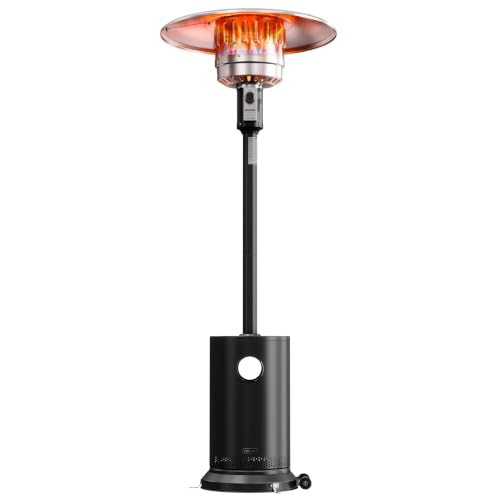
- Best overall for backyards: EAST OAK 50,000 BTU Propane Patio Heater with One-Hand Ignition, Black — Check on Amazon
- Best proven value: Amazon Basics 46,000 BTU Outdoor Propane Patio Heater with Wheels, Havana Bronze — Check on Amazon
- Best stainless look: Nexgrill Sundara 92″ Stainless Steel Propane Patio Heater, 48,000 BTU — Check on Amazon
See 3 more options
- Best for big gatherings: CIAYS 50,000 BTU Outdoor Patio Heater with Wheels and Tank Door — Check on Amazon
- Best reflector design: Garvee 48,000 BTU Stainless Steel Propane Patio Heater with Wheels, Grey — Check on Amazon
- Mr. Heater Portable Buddy (MH9BX) — portable zone heater for the fire-pit corner; described in the reviews below (check the current listing on Amazon before you buy)
Read the full guide ↓
Disclosure: As an Amazon Associate, dailyhomedecorating.com earns from qualifying purchases. Links to Amazon on this page are affiliate links; they cost you nothing extra. Listing details such as price and availability change often, so check the current Amazon listing before you buy.
A backyard is not a big patio, and treating it like one is how heaters disappoint. The best patio heater for backyards under $150 has to work in a space with zones — a dining patio by the house, a fire-pit corner at the fence, a stretch of open lawn in between — in a space with more wind, more distance, more dry vegetation at the edges, and nobody’s ceiling overhead to hold heat down. Raw output matters more here than anywhere else, because there is no roof and often no wall to help. So does honest placement: a tower warms the circle around it and nothing beyond, which means backyard heating is a strategy, not a purchase — the right tower at the main seating zone, a portable heater for the secondary zone, and a layout that keeps every flame a safe distance from the house, the fence, the play equipment and the autumn leaf pile.
Every pick in this guide is a full-size propane tower in the 46,000–50,000 BTU class, plus one portable wild card, because that is what the physics of an open yard rewards. Electric infrared has its place — a mounted bar over a fixed bench against the house wall is a fine second heater — but as the primary heat for an open backyard it runs out of reach quickly, and extension cords across a lawn are a hazard, not a plan. Propane towers go where the people are, run for an evening on a fraction of a 20 lb tank, and wheel back to the garage wall when the season ends. What separates the five towers below is not the formula, which they share, but the details: ignition you can work one-handed while carrying a tray from the grill, a sliding tank door versus a lift-off panel at the end of a cold night, a reflector design that throws heat outward instead of up, ground stakes for yards where the tower lives on a paver pad at the lawn’s edge, and the burner construction that decides whether the heater survives its third winter.
Two backyard-specific warnings before the picks. First, wind: an open yard is the windiest place you will ever run a heater, and every coverage figure in this guide assumes still air. Site the tower where a fence, hedge or the house itself breaks the prevailing breeze, or accept a warm zone half the advertised size. Second, surfaces: towers belong on firm, level, non-combustible ground — the patio, a paver pad, a deck with the maker’s clearances honored — never teetering on lawn, and never within reach of dry grass, mulch beds or leaf litter, which are the backyard’s version of the balcony’s combustible railing. The safety section covers distances in full.
In this guide
Quick picks: the best patio heater for backyards under $150 at a glance
| Pick | Best for | Output | Fuel | Standout feature |
|---|---|---|---|---|
| EAST OAK 50,000 BTU Patio Heater (Black) | Most backyards | 50,000 BTU | Propane, 20 lb | One-hand ignition, round table design |
| Amazon Basics 46,000 BTU Patio Heater | Proven value | 46,000 BTU | Propane, 20 lb | Water-box weighted base, wheels, one-touch ignition |
| Nexgrill Sundara 92″ Patio Heater | Stainless look, tall yards | 48,000 BTU | Propane, 20 lb | Anti-tip shutoff, electronic ignition, easy tank access |
| CIAYS 50,000 BTU Patio Heater | Big gatherings | 50,000 BTU | Propane, 20 lb | Sliding tank door, ground stakes, triple safety |
| Garvee 48,000 BTU Patio Heater | Reflector performance | 48,000 BTU | Propane, 20 lb | 3-piece reflector, tank cover |
| Mr. Heater Portable Buddy (MH9BX) | Fire-pit corner, portable zone heat | 4,000 / 9,000 BTU | Propane, 1 lb | Oxygen-depletion sensor, tip-over shutoff, carry handle |
The one-line version: anchor the main seating zone with the EAST OAK or the Amazon Basics, and let the little Buddy handle the far corner where a tower would be wasted. The reviews below explain which tower fits which yard — and the mistakes section covers the placement errors that make even the right tower feel weak.
How these picks were chosen
Backyard duty imposed its own filters. Output first: nothing under the 46,000 BTU class was considered for the main list, because open-air heating without a roof punishes weaker towers immediately. Stability second: every tower needed a base that can be weighted or staked, wheels for the constant repositioning backyard life demands, and tip-over protection — a heater that lives outdoors near running children, dogs and garden hoses must forgive contact. Third, durability for a harsher life than a patio gives: stainless or double-layer burner construction scored heavily, as did finishes that tolerate dew, sprinkler overspray and storage under a cover rather than in a climate-controlled garage. Fourth, verification: each model had to be a real, currently listed product whose identity and specifications could be confirmed against manufacturer information and cross-checked through the site’s own Amazon product data, and each brand and model was checked against the U.S. Consumer Product Safety Commission recall record — anything with an open recall on the heater itself was excluded and is not named in this guide.
The portable Buddy earned its place differently: not as a tower alternative but as the only honest way to heat a second, smaller zone — two chairs at a fire pit, a workbench at the garage door, a hunting-camp-style corner — without buying a second tower. It is included as a prose-only pick because, at the time of writing, its Amazon listing could not be re-confirmed through the site’s product-data cross-check (the check is recorded in this article’s sources file), and our rule is simple: no confirmed listing data, no purchase link. The heater itself is one of the most documented portable heaters ever sold, with manufacturer specifications a matter of public record, so we are comfortable describing it — and equally comfortable not linking it until the cross-check clears.
What did not make the cut, and why: glass-tube pyramid towers (beautiful, but above this budget in verified listings and less efficient heaters per BTU), natural-gas models (a backyard with a gas line is a different guide), and the crowd of unbranded 48,000 BTU towers whose burner construction and safety hardware could not be verified. A backyard heater lives a hard life; unverifiable is disqualifying.
The picks in detail
1. EAST OAK 50,000 BTU Patio Heater (Black) — best overall for backyards
Who it suits: The backyard host whose main seating zone is a patio or deck circle of four to eight people, who grills while the heater runs, and who wants the strongest output in the budget class with the easiest lighting in the business.
Start with the number: a rated 50,000 BTU is the highest output verified under this budget, and in an open yard — no roof, no walls, heat escaping upward and outward — those extra BTUs are not a spec-sheet vanity; they are the difference between a warm circle of six feet and one of eight on a still night. EAST OAK pairs the output with the round table design, a fixed ledge around the pole that backyard hosts use more than they expect: drinks, a plate of skewers, the grill tongs between runs. The one-hand ignition earns its name at exactly the moment backyard heating usually happens — you are carrying something with the other hand. One-person assembly matters in a yard too, because the person who buys the heater is usually the person who builds it, on the patio, alone, an hour before guests arrive. The black finish disappears against evening shadows and modern fencing better than bronze or bright steel, and the enhanced burner head is the current generation of EAST OAK’s tower design.
Pros:
- 50,000 BTU — the strongest verified output under $150, and open yards use all of it
- One-hand ignition; genuinely one-person assembly
- Round table ledge works as serving space during grill nights
- Black finish suits fences, shadows and modern yards
- Wheels for the constant patio-to-storage shuffle
Honest limitation: Full output drinks propane: run flat out, a 20 lb tank empties noticeably faster than under a 46,000 BTU burner, so frequent hosts should keep a spare tank or an exchange routine. The table ledge is also a magnet for exactly the wrong cargo — paper plates and napkins near a hot pole demand a house rule. And like every tower, it wants a level hard surface; the lawn’s edge is for the stakes-equipped pick below, not this one.
Choose it if your main zone is a proper patio and you host often. Skip it if your yard’s seating is scattered in small pockets — one big tower serves one zone, and the zone strategy in the how-to section matters more than raw BTU.
Check on Amazon — check price on Amazon; this model is also listed in grey.
2. Amazon Basics 46,000 BTU Patio Heater (Havana Bronze) — best proven value
Who it suits: The backyard owner who wants the most thoroughly proven budget tower on the market — the one with years of listings, manuals, covers and spare knowledge behind it — and whose yard is a standard suburban patio rather than an acre.
The Amazon Basics tower’s backyard credentials are stability and predictability. The base takes a water box for ballast, which matters more in a yard than anywhere: towers live closer to wind, sprinklers and bumped-by-a-linebacker accidents outdoors, and a filled base plus the included tank-securing chain is the correct foundation. Output is 46,000 BTU under a full-size 32.1-inch reflector, with Amazon rating the warmth at up to a 9-foot radius in still air — in a fenced yard that blocks the breeze, that figure is closer to honest than in an open field. One-touch piezo ignition, an adjustable knob, tilt auto-shutoff and wheels complete a package with no surprises, which is precisely the point: every cover, every replacement part question, every “which tank does it take” answer for this heater is a solved problem. The Havana Bronze finish also hides the yard’s cosmetic assaults — dust, pollen, water spots — better than any bright finish.
Pros:
- Water-box ballast base and tank chain — the stability benchmark in this class
- Proven design with deep documentation and easy-to-find covers
- 46,000 BTU with a full-size reflector; one-touch ignition
- Tilt auto-shutoff; wheels; finish that hides yard grime
Honest limitation: It is the least powerful tower here, and in a big, open, breezy yard you will feel those missing BTUs at the circle’s edge on cold nights. The powder coat is also a budget finish: stored uncovered through wet winters, seams and fasteners will show rust. A cover — and actually using it — is part of the real price of ownership.
Choose it if you want the calm, proven buy for a fenced suburban yard. Skip it if your property is large and exposed — start with the EAST OAK’s output, or plan on two heaters from the beginning.
Check on Amazon — check price on Amazon; a slate grey variant is listed separately.
3. Nexgrill Sundara 92″ Stainless Steel Patio Heater — best stainless look
Who it suits: The backyard owner whose outdoor kitchen and grill are already stainless, who wants the heater to match, and who values a taller profile — 92 inches — that throws its heat over standing groups at grill-side gatherings.
Nexgrill is a grill company, and the Sundara reads like it: stainless steel construction, electronic ignition instead of a piezo clicker, a temperature control, an anti-tip shut-off, and — the detail grill people appreciate — easy tank access, because anyone who has wrestled a tank door with greasy hands at dusk knows why it matters. The rated output is 48,000 BTU, squarely in class, and the extra height over the standard 91-inch towers buys a slightly wider throw for standing clusters, which is how backyard grill zones actually work: people stand, plates in hand, in a loose ring. Stainless also weathers the backyard’s sprinkler overspray and dew with less cosmetic drama than powder coat, though it shows fingerprints and heat tinting near the burner like any real stainless appliance.
Pros:
- Stainless construction from an established outdoor-cooking brand
- Electronic ignition and temperature control
- Anti-tip shut-off and easy tank access door
- 92-inch height throws heat over standing groups
Honest limitation: Stainless at this price is a finish and a frame, not commercial-gauge metal throughout — expect heat discoloration on the emitter area and keep the cover discipline anyway. The taller profile also catches more wind than shorter towers, so the weighted-base routine is not optional on exposed lots.
Choose it if your yard centers on an outdoor kitchen and standing gatherings. Skip it if your seating is low and lounge-style, where a standard tower’s throw is already well matched, or if your lot is very windy.
Check on Amazon — check price on Amazon, and budget for a cover sized to its taller profile.
4. CIAYS 50,000 BTU Outdoor Patio Heater — best for big gatherings
Who it suits: The household that hosts the big ones — birthday cookouts, team parties, holiday crowds — where the heater must serve a wide standing-and-sitting arc, get assembled fast, and stay put on a paver pad at the yard’s edge.
CIAYS builds this 50,000 BTU tower around gathering logistics. The maker describes 360-degree heating, a sliding tank door — quicker and kinder than a lift-off panel when you are swapping a tank between the burgers and the birthday cake — wheels for positioning, a triple safety protection system, and ground stakes, the feature that quietly matters most for backyard (rather than patio) placement: on a paver or compacted pad at the lawn’s edge, stakes plus ballast keep a tall tower honest in gusts that a patio’s shelter would have blocked. Assembly is pitched at about half an hour, which matches the backyard reality that this heater gets built the afternoon of its first party. Output matches the EAST OAK at the top of the class, so the warm zone is as wide as this budget allows.
Pros:
- 50,000 BTU with a wide, gathering-friendly throw
- Ground stakes included — the backyard-placement feature most towers omit
- Sliding tank door makes mid-party tank swaps painless
- Triple safety protection; wheels; fast assembly
Honest limitation: CIAYS is a younger brand than the biggest names here, with a thinner long-term track record for parts and support — test everything on arrival, while returns are easy. The 360-degree claim also deserves the usual translation: the heat is radial, but wind still picks a favorite side, and the downwind seats will always be the warm ones.
Choose it if you host crowds and your heater lives at the patio’s edge. Skip it if your gatherings are six people at a table — the tabletop and standard towers serve that better and cheaper.
Check on Amazon — check price on Amazon, and confirm the stakes are in the box contents of the current listing.
5. Garvee 48,000 BTU Stainless Steel Propane Patio Heater — best reflector design
Who it suits: The buyer who has read enough to know that on a mushroom heater the reflector is half the product — and wants the segmented, three-piece reflector design that aims more heat outward at people instead of cooking the sky.
A tower’s burner makes heat; its reflector decides where the heat goes. Garvee’s three-piece reflector assembles into a wide, well-angled disc, and owners of segmented reflectors get two practical benefits: a throw tuned for the seating circle rather than the clouds, and replacement economics — a damaged section can be swapped without replacing the whole top, if the part is available. The rest of the package is the class formula done completely: 48,000 BTU, stainless steel construction in a grey finish, adjustable heat control, wheels, and a tank cover so the base reads as furniture rather than equipment. For a backyard that doubles as the home’s outdoor room all summer, that finished look counts.
Pros:
- Three-piece reflector for an outward, people-first throw
- 48,000 BTU, adjustable control, stainless build
- Tank cover included — cleaner look on a finished patio
- Wheels for repositioning between zones
Honest limitation: A three-piece reflector is three pieces to assemble, keep aligned and keep clean — a bent or sooty segment throws unevenly, and the segmented design has more seams to check each season. Garvee, like CIAYS, is a smaller brand: verify all parts on delivery day.
Choose it if you care about where the heat lands and how the heater looks at noon. Skip it if you want the absolute simplest top assembly — the one-piece reflector towers go together faster.
Check on Amazon — check price on Amazon; inspect the reflector sections at assembly and keep the hardware bag.
6. Mr. Heater Portable Buddy (MH9BX) — the fire-pit corner heater (prose-only pick)
Who it suits: The backyard with a second zone: two chairs at the fire pit, a potting bench, a garage-door work spot — anywhere a tower is oversized, immovable or pointless, and two people want real heat for an hour or two.
The Portable Buddy is the most documented small propane heater in existence, and its manufacturer specifications explain its backyard role. It burns 4,000 or 9,000 BTU from a 1 lb propane cylinder — roughly three hours on high, six on low, per the maker’s figures — and its safety set is the reason it, and not a random camping heater, is the one we describe: a low-oxygen (oxygen depletion) shut-off sensor and an accidental tip-over shutoff, with a piezo igniter and a fold-down carry handle. Mr. Heater rates it for spaces up to about 225 square feet under favorable conditions; in a backyard, read that as two, maybe three, chairs pulled close. It is certified for indoor use in the U.S. under its ventilation requirements, which tells you how seriously its safety systems are engineered — but for this guide its job is outdoors, as a personal-zone heater that comes out of the deck box when the fire pit’s own warmth is not enough and goes back when the evening ends.
Pros:
- Genuinely portable — carry it to whichever corner the evening chooses
- Oxygen-depletion sensor and tip-over shutoff: the safety benchmark for small propane heaters
- Two heat settings; runs about 3–6 hours per 1 lb cylinder per the maker
- No assembly, no storage footprint worth mentioning
Honest limitation: It is a two-chair heater. Asking it to warm a gathering is the classic misuse, and its 1 lb cylinders are the priciest propane format per hour — fine for occasional zone heat, wasteful as a nightly whole-yard strategy. It also sits low, near ground level, so its placement discipline (level, clear of dry leaves and grass, out of foot traffic) matters more, not less, for its size. Two firm rules travel with it: never use refill adapters to refill its disposable 1 lb cylinders — they are not designed or certified for refilling, and refilled disposables must not be transported — and if you connect it to a 20 lb tank with the maker’s hose, the tank stays outdoors and the hose arrangement follows the manual exactly.
Choose it if your yard has a beloved second corner. Skip it if you need one heater to serve a whole patio — that is what the five towers above are for. Note: this pick is intentionally not linked in this guide, because its listing could not be re-confirmed through our product-data cross-check at writing time; check the current Amazon listing under the model name MH9BX before buying, and buy only from the brand’s own listing.
Side-by-side comparison
| Heater | Output | Fuel | Backyard-relevant feature | Best role |
|---|---|---|---|---|
| EAST OAK 50,000 BTU | 50,000 BTU | Propane 20 lb | One-hand ignition, table ledge | Main patio zone, frequent hosting |
| Amazon Basics 46,000 BTU | 46,000 BTU | Propane 20 lb | Water-box ballast base, tank chain | Fenced suburban yards |
| Nexgrill Sundara 92″ | 48,000 BTU | Propane 20 lb | Stainless build, easy tank access | Outdoor-kitchen yards |
| CIAYS 50,000 BTU | 50,000 BTU | Propane 20 lb | Ground stakes, sliding tank door | Big gatherings, patio-edge pads |
| Garvee 48,000 BTU | 48,000 BTU | Propane 20 lb | 3-piece reflector, tank cover | Finished patios, even throw |
| Mr. Heater Buddy MH9BX | 4,000 / 9,000 BTU | Propane 1 lb | ODS + tip-over shutoff, carry handle | Second-zone, two-chair heat |
The pattern to copy: one tower, properly sited at the main zone, beats two towers badly sited — and one tower plus a portable for the far corner beats both.
Safety: the backyard edition
Distances are the whole game outdoors. Keep towers at least 3 feet from the house siding, fences, furniture and overhanging branches on every side, with fully open sky above the reflector. In a yard, add the seasonal hazards a patio does not have: dry grass, mulch beds, leaf piles, firewood stacks and the fire pit’s own ember zone. A heater and a fire pit should never stand close enough to share a guest’s chair space — give each its own territory, with the heater’s clearance circle clear of the pit’s spark range.
Carbon monoxide does not care that you are “basically outside.” All propane heaters in this guide are open-air appliances. The garage with the door up, the carport, the enclosed gazebo and the party tent with its walls down are not open air. The Buddy’s indoor certification comes with ventilation requirements from its manual — follow them literally if it is ever used in a workshop or ice shelter, and never use any heater in a sleeping space.
Tip-over discipline scales with yard life. Weight every base (water or sand), use the stakes where provided, and site towers where the evening’s traffic pattern — kids cutting corners, dogs on leads, a cooler being dragged past — does not cross within a body’s width. A tower that falls onto dry grass is the backyard’s worst heater scenario, which is why stability features were a selection filter, not a footnote.
Fuel yard-craft. Leak-test connections with soapy water at season start and after tank changes. Store spare 20 lb tanks upright, outdoors, shaded, away from the house’s openings and never in the garage beside the water heater. Keep 1 lb cylinders in the deck box or shed, away from heat — and never refill disposable cylinders with adapter kits: they are not built or certified for it, overfill easily, and must not be transported once refilled. Exchange programs and fresh cylinders are the safe supply chain.
Kids, pets and play equipment. The warm circle is where everyone gathers, including the smallest and furriest. Set the no-touch rule for poles and reflectors, keep the heater out of the soccer game’s flight path, and turn it off — not down — when the gathering moves indoors. Let everything cool fully before the cover goes on or the tower wheels into the garage.
Weather judgment. Do not run a tower in strong wind: the flame leans, heating collapses, and a gust-loaded tall heater is a tip risk even weighted. Rain on a hot reflector and burner invites steam, spatter and accelerated corrosion. The correct move on a wild night is the covered porch, an electric bar if you have one, or indoors — in that order.
How to choose the best patio heater for backyards under $150
Zone the yard first. Stand in the yard at dusk and name the zones honestly: where do people actually sit for an hour (zone one), where do two people linger (zone two), and where does nobody stay (everywhere else — do not heat it). Zone one gets the tower, sited on hard level ground with its clearance circle respected and a windbreak at its back if the lot allows. Zone two gets the Buddy, or a second tower next season if it proves itself. This zoning step, done before shopping, is what separates warm backyards from expensive ones.
Then pick the tower by its working details. If you grill while hosting, one-hand ignition and a table ledge (EAST OAK) pay rent nightly. If the yard is fenced and calm, the Amazon Basics’ ballast base and proven record are the calm buy. If the heater lives at the patio’s edge on pavers, stakes (CIAYS) stop being a bullet point and start being the point. If the yard is an outdoor room, the Garvee’s reflector and finished look serve daily. Match the detail to the life, not the spec sheet to the ego.
Plan the fuel like a host. A 20 lb tank gives roughly nine to ten hours at full output — two long parties, or a month of hour-long evening uses at half throttle. Serious hosts keep a spare tank so a mid-party swap is a two-minute errand, and store both tanks by the rules in the safety section. Round out the zone with the comfort infrastructure that makes heat worth having: the seating from our Best Outdoor Sectional Under $300 guide arranged inside the warm circle, a Best Fire Pit Under $150 at its own safe distance for the flame-watchers, cold drinks in the Best Outdoor Cooler Under $150, and shade for the same spot in July from the Best Gazebo Under $300 guide. If the main roundup’s wider comparisons would help, they are in the Best Patio Heater Under $150, and the bigger-budget towers live in the Best Patio Heater Under $500.
Finally, budget the ownership, not the purchase. A cover, a spare tank and a set of replacement reflector bolts in year two are the difference between a heater that serves five seasons and one that serves two. Every tower here rewards that small discipline; none of them survives neglect at this price.
Common mistakes backyard buyers make
One tower, middle of everything. Placing the heater at the yard’s geographic center warms the walkway between zones and serves none of them. Heat belongs at the seating, close enough that chairs fit inside six to eight feet.
Running the tower on grass. Uneven, soft, combustible-adjacent — grass fails every siting test at once. Patio, pavers or a proper pad, every time, with dry vegetation cleared from the clearance circle.
Ignoring the prevailing wind. A tower on the windward edge of a patio heats the fence. Walk the yard on a breezy evening before choosing the spot; a hedge or wall at the heater’s back is worth thousands of BTUs.
Heater and fire pit as neighbors. Two flame appliances sharing one circle multiply every hazard — sparks near a tank, guests threading between hot surfaces. Give each flame its own zone and its own audience.
Skipping the spare tank. Propane runs out during parties with the reliability of a law of nature. The spare tank is the cheapest hosting insurance sold anywhere.
Storing the tank “temporarily” in the garage all winter. Temporary becomes permanent, and garages collect ignition sources. Tanks live outdoors, upright, shaded — the deck box is for cylinders’ small cousins and accessories, not a 20 lb tank in an enclosed box either.
The backyard heating season: a rhythm that works
Early autumn is for learning the yard. The first cold evenings teach you where the wind actually comes from (rarely where you assumed), which fence corner is a frost pocket, and where guests naturally gather when the temperature drops. Run the tower, move it twice, and take notes like a gardener: the spot that wins in October is the spot to formalize — with a paver pad if it is at the lawn’s edge, and with the tank-swap route rehearsed before it hosts a party.
Deep winter is for honesty about zones. In real cold, no under-$150 tower makes a whole backyard comfortable, and pretending otherwise wastes propane and goodwill. Shrink the inhabited yard: pull the seating into one well-sited circle, add the Buddy at the second chair pair if the evening demands it, dress the guests’ expectations along with their coats, and let the far lawn be scenery. Hosts who zone honestly in January get thanked; hosts who promise a heated acre get remembered.
Spring is for the second shift. The same heaters that serve evening gatherings earn a spring living at the yard’s working edges: the Buddy warming a potting bench session, the tower taking the chill off an early outdoor breakfast on the patio. This is also maintenance season — leak-test every connection, wire-brush the burner ports per the manual, check reflector bolts and wheel axles, and wash the cover before it goes on for summer. Twenty minutes in April is what separates a five-season heater from a two-season one.
Summer storage decides next year’s first evening. Towers stored covered, tanks upright outdoors in shade, the Buddy in its box with the cylinder removed and stored separately by the rules — that is the whole ritual. The yard that stores well lights instantly on the first cold night of autumn, while the yard that stored carelessly spends that night troubleshooting. Backyard heating is a seasonal system, and the season you are in is always preparation for the one that tests it.
A word on the two-heater budget. Readers sometimes ask whether two towers at this tier beat one premium tower above it. For a zoned backyard, usually yes: two warm circles in two real places outperform one excellent circle and one cold one, and the redundancy means a single failure never cancels a gathering. The premium tier buys materials and longevity, not geography. Zone first, upgrade second — the order matters more than the money.
Assembly and first-light checklist for tower buyers
Every tower in this guide assembles with hand tools and patience, and the hour invested decides the heater’s whole service life. Work through it like a checklist rather than a race. Lay out every part against the manual’s inventory before the first bolt — a missing reflector section discovered at dusk is a party problem, while the same discovery at noon is an email. Assemble on the patio or a clear garage floor, not on the lawn where small hardware goes to disappear. Snug every fastener, then re-snug the pole and reflector bolts after the first full heating cycle, because heat expansion loosens what cold hands tightened.
Before the first lighting, run the fuel checks that professionals never skip: tank valve and regulator connection hand-tight plus the maker’s specified finish, then a soapy-water leak test on every joint you disturbed — bubbles mean stop, reseat, retest. Fill the base ballast now, not after the first windy night teaches you why. Light the burner and read the flame: a healthy tower flame burns steady and predominantly blue at the burner with the emitter glowing evenly; a lazy, lifting, strongly yellow flame or an uneven glow means the burner or venturi needs the manual’s cleaning procedure before guests ever sit under it. Run the heater for fifteen minutes, confirm the tip-over switch kills it when the pole is nudged per the manual’s test, and note where the control knob’s low actually sits — you will adjust it by feel, in the dark, for years.
Finally, rehearse the shutdown while it is still daylight and low-stakes: valve at the tank closed first, burner allowed to consume the line’s remainder, control off, and hands off the metal until it cools. Hosts and owners who run this checklist once, on day one, are the ones whose heaters light first-time on the coldest night of the year. Everyone else is reading a manual with a flashlight, in a coat, while the yard waits.
Final recommendation
For the typical backyard, buy the EAST OAK 50,000 BTU for the main zone: the output an open yard actually uses, lit with one hand while the other holds the evening together. Choose the Amazon Basics if your yard is fenced and calm and you value a proven record over peak output, the CIAYS if your heater will stand at the patio’s edge serving crowds, the Nexgrill to match an outdoor kitchen, and the Garvee if even, well-aimed heat on a finished patio is the priority. Add the Mr. Heater Buddy when a second corner of the yard earns it — it is the rare accessory that makes the whole system feel designed. Site everything by the safety section, keep a spare tank, and your backyard gains a season on both ends of the year.
FAQ
How many patio heaters does a backyard need?
One per seating zone, not one per yard. A single tower serves a circle of about six to eight feet in still air. Most backyards do best with one tower at the main patio zone plus, optionally, a small portable for a second corner — not with two towers competing in the same space.
Can a patio heater sit on grass or a wooden deck?
Not on grass: it is uneven and surrounded by combustible material. On a wooden deck, only with the manufacturer’s clearances fully honored, the base weighted, and constant supervision — and many owners reasonably choose a paver or concrete pad instead. When in doubt, hard, level, non-combustible ground wins.
How far should a patio heater be from the house?
At least 3 feet from siding and any combustible construction on all sides, with open sky above — and follow the manual if it demands more. Remember the clearance is measured to the reflector’s edge and the heat column, not to the pole.
Is a fire pit or a patio heater better for a backyard?
They do different jobs. A fire pit is ambiance with some warmth and a spark-management duty; a tower is real, directed heat with no ambiance beyond its glow. Many yards run both, zoned apart — our fire pit guide is linked above if you are choosing between them.
Can I leave a patio heater outside all year in the yard?
Covered, weighted and with the tank valve closed, it can live on the patio — but it will age faster than one stored under shelter, and the cover must go on only when the heater is fully cold. Off-season, the kindest storage is a garage or shed for the heater, with its propane tank stored separately, upright and outdoors.
What about heating a screened porch or sunroom off the backyard?
Treat it as indoor space, because for combustion purposes it is. No propane tower or portable belongs inside screens or glass, whatever the door position — carbon monoxide does not respect the distinction, and neither do clearances. If that room needs heat, the answer is an electric infrared unit mounted by its manual’s rules, like the wall bars in our small-patio and apartment guides, or a space heater designed and rated for indoor use.
Why is one pick in this guide not linked?
Because its Amazon listing could not be re-confirmed through our product-data cross-check when this guide was written, and we only link listings we have verified. The Mr. Heater Buddy (MH9BX) is described from the manufacturer’s published specifications; search the model name on Amazon and buy from the brand’s own listing.
Related guides
- Best Patio Heater Under $150 — the main roundup across all space types
- Best Patio Heater Under $500 — premium towers and glass-tube models
- Best Fire Pit Under $150 — the ambiance-first alternative
- Best Outdoor Sectional Under $300 — seating that fits the warm circle
- Best Gazebo Under $300 — structure for the yard’s second zone


