Where to buy
Check the latest price, availability and delivery on Amazon. Orders are placed on Amazon. We may earn a commission from qualifying purchases.
- Best for open yards with no structure: Bromic Tungsten Smart-Heat Portable Propane (BH0510001) — Check on Amazon
- Best mounted workhorse for house walls and pergolas: Infratech CD-6024 SS Dual Element 6000W — Check on Amazon
- Best premium electric zone heater: Bromic Tungsten Smart-Heat Electric 6000W (BH0420033) — Check on Amazon
- Best for outdoor kitchens with a gas line: Sunpak S34 B TSH Two-Stage Gas Heater — Check on Amazon
- Best flame-ambience tower: Hiland HLDS01-CGTHG Quartz Glass Tube Pyramid Heater — Check on Amazon
- Best for covered porches and eaves: Infratech SL-4024 SS Slimline 4000W — Check on Amazon
Read the full guide ↓
Disclosure: As an Amazon Associate, dailyhomedecorating.com earns from qualifying purchases. Links to Amazon on this page are affiliate links; they cost you nothing extra. Listing details such as price and availability change often, so check the current Amazon listing before you buy.
A backyard changes the heating problem completely, and the best patio heater for backyards under $1500 is rarely the one that wins on a covered patio. Out in the yard there is often no ceiling to mount to, no wall in the right place, and nothing between the heater and the weather except distance. Wind crosses an open lawn in a way it never crosses a sheltered terrace, heat thrown upward is simply donated to the night sky, and the seating you care about might be a dining set on the deck this weekend and a fire-side circle of chairs twenty feet away next weekend. Backyard heating is therefore a game of placement, direction and honest coverage: radiant heat aimed at people from the side or above, sized for the zone it can actually hold, in equipment built to live outdoors full-time.
The $1500 budget buys a real strategy out here rather than a single heroic appliance. Spent well, it covers one premium anchor — a directional freestanding heater that can be wheeled to wherever the evening happens, or a commercial mounted heater on the house wall or pergola — plus, on many properties, the installation or the second smaller zone that turns “the deck is warm” into “the backyard works in November”. Spent badly, it buys the tallest, shiniest tower in the catalogue, parked in the middle of the lawn, radiating most of its output into empty air while the people at its base argue about whose side is warm. This guide is organised around the first outcome. Every pick was verified against its manufacturer’s data and matched exactly through the Amazon Creators API, every model family was checked against the CPSC recall database, and the coverage figures quoted are the manufacturers’ own — read with the wind in mind, as the planning sections explain. Readers whose yards are mostly covered patio should start from our main system guide instead, and those working with less to spend will find the same placement logic applied in Best Patio Heater For Backyards Under $700.
Our short answer. If your backyard has no structure near the seating, the Bromic Tungsten Portable is the anchor: it is the rare freestanding heater that aims its output at people, carries proper safety hardware, and publishes honest numbers. If you have a house wall, pergola or pavilion over the main seating, mounted radiant wins — the Infratech CD-6024 for published-data reliability, the Bromic Tungsten Electric 6000W for control sophistication. An outdoor kitchen with a gas line makes the Sunpak S34 the connoisseur’s choice. The Hiland pyramid earns its place honestly as the ambience pick — a visible flame column that warms its immediate circle — with its limitations stated plainly. And the Infratech Slimline covers the porch-and-eaves case that backyards so often include. Pair any of these with a gathering point from Best Fire Pit For Backyards Under $1500 and the yard has both warmth and a reason to stay out in it.
In this guide
Quick Picks: The Best Patio Heater for Backyards Under $1500, by Yard Type
| Yard situation | Pick | Why it stands out | Link |
|---|---|---|---|
| Open yard, no structure | Bromic Tungsten Portable (BH0510001) | 38,500 BTU aimed forward, rated up to ~215 sq ft, anti-tilt shut-off | Check on Amazon |
| House wall or pergola over seating | Infratech CD-6024 SS | 6,000W dual element, published coverage chart for 8–12 ft mounting | Check on Amazon |
| Premium covered zone | Bromic Tungsten Electric 6000W | Dual elements, dimmer and multi-zone remote options, wind-tough mesh front | Check on Amazon |
| Outdoor kitchen with gas | Sunpak S34 B TSH | Two-stage 25,000/34,000 BTU, hardwired switch, slim overhead body | Check on Amazon |
| Ambience plus local warmth | Hiland HLDS01-CGTHG Pyramid | 40,000 BTU behind a quartz glass flame tube, wheeled base | Check on Amazon |
| Porch, eaves, covered edge | Infratech SL-4024 SS Slimline | 4,000W in a slim 63.5-inch body for low structures | Check on Amazon |
How the picks were chosen
Backyard duty imposed three tests that covered-patio guides can soften. The first was exposure: a pick had to be built and rated for full outdoor life, with published weather resistance and a design that keeps performing when air moves. The second was directional honesty. In an open yard, a heater’s rated coverage is a fair-weather promise, so we favoured products whose manufacturers publish coverage by condition or mounting geometry — and we treat every figure in this guide as the sheltered best case, to be discounted for wind as the planning section describes. The third was placement flexibility: backyards rearrange themselves around seasons and occasions, so the list deliberately mixes one genuinely mobile anchor, fixed heaters for the structures yards do have, and a flame tower for the circle-of-chairs ritual, rather than pretending one format serves every lawn.
Verification worked the same way it does across this site. Each linked product was matched to its exact manufacturer model through the Amazon Creators API, with the returned listing title recorded in the source notes for this article; specifications come from manufacturer manuals and spec sheets; and each brand and model family was checked against CPSC recall records, with recalled products excluded entirely rather than mentioned. Prices are not printed, because they change; the check-price links carry the current figure. Where a famous backyard model could not be matched with confidence through the API, it was left out — a smaller list of certain products beats a longer list of guesses.
One more filter deserves stating: we did not let the budget force a single-product answer. On real quotes, a mounted commercial heater plus its circuit can consume most of $1500 on a straightforward job, while the freestanding anchor leaves room for the accessories that make a yard system complete. The recommendations below say, for each pick, what else the budget has to cover — because a heater whose installation is unfunded is not a recommendation, it is a cliffhanger.
The picks in detail
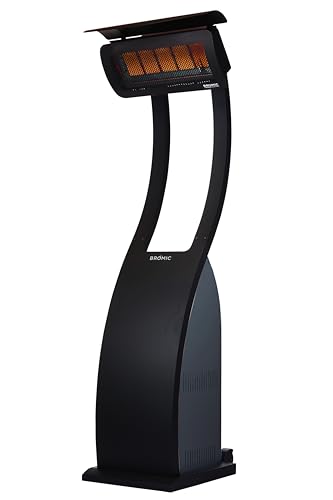
1. Bromic Tungsten Smart-Heat Portable (BH0510001) — best for open yards
Who it suits: Backyards where the seating has no roof or wall nearby — lawn-edge patios, pool decks, fire-side chair circles — and owners who want heat that can move when the gathering moves.
The Tungsten Portable solves the open-yard problem with direction. Instead of a burner on a pole warming a ring of air, its wide ceramic head projects 38,500 BTU forward in a defined throw, tilts to meet the seating, and is rated by Bromic for areas up to about 215 square feet in favourable conditions, with reliable operation in winds up to about 8 mph. Those are the two numbers that matter in a yard, and almost no competitor publishes both. The body is a serious object — about 124 pounds, on built-in wheels, with the 20-pound propane cylinder concealed inside — and the safety specification is what this class should always carry: an anti-tilt shut-off and a flame-failure device. Output adjusts from high to low on a dial, so the same unit that anchors a cold-night dinner can idle beside a card game.
Pros:
- Directional throw aimed at people — the correct physics for open air
- Published coverage and wind-tolerance figures from the manufacturer
- Anti-tilt shut-off, flame-failure protection, stable weighted body on wheels
- No installation, no trades, no permits for the appliance itself
Honest limitation: It needs a level, hard surface — not grass, not gravel, not a slope — and generous clearances on all sides, including above if it is ever used under a structure. It is heavy enough that moving it is a deliberate act, propane running costs are the highest per evening of any pick here, and it must be stored under cover and never used in an enclosed space. On a small, fully structured patio, a mounted heater is the tidier answer.
Choose it if your yard’s social centre has no structure. Skip it if you have a pergola over the seating — mount the heat and reclaim the floor space. Check on Amazon
2. Infratech CD-6024 SS — best mounted workhorse
Who it suits: Yards with one dominant structure — the house wall above the deck, a pergola, a pavilion — and owners who want restaurant-grade heat with engineering data instead of adjectives.
The CD-6024 is a 61.25-inch stainless heater with two quartz elements totalling 6,000 watts at 240 volts. Infratech publishes its coverage by mounting height and exposure: at 8 to 12 feet up, expect about 11 by 11 feet in average conditions, 10 by 10 when it is cold, 12 by 12 when the spot is protected — the single most useful table in backyard heating, because it lets you plan the yard the way the manufacturer engineered it. A duplex switch runs the elements independently for half or full power. There is no fan, no flame and no exhaust; mounted over a deck dining set or under a pergola beam, it simply makes the zone beneath it feel like a warmer climate, silently, for as long as the evening lasts.
Pros:
- Coverage published by height and condition — plan with real numbers
- Dual-element staging without any dimmer electronics
- Stainless, no moving parts, nothing to light, vent or refill
- Wall, ceiling and drop-pole mounting for tall structures
Honest limitation: It is fixed: once mounted, the warm zone is where it is, and a yard whose life happens elsewhere will not benefit. It needs a dedicated 240-volt circuit installed by an electrician, its clearances (18 inches on all sides, 36 inches in front) must survive your furniture plan, and the CD-Series cannot be flush-mounted — that is the W/WD family’s party trick.
Choose it if one structure hosts most of your yard life. Skip it if your gatherings migrate — that is the Portable’s brief. Check on Amazon
3. Bromic Tungsten Smart-Heat Electric 6000W (BH0420033) — best premium electric zone
Who it suits: Owners building a flagship covered zone in the yard — a dining pavilion, a poolside loggia, an outdoor room at the garden’s edge — who want the deepest control options in the category.
Bromic’s Tungsten Electric flagship pairs a 56-inch dual-element body with the most developed control ecosystem in this guide: independent element switching, dimmer controllers, and a master remote architecture that can run multiple zones across a large property. Its rated heat area reaches about 160 square feet in protected conditions, and the mesh-front design is specifically good at holding performance when air moves across the zone — a backyard condition even under a roof. If the long-term plan is two or three heated zones across a big yard, starting with this heater and its controls is how the system stays coherent as it grows.
Pros:
- 6,000W dual-element output with half-power switching built in
- Best-in-class controls, from dimmers to multi-zone remotes
- Wind-tough mesh front; wall, ceiling, pole and recess mounting
- Scales from one pavilion to a whole-yard system
Honest limitation: Premium is the operative word: the heater plus its 240-volt circuit (25 amps at 240 volts) plus controls can consume the entire budget for one zone, and its minimum floor clearances — 72 inches wall-mounted, 96 inches ceiling-mounted — exclude low structures. In a simple yard with one deck, the Infratech delivers the same warmth with less ceremony.
Choose it if you are building the yard’s flagship zone. Skip it if one honest workhorse zone is the whole ambition. Check on Amazon
4. Sunpak S34 B TSH — best for outdoor kitchens with gas
Who it suits: Yards with a serious outdoor kitchen or covered cooking-and-dining structure where a gas line already runs — or is being run for a grill — and electrical capacity is spoken for.
The S34 is the heater behind a generation of restaurant patios: a slim 48-inch overhead infrared unit with two stages, 25,000 BTU on low and 34,000 on high, run from a hardwired lighted switch, with electronic ignition and flame supervision. Mounted along the edge of a kitchen structure and angled down at the diners (the design permits up to a 30-degree mounting angle), it throws a broad, even warmth that suits long tables. Because it burns gas, it arrives with the full professional apparatus: a permitted, correctly sized gas line, a shut-off within reach, the manufacturer’s clearance chart observed to the inch — including the generous clearance below the unit — and a commissioning check by the installer.
Pros:
- Two-stage output sized for long evenings and big tables
- No electrical load of consequence — kind to full panels
- Slim overhead profile that suits kitchen structures
- Decades of commercial service behind the design
Honest limitation: Gas is professional-only territory: permits, a gas fitter, and carbon-monoxide discipline are part of the purchase, and the heater is for open-air use only — never in an enclosed porch, garage or any roofed-and-walled space. If your “outdoor kitchen” is effectively a room, buy electric.
Choose it if gas already serves the yard. Skip it if adding a gas line is a project you are inventing to justify the heater. Check on Amazon
5. Hiland HLDS01-CGTHG Pyramid — best flame-ambience tower
Who it suits: Yards where the evening centres on a visible flame — a circle of chairs on a paved area — and the heater’s job is as much gathering point as heat source.
The pyramid format exists because people like watching fire. Hiland’s commercial-grade version runs a 40,000 BTU burner up a quartz glass tube, producing a tall, visible flame column inside a wheeled pyramid body with variable output control. Gathered chairs get genuine radiant warmth on the sides facing the tube, and the yard gets a landmark. Included in this guide with its trade-offs stated plainly, it is the one pick bought with the heart as much as the head — and there is nothing wrong with that, provided the head has read this paragraph and the safety section.
Pros:
- A real visible flame — the social magnet no panel heater can imitate
- 40,000 BTU output with variable control warms its immediate circle
- Wheeled base for repositioning on paved surfaces
- Commercial-grade construction within its class
Honest limitation: Physics is not sentimental: much of a tower’s output rises with the flame, so its warmth-per-BTU for seated people is the weakest in this guide, and the effective zone is the ring of chairs close around it. The quartz tube is glass — it can break, replacements are a maintenance fact of the format, and the unit needs level paving, full clearances, and storage discipline. It is a propane appliance with a live flame: never enclosed spaces, never unattended, never near anything combustible.
Choose it if the flame is the point. Skip it if efficient warmth per evening is the point — that is the Bromic Portable or a mounted radiant. Check on Amazon
6. Infratech SL-4024 SS Slimline — best for porches and eaves
Who it suits: The covered edge of the yard — a porch along the house, a low pavilion roof, eaves over a deck — where headroom and structure rule out wider heaters.
Almost every backyard system ends up needing one heater in a tight architectural spot, and the Slimline is the specialist: 4,000 watts at 240 volts in a 63.5-inch anodized body only inches deep, rated by Infratech for about a 10 by 10 foot zone from an 8-to-11-foot mount. T-slot brackets slide to meet the structure you actually have, with positive stops for angled mounting, and the control options run from a plain switch to Infratech’s panels — so the porch zone can join the yard’s wider system instead of living as an orphan.
Pros:
- Slim profile fits eaves, beams and low porch ceilings
- Published coverage; flexible T-slot mounting
- Blends visually with trim and ceiling lines
- Compatible with the same controls as the yard’s other zones
Honest limitation: Single-element output means staging comes from the control you pair with it; it is hardwired and electrician-installed; and its clearances — 18 inches to the sides, 36 inches in front — must be verified against porch furniture and any ceiling fans before it is ordered.
Choose it if the structure is low and long. Skip it if the spot is actually a big open zone needing dual elements. Check on Amazon
Read the table below with the yard’s reality in mind: the same heater is a different product at the bottom of a windy garden than it is under a pavilion roof. The format column — freestanding or fixed — is the first decision; output is the second; brand is a distant third.
Comparison table
| Pick | Fuel | Output | Rated coverage | Placement |
|---|---|---|---|---|
| Bromic Tungsten Portable | Propane | 38,500 BTU | Up to ~215 sq ft (favourable) | Freestanding, wheeled |
| Infratech CD-6024 SS | Electric 240V | 6,000W dual | ~11 × 11 ft at 8–12 ft | Wall / ceiling / pole |
| Bromic Tungsten Electric 6000W | Electric 240V | 6,000W dual | Up to ~160 sq ft (protected) | Wall / ceiling / recess |
| Sunpak S34 B TSH | Natural gas | 25,000 / 34,000 BTU | Zone per maker layout | Overhead, angled ≤30° |
| Hiland Pyramid HLDS01-CGTHG | Propane | 40,000 BTU | Immediate circle around tower | Freestanding, wheeled |
| Infratech SL-4024 SS | Electric 240V | 4,000W single | ~10 × 10 ft at 8–11 ft | Wall / ceiling line |
Wind, exposure and the truth about coverage numbers
Every coverage figure in this guide carries an invisible asterisk: in still, sheltered air. Backyards rarely offer that air. Moving air does not blow radiant heat away the way it strips convected warmth — the radiation still lands on skin and fabric — but it cools the people being heated, chills exposed surfaces, and makes the edges of every zone feel thinner. The practical consequences are three. First, plan from the pessimistic end of the manufacturer’s data: Infratech’s “cold” column exists precisely for exposed yards, and a zone that works at 10 by 10 feet in the cold column is a promise; the 12-by-12 protected figure is a hope. Second, use the yard’s own shelter: a heater placed so a fence, hedge or the house itself breaks the prevailing wind will outperform a stronger heater in the open. Third, keep zones close to structures and seating tight to the heat: in a yard, the distance between chair and heater is worth more than another few thousand BTU.
Exposure also decides mounting. A heater on a pergola at the manufacturer’s ideal height, angled at the table, is backyard heating at its best — which is why a structure is often the highest-value purchase in the whole project. If a gazebo or pergola is in your plans at all, sequence it before the heaters: the layout logic in Best Gazebo Under $1500 and the heater positions in this guide are two halves of one design. Seating follows the same logic — the deep, settle-in furniture in Best Outdoor Sectional Under $1500 belongs inside the heated zone you have actually engineered, not wherever it happens to look good in June.
How to choose: a backyard plan in five moves
1. Map the yard’s social centres. Deck dining, the fire circle, the pool edge, the kitchen counter. Each is a candidate zone; you will heat at most two of them at this budget, so rank them by evenings actually spent.
2. Assign each zone a format. Structure overhead or beside it: mounted radiant. Nothing but sky: the directional freestanding anchor. A ritual circle: the flame tower, knowingly. A porch: the slimline.
3. Check the infrastructure honestly. Panel capacity and circuit routes for electric; an existing or planned gas line for the Sunpak; hard, level paving for anything freestanding. Infrastructure, not preference, eliminates most options — let it.
4. Size from the cold column. Use manufacturers’ pessimistic coverage for your mounting height, then decide if one unit truly holds the zone or whether the honest answer is a second, smaller zone rather than an oversized single.
5. Budget the system. Heater, control, circuit or gas work, and the freestanding anchor’s storage cover. Get installation quotes against a written plan before ordering, and keep a reserve for the discoveries every yard project makes.
6. Design the second zone before installing the first. Even if this year’s money builds one zone, decide now where the second would go and what it would be. That single decision shapes today’s choices productively: a multi-channel control instead of a single switch, a junction placed where a future circuit can branch, a gas line sized with one more appliance in mind, a freestanding anchor chosen to complement the fixed zone rather than duplicate it. Yards evolve over years, and the systems that evolve gracefully are the ones whose first installation was made by someone who had already imagined the third. Write the plan down, keep it with the house documents, and let each year’s project be a chapter rather than a restart.
Safety: the section to read twice
Fire and clearances. Every pick publishes minimum clearances to combustibles — siding, eaves, umbrellas, cushions, dry planting, fences. In a yard, the clearance check must include the seasonal layer: leaf litter, stored firewood, the cover on the grill, children’s play equipment that migrates. Keep heaters’ zones clear as a standing condition, not a pre-party tidy, and never leave a gas or propane heater running unattended or while anyone sleeps.
Carbon monoxide. Gas and propane heaters are outdoor appliances for open air. Never use one in a garage, shed, tent, enclosed porch or any space with a roof and closed sides, and never bring one indoors. If a yard structure has a roof and walls, it is a room for safety purposes, and combustion heat does not belong in it — use the electric picks.
Tip-over and surfaces. Freestanding heaters belong on level paving or decking, never on grass, gravel or slopes, and never where games, dogs or pool traffic can collide with them. Choose anti-tilt protection — the Bromic Portable carries it — keep cylinders upright and connected as the manual directs, and move any freestanding unit only when it is off, cool and closed at the valve.
Water, pools and electricity. Hardwired heaters near pools and spas fall under specific electrical rules; this is one more reason the installation belongs to a licensed electrician who knows them. Keep propane and flame appliances at a sane distance from pool chemicals and never store cylinders indoors, in garages or near ignition sources.
Children, dogs and games. A working backyard is a moving environment, and heater placement has to survive contact with real life. Mounted radiant is inherently the safest format for busy yards because the hot surface lives eight feet above the ball games. Freestanding units need a defined territory: out of running lines between house and garden, away from the goal mouth, the dog’s racing circuit and the pool gate swing, and never where a thrown ball or a chasing child can reach them at speed. Teach the household’s rules early — the heater is furniture that is never climbed, leaned on or used as a goal post — and supervise the first evenings until the territory becomes habit. On the busiest family yards, this section alone is a sufficient argument for mounted heat.
Recall hygiene. Before buying any heater — and before using one that has been in storage or bought second-hand — check the model against the CPSC recall database. A recalled heater is not a bargain at any discount; it is a hazard with paperwork.
Common mistakes in backyard heating
Heating the sky. Tall towers and upward-throwing designs in open air donate their output to the night. Direction beats height, every time.
Trusting the sheltered coverage figure. Your yard is not the manufacturer’s test courtyard. Plan from the cold, exposed column.
Putting a freestanding heater on grass. Uneven, soft, sloped: the three adjectives tip-over switches exist because of. Paving first, heater second.
One heater, three zones. A single unit warms the zone it aims at. If the yard has two social centres, the honest options are a movable anchor or two planned zones — not hope.
Forgetting storage and weather. Freestanding propane units live outdoors but age indoors: a cover at minimum, a shed ideally, cylinders stored outside upright per local rules. Equipment bought for a decade should be stored like it.
Letting the flame tower do a system’s job. The pyramid is a gathering point with warmth as a bonus. Asking it to heat a dining zone across the yard ends in cold diners and a disappointed host.
Worked examples: three real yards, three plans
The deck-and-lawn suburban yard. A raised deck off the house holds the dining set; the lawn beyond holds a fire circle used a dozen evenings a year. The plan: one CD-6024 mounted on the house wall above the deck, angled at the table, on a duplex switch — this is the zone that hosts weekly life, so it gets the permanent infrastructure. The fire circle gets no fixed heater at all; on its dozen evenings, the ritual is the fire itself, and the budget’s remainder funds the deck zone’s circuit and a proper cover for the furniture. Total heated zones promised: one, kept honestly. This is the most common right answer in this guide’s category, and its modesty is precisely the point worth remembering.
The pavilion yard. A detached stone pavilion with an outdoor kitchen sits twenty feet from the house; the family eats there three seasons a year. The plan: gas is already trenched to the kitchen for the grill, so a Sunpak S34 mounts over the dining side, angled at the table, on its hardwired switch — no new infrastructure class, just a branch of the existing one. A Slimline under the pavilion’s low eave covers the kitchen worktop zone where the cook stands. The budget absorbs both heaters and the gas fitter’s visit because the expensive decision — trenching gas to the pavilion — was made by a previous project. The lesson generalises: at this tier, the best heater is usually the one that rides infrastructure you already own.
The structureless garden. A paved terrace at the garden’s end, beautiful and entirely roofless, hosts everything from breakfasts to birthday parties, with furniture that rearranges constantly. The plan: the Bromic Portable, full stop — wheeled to the breakfast table in spring, to the party’s edge in summer, stored under its cover against the shed wall between times. A second smaller zone was considered and rejected: with no structure, a mounted heater has nothing to mount to, and a second freestanding unit would halve the anchor’s quality to double the clutter. The remainder of the budget goes to paving quality, a storage solution and the seating itself. Not every yard wants a system; some yards want one excellent, movable source of heat and the discipline to aim it well, season after season, wherever the chairs happen to land that particular week.
A season with a backyard system: what changes
The purchase is an evening’s decision; the system then has to earn its place across a calendar. In early spring, the pattern that emerges is zoning discipline: one zone, the one nearest the house, does all the work, because spring evenings are short and the household is testing the year’s first outdoor dinners. A staged heater earns its keep here — half power takes the edge off without turning a mild night into a performance. By late spring the yard’s second spaces wake up, and this is where the movable anchor justifies itself: the Portable migrates to wherever the weekend is happening, while the fixed zone keeps the deck on permanent standby.
Summer inverts the problem. The heaters rest for weeks at a time, and the system’s value is that resting costs nothing: no fuel ageing in a mounted electric line, no pilot burning, nothing to drain or winterise in July. The maintenance that matters happens now, in the warm months, when a bracket check, a fascia wipe and a clearance audit take ten minutes and nobody is shivering through them. Autumn is the system’s showcase — the season the whole purchase was for — and the households that planned from the cold column of the coverage charts discover their zones hold in October exactly as the plan said, while the households that believed the sheltered figures learn where their edges are. Winter separates climates: in mild regions the system simply continues, at higher outputs and tighter zones; in cold ones it retreats to bright midday weekends and the honest pleasures of a fire, and there is no failure in that. A backyard system sized for your real climate, used with zoning discipline, and maintained in the warm months will repeat this calendar for a decade — which is the entire argument for buying at this tier in the first place.
Running costs and ownership, honestly
Backyard systems ask for money after the purchase, and the fuels differ enough to matter. Electric radiant is the most predictable: a 6,000-watt zone at full output consumes six kilowatt-hours per hour, and the staged designs in this guide spend most evenings at half that. The habit that decides the bill is zoning — heating the deck while the party is on the deck — which fixed systems make effortless and forgettable, in the good way. Gas radiant shifts consumption to the gas bill at rates most households find modest across a season, with a professional service visit as its recurring appointment. Propane freestanding is the most legible and the most expensive per warm evening: the cylinder is a meter you can lift, and a household that entertains weekly will develop a relationship with the refill exchange. None of these costs is a reason to avoid a system; all of them are reasons to choose the fuel whose logistics fit the household’s temperament.
Ownership burdens differ too. Mounted electric is nearly maintenance-free: a wiped fascia, a seasonal check of brackets and clearances, elements rated for long service. Gas wants its professional interval — ignition, burner and connections inspected — and repays it with decades of service. Freestanding propane wants the most hands-on care: cylinder handling, storage discipline, and on the pyramid format, the occasional glass tube. The through-line of this guide is that the premium tier’s real product is not heat but permanence: equipment that is still working, safely and boringly, long after a budget appliance would have been replaced twice. Buy the format whose maintenance rhythm you will actually keep, because a system that is serviced beats a superior system that is neglected, every cold evening of its life.
Final recommendation
Start from your yard’s structure, not from a product page. No structure near the seating: the Bromic Tungsten Portable is the anchor this budget was made for, and its directional design is the closest thing freestanding heat has to a system. A wall or pergola over the main zone: mount the Infratech CD-6024 and enjoy a decade of silent, staged warmth, or step up to the Bromic Tungsten Electric if a multi-zone future is planned. Gas at the kitchen: the Sunpak S34, professionally installed. A circle of chairs and a love of flame: the Hiland pyramid, bought with open eyes. And whatever the anchor, give the yard’s covered edge its Slimline and the whole property a plan. A backyard heated by design rather than by impulse is a second living space for three seasons — which, at this budget, is exactly the return you should expect. The households that get that return share a pattern worth copying: they chose zones before products, respected the pessimistic coverage figures, let the yard’s existing infrastructure pick the fuel, and treated clearances and professional installation as part of the purchase rather than obstacles to it. Do those four things and the equipment in this guide will do the rest, quietly, for years. For the complementary view of heating hardware beyond the patio category, see also Best Outdoor Heater For Backyards Under $1500.
FAQ
Can one heater warm a whole backyard? No — and any product implying otherwise is selling you weather it cannot control. A heater warms a zone: a dining set, a seating circle, a porch. This budget heats one zone excellently or two zones well, which is how yards are actually used in practice, evening after evening, across the whole of the outdoor season.
What works best with no patio cover at all? Directional freestanding radiant — the Bromic Portable in this guide — placed on paving at the edge of the seating and aimed across it. Overhead mounting needs a structure; where none exists, aim from the side and keep the zone tight.
Are pyramid flame heaters actually warm? Close in, yes; at distance, modestly. Their output rises with the flame, so the chairs around the tower feel real warmth while the far side of the yard feels the view. Buy one for the gathering point it creates, with warmth as a welcome bonus.
How do heaters cope with wind? Radiant heat lands before wind can strip it, which is why radiant is the outdoor technology — but wind still cools people and shrinks zones. Use the yard’s shelter, mount at the lower end of the recommended range, and size from the manufacturer’s cold-weather coverage.
Can I leave a freestanding propane heater outside all winter? It will survive longer and work better stored under a proper cover or in a shed, with the cylinder disconnected and stored outdoors, upright, per local rules. Mounted electric and gas systems are designed to stay in place year-round within their ratings.
Where should a freestanding heater stand during a party? At the edge of the seating, never in the middle of circulation, on level paving, with its full clearances to furniture, planting and structures — and with its hot face aimed across the chairs rather than at the nearest one. Position it before guests arrive and before it is lit; moving a hot heater through a crowd is how accidents are scheduled.
Is it worth heating a yard we only use on weekends? Often, yes — weekend use is exactly the pattern a zoned system serves best, because the fixed zone is ready instantly and the movable anchor goes where the occasion is. What weekend use does not justify is overbuilding: one excellent zone, honestly sized, beats infrastructure spread across spaces that host twice a year.
How close can a heater be to the house? Exactly as close as the manufacturer’s clearance chart allows, and no closer — siding, eaves and window trim are combustible or heat-sensitive, and the chart for your model and mounting angle is the only authority. Installers measure clearances before drilling for this reason. If the spot you want cannot meet the chart, the spot is wrong, however convenient it looks.
Can a backyard system heat a screened porch? Electric radiant, yes, within its clearances — screens do not make the space indoors for electric purposes. Combustion heaters, no: screening and any roof-and-wall combination move the space out of the open-air category these appliances are certified for. When in doubt, treat the porch as a room and choose from the electric picks.
Do I need permits for a backyard heater? Freestanding propane, generally no. Hardwired electric and plumbed gas installations typically involve electrical or gas permits and licensed trades — check your jurisdiction, and treat the permit as part of the system’s safety case, not bureaucracy.


