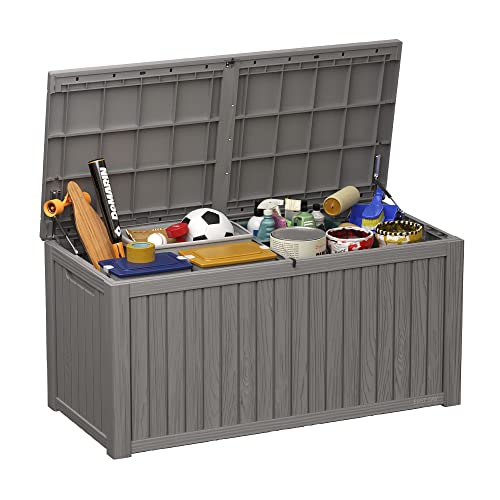
Where to buy
Check the latest price, availability and delivery on Amazon for the linked picks — orders for those are placed on Amazon, and we may earn a commission from qualifying purchases. Small-patio honesty note: this list is ranked by footprint first. The last two picks are excellent boxes that only belong on the largest ‘small’ patios and terraces, and their reviews say exactly where their size stops making sense.
- Best mid-large all-rounder: EAST OAK 180 Gallon Deck Box, Grey — Check on Amazon
- Best premium build: Keter Denali 200 Gallon Deck Box, Grey & Black — Check on Amazon
- Best soft-close family pick: Suncast 200 Gallon Extra Large Deck Box, Dove Gray — Check on Amazon
- Best big-box value: Keter Java 230 Gallon Deck Box, Grey — Check on Amazon
- Best maximum capacity: YITAHOME 320 Gallon Extra Large Deck Box — Check on Amazon
- Best shed-style capacity: Lifetime Horizontal Storage Box, 75 Cubic Feet (561 Gallon) — Check on Amazon
Read the full guide ↓
Disclosure: As an Amazon Associate, dailyhomedecorating.com earns from qualifying purchases. Links to Amazon on this page are affiliate links; they cost you nothing extra. Listing details such as price and availability change often, so check the current Amazon listing before you buy.
Choosing the best outdoor storage box for small patios under $700 is an exercise in square inches, not dollars: on a small patio every foot of wall is contested by the door swing, the seating and the grill, and a storage box earns its place only if its capacity per footprint beats everything else you could put there. The good news is that $700 is far more than the job requires — the best small-patio boxes are mid-priced — so this guide ranks the six premium options by the only metric that matters in a small space: how much storage each one returns for the patio it consumes, and how gracefully it doubles as the bench, table or plant stand a small patio also needs.
Small-patio storage fails in predictable ways. A box two inches too deep blocks the door. A lid that opens against the railing can never open fully, so the box’s back third becomes a tomb for forgotten items. A footprint chosen from the gallon badge rather than the tape measure eats the walkway. And a box that only stores — never seats, never surfaces — wastes the scarcest resource a small patio has. Every pick below was measured against those failures: exterior dimensions first, lid arc second, interior honesty third, and double-duty value always.
The EAST OAK 180 Gallon leads because it is the capacity-per-footprint champion here — real storage in the smallest outline on the page. The Keter Denali follows for narrow-but-tall storage: its height stores cushions upright along a short wall run where a long chest cannot fit. The Suncast serves small patios that host children, its soft-close lid safe in tight quarters. The Keter Java and YITAHOME close the ranked list as terrace-class options for patios at the generous end of ‘small’, and the Lifetime is included only to mark the boundary — a fine unit with no business on a small patio, named so you can rule it out with confidence. Tier comparisons live in our Best Outdoor Storage Box For Small Patios Under $500 guide.
Because the budget outruns the need, the buying guide treats $700 as a whole-patio allowance: the right box, its lock, vertical organizers that multiply a small interior, and the mat or risers that protect a small patio’s drainage. Measure first — the guide’s tape-measure routine takes five minutes and prevents the single most common small-patio purchase regret.
In this guide
Quick Picks: The Best Outdoor Storage Box for Small Patios Under $700 at a Glance
Each row names the job the purchase does best for this brief. Full reviews follow, with interior dimensions and honest limitations for every pick.
| Buyer type | Pick | Why it stands out | Link |
|---|---|---|---|
| Best mid-large all-rounder | EAST OAK 180 Gallon Deck Box, Grey | 180 gallons in the smallest footprint here — capacity per square foot wins | Check on Amazon |
| Best premium build | Keter Denali 200 Gallon Deck Box, Grey & Black | Tall, narrow storage: cushions upright along a short wall | Check on Amazon |
| Best soft-close family pick | Suncast 200 Gallon Extra Large Deck Box, Dove Gray | Soft-close safety in tight quarters, deep interior for loveseat sets | Check on Amazon |
| Best big-box value | Keter Java 230 Gallon Deck Box, Grey | Terrace-class only: maximum volume if your ‘small’ patio is generous | Check on Amazon |
| Best maximum capacity | YITAHOME 320 Gallon Extra Large Deck Box | Boundary pick: 320 gallons for large terraces, not true small patios | Check on Amazon |
| Best shed-style capacity | Lifetime Horizontal Storage Box, 75 Cubic Feet (561 Gallon) | Ruled out with respect: a great unit with no small-patio business | Check on Amazon |
How the Picks Were Chosen for the Best Outdoor Storage Box for Small Patios Under $700 Guide
The small-patio shortlist applied the harshest filter in this series to the premium field. Exterior dimensions were the first cut: any unit whose footprint could not plausibly share a small patio with a door swing and a bistro set was demoted to the honest-boundary section, however good the box. Survivors were then ranked on capacity per square foot of footprint, computed from maker-published exterior and interior dimensions — not from gallon badges, which reward tall marketing as much as usable space. Lid behavior was checked next, because small patios put boxes against railings and walls: assisted lids that open vertically and stay put (pistons, soft-close, controlled hinges) outrank free-swinging lids that need clearance behind. Interior dimensions were verified against the small patio’s actual load — a bistro or loveseat cushion set, folded chairs, a compact grill’s tools — rather than the sectional-scale loads of the main guide. Double-duty value (a lid that can host a tray or a sitter within its rating) counted as a genuine specification, because on a small patio it is one. Prices were checked last and honestly: the leaders here sit in the middle of the tier, and the guide says so. A small patio should never spend $700 on storage alone; it should spend what the right box costs and invest the rest in the patio itself.
Small-Patio Storage Physics
Capacity per square foot is the only honest metric
Gallons flatter long boxes; small patios pay in footprint. Divide a box’s usable capacity by the square feet it occupies and the field reorders itself: tall, deep designs (the Denali, the Suncast) and the compact EAST OAK return far more storage per patio inch than the long chests that headline ordinary roundups. When two candidates both pass your tape test, this ratio — not the badge — is the tiebreaker, and it is the arithmetic behind this guide’s ranking from first pick to last.
Vertical is the small patio’s free dimension
Walls, height and airspace are the resources a small patio has not spent. A taller box stores cushions upright, where they air instead of compressing; interior vertical organization — hung bags, a slim crate, rolled throws — multiplies a modest footprint; even the lid’s top is territory, hosting the planter that makes the box disappear into the planting scheme. Buyers who think in three dimensions routinely fit a full patio life into footprints that defeat two-dimensional shoppers, and the picks here were chosen for exactly that exploitability.
The discipline of the single box
A small patio gets one box, which makes it a curatorial decision: it must hold the patio’s whole soft inventory — cushions, throws, the compact grill’s tools, the string lights’ spares — and nothing else. Garage overflow, paint cans and someday-projects belong elsewhere, because a small patio’s box filled with strangers’ clutter is a patio with no storage at all. Choose the box that fits the curated list with a season’s growth to spare, keep a written inventory inside the lid if your household needs the reminder, and let the constraint keep the patio honest.
Assembly in a small space
Small-patio assembly is a logistics miniature: panels arrive through the door one at a time, the build happens on the taped footprint itself, and the blanket underneath protects the slab’s finish and your knees. Build the EAST OAK-class boxes solo without drama; recruit help for the Denali’s tall panels, which catch every breath of wind like sails. Finish by re-running the tape test with the real box — door swing, lid arc, walkway — because the five minutes that confirm the fit are the cheapest quality check in this entire guide.
The Best Outdoor Storage Box for Small Patios Under $700 Picks in Detail
EAST OAK 180 Gallon Deck Box, Grey
Who it suits: small patios with one honest stretch of wall — beside the door, under a window, along the fence. It stores a loveseat cushion set, folded chairs and the grill tools in the least patio of any pick, assembles easily in tight space, and leaves the rest of the patio for actually sitting on it.
A large resin chest in a clean grey finish: 180 gallons of lockable, waterproof, UV-resistant storage sized for cushion sets, gardening tools and pool accessories. EAST OAK builds this size as the step up from its popular smaller boxes, keeping the same straightforward panel assembly and a lid that takes a padlock. It is the smallest footprint on this page, which is exactly its role: big-box storage for households that cannot give a 200-plus-gallon chest a home.
The EAST OAK is the low-maintenance citizen of this guide. Assembly is the simplest here — panels and lid, no door alignment, no spring hardware — and most owners build it solo where it will stand. The resin needs nothing beyond a hose-down and an occasional wipe, the lockable lid covers the security basics, and the footprint forgives repositioning: at this size, changing your mind about placement is a two-minute job rather than a project. The one discipline it asks is lid courtesy — lower it by hand rather than dropping it, since there is no soft-close hardware — and in return it asks nothing else for years. For households graduating from a too-small first box, it is the calm, correct second purchase.
- Real capacity without the five-foot-plus footprint of the 200-gallon class
- Lockable, weather-sealed design from a brand whose smaller boxes are category staples
- The easiest assembly here — panels and lid, no door hardware or spring hinges to align
Honest limitation: No pistons or soft-close hardware — the lid is a manual lift and can drop if you let go of it mid-close, and 180 gallons fills fast once chaise cushions join the pile.
Choose it if the fit above sounds like your household; skip it if the limitation describes your space or habits — a smaller or simpler box below will serve you better. Check on Amazon
Keter Denali 200 Gallon Deck Box, Grey & Black
Who it suits: patios that are short on length but have height to spare: a narrow wall beside the door, the end of a galley balcony-style patio. Its tall interior stands cushions upright — better airing, better fit — and the paintable finish lets a visible box match the house instead of interrupting it.
Duotech resin panels a full 20 mm thick — double-wall construction you can paint and drill, which no thin-wall box on this page allows. Exterior is about 59.7 inches long, 28.5 inches deep and 35.4 inches tall; the interior runs about 56.2 by 25 by 33.2 inches, so tall cushions stand rather than slump. The lid is lockable, the resin is UV protected, and Keter backs the box with a two-year limited warranty.
Ownership is where the Denali separates itself from the field. The 20 mm panels do not oil-can in summer heat or drum in hail the way thin walls do, the box stays square season after season — which keeps the lid sealing as designed — and the surface takes exterior paint properly, so a color refresh in year five is an afternoon’s work rather than a replacement decision. Assembly is a panel-and-fastener build that rewards patience: lay every panel out, keep fasteners finger-tight until the carcass is square, then torque in sequence. Inside, the tall interior suits standing cushions on edge with a slim crate at one end for tools and ties. Expect the pistons and hardware to be the only wear items worth a thought over a decade, and both are the kind of standard fittings a maker can supply long after purchase.
- Thickest, stiffest walls here — panels can be painted to match a house and drilled for hooks or dividers
- Tall interior swallows deep-seat and chaise cushions that shorter boxes force you to fold
- Lockable lid and a wood-look finish that reads as furniture, not as a plastic bin
Honest limitation: It is the deepest step up in this guide: you pay for wall thickness and finish, not for raw gallons, and at roughly sixty inches long it still needs a real wall run or deck edge to live against.
Choose it if the fit above sounds like your household; skip it if the limitation describes your space or habits — a smaller or simpler box below will serve you better. Check on Amazon
Suncast 200 Gallon Extra Large Deck Box, Dove Gray
Who it suits: small patios that double as play space, where a lid is opened twenty times a day by small hands in a confined area. Soft-close is a safety system at this scale, and the deep interior still takes a proper loveseat cushion set without forcing.
Made in the USA from all-weather resin with a soft-close lid — the lid lowers itself the last stretch instead of dropping. Exterior is about 57.5 inches long, 31.5 inches deep and 32.75 inches tall; the interior runs about 54 by 27.5 by 30 inches, the deepest front-to-back interior among the chests here. Suncast documents a 300-pound lid capacity and a padlock-ready metal hasp, and the resin is UV protected.
The Suncast’s ownership story is its lid. The soft-close mechanism changes daily behavior more than any capacity figure: you stop bracing for the slam, children stop fearing the box, and the lid’s seal lands gently and completely every time — which is also why interiors stay dry, because a slammed lid eventually warps its own landing. The deep interior rewards a simple system: broad cushions flat at the base, back cushions on edge behind them, small items in one crate at the end. The resin wipes clean, the light finish reflects summer heat instead of absorbing it, and the reinforced lid holds its shape under its rated load year after year. Assembly is a straightforward panel build most owners finish solo in an unhurried session.
- Soft-close lid is the finger-safe choice around children and the quiet choice near bedroom windows
- Deepest interior here — broad seat cushions lie flat without curling at the edges
- US-made resin with a reinforced lid that doubles as occasional seating within its rating
Honest limitation: The soft-close hardware asks you to open the lid fully and let it work; forcing it down by hand fights the mechanism, and the light Dove Gray shows pollen and scuffs sooner than dark finishes.
Choose it if the fit above sounds like your household; skip it if the limitation describes your space or habits — a smaller or simpler box below will serve you better. Check on Amazon
Keter Java 230 Gallon Deck Box, Grey
Who it suits: the largest end of ‘small’: wide townhouse patios and terraces where a five-foot run exists and a sectional-scale cushion set must disappear. If your patio cannot spare the run, this box will own the space instead of serving it — measure before you dream.
Keter’s XXL chest in a rattan-look grey resin: about 57.5 inches long, 32.7 inches deep and 33.9 inches tall outside, with an interior around 51.9 by 28.3 by 31.1 inches and roughly 56 pounds of weight. Two hydraulic pistons lift the lid and hold it open, the lid is padlock compatible, and the resin panels carry a woven texture that hides dust better than smooth walls.
The Java is the box owners stop thinking about, which is the compliment big chests earn. The pistons hold the lid at working height through years of daily cycles, the rattan texture hides the dust film that makes smooth boxes look tired by July, and the sheer interior volume means the packing never has to be clever — sectional sets simply go in. Assembly is a snap-and-screw panel build, fastest with a second pair of hands for the long walls. Two ownership notes from the category’s experience: open the lid slowly after heavy rain so pooled water sheds outward rather than in, and keep the long walls out of direct reflected heat from south-facing glass, the one environment that ages any resin early.
- The most chest gallons per purchase on this page — full sectional cushion sets fit in one box
- Pistons hold the lid open hands-free while you load with both arms full
- Rattan texture shrugs off the dusty, chalky look that plagues smooth dark resin
Honest limitation: Single-wall panels flex more than the Denali’s double walls, the long lid can take on rain that runs in as you open it after a storm, and the footprint is a commitment on anything but a full-size deck.
Choose it if the fit above sounds like your household; skip it if the limitation describes your space or habits — a smaller or simpler box below will serve you better. Check on Amazon
YITAHOME 320 Gallon Extra Large Deck Box
Who it suits: terraces and courtyard patios mislabeled as small. With roughly sixty-eight inches of length it is a commitment; where the space truly exists, the divider turns one long box into the patio’s entire storage system, cushions and gear separated.
The capacity champion here: 320 gallons of double-wall resin with a flexible divider, so cushions can live on one side and pool or sports gear on the other. The maker rates the structure for a 1000-pound load, the lid is lockable, and the box is built as one long run — plan on roughly sixty-eight inches of wall. Double-wall panels and the divider are the two features that separate it from the generic oversize chests it competes with.
A 320-gallon box is a logistics decision before it is a storage one. It arrives as a large, heavy flat pack; plan the carry, the assembly space and the final position before the delivery day, and assemble it in place — a finished box this size does not love being dragged. In service, the divider is the feature owners praise: it converts one cavern into two rooms, and the double-wall panels keep the long spans from flexing when the box is loaded unevenly. The structure’s heavy load rating makes the lid a genuine gathering bench, though a cushion or runner keeps the finish kind. Keep the interior aired on dry mornings in humid climates; very large sealed volumes hold still air, and still air is what mildew eats.
- Largest capacity in this guide, with a divider that keeps wet pool gear off dry cushions
- Double-wall build and a heavy load rating make the lid usable as a gathering bench
- One box replaces the two mid-size boxes many households end up buying anyway
Honest limitation: It ships as a very large, heavy flat pack and the assembled box is a two-person move; measure gates and deck stairs before ordering, because returning an assembled 320-gallon box is nobody’s idea of fun.
Choose it if the fit above sounds like your household; skip it if the limitation describes your space or habits — a smaller or simpler box below will serve you better. Check on Amazon
Lifetime Horizontal Storage Box, 75 Cubic Feet (561 Gallon)
Who it suits: nobody with a small patio — and that is its honest role in this guide. At over six feet long, three and a half deep and four-plus tall, with doors that need a clear arc, it belongs to yards and driveways. It is listed so the boundary is explicit: if a salesperson steers you here for a small patio, walk away.
This is the one pick that stops being a chest and starts being a small horizontal shed: about 75.2 inches long, 42.5 inches deep and 52 inches tall outside, with an interior around 71.2 by 38.75 by 47 to 48 inches — 75 cubic feet in total. Dual-wall high-density polyethylene panels are steel reinforced, the front doors are lockable with an external latch, the lid rides on a controlled spring hinge, and Lifetime covers it with a five-year limited warranty. It is sized to hold two large wheeled bins, a mower, or bikes.
Owning the Lifetime is closer to owning a small building than a box. Assembly is the price of admission — a methodical two-person build with many panels, steel supports and door hardware to align — and it pays to assemble it exactly where it will live, on its level base, because moving the finished unit is a four-hand carry. Once built, daily life is doors and a lid that both open wide and latch positively; bins roll in and out without lifting, and the spring hinge keeps the heavy lid from ever dropping. The HDPE floor shrugs off bin drips and mower grime and hoses clean each spring. The five-year warranty is the longest in this guide, and the steel-reinforced dual walls are why: this is the pick least likely to be replaced for structural reasons.
- Front doors plus a lifting lid — you walk items in instead of hoisting them over a chest wall
- Steel-reinforced dual-wall HDPE and the longest warranty on this page
- Hides two full-size trash and recycling bins completely, which no chest here can do
Honest limitation: Assembly is a genuine two-person project measured in hours, it needs a level pad or deck section, and at about 52 inches tall it is far too big for balconies and most small patios.
Choose it if the fit above sounds like your household; skip it if the limitation describes your space or habits — a smaller or simpler box below will serve you better. Check on Amazon
Comparison Table
Capacities and dimensions are the makers’ published figures; where a maker publishes no lid rating or exact dimension, the table says so rather than guessing.
| Pick | Capacity | Exterior size | Construction | Lid and lock | Warranty |
|---|---|---|---|---|---|
| EAST OAK 180 Gallon Deck Box, Grey | 180 gal | Compact for its class | Resin | Lockable lid | Maker limited |
| Keter Denali 200 Gallon Deck Box, Grey & Black | 200 gal | 59.7 x 28.5 x 35.4 in | Duotech resin, 20 mm double-wall | Lockable lid | 2-year limited |
| Suncast 200 Gallon Extra Large Deck Box, Dove Gray | 200 gal | 57.5 x 31.5 x 32.75 in | All-weather resin | Soft-close, padlock-ready hasp | Maker limited |
| Keter Java 230 Gallon Deck Box, Grey | 230 gal | 57.5 x 32.7 x 33.9 in | Resin, rattan look | Hydraulic pistons, padlock compatible | Maker limited |
| YITAHOME 320 Gallon Extra Large Deck Box | 320 gal | About 68 in long | Double-wall resin | Lockable lid, flexible divider | Maker limited |
| Lifetime Horizontal Storage Box, 75 Cubic Feet (561 Gallon) | 75 cu ft / 561 gal | 75.2 x 42.5 x 52 in | Dual-wall HDPE, steel reinforced | Lockable doors + spring-hinge lid | 5-year limited |
How to Choose the Best Outdoor Storage Box for Small Patios Under $700
The five-minute tape routine
Measure the wall run you can truly spare, the depth from wall to the door’s swing or walkway edge, and the height to any window sill or railing line. Write the three numbers down and shop only inside them — exterior dimensions, not gallons, are the filter. Then tape the finalist’s footprint on the patio floor with painter’s tape and live with the outline for a day: walk past it, open the door, pull out a chair. Small-patio regrets are almost all visible at the tape stage. Our Best Patio Furniture Set For Small Patios Under $700 guide uses the same routine for seating.
Buy height and depth, not length
Small patios run out of length first. A taller box (the Denali) stores cushions upright along a short wall; a deeper box (the Suncast) takes broad cushions flat without eating the run. Long chests are the last resort of a small space, not the default. Inside, think vertically too: bags hung from the rim, a slim crate for tools, throws rolled rather than folded — a small interior organized vertically holds a surprising season’s worth of patio life.
Protect the lid’s arc and the patio’s drainage
Place the box so its lid opens fully without striking railing, wall or window — a lid capped at seventy degrees makes the box’s rear third unusable and its weather seal unreliable. Keep the base on slim risers or a mat so the patio’s drainage path — always engineered, always easy to block on a small slab — keeps flowing to its drain. A box that dams water against the door threshold creates an indoor problem, the worst outcome a patio purchase can have. Rug sizing for the same footprint discipline is in our Best Outdoor Rug For Small Patios Under $700 guide.
Make it double-duty or do not buy it
On a small patio the box must work a second job: a serving ledge with a tray, a plant stand that greens the corner, a seat within its published lid rating (the Suncast documents one), a side table beside the lounger. If a candidate cannot do any of those gracefully, its footprint is a pure cost. Spend the tier’s generous headroom accordingly — the box, its lock and organizers, and the plants and lighting that make the remaining patio feel larger. Seating-scale picks are gathered in our Best Camping Chair For Small Patios Under $700 guide.
Common Mistakes to Avoid
- Shopping by gallons. On a small patio the exterior tape measure is the specification; a ‘smaller’ 150-gallon long chest can eat more patio than a taller 180-gallon box.
- Skipping the tape outline. Five minutes with painter’s tape reveals the blocked door swing and the stolen walkway that a delivery-day discovery makes expensive.
- Strangling the lid. A box backed tight to a railing whose lid cannot fully open is a box half-used and poorly sealed for its entire life.
- Blocking the drain. Small slabs have one drainage path; a box parked on it sends storm water toward the door instead of the drain.
- Buying terrace-class boxes for a true small patio. The Keter Java and YITAHOME are fine products that will dominate a small space — the ranking puts them last for this brief on purpose.
- Spending the whole $700 on the box. The right small-patio purchase leaves most of the budget for the patio itself; overspending on storage for a small space is its own category error. Deck-first alternatives are compared in our Best Deck Box For Small Patios Under $700 guide.
The Small-Patio Load: Curating What Earns the Box
The definitive list
Write the list before the box arrives: the cushion set for the seating you own, one throw, the compact grill’s tools or the balcony garden’s hand tools, the watering can, string-light spares, and one folded extra chair if guests ever overflow. That list — typically 120 to 180 gallons packed well — is the entire brief. If a candidate box cannot hold it, the box is wrong; if the list will not stop growing, the patio has a curation problem no box solves. Small-patio storage succeeds by editing, and the list is the editor.
Packing in three dimensions
Inside a small patio’s box, height is the free resource: cushions on edge along the back wall, throws rolled into the corners they would otherwise waste, the slim crate of tools standing at one end, bags hung from the rim so the floor layer stays flat and findable. Reserve the top hand’s width for air and for the one item you grab daily. Photograph the packed order once it works — in a small box, the difference between a system and a pile is whether the second person to pack it can reproduce the first person’s arrangement.
The eviction rule
Small boxes stay useful under one law: an item that has not been used in a full season leaves — to the closet, the garage, the donation bag. Without the rule, the box silently fills with the patio’s past lives (the broken lantern, the predecessor cushions, the games nobody plays) until the current life no longer fits, which on a small patio means cushions spending nights on chairs. Apply the rule at each season’s turn, the same day the cushions are washed, and the box remains what it was bought to be: the current patio, protected.
When the list outgrows every box
Some small patios honestly outgrow storage: a sectional on a townhouse patio can generate more cushion than any footprint-respecting box holds. The escalations, in order, are breathable indoor bags for the overflow set, weatherproof-cushion furniture that needs no storage at all, and only then a terrace-class box whose footprint the tape test approves. What never works is the overpacked box — lid forced, seal spent, textiles mildewing in the crush. The tape routine and the list together tell you which patio yours is before money makes the decision for you.
The upgrade path from a first box
Many small-patio owners arrive here from a first box that failed — too small, lid unassisted, footprint dishonest. The upgrade discipline is to name the failure precisely before replacing it: capacity failures step to the EAST OAK, footprint failures step taller to the Denali, lid failures step to the Suncast’s soft-close. An upgrade bought against a named failure lands; one bought against a vague frustration repeats it at a higher price. And the retired box rarely goes to waste — it becomes the garage’s or a friend’s balcony’s perfectly adequate storage, which is the small-patio ecosystem working as it should.
Care, Placement and Longevity
Small patios forgive nothing, including neglect, because every flaw is in arm’s reach. Keep the box’s risers clear so drainage never dams against the door; wipe the lid weekly in season, since on a small patio the box’s top is always in view and usually in service; and audit the interior monthly against the curated list — the moment a stranger item moves in, the box stops fitting the patio’s life. Air textiles on the patio’s sunny mornings, check the lid’s arc clearance after any furniture rearrangement, and re-tape the footprint before any upgrade: on a small patio, the tape measure is a maintenance tool too.
And keep the tape measure in the box itself, on top of the crate, where the next decision will need it. Small patios change — a new chair, a different grill, a planter that grew — and every change re-asks the footprint question this guide opened with. The household that re-measures before it re-buys never stacks a second mistake on the first one’s outline. That, in the end, is the small-patio storage doctrine entire: measure, curate, and let the box protect a patio that was chosen — every inch of it — on purpose.
Final Recommendation
On a small patio, buy the tape measure’s answer: the EAST OAK 180 for most spaces, the Denali where wall length is scarce but height is free, the Suncast where small hands use the lid daily. Let the big Keter and YITAHOME serve the terraces they were built for, and let the Lifetime mark the boundary of the brief. Then spend the substantial change from $700 where a small patio feels it most — light, green and a seat you love — because storage was only ever there to protect exactly that.
Frequently Asked Questions
What is the best size storage box for a small patio?
For most small patios, the 180-to-200-gallon class in a compact footprint — the EAST OAK here — is the ceiling of sensible. It takes a loveseat or bistro cushion set, folded chairs and tools without owning the patio. Go taller (Denali) if wall length is your scarcest dimension, and treat anything beyond 230 gallons as terrace equipment that needs a measured five-foot run to justify itself.
How do I measure my patio for a storage box?
Three numbers: the wall run you can spare, the depth from that wall to the nearest door swing or walkway edge, and the height to windowsills or the railing. Compare them to the box’s exterior dimensions — never its gallons — then tape the footprint on the floor and live with it for a day before ordering. Check the lid’s opening arc against railings and walls while the tape is down.
Can a storage box work as a bench or table on a small patio?
Yes, within the maker’s published lid rating — the Suncast documents a 300-pound lid capacity, enough for a sitter or a full serving tray. Where no rating is published, use the lid for trays and planters only. A runner or cushion on the lid protects the finish and makes the double duty look designed, which on a small patio — where everything is visible — matters.
Where is the worst place to put a box on a small patio?
Three-way tie: blocking the door’s swing, sitting on the slab’s drainage path, and backed so tight to a railing that the lid cannot open fully. All three are tape-stage discoveries. The best spot is the wall run nearest the door the cushions travel through, on slim risers, with the lid’s arc clear — boring, and exactly right.
Is a $700 budget overkill for small-patio storage?
For the box alone, honestly yes — the leaders in this guide cost a fraction of the ceiling, and that is the correct outcome. The tier makes sense as a whole-patio budget: the right box, a lock, vertical organizers, risers or a mat, and the seating, lighting and planting that the protected cushions exist to serve. Anyone trying to sell a small patio a $700 single box is solving the wrong problem.
My patio is tiny — should I skip a box entirely?
Not necessarily: a compact box that also serves as your side table or plant stand can replace furniture rather than add to it, which is a net win in square inches. If even the EAST OAK’s footprint fails the tape test, store cushions indoors in breathable bags and put the budget into weatherproof-cushion furniture instead. The honest answer for the very smallest patios is sometimes no box — this guide’s tape routine exists to tell you which patio yours is.
Is a taller box or a longer box better for a small patio?
Taller, almost always. Length is the dimension small patios run out of first, while height to a windowsill or railing is usually unspent. The Denali’s upright format stores a cushion set along a short wall that no five-foot chest could use. The exception is the patio whose only free run is long and low — under a wide window, say — where a lower, longer box fits the architecture. The tape routine, not a rule of thumb, makes the final call.
Can I put a storage box on a small patio that slopes for drainage?
Yes — the slope is a feature to work with, not around. Set the box on slim risers leveled so the box itself sits true while water keeps flowing beneath it toward the drain. Never shim one corner with a wedge that twists the carcass, and never dam the flow path with a mat wall-to-wall. A level box on a sloped slab is a five-minute riser job, and it protects both the lid’s seal and your door threshold.


