Where to buy
Check the latest price, availability and delivery on Amazon. Orders are placed on Amazon. We may earn a commission from qualifying purchases.
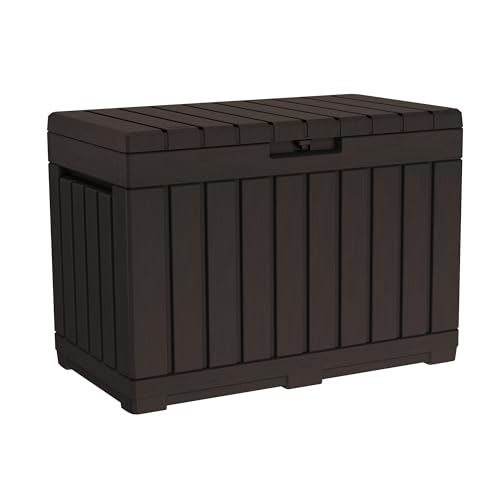
- Best overall for small patios: Keter Kentwood 50 Gallon Outdoor Storage Box and Side Table, Brown — Check on Amazon
- Best side-table box: Keter City 30 Gallon Outdoor Storage Box and Side Table, Brown — Check on Amazon
- Smallest footprint: Suncast 22 Gallon Small Deck Box with Seat, Java — Check on Amazon
- Most storage in a slim shape: Keter Marvel Plus 71 Gallon Deck Box, Dark Grey — Check on Amazon
- Premium compact upgrade: Keter Signature Collection 100 Gallon Deck Box, Ashwood — Check on Amazon
- Seating that stores: Keter Solana 70 Gallon Outdoor Storage Bench, Brown — Check on Amazon
Read the full guide ↓
Disclosure: As an Amazon Associate, dailyhomedecorating.com earns from qualifying purchases. Links to Amazon on this page are affiliate links; they cost you nothing extra. Listing details such as price and availability change often, so check the current Amazon listing before you buy.
Shopping for the best outdoor storage box for small patios under $500 is a lesson in respecting square feet. On a small patio — the townhouse slab, the condo terrace, the cottage garden’s paved corner — every object is in negotiation with every other object, and a storage box that wins on capacity but eats the walking line has lost the only contest that matters. The good news hidden inside this $500 budget is that small-patio storage tops out far below it: the best compact boxes, side-table boxes and storage benches in the category cost a fraction of the ceiling, which means your money buys the premium versions of small — better finishes, dual-purpose designs, a bench you would choose as furniture — rather than a compromise. The six picks below were chosen footprint-first and quality-second, and each was verified against the manufacturer’s catalog data before earning its link.
The shortlist is organized by the roles a small patio actually needs filled. Two picks are side-table boxes — the Keter City 30 and the Kentwood 50 — because on a small slab, a box that holds your coffee while it holds your cushions is worth two single-purpose objects. One is a true slim box, the Marvel Plus 71, long and low against a wall for patios that can spare depth in exactly one direction. One is the premium upgrade, the Signature 100 in ashwood, for small patios that are designed rooms rather than leftover slabs. One is a bench, the Solana 70, because seating is the other scarce resource and a bench that stores solves both scarcities in one footprint. And one, the Suncast 22, is the honest minimum — a seat-sized box for the patios where even 30 gallons must argue for its place.
Start with the Kentwood 50 if you want one box that does the whole job at side-table scale. Start with the Solana if your patio’s problem is chairs as much as clutter. The reviews below measure each pick against the small-patio realities — the door swing, the chair legs, the walking line, the view from the kitchen window — and say plainly which patios each one fits and which it will crowd.
In this guide
Quick picks: the best outdoor storage box for small patios under $500
| Pick | Best for | Capacity | Second job | Material | Amazon |
|---|---|---|---|---|---|
| Keter Kentwood 50 Gallon, Brown | Best overall small-patio box | 50 gal | Side table | Resin | Check on Amazon |
| Keter City 30 Gallon, Brown | Side-table storage | 30 gal | Side table | Resin | Check on Amazon |
| Suncast 22 Gallon with Seat, Java | Tiniest patios | 22 gal | Single seat | Resin | Check on Amazon |
| Keter Marvel Plus 71 Gallon, Dark Grey | Slim wall-hugging storage | 71 gal | Surface / plant stand | Resin | Check on Amazon |
| Keter Signature 100 Gallon, Ashwood | Premium compact | 100 gal | Console surface | Resin, ashwood look | Check on Amazon |
| Keter Solana 70 Gallon Bench, Brown | Seating plus storage | 70 gal | Two-person bench | Resin | Check on Amazon |
How the picks were chosen
Small-patio suitability filtered this list before anything else, on four gates. First, footprint shape, not just size: we favored boxes whose dimensions run long-and-shallow or compact-and-tall over square mid-size boxes, because small patios have spare inches along walls and beside chairs, not spare squares in the middle. Second, the second-job rule: on a small slab, a single-purpose object is a luxury, so every pick here works as a table, a seat, a bench or a console in addition to storing. Third, traffic honesty: each pick had to leave a walking line and a door swing intact on a realistic small patio — we mentally placed each one on an eight-by-ten slab with a bistro set, the most common small-patio geometry in the country, and eliminated anything that turned circulation into choreography. Fourth, visual weight: small patios are seen whole, from indoors as much as from outside, so finishes and silhouettes were judged as furniture, with low, calm profiles favored over tall utility shapes.
Underneath the small-patio filter, the standing standards applied: verified manufacturer models and specifications, confirmation through Amazon’s catalog data before any link was added, lockable lids on every pick (small patios sit close to neighbors and sidewalks, which argues for locks, not against them), and a screen against the U.S. Consumer Product Safety Commission recall database, in which none of these picks and none of the brands’ deck box lines appears. A small-patio safety note that is easy to miss: keep the box’s lid swing clear of the door and the grill, and never let a compact box become a step for reaching over the railing — lockable, stay-put lids are for storage, not for climbing.
Budget honesty, one more time: this category’s small end is inexpensive, and even this guide’s premium pick leaves most of $500 in your pocket. We did not inflate the shortlist with a big box “just in case your patio grows,” because patios do not grow — the slab you have is the slab the box must serve, this season and every season after it, through every rearrangement of the furniture it shares the space with. The right way to use the headroom is the patio system — box, bench pad, a pair of planters, the padlock — and the reviews note where each pick leaves room for exactly that.
Small-patio geometry: where a box can actually live
Before the reviews, a short course in the geometry that decides them, because small patios fail in predictable places. There are four viable homes for a box on a small slab. The wall run: the strip along the house wall, where a long, shallow box (the Marvel Plus, the Signature) sits under the window, out of the traffic pattern, doubling as a console for plants and drinks. The chair-side spot: the side-table position at the elbow of the main chair or loveseat, where the City and Kentwood were designed to live. The end cap: the short edge of the slab, where a bench (the Solana) can close the space like a banquette, defining the patio’s boundary while it stores. And the corner: the dead angle behind a chair or beside the door, where the little Suncast 22 converts wasted geometry into a seat with a secret. What does not work — the fifth placement, the one to avoid — is the center or the door swing: a box that must be walked around or that blocks the door’s arc will be cursed daily and eventually exiled.
Measure with the furniture in place, not on the empty slab, and tape the candidate’s footprint on the ground for a day before ordering. Small patios forgive nothing, but they reward precision completely: a box that lands in its intended geometry disappears into the patio’s life, while one that is two inches too deep becomes the patio’s defining annoyance. Every review below names the geometry its pick was born for, so you can match the pick to your slab’s map rather than to a capacity table.
A word about door swings and lid arcs, the twin assassins of small-patio plans. The patio door needs its full arc plus a person’s width; the box’s lid needs its own arc above and behind, clear of siding, railings and the grill’s heat. On the taped-footprint test, mark both arcs in a second color of tape and live with them for the same day. More small-patio storage fails on arcs than on areas, and both failures are visible in tape long before they are visible in a delivery.
The best outdoor storage boxes for small patios under $500, reviewed
1. Keter Kentwood 50 Gallon, Brown — best overall for small patios
Who it suits: The typical small patio: a loveseat or two chairs, a bistro table, and a storage list of cushions, a throw, the watering kit and the candle box. The Kentwood is the one-box answer at exactly the right scale.
Fifty gallons is the small-patio sweet spot, and the Kentwood wraps it in the right shape: side-table proportions that park at a loveseat’s elbow, a flat top that works as the patio’s end table, and a cavity that takes a loveseat’s cushions without a packing seminar. The wood-look brown finish is warm against concrete and composite decking, the lid locks, and the whole unit is light enough to shift when the patio’s layout changes with the seasons — a real virtue on small slabs, whose arrangements are revised constantly. It also pairs: two Kentwoods flanking a loveseat read as a designed set of end tables, a classic small-patio arrangement that stores the entire textile inventory while looking like furniture planning rather than storage creep.
Day to day, its manners are what owners notice: the top holds a coffee and a book at the right height, the interior swallows the daily kit without excavation, and the box washes clean with a bucket and cloth — no hose choreography on a slab the size of a parking space. In winter it can come indoors to a closet or utility corner without looking like exiled garden equipment, which townhouse owners with HOA clear-patio rules will appreciate more than any spec on the page.
The Kentwood also handles the small patio’s social math gracefully: it is the surface the second glass lands on when the bistro table is full, the step-free perch a child claims, the place the mail and the dog leash pause on the way through. Objects on a small patio are touched and used far more often per square foot than their backyard equivalents, and the Kentwood’s sturdy, wipeable, unpretentious build is exactly suited to that intensity of use. It is not the most glamorous pick here; it is the one most small patios would choose again.
Pros:
- 50 gallons in a true side-table footprint — the small-patio sweet spot
- Top surface earns its keep daily as the patio’s end table
- Lockable, light, and easy to relocate or bring indoors
- Pairs symmetrically beside a loveseat for a designed look
Honest limitation: The lid has no pistons, so you hold it open while loading — a minor tax at this size. And 50 gallons is a loveseat’s world, not a sectional’s: households whose small patio somehow hosts a big furniture set should jump to the Signature 100 and accept its larger footprint.
Choose it if one box must quietly do everything on a small patio. Skip it if your cushion count is large or your patio’s empty wall run invites the slim Marvel Plus instead.
2. Keter City 30 Gallon, Brown — the side-table box
Who it suits: The smallest furnished patios: two chairs, a tiny table, a morning ritual. The City stores that patio’s whole textile life — two chairs’ cushions, a throw, the book and candle kit — inside a side table.
The City’s design premise is that on a small patio, storage should hide inside furniture you already need. It stands at side-table height, holds the coffee cup on top, and takes the cushions when the weather turns or the evening ends. Thirty gallons is honestly sized for the two-chair patio: measure your inventory before dismissing it, because most small-patio households discover their entire outdoor textile collection fits with room for the watering can. The box is light, assembles in minutes, and is small enough to migrate — to the front porch for package duty in winter, to a closet during an HOA inspection, to the next home without a logistics plan.
It also plays well with the small patio’s other furniture: beside the chairs in our Best Adirondack Chair For Small Patios Under $200 guide, a City at each elbow is the classic composed arrangement — symmetry, surfaces and storage in two small footprints. For patios furnished around a loveseat, one City plus its bigger sibling the Kentwood covers both ends without a visual mismatch, since the finishes match.
The City has one more small-patio talent worth naming: it is the box most likely to be allowed. Condo and townhouse rules that frown at visible storage tend to be written against bins and chests; a neat side table that happens to open rarely triggers them, and at inspection time the City is the easiest pick here to carry inside and make disappear. In regulated communities, the most compliant storage is the storage that reads as furniture — and no pick reads more purely as furniture than this one.
Pros:
- Genuinely dual-purpose: end table by day, cushion box by night
- Light and compact enough to relocate, store indoors or reassign seasonally
- Fast assembly; washes clean in a tub or with a bucket
- Lockable lid despite its small size
Honest limitation: Capacity is the compromise — a lounger cushion or a family’s worth of gear overflows it, and an overfilled small box whose lid rides open protects nothing. It is also light enough for strong wind to shift an empty one; keep it loaded or cornered.
Choose it if your patio is a two-chair retreat and every object must work twice. Skip it if your inventory is a loveseat’s or larger — the Kentwood is the same idea with room to breathe.
3. Suncast 22 Gallon Small Deck Box with Seat, Java — the honest minimum
Who it suits: Patios where the storage question is whether any box fits at all — the narrow townhouse strip, the cottage corner, the slab already fully committed to a bistro set and a grill.
At 22 gallons, this is the smallest serious box in the guide, and its design justifies its footprint the way small-patio objects must: the reinforced lid is maker-rated as a seat, so the box is the patio’s extra chair every day and its storage on the days you open it. Inside goes the honest small inventory — a pair of cushions, the herb kit, the folded picnic blanket, the dog’s outdoor toys — which on a genuinely small patio is frequently the entire inventory. Suncast’s weather-resistant resin shrugs off the seasons, the java tone flatters brick and terracotta, and the unit is light enough to move on a whim when the patio rearranges, as small patios constantly do.
There is a compositional virtue here too: a tiny patio with a bistro set often has exactly one awkward corner left, and the Suncast is shaped to complete it — seat, surface and storage closing the geometry. Bought as furniture that stores rather than storage that apologizes, its size stops being the headline.
Small-patio owners should also know the Suncast’s quiet second career: package duty. On townhouse patios that serve as the delivery point, a lockable, weather-shedding box by the door keeps parcels dry and out of street view between the driver’s photo and your arrival home. Not every patio layout allows it, and HOA rules come first — but where it works, the little box earns its corner twelve months a year rather than two seasons.
Pros:
- Smallest footprint in the guide; fits the corners nothing else will
- Lid doubles as a rated seat — daily justification for its space
- Featherweight and endlessly rearrangeable
- Suncast resin and support behind it
Honest limitation: If your patio fits the Kentwood, buy the Kentwood — it stores more than twice as much for a modest step in footprint. The 22-gallon cavity also refuses full-size lounge cushions entirely, so check your largest cushion against the interior before ordering.
Choose it if your patio’s spare geometry is a single corner. Skip it if you have any wall run or chair-side space at all — the side-table picks store far more in it.
4. Keter Marvel Plus 71 Gallon, Dark Grey — the slim wall-hugger
Who it suits: Patios with one good wall run: the long narrow townhouse slab, the terrace under a window, the space behind the seating where a shallow box can live without entering the traffic pattern.
The Marvel Plus stores the most in this guide relative to the depth it consumes, because its gallons run long and low rather than square. Parked along the house wall, it takes two lounge cushions and a chair set’s pillows, the gardening kit and the string-light box — 71 honest gallons — while its flat top becomes the patio’s console: planters, lanterns, the drink tray during gatherings. The dark grey finish disappears against railings and shadow lines, which on a small patio is a visual mercy: the box reads as part of the architecture rather than as an object competing with the furniture.
Its panel construction assembles in place (carry the panels out, build it on the slab), and the finished unit is light enough to slide for cleaning behind it — a detail that matters on small slabs, where the strip behind a wall-run box is otherwise a permanent leaf-and-dust museum. The lid locks, the resin shrugs off weather, and the whole arrangement leaves the patio’s center — its living space — completely untouched, which is the entire philosophy of small-patio storage in one placement.
The Marvel Plus also suits the plant-heavy small patio, a common species: its console top is the staging shelf for the herb pots and the watering can lives inside it, so the garden’s working kit is stored directly beneath the garden. Gardeners on small slabs learn to think vertically and zonally, and a wall-run box with a useful top is the zoning made physical — tools below, plants above, living space untouched in front.
Pros:
- Most capacity per inch of depth in this guide
- Wall-run placement keeps the patio’s living space clear
- Flat top works as console, plant stand and party surface
- Neutral dark grey disappears against modern architecture
Honest limitation: It needs its wall run: on a square patio without a spare long edge, its length becomes the problem rather than the solution. The lid is unassisted, and the box’s low profile means deep items stack in one layer’s logic — tall, bulky objects are not its talent.
Choose it if your patio has a wall run and a real cushion inventory. Skip it if your slab is square and furnished on all sides — the side-table picks fit that geometry better.
5. Keter Signature Collection 100 Gallon, Ashwood — the premium compact
Who it suits: Designed small patios — the townhouse terrace furnished like a room, the condo slab with a considered set — where the box will be seen constantly and must look like it was chosen, because at 100 gallons in a compact class it is also the capacity upgrade.
Keter’s Signature line is the brand’s design-led range, and the ashwood finish — a pale, grained wood look — is made for small spaces: light tones visually shrink an object’s presence, so the Signature occupies the eye less than a dark box of the same size while storing a genuinely useful 100 gallons. That capacity is the step up from side-table scale: a full loveseat-and-chairs cushion inventory, the throws, the games, with the lid closing on the first try. Run along a wall it reads as a console; at a patio’s end it reads as a credenza; in photographs it reads as furniture, which on a small patio — always in frame — is a daily dividend.
The premium logic is the same as the line’s larger walnut model in our general guide, scaled to small-slab reality: you pay for finish and form, and in a small patio that payment is unusually rational, because there is nowhere for an ugly box to hide. Everything is in the sightline; everything might as well be beautiful. The resin body keeps the timber look maintenance-free, the construction feels a class above the standard line, and the box anchors a small outdoor room the way a good sideboard anchors a dining room.
There is a rental-deposit footnote to the Signature’s appeal: designed patios in rented townhouses cannot be drilled, built-in or permanently altered, so the room’s quality must come from freestanding objects. A furniture-grade box is exactly that — a high-impact, zero-installation upgrade that leaves with you at the lease’s end and upgrades the next patio on arrival. Premium freestanding pieces are how renters build rooms that look owned, and this is the storage expression of that strategy.
Pros:
- 100 gallons — real capacity — in a design-led compact form
- Pale ashwood finish visually lightens a small space
- Console proportions suit wall runs and patio end caps
- Resin body: the wood look without the wood upkeep
Honest limitation: The premium is for the finish; the Kentwood stores a loveseat’s world for notably less of the budget, so patios where the box hides behind the grill should not pay it. The Signature line is also newer than Keter’s decade-proven standard boxes, with a shorter track record behind it.
Choose it if your small patio is a designed room and the box is part of the design. Skip it if storage is purely functional for you — the Kentwood and Marvel Plus cover the same duties plainly.
6. Keter Solana 70 Gallon Storage Bench, Brown — seating that stores
Who it suits: Small patios that host. If the slab must seat four and store everything, the Solana is the arithmetic-breaker: a two-person bench with a backrest, hiding 70 gallons of the patio’s textile and gear inventory beneath the seat.
On a small patio, the bench is the highest-leverage object because it attacks both scarcities at once. As the end cap of the slab it defines the space like a banquette; as seating it hosts the guests the chairs cannot; as storage it takes the cushions for the rest of the set, the throws and the party kit. Seventy gallons matches the Marvel Plus for capacity while out-functioning it socially — nobody holds a conversation with a wall-run box, but the bench is where the evening’s best conversation reliably happens. The resin body keeps it movable, the cavity locks, and the brown finish speaks the wood-and-garden vocabulary most small patios are already furnished in.
Add a bench pad and two outdoor pillows — easily funded by what this guide’s budget leaves unspent — and the Solana becomes the patio’s best seat and its closet simultaneously. For small patios that entertain even occasionally, that combination is very hard to beat, and it is why the bench, not a bigger box, is this guide’s recommended upgrade path.
The Solana also changes a small patio’s daily rhythm in a way pure storage never does: it creates a destination. A slab with two chairs is a place you sit when you decide to; a slab with a bench under the window, cushions inside it and a throw over its back is a place you drift to with morning coffee without deciding anything. Small outdoor spaces live or die on that drift — on being used daily rather than admired occasionally — and the bench is the object most likely to cause it.
Pros:
- A real two-person bench with backrest, plus 70 gallons hidden inside
- Solves seating and storage — both small-patio scarcities — in one footprint
- End-cap placement defines the patio like a banquette
- Lockable; light enough to reposition as gatherings change
Honest limitation: A bench needs sitting depth in front of it, so the very shallowest slabs may fit the Solana’s footprint but not its use; measure the sitter’s legs, not just the bench. Its cushions-for-itself (a bench pad) are an extra purchase, and bare resin is a short-sit surface without one.
Choose it if your small patio hosts and chairs run out before cushions do. Skip it if the slab is under four feet deep in the bench’s intended spot — take the Kentwood and folding chairs.
Side-by-side comparison
| Pick | Capacity | Second job | Lockable | Born for |
|---|---|---|---|---|
| Keter Kentwood 50 | 50 gal | Side table | Yes | The typical small patio |
| Keter City 30 | 30 gal | Side table | Yes | Two-chair patios |
| Suncast 22 with Seat | 22 gal | Single seat | Yes | The last awkward corner |
| Keter Marvel Plus 71 | 71 gal | Console surface | Yes | Long wall runs |
| Keter Signature 100 | 100 gal | Console / credenza | Yes | Designed small patios |
| Keter Solana 70 Bench | 70 gal | Two-person bench | Yes | Hosting patios, end caps |
How to choose an outdoor storage box for a small patio
Map the slab before you shop. Sketch the patio with its furniture, door swing and walking lines, then mark the four viable box homes — wall run, chair-side, end cap, corner — from the geometry section above. The map chooses the pick’s shape; the inventory then chooses its size within that shape. Shopping in the reverse order (capacity first) is how small patios end up with a wonderful box and no way to live around it. If your map shows apartment-balcony constraints more than patio ones, our Best Outdoor Storage Box For Apartments Under $150 guide runs the same logic at balcony scale.
Count cushions, then demand a second job. Small-patio inventories are modest — two to eight cushions, a throw, a small kit — which is why 30–70 gallons covers most households here and 100 covers nearly all. With capacity that attainable, the differentiator is the second job: table, seat, bench or console. Buy the job your patio lacks, in the size your inventory needs, and let the budget’s remainder fund the pad, the planters and the padlock. Readers working with less can find the same shortlist logic at the Best Outdoor Storage Box For Small Patios Under $300 tier, and the broader category in our Best Outdoor Storage Box Under $300 guide.
Respect the sightline from indoors. A small patio is typically viewed from the kitchen or living room all day, which makes the box a piece of interior visual furniture whether you planned it or not. Low profiles, calm finishes and furniture silhouettes (the Signature, the benches, the wood-look side tables) keep the view composed; a tall utility bin in the window’s center will be looked at ten thousand times. Choose as if you were furnishing the room the patio is seen from — because you are.
Think vertically, carefully. Small patios tempt owners upward — stacking, shelving, hanging — and a storage box participates best as the base of that thinking: its flat top is the patio’s shelf for planters and lanterns, raising the green layer without consuming new floor. Respect the limits, though: the top is a surface, not a structure, so keep loads light and stable, keep anything breakable out of the lid’s swing, and never stack a second box on a first — lids are engineered for weather and sitting, not for being floors.
Keep the system movable. Small patios get rearranged — for gatherings, for seasons, for the new planter that changes everything. Favor boxes one person can shift (every pick here qualifies), avoid any arrangement that requires the box to be emptied before it can move, and keep the padlock habit so a rearranged box near the sidewalk stays secure. Flexibility is the small patio’s substitute for space.
Care and seasons on a small slab
Small-patio storage lives close to the house and closer to scrutiny, so its care rhythm is light but regular. A monthly wipe of the exterior keeps road film and pollen from settling into finishes; a seasonal empty-and-air — cushions out on a dry morning, interior wiped, lid left open to the sun for an hour — prevents the mustiness that small, sealed volumes develop faster than big airy ones. In autumn, decide each pick’s winter assignment honestly: side-table boxes can come indoors as hallway storage, benches and wall-run boxes can winter in place on the slab with their contents washed and dried, and the little Suncast can be promoted to parcel duty by the door. None of this takes an afternoon; all of it is the difference between a patio that opens in spring ready and one that opens to a remediation project.
One seasonal trap is specific to small slabs: the box as snow-and-leaf collector. A flat-topped box against the wall becomes the patio’s shelf for everything the weather drops, and a lid buried under wet leaves all winter will tell the story in spring. A quick brush-off after storms — ten seconds, part of the door-locking round — keeps the premium finishes in this guide looking like the furniture they were bought to be, season after season, in full view of the kitchen window.
Common mistakes small-patio buyers make
Buying the backyard bestseller. The big boxes that top general lists will consume a small patio’s living space and turn its door swing into an obstacle. This guide exists because the small-patio shortlist is a different shortlist — compact, dual-purpose, furniture-finished.
Measuring the empty patio. A box that fits the bare slab may not fit the furnished one. Measure with chairs, table and grill in place, tape the footprint, and live with the tape for a day before ordering.
Blocking the door swing or the drainage. Two small-patio classics: the box that the door hits every morning, and the box parked across the slab’s drainage path, damming water against its own base. Both are free to avoid at the mapping stage and miserable to live with after.
Ignoring the neighbors’ sightline. A small patio is shared visual territory: your box is in your neighbor’s view as surely as in yours, and in many communities the HOA’s opinion will arrive by letter if the box reads as a bin farm. Furniture-finished, low-profile picks keep the peace and the property values; when in doubt, choose the pick that looks like it belongs to the furniture set, because to everyone but you, that is what it is.
Single-purpose thinking. A box that only stores is a wasted footprint on a small slab. If the object does not also serve as table, seat, bench or console, it has not earned its square feet — send it back and buy one that works two jobs.
Letting the box top become the junk surface. On a small patio, every flat surface attracts the mail, the tools, the half-finished project. A storage box whose top is permanently buried reads as clutter even when it is beautiful furniture underneath. Keep the top curated — one plant, one lantern, or nothing — and the patio stays composed; the inside of the box is where the mess is allowed to live.
Forgetting that small patios are public. Townhouse and condo patios sit close to sidewalks and neighbors. A lockable box, locked, protects the cushions and the tools from casual opportunity — and keeps your storage from becoming the street’s business.
Final recommendation
For the typical small patio, buy the Keter Kentwood 50: the right capacity in a side-table shape that works every day. If your patio hosts, upgrade the plan to the Keter Solana 70 bench and let seating and storage share one footprint; if it is a designed room, the Signature 100 is the premium that small spaces justify best. The City 30 and Suncast 22 solve the genuinely tiny slabs, and the Marvel Plus owns the long wall run. Whichever you choose, tape the footprint first, buy the padlock in the same order, and spend the budget’s generous remainder on the rest of the patio — the pad, the planters, the lighting layer, the rug that ties the slab together — because that is what a $500 ceiling is actually for at this scale: not a bigger box, but a finished small room outdoors. Still comparing the category’s many shapes and sizes? Our Best Deck Box Under $500 guide covers the full-size end of the family.
FAQ
What size storage box is right for a small patio?
Most small patios are served by 30–70 gallons: 30 for a two-chair set’s cushions and kit, 50 for a loveseat set, 70–100 if the patio hosts a fuller furniture collection. The binding constraint is rarely capacity — it is footprint shape, which is why this guide organizes picks by the job and geometry they fit.
Where should a storage box go on a small patio?
In one of four homes: along the house wall (long, shallow boxes), at a chair’s elbow (side-table boxes), as the slab’s end cap (benches), or in the dead corner (the smallest boxes). Never in the door swing, never blocking the walking line, and never across the slab’s drainage path.
Can a storage box double as patio furniture?
Yes — that is the core strategy at this scale. Side-table boxes hold drinks, storage benches seat guests, and flat-topped wall-run boxes work as consoles and plant stands. On a small patio, a storage object that does not work a second job has not earned its footprint.
Will a storage box make my small patio look smaller?
A tall, dark, utility-styled box will; a low, pale or wood-finished, furniture-shaped one largely will not. Light finishes and low profiles recede, matched pairs look designed, and a bench reads as furniture entirely. Choose with the view from indoors in mind and the box becomes part of the room’s composition rather than an interruption of it, morning after morning, all year round.
How do I keep a small patio from feeling cluttered with storage?
One box, one job map: a single right-sized box holding the whole inventory beats three small containers scattered by category. Keep the lid closed, the top surface curated (a plant, a lantern — not a pile), and the box in its mapped geometry. Clutter is usually a placement problem wearing a storage costume, and the cure is almost always a map, a tape measure and one honest box rather than another container.
Can I put a storage box on a patio without a cover or roof?
Yes — every pick here is built for open-sky duty, with weather-resistant resin and lids that shed rain. An uncovered slab does argue for two habits: keep the box out of any spot where water pools, and store cushions fully dry, since an uncovered patio’s box sees more driving rain than a sheltered one. A fitted cover is optional insurance, not a requirement.
What is the best storage for a patio with no spare floor space at all?
Then the storage must be the furniture: a storage bench where a bench was going, or a side-table box where a side table was going, adds zero net footprint. If even that is impossible, the honest answer is that the patio’s textiles live indoors in a closet bin — some slabs are for sitting only, and forcing storage onto them costs more living space than it saves.
Is a 100-gallon box too big for a small patio?
Not if its shape is right: the Signature 100’s long, low console form fits wall runs that a square 70-gallon box would crowd. Judge by footprint and placement, not gallons — and tape the outline on your slab for a day before deciding.


