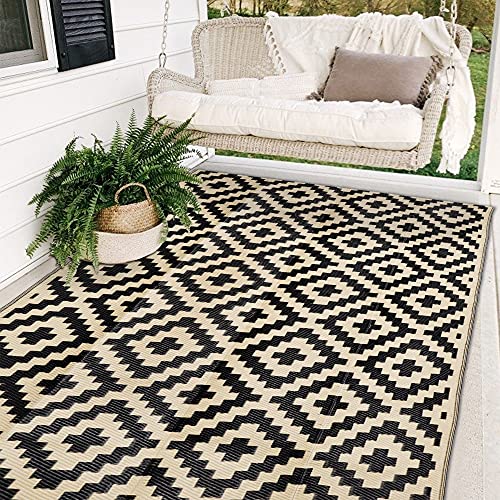
Where to buy
Every linked pick in this guide is sold on Amazon. Outdoor rug prices change with size and colorway, so this guide prints no fixed product prices — use the “Check on Amazon” links to see the live price for the exact size and color you are ordering.
Disclosure: dailyhomedecorating.com is reader-supported. When you buy through links on our site we may earn an Amazon affiliate commission, at no extra cost to you. It never influences which rugs we recommend, and two picks below are included without a purchase link because we could not verify them tightly enough to link responsibly.
The best outdoor rug for backyards under $75 has to survive a harder life than any patio rug, because a backyard is not one surface — it is four. There is the deck or patio slab where people sit, the grass where kids and dogs actually play, the dirt-and-mulch border that tracks mud onto everything, and the weather itself, arriving unfiltered with no roof to soften it. A rug that is perfect on the deck can be a soggy disaster on the lawn, and the size question runs in the opposite direction from a balcony: backyards tempt you to buy big, while this budget rewards buying smart. This guide was built around that reality. We verified what the under $75 ceiling honestly buys — and it is mostly excellent 5×7 and 5×8 rugs, not the 8×10 woven rug the listing photos imply — then matched each pick to the backyard zone it actually serves, screened every candidate against safety recall records, and paid special attention to drainage, mud, paws and fire-pit distance.
The strategy that works in a backyard is zoning. One well-chosen rug under the seating group, a second inexpensive mat where the kids and dogs land, and bare, honest grass everywhere else beats one oversized rug failing at every job. The six picks below divide exactly that way: reversible plastic straw mats that can live on grass, shed water and hose clean after muddy paws, and woven polypropylene rugs that turn a deck or patio corner into a barefoot outdoor room.
In this guide
Quick Picks
Each row matches a backyard job to the rug that does it best. The two prose-only picks are rugs we rate but could not verify tightly enough — on ASIN or on variant price — to link responsibly; their reviews explain what to check if you shop for them yourself.
| Backyard job | Pick | Why it stands out | Link |
|---|---|---|---|
| Best for grass and play zones | SAND MINE Waterproof Outdoor Rug, 5×8 ft | Waterproof reversible mat that lifts off the lawn and hoses clean — check price on Amazon | Check on Amazon |
| Best all-round backyard mat | GENIMO Outdoor Rug Waterproof, 5×8 ft | Reversible, quick-drying, huge pattern range for seating zones — check price on Amazon | Check on Amazon |
| Best for decks and patios | Nourison Aloha Indoor/Outdoor Rug, 5’3″ x 7’5″ | Woven texture and grip from a specialist rug maker — check price on Amazon | Check on Amazon |
| Best natural look | CAMILSON Outdoor Rug Bordered, 5×7 ft | Jute-look woven rug that suits garden-facing seating — check price on Amazon | Check on Amazon |
| Best for high-traffic paths | MontVoo Outdoor Rug Carpet, 5×7 ft | Dense Wilton-style weave built for daily foot traffic | Prose-only — see review |
| Best classic garden style | Safavieh Courtyard Indoor/Outdoor Rug, 5’3″ x 7’7″ | Traditional patterns that suit brick, stone and teak | Prose-only — see review |
How These Picks Were Chosen
We started with the honest size audit, because backyard marketing depends on shoppers not doing it. In woven constructions, an 8×10 outdoor rug from a real manufacturer costs more than this entire budget — the math of looms and yarn does not bend. What under $75 buys in a woven rug is a genuine 5×7-class area rug, and what it buys in a plastic straw mat is a 5×8 with money left over. Larger straw mats exist in these product lines and some colorways of some sizes are sighted within reach of this tier, but prices swing so sharply by size and color that we refused to anchor a pick on a size we had not verified. Every review below names the size its verification is tied to. If your seating group truly needs 8×10 woven coverage, the honest route is the next tier up — Best Outdoor Rug Under $150 — not a listing whose headline price belongs to a doormat size.
Construction was the second filter, judged by backyard abuse rather than showroom feel. On grass, only the straw mats qualify: they do not wick ground moisture, they lift in seconds so the lawn beneath can breathe, and mud hoses off them completely. On decks and patio slabs, woven rugs earn their place with grip, weight and barefoot comfort. Under dogs, the test is claws and accidents; under kids, it is juice, chalk and dragged toys; under a grill or fire pit, it is heat — and here the rule is absolute: polypropylene melts, so every rug in this guide must sit well clear of open flame and ember range, a point we return to in the safety notes. We also checked edge construction, because a rug dragged across a yard and folded into a shed dies at its edges first, and both mat picks use heat-treated edging for exactly that reason.
Safety screening came third and is non-negotiable in our process. We searched U.S. Consumer Product Safety Commission recall records for rug flammability hazards — cheap rugs are a recurring recall category, and a shag-style indoor rug was recalled for fire risk as recently as this season. None of the six brands in this guide appears in those records for the rugs discussed here, and under our rules a recalled product is excluded entirely rather than reviewed with a warning. Backyard-specific safety also shaped the picks: slip behavior when wet, corner lift as a trip hazard on the path from door to garden, and the heat rule above.
Finally, we weighted storage and seasonality. A backyard rug lives in a shed or garage, gets folded around garden tools, and must survive being put away damp once by accident. The picks that fold small, dry fast and forgive neglect scored accordingly. If you are building the backyard around the rug, our companion guides cover Best Adirondack Chair For Backyards Under $75 for seating, Best Deck Box For Backyards Under $75 for the storage these rugs fold into, and Best Camping Chair For Backyards Under $75 for overflow seating on the grass. Shoppers with a smaller zone to cover can also look at Best Outdoor Rug For Backyards Under $50, where the mat end of this same market lives.
The 6 Best Outdoor Rugs for Backyards Under $75
SAND MINE Waterproof Outdoor Rug, 5×8 ft — Best for Grass and Play Zones
The SAND MINE Waterproof Outdoor Rug is the backyard workhorse of this guide, because it is the pick that can go where backyard life actually happens: on the grass. Woven from 100% virgin polypropylene straw with heat-treated edges and a UV coating, it is fully waterproof, so a morning’s dew, a sprinkler cycle or a spilled cooler does not soak it — water sits on the surface and shakes off. At 5×8 it is big enough to define a play zone, a picnic patch or the landing area under a swing set’s exit, and it folds into its carry bag when the lawn needs to recover. One side is black, the other beige, and the darker side is the correct choice for the mud season.
Who it suits: Families whose backyard rug will host kids, dogs, picnics and sprinkler overspray — anyone who needs a floor that can be picked up, shaken out and hosed down in five minutes.
Pros:
- Truly grass-safe: waterproof, lifts in seconds so the lawn breathes — check price on Amazon
- Largest coverage at the lowest end of the tier
- Mud, paw prints and spills hose off completely
- Reversible black-and-beige; the dark side hides a season of yard dirt
- Folds into a carry bag for shed storage or park trips
- Heat-treated edges survive dragging and folding
Honest limitation: Any mat left on grass for weeks will yellow the lawn beneath it in a neat rectangle — that is grass biology, not a product flaw, and the fix is to lift or shift the mat every few days. It also feels like a woven plastic mat underfoot rather than a carpet, and it must be kept well away from fire pits and grill embers, since polypropylene melts.
Choose it if your rug’s home is the lawn and its enemies are mud and water. Skip it if the rug will live permanently on a furnished deck where barefoot texture matters — the woven picks below serve that spot better. Check on Amazon
GENIMO Outdoor Rug Waterproof, 5×8 ft — Best All-Round Backyard Mat
The GENIMO Outdoor Rug is the mat for the seating zone: a reversible 5×8 polypropylene straw rug with heat-sealed edges, a carry bag, and the widest color and pattern range in this tier — geometrics, stripes and palm prints, each woven double-sided so flipping it inverts the palette. In a backyard that range does practical work. A busy pattern under an outdoor dining set hides the evidence of outdoor dining; a bright print turns a plain slab into the yard’s focal point; and when one side fades after seasons of sun, the other side has been waiting in the shade. GENIMO’s line is also one of the few in this class with a materials certification noted in independent roundups, a detail worth having in a category of anonymous plastics.
Who it suits: Homeowners flooring a patio or deck seating zone who want mat practicality — waterproof, quick-drying, hose-clean — without giving up on looks.
Pros:
- Reversible designs with the widest pattern choice here — check price on Amazon
- Waterproof and quick-drying after storms and sprinkler runs
- Busy patterns camouflage crumbs, pollen and paw prints between cleanings
- Light enough to move between deck, lawn and campsite
- Heat-sealed edges and carry bag included
Honest limitation: On a smooth patio slab an unfurnished corner can skate or lift in wind until chairs and a table anchor it, and like its SAND MINE sibling it can hold a film of water against sealed surfaces — lift it after heavy rain to let the slab dry. It is also a mat, not a carpet: smooth and practical underfoot, without the woven picks’ textile warmth.
Choose it if you want one mat that dresses the seating zone and survives the sprinkler. Skip it if your zone is a shaded, wet corner where any covering will sit damp — there, lift-and-dry discipline matters more than brand. Check on Amazon
Nourison Aloha Indoor/Outdoor Rug, 5’3″ x 7’5″ — Best for Decks and Patios
The Nourison Aloha is the backyard’s indoor-outdoor rug proper: flat-woven polypropylene from a specialist rug manufacturer, with a high-low texture that carves its botanical pattern into the surface. On a deck or patio slab it does the things mats cannot — it grips, it lies dead flat, it feels like a floor covering under bare feet, and it turns a seating group into a room. The 5’3″ by 7’5″ size anchors a four-chair grouping or a sofa-and-chairs arrangement on a modest deck, and the non-shedding weave vacuums and hoses clean without drama.
Who it suits: Homeowners whose backyard living happens on a deck or patio and who want that space to feel furnished — especially covered or sun-washed decks where a woven rug can dry properly.
Pros:
- Real woven-rug feel and grip from an established rug maker — check price on Amazon for the 5’3″ x 7’5″
- High-low texture hides footprints, crumbs and garden dust
- Non-shedding; vacuum, sweep or hose to clean
- Lies flat with no curled corners on the door-to-garden path
- Bold patterns define a seating zone on a plain deck
Honest limitation: Keep it on the hard surface. On grass a woven rug wicks ground moisture, stays damp and shadows the lawn; after open-sky rain it needs real drying time even on a deck, and a permanently shaded, wet deck corner will keep it damp enough to mildew on the surface beneath. Its larger sizes also exceed this budget — the 5’3″ x 7’5″ is the verified size here, and bigger coverage means the next tier.
Choose it if your backyard rug lives on decking or pavers and barefoot feel matters. Skip it if you need one rug to migrate between deck and lawn — buy a mat for the grass instead, or one of each. Check on Amazon
CAMILSON Outdoor Rug Bordered, 5×7 ft — Best Natural Look
The CAMILSON Outdoor Rug in its bordered design is the pick for the garden-facing corner: a natural-brown field with a clean border that imitates woven jute, rendered in polypropylene so it can live outside without jute’s fatal habit of rotting when wet. Against planting, stone and timber it reads as part of the garden rather than an object placed on it, and its flat woven profile grips patio slabs and decking with quiet competence. At 5×7 it suits a two-chair retreat, a bench nook or the space under a small bistro set at the yard’s edge.
Who it suits: Gardeners and anyone whose seating spot overlooks planting — and anyone furnishing a porch or sunroom where the same rug can work indoors through winter.
Pros:
- Jute-look border design that blends with garden materials — check price on Amazon
- Woven polypropylene: washable, non-shedding, weather-tolerant
- Flat profile and good grip on slabs and decking
- Neutral palette pairs with teak, stone and brick
- Doubles as an indoor rug in the off-season
Honest limitation: Its pale natural tones are the least forgiving here for the backyard’s signature stains — mud, leaf tannin and ash all show, and while it cleans well, you will clean it visibly more often than a dark mat. At 5×7 it is also a nook-sized rug, not a full seating-group anchor; measure your grouping before assuming it covers it.
Choose it if natural looks and a quiet corner are the brief. Skip it if the rug will live under a messy tree or beside a fire pit — a dark reversible mat hides that life better and keeps a safer distance from embers. Check on Amazon
MontVoo Outdoor Rug Carpet, 5×7 ft — Best for High-Traffic Paths (Prose-Only)
The MontVoo Outdoor Rug Carpet is built for the backyard’s traffic lanes. Woven on Wilton looms from polypropylene, it has a dense, flat, textured weave with a boho geometric pattern in neutral browns, and independent comparisons single it out for high-traffic decks. In backyard terms that density is for the strip between the back door and the grill, the route to the garden gate, the ground under the outdoor dining chairs that scrape in and out a thousand times a summer. Its fade-resistant color suits full-sun exposure, and chairs slide over it without bunching.
Who it suits: Households whose deck or patio carries constant foot traffic, and anyone whose rug must survive chair legs and dragged coolers daily.
Pros:
- Dense Wilton-style weave with a genuinely textile surface
- Built for high traffic; resists bunching under chairs
- Fade-resistant for open, sunny yards
- Neutral geometry works with wood, composite and stone
Honest limitation: This pick is prose-only on verification grounds. Its 5×7 price has been sighted comfortably inside this budget in independent reporting, but we could not confirm the exact Amazon ASIN for the Wilton-woven 5×7 variant — MontVoo also sells a plastic straw line under similar names — and we do not link what we cannot verify. If you shop for it, confirm the listing describes a Wilton-woven polypropylene carpet rather than a straw mat, and check the live 5×7 price against your budget. As a woven rug, it dries slower than the mats after rain.
Choose it if traffic is your rug’s main enemy and you will do the one-minute listing check. Skip it if you want a verified one-click purchase from this page.
Safavieh Courtyard Indoor/Outdoor Rug, 5’3″ x 7’7″ — Best Classic Garden Style (Prose-Only)
Safavieh’s Courtyard collection is the traditional garden’s rug: power-loomed polypropylene, a low non-shedding pile, and a deep library of classic patterns — trellis, scroll and bordered designs in navy, beige and terracotta that were practically designed for brick terraces, stone patios and teak furniture. The 5’3″ by 7’7″ size anchors a formal seating group, the construction tolerates hosing and scrubbing after a muddy week, and the designs coordinate with the kind of established backyard that bright tropical prints would fight with.
Who it suits: Owners of traditional homes and gardens who want a proven, conservative rug for a terrace or patio — and who may bring it into a mudroom or porch for winter.
Pros:
- Deep classic pattern library from a major rug brand
- Power-loomed polypropylene: non-shedding, hose-clean
- Generous 5’3″ x 7’7″ proportion
- Coordinates with brick, stone, iron and teak
Honest limitation: Prose-only, on verification rather than quality: Courtyard pricing for this size swings by pattern, with recent Amazon sightings for 5’3″ x 7’7″ rugs on both sides of this guide’s ceiling, and no verified under-ceiling price could be pinned to one specific pattern’s ASIN. Shop the collection by size, and consider only patterns whose live price for the 5’3″ x 7’7″ fits your budget — several usually do, but it changes week to week. It also shares the woven family’s slower drying, so site it on hard surfaces, not lawn.
Choose it if classic styling leads and checking a live price per pattern is acceptable. Skip it if you need price certainty before you click.
Comparison Table
Backyard rugs separate on three axes: where they can live, how they handle water and mud, and how they store. The table compresses the six reviews onto those axes.
| Pick | Construction | Verified size | Grass-safe? | Mud cleanup | Link |
|---|---|---|---|---|---|
| SAND MINE Waterproof | Virgin polypropylene straw mat, reversible | 5×8 ft | Yes — lift regularly | Hose; releases completely | Check on Amazon |
| GENIMO Waterproof | Polypropylene straw mat, reversible | 5×8 ft | Yes — lift regularly | Hose; patterns hide residue | Check on Amazon |
| Nourison Aloha | Flat-woven polypropylene, high-low | 5’3″ x 7’5″ | No — hard surfaces | Vacuum grit, then hose | Check on Amazon |
| CAMILSON Bordered | Woven polypropylene, jute-look | 5×7 ft | No — hard surfaces | Washable; light tones show mud | Check on Amazon |
| MontVoo Carpet | Wilton-woven polypropylene | 5×7 ft | No — hard surfaces | Hose or scrub | Prose-only |
| Safavieh Courtyard | Power-loomed polypropylene | 5’3″ x 7’7″ | No — hard surfaces | Hose or vacuum | Prose-only |
The grass column is the whole backyard argument in one word per row. Mats can go anywhere but must be lifted so the lawn lives; woven rugs must stay on hard surfaces but reward that discipline with feel and grip. Most backyards want one of each, in that order.
How to Choose the Best Outdoor Rug for Backyards Under $75
Zone the yard before you shop. Walk the backyard and name its zones: seating, dining, play, path, grill. Each zone has a different right answer, and trying to cover two zones with one rug usually serves neither. Seating and dining on hard surfaces take woven rugs or mats; play and picnic zones on grass take mats only; paths take density, which means the woven MontVoo class or a mat you accept replacing sooner; the grill zone takes no rug at all within ember range.
Be honest about size — in both directions. Under this budget, woven coverage tops out at the 5×7 class, and that is enough for a four-chair grouping with front legs on the rug. If your grouping is a six-seat dining set or a sectional, two honest options exist: accept a straw mat’s larger, cheaper coverage knowingly, or move the woven purchase up a tier with Best Outdoor Rug Under $150. The dishonest option — a listing whose headline price belongs to a tiny size — is how backyards end up with a rug that looks like a postage stamp. Measure the furniture footprint, add roughly two feet around a dining table for pulled-out chairs, and buy the size the tape says.
Match construction to surface and weather. Grass, gravel and dirt: straw mats, lifted regularly. Decks and patios in sun: either family, chosen by feel. Shaded, wet hard surfaces: mats, or woven rugs only with a real lift-and-dry habit, because a woven rug that never dries keeps the surface beneath it damp and invites mildew. Under trees that drop sap, berries or heavy leaf litter, mid-tone busy patterns are camouflage; pale rugs under a mulberry tree are a life choice you will regret by July.
Plan for dogs and kids as design inputs, not afterthoughts. Claws do not harm polypropylene in either construction, but looped textures can snag — the flat weaves and straw mats here are the claw-safe choices. Accidents hose off mats completely and wash out of woven rugs with a scrub; the difference is drying time afterward. For toddlers, a mat’s slightly springy flat surface is a fine play floor, while a woven rug’s grip wins on a deck where falls happen on the way to the grass.
Respect heat, and store for winter. Polypropylene softens and melts at temperatures a fire pit’s embers and a grill’s dropped coals reach easily. Site every rug well outside ember range, never under a fire bowl, and treat any rug near a grill as a floor covering, not a hearth mat. In autumn, clean, dry fully, then fold mats into the shed or roll woven rugs; a rug stored dry in October is a rug that looks new in April.
Rugs, Fire Pits and Grills: The Backyard Safety Notes
Backyard rugs live closer to open flame than any other floor covering in the home, so this guide’s safety screening deserves its own plain summary. First, the recall screen: we check every pick against U.S. Consumer Product Safety Commission records for rug flammability violations, because federal standards for carpets and rugs exist and some imports fail them — a shag-style indoor rug was recalled on exactly those grounds this season. No pick in this guide is a recalled product, and a recall would have excluded it outright.
Second, placement. No polypropylene rug — mat or woven, from any brand — belongs under or beside a fire pit, chiminea, grill or smoker at ember distance. Embers melt synthetic fiber on contact, and a rug that has taken a few ember burns is both unsightly and compromised. Give fire features a surround of bare stone, gravel or concrete, and let the rug start where the seating starts. The same logic keeps rugs out from under grill drip zones, where hot grease is both a stain and a slip hazard.
Third, the wet-weather basics: a wet mat on a smooth slab can be slick underfoot, a curled corner on the door-to-garden path is a trip hazard for anyone carrying a tray, and a rug left sealing a wet deck for weeks can mark the boards beneath. All three are managed by the same habits this guide repeats — furniture anchoring the corners, lifting after storms, drying before storage. None requires giving up the rug; all require treating it as outdoor equipment rather than indoor carpet that happens to be outside.
Common Buying Mistakes
Putting a woven rug on the lawn. It wicks ground moisture, stays damp, mildews underneath and shadows the grass. Grass takes straw mats, lifted every few days — full stop.
Buying for the headline price. The big price belongs to the smallest size. Select size and color first, then judge — an 8×10 woven rug under this budget does not exist, whatever a listing implies.
Siting a rug at ember range. Polypropylene melts. Keep every rug well clear of fire pits, grills and smokers, with bare hard surface around the heat.
Leaving a mat on grass all season. The lawn beneath yellows in a perfect rectangle. Lift or shift mats regularly so the grass gets light and air.
Storing a damp rug. One damp fold in October becomes spots and odor by April. Clean it, dry it fully in the sun, then store it.
Choosing pale colors under trees. Leaf tannin, berries and sap mark light rugs. Under canopy, mid-tones and busy patterns are the honest choice.
Two-Rug Zoning in Practice: A Worked Example
Abstract advice about zoning gets concrete fast with a typical backyard in mind: a modest deck off the back door, a lawn beyond it, a grill on the deck’s edge and a family that eats outside three nights a week in summer. Here is how this guide’s budget furnishes that yard well. The deck takes the woven rug — the Nourison if the deck is covered or sunny, the CAMILSON if the seating is a quiet two-chair corner — sized to the seating group with front legs on the rug and the grill standing on bare boards outside the rug’s edge. The lawn takes the SAND MINE mat, not as a permanent installation but as a deployable floor: out for the weekend’s picnic, the kids’ water play and the evening the seating overflows onto the grass, then shaken, dried and back in the shed or the deck box before the work week. The path between door and grill stays bare, because it is a traffic lane and a grease route, and no rug earns its keep there.
Notice what that arrangement buys. The deck feels furnished every day, which is what the household actually uses. The lawn gets a floor exactly when a floor is wanted and light and air the rest of the time, so there is no yellow rectangle by August. The grill keeps its safe, bare surround without negotiation. And the whole scheme fits the budget because each rug was bought at the size its zone honestly needed — a 5×7-class woven rug and a 5×8 mat — rather than one heroic 8×10 asked to do three jobs and doing the wettest one badly. When the household grows into a sectional or a six-seat table, the upgrade path is equally clear: the woven rug’s zone is the one that steps up a tier, and the mat simply keeps doing mat work.
The same logic scales down as well as up. A small yard with only a patio slab and a strip of grass still zones: woven or mat on the slab by feel and exposure, mat alone for the grass strip’s occasional use, and nothing anywhere near the grill. Zoning is not about buying more rugs. It is about refusing to ask one rug to be waterproof play equipment and barefoot furniture at the same time.
A Backyard Rug Care Calendar
Backyard rugs fail from neglected calendars more than from bad construction, so here is the whole maintenance burden laid out honestly — it is smaller than most owners fear. Weekly, in season: sweep the woven rugs, shake the mats, and glance at edges and corners for the lift or fray that is cheap to fix early. After storms: lift each rug once, check the surface beneath, and let both dry — ten minutes that prevents the mildew and deck-marking that account for most one-star stories in this category. Monthly: a real clean, hose and brush, with attention to the grill-adjacent and under-table zones where grease and food actually land; and a rotation, turning woven rugs a half-turn so sun and traffic even out across the surface instead of concentrating on one corner.
Seasonally, the calendar has two entries that matter. In spring, inspect before furniture lands: edges, underside, any winter-storage spots; wash, dry fully in sun, then set the yard up. In autumn, reverse the ritual with more care — the pre-storage clean and complete drying are the difference between a rug that returns fresh and one that returns spotted — then fold mats flat into the deck box or shed and roll woven rugs around a tube if you have one. In freeze climates, that storage is not optional housekeeping; standing water plus freeze-thaw is the one weather pattern that genuinely shortens polypropylene’s life.
Dogs and kids add one line to the calendar: a rinse after accidents, promptly, because what hoses off in a minute today is a scrubbing job next week. That is the entire regime. Followed loosely, it takes a rug from this tier through several summers; ignored entirely, it makes even the best rug in this guide look tired by its second season — which is why the reviews above weight forgiveness and drying speed as heavily as they do.
Backyard Surfaces, One by One
Because a backyard is several floors pretending to be one, it is worth walking the surfaces individually. Wood decking is the most demanding host: it wants a rug that breathes, a household that lifts after storms, and a strict rule against rubber backings — which is why every pick here is unbacked polypropylene. Composite decking is more forgiving of moisture but can be marked by some backing materials and by prolonged gritty contact, so sweep beneath the rug monthly and it will never know the rug was there. Concrete and pavers take anything in this guide and ask only for the occasional lift in wet seasons. Gravel takes mats only, laid over a smoothed patch, and rewards them by draining instantly. Bare dirt takes mats too, for events, with the understanding that the mat is a floor for a day rather than a season. And grass, the surface that tempts everyone, takes mats on a lifting schedule or nothing at all — the lawn is itself a floor covering, and the rug’s job on it is temporary definition, not permanent replacement.
Slopes deserve a final word, because backyards are rarely as flat as patios. On a gentle grade, orient a rug so its long dimension runs across the slope; chairs creep less, the rug creeps less, and rain sheets across rather than pooling along one edge. On a real slope, skip the rug in the traffic path entirely — a sliding rug on a wet incline is a hazard wearing a pattern. The flat zones of the yard are where rugs belong, and most yards have more of them than their owners first think.
What a Season Does to Each Construction
Expectations set in the first month decide whether a backyard rug is loved in the fourth, so it is worth forecasting honestly. A straw mat ends its first season looking much as it began, provided it was lifted off grass and stored dry; its aging shows first at the fold lines and in a gentle overall fading on the sun side, which flipping redistributes. A woven rug ends its first season softer in appearance — the weave relaxes, colors settle — and its aging shows first in the traffic lane and under the dining chairs, which the monthly half-turn rotation in our care calendar exists to even out. Neither trajectory is a defect; both are what honest materials do outdoors, and both are dramatically slowed by the same three habits: shade when possible, dryness when stored, and grit removed before it is ground in.
The second season is where the tier proves itself. The picks in this guide were chosen so that year two is a continuation, not a decline narrative — heat-sealed edges that have not started to fray, solution-dyed style color that has not bleached to a ghost, weaves that still lie flat. When a backyard rug does reach its end, it is almost never the middle that fails; it is an edge, a corner or a stored-damp spring surprise. Buy the edge construction, keep the storage dry, and the middle will take care of itself.
Final Recommendation
Build the backyard in zones and this guide resolves itself. For the grass — play, picnics, dogs, sprinklers — buy the SAND MINE 5×8 and lift it like you mean it. For the seating zone, choose by surface: the GENIMO 5×8 mat if the spot is open to weather and you want pattern choice, the Nourison Aloha if it is a deck or patio that deserves a real rug’s grip and texture, and the CAMILSON Bordered for the quiet garden corner. The MontVoo and Safavieh reward a search of your own if traffic density or classic patterns lead your list — verify variant and live price as their reviews describe. Measure the grouping, keep rugs clear of the fire, and let each zone have the construction it actually needs.
Frequently Asked Questions
Can you put an outdoor rug on grass?
Yes — a plastic straw mat, not a woven rug. Mats are waterproof, do not wick ground moisture, and lift in seconds. The discipline is lifting: move or roll the mat every few days so the grass beneath gets light and air, or it will yellow in the rug’s outline. Woven rugs on grass stay damp and should stay on hard surfaces instead.
What size outdoor rug do I need for a backyard seating area?
A 5×7 or 5×8 carries a four-chair grouping or a compact dining set with front legs on the rug — the honest maximum for woven rugs under $75. Larger groupings need either a straw mat’s cheaper coverage or a higher budget tier. Measure the furniture footprint and add about two feet around dining tables for pulled-out chairs.
Are outdoor rugs safe near a fire pit?
Not at ember range. Polypropylene melts when embers land on it, so keep any rug well away from fire pits, chimineas and grills, with bare stone, gravel or concrete around the heat source. This guide also screens every pick against federal flammability recall records; no pick here is a recalled product.
How do I clean mud and paw prints off an outdoor rug?
Let mud dry, shake or sweep it off, then hose the rug down. Straw mats release dirt completely and dry within about an hour in sun. Woven rugs hold grit in the weave, so vacuum or brush first, then hose and scrub stubborn spots with mild soap, and dry fully — ideally over a fence or railing — before laying the rug back down.
Will an outdoor rug kill the grass underneath?
Any covering left in place for weeks will yellow grass by blocking light. Mats minimize the damage because they are light and easy to move: lift or shift yours every few days and the lawn recovers. Leaving any rug in one spot for a whole season will leave a mark regardless of material.
How many rugs does a backyard actually need?
For most yards, two at most: one for the hard-surface seating zone and one mat for grass and play, bought at the sizes their zones honestly need. A third rug is justified only by a third genuine zone, like a separate dining terrace. More rugs than zones means more lifting, drying and storing than most households sustain — and an unmaintained rug ages faster than a used one. Start with the zone you use daily; add the second when its absence, not its presence in a catalog, bothers you.
Do I need a rug pad under a backyard rug?
On grass and gravel, no — a pad has no job there. On smooth sealed concrete or glossy pavers, a pad earns its place under a mat that slides or a woven rug you want cushioned: choose an open-weave outdoor pad that drains freely, never a solid indoor pad that would hold water against the surface. Most furnished seating zones need no pad at all, because the furniture anchors the rug; try the rug bare first and add a pad only if it actually creeps.
Can outdoor rugs stay outside all winter in a backyard?
They survive it better folded in a shed. Clean and dry the rug fully, fold mats or roll woven rugs, and store under cover; months of standing water and freeze-thaw degrade even polypropylene and can stain the surface beneath. In mild, dry climates a mat can work through winter with regular lifting.
Furnishing the rest of the yard? Start with Best Adirondack Chair For Backyards Under $75 for seating and Best Deck Box For Backyards Under $75 to store the rugs and cushions between seasons.


