Where to buy
Check the latest price, availability and delivery on Amazon. Orders are placed on Amazon. We may earn a commission from qualifying purchases.
- Best overall for backyards: SAND MINE Reversible Mats, 5′ x 8′, Black & Beige — Check on Amazon
- Best for patio-and-lawn life: GENIMO Outdoor Rug, 5′ x 8′, Grey & White Leaf — Check on Amazon
- Best party pattern: MontVoo Outdoor Rug Carpet, Waterproof 5′ x 8′, Reversible — Check on Amazon
- Best for covered backyard patios, at the top of this tier on sale: Gertmenian Indoor Outdoor Flatweave Rug, 5′ x 7′, Sand Dollar Starfish, Oasis Green — Check on Amazon
- Best for fire-pit and grill zones: SAND MINE Waterproof Outdoor Rug, 4′ x 6′ — Check on Amazon
- Best quality benchmark, prose-only: Nourison Aloha Indoor/Outdoor Rug, 5’3″ x 7’5″, Blue and Multicolor — discussed below without a purchase link, for the reason given in its review.
Read the full guide ↓
Disclosure: As an Amazon Associate, dailyhomedecorating.com earns from qualifying purchases. Links to Amazon on this page are affiliate links; they cost you nothing extra. Listing details such as price and availability change often, so check the current Amazon listing before you buy.
A backyard is the hardest workplace a budget rug can draw, and the best outdoor rug for backyards under $50 has to survive all of it: full sun with no roof, rain that arrives in inches, grass and soil at the edges, mud on every shoe and paw, and furniture that lives outside through all of it. The backyard also changes the size conversation. A patio slab wants one anchored zone, but a backyard invites zoning, a seating zone on the slab, a dining zone under the tree, a mat by the grill, and the winning strategy at this budget is usually one honest five-by-eight where people sit plus smaller mats where work happens, rather than one heroic rug straining to cover a yard. Ground contact is the backyard’s defining demand. A rug here may sit half on concrete and half on soil, or move between slab and lawn with the season and the party, so breathability, ground stakes and a weave that will not cook the grass are first-order features, not fine print.
Sun is the second demand. Backyard rugs take ultraviolet from dawn to dusk with no building shadow to help, so UV-stable color in the fiber itself, polypropylene in every pick here, is what stands between a rug that looks good in year two and a rug that looks bleached by August. The third demand is cleaning at backyard scale: mud, leaf tannins, pollen paste and the occasional sauce disaster. This is hose country, and the picks below are ranked by how completely a hose and a sunny afternoon can reset them. For every linked pick, check price on Amazon for the named size and colorway, and be honest about which surface, slab, deck or lawn, the rug will mostly touch, because the reviews below split on exactly that line.
In this guide
Quick Picks
Short on time? Each row names a buyer type and the rug that suits it. Always select the size named in the row first and then check price on Amazon, because with outdoor rugs the price belongs to the size and the colorway, not to the product name.
| Buyer type | Pick | Why it stands out | Link |
|---|---|---|---|
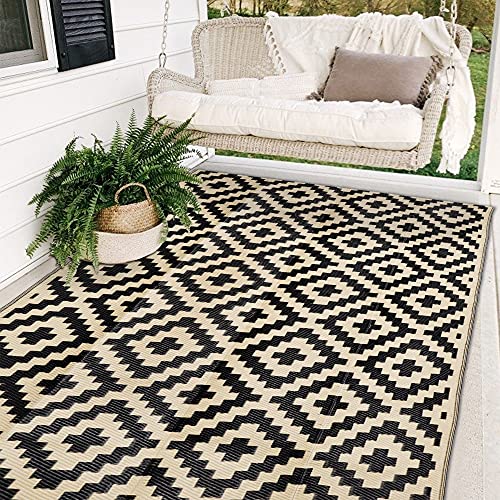
| Best overall for backyards | SAND MINE Reversible Mats, 5′ x 8′, Black & Beige | Breathable, stake-down straw that survives lawn and slab alike; check price on Amazon | Check on Amazon |
| Best for patio-and-lawn life | GENIMO Outdoor Rug, 5′ x 8′, Grey & White Leaf | Reversible five-by-eight that moves between zones and flips for a fresh face; check price on Amazon | Check on Amazon |
| Best party pattern | MontVoo Outdoor Rug Carpet, Waterproof 5′ x 8′, Reversible | Boho face that photographs like a designed yard, hoses clean after; check price on Amazon | Check on Amazon |
| Best covered patio feel | Gertmenian Indoor Outdoor Flatweave Rug, 5′ x 7′, Sand Dollar Starfish, Oasis Green | Flatweave for the roofed corner of the yard, at the top of this tier on sale; check price on Amazon | Check on Amazon |
| Best small zone mat | SAND MINE Waterproof Outdoor Rug, 4′ x 6′ | Four-by-six for grill and fire-pit zones, kept clear of embers; check price on Amazon | Check on Amazon |
| Best quality benchmark | Nourison Aloha Indoor/Outdoor Rug, 5’3″ x 7’5″, Blue and Multicolor | Woven floral for the slab-as-living-room, above this tier in room size, so prose-only | Prose-only pick, no link |
How These Picks Were Chosen
Backyard judging begins underground. We favored weaves that let the surface beneath them breathe and dry, because a backyard rug sits on living ground or on a slab that sweats, and a sealed plastic layer creates a pale, damp rectangle of regret by midsummer. Included stakes, corner loops and carry bags all scored, because backyard rugs travel: to the lawn for a party, to the driveway for a wash, to the shed for winter. UV stability was treated as a construction fact to verify in the listing, not a slogan, and polypropylene’s inherent fade resistance is why it monopolizes this shortlist.
Cleaning realism came next. A backyard rug will be muddy, and the question is whether mud is a five-minute hose job or a weekend project. Open straw weaves reset completely with water and sun. Flatweaves reset with more effort and more drying time, so the one flatweave here is assigned to covered backyard corners only. Pattern forgiveness mattered too: lattices and busy prints hide the pollen film and leaf shadows that pale solids display like evidence.
As everywhere in this batch, positioning is labeled honestly. The straw mats sit in the lower part of this tier as ordinary options at their named sizes. The Gertmenian sits at the top of the tier on sale. The Nourison Aloha is prose-only because room-size woven quality does not verify inside this budget. We worked from maker listings, specifications and care directions, and checked the lines against recall records, rather than using the rugs ourselves. Backyard planners laying out more than a rug should see Best Outdoor Rug For Backyards Under $75 for the larger woven sizes a step up unlocks.
The 6 Best Outdoor Rugs for Backyards Under $50
SAND MINE Reversible Mats, 5′ x 8′, Black & Beige
Who it suits: Slab-and-lawn backyards, dog owners and anyone whose rug will touch grass, soil and weather in the same week.
SAND MINE builds its reversible mats from one hundred percent virgin polypropylene, and the detail that separates this mat from the cheapest straw rugs is the edging: the borders are heat-treated so the woven tubes do not fray at the corners where straw mats usually die first. The weave is UV-coated against fading, breathable enough that the maker states it will not harm grass or scratch a deck, and open enough that water drains straight through. The package thinking is practical: corner loops and a set of stakes for ground use, plus a carrying bag for storage. The Black and Beige colorway in the five-by-eight size is the classic lattice look that reads as a deliberate design choice rather than a camping accessory, and the reverse face inverts the scheme for a lighter or darker mood. At about five millimeters thick it has slightly more presence underfoot than the thinnest straw mats while staying firmly in hose-it-and-forget-it territory.
This is the backyard pick because it was designed by people who clearly expect it to live on the ground. The stakes go through the corner loops and end the windy-day chase across the yard. The breathable weave lets the lawn beneath stay alive through a season of parties in a way a solid mat will not, and when the mat itself is filthy, the cleaning venue is the driveway and the tool is the hose, full stop. Dogs approve of it in the way dogs approve of anything flat and warm in the sun, and their mud wipes off the straw instead of working into a pile. If your yard plan includes evening hours, Best Fire Pit For Backyards Under $50 is the companion read, with the standing rule that any rug keeps the distance the fire maker requires and never sits where embers land.
- Stakes and loops for real ground use, not just slab use; check price on Amazon
- Breathable weave is the lawn-friendly choice in this guide
- Heat-treated edges for seasons of dragging and hosing
Honest limitation: Grit falls through the weave onto the ground beneath, which is fine on lawn and means a sweep on slabs; and like all straw, it offers no cushion on concrete.
Choose it if your backyard rug will touch grass or soil, host dogs or kids, and be cleaned with a hose or not at all. Skip it if your backyard surface is a finished deck you are protecting cosmetically; a woven pick presents better there.
GENIMO Outdoor Rug, 5′ x 8′, Grey & White Leaf
Who it suits: Families who move the party between slab and lawn and want one rug that works in both places.
Construction is where the GENIMO earns its place. The listing specifies polypropylene, a braided weave and effectively zero pile height, and each of those facts solves a real outdoor problem. Zero pile means chair legs glide instead of catching, crumbs sit on top where a broom can reach them, and the mat dries in hours rather than days because there is no absorbent layer. The reversible build doubles the design options and the service life: when one face fades or stains, the other is still fresh. Because it folds flat and travels in a carry bag, it is as much camping and picnic equipment as it is patio furniture, and that portability matters in any home where outdoor space is borrowed, shared or seasonal. The five-by-eight size is the sweet spot of the range, large enough to define a seating zone and small enough to hose off on a driveway without help.
The GENIMO’s backyard virtue is mobility with dignity. At five-by-eight it is a real room’s worth of floor, yet it folds into its bag and rides to wherever the gathering actually happens: under the dining set on the slab in June, under the picnic blanket zone on the lawn in July. The reversible faces suit backyard psychology too, because the side that took the barbecue can flip to the clean pattern for the birthday party while you postpone the deep hose-down. Its zero-pile surface shrugs off the backyard’s specific insults, grass clippings, spilled lemonade, the dog’s excavation souvenirs, with a broom and a rinse. Households setting up a whole yard on a budget often pair it with shade from Best Gazebo For Backyards Under $50, and the rug-plus-shade combination is the cheapest route to a backyard that feels hosted rather than merely owned.
- Room-size coverage that still folds and travels; check price on Amazon
- Two faces for the clean-party, muddy-weekend rotation
- Zero pile releases grass, crumbs and dried mud with a broom
Honest limitation: Unstaked and unfurnished on an open lawn it can lift in gusts; use furniture weight or borrow the staking habit from the SAND MINE routine.
Choose it if your backyard life moves between surfaces and you want one rug that follows it gracefully. Skip it if your rug will live permanently on grass; the staked, breathable SAND MINE above is built for that posting.
MontVoo Outdoor Rug Carpet, Waterproof 5′ x 8′, Reversible
Who it suits: Hosts and decorators whose backyard has a look, boho, garden-party or festival, and needs the floor to join in.
The honest way to describe the MontVoo is that it is a style upgrade inside an identical technology. Underneath the boho print it is the same family of reversible plastic-straw mat as the other straw picks: waterproof rather than water-resistant, quick to dry because there is nothing absorbent in it, and stable in sun because the color lives in UV-treated polypropylene tubes. Where it differs is choice. The line runs to multiple colorways built around grey, blue and warm brown palettes and to a long size ladder, so it is the easiest straw mat here to match to existing cushions and furniture. Care is rinse, shake and wipe, and the mat folds for storage between seasons. If two mats tie on construction, the one whose pattern you still enjoy in year two is the right one, and that is the contest the MontVoo is built to win.
Backyards are where pattern pays off most, because the competition is green: lawn, shrubs and sky. A boho MontVoo under a dining set gives a garden party a floor that photographs as styled, and after the party the same mat hoses clean of cake, wine and grass stains without a trace of the textile anxiety a woven rug would cause. The UV-stable color matters at backyard exposure levels, where a lesser print would fade to a rumor by Labor Day. Choose the colorway against your fixed elements, fence, house siding, the umbrella you already own, rather than against the listing’s staged garden. Hosts building the full scene will find Best Outdoor Cooler For Backyards Under $50 a practical next read, since drinks logistics decide backyard parties as surely as floors do.
- Pattern strong enough to style a green, open-air room; check price on Amazon
- UV-stable color for dawn-to-dusk exposure
- Party messes rinse off the straw surface completely
Honest limitation: Bold pattern plus garden color can be a lot; in a small, flower-heavy yard the lattice mats may sit quieter.
Choose it if your backyard hosts gatherings and you want the ground to look as planned as the table. Skip it if your yard is a calm, minimal space; a lattice or a flatweave will respect its quiet better.
Gertmenian Indoor Outdoor Flatweave Rug, 5′ x 7′, Sand Dollar Starfish, Oasis Green
Who it suits: Covered backyard patios, pergola corners and screened porches attached to the yard.
The Gertmenian is the pick for shoppers who want a rug that reads as a rug. Where the straw mats are woven plastic tubes, this is a classic flatweave: a textile surface with a printed coastal design of sand dollars and starfish in a soft oasis green, built for indoor-outdoor use and described by its maker as washable, stain-resistant and UV-resistant. Underfoot it feels like a thin carpet rather than a mat, chair legs sit on it the way they sit on an indoor rug, and the five-by-seven footprint is the traditional area-rug proportion that furniture layouts are planned around. Gertmenian is an established American rug house rather than a marketplace-only label, which shows in the finishing and in a size range that behaves like a real rug program. Its positioning in this tier is a sale positioning at the very top of the budget, and this guide labels it that way: when the promotion is not running, this rug lives in the next tier up.
Many backyards have one roofed corner, and that corner deserves the Gertmenian. Under a pergola or porch roof, its flatweave makes an outdoor room that feels continuous with the house: bare feet approve, dining chairs glide, and the coastal print suits the garden view it frames. Its brief is honestly narrower than the straw picks’, because a backyard flatweave that takes direct rain will spend its life drying, so place it where the roof earns its keep and give it air after storms. Its sale positioning at the top of this tier is the gate; check price on Amazon, and if the sale is live and your corner is covered, this is the backyard pick that guests will mistake for a far pricier rug.
- Room-like feel for the yard’s covered corner; check price on Amazon
- Smooth under dining chairs that move all evening
- Coastal print pairs with garden greenery naturally
Honest limitation: Direct rain is its enemy: in an open yard it will dry slowly and age fast, and its tier place depends on a sale being live.
Choose it if your backyard has a genuinely covered seating corner and the sale positioning is showing. Skip it if your seating is in the open yard; every straw pick above will outlive it there.
SAND MINE Waterproof Outdoor Rug, 4′ x 6′
Who it suits: Grill stations, fire-pit seating edges and potting corners: the backyard’s work zones.
This is the five-by-eight SAND MINE idea cut down to the size small spaces actually need. Four by six feet is twenty-four square feet: enough to sit under a bistro set, a pair of lounge chairs or a small loveseat, small enough to leave a border of floor visible so the space does not look carpeted wall to wall. The construction carries over from the larger mat, a woven polypropylene straw with heat-treated edging, in lattice patterns that pair with warm wood and black metal furniture. The listing weight for this size is about a pound and a half, which changes how you live with it: one person can shake it over a railing, rinse it in a shower stall or a driveway corner, and roll it into a closet without a second pair of hands. Small size is not a compromise here; it is the feature that makes weekly cleaning realistic.
Backyards run on zones, and the four-by-six SAND MINE is the zone rug. Under the grill it catches the drips that would tattoo the slab, and when it is too stained to forgive, its price forgives instead. Around a fire feature it defines the seating edge, placed at the full distance the fire maker’s instructions require and never where embers can land, because synthetic straw and sparks are enemies and this guide will not pretend otherwise. By the potting bench it gives knees and pots a clean, hoseable stage. Small mats are the backyard’s unsung strategy: they let you spend the budget where feet actually are instead of carpeting traffic lanes nobody uses. The same zoning logic drives Best Hammock For Backyards Under $50, the other small-footprint upgrade yards love.
- Cheap enough to dedicate to dirty work zones; check price on Amazon
- Hoseable surface for grill drips and potting soil
- Defines seating edges around fire features at a safe distance
Honest limitation: It is a zone tool, not a room anchor, and it must stay clear of ember range; no synthetic rug belongs where sparks land.
Choose it if you want the grill, fire or garden zones floored without spending the seating rug’s budget there. Skip it if you need one rug to anchor the main seating set; the five-by-eight picks are sized for that.
Nourison Aloha Indoor/Outdoor Rug, 5’3″ x 7’5″, Blue and Multicolor
Who it suits: Finished backyards where the slab is a true outdoor living room with real furniture and a long horizon.
The Aloha is what the woven end of this category looks like when a major rug house builds it without a budget ceiling. Nourison machine-makes it from polypropylene in a flatweave with a raised, high-low cut pile, so the big tropical floral pattern is not printed on the surface but built into it, with texture you can feel underfoot. It does not shed, it rinses clean with a hose and air-dries, and it carries the finishing quality, edge work and pattern scale of a rug designed to anchor a furnished patio for years. It is included in this guide as a prose-only pick for one plain reason: in the five-by-seven class its verified positioning sits above this budget, and a guide that linked it as an under-budget pick would be lying to you. Read its review as the quality benchmark, the rug to buy when the budget grows or when a smaller size fits your space and its live listing confirms the tier.
Where a backyard has been built out, slab, furniture, lighting, planting, the Aloha is the floor that matches the investment, with woven depth that reads from the kitchen window and a body that stays flat under a sectional for years. It is prose-only here because that quality does not verify inside this budget in room sizes, and the backyard framing makes the trade clearest: straw mats are consumables you replace in a few seasons without regret, while the Aloha is a fixture you buy once and plan around. Neither philosophy is wrong. Choose by how finished your yard already is, and check the current price on Amazon for any smaller Aloha size before ruling it out for a defined seating zone.
- Fixture-grade woven texture for built-out yards
- Lies flat and stays flat under heavy furniture
- The buy-once option when the yard is finished
Honest limitation: Above this budget in room sizes, and heavy enough that seasonal moving is a two-person job.
Choose it if your backyard is a finished outdoor room and the rug is the last layer, bought for years. Skip it if your yard is still evolving; straw now, and let the fixture rug follow the final layout.
No purchase link for this pick: see the positioning note above and check the current price on Amazon for the exact size before considering it.
Comparison Table
Backyard reading order: ground contact first, sun second, cleaning third. The rug that matches your surface wins; the rest is taste.
| Product | Type | Best use | Link |
|---|---|---|---|
| SAND MINE Reversible Mats, 5′ x 8′ | Virgin polypropylene straw, breathable, regular positioning | Lawn, soil and slab rotation with dogs and weather | Check on Amazon |
| GENIMO Reversible Rug, 5′ x 8′ | Plastic straw, reversible, regular positioning | One rug that follows the party between zones | Check on Amazon |
| MontVoo Outdoor Rug, 5′ x 8′ | Plastic straw, reversible, regular positioning | Garden-party pattern with hose-off cleanup | Check on Amazon |
| Gertmenian Flatweave Rug, 5′ x 7′ | Woven flatweave, sale positioning at the top of this tier | Covered backyard corners and porch rooms | Check on Amazon |
| SAND MINE Outdoor Rug, 4′ x 6′ | Polypropylene straw, small size, regular positioning | Grill, fire-edge and potting work zones | Check on Amazon |
| Nourison Aloha, 5’3″ x 7’5″ | Woven polypropylene high-low, above this tier in room size | Finished yards buying a fixture | No link, see review |
How to Choose the Best Outdoor Rug for Backyards Under $50
Zone the yard before you size the rug. Walk the yard and name the zones: sitting, dining, cooking, playing, working. Budget rugs earn their keep inside zones, not across whole yards. One five-by-eight for the main sitting zone and a four-by-six for the grill will serve a backyard better than a single mid-size rug centered nowhere. If dining dominates, size for the table with chair pull-out room; if lounging dominates, size for front legs on the rug and a walkway behind.
Match the weave to the ground it touches. Grass and soil demand breathable straw and stakes, and a commitment to lift the mat occasionally so the ground dries. Concrete slabs forgive almost anything but reward drainage after storms. Wood decks demand breathability and no trapped grit, which scratches finishes, so shake mats out rather than dragging them. Composite decks sit between: breathable, light-colored rugs avoid heat build-up and trapped moisture alike.
Respect the sun as a material force. Full-sun yards fade weak dyes by midsummer. Polypropylene’s color stability is the budget answer, and darker, busier patterns hide the pollen and dust film that full exposure delivers daily. If your yard is a sun trap, also expect any rug to get hot underfoot at noon; lighter colorways are the barefoot-friendly choice for pool and play zones.
Keep every rug out of ember range. Fire pits, grills and smokers throw sparks further than intuition says. Follow the fire maker’s clearance instructions, keep synthetic rugs beyond that distance, and never use a straw or woven rug as a hearth mat. The four-by-six zone mat in this guide defines seating near fire; it does not protect flooring from fire, and nothing at this budget does.
Plan winter like you mean it. Backyard rugs that are cleaned, dried and stored in a shed or Best Deck Box For Backyards Under $50 come back for several seasons; rugs left under snow come back tired. Straw folds small, flatweaves roll, and both reward the ten minutes of storage effort with a full extra year of life.
A Season-by-Season Backyard Rug Calendar
Spring is installation season, and it rewards a slow start. Before any rug goes down, sweep and wash the slab, let it dry fully, and inspect the ground the rug will cover, because a rug laid over a damp, dirty surface preserves exactly that damp and dirt. Unroll or unfold the new rug in the sun for a day before furniture lands on it; warmth relaxes folds and curls better than any weight trick, and a day of patience buys a flat rug for the whole season. Set the zones while the yard is empty: seating on the main mat, work zones on the small mat, traffic lanes left bare. Spring is also when stakes should go in while the ground is soft, and when you should note where the sprinkler arcs actually land, because the map in your head from last year is wrong in at least one place.
Summer is maintenance at hose scale. The weekly rhythm that keeps a backyard rug honest is short: shake or sweep the surface, lift a corner to check the ground beneath, and move the mat a few inches if the lawn beneath is yellowing. The monthly rhythm adds a real wash, both sides, on the driveway, with mild soap only where stains demand it, and a full sun-dry before the rug returns to its zone. After storms, the rule is lift-and-look: any rug that sat through inches of rain deserves an hour of air on its ground before the furniture goes back. Summer is also ember season and pollen season at once, so the calendar carries two standing orders: rugs stay beyond fire clearance at all times, and busy patterns earn their keep by hiding the yellow film that pale rugs display like a headline.
Autumn is decision season. Leaves are prettier than they are kind: left on a rug they hold moisture and can stain textiles with tannins, so the autumn rhythm is a more frequent sweep and a refusal to let the rug become a leaf compost layer. This is the season to judge the rug honestly. Edges fraying, color tired, weave holding a smell that washing does not lift: note it now, while end-of-season sales make replacement cheap, rather than discovering it at the first spring party. If the rug is staying in service, autumn gets the deep clean, the full dry and any edge repair the maker allows, because a rug should enter winter, whether stored or in place, in its best condition rather than its worst.
Winter is storage season in cold climates and quiet season in warm ones. Stored rugs live clean, dry, folded or rolled, off the floor of the shed and away from the wall that sweats, ideally in the deck box or a ventilated bag rather than sealed plastic that can trap residual damp. Rugs that winter in place in mild climates still deserve a midwinter lift-and-dry on the first clear weekend, because the season’s damp is patient and cumulative. Either way, winter is when the calendar pays you back: the household that runs this rhythm gets three, four, five seasons from a budget rug, which quietly converts a fifty-dollar purchase into one of the cheapest floors in the home, and the household that skips it buys the same rug again in spring and calls the category disappointing.
Common Mistakes Backyard Shoppers Make
Sealing the lawn. A solid or backed mat left on grass creates a yellow rectangle and a smell. Breathable straw, periodic lifting and moving the mat’s position slightly through the season keep the lawn alive under your social life.
One giant rug for a yard that lives in zones. Oversized rugs cost more, clean harder and anchor nothing well. Two right-sized rugs beat one compromise, in looks, in upkeep and in total seasons of service.
Dragging instead of lifting. Dragging a gritty mat across a deck or slab grinds the grit into both surfaces. Shake it out over the lawn, carry it to the driveway, and hose it there.
Leaving the rug under the sprinkler’s daily arc. Constant wetting defeats every construction. Angle sprinklers to water planting, not furniture, and let the rug’s zone dry between cycles.
Judging color from the listing garden. Your fence, siding and light are the context the rug will live in. Busy mid-tone patterns are the safe backyard default precisely because they negotiate with every context and hide the yard’s daily evidence.
Backyard Rug Troubleshooting: Six Problems and Their Fixes
The rug smells musty. The cause is almost always a rug that was covered, stored or left over damp ground before it dried. The fix is a full wash on the driveway, both sides, followed by a complete sun-dry with air beneath it, propped on chairs if needed. If the smell survives that treatment on a textile rug, it lives in the fibers and the rug is telling you its service is over; straw that still smells after a wash and a day of sun is usually innocent and the smell is the ground beneath, so dry the ground too.
The corners curl and catch feet. New rugs curl from packaging memory; old rugs curl from uneven sun and traffic. Reverse-roll the corner overnight, weight it under furniture for a week, and give it a warm sunny day to relax. A corner that still lifts is a trip scheduled for a guest, so tape it down with outdoor rug tape or retire the rug to a lower-traffic zone where its edge does no harm.
The lawn beneath is yellowing. The mat is staying too long in one exact place. Lift it after wet spells, shift it a few inches at every mowing, and let the patch see a full week of open sun monthly. Breathable weave slows the problem; only movement solves it.
Color has faded unevenly. The covered half kept its color while the exposed half lightened. Rotate the rug a half-turn each season, flip reversible faces annually, and accept gentle, even fading as the patina of outdoor life. Uneven fading is a rotation failure, not a product failure, and it is the cheapest lesson in this guide.
The rug slides on the slab. Furniture weight is the first fix and usually the last one needed. On an unfurnished slab, outdoor tape at the corners or a thin outdoor pad under the traffic edge ends the wandering. A rug that still travels is on too exposed a site for its weight; a smaller size or a staked placement on ground will behave better.
Edges are fraying. Fraying starts where the rug is dragged, folded sharply or trimmed by a mower’s curiosity. Heat-treated edges resist it longest, which is why they headline the SAND MINE reviews. Once fraying starts, move the rug to a gentler zone, keep it clear of the mower’s world, and let the next purchase be chosen by its edging rather than its pattern.
The Driveway Wash, Done Properly
Backyard rugs earn their keep in mud, so their wash deserves a method rather than a mood. Choose a sunny, breezy day and a hard surface, the driveway or the slab itself after the furniture moves. Start dry: shake the rug hard, sweep both sides, and let dried mud leave as dust before any water arrives, because water turns loose dirt into paste and paste into work. Wet the rug fully, then work it with a soft brush and a bucket of water with a small amount of mild soap, paying attention to the traffic lanes and the dining zone where grease lives. Rinse until the water runs clear, which on straw takes surprisingly little time, and then dry the rug the way it will live: flat, in sun, with air invited underneath by propping one edge on a chair for the first hour.
Two refinements separate a wash from a ritual. First, wash the ground too: the slab or patch beneath the rug holds the season’s grit and spores, and returning a clean rug to a dirty floor restarts the clock. Second, inspect while it dries: edges for fray, corners for curl memory, the weave for any thin place where sun and traffic have teamed up. Caught in the wash, each of these is information for placement and rotation; caught at the first party of next season, each is a small emergency. A rug washed this way twice a year and lifted after storms is a rug that makes a mockery of its price, in the best direction.
Final Recommendation
Make the SAND MINE five-by-eight your backyard default: it stakes to the ground, breathes over lawn and slab, and hoses back to new after the worst weekend you can throw at it. Add the GENIMO if your gatherings migrate, the MontVoo if they pose for photos, and the four-by-six SAND MINE for the work zones. Give the covered corner the Gertmenian when its sale is live, and keep the Aloha as the fixture for the finished yard. Select the named size, check price on Amazon, stake the corners, and keep it out of ember range: that is the whole backyard rug doctrine at this budget.
FAQ
Will an outdoor rug kill the grass underneath? A breathable straw weave, lifted periodically, lets a lawn survive a season of use with modest thinning. A solid mat left in place will yellow or kill the patch. Move the mat slightly through the season and lift it after wet spells for the best lawn outcome.
What rug survives a dog-heavy backyard? An open straw weave. Mud and accidents rinse out completely, there is no pile to trap odor, and the surface tolerates nails without snagging loops. The SAND MINE and GENIMO picks are the dog-honest choices in this guide.
Can I put a rug under a fire pit? No. Keep every rug in this guide beyond the fire maker’s stated clearance and out of ember range entirely. Use rugs to define the seating around a fire feature, never as a surface beneath or beside the bowl where sparks land.
How do I clean a muddy backyard rug? Shake and sweep the dried mud off first, then hose both sides on a driveway, use a mild soap only for stubborn stains, and dry it fully in sun before it goes back. Straw mats reset in one sunny afternoon; that speed is their core virtue.
Is one big rug or two smaller ones better for a backyard? Two, in most yards. Zoning matches how backyards are used, costs less in total, cleans easier and lets you replace the hard-worked zone without replacing the whole floor. Start with the main seating zone and add the work zone when you can.
Should I put a pad under a backyard rug? On lawn and soil, no pad at all; stakes and breathability do the work. On slabs, a pad is optional and usually unnecessary under furniture weight. Pads hold water outdoors, so if you use one on a deck, choose a thin outdoor-specific pad and lift the whole system after wet spells.
What about rugs under a backyard swing set or play zone? Use a straw mat and treat it as a renewable surface: it gives knees and landing feet a cleaner, splinter-free zone than bare ground, it hoses off the evidence of play completely, and when a season of hard use finally tires it, replacement at this tier is a shrug rather than a budget event. Keep it staked so it cannot bunch under running feet, lift it with the mowing rhythm so the grass survives, and never place any mat where it can slide on a slope; flat ground and firm staking are the safety features, and they are free.


