Disclosure: As an Amazon Associate, reviewstook.com earns from qualifying purchases. Links to Amazon on this page are affiliate links; they cost you nothing extra. Listing details such as price and availability change often, so check the current Amazon listing before you buy.
A shrill electronic beep is a blunt way to meet the day. A growing group of bedside clocks swaps the beep for birdsong, rain, ocean waves or a slowly brightening lamp, and many also play steady white noise in the evening. If you are searching for the best nature sounds alarm clocks, you are probably looking for a calmer opening to the morning and a single device that covers both bedtime sound and wake-up.
This guide is for people who want a gentler alarm, parents of light sleepers who already use a sound machine, and anyone replacing a phone alarm with something more deliberate. We compare five bedside clocks from Hatch, Philips and Loftie. We stick to what the makers list on their pages, because we cannot promise any health or sleep outcome from a clock, and we explain the real-world trade-offs such as apps, memberships and size.
Quick Comparison
| Product | Best for | Main point | Link |
|---|---|---|---|
| Hatch Restore 3 | Buyers who want the current Hatch adult model | Sound machine with light and routines | Check on Amazon |
| Hatch Restore 2 | App-controlled routines and sound library | Sunrise alarm with a large set of sounds | Check on Amazon |
| Hatch Rest 2nd Gen | Night light and white noise first | Sound machine and night light with app control | Check on Amazon |
| Philips SmartSleep HF3520 | Light-based waking without a phone | Wake-up light with touch controls | Check on Amazon |
| Loftie Clock | A phone-free bedside routine | Alarm clock with soft tones and no screen glare | Check on Amazon |
In this guide
How These Options Were Chosen
This list comes from maker pages, retailer listings and published reviews. We have not lived with these clocks, so we cannot comment on how they feel in your room. We looked for named brands, an alarm function, soft or nature-themed sounds, and either a light or a sound-machine role. We then aimed for a spread of control styles, from app-driven to button-driven. The category changes quickly, with new versions replacing old ones, so check that the model on the listing is the one you intend to buy. Several sellers carry older stock.
The Best Nature Sounds Alarm Clocks
Hatch Restore 3 Sunrise Alarm Clock and Sound Machine
Hatch has been the best-known name in this niche, and the Restore 3 is described in recent coverage as the company’s current adult model. It follows the Restore line, combining a bedside light, a sound machine and an alarm that can wake you with light and sound together. Routines are set up through the app.
It suits someone who wants the newest design from the brand and is happy to use a smartphone to set it up. The lamp can brighten before the alarm, and the sound library includes nature and white-noise options, according to the maker. It is a good fit for a household that already knows the Hatch ecosystem.
The trade-offs are the usual ones for a connected device. Setup needs the app and Wi-Fi, some features sit behind an optional paid membership, and the exact code can vary by finish, so check the listing. Skip it if you want a clock that works without any account or phone.
Hatch Restore 2 Sunrise Alarm Clock and Sound Machine HBR4802P
The Restore 2 is the previous generation, and it still turns up in stores and online. Reviews describe a sunrise alarm with a large library of sounds, with HBR4802P shown as the code for the putty color. It does much the same job as the newer model, so it is a way to get the Hatch approach if a seller has stock.
It suits people who like to build routines: a wind-down light, background sound that runs for a time, and a morning light with a chosen tone. The app lets you pick the nature sounds you prefer, whether rain, forest or waves.
Hatch has said that the Restore 2 is no longer its current model, so support and updates may differ over time. An optional paid plan adds more content. Skip it if you want certainty about long-term support, or if you do not want to depend on an app for the main functions.
Hatch Rest 2nd Gen Sound Machine and Night Light HBR4400
The Rest line is aimed at the sound-machine and night-light role. It is smaller than the Restore models and is often bought for a child’s room, though adults use it too. The maker lists sounds, a color light and app control, and an alarm style routine can be built in the app.
Choose it when white noise and a low light are the top priorities and a built-in sunrise lamp is less important. The device is compact and can sit on a shelf without taking much room.
It is not a traditional alarm clock with a big time display. It is a sound machine with scheduling, so people who want a clear readout at a glance may be disappointed. Skip it if you want a clock face that tells the time, or if you want a lamp strong enough to read by.

Philips SmartSleep Wake-Up Light HF3520
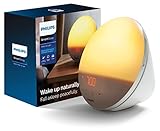
Philips takes a button-based approach. Reviewers describe the HF3520 as a wake-up light that brightens gradually before the alarm, run with touch-sensitive controls and no phone required. Sound options sit alongside the light, and the maker lists a choice of wake-up sounds.
It suits people who dislike apps, subscriptions and screens by the bed. You set the time on the unit itself, pick a sound, and let the lamp do its work. For anyone who wants a quieter, analog-style routine, this is the least complicated option here.
Its strength is the light rather than a library of nature recordings, so the sound choices are modest compared with the Hatch family. The unit is also bigger than a plain clock. Skip it if a large library of sounds matters more than the lamp, or if you would like a white noise machine for the evening.
Loftie Clock Bedside Alarm Clock
The Loftie Clock is designed around keeping your phone out of the bedroom. Coverage describes a stand-alone alarm with a soft look, gentle tones, and an approach that favors a wind-down routine over notifications. It is sold as a premium bedside object.
It fits someone who wants a deliberate, phone-free routine and likes the idea of one object that makes the bed feel simple. The tones are softer than a typical beep, and the device is meant to look good on a nightstand.
It has no sunrise lamp, and the list of features is shorter than the Hatch devices. Retail details, including the model name, change, so read the listing. Skip it if you want strong light, an extensive nature sound library or a simple gadget.
Best White Noise Alarm Clocks
The Hatch Rest 2nd Gen leans furthest into steady background sound, with the Restore models close behind. Both let you choose a sound and set how long it plays. We cannot say what any sound does for you, so choose what you enjoy.
Best Soothing Alarm Clocks Without a Phone
The Philips HF3520 and the Loftie Clock both avoid the phone at the bedside. One uses light and the other uses soft tones. Pick the Philips if you want a gradual glow, and the Loftie if you want a calm object and a minimal routine.
Best for a Gentle Morning
Makers of sunrise clocks describe a gradual increase in light before the alarm. Whether that suits you is personal, and we cannot promise it will reduce morning grogginess. Check the seller’s return policy so you can see how you feel about it after a few mornings. The Hatch Restore 3 and the Philips HF3520 are the two to compare.
Best for Sleeping in a Noisy Home
If outside noise is the issue, a steady sound can mask some of it. The Hatch Rest and Restore models are built for that role. Place the unit away from the bed’s head and set the volume conservatively.
How to Choose
Begin with the role you most want the clock to play. If it is mainly a sound machine, a Hatch unit gives the widest choice. If it is mainly a light, the Philips may be the better fit. If it is mainly a phone-free object, think of the Loftie. Many buyers choose one without noticing that they wanted something else.
Check the control method. App-controlled devices offer detailed routines but need an account, Wi-Fi and a phone. Button-controlled units are simpler, yet offer fewer options. Consider what happens if the Wi-Fi drops or the company changes its app, and read what the maker says about offline operation.
Look at the sound options. Some people prefer rain or ocean, others like a plain fan-like hum. Check whether the sounds loop smoothly and whether you can set a timer. Volume range matters, too: you want enough to be heard and a low setting that suits a quiet room.
Consider light. A sunrise lamp needs room on the nightstand and should be positioned where the glow will reach you. Look at brightness settings and the color of the night light. People who are sensitive to light should look for a dim or off option.
Finally, weigh the ongoing cost. Some clocks have optional memberships that add content. Decide whether the base features are enough for you. A common error is assuming the full sound library is included for life. Another is placing a unit too far from the bed for the light to be useful.
Installation, Safety and Legal Notes
Follow the maker’s instructions for power, placement and setup. Keep the device away from water and out of direct heat. If a clock will be used in a child’s room, follow the maker’s safety guidance on cords and placement. We make no health claims for any of these products; if you have a concern about your rest, speak to a qualified professional. Use a licensed electrician for any new outlets by the bed, and check house rules in shared housing about overnight devices.
Care and Troubleshooting
| Problem | What to try |
|---|---|
| App cannot find the clock | Check the Wi-Fi band and power-cycle both devices |
| Sound is too quiet | Raise the volume in the app or on the unit |
| Light seems too strong | Lower the brightness setting in the routine |
| Alarm did not go off | Check that the routine is active and the clock is powered |
If a firmware or app update changes how routines behave, review each saved schedule afterwards rather than assuming nothing moved. Wipe the case with a dry cloth and keep vents clear. Install updates when the app asks.
Why Sound Choice Affects How You Wake and Sleep
The audio file on your bedside clock is not just a feature on a spec sheet. It shapes how quickly you fall asleep and how you feel when the alarm goes off. Understanding the basic categories of sound makes it easier to choose a clock whose library fits your habits.
Natural recordings such as rain, ocean waves, a stream or a forest at dusk offer variation and texture. They suit people who like a sense of place and who are not bothered by small changes in volume or pattern. White noise is a steady blend of frequencies that sounds like static or a fan. It is designed to mask sudden changes in the room, like a car door or a hallway footstep. Pink and brown noise shift the balance toward lower frequencies and sound softer and deeper, which many people find less harsh.
There is no universal best option. Someone who lives on a busy street may need continuous, even masking. Someone who sleeps in a quiet house may prefer gentle rain. It is reasonable to try several sounds over a week before deciding which one you want to keep on for the night.
Looping, Fading and Timers
How a clock plays a sound matters as much as which sound it plays. The way a track repeats can distract you if the loop is short, because you may notice the same bird call or wave crash returning every minute. Longer recordings or a randomized mix tend to disappear into the background better.
Timers and fade-out behavior are also worth checking. Some people want the sound to run all night to cover noise at dawn. Others want it to fade after thirty or sixty minutes so they are not listening to it for eight hours. Look for models that let you choose between those two approaches, and check whether the sound can continue until the alarm triggers, then switch to a different wake-up tone. If the product description does not make this clear, read the manual or support page before buying.
- Continuous play: best for noise masking and light sleepers.
- Timed fade: best for falling asleep without all-night sound.
- Separate sleep and wake sounds: lets you pair soft rain with a brighter morning chime.
- Volume ramp: starts quietly and rises, which many find less jarring.
Placement, Speakers and Room Acoustics
A clock with a small speaker will sound different on a nightstand than in a bookcase or across the room. Hard surfaces reflect sound and can make a tinny speaker sound sharper, while soft furnishings absorb it. If the sound seems too bright or thin, try moving the clock a few feet or placing it on a book or a fabric mat.
Distance and direction matter more for white noise than for alarms. If the goal is to mask a noise from outside, the sound source should ideally sit between you and the source of the noise, such as near a door or window. For a shared bedroom, point the speaker toward the person who needs it most and keep the volume low enough that it does not overpower the other person. Volume that is comfortable at bedtime can feel too loud at three in the morning, so set it a notch lower than you think you need.
Also think about sound versus light. Sunrise models like the Philips SmartSleep and the Hatch units add gradual light, and the glow can be too bright for people who wake easily. A dimmer setting or a model with a screen-off option is a sensible feature to look for.
Using a Sound Clock for Kids, Travel and Shift Work
Sound clocks are useful outside the standard adult bedroom, and a few practical points apply.
For children, choose a model with simple controls and a way to lock buttons, so a curious hand does not change settings. Keep the volume modest and the clock out of reach of the crib. Many parents also prefer a clock that uses color or light as a cue for when it is time to get up, which can help young kids learn the difference between night and morning.
For travel, a smaller or battery-friendly device is easier to pack than a heavy one. Check whether the clock works without Wi-Fi, since hotel networks often block device connections. Offline sound libraries and manual controls are more dependable than apps when you are away from home.
For shift workers, daytime sleep is the challenge. Blackout curtains, a steady masking sound and an alarm with a predictable ramp can all help, but pay attention to your schedule. A clock with multiple alarm profiles, or one that is easy to change on the fly, saves frustration when your hours rotate.
Whichever route you choose, treat the first week as a trial. If you wake up tired or find the sound irritating, adjust the volume, change the sound or try a different placement before concluding that the clock is the problem.
One Machine, Two Jobs: The Night Shift and the Morning Shift
A sound machine alarm clock is really two products sharing a speaker, and they work opposite shifts. The night shift masks the world: traffic, a partner’s snoring, the neighbour’s dog, the plumbing’s opinions, all smoothed under a blanket of chosen sound so sleep can proceed undisturbed. The morning shift does the reverse, introducing sound, or light, or both, in a way designed to lift the sleeper out of that protected sleep as kindly as the night shift protected it. Judging these devices by either shift alone misleads. A magnificent masker with a clumsy dawn will be resented at seven; a beautiful dawn attached to a thin, loopy, irritating night sound will be resented at midnight. The picks in this guide were chosen for households that need both shifts covered, and your own weighting of the two shifts should steer you among them.
The night shift’s quality hides in a detail most listings never mention: the loop. Recorded nature sounds repeat, and a repeat the ear can find, a bird that calls at the same interval, a wave pattern that resets audibly, becomes a small nightly irritation that grows with familiarity. The better implementations, whether by long recordings, layered generation or careful editing, hide their seams from a listener who hears them eight hours a night for years. Test for the seam deliberately: listen to your chosen sound, in the dark, for longer than feels reasonable, and wait for the moment you can predict. If prediction arrives quickly, that sound will age badly in your bedroom whatever its other charms.
The morning shift’s quality hides in the opposite detail: the transition. A gentle wake is not a quiet alarm; it is a sequence, sound or light rising along a curve the sleeper’s brain can climb rather than be pushed up. The sunrise models in this guide build the whole product around that curve. The sound-led models build it from fades and gradually introduced layers. Either way, judge the transition as a piece of design in its own right, because it is the moment the product exists for, the hinge between the two shifts, and the thing you will experience more intimately than any specification.
How the Five Picks Divide the Gentle Territory
The Hatch Restore 3 is the ecosystem’s current flagship idea: a sunrise clock and sound machine built around app-designed routines, a put-down-the-phone philosophy, and a bedside presence designed to look like furniture rather than equipment. Its proposition is that the whole evening and morning, not just the alarm minute, is the product, and it suits the sleeper who wants their wind-down choreographed as carefully as their wake-up. The Restore 2 carries the same philosophy in its earlier form, and for many households its simpler routine set is not a lesser version but a calmer one; the difference between the generations matters most to owners who actively design and redesign their routines.
The Hatch Rest, though born as a nursery device, earns its place in this guide honestly: households with babies and young children run their bedrooms as shared sound environments, and a machine that serves the child’s sleep and the parents’ sanity from one footprint solves a real geography problem. Its presence here is a reminder that sound machines are household infrastructure, not personal gadgets, wherever sleep is a group project. The Philips SmartSleep Wake-Up Light is the light-first interpretation: a dawn simulation of proven pedigree, with sound as the supporting actor, suited to the sleeper whose body answers light more honestly than audio, especially in the dark months when the natural dawn is absent at waking time. The Loftie takes the design-and-simplicity path, a handsome, deliberately limited device built around the idea that the bedroom should contain less technology, not more, with its sounds and alarms curated rather than infinite.
Choosing among the five is a matter of which sense leads your waking, which ecosystem your household tolerates, and whether children share the soundscape. Light-led sleepers should start with the Philips and test the Hatch pair against it. Routine designers should start with the Restore line. Simplicity seekers should hold the Loftie in their hands and notice how little it asks. Parents should let the Rest make its practical case. There is no loser in the group; there are only mismatches, and they are avoidable by knowing which shift, night or morning, matters more in your house.
The Subscription and App Question, Faced Squarely
Several devices in this category live partly inside apps and content libraries, and a buying guide owes its readers a clear-eyed account of what that means across years. An app-driven clock can gain sounds, routines and refinements over its life, which is a genuine good. It can also change its terms, retire a feature, or ask for a subscription to unlock content that lives on the device you already own. Neither future is guaranteed, and the wise purchase prices the hardware for what it does on the day it arrives, treating everything the app later adds as a bonus rather than as part of the bargain. If a device’s core promise, the alarm, the core sounds, the sunrise, would survive its company’s servers going dark, it is an appliance with an app. If it would not, it is a service with a speaker, and it should be bought with a service’s expectations.
The phone-free question sits inside this one. Much of this category’s appeal is retiring the phone from the bedroom, yet several of its devices are configured by phone and some lean on it for their full repertoire. There is no hypocrisy in a clock set up by an app and then left alone for months; the phone visits as a tool and leaves. The arrangement to avoid is the nightly dependency, where the evening routine requires the phone in hand at the bedside, because that reimports exactly the scrolling the clock was bought to exile. When you set up any of these devices, complete the configuration in another room, in daylight, and then let the clock live its own life at the bedside. Setup is an event; sleep is a practice.
Children’s devices add a data dimension parents should consider with the same calm: accounts, recordings of the room, and apps that know a child’s schedule are conveniences with a privacy price, and households differ in what they will pay. The Rest and its kin can be used thoughtfully within a family’s own rules, but the rules should be the family’s, set deliberately, rather than the defaults the setup flow suggests. This category asks more setup wisdom than any other in this series, and repays it more, because what is being set up is not an alarm but an environment.
White Noise, Nature Sounds and the Ears That Choose
The choice between white noise and nature sounds is more personal than technical, and it is worth understanding your own ears before a library’s size impresses you. White noise and its coloured cousins, pink and brown noise, work by consistency: a steady spectrum that raises the threshold at which real-world sounds intrude. They flatter light sleepers in noisy buildings, tinnitus sufferers who need the ringing masked, and anyone whose sleep is broken by irregular sounds, the door, the pipes, the street. Nature sounds work by pleasantness and association: rain, surf, woodland, sounds the brain files as safe. They flatter sleepers whose problem is an active mind rather than a noisy building, because they give attention somewhere gentle to rest.
Many households discover their true preference is situational: noise for the city flat’s traffic, rain for the anxious evening, silence for the countryside house where the real night is already quieter than any recording. A machine with a good library serves the discovery, but the discovery itself is the valuable part, and it takes a fortnight of honest trials rather than one evening’s sampling. Keep a small note, literally, of which sounds you slept through and which you noticed, because memory flatters novelty and the third night with a sound is the truthful one.
Volume discipline belongs here too. A masker should sit at the lowest level that does its work, because a sound machine played loudly all night is itself a noise exposure the household chose, and because a masker that must compete with a partner’s different preference will lose the diplomacy war. Place the machine nearer the noise source it masks, a window, a door, than the sleeper where possible, so the blanket sits between the world and the bed rather than on the sleeper’s ear. That placement principle, borrowed from every nursery that ever worked, is the difference between a room that feels quiet and a room that feels filled.
Light as the Leading Sense: The Dawn Argument
The Philips entry in this guide represents an argument the whole category must answer: that for many bodies, light is the senior sense at waking, and sound is its assistant. A simulated dawn works on the physiology underneath sleep, easing the sleeper toward the surface before any sound arrives, so that the eventual audio cue lands on a brain already half prepared. Owners in northern winters describe the effect in almost emotional terms, because the alternative, a beep in a pitch-black room in January, is a small daily violence the body remembers. If your waking misery is seasonal, weight the light-led models heavily and treat their sound features as the supporting cast they are designed to be.
Light has its own diplomacy, of course. A dawn simulation in a shared bed is a public event in a way a personal sound can avoid, and partners with different wake times need the light’s direction and intensity thought through: angled toward its sleeper, kept at the lowest effective curve, or replaced by sound for the earlier riser and reserved for the shared wake time. The devices here allow enough shaping that most couples find an arrangement, but the arrangement must be found, in the first fortnight, by trial, and not assumed from the product’s promises.
Children and dawn light are a happier story. A clock that teaches a child when the room’s light means morning, the okay-to-wake idea, converts the household’s earliest battle into a rule the child can see, and parents who have lived it speak of it as infrastructure rather than gadgetry. Whether through the Rest’s nursery heritage or a sunrise clock in a child’s room, light as a time signal is one of this category’s most durable gifts to a household, long outlasting any particular sound library.
Keeping the Environment Machine Honest
These devices ask a maintenance of attention rather than of parts. Every few months, audit the routine itself: is the evening programme still the one you would choose, or has it fossilised around a schedule the household no longer keeps? Are the wake sounds the ones your notes said you slept and woke best with, or the ones novelty chose in the first week? Has the volume crept, as volumes do, a notch a month, until the masker is louder than the world it masks? A ten-minute audit restores the environment to its designed state, and the household’s sleep usually reports the difference within days.
The hardware asks the series’ familiar small cares: a dusted speaker, a clear stage so light and sound are not firing into clutter, a surge-protected socket, and backup arrangements understood rather than assumed, since an app-driven clock’s behaviour in a power cut is a thing to learn on a calm evening. Beyond that, let the machine do the work it was bought for, which is considerable: to stand guard over the night’s soundscape and the morning’s first light, asking almost nothing, and to make the bedroom the one room in the house where technology behaves as if it, too, understood that people are trying to sleep.
Travel, Shift Work and Sleep Away From the System
A household that builds its sleep around a sound environment discovers the system’s value most sharply when it travels. Hotel rooms have unfamiliar noises, corridors, lifts, ice machines, and a sleeper accustomed to a curated soundscape feels their absence like a missing pillow. The lesson is not to pack the bedside machine, though some owners do exactly that with the more portable members of this category, but to know which element of the home system does the heavy lifting. If it is the masking sound, a phone or a small travel machine can carry that one sound faithfully. If it is the dawn light, a hotel’s curtains and a sound alarm set kindly will have to approximate it. Knowing your own system’s active ingredient, learned from the fortnight of notes this guide keeps recommending, turns travel sleep from a lottery into a packing decision.
Shift workers are this category’s most deserving special case, because they sleep when the world is loud and wake when it is dark, the precise inverse of the conditions these devices were designed around, and yet the design transfers beautifully. The masker earns double wages in a daytime bedroom, where traffic, doorbells and the household’s ordinary life must all be smoothed away. The dawn simulation becomes a personal sunrise at whatever hour the shift demands, indifferent to the real sun’s position. Households with a shift worker should treat the bedroom’s sound and light environment as occupational equipment, chosen and maintained with the same seriousness as a uniform, because for that sleeper the room is not a retreat from work. It is where work is made possible.
One more domestic pattern deserves recording: the weekend lie-in, which gentle clocks handle with a grace their louder cousins cannot. A sunrise that arrives later on Saturday, a masker that keeps masking while the household stirs elsewhere, an alarm that can be skipped by a day pattern rather than by a nightly act of memory: these small accommodations are where the routine-based devices earn their complexity. Set the week up as the household actually lives it, workdays and rest days distinct, and the machine stops being an alarm that must be managed and becomes a rhythm that manages itself, which is the state every product in this guide is ultimately promising.
Guests benefit from the system too, in a way hosts rarely anticipate. A spare room with a simple sound machine, set to a neutral rain or a soft noise and explained in one sentence, gives a visitor control over an unfamiliar house’s night noises, the fridge’s hum, the pipes, the street, and many guests sleep better for that one offered kindness than for any thread count. Keep the guest setup simple, though: the full routine design that delights the household will bewilder a tired traveller, and the spare room is a place for the category’s simplest virtues.
When Gentle Is Not Enough, and Other Honest Limits
The closing honesty for this gentlest of categories: some sleepers cannot be woken kindly, and they know who they are. The deep sleeper who sleeps through a full sunrise and a rising chorus does not need a better curve; they need the escalation of the loud and shaker guides, and buying ever more refined gentleness is a way of avoiding that conclusion at considerable expense. Equally, some sleepers are woken by everything, and for them the masker’s night shift is the product and the alarm could be a whisper; they should weight the library, the loop quality and the volume’s fine control above every dawn feature in this guide.
There are also households whose sleep problem is not environmental at all, and for whom no machine in this series is the answer: pain, apnoea, anxiety and a dozen other conditions wear the disguise of a soundscape problem, and a new device can delay a needed conversation with a clinician by months. Buy the machine for the job it can do, masking a noisy world and softening a morning, and let it do that job superbly. Where the problem lives elsewhere, let the machine’s failure to fix it be information rather than disappointment. Judged on those honest terms, the five devices in this guide are among the most life-improving objects in this entire series, not because they wake people, but because they treat the whole night, and not just its final minute, as worthy of design.
Frequently Asked Questions
Are these clocks good for sleep?
Makers market them for bedtime and morning routines, but we cannot promise any result. Use the listing as your guide.
Do I need a subscription?
The Hatch devices offer an optional paid plan for extra content. The Philips and the Loftie do not use the same model, so check each listing.
Can I use one without my phone?
The Philips and the Loftie are designed for that. The Hatch units rely on an app for most settings.
Can I fall back on a normal alarm if the app fails?
Keep your phone alarm or a plain backup clock set for any morning that matters, since a connected device can lose its network link.
Which has the most nature sounds?
Hatch lists the largest sound libraries among these, but numbers change over time.
Will white noise bother a partner?
It depends on volume and placement. Begin low and ask your partner.
Is a sunrise alarm louder or quieter?
Most pair light with a soft sound that rises gradually. Check whether the volume range suits you.
What is the difference between white, pink and brown noise?
White noise spreads energy evenly across frequencies and sounds like static. Pink noise reduces the higher frequencies and sounds softer, like steady rain. Brown noise emphasizes low frequencies and sounds deeper, like a distant rumble. Which one works best is personal, so try a few for several nights.
Should I leave a sound machine on all night?
Many people do, especially when masking outside noise. Others prefer a timer that fades the sound out after they fall asleep. Keep the volume comfortable and not too close to your head. If you have concerns about sleep or hearing, ask a healthcare professional.
How loud should a bedside sound machine be?
Keep it just loud enough to cover disruptive noises without being the main thing you hear. Place it a few feet away rather than next to your pillow. For infants and children, use a lower volume and keep the device out of reach.
Can a sunrise alarm clock help with dark winter mornings?
Some people find a gradual light easier than a sudden alarm tone, especially when mornings are dark. Results vary, and it is not a medical treatment. If low mood or tiredness in winter is a concern, speak with a doctor rather than relying on a clock.
Bottom Line
The Hatch Restore 3 is the current all-round choice for people who like an app, the Restore 2 is a fallback if you find stock, and the Hatch Rest is a sound-first device. The Philips HF3520 favors light with simple controls, and the Loftie suits a phone-free room. Choose by control style, and confirm the exact listing before you buy.