Disclosure: As an Amazon Associate, reviewstook.com earns from qualifying purchases. Links to Amazon on this page are affiliate links; they cost you nothing extra. Listing details such as price and availability change often, so check the current Amazon listing before you buy.
A digital clock should tell you the time, not light up the ceiling. Anyone who has woken at three in the morning to a glaring red number knows how much the display matters. The best LED alarm clocks give you big, readable digits in the daytime and let you turn the brightness way down, or off, when the room is dark.
This guide is for adults who want a plain bedside clock instead of a phone, for couples with different schedules and for people who dislike light in the bedroom. We compare five LED models: three dedicated digital clocks and two clock radios from Sony and Emerson. You will see how each one handles dimming, alarms and power, what you give up with each choice, and how to choose the glow that suits your room. Details come from the makers and retailers, not from our own use.
Quick Comparison
| Product | Best for | Main point | Link |
|---|---|---|---|
| JALL Digital Alarm Clock | Changing weekly schedules | Three alarms, weekday modes and a dimmable display | Check on Amazon |
| DreamSky Large Digital Alarm Clock | Easy reading from across the room | Jumbo digits with adjustable brightness | Check on Amazon |
| PPLEE LED Digital Alarm Clock | A plain clock with big numbers | Large LED digits and a backup option | Check on Amazon |
| Sony ICF-C1 | A clock radio with a trusted name | Dual alarms with AM/FM | Check on Amazon |
| Emerson SmartSet CKS1900 | A clock that sets itself | Automatic time with a dimmable display | Check on Amazon |
In this guide
How These Options Were Chosen
We read manufacturer and retailer listings, and selected clocks that have large LED displays, some way of dimming them and a simple set of controls. We have not used the clocks ourselves, so we cannot tell you how bright the lowest setting looks in your bedroom. That is a very personal judgment, and it depends on the room.
We left out clocks that rely on an app. Listings change often, so confirm the model code, the number of brightness steps and the power and backup options before buying.
The Best LED Alarm Clocks
JALL Digital Alarm Clock with Dimmable Display
The JALL clock turns up in roundups as a strong all-round digital model. The listing describes three alarm settings, a mode that separates weekdays from weekends and a dimmable display, plus battery backup. In practice that combination answers what most bedroom shoppers want: a clock that knows Saturday is not Monday.
It suits someone with a regular working week and a different weekend, since you can set weekday alarms and leave the weekend quiet. It also suits a couple who need separate alarm times.
The weaker point, according to those same roundups, is that the loudest setting may not reach every deep sleeper. It is better as a tidy everyday clock than as a rescue for chronic oversleeping. Look at the listing for the battery type and for how the backup works during a power cut.
Choose it if you want multiple alarms and a simple layout. Skip it if you need a very loud alarm.

DreamSky Large Digital Alarm Clock with Dimmer
DreamSky sells several digital clocks, and its large-display models are known for oversized digits. One roundup describes jumbo LED digits up to nine inches across with a dimming range from low to full. Check the listing for the exact version, since the brand sells more than one clock.
It is a natural answer for people who want to see the time without reaching for glasses. A big readout is helpful for older eyes, for shared bedrooms and for anyone who keeps the clock on a dresser across the room.
The trade-off is size. A large display needs space, and in a small room the glow can dominate the walls if you do not lower it. Look for the dimmer and test it on the first night. The same roundup mentions a USB port and a single alarm on one model, so verify the features you need.
Choose it if readability comes first. Skip it if you prefer a small, discreet clock.

PPLEE LED Digital Alarm Clock
The PPLEE clock appears in guides as a plain, large-number LED model with a backup option for the alarm. It is meant for people who want bright, bold digits and not many features.
It suits a bedside table or an office desk, and the large characters are easy to read from a distance. For anyone annoyed by tiny buttons and menus, a simple layout is a relief.
As with many clocks from lesser-known makers, details such as the number of brightness levels, the alarm tone and the backup method differ between listings, so read them closely. If a feature you need is not clearly listed, ask the seller before ordering.
Choose it if you want bold numbers and a basic clock. Skip it if you need a radio, a temperature readout or a detailed schedule.

Sony ICF-C1 AM/FM Clock Radio
The Sony ICF-C1 earns a place here because it combines a clear digital display with a radio and dual alarms. Shoppers who want a simple electronic clock often end up with a clock radio for the sake of the brand, and Sony has a long record in the category.
It works for a bedroom where the clock will be on every night. You can wake to the radio or a buzzer, and each person can set a separate alarm. Check the listing for how many brightness levels the display has and whether it can be dimmed fully.
The compromise is that a clock radio is a little busier than a pure digital clock, and the radio is not necessary for everyone. If you do not listen to the radio, the extra controls will go unused.
Choose it if you want a well-known name and a radio. Skip it if you want the plainest clock.
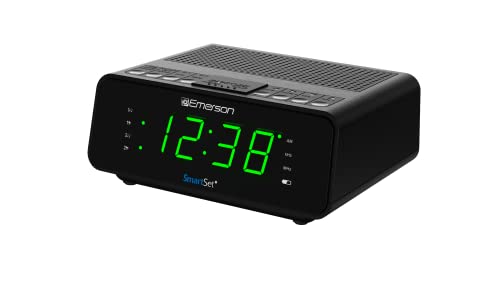
Emerson SmartSet Alarm Clock Radio CKS1900
Emerson built SmartSet around automatic time setting. For people who dislike seeing a blinking display after a power cut, it saves effort. The listing describes AM/FM, dual alarm and a display that can be dimmed, though you should confirm which dimming options your version has.
It is a good fit for a spare bedroom or a relative who is not interested in menus. The face is plain and the buttons are clearly labeled.
The trade-off is its mainstream feel. It will not impress anyone with its design, and the radio and speaker are typical for the class. If you want an object that looks refined on the nightstand, look at other styles.
Choose it if easy upkeep matters. Skip it if you care about design.
Best for Dark Bedrooms
The DreamSky model is the one to try when the room is very dark, because its dimming range is a main selling point. A low setting turns big digits into a soft glow.
Best for Couples
The JALL clock gives each person a place in the schedule, with three alarm settings and weekday modes. The Sony and the Emerson also offer dual alarms.
Best for Simple Bedside Use
The PPLEE clock is the least complicated. It shows the time in large numbers and rings when you tell it to, which suits a person who wants no extra features.
Best for Easy Maintenance
The Emerson SmartSet corrects its own time. After a power cut or a daylight saving change, it needs little attention.
How to Choose
The display is the point of an LED clock, so judge it before anything else. Then check the alarm, the power and the controls.
Brightness and color
Look for several brightness levels, and for a low setting that really is low. Some people prefer a warm color such as red or amber at night, and others find blue or white too harsh. If the listing mentions an off setting, that suits someone who wants a fully dark room. A model that stays dim at the lowest step is better for a bedroom than one that only has bright and brighter.
Alarms and schedules
Dual alarms or weekday and weekend modes spare you from changing the time each night. Pick a model with clear labels for the alarm, snooze and mode. A snooze that you can set to a convenient length is helpful, though the point of a clock is to get up eventually.
Power and battery backup
Most LED clocks plug into the wall. A battery backup keeps the time and the alarm during a power cut. Check the listing for the battery type, and whether the display stays lit during an outage. Replace the backup battery regularly.
Extras: temperature, USB and night light
Some models show the indoor temperature, include a USB port for charging a phone or offer a faint night light. These are nice extras, but do not choose a clock on extras alone. A dimmable display and clear alarm controls matter more.
Phone-free bedside habits
Many people buy an LED clock to keep the phone out of reach overnight. That only works if the clock does the jobs the phone did: a dependable alarm, a readable time and an easy way to switch the alarm off for the weekend. Pick a model whose controls you can operate in the dark by feel, so you are never tempted to pick up the phone just to check the settings.
Style and size
Black and white cases are the safest for most rooms, and some makers offer other colors. Large digits help older eyes, while small clocks suit small tables.
Common mistakes
Many buyers pick a clock because it looks good online and later discover that the lowest brightness is still too strong. Another mistake is ignoring the backup battery. A third is buying an LED clock with a built-in radio that you never use.
Installation, Safety and Legal Notes
Follow the maker’s instructions and use the supplied power adapter. Keep the clock off the bed and away from water, and do not cover the vents. If you plan to add an outlet or move wiring near the bed, hire a licensed electrician.
Charging ports on a clock are meant for the devices the maker lists, so read the limits. In a shared home, consider your neighbors when you set an early alarm, and check any quiet hours in your lease.
Care and Troubleshooting
| Problem | What to check |
|---|---|
| Display too bright | Lower the dimmer setting, or move the clock away from the bed |
| Time resets | Fit or replace the backup battery |
| No alarm | Check that the alarm is switched on for the right day |
| Flickering digits | Try another outlet and check the cable |
Wipe the case with a dry cloth, keeping moisture away from the vents.
How LED Clock Displays Actually Work
Most bedside clocks use seven-segment LED digits, the same layout found on old calculators. Each digit is built from seven small bars that switch on in combinations, and the brightness of those bars is set by how much current reaches them. A dimmer is usually a simple step control that cuts that current in a few stages, such as high, medium, low and sometimes off. Some clocks use a smooth sensor instead, reading the light in the room and lowering the glow on their own. Both approaches can work, but a sensor can be fooled by a lamp left on, so a manual control is easier to predict.
Digit height is the spec that shapes how a clock feels. A one-inch readout is fine on a nightstand within arm’s reach. A display of two inches or more is meant to be read from across a room, and it will throw more light at the same brightness setting simply because there is more lit surface. That is why the same brightness label can feel gentle on one clock and harsh on another. When two listings both claim a dimmer, compare digit size first, then the number of steps.
Display color is a matter of the LED chip itself, so it cannot be changed with a setting unless the listing says the clock offers several colors. Red and amber are widely suggested for bedrooms because they contain little blue light, and blue-white light is generally considered the most stimulating at night. Treat that as a common rule of thumb rather than a guarantee for every sleeper, and remember that a very bright red can still be bothersome.
Matching a Clock to Your Room and Routine
The right clock depends less on the product than on where it sits and who shares the room. These scenarios cover the most common situations.
- A small bedroom with a pale ceiling: light bounces more in compact, light-colored rooms, so a modest digit size and a true low setting matter more than extra features.
- A shared room where one person sleeps later: choose a clock with separate alarm slots and a low-glow mode, and place it so the display faces only the person who needs it.
- A guest room: a self-setting model like the Emerson SmartSet or a plain clock with a battery backup avoids the blinking 12:00 that guests cannot fix.
- An older adult’s room: large digits and clearly labeled, physical buttons beat clever menus. A clock radio such as the Sony ICF-C1 can also give a familiar sound to wake to.
- A light sleeper who dislikes any glow: look for an off or near-off setting, or plan to turn the display away from the bed or place it behind a small object that blocks direct view.
Placement is a free upgrade. A clock at eye level when you lie down is far brighter to you than one on a low shelf angled away. Moving it a foot or two, or to the far side of a dresser, often solves a brightness complaint better than buying a new model.
Questions to Ask Before You Order
A short checklist keeps you from discovering problems after the box is open. Read the listing, the manual if it is posted, and the questions section for answers to the following.
- How many brightness levels are there, and is the lowest step described as dim or as off?
- Does the alarm have a gradual volume rise, or does it start at full volume?
- What happens when power is lost: does the clock keep time, keep the alarm, or both?
- Is the power adapter included, and how long is the cord? A short cord can force the clock into an awkward spot.
- Are the buttons on top, front or back? Top buttons are easiest to find in the dark.
- Can the display stay lit during a power outage, or does it go blank to save the battery?
- Is there a warranty, and how does the seller handle returns on electronics?
If a listing leaves a key question unanswered, that gap is information too. Makers who are proud of a feature usually describe it plainly.
Budget Clocks Versus Pricier Ones
Simple LED clocks are inexpensive, and a low price does not make a clock a poor choice. The core job, showing digits and sounding a buzzer, is cheap to build. What extra money tends to buy is refinement: more brightness steps, a more pleasant alarm tone, a better radio tuner, clearer printing on the case and a more dependable backup system. Brand names also bring clearer manuals and easier warranty claims.
Spending more makes sense if you are sensitive to light, if you rely on the clock for work mornings, or if the clock will run every night for years. For a guest room or a second clock, a basic model is usually enough. The one place to avoid the cheapest end is the dimmer: a clock with only a bright and a slightly less bright setting defeats the purpose of buying a dimmable model.
Also think about what you will replace. If you currently use a phone, the alarm’s reliability and the clock’s independence from Wi-Fi are real advantages that cost very little. A dedicated clock that simply works each morning has value that does not show on a spec list.
Brightness Is a Relationship, Not a Setting
Every LED clock offers dimming, but the number of steps matters less than where those steps land. A display whose lowest setting is still a small lantern will fail the light-sensitive sleeper no matter how many brighter settings sit above it, while a display that can descend to a whisper, or switch off entirely while its alarm stands guard, serves the whole range of bedrooms. The honest test is not in the shop or even in your lit bedroom at unpacking time. It is at 3 a.m., from the pillow, with eyes adapted to full dark, asking one question: can I read it if I want to, and can I ignore it if I do not? A clock that passes both halves of that question has its brightness right, whatever its specification sheet claims.
Adaptation is the subtlety owners miss. Eyes that have been in darkness for hours become astonishingly sensitive, so a brightness that seemed tasteful at bedtime can feel aggressive at three in the morning, and a brightness that seems invisible at bedtime may be exactly right at three. This is why experienced owners set the dimmer twice, once when they go to bed and once when they wake in the night, and why clocks with smooth, wide dimming ranges outperform clocks with three heroic steps. The models in this guide were chosen with that night-time audit in mind, and the ones that can go fully dark while remaining armed deserve special attention from anyone who shares a bed with a light-sensitive partner.
Colour is brightness’s quiet partner. Cool white and blue-leaning displays read as brighter and harsher than their measured output, and they carry the visual language of screens and alerts. Warm whites, ambers and reds read softer and older, closer to lamplight than to a phone. In a bedroom being deliberately de-screened, digit colour is not a trivial preference; it is part of whether the clock feels like furniture or like one more device demanding the eye. Choose the colour your half-asleep brain finds ignorable, and let the partner with the stronger opinion on light hold the casting vote, because they are the one who will be awake to have it.
How the Five Picks Light the Room
The JALL digital clock is the category’s familiar all-rounder, a dimmable LED display in a compact form that has found its way onto a great many nightstands by doing the basics, time, alarm, dimming, with no drama. Its appeal is proportion: nothing about it shouts, and its display can be tamed to bedroom levels without a fight. The DreamSky large clock answers a different need entirely: digits meant to be read across a room, by eyes without glasses, by a household member who wants the time from the doorway or from a child’s bed across the room. Large digits and darkness are natural enemies, so the DreamSky’s dimming range carries more responsibility than most, and its owners should run the 3 a.m. test with particular care.
The PPLEE clock represents the simple, compact end of the LED family, the bedside minimalist’s choice where the nightstand is small and the requirements are honest: a clear time, a working alarm, a display that can be kept low. The Sony ICF-C1 adds a radio to the LED formula, bringing the clock-radio tradition into this guide, and with it the question of whether the display’s manners suit a device that will also fill the morning with a station. The Emerson SmartSet CKS1900 completes the five with automatic time setting under its LED face, the model for households whose hatred of resetting clocks after outages outweighs every other consideration.
Across the five, the axes repeat this series’ familiar pattern: size of digit against darkness of room, simplicity against features, and the household’s tolerance for light as the referee. There is no universally best LED clock here because there is no universal bedroom. There is a best clock for the couple where one partner reads time across the room and the other sleeps facing it, and it is found by testing the dimmer at its floor, in the dark, with both sleepers present, which is the only laboratory this category respects.
The Display-Off Question and the Anxious Checker
Clocks that can darken their display completely while the alarm remains set raise a psychological question worth examining honestly. For most sleepers, a dark room is simply better, and the display-off clock is the category’s gift to them. For the anxious checker, the person who wakes and must know the time to settle, a vanished display can feel like a small abandonment, and the reaching for a phone that follows defeats the whole exercise. Know which sleeper you are. Checkers should choose a display that dims to a genuine whisper rather than to black, keeping the reassurance available at a level the room can tolerate. Non-checkers should take the black and enjoy it.
There is a middle population, the occasional checkers, who want the time on bad nights and darkness on good ones, and for them the best feature in this category is a display that can be woken by a touch or a press and then fades back to dark on its own. Where a model offers a night mode or a timed display, set it up during the calm of the first evening rather than discovering it at 4 a.m. The general principle generalises: every behaviour of an LED clock should be rehearsed in daylight, because the night is not when any household learns its equipment well.
Children’s relationships with displays deserve their own sentence. A child who can read the clock gains a tool for owning their morning, and a dim display in a child’s room doubles as the gentlest of night lights, present without being a lamp. But a bright display in a child’s room can become a fascination that delays sleep, and parents should run the same darkness audit there, erring toward the whisper settings. The clock should be the room’s servant, in a child’s room most of all.
Digit Size, Distance and the Glasses Problem
The glasses problem is the LED category’s most practical design brief: most adults who wear glasses do not wear them in bed, and the clock must speak to unaided eyes at pillow distance. Digit height helps, but contrast and simplicity help more. A modest digit in a clean, uncluttered display, showing hours and minutes and very little else, is often more legible at a blur than a large digit surrounded by indicators, temperatures, dates and icons competing for the same unfocused glance. When you test a clock, strip the test to reality: lights out, glasses where they sleep, head on the pillow, and ask whether the time resolves within a second or two of looking. If you must squint, lean or guess, the display has failed its primary examination, whatever its size claims.
Distance multiplies the problem across a room. The DreamSky pattern, genuinely large digits, exists because some households read the clock from a chair, a doorway or a second bed, and for them the bedroom is a small hall whose clock is a public notice. Public-notice clocks and darkness can coexist only with excellent dimming, which is why the pairing of large digits with a wide, smooth dimmer is the specific engineering to look for in that use. A large-digit clock with crude dimming is a lighthouse; with fine dimming, it is a considerate neighbour that can whisper across a room.
Angle finishes the legibility story. A display aimed at the ceiling or at the foot of the bed wastes its clarity; a display tilted or placed to face the pillow’s natural sightline delivers it. Nightstand height relative to the bed, the clock’s own stance, and the sleeper’s side all enter the calculation, and the fix is usually a few centimetres and a slight turn rather than a different clock. Set the angle during the first evening’s rehearsal and then, like so much in this series, leave a working arrangement alone.
Power, Backup and the LED Clock’s Long Service
LED clocks are mains creatures with battery memories, and their backup behaviour deserves the rehearsal this series prescribes for every category: unplug the clock on a calm evening and learn what it keeps. Some keep the alarm and the time and merely darken; some keep the time but must be reminded about the alarm; the SmartSet pattern rebuilds the time from its own intelligence when power returns. The differences matter exactly once, on the worst night of the year, and the household that has rehearsed sleeps through that night untroubled. Put fresh backup batteries in on the annual rhythm, because a backup that died two years ago is a rumour, not a system.
Longevity in this category is otherwise a gentle story. LED displays do not burn out like old bulbs; they may dim unevenly across many years, which the owner experiences as a clock growing gradually more considerate. Buttons wear before digits do, especially the snooze control that absorbs the household’s least gentle touches, and a clock whose snooze is a broad, forgiving surface will outlast one that demands precision from a hand that is not awake. Dust is the other slow enemy, settling on the display’s face and softening its contrast; a wipe during the room’s regular clean keeps the digits crisp.
Surge protection, the series’ recurring footnote, applies here with the usual force: the LED clock concentrates the household’s morning in one small mains-powered object, and a protected socket is cheap insurance for it. Do these small things, rehearse the backup once, set the dimmer at 3 a.m. rather than at teatime, and an LED alarm clock becomes what the best of them are: a clear, quiet servant that tells the truth in light gentle enough to sleep beside, and wakes the house as if it had never been asleep itself.
When LED Is the Wrong Light
The closing honesty: some bedrooms should not have an LED clock at all. The sleeper pursuing a genuinely dark, screen-free room may find even a whisper of digits one light too many, and for them the analog guide’s silent dials, or a clock whose display sleeps completely, are the honest recommendations. The household that reads time from across a workshop-sized room may need a wall clock’s scale rather than a nightstand’s. And the deep sleeper needs escalation, not legibility, and should be shopping in the loud and shaker guides where the waking, not the display, is the engineering problem.
For the broad middle, though, the LED clock is the nightstand’s natural modern citizen: exact, tireless, adjustable to the room’s darkness with a precision no earlier clock technology could offer. Choose it by its dimmer’s floor and its digits’ clarity at a blur, place it at the pillow’s angle, rehearse its backup, and then forget it exists, which, for an object made of light, is the most impressive trick of all.
Two Sleepers, Two Relationships With Light
Shared bedrooms turn the display into a negotiation this guide has touched in other categories, but the LED clock makes the negotiation unusually concrete, because the display has an owner-side and a wrong side. The sleeper who bought the clock reads it; the sleeper across the bed sleeps in its glow. The civilised arrangements are known and few: angle the display toward its reader, run it at the lower sleeper’s tolerance rather than the reader’s preference, since the reader can always lean closer and the sleeper cannot lean away from light, and where the gap between the two is unbridgeable, choose a model that can go fully dark and let the reader use a touch-to-wake display or accept the phone on the rare nights they must know the hour. That hierarchy, the sleeper’s darkness outranks the reader’s convenience, settles most display arguments before they start, and the couples who adopt it stop having the argument entirely.
There is also the question of the second clock. Some shared bedrooms solve everything with two modest clocks, one at each side, each dimmed to its own sleeper’s taste, alarms assigned to whoever rises. The cost is small and the peace is total, and households that have tried the single-clock compromise for years often wonder why the obvious answer took so long. Two dim whispers are darker, in every way that matters, than one display negotiated to a brightness neither sleeper chose.
The LED Clock Beyond the Bedroom
Although this guide is written for bedrooms, the LED clock’s virtues travel, and households often discover the second placement after the first succeeds. A dimmable LED clock in a hallway gives a house a quiet public time that harms no one’s sleep. In a kitchen, a large-digit model serves cooks whose hands are occupied and whose eyes are at distance, the DreamSky pattern working as a small wall notice. In a home office, the LED clock’s discipline, time without notifications, is precisely what the desk’s other screens cannot offer, and more than a few owners report that the office clock, bought as an afterthought, became the household’s most consulted timepiece.
For shift workers sleeping in daylight, the LED clock earns a specific commendation: its display can be kept present but subdued in a blacked-out room, giving the day-sleeper orientation during waking moments without the blast of a phone screen at full brightness in a dark-adapted eye. Paired with the household’s agreement about quiet hours, it helps a room serve two shifts of life. The same subdued presence serves parents in a nursery season, where the clock’s whisper of light answers the what-time-was-that-feed question without waking the room’s most important sleeper. A category this simple should not have this many second careers, but light, time and restraint turn out to be wanted in every room where people are tired, which is most of them.
One small buying discipline follows from all of this: if you are choosing between two LED clocks and cannot decide, choose the one whose dimmer goes lower, not the one whose digits go larger or whose feature list runs longer. Features are used in the first week and forgotten; the dimmer’s floor is experienced every night for the life of the clock. It is the single specification in this category that compounds, quietly, into either gratitude or grievance, and it is the one least visible in a bright shop, which is why this guide keeps returning to the dark, the pillow and the third hour of the night as the only honest showroom an LED clock will ever have, the one place where its promises are actually kept or broken, and where a well-chosen clock quietly proves itself, night after unremarkable night, for years, asking nothing but a socket, a fair angle toward the pillow, fresh backup batteries once a year, and an occasional wipe of its face.
Reading Owner Reviews of LED Clocks Without Being Misled
Reviews of this category follow patterns worth decoding before you let them steer you. Complaints that a clock is too bright divide into two kinds: too bright at its lowest setting, which is a real verdict about the dimmer’s floor, and too bright at the setting the reviewer happened to leave it on, which is a verdict about the reviewer’s evening. Complaints that a clock is too dim are usually written by across-the-room readers who bought a pillow-distance clock. Praise for a huge display and complaints about the same display often describe the identical product in different rooms, which is this category in miniature: the room is half the product, and a review that does not describe the room is only half a review.
The reviews that deserve your trust mention the 3 a.m. test, the partner’s verdict, the backup behaviour during an actual outage, and the snooze found by touch in the dark. Those reviewers lived with the clock through the moments the category is judged by. Reviews written on delivery day, impressed by brightness in a lit room, are describing a torch. You are buying a nightlight that tells time and wakes you up; judge every testimony by whether its author seems to have met the product at night.
Finally, weigh the household pattern behind any verdict about alarm loudness or sound. An LED clock’s alarm lives or dies by the sleeper, not the speaker, and the same tone that one reviewer calls feeble another calls perfect. Cross-reference alarm comments against the sleeper described, and use this series’ other guides, loud, shaker, radio, to place the reviewer on the map. A light sleeper’s five-star alarm is a deep sleeper’s one-star failure, and both are telling the truth about different mornings.
Frequently Asked Questions
How dim can an LED clock get?
It depends on the model. Read the listing for the number of levels and any off setting.
Do LED clocks keep time during a power cut?
Only with a backup battery. Without one, the time may reset.
What color is best for a bedroom?
Many people like a warm red or amber, but it is a matter of taste.
Can a digital clock have different weekday alarms?
Yes. Models with weekday and weekend modes or multiple alarm slots allow it.
Is a clock radio better than a plain LED clock?
Only if you like listening to the radio. Otherwise a plain clock is simpler.
Why does my display seem so bright at night?
Many clocks are bright by default. Reduce the setting, and place the clock out of your direct view.
Do LED alarm clocks use a lot of electricity?
No. A small LED clock draws only a few watts at most, and the display is a minor share of that. Running one every night adds very little to a household bill. Check the adapter label if you want the exact rating.
How can I make my alarm clock less bright without a dimmer?
Turn the display away from the bed, move the clock lower or farther away, or place a small semi-opaque cover over the digits. Avoid blocking vents or covering the whole unit, since that can trap heat.
Is a red clock display better for sleep than a blue one?
Many people find red or amber gentler because those colors contain less blue light. Sensitivity varies from person to person, so the brightness setting and where you put the clock matter as much as the color.
Why does my digital clock lose the alarm after a power cut?
Without a backup battery, many clocks lose their settings when power drops. A model with a battery backup keeps the time and alarm. If yours has one, replace the battery on a regular schedule.
Bottom Line
For a flexible schedule, the JALL clock is a sensible bet, and the DreamSky shines for large digits. The PPLEE keeps things bold and simple, the Sony ICF-C1 adds a radio and the Emerson SmartSet looks after its own time. Whichever you pick, test the dimmer on the first night and confirm the backup battery in the listing.