Disclosure: As an Amazon Associate, dailyhomedecorating.com earns from qualifying purchases. Links to Amazon on this page are affiliate links; they cost you nothing extra. Prices and availability change often, so check the current Amazon listing before you buy.
Searching for the best hot tubs for sale puts you in front of the widest spread in home leisure: inflatable spas that arrive in a box this week, permanent acrylic spas that require a pad, a crane, and a decision you will live with for a decade, and everything between. The best hot tubs for sale are not a single ranking so much as a match between four things: the soak you actually want, the site you actually have, the climate you actually live in, and the total cost, purchase plus energy plus water care plus time, that you will actually sustain. This guide ranks three verified inflatable spas you can buy on Amazon today and describes the three permanent types in prose, because the verified pool for this site contains inflatables only, and then spends its real effort on the buying decision itself: how the market is structured, what the specifications mean, and where buyers reliably waste money.
The most useful early distinction is between testing the life and committing to it. An inflatable spa is a season-long trial with genuine heat and bubbles, bought for a fraction of a permanent installation and removable if the habit fades. A hard-shell spa is infrastructure, bought for a decade of evenings and valued like it. Neither choice is the smart one in the abstract; the smart choice is the one matched to your certainty. First-time buyers with high enthusiasm and no track record should usually test. Households replacing a dead spa, or building a garden around the ritual, should commit. Readers with a specific budget ceiling will find the tier guides in this series useful companions: Best Hot Tubs Under $5000 and Best Hot Tubs Under $1000 bracket the market from the middle and the floor.
Read the Quick Picks for the shape of the market, then the reviews for what each option is like to own, and then give the buying guide your full attention, because in this category the purchase process is where satisfaction is decided. The how-to sections cover siting, delivery, first fill, and the first month of ownership, which is when most hot tubs are either loved into a routine or quietly abandoned to become very expensive planters.
Where to Buy
The three linked picks are sold on Amazon, where you can check the current price, availability, delivery terms, and full listing details. Begin with the Coleman SaluSpa Miami Energy-Efficient AirJet Inflatable Hot Tub for its balance of jets, insulation, and freeze protection, and confirm it via its Check on Amazon link. The other linked picks are the INTEX 28425EH PureSpa Bubble Massage Spa Set — Check on Amazon — and the Bestway SaluSpa Cancun Energy-Efficient Inflatable Hot Tub — Check on Amazon. The three permanent picks are types described in prose without links; for those, compare Amazon listings with local spa dealers, because delivery, placement, electrical work, and warranty service are part of what you are buying.
In this guide
Quick Picks
| Pick | Badge | Why it earns its place |
|---|---|---|
| Coleman SaluSpa Miami Energy-Efficient AirJet Inflatable Hot Tub | Best Overall | 120 AirJets, EnergySense insulation, Freeze Shield protection, and dispenser-based water care in one balanced package. |
| INTEX 28425EH PureSpa Bubble Massage Spa Set | Best Complete Package | Insulated cover, hard-water treatment, and saltwater readiness make ownership gentler from the first fill. |
| Bestway SaluSpa Cancun Energy-Efficient Inflatable Hot Tub | Best Budget | The same 120-jet, insulated, freeze-protected formula in a finish that looks designed rather than temporary. |
| Hard-Shell Acrylic Spa (Type) | Best Premium | The permanent benchmark: molded seats, directional jets, and a decade-scale service life. |
| Rotomolded Plug-and-Play Spa (Type) | Best Durability per Dollar | A one-piece tough shell and simpler electrical path for buyers committing without flagship money. |
| Wood-Fired Hot Tub (Type) | Best Off-Grid | Fire-heated, electricity-free soaking for rural and rustic properties with hands-on owners. |
Key Takeaways
- Decide first whether you are testing the hot tub life or committing to it; that answer picks the category.
- Total cost is purchase plus pad and power plus energy plus water care plus your time, every month, for years.
- Insulation and cover quality decide running costs more than heater size ever will.
- Capacity labels flatter: a four-person inflatable is a comfortable two, and hard-shell seat maps matter more than person counts.
- Water care is a system choice made at purchase: chlorine, bromine, saltwater, or mineral-assisted, each with its own routine.
- Buy the dealer and the warranty along with the spa in the permanent classes; service is part of the product.
How These Picks Were Chosen
Linked picks come from the verified supplement pool for this site, with features and specifications taken from the manufacturers’ own listings and reproduced in the spec boxes. The selection spans the inflatable class by genuine differences, bubble intensity, insulation and freeze protection, water-care gentleness, and value, rather than by trivial trim changes. The permanent types are prose-only because the pool contains no such models; they are described qualitatively, with no invented model specifications, because a market guide that omitted the majority of the market would fail its readers.
Excluded were used spas as a recommendation class, since a used hot tub’s value depends entirely on inspection of one specific unit’s shell, plumbing, and electricals, which no guide can do at a distance; the buying guide below does cover what to inspect if you go that route. Also excluded was the supplement pool’s cold-plunge product, which is not a hot tub and is covered in this lot’s ice bath guides instead. Novelty party tubs with no insulated cover and no real heating were filtered out as false economy.
The method is market- and ownership-based: verified product data for the linked picks, and established category knowledge for the types, including how insulation, covers, and water-care systems behave across seasons. No medical claims are made for any pick; a hot tub is comfort and ritual, and it is sold here as exactly that.
The 6 Best Hot Tubs for Sale — Reviewed

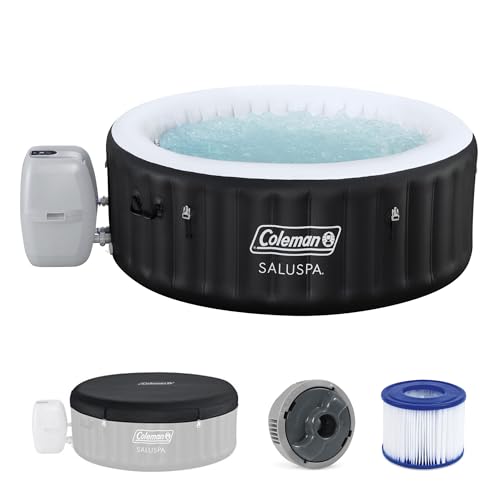
Coleman SaluSpa Miami Energy-Efficient AirJet Inflatable Hot Tub
Our badge: Best Overall
The Coleman SaluSpa Miami Energy-Efficient AirJet Inflatable Hot Tub is the balanced center of the inflatable market. Its 120 AirJets deliver the fullest bubble massage in the class, its EnergySense insulated walls and cover are designed to keep water warmer with less energy than comparable spas, and its Freeze Shield system protects the pump and liner in cold weather, which extends its selling season and its working life across most climates. MaxHold fabric beams and a three-layer Tritech shell address the durability question honestly, the ChemConnect dispenser keeps chlorine steady without daily measuring, and the power-saving timer can schedule heat up to forty days ahead, a feature that sounds like a gimmick until your first planned weekend away.
Strengths
- Strongest bubble specification among the linked inflatables, with insulation to match.
- Freeze Shield and an energy package make it a genuine four-season purchase in most regions.
- Dispenser-based water care and a scheduling timer minimize daily ownership friction.
Trade-offs
- Bench seating and bubble action only; no molded seats or directional jets.
- Realistic comfort capacity is two, whatever the four-person label says.
- Inflatable ownership includes pressure checks and puncture awareness for the life of the spa.
| Color | Black |
|---|---|
| Size | Energy Efficient 2.0 |
| Dimensions | 71 x 71 x 26 inches |
| Weight | 101.2 pounds |
As an ownership proposition, the Coleman is the inflatable least likely to teach you a hard lesson. It heats to the standard 104 degrees Fahrenheit, holds temperature with less complaint than uninsulated rivals, and its controls are a single panel a household can share without a manual. Set it on a level, protected base, keep the cover on whenever it is not occupied, and the running costs stay in the predictable band that makes a first spa a pleasure rather than a meter-watching exercise. In cold states it is the default recommendation, a point the dedicated guide Best Hot Tubs For Colorado develops for altitude and freeze-thaw conditions.
Its ceiling is the class ceiling: when you have soaked through a winter and find yourself wanting shaped seats and aimable jets, the Coleman will have done its job, which was to prove the ritual at a removable price. Resale or gifting an inflatable is painless, which cannot be said of a plumbed mistake.
Best for: first-time buyers in most climates who want the complete inflatable package / Not suited for: buyers certain they want permanent molded seating now
Choose the Coleman as the market’s sensible center. Skip it only if you already know you are a hard-shell buyer. Check on Amazon

INTEX 28425EH PureSpa Bubble Massage Spa Set
Our badge: Best Complete Package
The INTEX 28425EH PureSpa Bubble Massage Spa Set competes on the quality of the water and the completeness of the box. The set includes an energy-efficient insulated cover with high-density thermal foam that Intex credits with major heat-loss reduction, a built-in hard water treatment system that makes water gentler on skin and kinder to the spa’s own components, and readiness for a saltwater system, the low-fuss care route many owners prefer. The Fiber-Tech beam construction gives the 77-inch, four-person, 210-gallon spa a firmness that surprises first-time inflatable skeptics, and the bubble massage is the gentle, all-over kind that suits long, quiet soaks.
Strengths
- Hard-water treatment and saltwater readiness simplify and soften water care.
- Included insulated cover is a genuine running-cost feature, not an accessory upsell.
- Firm Fiber-Tech walls and a generous 210-gallon interior for the class.
Trade-offs
- No freeze-protection system is claimed, so cold-climate buyers should weigh the Coleman or Bestway.
- Bubble massage is ambient rather than intense or targeted.
- The tan finish shows garden dirt more readily than darker shells.
| Color | Tan |
|---|---|
| Size | 4-Person |
| Weight | 99.66 pounds |
The Intex suits households whose water is hard and whose patience for chemistry is short. Hard water quietly taxes every spa through scale on heaters and rough-feeling water, and a built-in treatment system is the rare feature that improves both the soak and the maintenance log at once. Add the saltwater path and the Intex becomes the gentlest ownership experience in the inflatable class, which is why hosts and sensitive-skinned soakers gravitate to it; the rental-focused guide in this lot ranks it first for exactly those reasons.
Temperature range runs from 68 to 104 degrees Fahrenheit, so the same spa can hold a cooler summer soak, a detail warm-climate buyers underrate until August. If your winters are mild and your water is hard, this is arguably the best overall pick in the guide; if your winters bite, let Freeze Shield argue for its rivals.
Best for: hard-water areas, gentle water care, and mild to moderate climates / Not suited for: unprotected outdoor use through hard freezes
Choose the Intex for water quality and completeness. Skip it if freeze protection is non-negotiable. Check on Amazon

Bestway SaluSpa Cancun Energy-Efficient Inflatable Hot Tub
Our badge: Best Budget
The Bestway SaluSpa Cancun Energy-Efficient Inflatable Hot Tub is the value expression of the same formula as the Coleman: 120 bubble jets, insulated energy-efficient construction, Freeze Shield cold protection, MaxHold beams inside a three-layer Tritech shell, a ChemConnect chlorine dispenser, and a pump that inflates the spa and runs the show from a simple digital panel. Its distinguishing feature is presentation: a grey wicker-look finish that sits in a garden like furniture. For buyers who want the four-season inflatable experience at the lowest entry point in this guide, and who would like it to look intentional in the listing photos of their own backyard, the Cancun is the pick.
Strengths
- Full jet, insulation, and freeze package at the budget end of the range.
- Wicker-look finish integrates with patio furniture instead of announcing itself as equipment.
- Simple panel controls and dispenser care suit first-time owners.
Trade-offs
- Two-to-four-person sizing is a couples’ spa in honest use.
- Pool data lists no usable dimensions or weight, so verify both on the listing before siting.
- Shares the class limits: bench seating, bubble action, pressure checks.
| Color | Grey Wicker |
|---|---|
| Size | Energy Efficient 2.0 |
Ownership mirrors the Coleman closely, which is a compliment: same care rhythm, same cover discipline, same timer convenience. The Cancun’s buyers should spend the savings deliberately, on the insulated base pad, a spare filter set, and the robe-and-towel staging that makes a spa feel like a resort corner, rather than banking the difference and skimping the setup. A budget spa on a good base with a disciplined cover will out-soak a premium spa on bare concrete with the cover in the garage, every winter of its life.
For warm and moderate climates it is the easiest recommendation in this guide; for cold ones, its Freeze Shield keeps it in the conversation against its own sibling. Either way, it proves the point of the inflatable class: the ritual first, the infrastructure later if the ritual sticks.
Best for: value-focused first-time buyers who care how the garden looks / Not suited for: groups, or buyers wanting the largest inflatable interior
Choose the Cancun for the complete formula at the gentlest entry. Skip it if four adults must soak at once. Check on Amazon
Hard-Shell Acrylic Spa (Type)
Our badge: Best Premium
The hard-shell acrylic spa is the permanent end of the market for sale: a cabinet spa with a molded acrylic shell, shaped seats including often a lounge, directional and adjustable jets, serious insulation, a filtration cycle, and a locking cover, installed on a reinforced pad with a dedicated electrical supply. It is described in prose because the verified pool holds no such model, but no guide to hot tubs for sale can omit the category most buyers are ultimately comparing against. Bought well, it is a ten-to-fifteen-year appliance that anchors a garden and a routine; bought badly, it is the most expensive regret in home leisure, which is why the purchase process, dealer, warranty, wet test, matters as much as the model.
Strengths
- Seat shaping, jet targeting, and capacity that inflatables cannot offer.
- Insulation and filtration built for efficient daily, year-round use.
- Dealer delivery, placement, and service turn a complex appliance into a managed one.
Trade-offs
- Highest total cost: spa, pad, electrical work, cover lifter, and delivery.
- Permanence cuts both ways; siting mistakes are expensive to undo.
- Repairs are technician work with technician timelines.
Shop this type at dealers as much as online, sit in seats dry and wet, and compare insulation methods and warranty terms with the same attention you give jet counts. The right dealer relationship is worth a meaningful premium over a faceless discount, because the spa will need its dealer long after the delivery truck leaves. Households certain of the ritual, with the site and the budget ready, should not let the inflatable class delay them; households still guessing should not let a showroom rush them past the experiment that would have answered the question cheaply.
Best for: committed households building a permanent garden spa / Not suited for: uncertain first-timers or sites without pad and power
Choose hard-shell when certainty and budget meet. Skip it while either is missing.
Rotomolded Plug-and-Play Spa (Type)
Our badge: Best Durability per Dollar
The rotomolded plug-and-play spa occupies the market’s pragmatic middle: a one-piece molded shell that is light for its size, resistant to dents and weather, and in many models able to start life on a standard outlet before an electrician upgrades the supply. Seats are simpler and jets fewer than acrylic flagships, finishes are workmanlike, and the whole product feels engineered for owners rather than showrooms. As a type described in prose, it is the permanent option most often recommended to rural buyers, rental hosts, and families whose spa will be used hard by many people in all weathers.
Strengths
- One-piece toughness tolerates heavy, careless, real-world use.
- Simpler siting and electrical path than acrylic installations.
- Permanent capacity and insulation at a mid-market total cost.
Trade-offs
- Simpler seating and fewer, less adjustable jets.
- Utilitarian looks need landscaping and staging to shine.
- Still a plumbed appliance when service is needed.
For buyers whose spreadsheet says commit but whose budget says carefully, this type is the reconciliation. It also ages gracefully in rental and multi-generational settings where an acrylic spa’s gloss would be a worry. Pair it with a good cover and lifter, site it with the same care as any permanent spa, and it will return a decade of unglamorous, dependable soaking, which is what most owners actually wanted from the market in the first place.
Best for: durability-led permanent buyers and hard-use households / Not suited for: design-first luxury projects
Choose rotomolded for the working permanent spa. Skip it if sculpted luxury is the brief.
Wood-Fired Hot Tub (Type)
Our badge: Best Off-Grid
The wood-fired tub closes the market tour at its oldest technology: a wooden or lined soaking tub heated by a wood stove, needing no electricity, heating a large volume quickly once the fire is lit, and delivering a soak that feels like a place rather than a product. As a prose-described type it belongs in a for-sale guide because for off-grid, rural, and rustic properties it is not a novelty but the correct engineering answer, and because its running costs are measured in firewood and attention rather than in kilowatt-hours and chemicals.
Strengths
- Completely independent of electrical supply and outages.
- Fast heating of large volumes and a uniquely atmospheric soak.
- Water can be managed by fresh fills, reducing chemical dependence.
Trade-offs
- Fire must be lit, tended, and judged by a competent person.
- Temperature control is manual and overshoot is a beginner’s rite.
- Burn rules, chimney placement, and insurance need checking.
Buy this type with your hosting reality in view: it rewards owners who enjoy the fire ritual and punishes absentee automation. In the right hands and the right valley, it is the most memorable soak in this entire guide, and the one guests and family describe to other people, which no specification in the inflatable class can buy.
Best for: off-grid and rustic properties with hands-on owners / Not suited for: suburban convenience seekers
Choose wood-fired for independence and character. Skip it if you want a button to do the work.
Comparison Table
| Pick | Class | Site Needs | Ownership Style | Check price on Amazon |
|---|---|---|---|---|
| Coleman SaluSpa Miami | Inflatable | Level base, standard outlet | Four-season, low friction | Check price on Amazon |
| INTEX PureSpa | Inflatable | Level base, standard outlet | Gentle water care | Check price on Amazon |
| Bestway SaluSpa Cancun | Inflatable | Level base, standard outlet | Value, presentable | Check price on Amazon |
| Hard-Shell Acrylic (Type) | Permanent | Pad, dedicated power | Dealer-supported luxury | Check price on Amazon |
| Rotomolded Plug-and-Play (Type) | Permanent | Firm base, outlet or upgrade | Tough, mid-cost | Check price on Amazon |
| Wood-Fired (Type) | Stove-heated | Fire-safe siting, water supply | Hands-on ritual | Check price on Amazon |
How to Choose the Best Hot Tubs for Sale
Run the Total Cost, Not the Ticket Price
Add the spa, the base or pad, any electrical work, the cover and lifter, steps, the first year of water care, and a realistic energy estimate for your climate and tariff. Then compare totals across classes. Inflatables win the first year almost every time; permanent spas argue their case across a decade of lower per-soak friction and higher capacity. The buyer who runs this arithmetic once, honestly, rarely regrets the purchase that follows.
Match Capacity to Bodies, Not Labels
Person ratings assume a friendliness that real shoulders dispute. As a working rule, inflatable four-person spas are couples’ spas with room to stretch, and even hard-shell six-person spas seat four adults in true comfort. Count the bodies who will actually soak together on an ordinary evening, buy for them, and let the rare party overflow into chairs with drinks, as parties always have.
Choose Your Water-Care System at Purchase
Chlorine is cheap and familiar, bromine is gentler at high temperatures and common in spas, saltwater systems generate their sanitizer for a softer feel, and mineral-assisted systems reduce the sanitizer load. Each has a routine and a cost, detailed in this lot’s guides to Best Bromine For Hot Tubs, Best Non Chlorine Shock For Hot Tubs, and Best Shock For Hot Tubs. Pick the system whose weekly rhythm you will actually keep, because water care postponed is water replaced.
Interrogate Insulation and the Cover
Ask how the cabinet or walls are insulated and what the cover is made of, and treat evasive answers as answers. Full-foam and quality insulated-wall designs with a dense, well-sealed cover cost less every month you own them. In cold climates this section outranks jets entirely; in warm ones it still decides whether the spa idles cheaply between weekends.
Inspect the Used Market Like a Skeptic, If You Enter It
A used spa can be a bargain or a disposal problem wearing one. See it full, hot, and running; check for shell cracks and blisters, leaks at every jet and union, heater and pump function, and control behavior; ask about its water-care history; and price the move, the electrical work, and a new cover into the deal before admiring the discount. If you cannot see it running, the discount is not large enough, because it never is.
From Delivery to First Soak: Setting Up Any Hot Tub
Prepare the site before the spa arrives: a level, load-bearing base that will not settle, drainage for the inevitable spills and the eventual drain-downs, and a path for delivery that you have physically walked with the spa’s dimensions in mind. Permanent spas need their electrical work completed and inspected before the first fill, not improvised after. On fill day, use a pre-filter if your water is hard, balance the water in the order your care system specifies, sanitizer last in the sequence your test strips confirm, and heat with the cover on. Resist the first-night soak in unbalanced water; the ritual deserves a clean start.
The first month sets the ownership pattern. Test the water a few times a week until the rhythm of your bather load is familiar, keep the cover religiously on, rinse filters on schedule, and write down what you did, because the notebook becomes the manual your future self actually reads. Most abandoned hot tubs are not broken; they are tubs whose owners never got a routine, and routine is a first-month achievement.
Problem: The spa loses heat overnight — Check the cover seal and fit first, then insulation claims against reality, then heater behavior; most overnight losses are cover problems wearing a heater costume.
Problem: Water goes cloudy in the first weeks — Test and balance in order, shock per your system, rinse the filter, and review bather habits like lotions and detergents on swimwear; new owners almost always under-sanitize a heavily used new toy.
Problem: Running costs surprise you — Lower the idle temperature between use days, use the timer, verify the cover, and check your tariff’s off-peak hours before blaming the spa’s size.
Problem: The site puddles and the base shifts — Stop, drain, and correct the base properly; a spa that settles out of level stresses its shell and plumbing in ways that turn a site problem into a product failure.
Timing, Seasons, and the Shape of the Market
Hot tubs sell in seasons, and buyers who understand the calendar buy better. Demand peaks as the weather cools and again in spring garden season, which is when ranges are freshest and discounts thinnest. The quieter weeks, deep winter in cold regions for permanent spas, and the post-holiday lull, often carry the negotiable prices, floor-model sales, and dealer attention that peak season cannot spare. Inflatables follow the retail calendar more than the spa one, appearing in seasonal ranges and promotions. None of this argues for buying the wrong spa at the right moment; it argues for doing your deciding in advance, so that when your chosen class is well priced you are ready to move. Availability also matters: a spa bought in a stockout month may arrive after the season it was bought for, which is a cost no discount repays.
New Versus Used, Dealer Versus Online
The channel is part of the product in the permanent classes. A local dealer charges for delivery, placement, water-care onboarding, and being findable when a pump fails in year three, and for many buyers that bundle is the difference between a spa and an ornament. Online and big-box channels win on price and convenience, and in the inflatable class, where the product is a box and the service is a spare part, they are usually the right channel outright, as the linked picks in this guide assume. Used purchases transfer all service risk to you and reward only buyers who can inspect a running spa and move it cheaply. There is no universally correct channel, only a correct match between the spa’s complexity and the support wrapped around it. Decide which you are buying before comparing prices, because a bare price and a supported price are not the same number wearing different clothes.
Common Buying Mistakes
Comparing Ticket Prices Across Classes
An inflatable and a hard-shell spa are different products that share a name. Compare totals within your chosen class, after you have chosen it on certainty and site, not before.
Believing Person Ratings
Four-person means four friendly people in a photograph. Buy for the bodies who will soak on an ordinary evening and let parties improvise.
Skipping the Site and Electrical Budget
Pads, power, and placement routinely surprise permanent-spa buyers. Price the whole installation before admiring the spa’s discount.
Choosing Water Care by Habit Instead of Fit
The best system is the one whose routine you will keep for years. Decide it at purchase and stock it from day one, using the chemical guides in this lot.
Buying Used Without Seeing It Run
A dry, silent used spa is a story, not a product. Full, hot, and running, or walk away, whatever the price.
Reading a Listing Like an Inspector
Hot tub listings, new and used alike, are written to be skimmed, and the buyer who reads them forensically saves the most money in this entire guide. Start with the water capacity and the dry weight, which quietly determine the delivery, the pad, and the deck engineering, and which marketing places last for exactly that reason. Find the heater’s specification and the pump count, then translate the jet count, the industry’s favorite number, into the only question that matters: how many jets can the pumps drive at once at full pressure, a figure the specifications imply and the wet test confirms. Read the insulation description for substance, full foam, foam panels, or a thermal blanket narrative, because the running cost lives there. On a used listing, read for the words that predict expense: new cover, new heater, new pump, each a confession that a major component recently died, which is either reassurance, replaced already, or a warning about the care the spa has had, and the seller’s answers about water care will tell you which within two questions.
The photographs deserve the same skepticism. A spa photographed full, hot, and steaming at dusk is being sold at its best angle; ask for the cabinet with a panel removed, the equipment bay, the cover’s underside, and the shell at the waterline, the four views that disclose age and care. Receipts for service, a water-care log, and a dealer who knows the spa by name are the used market’s gold, worth more than a fresh coat of cabinet stain. None of this requires expertise, only sequence: specifications, structure, service history, then price, and the buyer who holds the sequence will find that sellers sort themselves into the honest and the hopeful within a single conversation.
The Total Cost of the First Year
The purchase price is the down payment on a year of ownership, and buyers who budget the whole year buy calmer. Beyond the spa itself stand the site works, pad or deck reinforcement, the electrical run and its inspection, delivery and placement, which on difficult lots becomes a crane line item, and the startup chemistry and accessories. Then the running year: electricity governed by insulation quality and climate, filters and their cleaning supplies, sanitizer and balance chemistry, a cover whose condition decides how much of the electricity figure is negotiable, and the small tools, test strips, a thermometer, a skim net, that water care assumes. A reserve for the first repair belongs in the budget not from pessimism but from statistics, since pumps and heaters live finite lives and a used spa’s may be partly spent.
None of this is an argument against buying; the guides in this lot exist because a hot tub, honestly costed, still returns its money in evenings. It is an argument for costing before the sale rather than discovering after it, because the households that resent their spas almost always resent a surprise, and every figure in this section is knowable in advance from the seller, the electrician, and the spa’s own specifications. Run the year’s arithmetic on the two finalists, and the cheaper spa is occasionally the one with the higher sticker, a result that surprises only buyers who never did the sum.
Negotiating the Purchase: Where the Money Actually Moves
Hot tub prices are more negotiable than their tags suggest, and the movement is usually in the bundle rather than the headline. Dealers guard the spa’s sticker and give ground on the things around it: delivery and placement included rather than itemized, the upgraded cover substituted for the standard, steps and a lifter thrown in, the first season’s chemistry kit, an extended warranty’s price softened, the old spa’s removal handled. A buyer who asks for the bundle rather than a discount often leaves with more value than the discount would have bought, because the dealer’s costs on accessories are lower than their prices, which makes them the natural currency of goodwill. Timing helps the patient: floor models at season’s turn, the outgoing year’s colors, and the quiet weeks after the holidays all soften a showroom, while the first warm weekend of spring hardens every price in the building. Online purchases negotiate differently, in shipping terms, return windows, and the fine print of who pays when a spa arrives damaged, and those terms, read before the order rather than after the truck, are the online buyer’s entire leverage.
Used purchases negotiate on evidence. Every flaw the inspection sections of this guide teach you to find, the aging cover, the tired pump, the undocumented history, is a priced fact rather than an insult when it is raised with the numbers attached: the cost of the cover, the cost of the component, the cost of the uncertainty. Sellers who have priced emotionally meet buyers who have priced arithmetically, and the arithmetic usually wins the middle ground where deals close. Whichever market you buy in, keep the negotiation inside the total first-year cost this guide has built, because a victory on the sticker that loses the delivery, the electrical, or the warranty is a defeat wearing a sash.
After the Signature: The First Thirty Days of Ownership
The month after purchase decides whether a spa becomes a habit or a monument, and a few deliberate practices stack the odds. Schedule the first soaks rather than awaiting inspiration, because a new behavior needs appointments before it has momentum, and invite the household in early so the spa becomes shared property rather than one person’s project. Keep the water routine embarrassingly simple in the first month, test, balance, sanitize, shock on rhythm, and resist the urge to fine-tune what has not yet misbehaved, since most new-owner water crises are interventions in search of a problem. Log everything while the habit is young: the readings, the doses, the filter’s state, the electricity’s behavior, because the first month’s log is the baseline every future troubleshooting conversation will quote. Finally, forgive the learning curve its small embarrassments, the cloudy weekend, the foam incident, the cover left open in the rain, since every experienced owner in this guide’s correspondence owns the same stories and differs from the discouraged only in having kept going past them. The spa that survives its first thirty days with its routines intact tends to be soaked in for a decade.
Selling Your Old Spa: The Other Side of the Market
Many buyers in this guide are also sellers, replacing a first spa with the one they now know they wanted, and the sale of the old spa deserves the same forensic honesty as its purchase once did. Price it from the used market’s evidence rather than from memory of its sticker, discounting openly for the components at their life’s end, the cover above all, since a buyer who must immediately spend on a cover will subtract that cost and a penalty from any price. Prepare it as you would have wanted to find it: water balanced and sparkling on viewing day, the equipment bay clean enough to photograph, the service log and manuals in a folder, and the faults you know about stated before the buyer finds them, because a stated fault is a priced fact and a discovered fault is a character reference. Offer the wet run if the logistics allow, since a spa humming at temperature sells itself in a way no photograph survives. Finally, plan the extraction as carefully as you once planned the delivery, gate, path, and the crew’s equipment, and put the access truth in the listing, because the used spa that cannot leave the yard is worth exactly what a buyer will pay for a beautiful problem. Handled so, the old spa funds a real share of the new one, and the market this guide has taught you to read becomes, for one transaction, a market that pays you.
Final Recommendation
For most buyers searching the market today, the top pick is the Coleman SaluSpa Miami Energy-Efficient AirJet Inflatable Hot Tub: the most balanced combination of bubble comfort, insulation, freeze protection, and simple water care in the inflatable class, at a removable level of commitment. The runner-up is the INTEX PureSpa, the gentler-water complete package; reach it through its Check on Amazon link. Value buyers should take the Bestway Cancun, certain households with ready sites should buy the hard-shell or rotomolded types through a dealer they trust, and off-grid properties should consider the wood-fired route. Decide your class on certainty, your model on insulation and care, and your moment on the market’s calendar, and the spa you bring home will still be earning its place years from now.
Frequently Asked Questions
What is the best type of hot tub for a first-time buyer?
For most first-timers, a quality inflatable like the linked picks, because it delivers the real ritual at low commitment while you learn your climate, your water-care habits, and your actual frequency of use. Buyers with a proven habit and a ready site can go straight to a permanent spa and skip the tuition.
How much does it cost to run a hot tub?
It varies with climate, temperature kept, insulation quality, cover discipline, and local energy prices, which is why this guide refuses a single figure. Inflatables on standard outlets and well-insulated permanent spas both keep costs moderate when the cover is used; the honest method is to estimate from your tariff and the spa’s insulation class before buying.
How long do hot tubs last?
Inflatable spas typically serve several seasons with careful handling and storage; permanent acrylic and rotomolded spas are decade-scale appliances with maintained water and covered storage of their components. Longevity in every class tracks water care and cover discipline more than brand.
Do I need a concrete pad and an electrician?
Inflatables and many plug-and-play models need only a level, load-bearing surface and a suitable standard outlet with proper protection. Full hard-shell spas generally need a reinforced pad and a dedicated supply installed by an electrician. Check your chosen model’s requirements and local codes before ordering.
When is the best time to buy a hot tub?
When your decision is already made and your class comes into a quiet selling period: post-holiday weeks, deep-winter dealer lulls for permanent spas, and seasonal promotions for inflatables. A prepared buyer captures these; an impulsive one merely spends in them.
Should I buy a used hot tub to save money?
Only if you can inspect it full, hot, and running, verify the shell, plumbing, heater, and controls, and price the move, electrical work, and a new cover into the comparison. Without that inspection, a new inflatable with a warranty is usually the cheaper true bargain.


