Disclosure: As an Amazon Associate, dailyhomedecorating.com earns from qualifying purchases. Links to Amazon on this page are affiliate links; they cost you nothing extra. Prices and availability change often, so check the current Amazon listing before you buy.
Non-chlorine shock exists for one elegant reason: a spa can need its waste oxidized without needing, or tolerating, another dose of chlorine. The best non chlorine shock for hot tubs is the oxidizer matched to your sanitizer system, most often monopersulfate, which burns off chloramines, lotions, and bather waste, reactivates a bromine bank into active sanitizer, and lets a mineral or low-chlorine system sparkle, all without raising the chlorine level or imposing the long wait a chlorine shock demands. This guide ranks the verified products you can buy today that make the non-chlorine routine work, the bromine-bank foundation and the testing strips that keep it honest, and then describes the oxidizer types themselves in prose, because the best non chlorine shock for hot tubs is usually bought by its chemistry name, monopersulfate, rather than by a brand, and a guide that pretended otherwise would send you shopping for the wrong thing.
Three households arrive at this keyword, and the guide serves each distinctly. Bromine owners need oxidizer as a system component: without it, their bank of bromide sits inert. Chlorine owners with sensitive skin or a household preference for lower chlorine exposure use non-chlorine shock between soaks to oxidize without stacking chlorine. Biguanide owners have no choice at all: chlorine and bromine are incompatible with their system, and only their designated oxidizer may be used. The sibling guides complete the chemistry library: Best Shock For Hot Tubs for the full shock picture including chlorine shock, Best Bromine For Hot Tubs for the bromine system in depth, and Best Filtration System For Hot Tubs for the mechanical partner of clear water.
Read the Quick Picks for the system pieces, then the reviews, which are explicit about what each pick does and does not do. The buying guide explains oxidizer chemistry plainly, and the how-to sections give the routine and its troubleshooting, because non-chlorine shock is simple to use and even simpler to misuse as a sanitizer substitute, the one error this guide exists to prevent.
Where to Buy
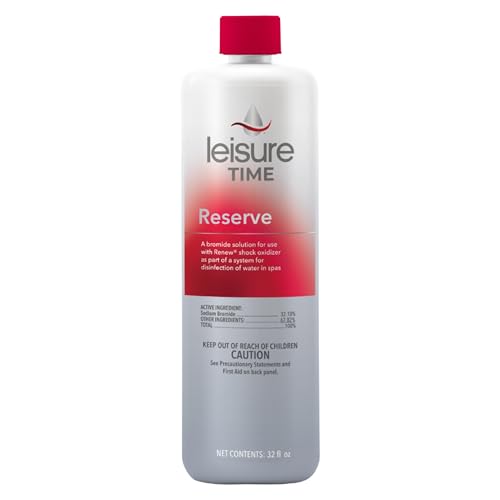
The linked picks are sold on Amazon, where you can check current price, availability, and full label directions. Start with the Leisure Time Reserve, the bromine-bank foundation of the classic non-chlorine shock system, and confirm it through its Check on Amazon link. The other linked pick is the AquaDoc 7-in-1 Test Strips — Check on Amazon — for testing chlorine, bromine, and balance before and after every oxidation. The prose-only oxidizer types are sold in every spa aisle and online; buy monopersulfate by its chemistry name on the label, and buy biguanide-system oxidizer only from your own system’s product line.
In this guide
Quick Picks
| Pick | Badge | Why it earns its place |
|---|---|---|
| Leisure Time Reserve | Best System Foundation | A liquid bromine sanitizer that builds the bank a non-chlorine oxidizer then reactivates, the classic chlorine-free routine. |
| AquaDoc 7-in-1 Test Strips | Best Testing Partner | Two hundred strips reading chlorine, bromine, pH, alkalinity, and hardness, so oxidation is dosed and verified on evidence. |
| Monopersulfate Oxidizer Shock (Type) | Best Non-Chlorine Shock | The oxidizer itself: burns waste, reactivates bromine, adds no sanitizer, and allows a short wait before soaking. |
| Biguanide-System Oxidizer (Type) | Best for Biguanide Spas | The only oxidizer compatible with biguanide sanitation, used strictly within its own product system. |
| Ozonator Oxidation Support (Type) | Best Equipment Assist | An ozone system that oxidizes continuously, reducing how much chemical shock a spa needs. |
| Enzyme Water Clarifier (Type) | Best Gentle Adjunct | Digests oils and lotions between shocks, easing the oxidizer’s workload without replacing it. |
Key Takeaways
- Non-chlorine shock oxidizes waste; it does not sanitize, and it must always partner with a sanitizer system.
- Monopersulfate is the standard chemistry; buy it by that name on the label.
- In bromine spas the oxidizer is the activator: no oxidizer rhythm, no active bromine.
- Biguanide systems accept only their own oxidizer; chlorine and bromine products are incompatible with them.
- The wait after non-chlorine shock is short, but a test confirming sanitizer presence still comes before soaking.
- Testing before and after is what turns oxidation from a habit into a method.
How These Picks Were Chosen
Linked picks come from the verified supplement pool. The honest structure of this category shaped the selection: the oxidizer itself is a commodity chemistry sold under many labels, so the guide links the two products that anchor the routine with verified listings, the bromine-bank foundation whose system is built around a non-chlorine oxidizer partner, and the test strips that govern dosing, and describes the oxidizer types in prose with buying criteria instead of inventing a branded oxidizer link the pool does not contain. Features and specifications are reported from the manufacturers’ listings.
Excluded were chlorine shocks, which belong to the sibling guide, and any framing of non-chlorine shock as a complete water treatment. The guide is emphatic, in the reviews, the buying guide, and the FAQ, that oxidation without sanitation is not water care, because the category’s one dangerous misunderstanding lives exactly there. Biguanide oxidizer is included as a type with a strict within-system rule, since that system’s owners have the fewest safe substitutions of any spa household.
The evaluation standard is system completeness: a pick earns its place by making a chlorine-free or low-chlorine routine actually work, measurably and safely, week after week.
The 6 Best Non Chlorine Shock for Hot Tubs — Reviewed

Leisure Time Reserve
Our badge: Best System Foundation
The Leisure Time Reserve leads because the most successful non-chlorine shock routine in the category is built on it. Leisure Time describes Reserve as a liquid bromine sanitizer that creates a chlorine-free sanitation system: dosed at fill and weekly, it establishes a bank of bromine in the water, and it is designed to be used with an oxidizer, the maker’s Renew, which is the non-chlorine shock half of the pairing. The chemistry is the point of this entire guide in miniature. The oxidizer does not sanitize; it converts the bank into active bromine, which sanitizes and partly returns to the bank, so the spa’s protection is regenerated by each shock rather than consumed by it.
Strengths
- Builds the bromine bank that non-chlorine shock exists to activate.
- Liquid formula dissolves immediately at fill and at weekly dosing.
- A complete labeled system, bank plus oxidizer, rather than an improvisation.
Trade-offs
- Two-part ownership: the oxidizer partner is a separate, ongoing purchase.
- Bromine water must be tested on the bromine scale, a habit chlorine converts must relearn.
- Not applicable to biguanide spas, whose systems are closed to bromine entirely.
| Size | 1-Pack |
|---|---|
| Dimensions | 3.12 x 3.12 x 9.38 inches |
| Weight | 2.5 pounds |
Run the system as its labels choreograph: bank established at fill, oxidizer after use patterns and weekly, testing that reads bromine, and balance kept in range so the chemistry can do its work. Owners who adopt the full rhythm describe bromine water as the set-and-forget end of spa care, steady at temperature, gentle in character, and maintained by exactly the non-chlorine shock this keyword is about. Half-adopting it, bank without oxidizer or oxidizer without bank, is the failure mode the reviews below keep warning against, because each half alone is inert.
Best for: bromine-system spas wanting the labeled chlorine-free routine / Not suited for: biguanide systems or single-bottle households
Choose Reserve as the foundation of a bromine routine. Skip it if your system is biguanide, and stay inside that system’s own line. Check on Amazon

AquaDoc 7-in-1 Test Strips
Our badge: Best Testing Partner
The AquaDoc 7-in-1 Test Strips govern every non-chlorine routine in this guide, because oxidation decisions are reading decisions. The pack of two hundred strips tests total chlorine, free chlorine, bromine, pH, total alkalinity, total hardness, and cyanuric acid by a dip, a short wait, and a color-chart comparison, and can pair with the maker’s digital reader. For the non-chlorine shock user the critical readings are the sanitizer level, which proves the oxidizer has a partner doing its job, and pH and alkalinity, which decide whether the oxidation will work at full strength. Two hundred strips make the test-before-and-after rhythm affordable in the only currency that matters, which is strips not rationed.
Strengths
- Reads both chlorine and bromine plus the balance parameters oxidation depends on.
- Generous count supports testing before and after every shock.
- Method simple enough for every adult in the household to run.
Trade-offs
- Color comparison has limits; the digital reader or a liquid kit sharpens precision.
- Strips must be stored dry and within date to read true.
- A reading informs the dose; the shock’s own label still sets it.
| Size | Digital Water Test Kit |
|---|
The non-chlorine routine’s signature failure, cloudy water in a spa shocked faithfully every week, is almost always a testing failure in disguise: the sanitizer bank had quietly emptied, and the oxidizer was activating nothing. A strip before each shock catches that week, when the fix is a bank dose, rather than the month, when the fix is a drain. Keep the strips at the spa in a dry container and the routine stays honest.
Best for: every non-chlorine routine, as its evidence base / Not suited for: owners wanting laboratory precision from a strip
Choose AquaDoc to keep oxidation honest. Skip it only if a liquid kit is already in faithful use. Check on Amazon
Monopersulfate Oxidizer Shock (Type)
Our badge: Best Non-Chlorine Shock
Monopersulfate shock, sold everywhere as non-chlorine shock and described here as a type, is the product this keyword actually names. It is a granular oxidizer, potassium monopersulfate, that destroys chloramines, oxidizes lotions and bather waste, clears the dullness that filtration cannot, and reactivates bromine banks, while adding no sanitizer and no chlorine. Its practical signature is the short turnaround: once the label’s brief circulation has passed and a test confirms sanitizer is present, the spa can typically return to use the same day, which is why it is the midweek and pre-gathering shock of chlorine spas and the standing shock of bromine and mineral spas.
Strengths
- Pure oxidation with no sanitizer added, suiting bromine, mineral, and low-chlorine routines.
- Short wait before soaking compared with chlorine shock, per label directions.
- A commodity chemistry available everywhere at honest prices.
Trade-offs
- Sanitizes nothing; a spa without residual sanitizer is not made safe by it.
- Repeated use nudges total dissolved solids upward, hastening the eventual drain.
- Labels hide behind brand names; the monopersulfate ingredient line is what to verify.
Buy it by chemistry: the ingredient panel should name potassium monopersulfate or potassium peroxymonosulfate, dosed for spa volumes, from any reputable spa brand. Dose by the label for your gallons, with the pump running and cover open, and log it alongside the test readings. It is the least glamorous and most useful bag in the spa cupboard, and this guide’s refusal to attach a single brand to it is a feature: the chemistry is the product.
Best for: bromine activation, mineral-system oxidation, and chlorine spas between soaks / Not suited for: any spa as its only treatment
Choose monopersulfate by name and dose by label. Skip any product that will not tell you its chemistry.
Biguanide-System Oxidizer (Type)
Our badge: Best for Biguanide Spas
Biguanide sanitation, the chlorine-free and bromine-free system built on PHMB sanitizer, uses its own oxidizer, a hydrogen-peroxide-based product sold within each biguanide brand’s line, described here as a type because substitution across systems is the one thing this category forbids. The oxidizer clarifies the water and burns off organic load as part of that system’s three-step routine, and it is genuinely non-chlorine in the strictest sense: chlorine or bromine introduced into a biguanide spa reacts badly, clouding water and breaking the system down. For biguanide owners, then, the best non-chlorine shock is not a choice but a loyalty: your own system’s oxidizer, at its label’s dose, on its label’s rhythm.
Strengths
- The only oxidizer chemistry compatible with biguanide sanitation.
- Gentle water character that biguanide households choose deliberately.
- A closed, labeled system removes cross-brand guesswork.
Trade-offs
- Zero interchangeability: no other shock in this guide may be used.
- Biguanide systems need their own test method and resist conversion without a full drain.
- Product availability follows the brand’s distribution, so keep a spare.
The guidance is short because the rule is absolute: if your spa runs biguanide, buy the oxidizer from the same system that supplies your sanitizer, follow that system’s test and dose instructions, and treat every other product in this article as reading material only. Owners considering a switch away from biguanide should plan a drain, a thorough rinse, and a fresh start rather than a gradual blend, which exists in no manufacturer’s instructions.
Best for: biguanide-system spas exclusively / Not suited for: chlorine, bromine, or mineral systems
Choose your own system’s oxidizer, always. Skip every other shock while biguanide is in the water.
Ozonator Oxidation Support (Type)
Our badge: Best Equipment Assist
An ozonator, described as a type, moves oxidation from a weekly event to a continuous process. The unit generates ozone, a powerful oxidizer, and injects it into the circulation stream, where it destroys waste and chloramines as the water passes and then reverts to oxygen. Spas equipped with one typically need less chemical shock and hold clarity longer between doses, and many spas are built ozone-ready or ship with one installed. It is an assist rather than a replacement: ozone works only while water circulates, leaves no residual in the tub itself, and partners with, rather than abolishes, a sanitizer and an occasional monopersulfate dose.
Strengths
- Continuous oxidation reduces chemical shock frequency and size.
- No residual chemistry added to the soaking water.
- Supports every sanitizer system that permits it, per the spa’s maker.
Trade-offs
- Equipment cost and a consumable ozone cell or lamp with a service life.
- Works only during circulation; it cannot rescue neglected water alone.
- Compatibility and installation belong to the spa maker’s instructions.
Owners whose spas already carry an ozonator should keep it maintained, since a dead ozone cell silently returns the full oxidation load to the chemical shelf. Owners considering a retrofit should confirm with the spa’s maker that the model supports one and have it fitted properly, treating it as equipment rather than as an accessory. Either way, its honest badge is assist: the shock bag gets lighter, not retired.
Best for: spas built or approved for ozone, wanting lower chemical load / Not suited for: owners wanting equipment to replace water care
Choose ozone as a load-reducer where the spa supports it. Skip it as a rescue strategy.
Enzyme Water Clarifier (Type)
Our badge: Best Gentle Adjunct
An enzyme clarifier, described as a type, attacks the specific fraction of the waste load that oils the water: lotions, sunscreens, and body oils that oxidizers burn slowly and filters smear rather than catch. Enzyme products digest those organics into simpler compounds the filter and oxidizer can finish, and in non-chlorine routines they earn their shelf space by reducing the scum line, easing foam, and stretching the interval between full oxidizer doses. They are adjuncts in the strict sense, supporting the shock and sanitizer without performing either job, and this guide includes them because non-chlorine households, who dose gently by philosophy, benefit most from a gentler workload.
Strengths
- Targets the oil fraction that drives foam and scum lines.
- Reduces oxidizer demand between scheduled shocks.
- Compatible, per most labels, across chlorine, bromine, and mineral routines.
Trade-offs
- Neither sanitizer nor oxidizer; it cannot substitute for either.
- Effects are gradual and preventive rather than dramatic.
- Labels vary; confirm system compatibility before adding.
Dose it weekly per its label, ideally right after the shock so the two divide the work, enzymes taking the oils and the oxidizer the rest. Owners who keep the pairing find the waterline staying clean and the shock doses holding their effect longer, small mercies that compound across a season into the feeling that the spa has become easy.
Best for: oil-prone spas and gentle-routine households / Not suited for: rescue or sanitation
Choose enzymes as the shock’s helper. Skip them as a headline treatment.
Comparison Table
| Pick | Role | System Fit | Sanitizes? | Check price on Amazon |
|---|---|---|---|---|
| Leisure Time Reserve | Bank foundation | Bromine | Yes, as bromine system | Check price on Amazon |
| AquaDoc 7-in-1 Test Strips | Testing | All | No | Check price on Amazon |
| Monopersulfate Shock (Type) | Oxidizer | Bromine, mineral, chlorine assist | No | Check price on Amazon |
| Biguanide Oxidizer (Type) | Oxidizer | Biguanide only | No | Check price on Amazon |
| Ozonator (Type) | Equipment assist | Maker-approved spas | No | Check price on Amazon |
| Enzyme Clarifier (Type) | Adjunct | Most, per label | No | Check price on Amazon |
How to Choose the Best Non Chlorine Shock for Hot Tubs
Start From Your Sanitizer, Not From the Shock Shelf
Bromine spa: monopersulfate, with the bank maintained. Mineral or low-chlorine spa: monopersulfate on rhythm. Biguanide spa: your system’s own peroxide oxidizer and nothing else. Chlorine spa wanting gentler intervals: monopersulfate between chlorine shocks. Every path on that list is decided by the sanitizer already in your water, which is why the first purchase in any non-chlorine routine is a test that tells you what that sanitizer is doing.
Verify the Chemistry on the Label
For monopersulfate, the ingredient line is the product: potassium monopersulfate or peroxymonosulfate, spa dosing on the label, and no chlorine content. Brand, fragrance, and packaging theater add nothing. For biguanide oxidizer, the verification is the opposite: the brand must be your system’s own, and no generic substitute is acceptable at any price.
Keep the Safety Arithmetic Visible
Non-chlorine shock’s gentleness invites the one dangerous inference, that the water is treated because it looks treated. Build the routine so the inference cannot form: sanitizer tested before soaking, oxidizer logged when dosed, and the pair kept in separate, labeled, dry storage. The system’s elegance is real, and so is its single rule, that oxidation partners sanitation and never impersonates it.
Consider Equipment and Adjuncts as Load Management
If oxidizer doses keep growing, the load is growing, and load has sources: bather habits, filter condition, water age, and circulation. An ozonator where the spa supports one, enzymes for oil-heavy use, and honest filter care each shrink the load the shock must carry, and any of them may be the better purchase than a bigger bag of oxidizer.
How to Use Non-Chlorine Shock, Step by Step
Test first: sanitizer, pH, and alkalinity, because the oxidizer works inside a balanced, sanitized spa and disappoints outside one. If the bromine bank or chlorine residual has collapsed, restore the sanitizer per its system before or alongside the oxidation, as the labels direct. With the pump running and the cover open, broadcast the label’s monopersulfate dose for your gallons across the surface and circulate for the directed period, typically a quarter hour or so, keeping bathers out. Retest to confirm sanitizer is present in range, then soak when the label’s short wait has passed. Log the dose, the readings, and the water’s response, because the log is what turns next month’s cloudy evening from a mystery into a lookup.
The rhythm for bromine spas is oxidize after use and weekly at minimum, with the bank dosed on its own schedule. For chlorine spas using monopersulfate as the gentle intermediate, alternate it with a true chlorine shock on the slower rhythm the sibling guide describes, so chloramines never get a month to consolidate. For biguanide spas, the system’s own calendar governs, and this guide defers to it entirely.
Problem: Water stays cloudy despite weekly non-chlorine shock — Test the sanitizer before blaming the oxidizer; an empty bromine bank or absent residual is the usual cause, followed by filter condition and water age.
Problem: The spa smells musty after shocking — Oxidation exposes what the cover traps; leave the cover open for the full circulation period, clean the cover’s underside, and check that the dose matched the gallons rather than habit.
Problem: Foam persists — Oils are outpacing oxidation; add the enzyme adjunct, rinse swimwear in plain water, and skim, rather than doubling oxidizer doses beyond the label.
Problem: Skin feels irritated after a non-chlorine routine — Test balance first, since pH drift irritates more often than oxidizer does, and confirm sanitizer is in range rather than absent or excessive; persistent irritation is a reason to review the whole system, not to add products.
Why Bromine and Non-Chlorine Shock Belong Together
The bromine system is the non-chlorine shock’s native country, and understanding their marriage explains the whole category. Bromine’s sanitizer is stored in the water as inactive bromide, a bank. The oxidizer’s arrival converts bank into active bromine, which does the sanitizing and then, its work done, partly settles back into the bank to be activated again. No other common system recycles its sanitizer this way, which is why bromine at hot-tub temperatures is both steady and economical, and why the oxidizer is not an accessory to the system but its trigger. Owners who grasp the cycle stop asking whether they still need shock without chlorine, because in their spa the shock is what makes the sanitizer exist in active form at all. The full bromine picture, tablets, granules, floaters, and conversion from chlorine, lives in the sibling guide linked throughout this one.
Non-Chlorine Shock in Chlorine and Mineral Spas
Chlorine owners sometimes treat monopersulfate as a betrayal of their system; it is better understood as its relief pitcher. A chlorine spa’s weekly oxidation can alternate between a true chlorine shock, which also tops up sanitizer and destroys consolidated chloramines, and monopersulfate, which oxidizes the week’s waste without pushing chlorine above soaking range and lets the household back in sooner. Mineral-system spas lean on monopersulfate as their primary oxidizer, since their low sanitizer residual is maintained by the mineral and cartridge system rather than by dosing, and oxidation is precisely the job left over. In both cases the discipline is identical: the sanitizer, however maintained, is tested and present, and the oxidizer is its partner. The systems differ; the rule does not.
Common Buying Mistakes
Believing Non-Chlorine Means Chemical-Free
Monopersulfate is a real oxidizer with real handling rules, and biguanide peroxide likewise. Gentler is a comparison, not an exemption; labels, storage, and testing all still apply.
Using Oxidizer as the Only Treatment
The category’s cardinal error. Clear, oxidized, unsanitized water is not cared-for water. If a product or a routine promises shock alone is enough, it is selling the misunderstanding this guide exists to correct.
Mixing Systems Mid-Water
Adding bromine products to a biguanide spa, or chlorine shock to water whose owner cannot name its system, creates reactions nobody wants. Conversion between systems happens at a drain, with a rinse, on purpose.
Skipping the Post-Shock Test Because the Wait Is Short
The short wait is conditional on sanitizer being present. Thirty seconds with a strip is the condition’s proof, and it is the cheapest safety step in all of spa care.
Buying Oxidizer by Brand Story Instead of Ingredient
For monopersulfate the chemistry is standardized; pay for spa dosing, honest labeling, and freshness, not for narrative. The exception proves the rule: biguanide oxidizer is bought by brand loyalty alone, because there the brand is the compatibility.
Non-Chlorine Shock and Sensitive Households: An Honest Conversation
Many households arrive at this keyword carrying a hope this guide should address directly: that removing chlorine will remove a bather’s discomfort. Sometimes it does. Chlorine’s smell and its effect on some skin and eyes are real, and bromine or mineral systems with monopersulfate oxidation genuinely change the water’s character in ways sensitive bathers often prefer. But the honest guide must also say what the marketing will not: much of what bathers blame on chlorine is imbalance, pH drifted high, chloramines from under-oxidized water, water old enough to irritate anyone, and those faults follow a household into any system whose testing lapses. The households that find relief are the ones who change systems and tighten their testing in the same month, and they can rarely say which change deserved the credit, a confession this guide makes on their behalf. The practical advice follows: if sensitivity is the motive, choose the system whose routine your household will actually run with strips in hand, because a balanced bromine spa will treat sensitive skin kinder than a neglected chlorine one, and the reverse is equally true.
The Rental and Second-Home Problem: Oxidation Between Visits
Non-chlorine routines face their hardest test in spas that sit between visits, rentals, cabins, the second home used monthly, because oxidation is an event, not a residual, and a spa shocked on departure day has no oxidizer working in week three. The honest systems answer is that the sanitizer residual does the long watch, the bromine bank’s steadiness is precisely why bromine suits absentee spas, while the oxidizer waits for the arrival ritual: test, restore the bank if it sagged, oxidize, circulate, retest, soak. Hosts and owners who formalize that arrival sequence, in the property’s book, with the strips and products staged, convert the absentee spa’s water from a gamble into a procedure. The alternative sometimes marketed, heroic dosing at departure, misunderstands the chemistry this whole guide exists to explain: shock is a spark, not a storage battery, and the spa that sits safely is the one whose sanitizer system was designed for the sitting.
Reading the Water After Oxidation: What Success Looks Like
New oxidizer users often cannot tell whether the shock worked, and the signs deserve spelling out, because confidence in the routine is built from readings, not vibes. In the hour after a correct dose, the water’s dullness lifts visibly against the underwater light, the flat or sweetish smell of a tired spa gives way to neutral, and a bromine system’s test shows the sanitizer awake in its range, the single most satisfying strip in spa keeping, since it proves the bank and the spark met. Foam from the week’s lotions may briefly flourish as oxidation frees it, then collapse under skimming and filtration, which is success wearing a disguise new owners misread as failure. The failures have their own signatures and should be learned with equal clarity: cloudiness unchanged after circulation points away from chemistry toward the filter or the water’s age; a sanitizer reading still flat after oxidation says the bank or residual was absent, not that the oxidizer was weak; and a sharp, unpleasant odor after dosing in a chlorine spa says chloramines were heavy and the dose deserves repeating after the retest, per the label. Owners who learn the two vocabularies, success and failure, stop dosing by hope within a month, and their spas show it.
Oxidizer Storage and Shelf Life: The Quiet Half of the Routine
Monopersulfate and its companion products lose their virtue in bad storage, and a short section on the shelf completes the system. Oxidizers belong in their original containers, sealed, dry, and cool, because moisture is their slow enemy: a bag that has caked or a tub whose granules have clumped is reporting that its strength has been leaving by degrees, and dosing with it becomes guesswork. Keep the oxidizer physically apart from the chlorine products and from acids, in the separated order the shock guide prescribes for the whole chemical cupboard, since oxidizers stored carelessly among their reactive cousins are an incident arranging itself. Buy in sizes the household will consume within a reasonable season rather than the warehouse quantity whose price flatters and whose last third is spent at half strength, and mark the purchase date on the container in the same spirit as the spa log. The routine’s glamorous half is the sparkling water; its reliable half is a dry shelf, a dated bag, and a measuring scoop that lives with the product, and owners who honor both halves find their oxidation boringly predictable, which is the highest state spa chemistry can achieve.
The Chemistry Shelf Audit: Knowing What You Actually Own
Most spa households own a shelf of half-remembered bottles, and the non-chlorine routine, which lives or dies by system clarity, is the right occasion for an audit. Spread the shelf on a table once a year and sort it by function with a ruthlessness the water will thank you for: sanitizer and its system partners in one group, oxidizer in its own, balancers in a third, and a fourth, uncomfortable group for the products nobody can assign, the clarifier from a forgotten experiment, the bottle whose label has faded past reading, the duplicate bought because the first was mislaid. The unassignable group should leave the shelf, disposed of per local guidance for household chemicals, because a product that cannot be identified cannot be dosed, and a crowded shelf invites the grab-and-pour errors this guide has warned against from its first page. What remains gets labeled with purchase dates, arranged so the weekly routine’s products stand at the front in their order of use, bank, oxidizer, test, and the audit closes with the household able to narrate its own system in one breath. It is housekeeping as chemistry, and spas run from audited shelves have a way of staying clear that their owners attribute to luck until they read their own log.
The Traveler’s Spa: Oxidizing Around an Irregular Life
Households that travel, for work, for family, for the pleasure of it, keep spas on an irregular rhythm that fixed weekly schedules serve badly, and the non-chlorine routine adapts to the irregular life with a few honest adjustments. Before departure: balance the water, confirm the sanitizer system is at its most self-sufficient, a loaded floater or a fresh bank, set filtration to run daily, and oxidize, since a spa left freshly oxidized with its sanitizer awake is a spa with the best possible starting position. During absence, no oxidizer works, and this guide will not pretend otherwise; the sanitizer residual is the whole watch, which is why bromine’s bank and the mineral systems earn their absentee reputation honestly. On return, the arrival ritual from the absentee section governs, test before anything, restore what sagged, oxidize, circulate, retest, and only then soak, however inviting the water looks after a long drive. Travelers who formalize the two rituals, departure and arrival, on the card that lives with the strips, find their spas survive a wandering life gracefully, while travelers who improvise each return eventually improvise a drain. The spa can wait for its people; it only asks that they meet it with a test strip before they meet it with a swimsuit.
A Note on Language: What ‘Chlorine-Free’ Should and Should Not Promise
The phrase that sells this entire category deserves a closing audit, because households buy expectations along with oxidizer, and mismatched expectations are how good systems get abandoned. Chlorine-free, honestly used, describes a sanitation system that does not rely on chlorine, the bromine and biguanide households of this guide, and their water is genuinely a different chemical environment from a chlorinated spa’s. It does not mean chemical-free, a claim no sanitized body of warm water can make and none should, since the alternative to chemistry in a hot tub is not purity but biology. It does not mean maintenance-free, as the testing rhythm through this guide attests, nor does it guarantee any bather’s comfort, since sensitivity is personal and balance matters in every system. The households that thrive with the phrase are the ones who hear it precisely, a system choice with real character and real duties, while the ones who hear a spa that asks nothing will be disappointed by any water on earth. This guide has tried throughout to sell the non-chlorine routine at its true value, which needs no inflation: elegant chemistry, gentle water character, and a weekly rhythm well within any household’s power. Bought at that value, it will not be returned.
The Coexistence Guide: When Two Systems Share One Street
A closing practical note for the households and neighborhoods where systems meet, because shared equipment and borrowed products are where cross-system accidents actually happen. The friend with the chlorine spa who offers your bromine household a scoop of their shock at a weekend house, the rental whose shelf holds three systems’ leftovers, the second-hand spa that arrives with a cupboard of the previous owner’s chemistry: each is a small test of the discipline this guide has taught, which is that a product’s identity is its chemistry and its system, not its intentions. The rules that keep coexistence safe are brief enough for the chemical card: never borrow a dose across systems, never accept an unlabeled container from any hand however trusted, and when inheriting a spa, inherit nothing chemical with it, starting the shelf fresh from the audit section’s clean table. Hosts of multi-system properties, the cabin with two spas, the rental with a hot tub and a pool, should keep the shelves physically separate and labeled by water body, since the pool’s chlorine shock and the spa’s oxidizer are cousins that must never be introduced. Chemistry is sociable within its rules and unforgiving outside them, and the households that state the rules once, on the card, in the cupboard, are the ones whose coexistence stories stay boring.
The Partnership, Restated
If this guide leaves one sentence in the reader’s keeping, it should be the one its whole length has been building: oxidation is the partner, never the replacement. A spa whose sanitizer is awake and whose oxidizer arrives on rhythm is a spa whose water stays beneath notice, clear, neutral, and ready, and that unremarkable state, maintained month after month, is the true luxury every product in this category is actually selling. Keep the partnership, keep the strips honest, and the non-chlorine routine will repay the discipline with the calmest water in the neighborhood.
Final Recommendation
The recommendation is a system, stated plainly. Bromine households: build on the Leisure Time Reserve and shock with monopersulfate by chemistry name, testing with the AquaDoc strips through their Check on Amazon link before and after. Biguanide households: your own line’s oxidizer, exclusively. Chlorine and mineral households: monopersulfate as the gentle oxidizer between stronger interventions. In every case the oxidizer partners a tested sanitizer, and that partnership, not any single bag or bottle, is the best non-chlorine shock a hot tub can have.
Frequently Asked Questions
Does non-chlorine shock sanitize the water?
No. It oxidizes waste, destroys chloramines, and in bromine spas activates the sanitizer bank, but it leaves no sanitizing residual of its own. A spa needs a maintained sanitizer system, chlorine, bromine, mineral-assisted, or biguanide, with non-chlorine shock as its partner. Any routine that shocks without sanitizing is incomplete.
How soon can I use the hot tub after non-chlorine shock?
Typically much sooner than after a chlorine shock, once the label’s directed circulation period has passed, often around a quarter of an hour, and a test confirms sanitizer is present in range. The product label governs the wait for your dose and gallons; the test governs whether the water is ready in fact.
What is monopersulfate?
Potassium monopersulfate, also labeled potassium peroxymonosulfate, is the standard non-chlorine oxidizer for spas. It is the active ingredient behind nearly every product sold as non-chlorine shock, which is why this guide advises buying it by the ingredient line and spa dosing rather than by brand story.
Can I use non-chlorine shock in a chlorine hot tub?
Yes, and many owners do, as the between-soaks oxidizer that clears waste without raising chlorine. It does not replace chlorine shocking entirely, since consolidated chloramines and sanitizer top-ups remain chlorine’s jobs, so most chlorine spas alternate the two on the rhythm the shock guide describes.
Why does my bromine spa go cloudy when I skip the oxidizer?
Because the oxidizer is what converts your bromine bank into active bromine. Without it the bank sits inert, sanitizer effectively vanishes, and waste accumulates, so the water clouds even though bromine product is present. Restore the oxidizer rhythm and test on the bromine scale to confirm the system is awake.
Is non-chlorine shock safer for sensitive skin?
Many households with chlorine sensitivity prefer bromine or mineral systems paired with monopersulfate, and find the water gentler in character. What this guide can honestly say is that the chemistry differs and the chlorine exposure is lower in those systems; individual sensitivity varies, balance and correct dosing matter as much as system choice, and persistent irritation deserves a system review rather than more product.


