Disclosure: As an Amazon Associate, dailyhomedecorating.com earns from qualifying purchases. Links to Amazon on this page are affiliate links; they cost you nothing extra. Prices and availability change often, so check the current Amazon listing before you buy.
The best hot tubs for minnesota have to survive the most demanding spa climate in the continental United States, and this guide will rank them with that winter in the room. Minnesota cold is not a chilly evening; it is weeks of sub-zero air, wind that finds every seam, and snow loads that test covers and owners alike. The best hot tubs for minnesota are therefore the ones whose insulation, freeze protection, and construction treat January as the design case rather than the exception: full-insulation hard-shell spas at the top of the honest ranking, and, among inflatables, only the freeze-protected models with insulated walls and covers, sited on insulated bases in sheltered spots, with owners who understand the system they are running. This guide ranks three permanent and seasonal types in prose, because the verified pool for this site contains inflatable spas, alongside the two Freeze Shield inflatables and one insulated-cover model whose limits in this state are stated without varnish.
Minnesotans also get the greatest reward in the category for getting this right. A January soak in Duluth or Ely, steam rising into black, star-pricked air while the yard is locked in snow, is the single finest hot tub experience on the continent, and locals who own the right spa describe it the way other people describe travel. The state’s spa culture, from north-woods resorts to backyard decks in the Twin Cities, exists because the contrast is worth engineering for. The engineering is the subject here: what to buy, where to site it, how to run it through the polar weeks, and when the honest answer is to drain an inflatable and wait for spring. Readers still deciding their format should start with Best Inflatable Hot Tubs For Cold Weather for the cold-weather principles in general, then return here for the Minnesota application.
Read the Quick Picks for the shape of the answer, then the reviews, which in this guide function partly as climate verdicts. The buying guide translates Minnesota conditions, deep cold, wind, snow load, and spring thaw, into purchase checks, and the how-to sections cover winter running, cold-snap protocol, and the autumn preparation that decides whether January is a triumph or a repair bill.
Where to Buy
Permanent spas in this state are best bought through Minnesota dealers who deliver, place, and service through winter, because a spa that fails in January needs a local answer. The linked inflatable picks are sold on Amazon with current pricing and availability: the Coleman SaluSpa Miami Energy-Efficient AirJet Inflatable Hot Tub leads them with its Freeze Shield system, via its Check on Amazon link, followed by the Bestway SaluSpa Cancun Energy-Efficient Inflatable Hot Tub — Check on Amazon — and the INTEX 28425EH PureSpa Bubble Massage Spa Set — Check on Amazon, included with its freeze boundary clearly marked. Buy base insulation, a spare filter set, and cover accessories in the same order as any inflatable; in Minnesota they are not accessories but components.
In this guide
Quick Picks
| Pick | Badge | Why it earns its place |
|---|---|---|
| Fully Insulated Hard-Shell Spa (Type) | Best Overall | Full-foam or equivalent insulation, enclosed plumbing, and a snow-rated cover: the Minnesota benchmark. |
| Coleman SaluSpa Miami Energy-Efficient AirJet Inflatable Hot Tub | Best Inflatable | Freeze Shield protection and EnergySense insulation make it the only class of inflatable this guide endorses for a Minnesota winter outdoors. |
| Bestway SaluSpa Cancun Energy-Efficient Inflatable Hot Tub | Best Value Inflatable | The same Freeze Shield and insulation package at a gentler point in the range. |
| Rotomolded Spa (Type) | Best for Cabins | One-piece toughness for lake-country properties where service is a drive away and winters are long. |
| Indoor or Garage Spa Installation (Type) | Best for Extreme North | Moving the spa inside the thermal envelope is the far north’s oldest and soundest answer. |
| INTEX 28425EH PureSpa Bubble Massage Spa Set | Best for Shoulder Seasons | A superb insulated-cover spa for spring through fall and mild spells, with a drain-and-store winter plan. |
Key Takeaways
- In Minnesota, insulation class and freeze protection are the product; everything else is trim.
- Hard-shell spas with full insulation and enclosed plumbing are the state’s benchmark for a reason.
- Among inflatables, only freeze-protected, insulated models belong outdoors here in winter, on insulated bases in sheltered sites.
- Power continuity is a safety system for the spa: never switch a water-filled spa off in a Minnesota freeze.
- Snow load, wind shelter, and a cleared, salted path are part of the installation, not afterthoughts.
- Have a polar-outbreak plan, monitor or drain, decided in autumn, not improvised in the dark at thirty below.
How These Picks Were Chosen
Permanent options are prose-described types because the verified pool contains inflatable spas only; no specifications were invented for them. Selection applied Minnesota’s climate as the filter: insulation method, whether plumbing lives inside the thermal envelope, freeze-protection systems, cover construction and snow behavior, and the availability of in-state service. The linked inflatables carry their verified manufacturer specifications in the spec boxes, and the two Freeze Shield models are the only inflatables this guide recommends for outdoor winter water in Minnesota, with the Intex included explicitly as a shoulder-season and protected-site option.
Excluded were all unprotected inflatables for winter use, spas whose insulation method the maker will not state, and any buying advice that treats a Minnesota January like a Colorado one. The pool’s cold-plunge entry was excluded as a non-hot-tub, though Minnesotans cutting a hole in a lake are respectfully noted as operating beyond this guide’s scope. No static prices or ratings appear; cold performance is described from stated systems and thermal principles, and buyers should confirm their model’s low-temperature guidance in its manual.
The standard is January truth: a pick must plausibly hold temperature, protect its plumbing, and remain usable through the state’s real winter under the routine this guide describes, not merely survive a photograph of one.
The 6 Best Hot Tubs for Minnesota — Reviewed
Fully Insulated Hard-Shell Spa (Type)
Our badge: Best Overall
The fully insulated hard-shell spa is Minnesota’s benchmark because its engineering matches the climate point for point. A cabinet insulated to the shell, by full foam or an equivalent verified method, keeps the equipment bay and plumbing inside the thermal envelope, so the water’s own heat protects the pipes that carry it. Molded seats and directional jets deliver the soak, a dense, well-sealed cover with the strength for snow country caps the system, and a Minnesota dealer’s service network stands behind it in the season when failure is most expensive. Described as a type because the pool holds no such model, it is nonetheless the purchase this guide recommends first to any Minnesota household buying for the long term.
Strengths
- Insulation architecture designed for sustained sub-zero operation.
- Enclosed, heat-sharing plumbing is the freeze-safe configuration.
- Dealer service in-state when January makes failure urgent.
Trade-offs
- The largest purchase and installation project in this guide.
- Running costs in deep winter are real even with the best insulation.
- Repairs are professional work with winter timelines.
Buy it on the insulation method stated in writing, the cover’s construction, and the dealer’s winter service reputation among actual Minnesota owners, whose reviews in local groups are the most honest literature in the category. Site it close to the house, in the lee of the prevailing wind, with a path you can keep clear, because the distance from door to water is the distance your January self must forgive nightly. Bought and sited that way, this type does not merely survive Minnesota; it is the reason some Minnesotans claim winter as their favorite season.
Best for: long-term Minnesota homes wanting the definitive winter spa / Not suited for: renters, seasonal properties without winter occupancy, or unproven habits
Choose the insulated hard-shell as the state’s default ambition. Skip it only where the inflatable or cabin strategies below honestly fit better.

Coleman SaluSpa Miami Energy-Efficient AirJet Inflatable Hot Tub
Our badge: Best Inflatable
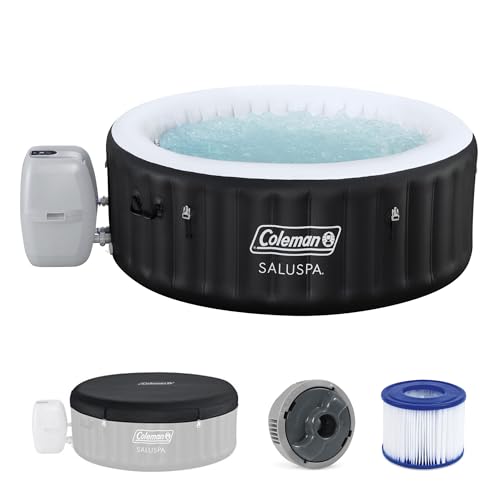
The Coleman SaluSpa Miami Energy-Efficient AirJet Inflatable Hot Tub is the inflatable this guide can endorse for a Minnesota winter, because its Freeze Shield automatic heating protects the pump and liner from cold damage and its EnergySense insulated walls and cover are built to hold warmth economically. MaxHold beams and a three-layer Tritech shell keep the structure honest in the cold, 120 AirJets deliver the full bubble soak, the ChemConnect dispenser steadies water care, and the power-saving timer schedules heat far ahead. Endorsement comes with the system conditions this guide repeats deliberately: an insulated base, a sheltered site, an uninterrupted power supply, and an owner who treats the polar-outbreak plan as part of ownership.
Strengths
- Freeze Shield protection designed for year-round operation.
- Insulation package that fights Minnesota running costs directly.
- Complete, light-touch ownership for a removable format.
Trade-offs
- Deep polar outbreaks test any inflatable; monitoring or draining may still be the right call.
- Protection dies with the power supply; outage planning is part of the purchase.
- Two-adult comfort capacity, as with the class.
| Color | Black |
|---|---|
| Size | Energy Efficient 2.0 |
| Dimensions | 71 x 71 x 26 inches |
| Weight | 101.2 pounds |
Site it like you mean it: against the house’s sheltered side, on a thick insulated base, with a windbreak on the weather flank and the cover brushed free of snow rather than loaded with it. Twin Cities and southern Minnesota owners will find the Coleman a genuine four-season spa under that discipline. Northern-tier owners should weigh the indoor strategy below with equal seriousness, because the state’s north is a different country in January and honesty about that is a feature of this guide, not a slight on the spa.
Best for: inflatable buyers in the Twin Cities and southern Minnesota, and sheltered sites statewide / Not suited for: exposed far-north sites through polar outbreaks without a drain plan
Choose the Coleman as the inflatable Minnesotans can defend. Skip it if your site and power cannot meet its conditions. Check on Amazon

Bestway SaluSpa Cancun Energy-Efficient Inflatable Hot Tub
Our badge: Best Value Inflatable
The Bestway SaluSpa Cancun Energy-Efficient Inflatable Hot Tub brings the same Freeze Shield protection, insulated energy-efficient construction, MaxHold and Tritech build, 120 bubble jets, and ChemConnect dispensing as the Coleman, at the gentler point in the range and in a grey wicker finish. For Minnesota buyers whose winter budget must also cover the base, the windbreak, and the spare filters this guide insists on, the Cancun’s savings are not a compromise but the funding source for the system that makes any inflatable viable here.
Strengths
- Full freeze-protection and insulation package at a value position.
- Savings fund the base, shelter, and spares the climate requires.
- Simple controls and dispenser care suit a winter routine.
Trade-offs
- Couples-scale in honest capacity.
- No usable dimensions or weight in the pool data; confirm on the listing.
- Identical polar and power caveats to its sibling.
| Color | Grey Wicker |
|---|---|
| Size | Energy Efficient 2.0 |
Everything said about siting and discipline for the Coleman applies here without amendment. The Cancun’s Minnesota buyer is making a systems purchase, spa plus base plus shelter plus spares, and judged as a system it is one of the strongest cold-weather values in this entire lot. Keep the cover sealed, the power on, and the snow brushed away, and it will steam through a Twin Cities winter with its dignity intact.
Best for: system-minded value buyers in moderate Minnesota cold / Not suited for: exposed far-north wintering
Choose the Cancun when the system matters more than the badge. Skip it where the hard-shell benchmark is affordable and intended. Check on Amazon
Rotomolded Spa (Type)
Our badge: Best for Cabins
The rotomolded spa is Minnesota’s cabin answer: a one-piece molded shell with permanent capacity and insulation, simple systems, and a tolerance for the lake-country realities of intermittent occupancy, long service distances, and hard use by generations of guests. Described as a type, it suits the property that is visited in every season but serviced rarely, where a flagship’s complexity would be a liability and an inflatable’s winter conditions cannot be guaranteed by an absent owner. With a proper cover and a winterization or keep-running plan matched to the cabin’s occupancy pattern, it is the durable middle of the state’s market.
Strengths
- One-piece toughness for remote, hard-use properties.
- Simpler systems suit long service intervals.
- Permanent insulation and capacity without flagship complexity.
Trade-offs
- Intermittent winter occupancy still demands a freeze plan, running or drained.
- Seats and jets are functional rather than luxurious.
- Delivery to remote sites is its own project.
Cabin owners should decide the winter doctrine before the first freeze: keep the spa running at a holding temperature with power guaranteed and someone able to check it, or winterize it fully and correctly per the manufacturer’s method. The fatal middle is a spa left full, powered by optimism, at a property nobody visits for six weeks. Choose the doctrine that matches the property’s real winter life and the rotomolded will serve the lake for decades.
Best for: lake cabins and rural properties with a clear winter doctrine / Not suited for: properties left full and unattended through winter
Choose rotomolded for the cabin belt. Skip it if no winter doctrine can be honestly kept.
Indoor or Garage Spa Installation (Type)
Our badge: Best for Extreme North
The indoor installation is the far north’s ancestral answer, and it deserves its place in a modern guide: a spa placed in a garage, a purpose-built spa room, or a three-season porch brought inside the thermal envelope never fights the freeze at all. Described as a type, it converts the hardest variable in Minnesota spa ownership, ambient cold, into a non-issue, at the cost of the outdoor experience and with ventilation and moisture management as its engineering price. For properties above the state’s cold line, and for owners whose priority is a guaranteed January soak over a starlit one, it is not a compromise but the correct design.
Strengths
- Freeze risk effectively eliminated by the building itself.
- Running costs fall when the spa heats room air’s neighbor, not the arctic.
- Usable in any weather, including the nights outdoors is genuinely dangerous.
Trade-offs
- Ventilation and humidity must be engineered, not improvised.
- The outdoor winter spectacle is traded away.
- Space inside a Minnesota garage is contested territory.
Ventilation is the whole technical story: warm, wet air must leave the building reliably, or the building will keep it in its timbers. A properly vented spa room with drainage and washable surfaces is a solved problem and a genuine luxury, the steam room’s domestic cousin. Owners who build it once tend to become evangelists, particularly in the weeks when the outdoor owners are executing their polar plans.
Best for: far-north homes and guaranteed-access priorities / Not suited for: romantics for whom the outdoor soak is the entire point
Choose the indoor route where the cold is sovereign. Skip it where the winter sky is the amenity.

INTEX 28425EH PureSpa Bubble Massage Spa Set
Our badge: Best for Shoulder Seasons
The INTEX 28425EH PureSpa Bubble Massage Spa Set is a fine Minnesota spa for most of the Minnesota year. Its insulated cover with high-density thermal foam is the class’s best defense of held heat, its hard water treatment suits the state’s well-water households, its saltwater readiness simplifies care, and its Fiber-Tech four-person interior is generous. Its boundary is equally clear and this guide states it as a condition of inclusion: Intex claims no freeze-protection system for the pump and liner, so in Minnesota this spa’s winter doctrine is drain, dry, and store before the hard freezes, or operate only in a protected indoor or garage setting per the manual. Judged as a three-season spa with an honest winter plan, it is excellent; judged as a January outdoor spa in this state, it is the wrong tool.
Strengths
- Superb insulated cover and gentle water systems.
- Generous interior and firm construction for spring through fall.
- Simple storage doctrine for winter removes all freeze anxiety.
Trade-offs
- No freeze protection; outdoor winter water in Minnesota is outside its brief.
- Seasonal setup and storage are annual chores.
- Bubble action is calm rather than vigorous.
| Color | Tan |
|---|---|
| Size | 4-Person |
| Weight | 99.66 pounds |
Many Minnesota households will recognize their real pattern in this pick: the spa that serves April through November gloriously and sleeps through the months when even the hard-shell owners are brushing snow off covers with respect. There is no failure in that rhythm, and for households whose January is given to ice fishing, skiing, and the sauna tradition, it may be the most Minnesotan choice in the guide.
Best for: three-season soaking with a clean winter storage plan / Not suited for: outdoor winter operation in Minnesota
Choose the Intex for the long Minnesota shoulder seasons. Skip it for January unless it lives indoors. Check on Amazon
Comparison Table
| Pick | Format | Minnesota Winter Verdict | Service Reality | Check price on Amazon |
|---|---|---|---|---|
| Fully Insulated Hard-Shell (Type) | Permanent | Benchmark: built for it | Dealer network in-state | Check price on Amazon |
| Coleman SaluSpa Miami | Inflatable | Viable with full system discipline | Owner-maintained | Check price on Amazon |
| Bestway SaluSpa Cancun | Inflatable | Viable with full system discipline | Owner-maintained | Check price on Amazon |
| Rotomolded Spa (Type) | Permanent | Strong with a winter doctrine | Simpler systems, remote-friendly | Check price on Amazon |
| Indoor Installation (Type) | Any, indoors | Freeze removed from the equation | Ventilation is the project | Check price on Amazon |
| INTEX PureSpa | Inflatable | Shoulder seasons; store for deep winter | Owner-maintained | Check price on Amazon |
How to Choose the Best Hot Tubs for Minnesota
Ask How the Plumbing Stays Warm
The Minnesota question is never whether a spa can heat its water in January; it is whether its pipes, pump, and unions share that warmth or sit outside it. Full-insulation designs that enclose the equipment in the thermal envelope are the freeze-safe architecture. For inflatables, the equivalent question is whether an automatic freeze-protection system guards the pump and liner, and the only acceptable answers are a named system or a storage plan.
Price the Cover Like a Roof
In Minnesota the cover is a structural element: it carries snow, seals against wind-driven cold, and decides the monthly bill. Ask its core, its seal, and its snow behavior, budget for the dense end of the range, and plan a lifter or a handling routine one person can execute in mittens. A cover that is wrestled is a cover left ajar, and a cover left ajar in a Minnesota January is an energy and freeze emergency in slow motion.
Site Against the Wind, Near the Door
The prevailing winter wind is the site planner. Put the spa in the lee of the house or a solid fence, close enough to a door that the path can be kept clear and the walk stays a pleasure, and far enough from roof edges that sliding snow has somewhere else to go. Every Minnesota spa owner eventually learns that the best site is the one their February self would have chosen.
Decide the Polar Doctrine in October
Write down, before the cold, what your spa does when a genuine polar outbreak is forecast: run with monitoring, or drain before it arrives. Include the power-outage version of the plan. The doctrine’s content matters less than its existence, because the owners who lose spas in Minnesota almost always lose them to a decision improvised too late.
Running a Spa Through a Minnesota Winter
Enter winter with fresh, balanced water, a clean filter and a spare, the cover’s seal inspected, and the base insulation in place. Through the season, test weekly and keep sanitizer steady, remembering that cold water is chemically patient; the routine in Best Shock For Hot Tubs covers the reset after holiday gatherings. Brush snow off the cover after storms rather than letting it compact and sag, keep the path cleared and treated, and never, in any circumstance, switch a full spa off at the wall to save money during cold weather. The holding-temperature strategy, moderate heat always, rising for evenings on the timer, is both the cheapest and the safest way to live with a Minnesota spa.
Spring is the audit: drain, clean, inspect every union and the cover’s underside, and service what the winter revealed while dealers are still quiet. Owners who run this annual rhythm, autumn preparation and spring audit, are the ones whose spas reach their second decade in a state that eats the unprepared.
Problem: A polar outbreak is forecast — Execute the October doctrine: verify power and cover, raise the holding temperature if your plan calls for it, monitor without repeatedly opening the cover, or drain ahead of the worst if that is your spa’s plan.
Problem: The power failed overnight in deep cold — Keep the cover sealed and untouched, restore power as the first priority on its return, and inspect for leaks as the system rewarms before assuming the worst or the best.
Problem: Snow load is bowing the cover — Clear it with a soft brush or broom, never a shovel edge, and review whether the cover’s specification matches snow country before next season.
Problem: The path to the spa is a skating rink — Treat the path as part of the spa: clear it, sand or salt it, and light it, because a fall on the way to a soak is the most Minnesota injury imaginable and entirely preventable.
The Sauna Question, and Other Minnesota Honesties
Every Minnesota spa guide should acknowledge the state’s other heat tradition: the sauna, which handles January with an indifference no water-filled vessel can match and which many households choose instead, or alongside. A spa guide’s honest position is that the two are different pleasures, dry and wet, social in different ways, and that the household that loves both is not confused but Minnesotan. What the comparison usefully teaches spa buyers is humility about physics: water outside in January is an engineering commitment, and the households that thrive with it are the ones who budgeted, sited, and routinized it like the commitment it is. Do that, and the state’s winter stops being the spa’s enemy and becomes its entire argument.
Twin Cities Decks, North Woods Cabins, and Prairie Winds
Minnesota is three spa climates wearing one name. The Twin Cities metro adds urban shelter, reliable power, dealer density, and decks whose structure must be verified for a filled spa’s weight, a check suburban buyers skip at their peril. The north woods add distance, intermittent occupancy, and the coldest air, which is why the cabin doctrine and the indoor option carry their own badges in this guide. The western prairie adds wind above all, where shelter is not a preference but the difference between a spa and a snowdrift with a pump. Read your own Minnesota into the recommendations, because the state line is the least informative boundary in this entire article. Lake-country readers may also enjoy Best Solar Bird Bath Water Pumps in the brief season when open water is a garden feature rather than a commitment.
Common Buying Mistakes
Importing Another State’s Advice
A spa that winters happily in Colorado or Michigan may be under-insulated for a Minnesota January. Buy to the local design case, not to a review written under a milder sky.
Leaving a Full Spa Unpowered
Whether by economy, accident, or an unattended cabin, this is how Minnesota spas die. Power continuity or a proper drain: those are the only two winter states a full spa may occupy.
Underbuying the Cover
A thin cover in snow country fails thermally and structurally. The cover is a roof; buy it like one.
Siting at the Far End of an Unclearable Yard
Romance places spas under distant pines; February places owners on a long icy path with a brush. Site near the door and let the view be the winter itself.
Skipping the October Doctrine
Polar air does not schedule consultations. Decide the plan in autumn, write it down, and make sure anyone house-sitting knows it too.
The Power Outage Playbook
Minnesota winters include the night the power fails at twenty below, and a spa owner’s calm depends on having rehearsed it. The principles are few and absolute. Do not open the cover to check; every opening spends the heat that is the spa’s only asset, and the water’s thermal mass, under a good cover on a well-insulated spa, buys many hours before freezing threatens the plumbing. Do not drain the spa in a panic; a full spa freezes slowest, and a drained spa with wet plumbing freezes fastest and worst. If the outage stretches and a generator is available, the spa’s circulation and heat are a legitimate priority load after the house’s essentials, run long enough to restore temperature and movement. When power returns, let the spa circulate and inspect for leaks before assuming the best, and if a freeze is suspected, a dealer’s winter emergency line is money well spent before the thaw makes the diagnosis for you. Inflatables follow the harsher version of the same logic given in the cold-weather guide: their margin is hours, not a day, and the household’s plan, generator, indoor drain-and-store decision, or acceptance of the risk, should exist before the storm rather than during it.
Preparation is the playbook’s real content: the spa’s breaker and the home’s panel labeled, the dealer’s number in the phone, a cover that actually seals, and insulation that was bought in October rather than regretted in January. Minnesota owners who treat the outage as a when rather than an if describe these nights the way they describe the weather itself, as a thing the house was built for.
Snow Load, Ice Dams, and the Spa’s Winter Roofline
A Minnesota spa lives under a snow regime, and the load paths deserve a section. The cover is the spa’s roof, and like a roof it has a load limit: the daily brush-off after storms is not fussiness but structural respect, since a season’s wet snow can bow a cover, strain its hinge, and pool meltwater that then freezes into the seal. Keep the area around the spa shoveled to the same standard as the path, because meltwater that ponds at the cabinet’s base and refreezes is working against the shell and the equipment door all winter. Watch the house’s own roofline above the spa, since the slide of a roof’s snow load or the drip of an ice dam belongs nowhere near a bather or a cover, and site or shield accordingly. The reward for this vigilance is the scene the whole purchase was for: the spa steaming in a cleared circle, the snow banked around like a fort, and the January night doing its worst somewhere beyond the cover’s edge.
The Spring Reckoning: Opening the Spa After the Hard Months
Minnesota spas earn a spring audit, and the owners who perform it catch the winter’s small damages while they are still small. Begin with the cover, the winter’s hardest worker: lift it and judge its weight honestly, since a cover that has taken on water has spent its insulation and begun taxing the lifter and the heat bill, and spring is when its replacement should be ordered rather than in the first cold week of autumn when every dealer is busy. Walk the cabinet and the pad for the frost’s signatures, heaved corners, a door that no longer sits true, the equipment bay’s floor for the damp that betrays a slow winter leak. Run the water’s own audit: if the spa wintered in use, spring is a natural drain-and-refill candidate, with the filter deep-cleaned or replaced and the shell wiped down at empty, the one time all year it can be. Test the safety systems that winter makes vital, the breaker’s trip, the heater’s honest recovery rate, and log the whole reckoning in the spa book, because the second spring’s audit is only useful against the first one’s notes. A Minnesota spa maintained this way ages in dog years slower than its neighbors, and the reckoning, an hour with coffee in the first mild week, is the cheapest longevity in this entire guide.
Community, Codes, and the Minnesota Neighbor Test
A hot tub in Minnesota is also a civic object, and a short section on its public life saves owners real friction. Many municipalities and townships speak to spas in their codes, fencing or locking-cover requirements, setback from lot lines, electrical permits for the hardwired installation, and the wise owner reads the local word before the pad is poured rather than after the inspector’s visit. Homeowners’ associations in the metro suburbs add their own layer, screening, noise, and placement rules that reward a conversation held in advance. Then there is the unwritten code, which in Minnesota is not a small thing: a spa is a visible luxury in a culture that prizes modesty, and the owners who thrive with one are those who share it, the neighbors invited for the January soak, the borrowed-cup-of-sugar economy extended to the backyard’s warmest asset. The spa that becomes a street’s occasional gathering place stops being an indulgence and becomes infrastructure, and more than one Minnesota owner has reported that the hot tub did more for their standing on the block than any lawn ever mowed. Buy the spa for the water; keep it for the neighborhood it creates.
The Cabin Question Settled: Which Spa for the Lake Place
Minnesota’s defining spa decision is not really about models; it is about the lake place, and this guide should settle its advice for the cabin plainly. A cabin visited year-round, heated through winter, with family arriving most weekends, can carry a proper hard-shell spa as its crown, run under the second-home discipline of the Michigan guide’s absentee chapter: locked cover, slow sanitizer, monitored temperature, a caretaker or a connected controller watching between visits. A cabin closed for the winter, drained and shuttered from November to April, should not own a plumbed spa at all through the frozen months, since an unheated building and a water-filled appliance are enemies introduced by optimism; its honest options are the inflatable, inflated for the summer season and stored by this guide’s storage discipline, or no spa, with the lake itself, a sauna if the family is serious, and the wood stove dividing the honors. The seasonal cabin that tries to split the difference, a hard-shell winterized by hope, generates the spring service calls that keep northern dealers in business. Choose by the building’s winter truth rather than by the family’s summer dreams, and the cabin spa, in whichever honest form, will be the place’s joy instead of its annual apology.
A Minnesota Spa Calendar: Twelve Months on One Page
The state’s spa year compresses into a calendar worth printing for the equipment door. January and February are the deep-winter vigil: cover brushed after every snow, temperature and circulation confirmed daily in the coldest snaps, soaks taken with the wind chill as a co-host and enjoyed accordingly. March brings the thaw’s treachery, freeze-thaw working at seals and pads, and the first inspection of the spring reckoning begins as the snow retreats from the cabinet. April and May are the service season, drain and refill for the wintered-in-place spas, filter deep-cleaned or replaced, the cover judged and ordered if its winter was its last. June through August invert the problem: heat management, covers vented against overheating on the still, blazing days, water care tightened against the season’s heaviest use and its visiting relatives. September is the connoisseur’s month and the preparation month in one, the year’s finest soaking weather spent while the autumn checklist quietly gets done. October closes the preparations, insulation confirmed, caretaker arrangements renewed, the outage playbook reviewed before it is needed. November and December return the spa to its winter glory and its winter discipline together, first snow on the cover, first soak in the falling dark. A Minnesota spa kept to that calendar is not maintained so much as accompanied through the year, and the accompaniment, owners report, becomes one of the household’s own seasons.
Why Minnesota, of All Places, Loves This Appliance
It is worth ending the state’s guide by saying the obvious thing its owners already know: no state in the union is better designed for the hot tub, or needs it more honestly. Minnesota’s winter is long enough to be a season of life rather than a season of waiting, and a culture that has always refused to hibernate, that skis, skates, fishes through the ice, and saunas with ancestral seriousness, takes to a vessel of hot water in the snow as a birthright rather than an indulgence. The spa fits the state’s domestic architecture too, the deck behind the house, the yard that is a garden for five months and a snowscape for seven, the lake place that doubles the argument in summer. Owners elsewhere apologize for their spas as luxuries; Minnesotans describe theirs the way they describe a good wood stove, as equipment for living in a place properly. Buy it for that reason without embarrassment, keep it with the discipline this guide has laid out, and the January night when the air hurts and the water steams and the stars come out over the snow will make the entire case, silently, in about ninety seconds.
Final Recommendation
Minnesota’s top choice is the fully insulated hard-shell spa type, bought on its insulation architecture and its dealer’s winter reputation, and sited in shelter near the house. Among the linked picks available today, this guide recommends the Coleman SaluSpa Miami Energy-Efficient AirJet Inflatable Hot Tub as the state’s inflatable answer under full system discipline, with the Bestway SaluSpa Cancun as its value twin through its Check on Amazon link. Cabin country should take the rotomolded type with a written winter doctrine, the far north should seriously price the indoor installation, and three-season households will be delighted by the INTEX PureSpa with its storage plan kept. Respect January in the purchase, and January will repay you with the best soaking in America.
Frequently Asked Questions
Can an inflatable hot tub survive a Minnesota winter?
A freeze-protected, insulated model like the Coleman or Bestway here can, when it sits on an insulated base in a sheltered site with uninterrupted power and an owner running the system discipline this guide describes. An unprotected inflatable cannot, and should be drained and stored before hard freezes.
What insulation is best for a Minnesota spa?
Full insulation that encloses the shell and equipment bay in one thermal envelope is the benchmark for permanent spas, paired with a dense, well-sealed, snow-capable cover. Ask for the method in writing; in this state, vague insulation claims are a freeze claim waiting for its January.
How much does it cost to run a spa through a Minnesota winter?
More than in any other state, and the range is set by insulation class, holding temperature, cover discipline, and tariff rather than by spa size alone. The honest preparation is to budget winter as the premium season and to buy the insulation that keeps the premium proportionate.
Should a cabin spa be left running or winterized?
Either, but never anything in between. Running requires guaranteed power and someone able to check the property; winterizing requires doing the full manufacturer procedure correctly. The fatal option is a full, unpowered, unvisited spa, which this guide condemns in every section.
What should I do when a polar outbreak is forecast?
Execute the plan you wrote in October: confirm power and cover seal, avoid opening the spa repeatedly, monitor as your doctrine specifies, or drain ahead of the event if that is your spa’s plan. Early, calm execution is the whole secret.
Is a deck strong enough for a hot tub in Minnesota?
Only a verified one. A filled spa with bathers is a multi-thousand-pound load, and snow adds its own weight to the structure’s year. Have the deck’s capacity confirmed for the combined reality before any spa, inflatable or permanent, is filled on it.


