Best Hole Saws for Wood
The best hole saws for wood make a round opening without removing the entire center as chips. A hole saw cuts a ring around a center plug, which can be useful for wiring pass-throughs, recessed fixtures, pipe clearances, cabinet hardware, and other openings too large for an ordinary twist drill. The right choice depends on the wood or panel material, hole diameter, cut depth, edge-finish expectations, drill or drill press, and how the workpiece will be held.
This guide focuses on wood-specific hole saws and hole-saw kits. It covers solid wood, plywood, MDF, OSB, and wood with embedded fasteners where the manufacturer allows it. It distinguishes common carbon-steel saw cups, bi-metal designs, and carbide-tooth or carbide-tipped cutters, and explains arbors, pilot bits, tooth patterns, chip clearance, and support for clean cuts. It is distinct from our metal hole saw guide, which focuses on steel, stainless steel, aluminum, and metal-cutting conditions. This article does not rank products based on hands-on tests: we did not compare current kits, measure hole quality or life, or verify prices. Check current manufacturer documentation for the exact item before buying.
If your project needs straight rips or panel breakdown rather than a single round opening, a table saw or a circular saw may be the better tool. For holes in drywall or wallboard, see our drywall saw guide; the right cutter depends on the material and opening size.
Affiliate disclosure: This article may contain affiliate links. If you buy through one, DailyHomeDecorating.com may earn a commission at no extra cost to you. Recommendations should be based on the stated material, compatibility, and current manufacturer information.
Amazon product examples to compare

ASIN: B0BCG733FZ

ASIN: B08JCHY2DM

ASIN: B0FQ598X65
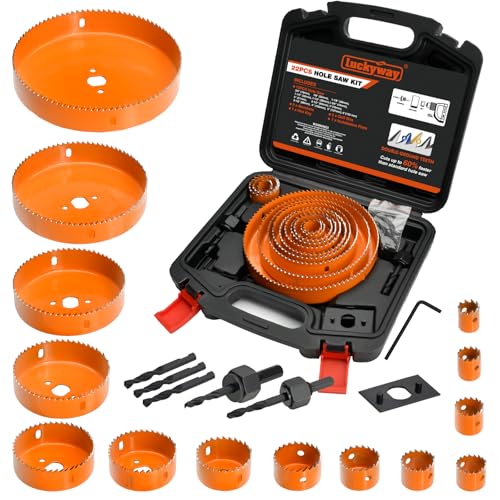
ASIN: B0FFYNKDSH
Certain content that appears on this site comes from Amazon. This content is provided “as is” and is subject to change or removal at any time. Product examples and images are supplied through Amazon Creators API; confirm specifications and availability on the current listing.
Quick answer: start with material, diameter, and drill compatibility
For routine openings in softwood, hardwood, plywood, or other wood products, choose a hole saw explicitly designed for those materials and the cut depth you need. A carbon-steel wood cup can be a straightforward option for many ordinary wood and panel holes; a bi-metal or carbide-tooth design may be better suited to repeated use or tougher material when the maker lists it for that job. Construction differs by brand and product, so use the manufacturer’s material chart rather than assuming all carbide or bi-metal saws behave alike.
Then confirm the exact diameter, depth, arbor, and pilot bit. If buying a set, check that its sizes match your project and that the arbor is included or compatible. Consider how the plug will be removed, whether the saw’s slots clear chips, and whether your drill can control the cutter’s reaction torque. A large hole saw can grab abruptly; secure the work rather than relying on your hand to resist the force.
For a clean opening in plywood or veneered material, plan a backing board or a two-sided cut if the tool instructions and setup allow it. A hole saw can tear fibers as it exits. Test on scrap of the same material and thickness before cutting a finished panel.
What a wood hole saw does
A hole saw is a cylindrical cutter with cutting teeth around its rim and an open center. The rim cuts an annular kerf, leaving a solid plug in the cup. A pilot drill bit at the center helps start and guide the cut, and an arbor connects the cup to the drill. Some wood-specific saws integrate the arbor and pilot as a one-piece assembly; other styles use a replaceable mandrel.
Compared with a large twist bit, the hole saw removes less of the interior material because it cuts only around the perimeter. That can make it practical for larger pass-through holes. The tradeoff is that the plug remains inside the cup and must be extracted. Chips also need a path out of the teeth. If the cup fills with sawdust, cutting can slow, heat can build, and the hole edge can scorch.
Hole saws create through-holes or shallow circular recesses depending on depth and technique, but they are not the best tool for every circular cut. For a flat-bottomed recess, a Forstner bit may be a better match. For accurate small holes, a brad-point bit may be better. For a large opening in a sheet where the center plug is not useful, a jigsaw or router template could be appropriate. Choose by the result needed, not by tool category alone.
Choose for the wood or panel
Softwood and construction lumber
Softwood is common in framing and home projects. A wood-rated hole saw can make openings for pipes, cables, or hardware when the diameter and depth fit. Knots, resin, dampness, and grain direction affect the cut. Keep the cutter aligned, avoid forcing the drill, and clear chips if they pack into the kerf. If the hole must be precise in a structural member, make sure the opening is allowed by the building plan or code; tool capability does not establish structural acceptability.
Hardwood
Hardwoods can demand more from the teeth and the drill, especially in thick or dense stock. Confirm that the maker permits the cutter for hardwood and the stock thickness. A sharp, suitable cutter and controlled feed help reduce burning. Do not dwell in one location while the cup is spinning. If the drill slows, stop and inspect the setup rather than adding body weight.
Plywood and veneered panels
Plywood is layered and may splinter at the entry or exit face. Veneered panels can show tear-out even when the hole size is correct. A sacrificial backing board can support fibers on the far face, provided the assembly is clamped safely and the saw can pass into it without contacting a hidden clamp. Another option is to cut partway from one face, then finish from the opposite face using the pilot hole to align the cup. Practice this method on scrap and follow the tool instructions.
For high-visibility cabinet work, test the exact panel and blade combination first. You may need to mark the finished side, protect the surface with tape if appropriate, and use a slower, controlled feed. Tape may help reduce surface splintering in some setups but is not a substitute for backing support or a sharp cutter.
MDF, particleboard, OSB, and laminated panels
Engineered panels vary in density, adhesives, coating, and surface layer. A wood-rated hole saw may be listed for some of these materials, but don’t assume the label covers all composite boards. Fine dust from MDF and other panels needs appropriate extraction and respiratory protection. Check the material’s safety information and follow the tool and dust-collector directions.
Melamine and laminate coatings can chip at the surface. Support the exit side and test the approach. If the hole’s appearance matters, use a cutter and setup recommended for laminated panels. A general-purpose wood saw may be adequate for a hidden utility hole but leave a rougher edge than a specialty tool.
Wood containing nails or screws
Some bi-metal or carbide-tooth hole saws are marketed for wood with nails or embedded fasteners, but the claim is product-specific. Metal hidden in wood can damage teeth, cause sparks, or deflect the cutter. Scan for fasteners and avoid them when possible. Only use a cutter for embedded-metal situations when the manufacturer expressly allows it and the work can be secured safely. Do not assume every wood hole saw can cut nails.
Carbon steel, bi-metal, and carbide-tooth designs
Carbon-steel wood hole saws
Wood-specific carbon-steel cups commonly use a tooth design intended for wood and may have integrated arbor and pilot features. They can be available in useful single sizes as well as kits. Confirm materials, depth, and compatible drill type. Bosch’s official Edge Carbon page describes its wood hole saws as high-carbon steel, lists softwood and hardwood as materials, and identifies an integrated arbor and pilot on the product family.
Carbon-steel cups are not automatically the best choice for every wood application. Tooth form, cup depth, chip slots, and the number of holes matter. A simple one-time opening may justify a single-size saw; repeated work may call for a more durable design or a kit with the right range.
Bi-metal hole saws
Bi-metal designs combine different steel properties in the body and cutting edge. They are often sold as general-purpose hole saws for wood and other materials, but each product has its own approved-material list. A multi-material saw can be useful if one tool must handle wood and occasional metal or plastic, yet the wood edge finish may not be optimized for every panel. If the main task is wood, compare dedicated wood-tooth geometry and chip ejection.
Do not let a “multi-material” label obscure whether the cup is appropriate for your material. Verify the exact chart, depth, arbor, and speed instructions. The existing metal hole saw guide focuses on steel and metal-specific issues; its recommendations are not automatically transferable to wood.
Carbide-tooth or carbide-tipped cups
Carbide-tooth hole saws may be designed for a broader material range, longer service life in selected applications, or rougher and more abrasive materials. Their tooth shape and function differ among brands. Some carbide-tipped products are marketed for wood products such as plywood, fiberboard, or flakeboard; others focus on cement board, tile, or embedded fasteners. Read the product page for the exact saw rather than assuming carbide means universal.
Carbide teeth can be brittle compared with some steel tooth forms and can be damaged by impact, chatter, or using the tool at an unsuitable angle. They still need stable support and correct speed. For ordinary clean wood, a simple wood-specific carbon-steel saw may be sufficient; for repeated holes or engineered materials, a carbide product may be worth considering if the manufacturer recommends it.
Tooth pattern, TPI, and edge quality
Hole-saw tooth patterns vary. A conventional saw cup has multiple teeth around the rim; some wood-specific designs use a small number of larger teeth, while others use groups of teeth or specialized tips. Fewer, larger teeth may clear chips differently than a fine-tooth metal cup. The right choice depends on material and the maker’s intended use. Avoid choosing by tooth count alone.
Aggressive tooth designs can cut quickly but may leave a rougher edge, catch more abruptly, or demand careful control. A fine or grouped-tooth pattern may be intended to reduce resistance or improve finish in selected panels. Manufacturer performance claims should be read with their stated comparison and conditions; they are not proof of results in every wood species or drill setup.
Sharpness and chip clearance matter as much as tooth pattern. Inspect the rim for chipped or flattened teeth. Clean packed sawdust from the cup while power is disconnected and the cutter is stationary. Never reach into a spinning cup to clear chips or remove a plug.
Diameter and cutting depth
Start with the required hole size. Measure the component that must pass through: pipe, cable bundle, grommet, vent, or fitting. Account for clearance and any trim ring. Hole-saw sizes can be listed in inches or millimeters, and a nominal measurement should be checked against the actual product dimensions. For an exact fit, make a test hole in scrap and test the part before drilling finished work.
Cutting depth is the cup’s working depth, not necessarily the thickness it can cut in one uninterrupted pass. A long arbor or extension may help reach through thick stock if the manufacturer supports it, but it can reduce rigidity and increase runout. If the saw is not deep enough, follow the maker’s instructions for cutting from both sides or choose a suitable deeper cutter. Align the cuts carefully through the pilot hole.
Be aware of what’s behind the material. A through-hole can hit wiring, plumbing, fasteners, or a fixture. For walls, cabinets, and installed assemblies, inspect the cavity first and use appropriate detection methods. Don’t drill blindly into a finished surface.
Arbor, pilot bit, and drill compatibility
The arbor or mandrel holds the cup and transmits torque from the drill. Some hole saws have an integrated arbor and pilot, which can simplify assembly and remove a compatibility step. Others use separate arbors that accept multiple diameters. Check the cup’s thread or attachment type, arbor diameter range, pilot-bit size, and the drill chuck capacity.
Arbor compatibility is especially important in kits. Confirm which sizes work with each included arbor and whether a larger cup requires a different mandrel. Check if the pilot bit is replaceable, whether a spare is included, and how the saw locks to the arbor. A product photograph may show an arbor that is not included in a single-cup purchase, so inspect package contents.
The drill must be suitable for the cutter diameter and material. Large hole saws can produce strong torque reaction. A drill with an auxiliary handle can offer more control when the manufacturer permits the combination. A drill press provides perpendicular guidance but does not eliminate the need to clamp the work. Never hold a large panel by hand while drilling.
Chip clearance and plug removal
Large gullets, side slots, and open cup geometry can help clear sawdust and make plug removal easier. Bosch’s wood hole-saw page calls out chip-clearance slots and easier plug removal for its Edge Carbon family. Other brands use different slot shapes or core ejection mechanisms. Evaluate whether the cup can be cleaned and the plug extracted without prying against fragile teeth.
When a hole is deep, sawdust can pack around the plug. Pause only after stopping the drill; remove the cup from the work and clear chips with a safe tool. Some operators make shallow relief cuts or withdraw the cutter periodically to clear sawdust, but follow the specific instructions and keep the tool controlled. Do not rock the saw violently to break a plug free.
A plug can be useful as a matching wood disk for a project. If you want to preserve the plug, use sharp teeth, stable support, and a clean entry and exit. The center pilot hole remains in the disk. If the plug is waste, easy-ejection slots can save time, but they do not outweigh compatibility or safety.
Buying a kit or individual wood hole saws
When a kit makes sense
A kit is practical if it contains several diameters you will actually use and provides compatible arbors, pilots, and storage. Check the range for common project openings, but don’t buy a large assortment simply because the piece count is high. Some kits combine wood and metal-rated cups; ensure that the tooth type and material chart match your intended use.
When to buy individual cups
For a one-off opening or a recurring exact diameter, an individual cup can avoid paying for unused sizes. Check whether it includes the arbor and pilot. If not, price and compatibility of the required arbor are part of the total purchase. Also consider if the saw can be reused with a replacement cup from the same family.
Questions for comparing models
- Is the saw specifically listed for the wood or panel material?
- What exact diameter and working depth does the product provide?
- Are the arbor and pilot integrated or sold separately?
- What drill types and speed guidance does the manufacturer specify?
- Can chips escape and can the plug be removed safely?
- Does the kit include the sizes and replacement parts you need?
- Are there restrictions for plywood, laminate, hardwood, or wood with nails?
Research method and primary sources
This is a research-based buying guide rather than a comparative product test. We reviewed primary manufacturer material and OSHA drill-press safety guidance. We did not make measured claims about speed, hole finish, lifespan, or current pricing. Manufacturers use different tooth designs, and their material recommendations are product-specific; verify the exact item page and instructions before using a saw.
Bosch’s official Edge Carbon Hole Saws page identifies the wood-specific product family, material use, integrated arbor and pilot, and chip-clearance features. It is a primary source for those Bosch products, not a general guarantee about every wood hole saw. Bosch’s broader hole-saw category page distinguishes wood-specific carbon cups from other product types.
Milwaukee’s product page for a carbide-tipped hole saw lists wood products such as fiberboard, flakeboard, and plywood among its stated applications. That source illustrates why the exact product material list matters; it does not establish that all carbide-tipped hole saws are interchangeable.
OSHA’s drill-press guidance explains the risk of stock spinning when held by hand and recommends appropriate hold-down fixtures where possible. The OSHA drill-press training script also emphasizes clamping material and keeping clear of rotating parts. These are safety references, not substitutes for the drill manual or hands-on instruction.
Safe setup and cutting technique
Inspect the material and the work area
Confirm the hole location, stock thickness, and both-side clearance. Check for screws, nails, wires, pipes, and structural components. Secure the work on a stable surface. If using a drill press, clamp both the work and any fixture to the table as directed. A handheld drill also requires a stable workpiece; don’t use your hand to resist cutter torque.
Assemble with power disconnected
Unplug the drill or remove its battery before fitting the arbor, cup, or pilot. Tighten components according to the manuals. Confirm that the cup is centered and the arbor is within the drill’s chuck capacity. Inspect the teeth and pilot for damage. Wear eye protection and use dust control appropriate for the wood product. MDF and some composite materials can produce fine dust that requires more than a simple shop vacuum.
Support entry and exit faces
Use a sacrificial backing board when it can be clamped securely and won’t interfere with the cutter. This can support fibers as the teeth exit. For a two-sided cut, make a controlled first pass and use the pilot opening to align from the opposite face. Test the technique on scrap, especially with veneer or laminate. Do not improvise a fixture that could be pulled into the hole saw.
Start the hole and maintain control
Place the pilot at the center mark and keep the drill square to the surface. Start at the speed and with the feed technique described by the manufacturer. Allow the teeth to cut; don’t lean heavily on the drill. If the cup begins to bind, chatter, smoke, or wander, release the trigger and keep the tool steady until it stops. Disconnect power before clearing chips or adjusting the setup.
Finish without reaching into the cup
Wait for the cutter to stop before moving the work or removing the plug. Use the side slots or the maker’s ejection procedure. Teeth remain sharp after the drill stops, so use a tool rather than bare fingers to clear the core. Deburr or sand the edge with the stock secured, and inspect both faces before installing a fitting.
Common problems and what to check
Burning or dark edges
Burning can result from a dull cutter, packed sawdust, excessive dwell, unsuitable speed, or forcing the tool. Stop and clear chips after isolating power. Check the teeth and the maker’s speed guidance. Use a test piece to adjust technique before returning to finished stock.
Splintering on the exit side
Support the back face, use a sacrificial board, or consider a two-sided cut if the maker’s instructions permit it. Use a sharp cutter and avoid pushing through the final fibers under excessive force. On veneered surfaces, test with the exact panel and orientation.
The drill twists or the cup catches
Stop. The work may be loose, the cutter may be oversized for the drill, or the teeth may have bound in packed chips. Secure the work, confirm compatibility, and use a machine you can control. Do not counter the reaction by grabbing the workpiece or bracing your hand near the cutter.
The plug will not come out
Disconnect power and allow everything to stop. Use the maker’s slots or core-removal method. Clean sawdust away with a brush or suitable tool. Avoid prying on teeth or restarting the drill with a screwdriver wedged in the cup.
Care and storage
Clean resin and sawdust from the cup after use. Use a brush while the cutter is disconnected and stationary. Inspect teeth, body, arbor, and pilot for wear or damage. Replace components that are cracked, bent, loose, or dull beyond the maker’s service recommendation. Do not sharpen a specialty cutter unless the manufacturer provides a procedure.
Store cups so teeth do not strike each other or cut through packaging. Keep the arbor and pilot bits with the relevant sizes and label kits clearly. Protect the cutting edge from rust and impact. Keep the manufacturer’s instructions or a link to them so you can recheck material limits and compatible parts later.
Frequently asked questions
What type of hole saw is best for wood?
Choose a product explicitly made for the wood species or panel you plan to cut. Carbon-steel wood cups can be suitable for ordinary softwood and hardwood tasks; bi-metal or carbide-tooth options may suit selected repeated or engineered-material work. Follow each maker’s chart.
Can I use a metal hole saw on wood?
Some multi-material hole saws are rated for both metal and wood, but a metal-focused cup may not produce the best chip clearance or edge finish in wood. Check the exact material list and choose a wood-specific cutter when wood is the primary task. Our metal hole-saw guide covers the metal-specific use case.
Are carbide hole saws better for wood?
Not universally. Carbide-tooth designs may be intended for selected engineered boards or embedded fastener materials, while carbon-steel wood cups may be suitable for ordinary wood. Compare material ratings, tooth design, cost, depth, and how often you will use the tool.
Do I need an arbor with a wood hole saw?
Usually a compatible arbor connects the cup to the drill, but some wood hole saws integrate the arbor and pilot. Confirm package contents and compatibility. Larger diameters may require a different arbor than smaller cups.
How do I prevent splintering in plywood?
Use a sharp, suitable cutter, support the exit face with a sacrificial backing board, or use a carefully aligned two-sided cut where appropriate. Make a test hole in similar scrap and follow the manufacturer’s method. Veneers and laminates may need extra care.
Can I cut through thick wood in one pass?
Only if the cutter’s usable depth and arbor arrangement support the stock thickness. Check the manufacturer’s specification. For deeper stock, follow its approved procedure or choose another tool; do not force the cup until the arbor bottoms out.
Can a hole saw cut wood with nails in it?
Only if the exact product is explicitly rated for embedded fasteners. Hidden metal may damage teeth or cause the cutter to deflect. Locate and avoid fasteners when possible, and use safe support and eye protection.
Should I use a drill press or handheld drill?
Either may be appropriate if the tool, cutter, and work are compatible. A drill press can help maintain a perpendicular path but requires clamping. A handheld drill is more flexible but needs a stable stance and workpiece. Large cutters can create strong torque, so use a suitable drive and auxiliary handle when specified.
How do I choose among the best hole saws for wood?
Start with material, hole diameter, depth, and finish expectations. Then compare tooth material and pattern, arbor and pilot compatibility, chip clearance, and kit contents. Read the manufacturer instructions and plan how to clamp and support the work safely.
Final buying perspective
The best hole saws for wood match the panel or lumber, cut depth, and opening you need. A simple wood-specific cup can be enough for occasional holes; repeated work or engineered materials may call for a different tooth design. Verify the arbor, pilot, package contents, and material rating, and think ahead about chip clearance and plug removal. Use a sharp cutter, support both faces where possible, secure the stock, and test on scrap. These choices matter more than buying the largest kit or assuming one cup can handle every material.