Where to buy
Check the latest price, availability and delivery on Amazon. Orders are placed on Amazon. We may earn a commission from qualifying purchases.
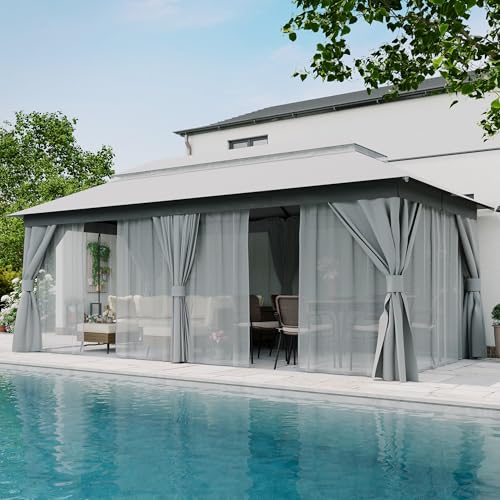
- Best overall for entertaining: LAUSAINT HOME 10×20 Patio Gazebo with Double Roofs — Check on Amazon
- Aoxun 10×12 Hardtop Gazebo with Double Galvanized Steel Roof — Check on Amazon
- Aoxun 12×10 Hardtop Gazebo with Polycarbonate Double Roof — Check on Amazon
- Aoxun 12×10 Outdoor Gazebo Canopy with Netting and Curtains — Check on Amazon
- COOS BAY 11×11 Pop Up Gazebo with Netting — Check on Amazon
- MELLCOM 10×12 Hardtop Gazebo — sold through Amazon and home retailers; covered without a direct link for the reason given in its review below
Read the full guide ↓
Disclosure: As an Amazon Associate, dailyhomedecorating.com earns from qualifying purchases. Links to Amazon on this page are affiliate links; they cost you nothing extra. Listing details such as price and availability change often, so check the current Amazon listing before you buy.
Entertaining outdoors fails in predictable ways, and almost none of them are about the food. The sun swings low at exactly the hour guests arrive and blinds half the table. A ten-minute shower sends twelve people and a buffet into a kitchen built for four. Mosquitoes clock in at dusk, right when the evening was supposed to peak. The best gazebo for outdoor entertaining under $700 is the one that quietly deletes those failure modes: enough roof to keep a full guest list dry and shaded, enough airflow that grill heat and crowd warmth do not pool under the canopy, netting that turns the space into a screened room when the insects arrive, and a shape that lets people circulate instead of queuing. Notice what is not on that list — permanence for its own sake, architectural drama, a roof you can brag about in February. Entertaining is an event discipline. The structure serves the gathering, and the right choice depends on how many people you host, how often, and how much setup ritual you will honestly perform before each one.
That framing splits this tier into two honest strategies. The first is the big soft-top: a 10×20 fabric-roofed frame that shelters twenty guests today and comes down when the season or the forecast says so. The second is the permanent hardtop in the 10×12 class: smaller, but always ready — the dinner party that happens because the space is simply there, shaded and screened, with no assembly standing between the idea and the event. Both strategies are represented below, along with a pop-up for households whose entertaining is real but rare, and a polycarbonate hardtop for hosts whose parties run long into bright afternoons. What you will not find is a pick that pretends one structure does all of it. A 10×12 hardtop does not seat twenty, and a 10×20 soft-top does not survive a winter of neglect, and any guide that blurs that is selling you something.
Our short answer: if your gatherings regularly reach double digits, buy the LAUSAINT HOME 10×20 and treat its canopy as seasonal equipment. If your entertaining is the weekly six-to-eight-person dinner, buy the Aoxun 10×12 steel-roof hardtop and enjoy a room that is ready before the invitation is. The Aoxun polycarbonate model is the pick when your parties happen under brutal midday sun and you want shade that does not darken the mood, the Aoxun soft-top is the budget route to a full-size screened dining room, and the COOS BAY pop-up is the honest answer for two-big-parties-a-year households. The MELLCOM 10×12 hardtop closes the list as a prose-only pick — specifications verified from the maker’s own documentation, current Amazon pricing for its exact listing not verifiable when we checked, so no link. Read on for capacities, layouts and the hosting details that decide which of these your guest list actually needs.
In this guide
Quick Picks
In a hurry before the next gathering? This table matches each gazebo to the entertaining style it serves best.
| Buyer type | Pick | Why it stands out | Link |
|---|---|---|---|
| Best overall for entertaining | LAUSAINT HOME 10×20 Patio Gazebo, Double Roofs | Roughly 200 square feet of covered space — two tables, a buffet line, and room to circulate | Check on Amazon |
| Best permanent party room | Aoxun 10×12 Hardtop Gazebo, Double Galvanized Steel Roof | Always-up metal roof with netting and curtains; seats six to eight diners in any weather short of a storm | Check on Amazon |
| Best for bright, long afternoons | Aoxun 12×10 Hardtop Gazebo, Polycarbonate Double Roof | Translucent panels cut glare and heat while keeping the space daylit | Check on Amazon |
| Best budget dining room | Aoxun 12×10 Outdoor Gazebo Canopy with Netting and Curtains | Full-size screened soft-top that leaves budget for the table, chairs and lighting | Check on Amazon |
| Best for occasional events | COOS BAY 11×11 Pop Up Gazebo with Netting | Party shade in minutes, screened for the evening, gone by Monday | Check on Amazon |
| Best heavyweight hardtop (prose-only) | MELLCOM 10×12 Hardtop Gazebo | A roughly 313-pound galvanized steel hardtop for hosts who want maximum structure; no link because we could not verify a current Amazon price for its exact listing | See review |
How These Picks Were Chosen
Entertaining imposes tests that a quiet Tuesday-afternoon shade structure never faces, so we filtered for them explicitly. Capacity first: every pick had to shelter a real gathering, which in practice means a nominal footprint of at least 10×12 for seated dining or a documented party format — nothing in this guide is a two-person bistro canopy wearing a gazebo’s name. Airflow second: a roof over twelve warm bodies and a grill needs somewhere for heat to go, so double roofs and vented tops scored heavily, and single-skin designs without vents were cut. Third, the dusk test: every pick includes mosquito netting or is a design whose netting situation we could state plainly, because an entertaining space that empties at sunset has failed at its job. Fourth, weather honesty: we favored picks whose makers describe their structures in terms a host can plan around, and we describe takedown duties openly rather than letting a soft-top masquerade as permanent.
Verification standards were the same as across this series. Each linked pick’s Amazon listing identity and a current price sighting for that exact listing were confirmed through independent price-tracking sources, and specifications — dimensions, weights, frame and roof materials — were checked against manufacturer documentation where available. The MELLCOM 10×12 is covered prose-only because its manual and specifications are verifiable but a current price for its precise Amazon listing was not; our rule is that unverifiable pricing means no purchase link, however good the hardware. We also checked recall records: the only major gazebo recall of recent years covered Berkley Jensen cedar models sold through a warehouse club, and none of the picks here belongs to that family or carries a CPSC recall.
One more filter specific to this guide: setup realism. An entertaining gazebo that demands a full day of assembly before every event will be skipped by real hosts, so we distinguished sharply between assemble-once structures (the hardtops), assemble-seasonally structures (the soft-tops) and assemble-per-party structures (the pop-up), and matched each to the hosting frequency it can actually sustain. If your entertaining happens on a patio rather than a lawn, the companion guide to the Best Gazebo For Small Patios Under $700 applies the same thinking to tight footprints; if your budget is larger, the Best Gazebo For Outdoor Entertaining Under $1500 roundup covers the heavier hardtops built for bigger guest lists.
The Picks in Detail
LAUSAINT HOME 10×20 Patio Gazebo with Double Roofs — Best Overall for Entertaining
Who it suits. Hosts whose guest lists run to twelve, sixteen, twenty: the graduation party, the holiday cookout, the reunion dinner that needs two tables end to end. Also the household that hosts big a few times a year and small never — the one that would rather raise a venue than own a room. If your entertaining problem is square footage, this is the only pick in the tier that solves it outright.
What you get. A 10 by 20 foot soft-top gazebo: fabric double roofs over a heavy-duty steel frame, mosquito netting and privacy screens included, in gray. The covered area is roughly 200 square feet — enough for two six-person tables with circulation space, or one long banquet arrangement plus a serving table, or a dining set at one end and a lounge grouping at the other with the grill working just outside the roofline. At about 103.5 pounds total, it is remarkably light for its coverage, which is the soft-top trade in one number: fabric overhead instead of metal, so the structure raises faster and stores smaller, and in exchange it asks for seasonal discipline.
Why it works for entertaining specifically. Layout freedom. Under a 10×12, the table goes in the middle and the party arranges itself around the host’s one option. Under a 10×20, you can zone: dining at one end, drinks and conversation at the other, a buffet along one long side where guests serve themselves without crossing the seated diners. The double-roof design vents the combined heat of a crowd and a nearby grill instead of trapping it, and the full netting converts the whole venue into a screened room at dusk — at this scale, that conversion is the difference between a party that drifts indoors at 8 p.m. and one that runs to midnight. The privacy screens also give you a windward wall on breezy evenings, which keeps napkins, candles and tempers in place.
Honest limitation. This is event infrastructure, not a fixture. The canopy is a consumable that fades and eventually needs replacement; it must come down before snow and ahead of severe wind; and a 200-square-foot fabric roof is a serious sail, so anchoring on party day is not optional decoration — every stake and anchor point, every time, or the structure stays in its bags. First assembly is a two-person job measured in hours, and the volume of netting and screening needs dry storage and occasional cleaning in humid climates. Hosts who will resent every one of those sentences should buy the smaller permanent hardtop below and cap their guest list instead.
Choose it if headcount is the whole point and your hosting calendar justifies a seasonal raise-and-store rhythm. Skip it if your parties are six people and a bottle of wine — you would be maintaining a venue to use a corner of it.
Aoxun 10×12 Hardtop Gazebo with Double Galvanized Steel Roof — Best Permanent Party Room
Who it suits. The weekly host: six to eight people around one table, often, in a space that must be ready without a setup ritual. If your entertaining style is “text friends at four, dinner outside at seven,” a permanent hardtop is the only honest answer, and this is the tier’s benchmark.
What you get. A 10 by 12 foot aluminum-frame gazebo with a double galvanized steel roof, mosquito netting and privacy curtains on tracks, about 199.5 pounds assembled, standing roughly 116.5 inches at the peak. The maker rates the design to wind grade 7. The double roof vents hot air continuously — during a crowded dinner that passive exhaust is worth more than any single feature on the spec sheet — and the steel surface means a passing shower interrupts nothing: no sagging fabric, no pooled water, no host sprinting outside to rescue a canopy.
Why it works for entertaining specifically. Readiness compounds. A permanent, screened, weatherproof room lowers the activation energy of hosting until outdoor dinners become the default rather than the production. The curtains earn their keep at parties in a way solo users never discover: drawn on the windward side they stop the breeze that murders candles and chills shoulders; drawn at the evening’s end they give the space a finished, room-like feel that keeps people lingering. The 120-square-foot footprint seats eight snugly or six luxuriously, and the roof’s overhang keeps angled rain off diners at the edge seats — the seats everyone fights to avoid under smaller canopies. Storage for the entertaining kit matters too; a Best Deck Box For Outdoor Entertaining Under $300 beside the posts keeps cushions, candles and the curtain panels’ off-season storage sorted.
Honest limitation. Eight is the ceiling. The host who regularly seats ten-plus will feel the walls that are not there, and no arrangement of a 10×12 fits two tables honestly. Assembly is a full project — two adults, a ladder, most of a day — and the steel roof announces heavy rain audibly, which some hosts find festive and others find loud. The roof also makes the space beneath noticeably darker than a fabric or polycarbonate top at midday.
Choose it if your entertaining is frequent, seated and capped around eight. Skip it if your signature event is the annual twenty-person cookout — buy the LAUSAINT and rent nothing, ever again.
Aoxun 12×10 Hardtop Gazebo with Polycarbonate Double Roof — Best for Bright, Long Afternoons
Who it suits. Hosts whose parties start at lunch and end at dinner: weekend barbecues, pool-adjacent gatherings, garden parties where the point is being outside in the light, not retreating from it. If a dark steel roof over a midday party feels like eating in a garage to you, this is your pick.
What you get. A nominal 12 by 10 foot hardtop whose double roof is built from polycarbonate panels on a metal frame, with netting and privacy curtains included, at about 197 pounds and a peak height near 107 inches — the lowest roofline in this guide. The panels block the direct overhead sun while passing diffuse daylight, so the space underneath reads as bright shade: sunglasses off, sunscreen mostly optional, food still photogenic.
Why it works for entertaining specifically. Mood is a hosting feature. Under polycarbonate, a long afternoon party keeps its garden-party character — faces are lit, the space feels open, and guests do not drift toward the sunny lawn the way they do from under a dark roof. The panels flex under hail and falling twigs instead of denting, which matters for parties scheduled weeks ahead in tree-covered yards: the roof that survives the storm the night before is the roof the party happens under. Rain noise is present but softer than steel, so conversation survives a shower. For hosts comparing roof types across the whole tier, our Best Gazebo Under $700 roundup lays out the steel-versus-polycarbonate-versus-fabric trade in full.
Honest limitation. The low peak height is real: tall guests and hanging light fixtures compete for the same air, and anyone planning to suspend a chandelier or a tall heater should measure twice. Polycarbonate panels also age — UV exposure gradually hazes them over years, and panels installed with the UV-protected face inward age fastest, so the manual’s orientation warnings matter. Snow load is a clear-it-yourself proposition; this roof is not designed to carry a winter’s accumulation while you ignore it.
Choose it if your entertaining is a daytime art and your climate’s threats are hail and sun rather than snow. Skip it if your parties are candlelit dinners where the steel roof’s darker, room-like feel is the point.
Aoxun 12×10 Outdoor Gazebo Canopy with Netting and Curtains — Best Budget Dining Room
Who it suits. The host furnishing a whole outdoor room on a fixed total budget — gazebo, table, chairs, lighting — who would rather have a complete, comfortable space than a premium roof over a picnic blanket. Also first-time hosts who want a full season of real parties before deciding whether the permanent-hardtop life is theirs.
What you get. A 12 by 10 foot soft-top: double-layer fabric roof over a powder-coated steel frame, mosquito netting and privacy curtains in the box, about 85 pounds, roughly 111 inches at the peak. The double roof vents crowd heat, the curtains zip the space into a screened dining room, and the whole kit costs a fraction of the hardtops — check the current price on Amazon, and note what the saving buys in furniture.
Why it works for entertaining specifically. Because parties are furnished, not roofed. The difference between this pick and a hardtop funds the eight-person dining set, the string lights, the outdoor rug that defines the room — the things guests actually remember. The soft-top’s assembly is a few hours rather than a day, its fabric roof is silent in rain in a way metal never is, and its slightly forgiving frame tolerates the not-quite-level lawn most hosts actually have. For a household that entertains through one long season and stores the canopy in winter, the ownership rhythm is simple and the per-party cost is tiny.
Honest limitation. The canopy is a consumable with a realistic life of a few strong-sun seasons, and replacement canopies are a recurring cost the hardtop buyer pays once. Wind discipline is absolute: forecast storms mean the canopy comes off, and a host who leaves it up to chance will eventually lose it. The steel frame’s coating will rust at scratches over time in wet climates. None of this is hidden — it is the explicit trade for the price — but it must be a trade you choose, not one you discover.
Choose it if the total room budget matters more than the roof’s lifespan. Skip it if you know the canopy-removal ritual will be skipped by October — buy the hardtop and be honest with yourself at the cheaper moment, which is now.
COOS BAY 11×11 Pop Up Gazebo with Netting — Best for Occasional Events
Who it suits. The two-to-four-parties-a-year household, the renter who entertains, the family whose big events happen at different spots in the yard — and, quietly, the smart first-timer who wants to learn where gatherings naturally happen before committing to a permanent structure.
What you get. An 11 by 11 foot pop-up with a dual-vented UPF 50+ top, full mosquito netting and a carry bag, at about 42 pounds. Two people raise it in minutes; the peak stands roughly 116 inches. It shelters a buffet-and-drinks station plus milling guests, or a single table for six, and when the party ends it folds into its bag and the yard is a yard again.
Why it works for entertaining specifically. Placement freedom is a hosting superpower. The pop-up goes where this party needs it — over the serving table near the kitchen door for a cookout, over the gift table at the garden’s far end for a shower, over the kids’ zone for a birthday — and its netting keeps the evening portion civilized wherever it stands. There is no permanent footprint dictating that every future event happen in the same corner. For hosts still designing their outdoor life, one season with a pop-up answers the permanent-gazebo questions — where, how big, how often — with evidence instead of guesses, at the lowest price in this guide.
Honest limitation. It is a fair-weather employee. Wind that a hardtop ignores will bend a pop-up’s legs, so it comes down when weather threatens, without exception or optimism. The usable shade is smaller than the nominal size suggests once the sun angles in, the fabric and frame are the lightest here, and there is no hanging anything meaningful from the frame. If your parties are monthly, the setup ritual — however short — will eventually argue for a permanent structure; that argument is this pick succeeding at its real job, which is teaching you what you need.
Choose it if your calendar says occasional and your yard says flexible. Skip it if you host monthly or more — your future self is already shopping for the hardtop.
MELLCOM 10×12 Hardtop Gazebo — Best Heavyweight Hardtop (Prose-Only)
Who it suits. The host who wants the most structure this tier can hold: a permanent 10×12 entertaining room whose frame and roof feel closer to the next price class, and who is willing to shop for it across retailers rather than through a link in this guide.
What you get, per the manufacturer’s documentation. A 10 by 12 foot hardtop with a galvanized steel roof on an aluminum frame, curtains and netting in the maker’s standard configuration, at roughly 313 pounds — the heaviest pick here by a wide margin, with a peak height around nine and a half feet. That mass is the point: heavier posts and roof structure translate to a structure that feels planted rather than assembled. We cover it without a purchase link because, while its specifications are verifiable from the maker’s manual, we could not verify a current Amazon price for its exact listing when this guide was prepared — and unverifiable pricing means no link, by our standing rule. Expect it, when in stock, to sit toward the top of this tier, and compare its delivered price against the $1500-class hardtops in our Best Gazebo For Backyards Under $1500 guide before buying, because the gap sometimes narrows to very little.
Why it works for entertaining specifically. Presence. A heavyweight hardtop reads as architecture — the outdoor room guests describe as “their pavilion” — and the extra frame mass buys steadiness in the gusty, door-slamming conditions of a real party evening. The full curtain and netting setup gives the same dusk conversion as the other hardtops, and the generous peak height keeps hanging fixtures and tall guests out of each other’s way better than the low polycarbonate roofline.
Honest limitation. The weight cuts both ways: shipping arrives in multiple heavy boxes, assembly is the longest project in this guide at two adults and a full day or more, and repositioning after anchoring is effectively not a thing. Availability of this brand’s larger models has historically swung, so confirm replacement-panel and curtain availability before purchase if you plan to own it for a decade.
Choose it if permanence and presence outrank convenience and you find it priced honestly in tier. Skip it if a verified in-guide price matters to your process, or if the assembly weekend is a dealbreaker — the Aoxun steel hardtop delivers most of the experience with far less iron.
Comparison Table
| Pick | Type | Nominal size | Realistic party capacity | Netting / curtains | Weight | Link |
|---|---|---|---|---|---|---|
| LAUSAINT HOME 10×20 | Soft-top | 10 x 20 ft | 12–20 guests, two tables | Netting and privacy screens included | ~103.5 lb | Check on Amazon |
| Aoxun 10×12 Hardtop, Steel Roof | Hardtop | 10 x 12 ft | 6–8 diners | Both included | ~199.5 lb | Check on Amazon |
| Aoxun 12×10 Hardtop, Polycarbonate | Hardtop | 12 x 10 ft | 6–8 diners | Both included | ~197 lb | Check on Amazon |
| Aoxun 12×10 Canopy | Soft-top | 12 x 10 ft | 6–8 diners | Both included | ~85 lb | Check on Amazon |
| COOS BAY 11×11 | Pop-up | 11 x 11 ft | 6 at a table, or a serving station plus standing guests | Netting included | ~42 lb | Check on Amazon |
| MELLCOM 10×12 Hardtop | Hardtop | 10 x 12 ft | 6–8 diners | Included in maker’s standard configuration | ~313 lb | Prose-only — see review |
How to Choose the Best Gazebo for Outdoor Entertaining Under $700
Count chairs, not square feet. Work backward from your real guest list. Six diners need a 10×12 with the table centered and serving done from the kitchen. Eight diners need the same footprint and tighter manners. Twelve or more seated, or any event with a buffet line, needs the 10×20 class — no furniture arrangement conjures floor area that does not exist. Standing events are more forgiving: guests circulate, drift in and out of shade, and a smaller roof over the food and drinks station covers the part of the party that actually needs covering.
Plan the flow. Entertaining spaces fail at the edges: the grill marooned in full sun while guests cluster in shade, the cooler blocking the only entry gap, the buffet queue crossing the seated diners. Sketch the layout before buying — table zone, serving zone, circulation path, grill outside the roofline but within a few steps — and check your chosen footprint against it. Remember that nominal sizes describe the roof; posts stand inside it, and the floor you can actually furnish is smaller on every side.
Take the dusk test seriously. Most outdoor entertaining peaks after sunset. Netting is therefore not an accessory but the main event, and it must be included, full-perimeter and zippered — partial netting is a mosquito suggestion, not a barrier. Curtains matter secondarily: they block the windward breeze, add privacy from neighboring yards, and give the space its room-like evening character. If a candidate structure lacks netting entirely, it is a lunch structure; price it accordingly.
Match the structure to your hosting frequency. Monthly or more: permanent hardtop, because readiness is the feature. A few big events a year: the large soft-top, raised for the season or the event. A couple of gatherings, locations shifting: the pop-up. The most common entertaining mistake is buying permanence for an occasional calendar — a structure maintained all year for three parties — or buying a pop-up for a weekly dinner habit and reassembling your life every Friday.
Respect the weather plan. Every entertaining gazebo needs an answer to “what happens when the forecast turns?” Hardtop: guests stay, within reason. Soft-top: the canopy comes down ahead of the storm, which means someone owns that chore before the event, not during it. Pop-up: it folds in minutes, which is a genuine plan — if the host remembers the party is the deadline. Choose the plan your household will actually execute, then anchor whatever you bought like the plan depends on it, because it does.
Common Mistakes Hosts Make When Buying a Gazebo
Buying for the biggest party of the year. The twenty-person reunion happens once; the six-person dinner happens twenty times. Size for the frequent event and rent, borrow or pop-up the annual peak — or consciously choose the big soft-top knowing the weekly dinners will use a third of it.
Forgetting the serving surface. A dining table seats guests; it does not hold a buffet, drinks, desserts and the grill output simultaneously. Layouts that omit a serving table or side station collapse into laps and lawn chairs. Include one in the footprint math.
Placing the grill under the roof. Grill heat, smoke and grease belong at the roof’s edge or outside it — under a vent, never under a low fabric canopy, and always with clearance from curtains and netting. Several picks here vent well, but venting is not permission.
Skipping anchoring because “it’s just for the party.” Party day is precisely when a gust does the most damage — to the structure and to the event. Anchor permanent structures at installation and stake temporary ones at setup, every time.
Ignoring the evening sun. A roof placed for noon shade can leave the whole table in glare at 6 p.m., when dinner actually happens. Check the sun’s path at your real hosting hour before finalizing placement; curtains on the west side are the other half of the fix.
Treating netting as optional. Covered above, repeated here because it ends more parties than rain does: no netting, no evening. Verify it is included before purchase, not after the first bitten dinner.
Final Recommendation
Entertaining rewards honesty about two numbers: how many people, how often. Twelve-plus guests even a few times a year makes the LAUSAINT HOME 10×20 the right buy — nothing else in the tier shelters a real event, and its seasonal rhythm is manageable. Six to eight guests on a weekly rhythm makes the Aoxun steel-roof hardtop the right buy, because a permanent screened room turns intentions into dinners. Daytime hosts should take the polycarbonate Aoxun’s bright shade, budget furnishes should take the Aoxun soft-top and spend the difference on the room itself, and occasional hosts should take the COOS BAY pop-up without a whisper of shame — it is the correct tool, honestly matched. The MELLCOM 10×12 stands as the heavyweight alternative for hosts who find it priced in tier and want maximum structure. Whichever you choose, decide the layout, the anchoring and the weather plan before the boxes arrive, and your gazebo will be the reason the party worked rather than the story of the party that didn’t. If your venue is a lawn, the Best Gazebo For Backyards Under $700 companion guide is worth reading too, since its placement and anchoring advice applies to every pick here.
Party-Day Playbook: Getting the Most From an Entertaining Gazebo
The day before. Entertaining gazebos fail on logistics more than on weather, so run the boring checklist early: netting zipped and inspected, curtains on their tracks and tied back, the floor swept, the anchor points or stakes checked if your structure is seasonal or temporary, and the layout chalked or paced out — table zone, serving zone, circulation path, grill position outside the roofline. If you are raising a soft-top or pop-up for the event, raise it the day before, not the morning of; a structure that goes up calmly gets anchored properly, and a structure raised in a hurry gets neither anchoring nor forgiveness from the wind.
Layout patterns that work. For seated dinners under a 10×12, center the table, serve family-style or from the kitchen, and keep one short side open as the service entry so the host is not squeezing past seated guests with hot dishes. For buffet events, put the serving table along one long side, plates at the end nearest the kitchen door, drinks at the far end to pull the queue away from the food, and seating outside the roof or at its edges — the roof’s real job at a buffet party is protecting the food and the serving line, not the chairs. For the 10×20 class, zone deliberately: dining at the end away from the grill, conversation at the grill end where the cook holds court, and the middle kept as circulation, because a long roof with a blocked middle becomes two small parties that cannot reach each other.
Managing heat, glare and bugs in real time. Heat pools under any roof by the second hour of a crowded event; the vented double roofs in this guide exhaust passively, and you amplify them by keeping the windward curtains open and the grill at the downwind edge. Glare arrives on schedule in the evening — the west-side curtains exist for exactly this, and drawing them at golden hour converts a squinting table into a lantern-lit room. Bugs clock in at dusk; the winning move is to zip the netting before the first mosquito, not after the tenth, and to place any citronella or traps outside the netting line so they draw insects away from the perimeter rather than into it.
Lighting makes the room. More parties are saved by lighting than by any other single upgrade: string lights along the roof’s interior perimeter (hung only from points the maker rates for it, and never from a pop-up’s scissor frame), a lantern or two on the table rather than a single harsh source, and a lit path back to the house so guests are not navigating a dark yard with full plates. On hardtops, a rated ceiling hook turns the space into a genuine dining room; on soft-tops and pop-ups, freestanding lanterns and table lighting do the same work without loading the frame.
The weather pivot. Decide your rain plan while the sky is still blue: which events continue under the roof (most, under a hardtop), which move the food indoors and keep drinks outside, and who owns the takedown call for temporary structures. The host who has decided in advance loses five minutes to weather; the host who improvises loses the party. And when the evening ends, the entertaining gazebo’s last job is storage discipline — cushions and soft goods into a deck box or indoors while they are still dry, because the mildew that ruins next month’s party is planted on this one’s cleanup.
Three Entertaining Formats, Honestly Compared
The seated dinner is the most demanding format per guest: everyone stationary, everyone expecting comfort for two hours, every flaw in shade, airflow and insect defense on continuous display. It is the format hardtops were born for — a permanent 10×12 with netting drawn at dusk delivers it without a single compromise, which is why the weekly-dinner household should weight this format above all others when choosing. Judge candidates by the dinner test: at 6 p.m. in July, with eight people seated, is everyone shaded, is the air moving, and can the space be screened in one minute? If a structure fails any leg of that test, it is not a dinner gazebo whatever its brochure says.
The standing party — drinks, grazing, circulation — is the most forgiving format and the one where square footage outranks structure. Guests self-distribute between sun and shade, the roof’s critical job narrows to protecting the food and the serving station, and even a pop-up performs honorably. This is the format that justifies the big soft-top: at a standing event, the 10×20’s coverage is not excess but the entire product, and its impermanence costs nothing because the party itself is temporary. Hosts whose calendar is mostly standing events should buy coverage first and permanence second, in that order.
The long afternoon — barbecue hours, pool days, garden parties that begin at lunch — tests a different axis: heat endurance and light quality across a moving sun. Venting matters most here, because a roof that performs at noon can become an oven by three; so does the roof’s character, because five hours under a dark steel ceiling and five hours under bright polycarbonate are different parties. This format is also where the grill’s placement graduates from detail to design: the cook works at the roof’s edge for hours, and a layout that strands them in full sun while guests lounge in shade will be renegotiated by the cook, permanently, after one event.
Most households host all three formats across a year, which is why this guide refuses to crown a single winner for everyone: the right gazebo is the one that aces your most frequent format and survives your most demanding one. Name your formats before you name your pick, and the choice usually makes itself.
FAQ
How many people fit under a 10×12 gazebo? Six diners comfortably, eight snugly, around a standard rectangular table. For standing events, a dozen people can circulate under the roof, though not all in shade at once when the sun is low.
Is a 10×20 gazebo too much for a normal backyard? For weekly family dinners, yes — you will furnish a third of it. For households whose signature events seat twelve or more, it is the only size in this tier that works, and its soft-top design stores away when the season ends.
Can I cook under a gazebo? Grill at the roof’s edge or just outside it, never under a low fabric canopy, and keep curtains and netting clear of heat. The vented double roofs in this guide handle ambient heat well, but no gazebo roof is a range hood.
Do I really need the netting? If any of your entertaining happens after dusk, yes. Netting is what converts a shade structure into an evening room, and every pick in this guide includes it for exactly that reason.
Hardtop or soft-top for a party space? Frequency decides. Host monthly or more and the hardtop’s always-ready permanence wins. Host big a few times a year and the soft-top’s size-per-dollar wins. There is no third answer that is not a compromise of one of those.
What happens to my party if it rains? Under a hardtop, it continues — steel and polycarbonate roofs handle rain indefinitely. Under a soft-top or pop-up, light rain is fine and heavy weather is a takedown signal; plan the indoor fallback for the events that matter most.
How far ahead should I set up for a big event? A day ahead for anything seasonal or temporary: the structure goes up calmly, gets anchored properly, and gives you a full evening to arrange furniture, lighting and the serving layout. Permanent hardtops reduce the same preparation to an hour of tidying — which is, in the end, the real product they sell.
Can one gazebo handle both weekly dinners and the annual big party? Honestly, only by compromise: a 10×12 hardtop aces the dinners and can host the big day with a borrowed pop-up beside it for the overflow — a combination many experienced hosts land on, because it matches each structure to the format it serves best instead of forcing one roof to be two products.


