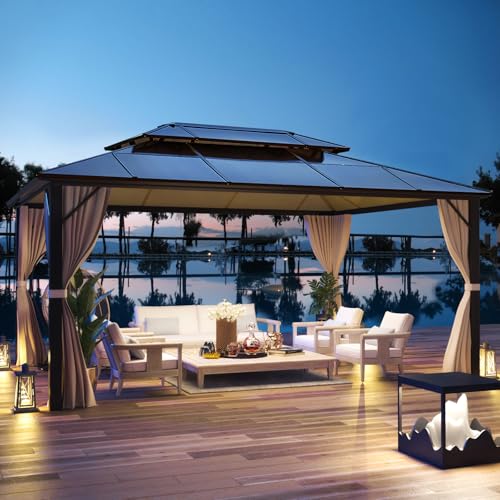
Where to buy
Check the latest price, availability and delivery on Amazon. Orders are placed on Amazon. We may earn a commission from qualifying purchases.
- Best value in a full 12×16 footprint: YOLENY 12’x16′ Hardtop Gazebo, Polycarbonate Double Roof — Check on Amazon
- Best steel-roof entertainer on a budget: Endark 12’x16′ Hardtop Gazebo (GA2107) — Check on Amazon
- Best light under the roof: YITAHOME 12×16 FT Hard-Top Double Roof Gazebo, Polycarbonate, Brown — Check on Amazon
Three picks in this guide are covered in prose with no Amazon link, each for a stated reason: the Domi 12×16 wood-look hardtop, whose Amazon price we could not verify against this tier at research time; the Kozyard Alexander 12×16, whose current Amazon price sits above this guide’s ceiling even though it drops below it on promotion; and the Sunjoy 12×16 cedar gazebo, whose price we likewise could not verify inside the tier. All three are real, buyable structures — through Amazon when the price behaves, or through the makers and home centers — and each review below says exactly where it stands.
Read the full guide ↓
Disclosure: As an Amazon Associate, dailyhomedecorating.com earns from qualifying purchases. Links to Amazon on this page are affiliate links; they cost you nothing extra. Listing details such as price and availability change often, so check the current Amazon listing before you buy.
Finding the best gazebo for outdoor entertaining under $1500 is a different shopping problem from finding a gazebo for shade. Entertaining is a load case: a dining table for eight with chairs pulled out and people circulating behind them, a serving station that cannot live in the rain’s reach, a grill that must stay outside the roofline but close enough to matter, and a party that keeps going after the mosquitoes clock in. A gazebo that photographs well and hosts badly is a lawn ornament. This guide ranks six permanent hardtops by how they actually host — floor plan first, weather manners second, and the unglamorous details of anchoring, assembly and drainage given the weight they deserve, because a structure you entertain under for a decade is infrastructure, not furniture.
The honest headline about this tier: $1500 is where the entertaining sizes live. The 12×16 footprint — 192 square feet, the smallest rectangle that holds a real dining set and a lounge corner at once — is achievable here in aluminium and polycarbonate or steel, with curtains and netting included, from several makers. What the tier will not reliably buy is the premium end of that same footprint: the heaviest aluminium frames and real cedar sit at or above the ceiling depending on the week, and this guide says so pick by pick rather than pretending otherwise. Three of our six picks are linked because we verified their Amazon listings inside the tier; three are covered in prose because honesty about price is worth more than a link.
Plan the party before the purchase. Count your real guest list, not the aspirational one; measure the slab or the lawn rectangle the structure will occupy, including the swing of the house door and the path from the kitchen, because every entertaining gazebo is also a corridor problem. Then read the picks against your floor plan. The right 12×16 turns a backyard into the room your house was missing. The wrong one is a very permanent hat on a space that never quite works.
In this guide
Quick Picks: best gazebo for outdoor entertaining under $1500
| Pick | What you get | Best for | Entertaining virtue |
|---|---|---|---|
| YOLENY 12’x16′ Polycarbonate Hardtop | 12×16 aluminium frame, polycarbonate double roof | Maximum covered party space per dollar | Full 192 sq ft with curtains and netting included |
| Endark 12’x16′ Hardtop (GA2107) | 12×16 aluminium frame, steel double-tier roof | Steel-roof durability at a value spend | Hooks for lights and fans over the table |
| YITAHOME 12×16 Polycarbonate | 12×16 aluminium frame, polycarbonate double roof | Bright daytime hosting | Light through the roof panels; brown finish |
| Domi 12’x16′ Wood-Look Hardtop (prose-only) | 12×16 wood-look aluminium, galvanized steel double roof | The finished, furniture-grade look | Built-in drainage gutters keep the party dry |
| Kozyard Alexander 12’x16′ (prose-only) | 12×16 aluminium, galvanized steel double roof | The heaviest-duty frame in this guide | Triangular posts, gutters, full curtain set |
| Sunjoy 12×16 Cedar Wood Gazebo (prose-only) | 12×16 cedar frame, 2-tier steel roof | Hosts who want real wood | Cedar presence nothing aluminium imitates |
The one-line answer: the YOLENY is the entertaining buy inside this tier, the Endark is its steel-roofed shadow, and the three prose-only picks are the upgrade path for hosts whose timing or channel lets them catch the premium frames fairly.
How we chose these entertaining gazebos
Our first filter was the floor plan. Entertaining sizes start at 12×16 in this guide because that is where a dining table for eight, pulled-out chairs and a circulation lane coexist under one roof; every pick is that size, and the differences that matter are what the roof is made of, how the frame carries it, and what arrives in the boxes. Any structure whose maker would not publish dimensions and materials was cut — a party is no place for a surprise footprint.
Second, the enclosure. Outdoor entertaining runs into the evening, and the evening belongs to the mosquitoes unless the gazebo fights back. All six picks ship with mosquito netting, and most add privacy curtains on their own track, so the space can be screened at dusk, curtained against a neighbour’s sightline or a low sun, and opened again when the air is clear. A gazebo without netting is a daytime-only venue, and we treated it that way in our wider research for the Best Gazebo Under $1500 roundup as well.
Third, weather manners — stated carefully. Makers print snow and wind figures for these structures, and those figures are marketing claims with conditions attached, usually anchoring, rather than independently certified ratings. We report what each maker claims, in the maker’s name, and we weigh the construction behind the claim — post section, roof material, frame weight — more heavily than the number itself. A heavier structure with a steel roof and triangular posts earns more confidence than a bigger number on a lighter frame.
Finally, price honesty, which is this guide’s spine. A pick is linked only when we verified its Amazon listing and a price sighting for that exact listing inside the $1500 ceiling. Picks that failed that test — however good the structure — are covered in prose with the reason printed in the review. If your budget is genuinely lower, our Best Gazebo For Outdoor Entertaining Under $700 guide applies the same hosting logic at half the spend, and the Best Gazebo For Backyards Under $1500 guide covers this tier from the lawn’s point of view rather than the party’s.
The 6 best gazebos for outdoor entertaining under $1500, reviewed
1. YOLENY 12’x16′ Hardtop Gazebo, Polycarbonate Double Roof — the value entertainer
The YOLENY 12’x16′ Hardtop Gazebo is the pick that makes this tier make sense: a full 12×16 aluminium frame under a polycarbonate double roof, with curtains and netting in the box, at a spend that leaves most of a $1500 budget unspent. The entertaining arithmetic is the headline — 192 square feet is a dining table for eight along one axis and a lounge pair or a serving station along the other, with the double roof’s vent letting summer air escape instead of pooling over the table. At roughly 203 pounds it is the lightest structure in this guide, which cuts both ways: assembly is the most manageable here, and anchoring is not optional decoration but the thing that makes it a permanent structure rather than a kite with ambitions.
The polycarbonate roof is the design’s personality. It sheds the absolute darkness a steel roof creates at noon, so daytime parties keep a bright, open feel, and it weighs far less panel for panel, which is part of why the whole structure is so liftable. The trade is acoustic and thermal: rain on polycarbonate is a drum solo compared with steel’s murmur, and the panels transmit more heat on a still, blazing afternoon than an opaque roof would. Hosts in loud-rain climates or full-sun yards should weigh that honestly; hosts in mild, dappled yards get the best of it.
Who it suits: hosts who entertain often, seat eight or more, and would rather spend the tier’s remainder on the furniture and lighting the gazebo shelters.
Pros:
- Full 12×16 entertaining footprint at the friendliest spend in this guide
- Double roof vents heat away from the table
- Curtains and netting included — dusk-ready out of the box
- Lightest structure here: the kindest assembly and the easiest panels to handle
Honest limitation: the light build demands real anchoring — bolt it to concrete or weight and stake it properly on lawn, and do not believe any wind figure for it until you have. Polycarbonate also asks for gentle cleaning; harsh solvents and pressure washers will cloud or crack panels that a soft brush keeps clear for years.
Choose it if the party is the point and the budget has other jobs to do. Skip it if your yard takes serious wind or your winters load roofs with snow — the steel-roofed Endark below, or the heavy frames further down, are built for your weather. Check on Amazon for the current price and colour options.
2. Endark 12’x16′ Hardtop Gazebo (GA2107) — steel overhead, value underfoot
The Endark 12’x16′ Hardtop Gazebo answers the YOLENY’s one real weakness: it puts a double-tier galvanized steel roof over the same entertaining footprint. The structure measures about 189 by 142 inches and stands roughly 116 inches tall, weighs around 352 pounds — serious mass next to the polycarbonate picks — and ships with privacy curtains, mosquito netting and the U-hooks and J-hooks that entertaining actually uses: string lights over the table, a fan over the cook’s shoulder, a lantern at the serving end. Reinforced roof corners address the place big flat roofs work hardest, and the vented second tier keeps the air moving on still evenings.
For hosting, the steel roof changes the room’s feel in ways guests notice without naming. Rain goes quiet. Midday shade goes complete — a steel roof is a ceiling, and a ceiling makes the space underneath read as a room, which is why dinners under steel-roofed gazebos run later and feel more deliberate. The cost of that ceiling is the noon gloom polycarbonate avoids and a heavier, slower build: 352 pounds of aluminium and steel panels is a two-person weekend with a ladder, not an afternoon project, and every panel is a sail until it is screwed down, so pick a calm day and finish the roof once you start it.
Who it suits: hosts in real-weather country — rain, bright sun, the occasional stormy evening — who want the room-like feel of a metal ceiling without leaving the value end of the tier.
Pros:
- Galvanized steel double-tier roof: quiet rain, complete shade
- 352 lb of structure — the substantial feel guests register as quality
- Hanging hooks included for lights and a fan
- Curtains and netting included for the dusk transition
Honest limitation: Endark is a younger, thinner-documented brand than the premium names below — expect a picture manual and email support rather than a deep dealer network, and inspect every panel on arrival, because value-brand steel panels occasionally travel with dents that are far easier to exchange before assembly than after.
Choose it if you want steel overhead at a polycarbonate-adjacent spend. Skip it if you want the heaviest frame and the longest track record — that is the Alexander’s brief, further down. Check on Amazon for current availability.
3. YITAHOME 12×16 FT Hard-Top Gazebo, Polycarbonate — the bright-room option
The YITAHOME 12×16 FT Hard-Top Double Roof Gazebo is the second polycarbonate route into a 12×16 entertaining space, and its differences from the YOLENY are finish and feel rather than footprint. The brown colourway warms the structure toward wood tones that suit traditional gardens, the double roof vents the same way, and the included netting and shaded curtains handle the evening shift. YITAHOME is one of the highest-volume gazebo sellers on Amazon, which cuts in the buyer’s favour in one specific way: the ecosystem of answered questions, owner photos and replacement-part chatter around its listings is deeper than most, so the structure you are buying has been bought, built and argued about by a crowd before you.
Under the roof, the hosting experience tracks the YOLENY’s — bright at noon, sociable at dusk, drum-loud in a downpour — with the polycarbonate caveats applying in full: anchor it like you mean it, clean the panels gently, and do not lean anything against the roof from inside. Where the YITAHOME earns its own place in this guide is for buyers who prefer its colour and its seller’s scale, or who find its listing priced keener on the week they buy. Cross-shop the two polycarbonate picks against each other at checkout; they are the same idea executed by two factories, and the better buy is the one whose listing is healthier that week.
Who it suits: daytime hosts, traditional gardens that want a brown rather than grey structure, and buyers who value a high-volume seller’s parts-and-answers ecosystem.
Pros:
- Full 12×16 footprint with a warm brown finish
- Bright polycarbonate roof for daytime parties
- Netting and shaded curtains included
- Deep owner community around the listing for build advice
Honest limitation: the same light-build physics as every polycarbonate pick — anchoring is structural, not optional — and YITAHOME’s own listing language is candid that its gazebos are not rated for extreme weather, so hosts in storm or heavy-snow country should read that as the maker talking them out of the wrong purchase and look at the steel picks instead.
Choose it if the YOLENY’s grey palette is wrong for your garden or its listing is the stronger one this week. Skip it if weather, not brightness, is your binding constraint. Check on Amazon for the current price.
4. Domi 12’x16′ Hardtop Gazebo, Wood-Look — the finished room (prose-only)
The Domi 12×16 is the pick for hosts who look at the value structures and see a kit, and look at this and see a room. The frame is aluminium wearing a convincing wood-look finish, the roof is a galvanized steel double canopy, and the published dimensions — about 192 by 144 inches and 121 inches tall, at roughly 459 pounds — make it one of the heaviest structures in this guide. The detail that separates it for entertaining is the drainage: built-in gutters channel roof water down through the posts instead of sheeting it off the eaves, which means the guest seated at the edge stays dry in a shower and nobody plays the move-the-chair game when weather passes through a party. Curtains and netting ride on their own tracks, and the whole assembly reads as garden architecture rather than equipment.
Why is it prose-only? Because at research time we could verify the structure and its Amazon listing, but not a price sighting for that exact listing inside this tier — Domi’s 12×16 pricing moves, and this guide links only what it has verified. Buy it through Amazon when its price sits inside your ceiling, or through the maker’s store and the home centers that carry the brand; the structure is the same. What you are paying the premium for, over the Endark’s steel roof, is the finish, the gutters and the mass — the three things guests perceive as the difference between a gazebo and a pavilion.
Who it suits: design-led hosts, poolside and patio installations where the structure is visible from the house all year, and anyone whose entertaining style is dinner-party rather than barbecue.
Pros:
- Wood-look aluminium: the warm read of timber, none of the sealing and staining
- Built-in gutter drainage — the edge seats stay dry
- Galvanized steel double roof with real heft behind it
- Curtains and netting on dual tracks
Honest limitation: 459 pounds across several boxes is the heaviest logistics in this guide — plan the delivery, the staging area and at least two builders, and note the maker’s warranty is a modest twelve months, short cover for a structure at this spend.
Choose it if the gazebo is also your garden’s centrepiece and you can buy it through a channel whose price you have verified. Skip it if you need the link-verified certainty of the picks above or the frame confidence of the Alexander below. Check price on Amazon and the maker’s store before you buy.
5. Kozyard Alexander 12’x16′ Hardtop Gazebo — the heavy frame (prose-only)
The Alexander is the benchmark the value picks are measured against, and it earns that status in the frame: triangular-section aluminium posts about 4.7 inches across, a galvanized steel double roof, an integrated gutter system, and curtains plus netting as standard. Kozyard publishes the category’s most confident weather claims for this line — a 2,500-pound snow figure and a 60 mph wind figure — and while those remain maker claims conditioned on proper anchoring rather than independent certifications, the construction behind them is visibly a class above the light builds: this is the 12×16 that snow-belt and storm-belt hosts cross-shop against cedar, and the one whose parts fit and finish draw the fewest apologies in owner discussions.
It is prose-only in this guide for one plainly stated reason: at research time its Amazon price sat above the $1500 ceiling, even though its recorded price history dips below that ceiling on promotion. A guide that linked it as an under-$1500 pick would be misleading on the weeks it costs more, so we cover it honestly instead: if you are reading this during one of its promotions, the Alexander at or under the ceiling is arguably the best buy in this entire guide — the heaviest frame, the fullest feature set, the strongest claims. If it is sitting above the ceiling when you shop, the Endark gives you the steel roof and most of the room for far less, and the Domi gives you the finish and the gutters.
Who it suits: hosts in demanding climates, buyers who keep a structure for a decade and maintain it, and patient shoppers who can wait for the promotion cycle.
Pros:
- Heaviest-duty aluminium frame in this guide — 4.7 in triangular posts
- Galvanized steel double roof with integrated gutters
- The strongest maker weather claims in the category
- Full curtain and netting set included
Honest limitation: the price behaviour described above — this is a premium product that visits this tier rather than living in it — and like every claim in this category, its weather figures assume anchoring done properly; gazebo warranties generally exclude storm damage, so treat the claims as engineering confidence, not insurance.
Choose it if you catch it at or under the ceiling, or if your climate justifies stretching for it. Skip it if you are buying this week at full price on a hard $1500 cap — the linked picks will host the same party. Check price on Amazon; it moves.
6. Sunjoy 12×16 Cedar Wood Gazebo — the real-wood room (prose-only)
Every other pick in this guide is aluminium pretending, to varying degrees of success, not to be. The Sunjoy 12×16 is the genuine article: a premium cedar frame carrying a matte black two-tier steel roof, measuring about 189 by 142 inches and 123 inches tall, at roughly 412 pounds. Cedar changes the entertaining experience in ways spec sheets flatten — the smell when rain hits warm wood, the way the structure ages into the garden instead of against it, the simple fact that a wooden pavilion reads as carpentry and an aluminium one reads as product. Sunjoy is the largest ready-to-assemble outdoor structure maker in this guide, with the parts network to match, which matters in year six when a bracket needs replacing.
The costs are real and should be chosen knowingly. Cedar is a maintenance material: it wants a sealer or stain refresh on a cycle aluminium never asks for, it greys if you let it — prettily, but grey — and the build is the most carpentry-like here, with timber components that reward careful squaring. It is prose-only because we could not verify an Amazon price for it inside this tier; Sunjoy’s cedar line generally trades above the aluminium tier at the home centers and the maker’s store, so treat it as the stretch pick: the one you buy when the gazebo is a garden building you intend to keep for fifteen years, and the budget bends because the material is the point.
Who it suits: hosts who want the structure to feel built rather than bought, garden traditionalists, and long-horizon owners who will happily trade a yearly hour with a brush for real wood.
Pros:
- Real cedar frame — presence, scent and ageing no coating imitates
- Two-tier steel roof: ventilation with a finished ceiling feel
- The deepest maker support and parts network in this guide
- Substantial 412 lb build with genuine timber sections
Honest limitation: wood maintenance is a standing commitment, the price generally lives above this tier, and a cedar structure this size can cross permit and HOA thresholds that a lighter kit slips under — check before you order, not after the truck arrives.
Choose it if material authenticity is the whole point of the purchase. Skip it if you want set-and-forget ownership — aluminium exists precisely for you. Check price on Amazon and at the home centers; cedar pricing varies by channel more than any pick here.
Comparison table
| Pick | Size | Roof | Frame | Weight | Sold via |
|---|---|---|---|---|---|
| YOLENY 12’x16′ | 12 x 16 ft | Polycarbonate double | Aluminium | ~203 lb | Amazon |
| Endark 12’x16′ (GA2107) | 12 x 16 ft | Galvanized steel double-tier | Aluminium | ~352 lb | Amazon |
| YITAHOME 12×16 | 12 x 16 ft | Polycarbonate double | Aluminium | Light build | Amazon |
| Domi 12’x16′ Wood-Look | 12 x 16 ft | Galvanized steel double | Wood-look aluminium | ~459 lb | Amazon / maker / home centers |
| Kozyard Alexander 12’x16′ | 12 x 16 ft | Galvanized steel double | Aluminium, 4.7 in triangular posts | Heavy build | Amazon / maker |
| Sunjoy 12×16 Cedar | 12 x 16 ft | Steel 2-tier | Cedar wood | ~412 lb | Amazon / home centers |
How to choose a gazebo for outdoor entertaining
Plan the floor plan, not the photograph. A 12×16 hosts in zones: dining at one end, serving or lounge at the other, and a circulation lane between the table edge and the posts that never drops below about two feet. Tape the footprint on your slab or lawn, place your actual table and chairs inside the tape, and pull the chairs out as if guests were leaving mid-meal. If the pulled-out chair crosses the tape, your entertaining size is bigger than your space, and no roof material fixes geometry. Hosts with a smaller slab should start from our Best Gazebo For Small Patios Under $1500 guide, where the same tier is spent on compact structures instead.
Choose the roof by your evenings. Steel is a ceiling: quiet in rain, fully dark at noon, the room-feel that stretches dinners. Polycarbonate is a skylight: bright, light, cheaper to ship and build, louder in a storm and warmer under a still sun. Neither is better in the abstract — the entertaining question is whether your parties are lunches or dinners, and whether your climate’s rain is a drizzle or a drum. Match the roof to the party you actually throw.
Demand the dusk kit. Netting is not an accessory at this tier; it is the difference between a venue and a curfew. Confirm netting is included, that curtains ride a separate track from the netting so both can be deployed independently, and that the roof carries hooks or a centre mount for lights and a fan. Then plan the light itself — our Best Outdoor String Lights For Backyards Under $300 guide covers the runs that make a gazebo glow without turning it into a fairground.
Anchor like the weather is real. Every wind figure in this category assumes the structure is fixed down. On concrete, that means the expansion bolts the kits include, into sound slab, at every post. On lawn, it means ground anchors rated for the structure’s sail area, not the tent pegs from a camping bin. On a deck, it means lagging into joists, not boards. The hour spent anchoring is the cheapest insurance in the entire purchase, and it is also frequently a condition of the warranty and of your homeowner’s policy treating the structure as permanent.
Furnish from the inside out. The gazebo is the room; the party still needs the furniture. Budget the structure first, then the dining set it shelters — our Best Patio Furniture Set For Outdoor Entertaining Under $1500 guide works that side of the ledger — and resist buying both at maximum spec in the same month. A value gazebo over an excellent table hosts better than a premium gazebo over wobbly chairs, every single time.
Common mistakes when buying an entertaining gazebo
Sizing to the table, forgetting the chairs. Listings sell the roof rectangle; hosting happens in the post rectangle minus chair pull-out, serving space and walking room. The tape test in the section above exists because this mistake is the category’s most returned-for reason.
Putting the grill under the roof. Grill heat, smoke and grease belong beside the gazebo, close enough for the cook to stay in the conversation, never under a roof whose panels and curtains will carry the evidence forever — and whose maker excludes exactly that use. Give the grill its own station at the roof’s edge, downwind.
Believing the weather numbers literally. Maker snow and wind figures are claims with anchoring conditions, not certifications, and warranties in this category typically exclude storm damage altogether. Buy construction you can inspect — post section, panel gauge, frame weight — and clear snow off any of these roofs rather than testing the claim.
Skipping the permit and HOA check. A permanent 12×16 structure crosses thresholds in many jurisdictions and most HOAs: setbacks, lot coverage, height, even colour. The check is a phone call before the order. The alternative is a finished pavilion and a compliance letter, which is the most expensive sequence in this guide.
Assembling alone, or in wind. These are two-to-four-person builds measured in hours to a weekend. Roof panels are sails until they are fastened; a gust mid-roof is how panels bend and people fall off ladders. Calm day, full crew, charged drivers, and read the whole manual before the first bolt — the kits reward sequence and punish improvisation.
The party, hour by hour: what the structure actually does
At four in the afternoon the gazebo is a shade machine, and the roof choice you made is the whole story: steel throws a complete, cool shadow that lets you set the table early without the sun cooking the place settings, while polycarbonate keeps the light and asks the host to chase the shadow line with the seating. At six it becomes a kitchen annex — the serving station under the eave, the drinks tub in the corner that stays shaded, the cook stepping between grill and table without crossing open lawn in the rain that was not forecast. At eight it is the netting’s hour: the screens zip down in a minute, the lights on the hooks come up, and the party crosses dusk without the migration indoors that ends most backyard evenings. At ten it is a room — curtains drawn on the windward side, the fan turning the warm air over, the structure doing the quiet work of making ten people feel hosted rather than parked. None of that is in the spec sheet, and all of it is what the money buys. When you read the picks, read them against those four hours, because a gazebo that serves all four is an entertaining gazebo and one that serves only the first is a sunshade with posts.
Assembly weekend: an honest plan
Every structure in this guide arrives as several heavy boxes and a picture manual, and the hosts who enjoy their gazebo soonest are the ones who treat assembly as a project with a plan rather than a surprise. Day zero is inventory: open every box, lay the parts out by the manual’s letters, and count the hardware before a single bolt turns — a missing bracket discovered on day zero is an email; discovered at the roof stage, it is a week. Day one is the frame: posts, beams, squaring, and anchoring, with the structure left braced overnight if the roof cannot follow the same day. Day two is the roof — the two-person minimum becomes three or four at this stage on the 12×16 sizes, because panels must be lifted, held and fastened simultaneously, ideally in the calm of a morning. Curtains and netting hang last, in minutes, and should be the first moment the structure looks like the photograph. Budget a full weekend for the steel-roofed picks, a long day for the polycarbonate pair, and double the manual’s cheerful time estimate regardless. The other honest note: professional assembly exists in most metro areas through the retailers and task platforms, costs real money, and for the 400-pound-plus structures is not an indulgence but a legitimate line item to weigh against a weekend of ladders.
Seasons under a permanent roof
Spring is the inspection: walk the structure with a driver and snug every accessible fastener, because a winter of thermal cycling loosens what summer torqued; wash the roof panels from the ground with a soft brush; check the gutter channels on the picks that have them, since a season of leaf-fall collects exactly there. Summer is the working season — curtains washed once, netting inspected for the snags that become tears, and the anchoring checked after the first real storm rather than before it, because that is when you learn what your soil does. Autumn asks the snow question early: polycarbonate and light steel roofs alike want snow cleared with a roof rake from the ground rather than loaded to the maker’s claimed figure, and curtains come off, get washed and stored dry if your winters are wet, since fabric stored damp is fabric replaced. Winter is when the permanent structure earns its adjective — the room stands ready for the bright cold days, a heater-safe distance observed, a coffee outside that reminds you why you built it. None of this is onerous; all of it is the difference between a structure that looks new in year five and one that looks tired in year two.
Light, heat and power: finishing the room
A gazebo becomes an entertaining room at the moment it can hold light and a little warmth, and the picks divide quietly on how well they support that. The hooks matter more than they look: the Endark’s included U-hooks and J-hooks, and the centre mounts on the other steel picks, carry string lights and a fan without a single drilled hole, while any structure in this guide will take lights along its beams with removable clips — the rule is simply never to screw into a roof panel or a post’s weather skin to hang a bulb. Run light around the perimeter rather than across the middle: a lit edge makes the room feel larger, keeps glare out of seated eyes, and leaves the centre free for the fan that makes August dinners survivable. Power is the planning step hosts skip: an outdoor-rated extension from a GFCI outlet, run along a post and buried or covered where feet cross, serves lights and a fan safely for a season, while a permanent buried line with its own outdoor outlet is the year-three upgrade most hosts eventually make — and the one that wants an electrician and, in many places, a permit of its own. Heat extends the season at both ends: a freestanding patio heater placed outside the roofline, its head above the eave and its clearance respected, warms the room’s edge without cooking the roof panels or the curtains, and the maker’s clearances — not optimism — set the distance. Do the light-and-power plan on paper before the structure goes up, because the post positions decide where everything can hang, and the time to discover your outlet is on the wrong wall is before the anchoring bolts go in.
What this tier actually buys: an honest ladder
Step back from the individual picks and the $1500 tier has a clear internal logic worth stating plainly, because it explains every recommendation in this guide. At the tier’s floor sit the polycarbonate 12x16s — the YOLENY and the YITAHOME — which buy the full entertaining footprint and the full enclosure kit at a spend that leaves half the budget for furniture; their compromise is mass, and mass is what weather eats. In the middle sit the value steel roofs like the Endark, which trade a little of that leftover budget for a ceiling that behaves like a ceiling. At the tier’s ceiling — and, week to week, beyond it — sit the heavy frames: Domi’s guttered, wood-look build and Kozyard’s Alexander, whose posts, panels and hardware are simply made of more, and whose prices therefore visit this tier on promotion rather than residing here. And off the ladder’s top rung entirely sits real cedar, which is not a better gazebo so much as a different purchase — a garden building priced like one. The practical consequence: a host with a hard $1500 cap and a party next month should buy from the ladder’s lower half without a flicker of regret, because the party will be identical; a host buying a decade of weather should either catch the Alexander’s promotion or accept that the honest price of the heavy frame is sometimes a little more than this tier’s name. What no host should do is buy a light structure at a heavy structure’s price from a listing that blurs the two — which is why this guide names construction, weight and roof material for every pick, and why those three numbers, not the marketing photograph, are the comparison that matters.
Final recommendation
For most hosts, the answer is the YOLENY: the full 12×16 entertaining footprint, netting and curtains in the box, and enough of the tier left over to furnish the room it creates. If your weather argues for steel overhead, the Endark is the same party under a quieter, darker ceiling for a similar spend, and the YITAHOME is the polycarbonate alternative when its finish or its listing suits you better. The prose-only three are the connoisseur’s path: the Domi for finish and gutters, the Alexander — caught on promotion — for the heaviest frame in the category, and the Sunjoy when nothing but cedar will do. Buy the floor plan first, the roof second, and anchor whichever you choose like the weather has read the same claims you have.
FAQ
What size gazebo do I need for outdoor entertaining?
For dining-led entertaining, 12×16 feet is the working minimum: it holds a table for eight with chairs pulled out, plus a serving or lounge zone and a circulation lane. Smaller structures host drinks and conversation well but force dining into the open. Always test your own table and chairs inside a taped outline of the post footprint before ordering.
Is a polycarbonate or steel gazebo roof better for parties?
Steel is quieter in rain and gives complete shade and a room-like ceiling, which suits evening dining. Polycarbonate keeps the space bright, weighs less and usually costs less, but is louder in rain and warmer under a still sun. Choose by your party hours and your climate, not by specification prestige.
Do I need a permit for a 12×16 gazebo?
Often, yes — or at least an HOA approval. Permanent structures of this size can trigger setback, lot-coverage and height rules that vary by jurisdiction. Check with your local building department and HOA before ordering; the call is free and the alternative can be removal.
Can these gazebos stay up all year?
They are designed as permanent, year-round structures, provided they are anchored as the maker specifies. In snow country, clear accumulation from the roof rather than relying on the maker’s snow figure, and in hurricane or severe-storm regions follow the maker’s guidance for extreme events — no kit gazebo is a storm shelter.
How long does assembly take?
Plan a long day for the lighter polycarbonate 12×16 models and a full weekend for the heavy steel-roofed and cedar structures, with two people minimum and three or four for the roof stage. Professional assembly is widely available and worth pricing for the heaviest picks.
Why are some picks in this guide not linked?
Because we link only listings whose price we verified inside the $1500 ceiling at research time. The Domi, the Kozyard Alexander and the Sunjoy cedar are excellent structures whose prices we could not verify inside the tier — the Alexander’s, for example, moves above and below the ceiling with promotions — so they are reviewed in prose with the reason stated, and you should check their current price before buying.


