Where to buy
Best overall for modern homes: WAC dweLED Vaughan 16″ LED Flush Mount, Aged Brass — Check on Amazon
Best statement panel: Govee Sky Ceiling Light 21″
Best modern value: Govee Ceiling Light Pro 15″
Best sculptural semi-flush: George Kovacs Alluria Semi-Flush Mount, Weathered Black with Autumn Gold
Best real materials: Quoizel Griffin 21″ Flush Mount, Palladian Bronze
Best replaceable bulbs: Kichler 8110NI 15.25″ Flush Mount, Brushed Nickel
Best Flush Mount Ceiling Light for Modern Homes Under $500: Silhouette First, Specs Second
As an Amazon Associate, dailyhomedecorating.com earns from qualifying purchases made through links on this page. That does not change what we recommend, and it never changes a fixture’s specs: the lumen figures below are the manufacturers’ own published numbers, every limitation we found is stated in the open — including the biggest one, which is that almost nothing in this category actually uses the full budget. Check the current price on Amazon for each pick before you buy, because listing prices change.
A modern ceiling is a design surface, and it is judged differently from any other ceiling in the house. In a traditional room, a flush mount can hide inside ornament — trim, medallions, layered moldings forgive a mediocre fixture. In a modern room there is nothing to hide behind. The ceiling is one flat, uninterrupted plane, the walls are quiet, and the single object mounted in the middle of that plane is read the way a painting is read: by its outline first. That is why this guide scores its six picks the way a modern room does — silhouette first, materials second, light third — and why some fixtures that win our general under-$500 guide change places here, and one honest, well-made fixture finishes last.
Three tests decide the ranking. The first is the silhouette test: how thin is the profile, and does the outline belong on a flat modern ceiling? A 3-inch disc or panel that reads as a continuation of the ceiling plane beats a dome every time, and a fixture that drops 8 to 12 inches into the room has to earn that interruption sculpturally or not at all. The second is the material test: modern rooms expose fake materials faster than any other style, because there is no visual noise to disguise them. Aluminum is aluminum and reads as such; etched opal glass is glass; and a polycarbonate shade or a plastic body will be identified as exactly what it is — so this guide names each material plainly, part by part, including on the picks we rank first. The third is the sightline test: in an open-plan modern home you can often see three or four ceiling fixtures from one chair, and if each one glows at a different color temperature, the whole composition falls apart. One temperature across the sightline is the discipline; how each fixture achieves it — fixed by hardware, or tunable and locked by scene — is a genuine buying decision, and it is covered in its own section below.
One finding from our broader research shapes everything that follows, and modern-home buyers deserve to hear it before the picks: the top of this budget band is largely empty. We searched for flush and semi-flush fixtures genuinely orderable on Amazon US near the top of the under-$500 budget, and even the highest-positioned verifiable pick here sits well below that ceiling — check price on Amazon to see where it sits today. The designer tier above it sells mainly through lighting retailers in the upper part of this budget, and its Amazon listings are so thin that this guide treats every pick the same way: check the current price on Amazon rather than relying on any printed figure. Read “$500” the way this guide does: as an allocation budget. One premium fixture plus a licensed electrician’s visit for a straightforward swap, or one smart panel plus a matched second fixture so two rooms on the same sightline agree with each other. Spending the whole $500 on a single fixture is, for almost every modern ceiling, simply not an available move.
Two honesty rules run through every review. Every lumen figure is a manufacturer claim with no common measurement standard behind it — a spec-sheet brand’s conservative 2,674 and a smart brand’s claimed 7,000 were not produced by the same test, and this guide never ranks by them. And dimming comes in incompatible flavors: TRIAC/ELV wall dimmers, or app-based scenes. The two smart fixtures here must never be wired to a wall dimmer at all; the wall-dimmer fixtures know nothing of scenes. Each review states which world its fixture lives in, because in a modern home — where the scene is rapidly becoming the dimmer — choosing the wrong world is the most expensive mistake on this page.
Quick Picks
| Buyer type | Pick | Why it wins | Check |
|---|---|---|---|
| Best overall for modern homes | WAC dweLED Vaughan 16″ (B08XN59K4Z) | A 3-inch aluminum disc that nearly disappears into the ceiling plane, fixed 3000K for sightline discipline, true wall-dimmer control to 0% — check price on Amazon; the family sits in the upper part of this budget at lighting retail | Check on Amazon |
| Best statement panel | Govee Sky Ceiling Light 21″ (B0H334QZG9) | A 21-inch square panel that reads as architecture, not appliance — daylight simulation and full scene control — check price on Amazon; among the higher-positioned verifiable picks here | Check on Amazon |
| Best modern value | Govee Ceiling Light Pro 15″ (B0F1N5HPVH) | The thin-disc silhouette at the value end of this budget — check price on Amazon: tunable white plus an RGBIC ring, with budget left over for a matching second fixture | Check on Amazon |
| Best sculptural semi-flush | George Kovacs Alluria (B07BB79YWZ) | Three etched opal glass globes on a black-and-gold frame — the one drop fixture here that earns its interruption of the ceiling plane; check price on Amazon | Check on Amazon |
| Best real materials | Quoizel Griffin 21″ (B00DEBBVGY) | Steel and etched glass with four replaceable E26 sockets and the guide’s only damp rating — traditional in outline, impeccable in substance; check price on Amazon carefully | Check on Amazon |
| Best replaceable bulbs | Kichler 8110NI 15.25″ (B0014HCHO0) | Real satin-etched glass and three E26 sockets at the value end of this budget — the serviceability champion, in the least modern silhouette of the six; check price on Amazon | Check on Amazon |
How These Picks Were Chosen
The candidate pool is the same verified pool as our general under-$500 guide: a fixture had to be a true flush mount or a close semi-flush, orderable on Amazon US under a confirmed ASIN, with specifications we could check against the maker’s own data or the listing itself — diameter, depth, light source, dimming method, materials, warranty. What changed for this guide is the scoring. Each surviving fixture was re-judged against the three modern tests above: profile depth and outline against a flat ceiling plane; an honest, part-by-part material audit; and a color-temperature story that can hold one discipline across an open-plan sightline. That re-scoring is why the ranking below is not the ranking in the base guide. The fixture with the best raw materials drops to fifth because its outline is a traditional bell. The cheapest fixture drops to sixth because a swirled glass dome is the single least modern silhouette in the set — even though its glass is real and its sockets are the most serviceable here. Modern rooms are not obliged to care about any of that; this guide is written for the rooms that do.
Pricing honesty needs one paragraph of its own, because this tier is where pricing data goes stale fastest. This guide prints no static price for any pick: for every fixture — the Govee Sky and the Govee Ceiling Light Pro at their respective ends of the budget, and the Vaughan, the Alluria, the Griffin, and the Kichler — check the current price on Amazon and judge it against the fixture’s position in this budget and its normal retail channel. Treat any third-party offer drifting far above that position as the fixture being unavailable, because functionally it is. The Griffin carries the strongest version of this warning in the guide, for reasons its review states in full.
The Silhouette Test: Why Thin Wins on a Modern Ceiling
Profile depth is the most under-reported number in ceiling lighting and the most important one in a modern room. A fixture 3 inches deep in a 16- or 21-inch diameter reads, from anywhere in the room, as a glowing plane — the ceiling itself appears to emit light, which is precisely the effect contemporary architecture chases with recessed channels and cove details it costs thousands to build. A fixture 6 inches deep reads as an object sitting on the ceiling. A fixture 8.5 or 12.5 inches deep reads as an object hanging in the room, and it had better be a beautiful object, because it has volunteered to be looked at. The six picks here span that whole range deliberately: two 3-inch planes (the Vaughan disc and the Sky panel), one slim disc (the Govee Pro), one deliberate sculpture (the Alluria, whose globes justify the drop), and two traditional depths (the Griffin at 8.5 inches, the Kichler dome at 6) that survive in this guide on materials and serviceability rather than outline. When you reach the comparison table, read the depth column before the lumen column. In a modern room, depth is the spec you will still be noticing in five years; the lumen claim is a number you will never verify.
One Temperature Across the Sightline
Stand in the middle of an open-plan modern home and turn slowly. From a single position you may see the kitchen pendants, the dining fixture, the living-room flush mount, and the hall light — four sources, one composition. If the flush mount glows at 3000K, the pendants at 2700K, and the hall at a bluish 4000K, no individual fixture is at fault and the room still looks wrong, the way a chord with one mistuned string sounds wrong. Color-temperature discipline is the least discussed and most consequential decision in modern ceiling lighting, and the six picks split into two philosophies for achieving it. The first is discipline by hardware: the Vaughan’s LED is fixed at 3000K and can never drift, so every Vaughan on a sightline matches every other light you have chosen at 3000K, forever, with no settings to manage. The Alluria, Griffin, and Kichler achieve the same discipline through their bulbs — pick one temperature of lamp, install it everywhere, and the hardware enforces the rest. The second philosophy is discipline by scene: the two Govee fixtures tune across wide ranges (2700K–6500K on the Pro; a claimed 1000K–10000K span on the Sky, with its full-spectrum portion in the 2700–4000K band), which is freedom that must be governed. Set the temperature once, save it as the default scene on every fixture, and never let a guest’s voice command leave one ceiling at 6500K daylight while its neighbor sits at 2700K. Tunability is a genuine advantage — one fixture can be working light at noon and evening light at eight — but in a sightline it is an advantage you have to administer. Choose the philosophy that matches how your household actually lives.
Scenes Are the New Dimmer Switch
The dimmer switch was a twentieth-century idea: one control, one fixture, one variable. The modern replacement is the scene — a named state (“Cook,” “Dinner,” “Movie,” “Morning”) that sets brightness and temperature on every fixture in a space at once, on a schedule or a voice command. Two of the six picks here are native to that world. The Govee fixtures dim only through their app and voice assistants, run schedules, and — in the Sky’s case — shift temperature through the day in a circadian pattern. They also carry the scene world’s non-negotiable rule: a smart fixture must be fed constant power from a plain switch and must never be wired through a TRIAC wall dimmer, which starves and confuses its electronics and is the leading cause of flicker complaints and “defective” returns. The other four picks belong to the wall-control world: the Vaughan dims from 100% to 0% on standard TRIAC/ELV dimmers — the smoothest, most architectural dimming in this guide — and the three socketed fixtures dim through whatever dimmable bulbs you install. Neither world is superior in the abstract. What fails is mixing them carelessly on one sightline: a scene that dims the smart panel while the wall-dimmed disc stays bright is worse than either system alone. Decide which world your ceiling lives in before you buy the first fixture, and let that decision, covered pick by pick below, discipline the rest.
1. Best Overall for Modern Homes: WAC dweLED Vaughan 16″ LED Flush Mount, Aged Brass (B08XN59K4Z)
Who it suits: Owners of genuinely modern interiors — flat ceilings, open plans, quiet walls — who want the ceiling light to behave like architecture: present as light, absent as object, and controlled from the wall like a permanent building system rather than a gadget.
The Vaughan is the only fixture in this guide that passes all three modern tests without an asterisk. Silhouette: a 16-inch disc just 3 inches deep, the thinnest profile here, so from across a room it reads as a luminous plane set into the ceiling rather than a thing attached to it. Materials: the body is real aluminum — WAC’s dweLED line is built to commercial spec-sheet habits, and it shows in the tolerances — finished in aged brass, a warm metallic note that works as the single permitted accent in a restrained room. Light: a 30-watt integrated LED published at 2,674 lumens, a figure from a maker that publishes conservatively, at a fixed 3000K. That fixed temperature is, for this guide’s purposes, a feature of the first rank: it is sightline discipline enforced by hardware. A Vaughan can never be left at the wrong temperature by a scene gone astray, because it has exactly one temperature, and it is the warm-neutral one most modern interiors are lit at. Dimming is the best in the guide and it is not close: the LED dims from 100% down to 0% on ordinary TRIAC or ELV wall dimmers, so the fixture works with the control already on your wall, reaches a candle-level glow, and never asks for an app, an account, or a Wi-Fi password. It mounts to a standard electrical box, accepts universal 120–277V input, weighs 5.84 pounds, and carries a five-year functional warranty with two years on the finish — the strongest coverage here, and the correct thing to demand of a sealed fixture.
Pros: The thinnest, quietest silhouette in the guide; real aluminum construction from a spec-driven brand; fixed 3000K that makes sightline discipline automatic; true TRIAC/ELV wall dimming to 0%; five-year functional warranty; standard-box mounting at under 6 pounds.
The honest limitation: The material audit has one genuine deduction: the shade is white polycarbonate — a high-grade plastic — not glass. The body is metal and the diffuser performs well, but this guide’s rule is to name every part, and at designer money a plastic shade deserves naming. Second, the LED is integrated, so the fixture is replaced whole when it eventually fails; the five-year warranty is the mitigation, not a cure. Third, the price position: the Vaughan family (13-, 16-, and 19-inch) sits in the upper part of this budget at lighting retail, so check price on Amazon and confirm the 16-inch still fits the under-$500 budget before you buy; if the live offer has drifted well above its usual retail position, the same fixture through a lighting retailer is the correct purchase.
Choose it if your ceiling is a long-term architectural surface and you want the light to disappear into it. Skip it if you want tunable temperature or scenes (the Govee Sky below), replaceable bulbs (the Alluria, Griffin, or Kichler), or a fixture whose current price you want to weigh against a simpler value pick first — check price on Amazon for each.

2. Best Statement Panel: Govee Sky Ceiling Light 21″ (B0H334QZG9)
Who it suits: Modern homes with a dark, north-facing, or window-poor main room — interior living spaces, basements finished to a contemporary standard, home offices — where the ceiling fixture is expected to be both the primary light and a visible design gesture.
If the Vaughan is the fixture that disappears, the Sky is the fixture that declares itself — and on a modern ceiling, a declaration can be the right answer. It is a 21-by-21-inch square panel, 3 inches deep, and that geometry matters: a large square plane reads as a skylight aperture or a light cove, an architectural element rather than a luminaire, which is exactly the reference contemporary interiors are built around. Inside are three light sources — a main downlight, a side light, and a ceiling-washing backlight — drawing 125 watts and claiming 7,000 lumens. Read that number the way this guide reads all of them, as a manufacturer claim with no shared standard behind it; the size, wattage, and early reviewer experience agree the panel is genuinely bright, in the class of a primary light for a large room. Its headline capability is the white range: a claimed 1000K–10000K span, with a full-spectrum daylight portion, a claimed CRI of 95+, and TÜV Rheinland flicker-free and RG0 blue-light certifications that Govee publishes for the model. The pitch is a skylight for rooms that lack one, shifting through the day on a circadian pattern. Control is Matter 1.3 over 2.4 GHz Wi-Fi plus the Govee app — scenes, schedules, and app dimming — with no remote in the box. For the sightline question, this is the discipline-by-scene philosophy at its most powerful and most demanding: the panel can match any temperature your other fixtures use, provided someone sets it and saves it. Renters eyeing a panel of this size should read the Best Flush Mount Ceiling Light For Apartments Under $500 first — a fixture this heavy raises permission and mounting questions a disc does not.
Pros: The most architecturally assertive silhouette here — a square luminous plane; daylight simulation and the widest claimed color range in the guide; Matter support avoids single-ecosystem lock-in; published flicker-free and low-blue-light certifications; check price on Amazon — it is among the higher-positioned verifiable picks here and still leaves part of the budget unspent.
The honest limitation: The install file is the thickest in this guide. The panel weighs about 17.6 pounds (8 kg), and Govee’s mounting does not use a standard octagonal junction box — verify your ceiling box and the install guide before ordering, because this is not a like-for-like swap in older homes. It is indoor-only with no IP rating. The warranty is one year, which is thin coverage on a sealed appliance at this end of the budget. And the scene rule is absolute: it dims in the app, wants a plain switch at full power, and must never be fed from a wall dimmer. Households that live by their wall dimmer should buy the Vaughan.
Choose it if the ceiling is meant to be seen and daylight simulation is a real need, not a novelty. Skip it if you need wall-dimmer control, a damp rating, a long warranty, or a standard-box mount.

3. Best Modern Value: Govee Ceiling Light Pro 15″ (B0F1N5HPVH)
Who it suits: Modern homes that need several ceilings to agree — an open plan plus a hall plus a bedroom — and would rather spend the allocation on matched fixtures everywhere than on one hero fixture somewhere.
The Ceiling Light Pro is the thin-disc silhouette at a price that changes the strategy. The fixture is a 15-inch disc with two lighting systems: a main white light claiming 4,300 lumens — a manufacturer figure, read as bright enough for a medium-to-large room — adjustable from 2700K to 6500K, and an RGBIC ambient ring that washes the ceiling edge with color for scenes. It runs on Matter as well as Alexa and Google Assistant, and dims through its app and voice down to a night-light glow. Check price on Amazon: it sits at the value end of this budget. That position changes the strategy a modern home actually faces: a matched pair of these, scene-locked to one temperature across a sightline, can make more sense than a single designer disc — and visual consistency across a sightline is worth more, in a modern interior, than any single fixture’s pedigree. The remaining budget can cover installation or stay unspent. For compact modern rooms, the companion Best Flush Mount Ceiling Light For Small Rooms Under $500 works through when a 15-inch disc is the right scale and when it overwhelms.
Pros: Thin-disc silhouette at a fraction of designer prices; tunable white plus RGBIC scenes in one fixture; Matter support; the strongest capability for its position in the budget in the guide by a wide margin — check the current price on Amazon.
The honest limitation: The material test is where this pick pays for its price: the body is plastic, and in a quiet modern room a plastic disc reads as a plastic disc — capable, tidy, and never mistakable for a premium designer fixture. Govee publishes no headline CRI figure for this model. Dimming is app and voice only: it wants a plain switch at full power and must not be run from a wall dimmer. And it is a sealed appliance, replaced whole when its electronics fail. You are buying light capability and silhouette, not materials or permanence — at the value end of the budget, that trade is honestly positioned, but it should be made knowingly.
Choose it if you are lighting several modern ceilings on one budget and one temperature. Skip it if the fixture is a single design centerpiece (that is the Vaughan or the Alluria), you rely on a wall dimmer, or real materials are the point of the purchase.

4. Best Sculptural Semi-Flush: George Kovacs Alluria Semi-Flush Mount (B07BB79YWZ)
Who it suits: Modern-glam and warm-contemporary interiors — dining rooms, entries, primary bedrooms — where the ceiling is allowed one piece of jewelry, and where replaceable lamps matter as much as the outline.
Every other pick in this guide competes to flatten itself against the ceiling. The Alluria competes on the opposite claim: that a deliberate, beautiful interruption beats a discreet one. It is an 18-inch-wide semi-flush mount dropping 12.5 inches, in weathered black with autumn gold accents, holding three etched opal glass globes on curved arms. George Kovacs is Minka’s designer brand, and the material audit is the cleanest in the guide: the globes are etched opal glass — real glass, not acrylic — on a metal frame with a genuine two-tone finish. In a dining room, over a table, that cluster of glowing orbs is a pendant-class gesture with a flush mount’s mounting simplicity, and it is the one silhouette here that guests will compliment by name. The lamping is the longevity story: three G9 sockets, and unusually for any era, the lamps are included — 3 × 75W JCD/G9 halogens per the maker’s spec sheet, with the listing claiming 1,800 lumens from the set. Dimming is the old, reliable kind, rated for a standard 120V wall dimmer, and the included halogens dim with the warmth shift that makes dining rooms feel expensive. When a lamp dies you replace a lamp, not a fixture — the Alluria is one of only three picks here whose light source never has to be thrown away with the body. For bedrooms, where that warm dimming behavior is the whole game, the Best Flush Mount Ceiling Light For Bedrooms Under $500 gives this fixture its own hearing.
Pros: A genuine designer object — etched opal glass globes, two-tone metal frame; replaceable lamps, nothing sealed; lamps included in the box; standard wall-dimmer compatible with true halogen dim-to-warm behavior; the 12.5-inch drop gives a dining room or entry real presence.
The honest limitation: The included lamps are halogen in 2026 — hot, thirsty, and short-lived next to LED — so budget for G9 LED retrofit capsules, and know that G9 LEDs vary wildly in dimmer behavior; buy dimmable-rated capsules and test one before committing to three. G9 is a smaller, fussier socket than E26 with a thinner replacement market. The 12.5-inch drop rules out ceilings under about 8.5 feet anywhere people walk. And the pricing honesty: check price on Amazon and confirm the live offer fits the under-$500 budget; if Amazon’s offer is absent or inflated, this fixture’s natural habitat is the lighting-retail channel.
Choose it if one sculptural fixture is the design move and you want glass and replaceable lamps. Skip it if your ceilings are low, you want LED efficiency out of the box, or you need a verified price before you click.

5. Best Real Materials: Quoizel Griffin 21″ Flush Mount, Palladian Bronze (B00DEBBVGY)
Who it suits: Transitional and warm-modern homes — and the modern purist’s one exception — where material honesty outranks outline: buyers who would rather have steel and real glass in a traditional form than plastic in a fashionable one.
Let the ranking be honest about what this fixture is. The Griffin’s silhouette is the second-least modern in the guide: a 21-inch-wide, 8.5-inch-deep flush mount in palladian bronze, a bell of etched glass painted white inside to diffuse the light. Nobody will mistake it for a luminous plane. What earns it a place in a modern guide is the substance underneath the outline. The body is steel; the shade is etched glass; and inside are four medium-base (E26) sockets rated to 60 watts each, bulbs not included. Four sockets is a capability no integrated fixture here can match: fit four quality LED A19s and you choose everything — output for a big room, 2700K warmth, 90+ CRI over a dining table — and you choose it identically on every fixture on the sightline, which is discipline by hardware in its most flexible form. Every wear part for the next thirty years is a bulb from a grocery-store aisle. Dimming is equally serviceable: dimmable bulbs on a standard wall dimmer. At 9.8 pounds on a 6-inch canopy it mounts like the substantial fixture it is, and its damp location rating is unique among the designer picks here — the sole candidate in this guide for a large modern bathroom or covered entry ceiling, where its traditional outline bothers nobody and its rating is the whole argument.
Pros: The most honest construction in the guide — steel, etched glass, no plastic theater; four replaceable E26 sockets, the most flexible and sightline-friendly light source here; damp-rated, uniquely among the traditional picks; a long-running Quoizel design with a deep retail track record.
The honest limitation: This is the highest-risk link in the guide, and it is not close. The listing dates to the model’s early years and its Amazon price record is stale, with no reliably current tracked price — and inflated third-party offers above this guide’s budget have been seen. Retailers position Griffin-family fixtures in the upper-middle part of this budget. So the rule is strict: check the current price on Amazon, confirm the live listing is the GF1621PN flush mount configuration (not its semi-flush sibling), buy only from a reputable offer that fits the under-$500 budget, and treat a marketplace-only listing at an inflated price as the fixture being unavailable, because functionally it is. Bulbs are extra, and the traditional outline is a real cost in a strict modern interior — buy it for substance, with eyes open about the silhouette.
Choose it if materials and decades of service outrank outline, or a damp rating is required. Skip it if you need a guaranteed-live Amazon offer today or a contemporary profile.

6. Best Replaceable Bulbs: Kichler 8110NI 15.25″ Flush Mount, Brushed Nickel (B0014HCHO0)
Who it suits: Pragmatists furnishing a modern home on a real budget — secondary bedrooms, halls, home offices — who want real glass, a real brand, and bulbs they can replace forever, and who can accept a traditional dome where the design stakes are low.
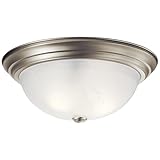
This guide ranks the Kichler last, and the review should say exactly why, because it is not a quality verdict. The 8110NI is a 15.25-inch flush mount, 6 inches tall, with a steel body in brushed nickel and a satin etched glass dome over three E26 sockets rated to 60 watts each. The glass is real — satin-etched, softly diffusing, the genuine article at a price where plastic is the norm — and Kichler’s own spec sheet lists the fixture as dimmable with dimmable bulbs on a compatible dimmer. Three sockets mean you set the sightline temperature yourself with matched bulbs, and you will still be setting it, with a twist of the wrist, in twenty years. It is dry-rated, carries a one-year limited warranty, weighs about 3.8 pounds, and it sits at the value end of this budget — check price on Amazon. The problem is purely the outline: a swirled-glass dome on a brushed-nickel ring is the visual dialect of a 2005 builder-grade hallway, and on a flat modern ceiling it announces itself as the one fixture that was not chosen. In a primary modern room, that announcement is the purchase. In a guest room or a hall, where the ceiling is not a design surface anyone studies, the same fixture is simply the smartest use of the budget in the guide: a value-tier fixture, a set of good bulbs, and a professional install still total far under this page’s budget.
Pros: Real satin-etched glass and steel from an established brand at a value price; three replaceable E26 sockets — full control of temperature, output, and CRI; dimmable per Kichler’s spec sheet; the lightest fixture here and the easiest install.
The honest limitation: The silhouette, stated plainly: this is the least modern outline of the six, and no bulb choice fixes a dome. Bulbs are not included, the warranty is one year, and it is dry-rated only. It is a check-price pick like the others — check the current price on Amazon and confirm it still sits at the value end of this budget before buying.
Choose it if the room’s ceiling is not a design statement and serviceability is. Skip it if the fixture will be looked at daily in a primary modern space — that is the Vaughan, the Sky, or the Alluria.
Comparison Table
| Product | Silhouette & materials | Color temperature | Dimming / control | Check |
|---|---|---|---|---|
| WAC dweLED Vaughan 16″ | 16″ Ø × 3″H disc — the thinnest here; aluminum body, polycarbonate shade (not glass); integrated 30W LED, 2,674 lumens (maker’s published figure) | 3000K fixed — discipline by hardware | TRIAC/ELV wall dimmer, 100–0% | Check on Amazon |
| Govee Sky Ceiling Light 21″ | 21″ × 21″ × 3″ square panel — reads as a skylight; plastic-bodied appliance; integrated 125W LED, 7,000 lumens claimed | Claimed 1000K–10000K range, CRI 95+ claimed — discipline by scene | App / Matter only — never a wall dimmer | Check on Amazon |
| Govee Ceiling Light Pro 15″ | 15″ Ø slim disc; plastic body; integrated LED, 4,300 lumens claimed + RGBIC ring | 2700K–6500K adjustable + color — discipline by scene | App / voice only — not for wall dimmers | Check on Amazon |
| George Kovacs Alluria | 18″ W × 12.5″H semi-flush sculpture; etched opal glass globes, two-tone metal frame; 3 × G9 lamps included (halogen) | Set by the lamps — halogens included, G9 LED retrofits available | Standard 120V wall dimmer | Check on Amazon |
| Quoizel Griffin 21″ | 21″ Ø × 8.5″H traditional bell; steel + etched glass, damp-rated; 4 × E26 bulbs (not included) | Your choice of bulbs — discipline by hardware | With dimmable bulbs + standard dimmer | Check on Amazon |
| Kichler 8110NI | 15.25″ Ø × 6″H dome — the least modern outline here; steel body, satin etched glass dome; 3 × E26 bulbs (not included) | Your choice of bulbs — discipline by hardware | With dimmable bulbs + LED-rated dimmer (per Kichler spec sheet) | Check on Amazon |
How to Choose a Flush Mount Ceiling Light for a Modern Home
- Score the silhouette before the spec sheet. On a flat modern ceiling, profile depth is destiny: 3-inch discs and panels read as part of the ceiling; 6-inch domes read as objects on it; drops beyond 8 inches must be sculpture (the Alluria) or admit they are traditional (the Griffin). Read the depth column of the comparison table first.
- Pick your temperature philosophy, then enforce it. Discipline by hardware — the Vaughan’s fixed 3000K, or matched bulbs in the socketed fixtures — can never drift. Discipline by scene — the two Govee fixtures — is flexible but must be set once, saved as the default on every fixture, and defended against casual voice commands. One temperature across every sightline, by whichever means.
- Choose your control world before your first fixture. Wall dimmers (Vaughan, Alluria, Griffin, Kichler with dimmable bulbs) and app scenes (both Govees) do not mix on one ceiling line. A smart fixture on a TRIAC dimmer will flicker and fail; a wall-dimmed disc ignores your scenes. Commit, then buy.
- Audit materials part by part, not brand by brand. The best-built fixture here has an aluminum body and a polycarbonate shade. The cheapest has real glass. The smart panels are plastic-bodied appliances whose price buys light, not substance. Modern rooms expose every substitution — read each part’s material and decide which substitutions you accept.
- Spend the allocation, not the headline. The top fixture band in this budget is largely empty, and even the highest-positioned verifiable pick here sits below the ceiling — check price on Amazon. The modern move is a matched pair on one sightline, or one premium fixture plus a professional install — the full reasoning is laid out in the base Best Flush Mount Ceiling Light Under $500 guide.
- Treat lumen claims as size classes, never as scores. There is no shared measurement standard. A spec-sheet maker’s 2,674 and a smart brand’s claimed 7,000 are different rulers; shortlist by diameter, wattage class, and room size instead.
- Check the mount before the money. The Sky weighs about 17.6 pounds and does not use a standard octagonal junction box. The Vaughan, at 5.84 pounds on a standard box, is the opposite install story. Older pancake boxes and plaster ceilings can turn any swap into the electrician visit this budget conveniently covers.
- Measure the drop against your ceiling height. The Alluria hangs 12.5 inches and the Griffin 8.5; on an 8-foot ceiling, keep fixture bottoms at roughly 6 feet 8 inches or higher in walkways, and reserve deep fixtures for over tables and beds.
- Check the location rating. Only the Griffin here is damp-rated. The rest are dry, indoor fixtures; over a shower or outdoors, none of the other five is the right purchase at any price.
- Interrogate check-price listings before buying. This guide prints no static price for any of these six picks. If a live offer is missing, third-party-only, or far above the position the reviews describe, buy through a lighting retailer instead — a real ASIN does not make every offer on it sane.
Common Buying Mistakes
- Letting each room pick its own color temperature. The single most common modern-lighting failure: a 3000K living room visible from a 4000K kitchen reads as a mistake even when every fixture is excellent. Buy the temperature once, for the whole sightline.
- Assuming spending to the top of the $500 budget buys a categorically better fixture. It mostly buys the same fixtures with better retail distribution. The top band is effectively empty, and the designer tier that does exist is thin on Amazon — see the absences below.
- Wiring a smart panel to a wall dimmer. The Govee fixtures want constant power from a plain switch. A TRIAC dimmer upstream is the most common cause of flicker, buzz, and “defective” returns for smart ceiling lights.
- Judging a fixture by its listing photo’s ceiling. Listing photos are shot in styled rooms with coves and coffers. On your flat ceiling, the dome that looked soft in the photograph is a builder-grade bell. Judge by depth and outline, not by the room in the picture.
- Paying a premium for claimed lumens. A 7,000-lumen claim is marketing arithmetic until a standard exists. Buy depth, materials, warranty, and control fit — not the biggest number on the box.
- Buying check-price fixtures at whatever the listing says. Third-party offers on stale listings can drift far above retail and over this guide’s budget, as the Griffin has shown. Compare the live offer against the position described in this guide and walk away from outliers.
- Choosing integrated LED for a forever ceiling without reading the warranty. A one-year warranty on a sealed premium panel means a year-eight failure is a new purchase. For a decade-long install, pick sockets or the Vaughan’s five-year coverage.
- Forgetting the bulbs in the socketed fixtures’ true cost. The Griffin needs four bulbs and the Kichler three; good dimmable, high-CRI LEDs are an extra cost to factor in — check price on Amazon — and matching them across the sightline is part of the discipline, not an afterthought.
The Fixtures That Are Not Here — and Why
A modern-home guide owes you its absences, because the fixture many readers came here expecting — the premium smart disc from the big lighting ecosystem — is one of them. The Philips Hue Enrave Large, a 16.7-inch metal White Ambiance fixture claiming 4,300 lumens and stocked at specialty retail in the upper part of this budget, has no Amazon US listing we could verify, so it is a benchmark, not a pick; buy it from a Hue retailer if that ecosystem is your ceiling’s control world, and spend the remainder on the Bridge and controls. The Govee Ceiling Light Ultra, a 21-inch pixel-matrix flagship positioned in the middle of this budget, is named here in prose and linked nowhere, because its Amazon ASIN could not be verified from a source we trust — its existence still proves that even flagship smart fixtures sit well below the top of this budget. Kichler’s Ceiling Space LED is sold through an electrical distributor in the upper part of this budget with no verifiable Amazon offer. The Hinkley Delaney, Maxim’s Prime fabric drum, and WAC’s own Chapeau — all positioned in the upper-middle to upper part of this budget at retail — make the same point from three more shelves: the designer band is real and healthy — it simply does not live on Amazon. And the Hinkley Reina was excluded outright, because its Amazon listing contradicts itself (the title describes a 16-inch semi-flush while the model field describes a chandelier) and no price could be verified anywhere — precisely the combination this guide exists to protect you from.
Final Recommendation
For a primary modern room, buy the WAC dweLED Vaughan — check price on Amazon first and confirm it fits the under-$500 budget, as its usual retail position says it should. It is the one fixture here that a modern ceiling would choose for itself: a 3-inch aluminum plane, one disciplined temperature, the best wall dimming in the guide, and a warranty written for a decade. For a dark room that needs daylight and a household that will actually run scenes, the Govee Sky — check the current price on Amazon — is the statement purchase, mount permitting. For several ceilings on one budget, matched Govee Ceiling Light Pros, scene-locked to a single temperature, will look more considered than any lone hero fixture. For a dining room that wants one beautiful object, the Alluria; for material honesty above outline, the Griffin; and for the rooms nobody studies, the Kichler 8110NI plus a professional install, with most of the budget unspent. If your real budget is a single fixture with no install to fund, start one tier down: the Best Flush Mount Ceiling Light For Modern Homes Under $300 covers the band where the designer names actually begin.
FAQ
What makes a flush mount look “modern”? Mostly geometry and restraint: a thin profile (3 inches or less) that reads as part of the ceiling plane, a simple outline — disc, panel, or a deliberate sculptural form — and honest materials. Depth is the giveaway: domes and bells belong to earlier dialects, however good their glass is.
Should every fixture in an open-plan home be the same color temperature? Yes — one temperature across any sightline you can see in a single glance. Achieve it by hardware (a fixed-3000K fixture like the Vaughan, or matched bulbs in socketed fixtures) or by scene (tunable fixtures set once and saved as the default). Mixed temperatures are the most common reason a well-bought modern interior still looks off.
Are scenes really a replacement for dimmer switches? For smart fixtures, yes — and they are the only option, since the Govee picks dim exclusively in their app and must never be wired to a wall dimmer. Scenes do more than a dimmer (temperature, schedules, multiple fixtures at once) but demand setup discipline. Wall-dimmer households are equally well served by the Vaughan’s TRIAC/ELV dimming to 0% — the mistake is mixing the two worlds on one sightline.
Does any flush mount actually cost $500? Almost none that we could verify. Even the highest-positioned Amazon-orderable pick in our research, the Govee Sky — check price on Amazon — sits well below the top of the budget, and the designer retail band sits in the upper part of this budget. Treat $500 as a budget for the fixture plus installation and controls — or for a matched pair — not as a fixture price.
Is a polycarbonate shade a deal-breaker at this price? It is a deduction, not a disqualification — and it is why this guide names it wherever it appears. The Vaughan’s body is aluminum and its diffuser performs well, but at designer money you are entitled to know which parts are plastic. The fixtures with glass throughout are the Alluria, the Griffin, and the Kichler; the Govee panels are plastic-bodied by design.
Can I install one of these myself, or do I need an electrician? A like-for-like swap on a sound, modern junction box is within many homeowners’ ability, breaker off and box rating respected — the Kichler at about 3.8 pounds and the Vaughan at 5.84 are easy. The 17.6-pound Govee Sky, with its non-standard mount, is the one to read carefully first. Hire the electrician this budget allows when the box is old, undersized, ungrounded, or moving location.
Flush mount or semi-flush in a modern home? Flush, on 8-foot ceilings and in walkways — the Vaughan’s and Sky’s 3-inch profiles are ideal. A semi-flush earns its place only as sculpture over a table or bed, which is the Alluria’s 12.5-inch drop and nothing else’s excuse. The Griffin’s 8.5-inch depth is the practical limit over a no-walk zone.