Where to buy
Best overall for modern homes: Philips Hue Infuse Medium Ceiling Light, White
Best smart value: Govee Ceiling Light Pro 15″
Best designer disc: WAC Lighting dweLED Vaughan 16″ LED Flush Mount, Aged Brass
Best minimalist panel: Artika Horizon LED Flush Mount Ceiling Light
Best thin disc with remote: KIWIVIC 16″ Dimmable Ceiling Light with Remote
Best replaceable bulbs: Kichler 8110NI 15.25″ Flush Mount, Brushed Nickel
Best Flush Mount Ceiling Light for Modern Homes Under $300: The Disc That Disappears
As an Amazon Associate, dailyhomedecorating.com earns from qualifying purchases made through links on this page. That never changes a recommendation or a specification: every lumen figure below is the manufacturer’s own published number, specifications were verified against manufacturer information and live listings during research, and every weakness we found — including the designer fixtures in this price band that Amazon does not sell at all — is stated in the open.
A modern interior judges a ceiling light by a standard no other style applies so ruthlessly: the best fixture is the one you stop seeing. Recessed cans earned their dominance in contemporary homes precisely because they vanish — a hole, a glow, nothing else. A flush mount in a modern home is therefore competing against invisibility, and it wins or loses on silhouette: how thin it sits against the ceiling plane, whether its edge reads as one clean line, and whether the light it throws looks like it comes from the architecture rather than from an object stuck to it. This guide scores six flush mounts under $300 by that standard first — depth, profile, and glow — and then by the two disciplines modern open-plan living actually runs on: one color temperature held steady across the whole sightline, and scenes, not switches, as the way light gets controlled.
Before the picks, the honest state of this price band on Amazon, because it shapes everything. The $200–$300 shelf is thin. The flush mount positioned closest to the top of this budget on Amazon itself is a smart fixture — check the current price on Amazon. Most of the designer fixtures that occupy this band in the wider market — WAC’s fabric-shaded Chapeau, positioned near the top of this band, and Kuzco’s sculptural Cruz, positioned in the upper part of this band — are distributed through lighting showrooms and could not be verified as orderable Amazon listings, so they appear here as prose benchmarks, never as linked picks. The designer fixture readers most often expect, Kichler’s Ceiling Space LED, sits above this guide’s budget through an electrical distributor, labeled over budget wherever it is mentioned. A truthful under-$300 list for a modern home is therefore one genuine fixture near the top of this budget, one designer disc — check price on Amazon — and the strongest low-profile fixtures from the tiers below — judged, all of them, by how completely they disappear.
Two technical warnings matter more in a modern home than anywhere else. The first is about lumens. No shared measurement standard sits behind the brightness numbers printed on LED ceiling lights, and this guide’s designer pick proves how much that matters: WAC publishes 2,674 LED lumens for its fixture and then, unusually, a second figure of 1,904 delivered lumens — the light that actually escapes the diffuser. The roughly 29 percent gap between those two numbers exists inside every fixture in this article; WAC is simply the only maker here honest enough to print both. Treat every lumen claim below as a rough size class, never as a score. The second warning is about dimming, because modern homes increasingly control light by scene and voice rather than by a knob on the wall — and the three dimming systems in this guide (wall dimmer, remote, app) are not interchangeable. A smart fixture fed through a TRIAC wall dimmer can flicker, buzz, drop offline, or fail early. Each pick below states exactly which control it answers to, and which it refuses.
Quick Picks
| Buyer type | Pick | Why it wins | Check |
|---|---|---|---|
| Best overall for modern homes | Philips Hue Infuse Medium, White (B09QFS12M4) | The closest thing to recessed-light invisibility in a surface fixture: about 3.3″ deep, light thrown up and down so it reads as a glow rather than an object, tunable white you can lock to one temperature across an open plan, and full scene control — check price on Amazon | Check on Amazon |
| Best smart value | Govee Ceiling Light Pro 15″ (B0F1N5HPVH) | A thin disc with tunable white, an independent color ring, scenes, and Matter support — check the current price on Amazon — the scene-driven modern ceiling in a more accessible tier than the Hue, with a plastic body as the honest trade | Check on Amazon |
| Best designer disc | WAC Lighting dweLED Vaughan 16″ (B08XN59K4Z) | A real aluminum designer fixture only 3″ deep, CRI 90, fixed 3000K that can never drift out of sync with the room, proper wall-dimmer dimming, and the most honest spec sheet in the category — check price on Amazon and confirm it sits within this guide’s budget | Check on Amazon |
| Best minimalist panel | Artika Horizon LED Flush Mount (B08SJ5KCHV) | The flattest silhouette here: a slim panel whose color temperature (3000K/4000K/5000K) is chosen once at install — set every fixture in the sightline to the same value and the discipline holds forever — check the live price | Check on Amazon |
| Best thin disc with remote | KIWIVIC 16″ Dimmable Ceiling Light (B0FQ59XD6K) | An ultra-thin 16″ disc that dims and tunes 3000K–6500K from a handheld remote — scene-like control with no app, no account, and no rewiring; check the live price before buying | Check on Amazon |
| Best replaceable bulbs | Kichler 8110NI 15.25″ Flush Mount (B0014HCHO0) | The only pick whose light source you can replace forever — three E26 sockets behind a real glass dome; its traditional silhouette is the least modern here, and this guide says so rather than pretending otherwise | Check on Amazon |
How These Picks Were Chosen
Each fixture was verified during research against its manufacturer’s specifications and its live Amazon listing — diameter, depth, LED wattage or socket count, dimming method, materials, and warranty. This guide does not print static prices, because they change; for every linked pick, check the current price on Amazon before buying. Designer and big-box fixtures on Amazon are commonly listed by third-party showrooms, so their live listing is the only price that counts for a buying decision.
The modern-homes lens then re-ranked what survived. Depth was the first sort: fixtures at roughly 3 to 3.4 inches deep can pass the disappearing test on an 8- or 9-foot ceiling, while the one 6-inch dome in this guide was carried only because it is the last replaceable-bulb fixture standing in the band, and it is labeled as a silhouette compromise wherever it appears. Finally, a fixture had to be a true flush mount and genuinely orderable on Amazon. That last rule is why two excellent in-band designer fixtures — the WAC Chapeau and the Kuzco Cruz, both positioned in the upper part of this band — are discussed in prose rather than linked: during research they were sold through showrooms, not Amazon, and a guide for modern homes does not get to link to listings it cannot verify.
How a Modern Ceiling Judges a Flush Mount
Stand in a contemporary living room and look up. The ceiling is a single uninterrupted plane, often the largest unbroken surface in the home, and everything mounted on it is either part of the plane or an interruption of it. That is the whole aesthetic problem this guide is solving. A flush mount passes the modern test when three things are true. Its depth is small enough that the eye reads it as a thickening of the ceiling rather than an object hanging from it — in practice, about 3.5 inches or less on a standard ceiling. Its edge is one clean line: a simple disc rim, a slim panel frame, no stepped trim rings, no finials, no decorative hardware competing for attention. And its light distribution hides the source: a fixture that washes the ceiling around itself, or diffuses so evenly that no bright center stares back, reads as architecture. A fixture with a visible hot spot and a molded shade reads as an appliance.
By those three tests, this guide’s field splits cleanly. The Vaughan and the Artika pass on profile: 3 inches and a slim panel respectively, each a single quiet shape. The Govee and KIWIVIC discs pass on depth and edge, and lose a little on materials — plastic reads as plastic at close range, whatever the product photos suggest. The Kichler fails the silhouette test outright: a 6-inch swirled glass dome is a traditional object, and in a minimalist room it will be the most old-fashioned thing you own.
One Temperature Across the Sightline
Open-plan design created a lighting problem that closed rooms never had. A 5000K disc over the island next to a 2700K fixture over the sofa does not read as “task light and mood light.” It reads as a mistake, the lighting equivalent of two whites that do not match. Modern interiors therefore run on a rule this guide treats as a scoring criterion: pick one white for the sightline — most contemporary homes land on 3000K, warm enough for living, clean enough for a kitchen — and hold every fixture to it.
The six picks enforce that rule three different ways, and the differences matter. The Vaughan enforces it by construction: its color temperature is fixed at 3000K, permanently, so it cannot drift, be mis-set by a guest with the app, or disagree with its twin across the room. That inflexibility, a limitation in a closed bedroom, is a genuine feature in an open plan. The Artika enforces it by decision: a switch on the fixture selects 3000K, 4000K, or 5000K once, at installation — set every fixture in the sightline to the same value before the ladder comes down, and the discipline holds for the life of the installation. If you run tunable fixtures across an open plan, build one named scene per activity with the temperature locked, and let the scene, not individual fixtures, be the unit of control.
Scenes Are the New Dimmer Switch — With One Hard Rule
Contemporary homes increasingly treat the wall switch as a backup and the scene as the real interface: “evening” drops every fixture in the sightline to 40 percent at 2700K, “cooking” takes the kitchen zone to full brightness, “movie” leaves a faint warm halo and nothing else. Three of the six picks are built for that world. The Govee delivers most of the same behavior, plus an independent color ring for ambient scenes, in a more accessible tier.
The hard rule, repeated in every smart review below because ignoring it is the most common way these fixtures get damaged: a smart ceiling light must receive full, uncut power from a plain switch. If your modern home has architectural wall dimmers you intend to keep, your shortlist in this guide is the Vaughan (built for TRIAC/ELV dimming, 100 down to 10 percent), the Artika (rated for most LED wall dimmers), and the Kichler with dimmable bulbs. Decide which control philosophy your house runs on before you decide which fixture it wears; the fixture is the easy part. For the same six fixtures re-scored for a household that cannot rewire at all, see the Best Flush Mount Ceiling Light For Apartments Under $300.
1. Best Overall for Modern Homes: Philips Hue Infuse Medium Ceiling Light, White (B09QFS12M4)
Who it suits: Modern households already living by scenes and voice — Hue, Alexa, Google, or Apple Home — who want the one flush mount that behaves like architectural lighting: invisible at a glance, exact about color, and dimmable to a whisper without ever touching a wall switch.
The Infuse Medium is a 15-inch disc, roughly 3.3 inches deep, in metal and synthetic materials rather than the all-plastic build of cheaper smart discs. Signify’s datasheet rates the 33.5-watt fixture at 2,350 lumens at 4000K and about 2,100 at 2700K — manufacturer figures, as throughout this guide, though from the one maker whose numbers are at least consistent across its own range. White tunes from 2000K candlelight to 6500K daylight, and the full Hue color palette sits behind that for the households that want it. Check the current price on Amazon — it is positioned near the top of this guide’s budget, as the premium smart option Amazon itself offers in this category.
For sightline discipline it is close to ideal: tune it to your home’s chosen temperature, fold it into the room’s scenes, and it will match every other Hue fixture in view exactly, at every brightness, forever. Dimming is deep and smooth, down to a night-light glow, and control runs through the app, voice assistants, schedules, and Hue’s own switches. Out of the box, Bluetooth covers basic control of up to ten lights in a room; the Bridge, sold separately, unlocks whole-home routines, out-of-home control, and Matter. The wall switch’s only job is to stay on.
Pros: The most architectural light here — up-and-down distribution that reads as a glow, not an object; metal body only about 3.3 inches deep, so it passes the disappearing test on real ceilings; tunable white 2000K–6500K plus full color, lockable into scenes so an entire open plan holds one temperature; deep, smooth dimming with the most mature smart ecosystem in the category; a position near the top of this guide’s budget as the premium smart pick.
The honest limitation: It is a sealed fixture rated at 25,000 hours — half the designer pick’s rated life — so when the electronics eventually fail, the whole fixture is replaced; there is no bulb to change. Full features require a Hue Bridge, sold separately. It must never be fed through a standard wall dimmer. And Signify does not headline a CRI figure for this fixture the way WAC does, so for laboratory-grade color rendering over art, the Vaughan below is the more transparent buy.
Choose it if your home runs on scenes and you want the flush mount that looks least like a fixture. Skip it if your rooms are governed by wall dimmers you will keep, you will not control a ceiling light from a phone, or you want a light source you can replace with a bulb.
2. Best Smart Value: Govee Ceiling Light Pro 15″ (B0F1N5HPVH)
Who it suits: Scene-driven households who looked at the Hue, admired it, and would rather choose a more accessible tier — anyone who wants tunable white, an ambient color ring, and Matter support in a thin disc, and is at peace with plastic.
The Govee is a 15-inch low-profile disc carrying two lighting systems: a main white light claiming 4,300 lumens — the highest figure in this guide and a manufacturer claim, best translated as “bright enough for a medium-large room,” especially set beside the Vaughan’s carefully delivered 1,904 — adjustable from 2700K to 6500K, and an RGBIC ambient ring that runs colors and animated scenes independently of the main light. It connects over Wi-Fi, speaks Matter alongside Alexa and Google Assistant — check the current price on Amazon. It sits in a more accessible tier than the Hue, which is the core of its value case.
On the sightline rule it performs well: set its white to the home’s temperature inside a scene and it will hold that white in step with the rest of the room. Its dimming is genuinely good — through the app, by voice, and on schedules. The compromises are material and mechanical. The body is a plastic disc; across a room it is clean and quiet, but it will never be mistaken for the Vaughan’s aluminum or the Hue’s metal at close range. There is no remote in the box, so control is phone, voice, or nothing. The radio is 2.4 GHz Wi-Fi only, which can complicate setup on mesh networks that merge their bands. And it is a sealed appliance: when the electronics fail, the whole unit is replaced.
Pros: Strong scene capability for its tier — tunable white plus an independent color ring; Matter support keeps it out of single-ecosystem lock-in; the highest claimed output here — check price on Amazon; a thin, quiet disc silhouette that suits modern ceilings; schedules and voice dimming that work the way modern homes actually live.
The honest limitation: It must not be run on a wall dimmer — it wants full power from a plain switch and dims internally — and there is no included remote. The plastic body will not pass for a designer fixture up close, no headline CRI is published, the Wi-Fi is 2.4 GHz only, and the sealed design is replaced whole at end of life. Its live listing can move with promotions, so check the current price on Amazon before buying.
Choose it if scenes are how your home already works and the budget matters. Skip it if you rely on a wall dimmer, want metal and glass rather than plastic, or want a fixture serviceable with a bulb.

3. Best Designer Disc: WAC Lighting dweLED Vaughan 16″ LED Flush Mount, Aged Brass (B08XN59K4Z)
Who it suits: Modern and transitional homes with a proper dimmer on the wall and a low tolerance for gimmicks — buyers who want a professional lighting brand’s fixture, honestly specified, that does one warm white perfectly and answers to the switch like lighting used to.
The Vaughan is the grown-up in this guide. Its body is aluminum — actual metal, in an aged brass finish — 16 inches across and only 3 inches deep, with the driver hidden in the canopy so the ceiling line stays clean. That profile passes the disappearing test on dimensions alone. WAC’s spec sheet is the most honest document in the category: it rates the 30-watt module at 2,674 lumens at the LED source and then, in the next column, 1,904 delivered lumens — the light that actually leaves the fixture. Roughly 29 percent of the headline number is lost to the diffuser and optics, a loss every fixture in this article quietly shares; WAC is the only maker here that prints both figures, and it is the standard this guide mentally applies to every rival claim. Color is a fixed 3000K at CRI 90, so wood, stone, fabric, and skin render the way a designer intended. The fixture is damp-location listed, Title 24 compliant, rated for 50,000 hours, and covered by a five-year warranty.
For an open-plan modern home, the fixed 3000K deserves a second look rather than a shrug. Tunable fixtures can match a sightline; the Vaughan cannot leave it. There is no app to mis-set it, no scene to forget it, no guest who can dial it to 5000K and break the room’s discipline — it is the one-temperature rule enforced by hardware. Dimming is the wall kind, done properly: ELV and TRIAC, 100 down to 10 percent, covering the great majority of LED-rated dimmers. Two candors belong here. First, designer fixtures drift between third-party showrooms, so check the current price on Amazon and confirm it sits within this guide’s budget before buying. Second, Amazon’s own spec table for this listing contradicts itself in places — it claims an E26 bulb base on a sealed LED fixture — which is exactly why this guide worked from WAC’s spec sheet instead.
Pros: Real aluminum designer construction, only 3 inches deep; CRI 90 at a fixed 3000K that enforces single-temperature discipline across an open plan by design; the category’s most honest spec sheet, delivered lumens included; true TRIAC/ELV wall-dimmer dimming to 10 percent; 50,000-hour rated life, damp listed, five-year warranty.
The honest limitation: The diffuser is polycarbonate, not glass, despite its designer positioning. The 3000K is fixed — there is no tuning to 2700K for a cozier room or 4000K for a crisper one. It is a sealed fixture, so end of life means replacement, softened by the long rating and warranty. And check the current price on Amazon; if it sits outside this guide’s budget, it is outside this guide however good it is.
Choose it if you have a wall dimmer, value materials and color fidelity over features, and want the one-temperature rule to be unbreakable. Skip it if you want tunable white or color scenes, or replaceable bulbs on principle.

4. Best Minimalist Panel: Artika Horizon LED Flush Mount (B08SJ5KCHV)
Who it suits: Kitchens, hallways, laundry rooms, and secondary ceilings in modern homes that want the flattest possible silhouette, a color temperature chosen once and then forgotten, and dimming from an ordinary wall dimmer — without moving into the smart or designer tiers.
Artika is the big-box lighting brand sold through warehouse and home-improvement stores, and the Horizon is its slim panel: a 24-watt integrated LED claiming 1,800 lumens. That is a manufacturer figure and the lowest claim among the integrated picks here — read it as “right-sized for a kitchen, hallway, or small-to-medium room,” not as a living-room centerpiece. What the Horizon offers a modern home is geometry and discipline. For discipline, its selectable white — 3000K, 4000K, or 5000K, chosen by a switch on the fixture at installation — is set once and then physically incapable of drifting: set every Horizon in a sightline to the same value before the ladder comes down, and the one-temperature rule holds for the life of the installation with no app involved.
Dimming is the wall kind, which in this guide is rarer than it should be: Artika rates the Horizon as dimmable with most LED dimmers, making it, with the Vaughan, one of only two integrated picks that obey a wall dimmer instead of demanding an app or remote. The limitations are about expectation management. Output is modest — do not ask it to anchor a large open-plan living space alone. It is sealed, so a failed driver means a replaced panel. Materials are big-box standard: clean and quiet at ceiling distance, ordinary in the hand. Its own documentation disagrees about warranty — the Amazon listing describes a five-year limited warranty while Artika’s printed manual says three years — so confirm the live listing’s terms before relying on either number. Check the current price on Amazon, expect it to sit well below the top of this guide’s budget in its big-box tier, and know that this is one fixture you can comparison-shop at warehouse stores before paying an inflated marketplace listing.
Pros: The flattest, quietest silhouette in the guide — a panel, not an object; selectable 3000K/4000K/5000K set once at install, enforcing sightline discipline mechanically; dims on most LED wall dimmers, no app or remote required; a real retail brand with stores and support behind it; normally positioned well below the top of this budget.
The honest limitation: The lowest claimed output here at 1,800 lumens — a supporting-room fixture, not an open-plan anchor; sealed design replaced whole at end of life; big-box materials and finish; a warranty its own documents state inconsistently (five years on the listing, three in the manual); and a live price to check on Amazon rather than assume.
Choose it if you want a set-and-forget panel with wall-dimmer control from a mainstream brand. Skip it if the room is large or formal, you want maximum brightness, or designer materials matter more than a flat profile.
5. Best Thin Disc With Remote: KIWIVIC 16″ Dimmable Ceiling Light with Remote (B0FQ59XD6K)
Who it suits: Modern rooms on a plain switch with no dimmer — older homes, rentals that cannot be rewired, spare rooms and home offices — where the household wants dimming and temperature control from the sofa or desk without an app, an account, or a smart-home platform.
The KIWIVIC’s proposition is minimalism of two kinds at once. Visually it is an ultra-thin 16-inch disc, the joint-thinnest profile in this guide, that sits on the ceiling as a plain white circle and asks for no attention. Operationally it strips smart control down to a single handheld remote: brightness and color temperature adjust across 3000K to 6500K from the sofa, the wall switch stays a plain switch, and nothing about the arrangement requires Wi-Fi, a hub, or a phone. Its 36-watt integrated LED claims 3,600 lumens — a manufacturer figure; read it as large-room bright rather than a measurement — and the 16-inch diameter spreads light more evenly than the 12-inch discs that dominate the budget tiers, in rooms up to roughly 200 square feet.
Why does a value-tier disc belong in a guide that also contains a WAC and a Hue? The trade-offs are stated plainly. It is a sealed fixture from a budget brand, so failure means replacement and the support horizon is shorter than WAC’s or Kichler’s. Construction is plastic, as its tier dictates, so the disappearing act works at ceiling distance rather than in the hand.
Pros: Real dimming and temperature adjustment with zero rewiring, no app, and no ecosystem; ultra-thin 16-inch disc with the plainest silhouette here; claimed 3,600 lumens is strong output for a thin disc; remote control suits rooms where the switch was never going to be upgraded; low profile suits 8-foot ceilings.
The honest limitation: A sealed LED appliance with a budget-brand support horizon; control depends on keeping one remote alive and findable; plastic construction; temperature discipline is voluntary rather than enforced — check the current price on Amazon before buying.
Choose it if you want scene-like control in a room that has no dimmer and cannot get one. Skip it if you want wall-dimmer control, whole-home smart integration (the Hue and Govee are those picks), or a serviceable bulb-based fixture.

6. Best Replaceable Bulbs: Kichler 8110NI 15.25″ Flush Mount, Brushed Nickel (B0014HCHO0)
Who it suits: Buyers replacing a builder-grade dome in a living room, bedroom, or dining room who rank a serviceable fixture above a fashionable one — and who have read this far knowing its silhouette is the compromise, not the selling point.
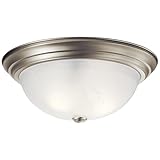
Let the silhouette verdict be stated first, because this is the modern-homes guide: the 8110NI is a 15.25-inch steel fixture standing 6 inches deep, with a swirled satin-etched glass dome, and in a minimalist room it will read as traditional — the deepest profile and the most decorated shape in this guide by a wide margin. It does not disappear. What it does instead is something none of the five sleeker fixtures can: it takes three ordinary E26 bulbs, rated to 60 watts each, that you choose and replace forever. That single fact rewrites every other specification. Brightness is your decision — roughly 800 lumens a bulb for a bedroom, more for a dining room. CRI is your decision, including 90+ bulbs over a dining table or art wall. And when a light source dies in year six, the repair is a bulb, not a fixture, a warranty claim, or a discontinued model that no longer matches the other rooms. Kichler’s spec sheet lists the fixture as dimmable, which for a bulb fixture means dimmable bulbs on a compatible LED-rated dimmer.
The remaining candor is brief. Bulbs are not included, so budget separately for three good LED bulbs — even with them, this remains the most value-positioned complete installation in the guide. It is rated for dry locations, so it belongs in living spaces rather than over a shower. Its one-year limited warranty is standard for its tier, not generous. Its listing is handled by third-party sellers, so check the current price on Amazon — and if a seller positions it like a premium fixture near the top of this budget, walk away, because that is a markup, not its usual value tier.
Pros: Real glass dome and steel body from an established brand; three replaceable E26 sockets make brightness, color temperature, and CRI your permanent choice — the strongest sightline discipline of all, enforced in the bulb drawer; dimmable per the manufacturer’s spec sheet with the right bulbs; typically sits well below the top of this budget, leaving room in the budget for excellent bulbs.
The honest limitation: The traditional swirled dome is the least modern silhouette here and, at 6 inches, the deepest profile — twice the Vaughan’s — so it wants an 8-foot ceiling or better and a room whose style can absorb it. Bulbs cost extra, the warranty is the shortest in the guide at one year, and its third-party Amazon listing should be checked on Amazon and refused when inflated.
Choose it if you want the fixture you install once and service with bulbs for a decade, and your room’s style is modern-leaning rather than strictly minimal. Skip it if the disappearing-disc look is the whole point, your ceiling is under 8 feet, or you want smart features and tunable color built in.
Comparison Table
| Product | Size & light source | Color temperature | Dimming | Check |
|---|---|---|---|---|
| Philips Hue Infuse Medium | 15″ Ø × ~3.3″H; integrated LED, 2,350 lumens claimed at 4000K, metal body | 2000K–6500K tunable + full color, lockable by scene | App / voice / Hue switch only — not for wall dimmers | Check on Amazon |
| Govee Ceiling Light Pro | 15″ Ø disc; integrated LED, 4,300 lumens claimed, plastic body | 2700K–6500K adjustable + RGBIC color ring | App / voice only — not for wall dimmers | Check on Amazon |
| WAC dweLED Vaughan 16″ | 16″ Ø × 3″H; integrated LED, 2,674 LED lumens / 1,904 delivered (maker’s spec sheet), CRI 90, aluminum, polycarbonate diffuser | 3000K fixed — cannot drift | Yes — TRIAC / ELV wall dimmer, 100–10% | Check on Amazon |
| Artika Horizon | Slim panel; integrated 24W LED, 1,800 lumens claimed | 3 selectable at install: 3000K / 4000K / 5000K | Yes — most LED wall dimmers | Check on Amazon |
| KIWIVIC 16″ with Remote | 16″ Ø thin disc; integrated 36W LED, 3,600 lumens claimed | 3000K–6500K via remote | Remote only — no wall dimmer needed | Check on Amazon |
| Kichler 8110NI | 15.25″ Ø × 6″H; glass dome, 3 × E26 bulbs (not included) | Your choice of bulbs | Yes — with dimmable bulbs + LED-rated dimmer (per Kichler spec sheet) | Check on Amazon |
How to Choose a Flush Mount Ceiling Light for a Modern Home Under $300
- Apply the disappearing test first. On an 8- or 9-foot ceiling, a fixture around 3 to 3.5 inches deep reads as part of the ceiling plane; a 6-inch dome reads as furniture hanging overhead. Depth, not diameter, is the number that decides whether a flush mount looks modern.
- Pick one temperature for the sightline and enforce it. Choose the white your open plan will live at — 3000K is the common modern answer — then pick the enforcement you trust: fixed by hardware (Vaughan), set once at install (Artika), locked into scenes (Hue, Govee), held by a remote (KIWIVIC), or standardized in the bulb drawer (Kichler).
- Decide your control philosophy before your fixture. Scene-and-voice household → Hue or Govee. Architectural wall dimmers you intend to keep → Vaughan, Artika, or Kichler with dimmable bulbs. No dimmer and no rewiring → KIWIVIC. Never feed a smart fixture from a TRIAC dimmer, and never put a non-dimmable driver on a dimmer circuit.
- Spend the budget on the right axis. At $300 you are not buying brightness — the largest claim here belongs to the Govee, positioned in a more accessible tier. You are buying profile, materials (aluminum, glass), color quality (CRI 90), warranty length, and honest specifications. If none of those matter in the room, a lower-budget guide in this series will serve you better.
- Read lumen claims the way WAC’s spec sheet teaches. Source lumens are not delivered lumens; the Vaughan loses about 29 percent between its two published columns, and every other fixture here loses a similar share silently. As a planning figure, aim for roughly 20 delivered lumens per square foot in living spaces, then judge the installed result inside the return window.
- Face the light-source fork honestly. Replaceable E26 bulbs (only the Kichler here) mean the fixture outlives its light source and you control brightness, temperature, and CRI forever. Integrated LED means thinner profiles and features, but the fixture is replaced whole when its driver dies — which makes warranty length a real specification: five years (Vaughan) against two (Hue) and one (Kichler’s fixture, though its bulbs are endlessly replaceable).
- Size the diameter to the room, not the ego. Slim panels and 15–16 inches suit rooms up to about 250 sq ft. There is no honest 20-inch-plus designer flush mount on Amazon at this budget; oversize open plans want two matched fixtures on one scene, or a showroom brand.
- Check CRI where color is the point. Over a dining table, art wall, or vanity, prefer a published CRI of 90 (Vaughan) or fit the Kichler with 90+ CRI bulbs. The smart discs do not headline CRI figures — their color is a scene effect, not a rendering specification.
- Read the material line literally. “Aluminum” in the Vaughan’s listing means a metal body — and its diffuser is still polycarbonate, as this guide states openly. On the plastic discs, housing and diffuser are plastic no matter how metallic the photography looks. Real glass appears exactly once in this guide, on the least modern silhouette.
- Verify the price like a professional. Four of these six picks are sold on Amazon largely by third parties, and their listings drift. Check the current price on Amazon for every pick: confirm the Vaughan sits within this guide’s budget, the Kichler sits in its usual value tier, and the Artika and KIWIVIC sit at value positioning for their tiers. A marketplace listing far above a fixture’s normal band is not a premium product — it is the same product with a worse price.
Common Buying Mistakes
- Judging a flush mount by its product photo instead of its depth. Rendered listings make every fixture look slim. The specification that decides whether it disappears is depth in inches: about 3 here is a disc, 6 is a dome, and no photograph changes that.
- Letting each fixture in an open plan pick its own white. A 5000K kitchen disc beside a 2700K living-room fixture is the most common modern-lighting error there is. Choose one temperature for the sightline and buy fixtures that can hold it.
- Putting a smart light on a wall dimmer. The Hue and Govee want a plain switch at full power; running one through a TRIAC dimmer is the leading cause of flickering, buzzing, and “defective” smart-light returns.
- Assuming $300 buys a designer fixture on Amazon. Mostly it does not — the band’s designer fixtures (the WAC Chapeau and Kuzco Cruz, both in the upper part of this band) are sold through showrooms, and Kichler’s Ceiling Space LED sits above this budget entirely. On Amazon, this budget buys one smart fixture near the cap and excellent fixtures from the tiers below it.
- Comparing fixtures by claimed lumens. A 4,300-lumen claim and a 2,674-lumen figure from different makers were not measured the same way — and the 2,674 comes with a delivered figure of 1,904 from the one maker honest enough to publish both. Shortlist by diameter, depth, and room size instead.
- Paying a third-party markup without noticing. Designer and big-box fixtures on Amazon are often listed by showrooms well above their normal band. If the Vaughan sits outside this guide’s budget or the Kichler is positioned anywhere near the top of it, you are looking at a markup.
- Forgetting the bulbs in the total. The Kichler plus three quality dimmable LED bulbs is the real complete installation — still excellent value, but compare it honestly against integrated fixtures whose light is built in.
- Mixing enforcement systems across one sightline. A fixed-3000K Vaughan in the kitchen and a tunable Govee left at 4000K in the living area will disagree every evening. One sightline, one temperature, one method of holding it.
- Expecting one 15-inch fixture to light a great room. No single flush mount in this guide honestly covers a 400-square-foot open plan. Two matched mid-size fixtures on a shared scene will always beat one oversized claim.
The Fixtures That Are Not Here — and Why
Three absences in this guide are deliberate, and in a modern-homes guide they sting a little, because all three are fixtures a designer would reach for. The WAC Chapeau (FM-49416) pairs a 16-inch aluminum body with a fabric shade over an etched opal glass diffuser, publishes 2,580 maker-rated lumens at CRI 90, and is positioned near the top of this band at lighting retailers. It is not a pick because it is not sold on Amazon — no orderable Amazon listing for it could be verified, and this guide links only to listings it can stand behind. If it appears on Amazon within this guide’s budget with a featured offer, it belongs at the top of this list beside the Vaughan. The Kuzco Cruz (FM22815), a sculptural flush mount positioned in the upper part of this band through showrooms, is absent for the same reason: a genuine designer fixture in this band that Amazon’s shelf simply does not carry. And the Kichler Ceiling Space LED (10886NILED), a 17.25-inch integrated fixture available through an electrical distributor above this guide’s budget, is the honest picture of the next tier up — labeled over budget wherever it appears. Together the three explain the shape of this whole guide: in this budget, the limiting factor for a modern ceiling is not money, it is Amazon’s catalog.
Final Recommendation
For most modern homes, buy the Philips Hue Infuse Medium: it is the one fixture here that behaves like architectural lighting — a slim metal disc whose up-and-down glow disappears into the ceiling plane, with its temperature lockable into the same scenes that run the rest of the sightline — just keep it on a plain switch and budget for a Bridge if you want the full system. If your house answers to wall dimmers, the WAC dweLED Vaughan is the disciplined buy: aluminum, CRI 90, a fixed 3000K that can never break the room’s one-temperature rule, honestly published delivered lumens, and a five-year warranty — provided you check the current price on Amazon and it sits within this guide’s budget. Take the Govee if you want most of the Hue’s scene craft in a more accessible tier, the Artika for the flattest panel with set-once temperature, the KIWIVIC when a remote is the only control your wiring allows, and the Kichler if a replaceable bulb matters more to you than a disappearing silhouette. Households furnishing a bedroom first will find the same budget weighed for warm, low light in the Best Flush Mount Ceiling Light For Bedrooms Under $300, and the step-down guide — the Best Flush Mount Ceiling Light For Modern Homes Under $200 — covers the band where Amazon’s own shelf is deepest.
FAQ
Why are there not six fixtures priced between $200 and $300 in this guide?
Because Amazon does not stock six recommendable ones. The band’s designer fixtures are sold mainly through lighting showrooms — the WAC Chapeau and Kuzco Cruz, both positioned in the upper part of this band, could not be verified as orderable Amazon listings during research — and the designer fixture readers most expect, Kichler’s Ceiling Space LED, sits above this budget. What Amazon does stock near the cap is the Philips Hue Infuse — check the current price on Amazon — plus excellent fixtures from the tiers below, which is what this guide honestly presents.
What makes a flush mount look modern?
Three things: depth (around 3 to 3.5 inches, so the fixture reads as part of the ceiling plane rather than an object on it), one clean edge with no stepped trim or decorative hardware, and light distribution that hides the source — an up-and-down glow like the Hue Infuse’s, or an even diffuser with no visible hot spot. Diameter and features matter far less than those three.
How do I keep every light in an open plan the same color?
Choose one temperature for the whole sightline — 3000K suits most modern living spaces — then enforce it by the method each fixture offers: the Vaughan is fixed at 3000K by construction, the Artika is set once at installation, the Hue and Govee hold a temperature inside named scenes, the KIWIVIC holds its remote setting, and the Kichler holds whatever single bulb model you standardize on. Mixed temperatures in one view are the most common modern-lighting mistake.
Is the Hue Infuse worth its premium over the Govee?
It depends on the room’s priorities. The Govee matches or beats the Hue on claimed brightness and adds an RGBIC ring and Matter. The Hue counters with a metal body, up-and-down light distribution that looks far more architectural, deeper and smoother dimming, and the most mature smart-lighting ecosystem in the category. As a visible centerpiece in a design-led room, the Hue’s premium is real; as a utility smart light, the Govee is the rational buy.
What is the difference between LED lumens and delivered lumens?
LED lumens measure the light the diodes produce at the source; delivered lumens measure what actually leaves the fixture after the diffuser and optics take their share. WAC’s spec sheet for the Vaughan publishes both — 2,674 at the source, 1,904 delivered, a loss of about 29 percent. Most brands publish only a single, larger figure with no shared measurement standard behind it, which is why this guide treats all lumen numbers as rough size classes.
Can I use one of these flush mounts with my existing wall dimmer?
Three of the six, yes: the Vaughan (TRIAC/ELV, 100–10%), the Artika (most LED dimmers), and the Kichler (with dimmable bulbs). The two smart fixtures — Hue and Govee — must not be run on a wall dimmer; they need full power and dim internally through their apps. The KIWIVIC ignores the wall entirely and dims by remote.
Do integrated LED ceiling lights really last 50,000 hours?
The diodes might; the driver electronics are the usual failure point, and in sealed fixtures they are not replaceable. Rated life still separates the field — the Vaughan’s 50,000 hours and five-year warranty against the Hue’s 25,000 hours and two years — but the only pick here whose light source is guaranteed replaceable forever is the bulb-based Kichler.
Can I put one of these flush mounts in a bathroom?
The Vaughan is damp-location listed, which suits a bathroom ceiling outside the shower enclosure. The Kichler is rated for dry locations. For the smart discs and panels, check the live listing’s location rating before installing over a tub or shower, and choose an explicitly damp- or wet-rated fixture for direct shower positions.