Where to buy
Best overall for a permitted rental: Philips Hue Infuse Medium Ceiling Light, White
Best if your lease already has a wall dimmer: WAC Lighting dweLED Vaughan 16″ LED Flush Mount, Aged Brass
Best smart value that leaves with you: Govee Ceiling Light Pro 15″
Best replaceable bulbs for long leases: Kichler 8110NI 15.25″ Flush Mount, Brushed Nickel
Best selectable color temperature: Artika Horizon LED Flush Mount Ceiling Light
Best remote dimming with zero rewiring: KIWIVIC 16″ Dimmable Ceiling Light with Remote
Best Flush Mount Ceiling Light for Apartments Under $300 — Read This Before You Touch a Screwdriver
As an Amazon Associate, dailyhomedecorating.com earns from qualifying purchases made through links on this page. That does not change what we recommend, and it never changes a fixture’s specs: the lumen figures below are the manufacturers’ own published numbers, and every limitation we found is stated in the open. For linked picks, check price on Amazon before you buy.
Start with the rule that decides whether this guide applies to you at all: a hardwired ceiling light belongs to the landlord, not to you. In nearly every standard lease, the flush mount bolted to your ceiling is part of the building’s electrical system, and swapping it without written permission can cost you your deposit, your lease, or both — no matter how ugly the builder-grade dome you are replacing happens to be. So this guide is written for two specific readers. The first is the renter who has asked, in writing, and received a written yes: an email from the landlord or property manager that names the room and the fixture is enough in most cases, and it is worth the five minutes it takes to get. The second is the small-condo owner, who is the landlord in this story and can change anything on their own ceiling. If you are a renter without that written yes, close this tab and buy a floor lamp instead — every recommendation below assumes a legal install.
For those two readers, the apartment version of this purchase has its own arithmetic, and it is not the same arithmetic a homeowner uses. The fixture you install will one day be uninstalled. It means you photograph the wiring before you disconnect a single wire nut: which wire went where, how the mounting bracket sat, what the junction box looks like. It means a near-budget fixture is only a good buy if you will take it with you to the next apartment, or if the lease is long enough to justify leaving value behind. And it means the best apartment flush mount is often not the best flush mount, period — it is the one that installs cleanly on a standard junction box, comes down cleanly in an hour, and travels well.
One more piece of honest context before the picks, because it shapes all six of them: the $200–$300 band for flush mounts on Amazon is remarkably thin. The mainstream flush mount Amazon itself stocks nearest this budget is a smart fixture — check price on Amazon. Above that, the shelf is mostly third-party showroom listings with drifting prices and no stable featured offer, and several of the band’s best-known designer fixtures — WAC’s Chapeau and Kuzco’s Cruz, both positioned in the upper part of this band — are sold through lighting showrooms and could not be verified as orderable Amazon listings at all. The designer fixture many readers expect at this price, Kichler’s Ceiling Space LED, sits above this budget at an electrical distributor. So a truthful under-$300 guide is not six fixtures clustered near the cap. It is one genuine near-cap pick, one designer fixture — check the current price on Amazon — and the strongest fixtures from the tiers below — each judged here by apartment rules: permission, reversibility, and whether the money walks out the door with you at the end of the lease.
The Apartment Rules: Permission, Photographs, and the Box in the Closet
Because every install in this guide happens in a home someone else owns — or in a condo you may sell — the procedure matters as much as the product. Treat this section as the price of admission.
Get the permission in writing, and keep it. An email thread is fine. If the answer is no, respect it; a ceiling light is not worth a lease dispute.
Photograph everything before you touch it. With the power off at the breaker, take the old fixture down slowly and shoot every stage: the fixture as installed, the canopy opened, each wire connection before you undo it, the mounting bracket, the junction box. Those photos are your restoration manual eighteen months from now, when you no longer remember which black wire was the switch leg. They are also your evidence, if a dispute ever arises, that the ceiling was exactly as you found it.
Box the old fixture like you mean it. The original dome, its shade, its screws, and its mounting hardware go into one labeled box — “living room ceiling light, original” — and into a closet. Landlords and their maintenance crews notice a missing or cracked original fixture at move-out inspection with unerring instinct, and a replacement dome bought in a panic costs more than the box and the shelf space ever will.
Kill the breaker, not the switch. Apartment panels are famously mislabeled. If your lease or your building requires a licensed electrician for any hardwired work — some do — that requirement is part of the permission conversation, and a one-hour electrician visit split across a two-year lease is cheaper than a deposit fight.
Plan the exit on day one. Every pick below is rated partly on reversibility: standard junction-box mounting, no proprietary ceiling hardware, nothing that leaves scars. The question to ask of any fixture in this guide is not only “will it light the room?” but “can I have the old dome back up, wires photographed back into place, in under an hour on moving day?” All six picks can. That is not an accident.
Quick Picks
| Renter situation | Pick | Why it wins in an apartment | Check |
|---|---|---|---|
| Best overall for a permitted rental | Philips Hue Infuse Medium, White (B09QFS12M4) | Check price on Amazon — the one fixture near this budget Amazon actually stocks. Tunable white 2000K–6500K plus full color means one install serves workdays and evenings for the whole lease, and at move-out it unscrews and travels to the next place | Check on Amazon |
| Best if your lease already has a wall dimmer | WAC Lighting dweLED Vaughan 16″ (B08XN59K4Z) | A designer fixture that obeys the dimmer already on your wall — no app, no account. Aluminum body, CRI 90, and the most honest spec sheet in the category; check the current price on Amazon and buy only if it sits within this guide’s budget | Check on Amazon |
| Best smart value that leaves with you | Govee Ceiling Light Pro 15″ (B0F1N5HPVH) | Most of the Hue’s tricks — tunable white, a color ring, Matter — at a value-tier position well below the cap — check price on Amazon — which is the right scale of money to bolt to a ceiling you do not own | Check on Amazon |
| Best replaceable bulbs for long leases | Kichler 8110NI 15.25″ Flush Mount (B0014HCHO0) | The only pick with ordinary E26 sockets: when a bulb dies in year three of the lease, you twist in an inexpensive replacement instead of re-opening the permission conversation. Check the current price on Amazon; it sits in a lower tier well below this budget | Check on Amazon |
| Best selectable CCT | Artika Horizon LED Flush Mount (B08SJ5KCHV) | Choose 3000K, 4000K, or 5000K with a switch at install — one fixture that fits a warm living room now and a cool laundry room in the next apartment. Check the current price on Amazon; it is normally positioned far below this budget | Check on Amazon |
| Best remote dimming, zero rewiring | KIWIVIC 16″ Dimmable Ceiling Light (B0FQ59XD6K) | Dimming and color adjustment from a handheld remote on a plain switch — the pick for renters whose permission covers the fixture but not a switch swap. Check the current price on Amazon before buying | Check on Amazon |
How These Picks Were Chosen
Every fixture here was checked against its manufacturer’s specifications and its live Amazon listing — diameter, depth, socket count or LED wattage, dimming method, materials, and warranty. On top of the usual filters, three apartment-specific tests were applied. Third, its control method had to work with the wiring a renter actually has — which is why the dimming taxonomy below matters more in an apartment than anywhere else.
A note on pricing deserves stating plainly, because it matters at this tier. This guide does not print static prices. For linked picks, check price on Amazon and check the current price on Amazon before you buy, because marketplace prices move. The Philips Hue Infuse Medium sits near the top of this budget, and the Govee Ceiling Light Pro sits in a lower, value tier well below the cap. The other picks span designer and big-box tiers below the cap — designer and big-box fixtures on Amazon are frequently sold by third-party showrooms whose prices move — so judge each by its live listing rather than by a number printed here. In a rental the stakes of overpaying are doubled: money spent above a fixture’s real band is money you cannot take with you.
Two measurement warnings run through the whole guide. First, every lumen figure is a manufacturer’s own published number, produced with no common measurement standard shared across brands. Treat lumens as rough size classes, never as scores. Second, “dimmable” is three different features wearing one word. In a rental, where you may not be allowed to change the switch, matching the fixture to the switch you already have is the single most important decision in this guide.
The exclusion rules mattered as much as the inclusions. It had to be orderable on Amazon with a real listing behind it, which is why two excellent in-band fixtures, the WAC Chapeau and the Kuzco Cruz — both upper-band fixtures sold through lighting showrooms and retailers — appear here as prose benchmarks rather than picks: they were sold through lighting showrooms, not Amazon, and a guide that links to a listing it cannot verify is not doing its job. And the Kichler Ceiling Space LED (10886NILED), the 17.25-inch designer fixture many readers will expect at this price, sits above this budget at an electrical distributor, so it appears only as a labeled over-budget reference point. The general version of this budget, without the rental rules, is the Best Flush Mount Ceiling Light Under $300.
Your Switch Decides Your Shortlist: The Three Kinds of Dimming
Homeowners choose a dimming system and wire the room to match. So before any fixture below can be judged, your apartment’s switch has to be identified, because it quietly eliminates half the list.
If your room has a plain on/off switch — the common case — everything in this guide works electrically, but the smart fixtures (Hue, Govee) and the remote fixture (KIWIVIC) are the natural fits, because they do their dimming inside the fixture and ask the switch only for full, constant power. The wall-dimmer fixtures (Vaughan, Artika) will light on a plain switch too, but you will be running them at full brightness unless you also change the switch — which is a second permission conversation.
If your room already has a wall dimmer — common in dining rooms and primary bedrooms of newer buildings — your shortlist inverts. In a rental you cannot always fix the wiring — so let the wiring choose the fixture.
If your lease lets you change the fixture but not the switch — a very common middle case, and worth asking about explicitly — the KIWIVIC is the pick designed for you: its driver listens to a handheld remote, so dimming and color temperature change from the sofa while the wall hardware stays exactly as the landlord left it. That is not a compromise pick. For that lease, it is the only full answer in this guide.
Sealed LED or Screw-In Bulbs? The Lease-Length Question
Five of the six picks are sealed LED fixtures, and only one takes ordinary screw-in bulbs. In a house you own, that split is a debate about convenience. In an apartment, it is a debate about time, because a sealed fixture and a lease run on two different clocks.
An integrated LED fixture — the Hue, Vaughan, Govee, Artika, and KIWIVIC below — can be thin, efficient, and capable of tricks no bulb can do: tunable color temperature, color scenes, selectable CCT. Its weakness is structural. In a home you own, that is an annoyance. In a rental, it is a project — the permission, the breaker, the ladder, possibly mid-lease, possibly in the last month when you are supposed to be restoring the old dome anyway. Rated life and warranty length are therefore real specifications for a renter: the Vaughan’s 50,000-hour rating and five-year warranty against the Hue’s 25,000 hours and two years is not fine print, it is the difference between “will outlast any lease” and “probably will.”
The bulb-based Kichler runs the opposite trade. But every wear part is an inexpensive LED bulb you can buy anywhere, at midnight, without touching a wire. On a long lease, or in a condo you own, the calculus flips toward the Vaughan’s build quality or the Kichler’s eternal serviceability. Either way, remember the exit rule: whichever fixture you choose, the landlord’s original dome goes back up at the end, so the sealed-versus-socket question is about your years in the middle, not about the handover.
1. Best Overall for a Permitted Rental: Philips Hue Infuse Medium Ceiling Light, White (B09QFS12M4)
Who it suits: Renters with written permission and a smart-home setup — Hue, Alexa, Google, or Apple Home — who want one install to serve the whole lease: bright tunable white for workdays, warm dim light and full color for evenings, in a fixture shallow enough for an 8-foot apartment ceiling and valuable enough to take along at move-out.
The Infuse Medium is a 15-inch round fixture, about 3.3 inches deep, built from metal and synthetic materials rather than the all-plastic construction of cheaper discs — a distinction you can feel in the hand during install, and one that matters when a fixture will be installed, removed, and reinstalled across two or three apartments. Signify’s own datasheet rates it at 33.5 watts with an output of 2,350 lumens at 4000K and about 2,100 lumens at 2700K. Those are manufacturer figures, as everywhere in this guide, but from the one maker whose numbers are at least consistent across its own range. The white range runs from 2000K candlelight-warm to 6500K daylight, and beyond white it produces the full Hue palette of 16 million colors. Check price on Amazon: it sits genuinely inside this budget, near the cap, and is the closest thing to a top-of-budget fixture that Amazon itself sells.
Control is entirely app-side, which for a renter is a genuine advantage: the fixture needs nothing from the apartment’s wiring except a plain switch left on. Out of the box it connects over Bluetooth to the Hue app for basic on/off, dimming, and color control; adding a Hue Bridge (sold separately) unlocks routines, out-of-home control, and Matter integration — and the Bridge, being a plug-in box, is unambiguously your property that never touches the landlord’s wiring at all. Dimming is smooth and deep, down to a night-light glow, and voice control works through Alexa, Google Assistant, and Apple Home. If your room’s switch is a dimmer, this pick is off your list unless the permission conversation includes swapping that switch too.
Pros: The most capable light Amazon stocks in this band — tunable white 2000K–6500K plus full color in one fixture; up-and-down light distribution looks genuinely premium in small rooms; metal-bodied and only about 3.3 inches deep, so it suits 8-foot ceilings; deep, smooth app dimming with scenes, schedules, and voice control; a mature ecosystem, and a fixture worth unbolting and taking with you when the lease ends.
The honest limitation: It is a sealed integrated fixture with a 25,000-hour rating — half the designer pick’s rated life — so when the electronics eventually fail, the whole fixture is replaced, and there is no bulb to change; mid-lease, that means repeating the whole install exercise. Full features need a Hue Bridge at extra cost. And Signify does not headline a CRI figure for this fixture the way WAC does, so if laboratory-grade color rendering is the priority, the Vaughan below is the more transparent buy.
Choose it if you have permission, your home runs on scenes and voice, and you want the best single flush mount under $300 — one you will take with you. Skip it if your room is controlled by a wall dimmer you cannot change, you refuse to control a ceiling light from a phone, or your lease is short enough that a near-budget ceiling fixture is hard to justify.
2. Best If Your Lease Already Has a Wall Dimmer: WAC Lighting dweLED Vaughan 16″ LED Flush Mount, Aged Brass (B08XN59K4Z)
Who it suits: Condo owners and long-lease renters whose dining room, primary bedroom, or entryway already has a proper dimmer switch on the wall — anyone who wants a designer fixture from a professional lighting brand, with published specs they can trust and a five-year warranty behind them, and no app or account anywhere in the loop.
The Vaughan is what the $200–$300 band looks like when a real lighting manufacturer builds for it. The body is aluminum — metal, not metallized plastic — in an aged brass finish, 16 inches across and only 3 inches deep, with the driver concealed in the canopy for a clean ceiling line that photographs well and, not incidentally, restores well: nothing about its mounting is exotic, so the original dome goes back exactly as it came down. WAC’s spec sheet is the most honest document in this guide: it rates the 30-watt LED module at 2,674 lumens at the source and then, in the next column, 1,904 delivered lumens — the light that actually escapes the fixture. Hold every other brand’s headline figure to that standard mentally. Color quality is equally grown-up: a fixed 3000K warm white at CRI 90, so wood, fabric, and skin tones render properly, and the fixture is damp-location listed and Title 24 compliant, with a rated life of 50,000 hours.
Dimming is the wall kind, done properly: the spec sheet rates it for ELV dimming from 100 to 10 percent and TRIAC dimming from 100 to 10 percent, which covers the great majority of LED-rated wall dimmers. This is the pick for the apartment where the dimmer already exists and the light must simply obey it — which is precisely why it leads the list for that reader and is a poor fit for everyone else: on a plain switch, with no permission to change it, the Vaughan lights at full brightness and its defining feature goes unused. Designer fixtures move between third-party showrooms, so check the current price on Amazon, and buy only if the live listing sits within this budget.
Pros: Real aluminum designer construction from a professional brand; CRI 90 at a flattering fixed 3000K; the most honest spec sheet in the category, with delivered lumens published; true TRIAC/ELV wall-dimmer dimming down to 10%, using the switch your apartment already has; 50,000-hour rated life, damp listed, and a five-year warranty — long enough to outlast any lease and most condo tenures.
The honest limitation: The diffuser is polycarbonate, not glass, despite the designer price class. And its Amazon price must be checked live; if the listing you find sits above this budget, it is out of this guide’s scope no matter how good the fixture is.
Choose it if your wall already has a dimmer, you value materials and color quality over features, and you want the fixture a lighting professional would recognize. Skip it if your switch is a plain toggle you cannot change, you want tunable white or color, or you are not willing to check the current price on Amazon before buying.

3. Best Smart Value That Leaves With You: Govee Ceiling Light Pro 15″ (B0F1N5HPVH)
Who it suits: Renters with permission who liked the Hue above and balked at the price — anyone who wants bright tunable white, a color ambient ring, and Matter support over a lease, and understands the renter’s version of value: capability now, at a price low enough that leaving it behind or carrying it onward both feel fine.
The Govee Ceiling Light Pro is a 15-inch low-profile disc with two lighting systems inside: a main white light claiming 4,300 lumens — the highest figure in this guide, and a manufacturer claim to be read as “bright enough for a medium-large room,” especially next to the Vaughan’s carefully delivered 1,904 — adjustable from 2700K warm to 6500K daylight, and an RGBIC ambient ring that glows in colors and animated scenes independently of the main light. It connects over Wi-Fi, supports Matter alongside Alexa and Google Assistant — check price on Amazon. It sits in a value tier well below the Hue and well below this budget’s cap. For an apartment living room that is a 6500K work light at noon and a warm, dim, faintly colored glow at midnight, nothing else under $300 does as much for its tier position — and at that value-tier position, the fixture is affordable enough that the move-out math is painless either way.
The dimming precision matters here too. Two smaller honest notes: there is no remote in the box, so control is phone or voice or nothing, and the radio is 2.4 GHz Wi-Fi only, which occasionally complicates setup on the merged-band mesh networks landlords and ISPs hand out. Govee also does not headline a high CRI figure for this model, so if rendering artwork or makeup colors perfectly is the priority, the Vaughan or a bulb fixture with 90+ CRI bulbs is the safer buy.
Pros: The most light capability per dollar in the guide — tunable white plus an independent RGBIC color ring; Matter support keeps it from being locked to one ecosystem; 4,300 claimed lumens is the highest output here; schedules and voice dimming are genuinely useful across a lease; value-tier positioning well below the cap — check price on Amazon — the right scale of money to attach to a ceiling you do not own.
The honest limitation: No wall-dimmer compatibility and no included remote; a plastic-bodied disc aesthetic that will not pass for a designer fixture; no headline CRI figure; 2.4 GHz Wi-Fi only; and a sealed design that is replaced whole when it fails. Its price also moves with Govee’s aggressive sale calendar — check the current price on Amazon, and patient buyers may find it positioned even lower in its tier during sales.
Choose it if scenes, schedules, and voice control are how your apartment already works and the budget matters. Skip it if your room runs on a wall dimmer you cannot bypass, you want designer materials, or you want a fixture that can be repaired with a bulb.

4. Best Replaceable Bulbs for Long Leases: Kichler 8110NI 15.25″ Flush Mount, Brushed Nickel (B0014HCHO0)
Who it suits: Renters on long leases — and condo owners — replacing a builder-grade dome in a living room, bedroom, or dining room, who want a fixture from a real lighting brand, with real glass, whose light source can be serviced forever with a bulb instead of a permission slip.
The 8110NI is Kichler’s long-running value flush mount: a 15.25-inch diameter steel fixture, 6 inches tall, in brushed nickel, with a satin etched glass dome over three standard E26 sockets rated for up to 60 watts each. It holds its place in an under-$300 apartment guide for one simple reason: it is the only fixture here whose light source you can replace forever. Three sockets is the detail that matters. With three decent LED A19 bulbs you choose everything yourself — roughly 800 lumens each for a bedroom, brighter for a dining room, 2700K for warmth or 3000K for a cleaner look, and 90+ CRI bulbs if color accuracy matters to you. Kichler’s own spec sheet lists the fixture as dimmable, which in a bulb fixture means dimmable with dimmable bulbs on a compatible LED-rated dimmer — so it also cooperates with an existing wall dimmer, if your unit has one.
The candor section is short but real. Bulbs are not included, so budget separately for three good LED bulbs on top of the fixture — check price on Amazon for the fixture itself. It sits in a lower tier far below this guide’s cap. Check the current price on Amazon; if a third-party seller positions it anywhere near the top of this budget, walk away, because that is not this fixture’s tier.
Pros: Real glass dome and steel body from an established brand; three replaceable E26 sockets mean brightness, color temperature, and CRI are your choice forever — and bulb failures never require opening the ceiling again; dimmable per the manufacturer’s spec sheet with the right bulbs; 15.25-inch size suits medium and large rooms; typically sells far below this budget, leaving money for excellent bulbs.
The honest limitation: Bulbs cost extra, the traditional dome styling will not suit a crisp modern room, the 6-inch depth is the deepest here alongside its warranty being the shortest (one year), and its Amazon price is third-party and unstable — verify it live and refuse inflated listings.
Choose it if you are settling in for years and want the fixture you service with bulbs, not installs. Skip it if your ceiling is under 8 feet in a walkway, you want smart features or tunable color, or the traditional dome style clashes with your room. Renters furnishing bedrooms on the same logic should also see the Best Flush Mount Ceiling Light For Bedrooms Under $300.
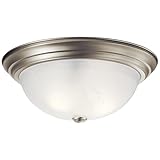
5. Best Selectable Color Temperature: Artika Horizon LED Flush Mount (B08SJ5KCHV)
Who it suits: Kitchens, laundry rooms, hallways, and entryways in apartments and condos that want a slim brand-name panel, the ability to choose a color temperature once at installation, and dimming on an ordinary LED wall dimmer — without paying designer or smart-fixture money for a utility ceiling.
Artika is the big-box lighting brand sold through Costco and Home Depot, and the Horizon is its representative slim panel: a 24-watt integrated LED fixture claiming 1,800 lumens — a manufacturer figure, and a modest one next to the smart discs here, best read as “right for a kitchen, hallway, or small-to-medium room” rather than a living-room centerpiece. Its defining feature is selectable white: a switch on the fixture chooses 3000K, 4000K, or 5000K at installation. A wrong first guess is a ladder trip rather than a return. That combination — selectable CCT plus wall dimming plus a brand with retail stores behind it — is rarer than it should be, and it is why the Horizon earns a place in this guide despite sitting in a much lower tier than the cap.
The honest limitations are about expectations. The documentation even disagrees with itself on warranty: Amazon’s listing describes a five-year limited warranty while the printed manual in Artika’s documentation says three years, so confirm the live listing’s terms before relying on either number. And as with the other picks in this guide, judge it by its live listing: check the current price on Amazon, expect a big-box, value-tier position far below this budget, and if Amazon’s marketplace price looks inflated, this is one fixture you can comparison-shop at warehouse and home-improvement stores before paying it.
Pros: Selectable 3000K/4000K/5000K at install — one fixture that can change jobs between rooms and between apartments; dims on most LED wall dimmers, no app or remote required; a real retail brand with stores and support behind it; slim panel profile suits the lower ceilings common in apartments; normally positioned in a value tier far below this budget.
The honest limitation: The lowest claimed output in the guide at 1,800 lumens — a supporting-room fixture, not a living-room anchor; sealed design replaced whole at end of life; big-box materials and finish; and a warranty term its own documentation states inconsistently (five years on the listing, three in the manual), so verify on the live page.
Choose it if you want selectable color temperature and wall-dimmer control from a mainstream brand at a mainstream price, for a kitchen, hall, or laundry ceiling. Skip it if the room is large or formal, you want maximum brightness, or designer materials matter more than convenience.
6. Best Remote Dimming With Zero Rewiring: KIWIVIC 16″ Dimmable Ceiling Light with Remote (B0FQ59XD6K)
Who it suits: Renters whose permission covers swapping the fixture but not touching the switch — bedrooms and living rooms on a plain toggle in older buildings — and anyone who wants to dim the overhead light from the bed or sofa without an electrician, an app, or a smart-home ecosystem.
The KIWIVIC solves the most common rental problem in this category: dimming without a dimmer, in a home where adding a dimmer is not yours to decide. The 16-inch diameter is a step up from the usual 12-inch budget discs, spreading light more evenly in rooms up to roughly 200 square feet, and the thin profile keeps it viable on the 8-foot ceilings where the Kichler’s 6-inch dome feels heavy.
Why does a value-tier disc belong in this under-$300 guide at all? The trade-offs are stated plainly. The construction is plastic, as its price class dictates. For compact units where even a 16-inch disc is a statement, the Best Flush Mount Ceiling Light For Small Rooms Under $300 applies the same budget with a stricter depth limit.
Pros: Real dimming and color adjustment with zero rewiring and no switch change — the renter’s dimmer; 16-inch size suits medium and large rooms; claimed 3,600 lumens is strong output for a thin disc; remote control is ideal for bedrooms; low profile suits 8-foot ceilings, and the untouched wall switch makes move-out restoration simpler.
The honest limitation: Sealed LED appliance with a budget-brand support horizon; control depends on keeping the remote alive and findable; plastic construction; so check the current price on Amazon — the live listing is what counts.
Choose it if your permission stops at the fixture and you still want a dimmable ceiling light. Skip it if you want wall-dimmer control, smart-home integration (the Hue and Govee are the picks), or a serviceable bulb-based fixture.

Comparison Table
| Product | Size & light source | Color temperature | Dimming | Check |
|---|---|---|---|---|
| Philips Hue Infuse Medium | 15″ Ø × ~3.3″H; integrated LED, 2,350 lumens claimed at 4000K, metal body | 2000K–6500K tunable + full color | App / voice / Hue switch only — not for wall dimmers | Check on Amazon |
| WAC dweLED Vaughan 16″ | 16″ Ø × 3″H; integrated LED, 2,674 LED lumens / 1,904 delivered (maker’s spec sheet), CRI 90, aluminum | 3000K fixed | Yes — TRIAC / ELV wall dimmer, 100–10% | Check on Amazon |
| Govee Ceiling Light Pro | 15″ Ø disc; integrated LED, 4,300 lumens claimed | 2700K–6500K adjustable + RGBIC color | App / voice only — not for wall dimmers | Check on Amazon |
| Kichler 8110NI | 15.25″ Ø × 6″H; glass dome, 3 × E26 bulbs (not included) | Your choice of bulbs | Yes — with dimmable bulbs + LED-rated dimmer (per Kichler spec sheet) | Check on Amazon |
| Artika Horizon | Slim panel; integrated 24W LED, 1,800 lumens claimed | 3 selectable: 3000K / 4000K / 5000K | Yes — most LED wall dimmers | Check on Amazon |
| KIWIVIC 16″ with Remote | 16″ Ø thin disc; integrated 36W LED, 3,600 lumens claimed | 3000K–6500K via remote | Remote only — no wall dimmer needed or changed | Check on Amazon |
How to Choose a Flush Mount Ceiling Light for an Apartment Under $300
- Settle the permission before the product. Written landlord approval for the fixture swap — and clarity on whether the switch may be changed too — comes before any of the six picks above can be ranked. No permission, no install; that rule outranks every specification in this guide.
- Identify your switch, then shortlist. Wall dimmer already installed → Vaughan, Artika, or Kichler with dimmable bulbs. Plain switch, permission for the fixture only → KIWIVIC’s remote, or a smart pick. Plain switch and an app household → Hue or Govee. Never feed a smart fixture from a TRIAC dimmer, and never put a non-dimmable driver on a dimmer circuit.
- Match the spend to the lease length. Short lease: buy the value picks (Govee, KIWIVIC, Artika) and treat the fixture as portable. A near-budget fixture on a nine-month lease is a donation to your landlord unless you take it with you.
- Decide the light-source question with the exit in mind. Replaceable E26 bulbs (only the Kichler here) mean a dead light mid-lease is an inexpensive bulb, not a repeat install. Integrated LED means thinner profiles and features, but the fixture is replaced whole when its driver dies — so on sealed picks, warranty length is a real specification.
- Read lumen claims the way WAC’s spec sheet teaches. Source lumens are not delivered lumens; the Vaughan loses about 29 percent between the two columns, and every other fixture here loses a similar share silently. As a planning figure, aim for roughly 20 delivered lumens per square foot in living spaces — then judge the installed result inside the return window.
- Measure depth against your ceiling. On the 8-foot ceilings typical of apartments, the discs and the 3-inch Vaughan work anywhere; the Kichler’s 6-inch dome belongs over beds, tables, and room centers rather than door swings and hallways. Design-led units get their own treatment in the Best Flush Mount Ceiling Light For Modern Homes Under $300.
- Pick a color temperature strategy that survives a move. Fixed 3000K (Vaughan) is the safest single choice for living spaces. Bulb fixtures outsource the decision to an inexpensive bulb, the most flexible answer of all.
- Check CRI where color matters. Over a dining table, art wall, or vanity, prefer a published CRI of 90 (Vaughan) or fit the Kichler with 90+ CRI bulbs. The smart discs do not headline CRI figures; their color quality is a party trick, not a rendering spec.
- Read the material line literally. “Aluminum” in the Vaughan’s listing means a metal body — and its diffuser is still polycarbonate, as this guide states openly. On the discs, housing and diffuser are plastic no matter how metallic the photos look. Glass appears exactly once in this guide, on the Kichler.
- Check the current price on Amazon like a professional. Four of these six picks are sold on Amazon largely by third parties, and their prices drift. Judge each against its tier: the Vaughan only if it sits within this budget, the Kichler only in its usual lower tier, and the Artika and KIWIVIC only at value-tier positioning. If this budget turns out to be more than your lease justifies, the step-down apartment guide, the Best Flush Mount Ceiling Light For Apartments Under $200, covers the band where Amazon’s own shelf is deepest.
Common Buying Mistakes
- Swapping a hardwired fixture without written permission. The most expensive mistake in this guide has nothing to do with light: it is a deposit deduction or a lease violation over a fixture that was never yours to change. Ask first, in writing.
- Throwing away the landlord’s original fixture. The dome you remove is the deposit you get back. Box it, label it, keep its screws with it, and photograph the wiring before you disconnect anything — your future self, on moving day, is counting on it.
- Putting a smart light on a wall dimmer. The Hue and Govee want a plain switch at full power; running one through a TRIAC dimmer is the most common cause of flickering, buzzing, and “defective” smart-light returns — and in a rental you may not be allowed to fix the switch that causes it.
- Assuming $300 buys a designer fixture on Amazon. Mostly, it does not — the band’s designer fixtures (the WAC Chapeau and Kuzco Cruz, both upper-band fixtures) are sold through showrooms, and Kichler’s Ceiling Space LED sits above this budget entirely. On Amazon, this budget buys one smart fixture near the cap and excellent value-tier fixtures below it.
- Comparing fixtures by claimed lumens. A 4,300-lumen claim and a 2,674-lumen figure from different makers were not measured the same way — and the 2,674 comes with a delivered figure of 1,904 from the one maker honest enough to publish both. Use diameter, wattage class, and room size to shortlist.
- Paying a third-party markup without noticing. Designer and big-box fixtures on Amazon are often listed by showrooms at prices far above their normal band. If the Vaughan shows above this budget or the Kichler is positioned near the cap, you are looking at a markup, not its usual tier — wait, or buy the fixture through its normal channels.
- Forgetting the bulbs in the cost. The Kichler plus three quality dimmable LED bulbs is the real install cost — still excellent value, but compare it honestly against integrated fixtures whose light is built in.
- Spending near the cap on a short lease. A near-budget fixture makes sense when it will be unbolted and carried to the next apartment, or when the lease is long. Otherwise the value picks light the room just as honestly and the leftover budget furnishes something you own outright.
- Buying fixed 3000K for a room that wanted 2700K. The Vaughan’s one real inflexibility is its fixed color temperature. If your home is decorated warm and dim, either accept 3000K as a slightly cleaner white or choose a tunable or bulb-based pick.
- Ignoring the warranty gap. At this budget, warranty is a specification: five years (Vaughan, per WAC; the Artika’s own documents disagree between three and five) against two years (Hue) and one year (Kichler). On sealed fixtures that cannot be repaired, the warranty is the lifespan guarantee — and in a rental, it is also your protection against a mid-lease failure you would rather not re-install around.
Final Recommendation
For most permitted renters with a smart home, buy the Philips Hue Infuse Medium: it is the one fixture that genuinely earns its near-cap position on Amazon — check price on Amazon — with tunable white, full color, up-and-down light, and a metal body shallow enough for real apartment ceilings — keep it on a plain switch, budget for a Bridge if you want the full system, and take it with you when you go. If your unit’s wall already has a dimmer, the WAC dweLED Vaughan is the grown-up buy — aluminum, CRI 90, honestly published delivered lumens, and a five-year warranty — provided the live listing sits within this budget; check the current price on Amazon. Choose the Govee if you want most of the Hue’s tricks at a value-tier position — check price on Amazon — the Kichler if a long lease makes replaceable bulbs a principle rather than a preference, the Artika for selectable color temperature on a wall dimmer in a utility room, and the KIWIVIC when your permission covers the fixture but not the switch and a remote is the only dimmer your lease allows. Whichever you choose, the apartment ritual is the same: permission in writing, photographs before wires, the landlord’s dome in a labeled box — and a ceiling that can be handed back exactly as you found it.
FAQ
Can I legally replace the ceiling light in a rented apartment?
Only with your landlord’s permission, and you should get it in writing. Without it, use plug-in lighting instead: floor lamps, table lamps, and plug-in pendants need no one’s permission.
What do I do with the landlord’s original fixture?
Keep it, complete and labeled. Never discard, sell, or “upgrade away” a fixture that is not yours.
Why are there not six fixtures priced between $200 and $300 in this guide?
Because Amazon does not stock six recommendable ones. The band’s designer fixtures are sold mainly through lighting showrooms — the WAC Chapeau and Kuzco Cruz, both upper-band fixtures, could not be verified as orderable Amazon listings — and the one designer fixture readers most expect, Kichler’s Ceiling Space LED, sits above this budget. What Amazon does stock near the cap is the Philips Hue Infuse — check price on Amazon — plus excellent fixtures from the tiers below, which is what this guide honestly presents.
My apartment has a wall dimmer. Which of these can I use?
Three of the six: the Vaughan (TRIAC/ELV, 100–10%), the Artika (most LED dimmers), and the Kichler (with dimmable bulbs). If your dimmer controls the room you most want to upgrade and it cannot be changed, the Vaughan is the pick this guide was built around.
What is the difference between LED lumens and delivered lumens?
LED lumens measure the light the diodes produce at the source; delivered lumens measure what actually leaves the fixture after the diffuser and optics take their share. Most brands publish only a single, larger figure with no shared measurement standard behind it, which is why this guide treats all lumen numbers as rough size classes.
Is a near-budget ceiling light a sensible purchase on a one-year lease?
Only if you will take it with you. The Hue Infuse unbolts as cleanly as it installs, and across two or three apartments its cost per year becomes reasonable. If you would leave it behind, the honest rental math points at the value picks — the Govee in its value tier, check price on Amazon, or the KIWIVIC and Artika at their usual value-tier positioning — and at keeping the difference for furniture that is unambiguously yours.
How many lumens do I actually need from a ceiling light?
As a planning figure, about 20 delivered lumens per square foot for living rooms and bedrooms and 30–50 for kitchens and work areas — so a 150 sq ft bedroom wants roughly 3,000 lumens of total light from all sources. Treat fixture claims as approximate, discount them mentally toward delivered reality, and remember a ceiling light is rarely an apartment room’s only source; a lamp or two usually shares the job.
Do integrated LED ceiling lights really last 50,000 hours?
The diodes might; the driver electronics are the usual failure point, and in sealed fixtures they are not replaceable. Rated life still separates the field — the Vaughan’s 50,000 hours and five-year warranty against the Hue’s 25,000 hours and two years — but the only pick here whose light source is guaranteed replaceable forever is the bulb-based Kichler, which is why it anchors the long-lease end of this guide.