Where to buy
Check the latest price, availability and delivery on Amazon. Orders are placed on Amazon. We may earn a commission from qualifying purchases.
- Best for a long lease: joelsantiques 60 Inch Solid Pine Floating Shelf, 12 Inch Deep, 2 Inch Thick — Check on Amazon
- URBANDI Rustic Fireplace Mantel Shelf, 60 Inch — Check on Amazon
- LUPWNEKA Solid Oak Floating Shelf, 36 Inch, 12 Inch Deep — Check on Amazon
- WOPITMER Solid Oak Floating Shelf, 36 Inch, 10 Inch Deep — Check on Amazon
See 2 more Amazon options
- FLYJOE Solid Maple Floating Shelf, 24 Inch
- BANFFLOW Solid Pine Floating Shelf, 3 Inch Thick, 24 Inch
Read the full guide ↓
Disclosure: As an Amazon Associate, dailyhomedecorating.com earns from qualifying purchases. Links to Amazon on this page are affiliate links; they cost you nothing extra. Listing details such as price and availability change often, so check the current Amazon listing before you buy.
Here is the honest version of this guide, up front: for most renters, a $500 solid-wood floating shelf system is a bad purchase, and this article will spend as much time talking you out of it as into it. That is not a disclaimer to get out of the way — it is the actual finding. Every shelf in this guide is real, verified, genuinely good furniture-grade wood. Every one of them also has to be lagged into wall studs to work, which in a rental means a row of bolt holes in a wall you do not own, a patching and repainting job waiting at the end of your lease, and — for the 60-inch shelves that anchor this price tier — a five-foot board that does not fit in most cars, some elevators, or the turn of a narrow stairwell when moving day comes. A shelf you cannot take with you is not furniture. It is a gift to your landlord, purchased with your deposit at risk.
There are exceptions, and they are real. If you are on a lease of three years or more, if your landlord has agreed in writing, or if you are renting a house you expect to stay in through several renewals, the calculus changes and some of these shelves become defensible — even smart. This guide is organized around that line. It takes the six best verified solid-wood floating shelves under $500 — the same six our research confirmed for Best Floating Shelves Under $500 — and re-sorts them by the only questions that matter in a rental: How many holes does it put in the wall? Can it come down cleanly? Can it physically leave the building with you? And is what remains after the exit costs still worth it?
One fact from the underlying research matters before any of that. We went looking for a single $500 floating shelf on Amazon and could not verify one exists: the most expensive single shelf we could confirm was a handmade 60-inch solid pine shelf sitting at the top of this tier, and nothing above it could be confirmed from a dated source — check the current price on Amazon for each pick below. So $500 in this category was never a one-shelf budget even for homeowners — it is a system budget, two or three shelves plus installation. For a renter, that framing doubles in importance, because a system means two or three installations, two or three sets of stud holes, and two or three removal jobs. The sections below do that math openly, shelf by shelf and hole by hole, and the final recommendation is split by lease length — because in a rental, your lease term is the budget that actually matters.
Quick Picks
Short on time? Each row names a renter situation and the shelf that survives it, with a link to the listing. Read the reviews before ordering — the exit costs are part of the pick.
| Renter situation | Pick | Why it stands out | Link |
|---|---|---|---|
| Long lease (3+ years), landlord agreed in writing | joelsantiques 60 Inch Solid Pine Floating Shelf, 12 Inch Deep | The largest verified shelf on Amazon — worth its holes only if you will live with it for years | Check on Amazon |
| Long lease with a fireplace (or a landlord who loves it) | URBANDI Rustic Fireplace Mantel Shelf, 60 Inch | A handcrafted beam-look mantel — check price on Amazon, and negotiate it as a fixture the landlord keeps | Check on Amazon |
| Two-to-three-year lease, real book load | LUPWNEKA Solid Oak Floating Shelf, 36 Inch, 12 Inch Deep | Solid oak a full 12 inches deep on two to three studs — serious shelf, moderate hole count | Check on Amazon |
| Best value that can move with you | WOPITMER Solid Oak Floating Shelf, 36 Inch, 10 Inch Deep | Verified solid oak at the lowest price point in this guide; 36 inches fits a car, a hallway and the next apartment | Check on Amazon |
| Short lease, one strong small shelf | FLYJOE Solid Maple Floating Shelf, 24 Inch | The stiffest shelf wood in a 24-inch span: fewest holes, easiest exit, fits anywhere next | Check on Amazon |
| The beam look, honestly rated, portable size | BANFFLOW Solid Pine Floating Shelf, 3 Inch Thick, 24 Inch | Load rating stated per stud (35 lb), and a pair still leaves budget for your patching fund | Check on Amazon |
How These Picks Were Chosen
The starting point was verification, not enthusiasm. Each shelf below has a real Amazon listing identified by ASIN, verified against dated, independent sources during research — the same standard that produced a short list of six across this whole price tier, because several well-known solid-wood shelves had genuine listings we could not fully verify, and we do not recommend products we cannot stand behind. That research also established the tier’s shape: one handmade shelf at the very top of the band, with the upper reaches of the tier empty of confirmable single-shelf offers. Custom workshops do sell walnut and white oak shelves at premium prices, through their own sites with four-to-six-week lead times — which, for a renter, is doubly irrelevant, since a made-to-order shelf fitted to a wall you will leave is the worst version of this purchase.
On top of that verified list, this apartment guide applied three renter filters that a homeowner guide has no reason to use. The first is hole count: every rating these makers publish assumes the bracket is fixed into studs, so the real question is how many lag holes a given shelf needs — a 60-inch bracket crossing three or four studs typically means six to eight holes through the drywall, while a 24-inch shelf on two studs can mean four. The second filter is reversibility: whether the shelf comes down leaving only fillable holes, or whether its size and mounting make removal a handyman job. The third is portability, the filter renters most often forget until the truck is loaded: a shelf’s length against your car’s cargo space, your building’s elevator, and the turn radius of your stairwell. A shelf that fails the third filter has a hidden cost — you will either pay to move it, pay to store it, or leave it behind and lose the entire purchase.
We did not mount these shelves in a test apartment. We read the maker listings and specifications, compared dimensions, materials, bracket systems and published load figures, and cross-checked listing details against dated sources. Load ratings throughout are maker or seller claims, labeled as such in every review, and they all carry the same condition: they describe a bracket lagged into studs. There is no stud-free version of any shelf in this guide, and any version of this purchase that avoids studs to keep a landlord happy is a version that ends with the shelf on the floor. If your lease forbids drilling entirely, the honest recommendation is in the alternatives section near the end — and it is not a shelf in this article.
The Renter’s Math: Holes, Patching and the Exit Bill
Homeowner guides price a shelf at its listing price. Renters should price it at listing price plus installation plus exit, because the exit is not optional and it is not free. Run the numbers on the flagship combination of this tier — the 60-inch pine shelf paired with the 60-inch mantel, the two of them filling this tier’s budget together — and the renter’s version looks like this. Installation: a stud finder and a long level if you do it yourself, or one to two hours of a handyman if you do not, because a five-foot bracket has to be plumb across three or four studs and it is a two-person lift. Occupancy: two walls of your home carry lag-bolted brackets for the duration of the lease. Exit: both shelves come down, leaving roughly a dozen to sixteen lag holes between them, each one wider than a picture-hook hole and each one needing fill, sanding, and paint that matches a wall color you did not choose — plus, in many leases, a repaint of the full wall if the touch-up shows. Add a handyman for the removal and patching if you are not confident doing it invisibly, and the true cost of the system lands noticeably above the shelves’ own prices across the lease, with your deposit exposed the whole time if any step goes wrong.
Now run the same math on the smallest pick in this guide. The 24-inch maple shelf fixes into two studs — typically four holes — comes down in ten minutes, patches with a fingertip of filler and a dab of paint, and rides to your next apartment in the trunk of any car, where it will fit the nursery, the desk wall or the kitchen corner of wherever you land. Its all-in renter cost stays very close to its listing price. That asymmetry — the big shelves carry $100–$250 of hidden tenancy costs, the small ones carry almost none — is the single most important fact in this guide, and it is why the rankings here are sorted by lease length rather than by shelf quality. The shelves are all good. The tenancies are what differ.
Two more line items belong in the math before any purchase. The first is permission: most leases allow picture hooks and small nails while saying nothing friendly about lag bolts into studs, and the difference between “small holes” and “structural fixings” is exactly where deposit disputes live. Written permission — an email from your landlord or property manager naming the shelf and the wall — converts this whole category from a gamble into a project, and it costs nothing to ask for. The second is the leave-behind negotiation, which experienced long-lease renters use constantly: a quality shelf, professionally left in place, is an improvement many landlords are happy to accept in lieu of patching, and some will split the cost or credit the rent if you propose it before installing rather than after. A handmade shelf you negotiate away is a better outcome than the same shelf abandoned in a panic on moving day — but only if the conversation happens first.
The 6 Best Floating Shelves for Apartments Under $500
joelsantiques 60 Inch Solid Pine Floating Shelf, 12 Inch Deep, 2 Inch Thick
Who it suits: A renter on a long lease — three years minimum, realistically — in a house or large apartment, with written permission, a long wall that needs a real working shelf, and a plan for what happens to five feet of pine when the lease ends.
The shelf itself is the strongest single piece in this category: 60 inches of solid Wisconsin pine, a full 12 inches deep and 2 inches thick, made in the USA with a patented heavy-duty hidden bracket in US steel — check the current price on Amazon; it sits at the top of this tier, the highest-priced single shelf we could verify. The depth is what justifies it in any home: dinner plates, pantry jars, hardcovers with room behind them, the loads that make 6-inch ledges look decorative. Its maker also publishes the most honest capacity information in the category, a tiered table by shelf length — 30 lb for 18-to-30-inch shelves, 45 lb at 36 to 54 inches, and 50 lb for the 60-to-72-inch band — figures that assume, as all of them do, a bracket lagged into studs. In a rental, those studs are the story: at 60 inches the bracket crosses three or four of them, which is excellent for strength and means roughly six to eight lag holes in your landlord’s wall, spread across five feet that will all need invisible repair on the same day.
Then there is the exit, which is where this shelf must be judged. Sixty inches of 2-inch-thick pine does not go in a hatchback. It may not turn the corner in a walk-up stairwell — measure yours before you order, not after — and in an elevator building it is fine only if the cab is deep enough diagonally. If it cannot leave with you, its real cost is the shelf itself plus installation plus removal, spread across the years you lived with it, and that arithmetic only works across a long tenancy. The negotiation route genuinely suits this shelf, though: it is handsome, handmade and furniture-grade, exactly the kind of fixture a landlord may agree to keep — ideally agreed before the first hole is drilled, with the shelf’s value acknowledged in writing.
- The largest verified single floating shelf on Amazon: 60 x 12 x 2 inches of solid pine, made in the USA.
- Maker publishes a tiered capacity table by length — 50 lb for the 60 to 72 inch band, into studs.
- Twelve inches of depth does real work: pantry rows, plates, appliances, full-size books.
Honest limitation: It needs six to eight lag holes across five feet of rented wall, two people to install and remove, and a vehicle and building geometry that can physically move a 60-inch board — on a short lease it is the worst purchase in this guide despite being the best shelf.
Choose it if your lease is long, your permission is written, and you have either a moving plan for a five-foot board or a landlord happy to keep it. Skip it if any of those three conditions fails — the oak shelves below deliver most of the function at a fraction of the tenancy risk.
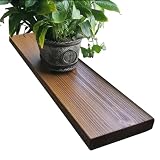
URBANDI Rustic Fireplace Mantel Shelf, 60 Inch (Brown, 60L x 6H x 8D)
Who it suits: A long-lease renter whose apartment or rental house actually has a fireplace — and who has had the fixture conversation with the landlord before falling for the beam look.
Urbandi handcrafts this mantel in Cincinnati, Ohio: 60 inches long, 8 inches deep, with a 6-inch-tall face that gives a room the beam-scale focal point styling photos promise — check the current price on Amazon. It hangs on a hanger-board cleat, the cabinet-shop method, and the maker capacity cited in roundups is 75 lb. Paired with the pine shelf above, it forms the flagship system of this tier. For a renter, though, this is the most landlord-shaped purchase in the guide. Most rentals with fireplaces have leases that care intensely about the fireplace: many prohibit using it, some prohibit altering anything around it, and every one of them will notice a beam-scale mantel at inspection. There is also a safety dimension with no renter workaround — combustible shelves above a working firebox have minimum clearance distances set by local code and the fireplace manufacturer, commonly around a foot or more depending on depth, and “the listing photo hung it lower” is not a defense.
The construction note cuts both ways for renters. The mantel is a hollow box built from pine boards, not a solid beam — the maker says so openly — which makes it lighter to hang and to carry than it looks, and entirely adequate for mantel loads: frames, greenery, stockings, candles. It is not a bookcase and not a step. Its best renter framing is as a negotiated fixture: landlords who would refuse a tenant’s shelf often accept a quality mantel as a permanent improvement to a room that probably needed one, and a mantel the landlord splits or credits is a very different purchase from one simply abandoned. If your rental has no fireplace, the same piece works as a statement ledge over a sofa or sideboard — but then it competes with the pine shelf above on the same wall math, and the pine shelf holds more.
- Handcrafted in Cincinnati, Ohio, with a true beam-scale profile: 60 inches long, 6-inch face, 8 inches deep.
- Hollow pine-box construction — lighter to install, remove and carry than a solid beam of this size.
- Maker capacity cited at 75 lb; hangs on a cabinet-style hanger board.
Honest limitation: It is five feet long, fixed with a cleat that screws across studs, attached to the one feature of a rental — the fireplace — that leases regulate most closely; without written permission and code-compliant clearance, it should not be installed at all.
Choose it if you have a fireplace, a long lease, written permission, and ideally a landlord who will keep or co-fund it. Skip it if your lease restricts fireplace alterations, your firebox clearances leave no legal mounting height, or your tenancy is short.

LUPWNEKA Solid Oak Floating Shelf, 36 Inch, 12 Inch Deep
Who it suits: A renter on a two-to-three-year lease who needs one shelf to do a real job — a full row of hardcovers, storage bins that actually fit, a coffee station — and wants the hole count of a mid-size shelf rather than a five-foot installation.
This is solid oak a full 12 inches deep and 36 inches long, on a screw-mounted metal support bracket — check price on Amazon. The depth is the point: most floating shelves are display ledges of 6 to 8 inches, while 12 inches swallows two rows of paperbacks, one row of hardcovers with prints behind, or the bins and machines of a working kitchen wall. Oak earns its place under those loads — its stiffness runs well ahead of pine’s, so a loaded 36-inch span stays honest over years — and at 36 inches the bracket crosses two to three studs, which typically means four to six holes: half the wall damage of the 60-inch picks, for a shelf that does most of what they do in a smaller apartment. It is also, at three feet, a movable object: it fits in a car, turns stairwell corners, and will find a wall in your next home.
The cautions are real ones. The listing data we reviewed publishes no headline load rating, so loads have to be planned from construction — heavy items against the wall, a full-depth row of hardcovers as the ceiling — and depth is a lever: a loaded 12-inch shelf torques its bracket harder than the same weight at 8 inches, so the stud fixings, not the oak, set the limit. LUPWNEKA is also a marketplace brand rather than a workshop, so grain and finish vary more between boards; if you plan a matched pair, order both at once and compare them before drilling. For renters, that variability has a practical edge — photograph your shelf against your wall at install, so a damage claim at checkout can be met with evidence of the wall’s prior state.
- Solid oak a full 12 inches deep — the deepest verified hardwood shelf in this guide.
- Thirty-six inches crosses two to three studs: a moderate, patchable hole count.
- Three feet long is genuinely portable — car, stairwell and next apartment all work.
Honest limitation: No published load rating in the listing data reviewed, and the 12-inch depth multiplies bracket torque — it still needs studs, and drywall-only mounting at book loads is not an option at any lease length.
Choose it if you need one serious working shelf on a medium lease and want hardwood that moves with you. Skip it if your wall offers no stud where the shelf must go, or your lease is under a year — the smaller picks below exit cheaper.

WOPITMER Solid Oak Floating Shelf, 36 Inch, 10 Inch Deep
Who it suits: The value-minded renter: someone who wants verified solid oak, at the standard depth, at the lowest confirmable price — and who is buying a shelf they fully intend to unscrew and take along.
This was the lowest-priced verified shelf we found whose listing copy itself confirms solid oak — check the current price on Amazon: 36 inches long, 10 inches deep, on a steel bracket mount. Ten inches is the category’s honest middle — a row of hardcovers, a real plant pot, dinnerware — without the bracket torque of the 12-inch shelf above. As tenancy math, it is the friendliest of the larger picks: two-to-three-stud mounting, a board one person can carry under one arm, and dimensions that fit virtually any next apartment. The system play works for renters too, in miniature: a homeowner might pair two of these with the Urbandi mantel, but the renter’s version is one or two of these alone, building a matched oak run you can dismantle in an afternoon and rebuild in the next place, which is precisely the flexibility this tier usually lacks.
Its limitation is a silence: WOPITMER publishes no weight-capacity figure, in the listing copy we reviewed or in the independent roundup that rated it highly. Oak’s stiffness at a 36-inch span is well understood and the engineering estimates are comfortable for book loads, but there is no maker number to plan from, so plan from construction instead — books and kitchen gear yes, cast iron and stoneware no — and note that the listing’s own guidance points it at sturdy, studded walls. In a rental that guidance is a lease clause wearing work clothes: no studs, no shelf, and no, the toggle-bolt workaround does not make a loaded oak shelf a deposit-safe idea.
- Verified solid oak — the lowest-priced confirmable oak shelf in this guide; check price on Amazon.
- The 10-inch depth suits books, plants and kitchen gear without deep-shelf torque.
- Thirty-six inches and one-person weight: the most movable of the full-size picks.
Honest limitation: The seller publishes no load rating at all, so heavy loads are planned from the wood and bracket rather than a figure — and the listing itself directs it at studded walls only.
Choose it if you want real oak that will follow you through several apartments. Skip it if you need a published capacity number to plan a heavy load, or your target wall has no studs in reach.

FLYJOE Solid Maple Floating Shelf, 24 Inch
Who it suits: The short-lease renter who still wants one genuinely excellent shelf — over a desk, in a rental nursery, in a kitchen corner — and wants the smallest possible footprint on the wall and the easiest possible exit.
Maple is the engineer’s shelf wood: hard maple posts the highest stiffness figures of any common shelf species and a hard, dent-resistant surface, which is why it ends up in butcher blocks. This shelf is solid, USA-sourced maple in a glued-lumber construction, 24 inches long — check price on Amazon. The seller rates it at 100 lb per shelf — the most aggressive claim in this guide relative to size, and it should be read as a seller’s claim, not a test result; the bracket and its fixings will always give up before maple does. What matters for a renter is the geometry: at 24 inches the bracket fixes into two studs, typically four lag holes total, the shelf comes down in minutes, the patching is a fingertip job, and the board itself fits in any car, any elevator, and any future room. Of the six picks here, this is the only one whose tenancy cost is effectively zero.
The trade-off is stated plainly: for a 24-inch shelf, this is the least shelf length for the money in the guide, and a 24-inch span barely tests any solid wood, so you are paying a premium for stiffness you structurally do not need at this length. The renter’s defense is that you are not buying span — you are buying a small, over-built, permanent piece of kit that will serve in five successive apartments, over changing tables and desks and coffee corners, without ever becoming a moving-day problem. Judged as a per-inch purchase it loses; judged as a per-lease purchase, across three or four tenancies, it may be the cheapest shelf in this article.
- Solid USA-sourced hard maple — the stiffest, hardest common shelf wood — in a 24-inch span.
- Two studs, roughly four holes: the smallest wall footprint and the cheapest exit in this guide.
- Seller-rated at 100 lb per shelf; treat as a claim and let the bracket and studs set the real limit.
Honest limitation: The most expensive pick here per inch of shelf, and its headline rating is a seller figure no board can cash if the bracket is not in studs.
Choose it if your lease is short, your walls must stay nearly pristine, and you want one small shelf to keep for years of moves. Skip it if you need wall coverage — the oak picks give far more shelf for the money.

BANFFLOW Solid Pine Floating Shelf, 3 Inch Thick, 24 Inch
Who it suits: A renter who loves the chunky beam profile — over a desk, flanking a fireplace, in a bathroom — and wants it in a size that patches cheaply and travels easily, with a pair priced to leave money in the moving fund.
Almost every shelf in this category is an inch or so thick; this one is a full 3 inches of solid pine, 24 inches long and 8 inches deep, in a dark walnut stain — check price on Amazon. Thickness is structural, not just visual: bending stiffness scales with the cube of thickness, so this short pine board stays flatter under load than thin hardwood shelves manage. Better still for a renter planning around real numbers, BANFFLOW states its rating the honest way — 35 lb per stud, 70 lb with the bracket fixed into two studs — which tells you the truth about every floating shelf: the rating lives in the wall fixings. Two of these, flanking a fireplace or stacked over a desk, still leave more than half of this tier’s budget unspent — which, in the renter’s math, is not leftover money but your patching, paint and handyman reserve, already funded.
The species honesty note matters: the finish is a walnut-toned stain on pine, not walnut wood, and pine is soft — it will dent under the daily knocks of an entryway or kitchen in a way oak and maple will not, whatever the color suggests. The 3-inch profile is also bulky in a small rental bathroom or a low-ceilinged room, where it can read as a beam that fell off a barn. And like the maple pick above, it is a short shelf: the thickness buys stiffness a 24-inch span only partly needs, so the purchase is the look plus the category’s most honestly stated rating, in the category’s most portable size class. For a renter, that combination is more sensible than it first appears.
- A full 3 inches thick — cube-law stiffness keeps this pine shelf flat under load.
- The most honest rating in the guide: 35 lb per stud, 70 lb across two studs, per the seller.
- A pair leaves most of the tier budget unspent — the beam look in two spots, with the exit fund left intact.
Honest limitation: It is pine under a walnut-colored stain and dents like pine; the chunky profile overwhelms small rooms, and at 24 inches it is a short shelf bought for looks and rating honesty, not coverage.
Choose it if you want the beam look on a short or medium lease, in a size that leaves four holes and fits in the car. Skip it if the shelf will take hard daily knocks — oak’s or maple’s harder surface earns its premium there.

Comparison Table
| Product | Size and material | Maker load claim | Renter reality | Link |
|---|---|---|---|---|
| joelsantiques 60 Inch Floating Shelf | 60 x 12 x 2 in, solid Wisconsin pine | Tiered table: 50 lb at 60–72 in, into studs | 6–8 lag holes across 3–4 studs; 60 in may not fit your car or stairwell | Check on Amazon |
| URBANDI Rustic Mantel Shelf, 60 Inch | 60 x 8 in, 6 in face, hollow pine box | 75 lb (maker figure cited in roundups) | Cleat across studs; fireplace leases and fire clearances govern — negotiate as a fixture | Check on Amazon |
| LUPWNEKA Solid Oak Shelf, 36 Inch | 36 x 12 in, solid oak | None published in listing data reviewed | 4–6 holes across 2–3 studs; three feet moves in any car | Check on Amazon |
| WOPITMER Solid Oak Shelf, 36 Inch | 36 x 10 in, solid oak | None published by the seller | Same friendly footprint as above; the pair-and-move play of this tier | Check on Amazon |
| FLYJOE Solid Maple Shelf, 24 Inch | 24 in, solid USA maple, glued lumber | 100 lb per shelf (seller claim) | Roughly 4 holes, 2 studs; ten-minute removal, fits anywhere next | Check on Amazon |
| BANFFLOW Solid Pine Shelf, 24 Inch | 24 x 8 x 3 in, solid pine, walnut stain | 35 lb per stud; 70 lb on two studs | Small footprint, honest rating; a pair keeps your patching fund whole | Check on Amazon |
How to Choose a Floating Shelf for a Rented Apartment
- Start with your lease term, not your wall. Under two years remaining: only the 24-inch picks in this guide are defensible, and even they need permission. Two to three years: the 36-inch oak shelves enter the picture. Three years or more, or a house rental you expect to renew: the 60-inch system becomes a real conversation. Any guide that skips this question is writing for homeowners.
- Get permission in writing before you buy anything. An email naming the shelf, the wall and the stud mounting, with your landlord’s yes in reply, is the difference between an improvement and a deposit dispute. If the answer is no, stop — the alternatives section below is your guide now, and no shelf in this article is worth a lease violation.
- Count holes, not inches. A 60-inch bracket across three or four studs means roughly six to eight lag holes; a 36-inch shelf, four to six; a 24-inch shelf, about four. Multiply by the number of shelves in your “system” and you have your move-out workload. That number, not the listing price, is the renter’s real budget line.
- Price the exit before the entrance. Filler, sandpaper, a paint match (or a full-wall repaint if your lease demands it), and possibly a handyman hour at each end. On the big shelves this runs $100–$250 across a tenancy; on the small ones, nearly nothing. If the all-in number shocks you, the shelf is too big for your lease.
- Measure the escape route. Car cargo length, elevator cab diagonal, stairwell turn. A 60-inch shelf that cannot leave the building is not a purchase, it is a donation — unless the landlord has agreed in advance to keep it, ideally with the value acknowledged.
- Open the leave-behind negotiation early. Landlords routinely accept quality fixtures in place of restoration, and some split costs for improvements that raise the unit’s appeal. The handmade pine shelf and the mantel in this guide are exactly the kind of pieces this works for — but only when proposed before installation, never pleaded after.
- Photograph everything. Walls before drilling, stud locations, the install, and the patched result at exit. Deposit disputes are evidence contests, and the tenant with dated photos usually wins them.
- Never trade studs for stealth. Every rating in this guide assumes lag fixings into studs. Mounting a loaded shelf on drywall anchors to avoid “real” holes replaces six patchable holes with one torn-out crater and a falling shelf — the single most deposit-destructive outcome available.
- Check the configuration and the live price. Every pick here is sold in other sizes and finishes at other prices; the verified figures in this guide belong to the exact configurations named. Confirm size, finish and current price on the listing before ordering.
If the Honest Answer Is No: Routes That Keep the Deposit Safe
For a large share of renters — short lease, strict lease, no written permission, or a building where a five-foot board simply cannot be moved — the correct conclusion from this research is not to buy a cheaper shelf. It is to change the storage, not the wall. A freestanding bookcase or étagère delivers the same cubic storage as the 60-inch system, costs less than the flagship pair, requires no permission, and leaves in the truck as ordinary furniture; the honest trade is a few square feet of floor space, which most apartments can spare more easily than deposit money. Ladder shelves and leaning desks split the difference, anchoring with a single small safety screw — a picture-hook-class hole most leases already tolerate — while carrying real loads on their own legs.
Two other routes deserve naming because renters rarely hear them. The first is to ask the landlord to buy the shelf: owners of long-term rentals regularly fund durable improvements a tenant proposes and installs, and a handmade shelf that stays with the unit is an easier yes than most requests a landlord receives. The second is to spend at a lower tier with portability as the spec — the 24-inch picks in this guide, or the smaller shelves surveyed in Best Floating Shelves For Apartments Under $300 — and bank the difference toward the home where a wall of oak is an asset instead of a liability. Readers furnishing a room they own, or nearly own, will find the same six shelves ranked by room rather than by tenancy in Best Floating Shelves For Bedrooms Under $500, Best Floating Shelves For Modern Homes Under $500 and Best Floating Shelves For Small Rooms Under $500.
Common Buying Mistakes
- Buying the homeowner version of this tier — the flagship two-shelf system — on a twelve-month lease, then discovering the exit costs more than the shelves saved.
- Drilling first and asking permission in the apology. Written consent obtained after installation is called a lease violation with photos.
- Assuming patching is trivial at five-foot scale. Sixteen lag holes across two walls, in a paint color you do not own, is a weekend and possibly a handyman — priced into none of the listings.
- Ordering a 60-inch shelf into a walk-up without measuring the stairwell turn, the elevator diagonal, or the car it will eventually need to leave in.
- Avoiding studs to “save the wall” and mounting on drywall anchors instead — converting small fillable holes into a torn-out section of wallboard when the loaded shelf lets go.
- Installing the mantel shelf over a fireplace the lease forbids you to alter, at a height chosen from a styling photo rather than from fire-clearance requirements.
- Leaving a quality shelf behind by default instead of negotiating it — landlords will often credit or accept a fixture that is agreed in advance and resented when it is simply abandoned.
- Believing the species in a title. Two picks in this guide are pine under walnut- or oak-toned finishes; the material line in the listing’s own copy is the truth, and it decides how the shelf dents in a busy rental.
- Skipping the before-photos. Without dated evidence of the wall’s original condition, every pre-existing mark becomes your mark at checkout.
- Spending the full $500 on shelves and nothing on the stud finder, level, filler and paint the tenancy actually requires.
Final Recommendation
- Lease under two years: FLYJOE Solid Maple or a BANFFLOW pair — four holes, a ten-minute exit, and shelves that will serve in your next three apartments.
- Lease of two to three years: WOPITMER Solid Oak — verified hardwood at the lowest price point in this guide, sized to move, priced to forgive.
- Real book loads on a medium lease: LUPWNEKA Solid Oak, 12 Inch Deep — the working shelf of this guide, on two to three studs.
- Long lease, written permission: joelsantiques 60 Inch plus the URBANDI Mantel — the flagship pairing of this tier, and worth it only across years.
- Fireplace rentals: the URBANDI Mantel, negotiated as a fixture the landlord keeps or co-funds.
- No permission, no studs, no time: none of the above — a freestanding bookcase, and keep the deposit.
Our top renter spend is deliberately the smallest one: the FLYJOE maple for short leases and the WOPITMER oak for medium ones, because in a rental the best shelf is the one whose total cost — holes, patching, moving, risk — stays closest to its price tag, and those two are the only picks here that manage it at $500-tier quality. The flagship pairing of the joelsantiques shelf and the Urbandi mantel remains a genuinely good purchase in exactly one tenancy: a long one, with permission in writing and an exit agreed in advance, where a flagship pairing of American-made solid wood gets years to earn its holes. If that sentence does not describe your lease, believe the math in this guide rather than the photographs in the listings — buy small, buy portable, or buy freestanding, and save the five-foot oak wall for the first home where the wall is yours.
Frequently Asked Questions
Will floating shelves cost me my security deposit?
They can, but the mechanism is usually not the holes themselves — it is the absence of permission and a patch job that does not match. A handful of filled, sanded, paint-matched lag holes, installed with written consent and photographed before and after, is a defensible move-out condition in most tenancies. A dozen unconsented holes, a shelf torn out of drywall, or an unpatched cleat line across a living room wall is where deposits actually die. The shelves in this guide range from about four holes (the 24-inch picks) to six or eight per shelf (the 60-inch picks) — count yours before you drill, and get the yes in writing.
Can I install these shelves without drilling into studs?
No — not honestly. Every load figure in this guide, from the maker’s tiered 50 lb table to the seller’s 100 lb claim, assumes the bracket is lagged into studs. Toggle bolts can hold a short shelf with light decor, but a loaded 36-inch oak shelf or any 60-inch shelf on drywall anchors is a falling hazard and a wall-destroying one; the crater a failed anchor tears out costs far more deposit than the stud holes you were avoiding. If studs or permission are unavailable, the freestanding route in this guide is the right purchase.
How much does it cost to remove shelves and repair the wall when I move?
For the small picks, nearly nothing: a tube of filler, a sanding sponge and a sample pot of matched paint handle four holes in under an hour of your own time. At system scale — two 60-inch shelves, roughly a dozen to sixteen lag holes — budget a full afternoon of careful work or one to two hours of a handyman, plus paint; if your lease requires whole-wall repainting where touch-ups show, that is the largest single exit cost and worth confirming with your landlord before you install, not after. Across a tenancy, plan on the big shelves carrying $100–$250 of installation and exit cost beyond their prices.
What if my landlord says no?
Then the answer is no, and this guide’s alternatives section is the shopping list: freestanding bookcases and étagères for storage, ladder shelves with a single safety fixing where the lease tolerates small holes, or an offer for the landlord to purchase a shelf as a unit improvement with you installing it. What not to do is install anyway and patch quietly — property managers inspect with the lease in hand, and an unconsented stud-mounted system is among the easiest deductions to justify.
Can I take a 60-inch shelf with me when I move?
Sometimes — and “sometimes” is doing heavy work. Five feet of board fits few car interiors (measure your cargo length with seats folded), turns some stairwells and not others, and fits elevator cabs only on a diagonal that may not clear the door. Professional movers will wrap and carry one for a fee, which is another exit cost to price in. If the shelf cannot leave, negotiate before installing: landlords frequently accept a quality handmade shelf in place of restoration, and that agreement converts a total loss into a clean exit.
Is a $500 shelf system ever right for a renter?
Yes — in a narrow, identifiable case: a lease of three years or more (or a rental house with expected renewals), written permission, walls with studs where the shelves belong, a building the boards can physically exit, and ideally a landlord who will keep or co-fund the fixtures. In that tenancy, the flagship pairing — the 60-inch pine shelf and the mantel together — delivers furniture-grade storage for years, at a cost spread across those years that beats replacing cheap shelves twice. Outside that case, the same money buys better outcomes in the 24- and 36-inch picks here, or in furniture that needs no holes at all.