Disclosure: As an Amazon Associate, dailyhomedecorating.com earns from qualifying purchases. Links to Amazon on this page are affiliate links; they cost you nothing extra. Prices and availability change often, so check the current Amazon listing before you buy.
Choosing the best fleece for tie blankets sounds like a small decision until you are standing in a fabric aisle facing forty bolts that all claim to be soft, in classes with names that mean nothing until you have tied, washed, and lived with the results. Fleece classes differ where tie blankets live: in how the cut fringe behaves, how the knots hold through fifty washes, how the surface looks in year three, and how the finished blanket feels against a sleeping child’s cheek versus a dorm couch. Anti-pill fleece keeps its looks. Blizzard fleece keeps your budget. Microfleece keeps babies comfortable. Plush and sherpa fleeces keep gift recipients gasping — and challenge your scissors. This guide ranks the classes for the craft specifically, with finished fleece blankets from our verified pool included as touch references so you can calibrate weight and softness before committing to yardage.
Read this alongside our fabric-first companion, Best Fabric For Tie Blankets, which covers the wider why-fleece argument and the non-fleece warnings; this guide goes deeper on the fleece family itself — the classes, the quality tells at the bolt, the weight and width arithmetic, and the class-by-class tying adjustments that experienced makers apply without thinking. If you have ever had a tie blanket pill into sadness or shed its knots in the wash, the answers are in the class choices below.
Where to Buy
Fleece yardage is sold by fabric and craft retailers, by the yard and often by pre-cut pieces. The finished reference blankets in this guide are sold on Amazon, where you can check current prices and verified weights. Start with the class benchmark, the Bedsure Fleece Bed Blanket — Check on Amazon. The other references: Bedsure GentleSoft Sherpa Fleece Throw Blanket — Check on Amazon; Bedsure Faux Fur Fluffy Fleece Sherpa Blanket — Check on Amazon; Exclusivo Mezcla Fleece Throw Blanket — Check on Amazon. The fleece-class picks are prose-only and described in their review blocks.
In this guide
Quick Picks
| Pick | Badge | Why it earns its place |
|---|---|---|
| Anti-Pill Fleece (prose-only) | Best Overall | The class that still looks new after years of washing — the keepsake standard. |
| Blizzard Fleece (prose-only) | Best Budget | Maximum blankets per dollar for groups, charities, and learning. |
| Microfleece (prose-only) | Best for Baby Blankets | Fine, light, drapey — ties small and neat for the smallest recipients. |
| Plush and Sherpa Fleece (prose-only) | Best Premium | Thick luxury classes for statement gifts, with longer-fringe technique. |
| Bedsure Fleece Bed Blankets Queen Size Grey | Best Reference for Standard Weight | What medium plush fleece should weigh and feel like, finished and washable. |
| Bedsure GentleSoft Sherpa Fleece Throw Blanket for Couch | Best Reference for Sherpa | The dual-texture target: flannel face weights and sherpa pile depth to compare bolts against. |
Key Takeaways
- Class is destiny: anti-pill for keepsakes, blizzard for volume, micro for babies, plush for drama.
- Judge bolts by recovery and density, not first softness — every fleece is soft in the store.
- Thicker classes need longer fringe and slower knots; thinner classes need a gentler hand.
- Print selection lives in blizzard and anti-pill; if the pattern matters most, start there.
- Buy both layers in the same class family unless you deliberately want a plush-smooth contrast.
How These Picks Were Chosen
We ranked fleece classes by tie-blanket outcomes over time: knot security through washing, surface appearance after repeated laundering, fringe behavior when cut, warmth and weight of the finished two-layer blanket, and print availability. The four finished blankets from the verified pool serve as references with real specifications — a standard-weight plush, a sherpa dual-texture, a deep faux fur, and a light brushed flannel — so readers can anchor the abstract classes to products they can actually handle or order. No specifications are invented for the prose-only classes; where numbers appear, they are the craft’s standard working ranges.
The 6 Best Best Fleece for Tie Blankets — Reviewed
Anti-Pill Fleece
Our badge: Best Overall
Anti-pill fleece earns the top rank on a single long-term fact: it is the class whose surface survives. Standard fleeces pill because their fibers migrate and tangle under friction; anti-pill constructions and treatments resist that migration, so a blanket washed fifty times still presents a smooth, soft face instead of a fuzzy, tired one. For tie blankets — which are washed constantly and given as keepsakes — that difference is the whole ballgame. The class also cuts the cleanest fringe and holds the most consistent knot tension across a whole perimeter.
Strengths
- Surface longevity no other standard class matches.
- Clean fringe, consistent knots, minimal shedding from day one.
- Strong print and solid selection in quality tiers.
Trade-offs
- Premium yardage tier, especially in licensed prints.
- Slightly firmer initial hand than ultra-plush classes.
- Quality varies by maker; the anti-pill label deserves a scrunch test.
The scrunch test: compress a handful of the bolt’s fabric hard for ten seconds, release, and look. Anti-pill quality springs back smooth; pretenders stay creased and fuzzy. Buy anti-pill for any blanket with a name and a date attached to it — births, weddings, graduations, memorials. Choose it as the default class. Skip it only when quantity outranks longevity.
Best for: Keepsake and gift blankets meant to last / Not suited for: Bulk charity production
Choose anti-pill for permanence; skip it for volume.
Blizzard Fleece
Our badge: Best Budget
Blizzard fleece is the people’s fleece: the class that fills craft-store walls, goes on sale constantly, and has produced more tie blankets than every other class combined. It ties easily, knots reliably, and feels genuinely good. Its surface will pill sooner than anti-pill under hard washing — a cosmetic aging, not a structural failure — and for blankets whose purpose is warmth and love delivered now, at scale, that trade is correct.
Strengths
- Unbeatable economics, especially during the sales cycles fabric stores run constantly.
- The largest print universe in fleece, from nursery to licensed sports.
- Forgiving to learn on: cheap mistakes, good results.
Trade-offs
- Earlier pilling under frequent washing.
- Bolt-to-bolt consistency varies; feel and compare.
- Occasional thin bolts in the class — density check matters.
Service groups standardize on blizzard for a reason, and a beginner’s first three blankets should be blizzard without apology. Inspect each bolt for even density — hold it to the light; thin patches show — and you will produce blankets indistinguishable from premium ones for their first year of life. Choose blizzard for learning and giving at scale. Skip it for the decade keepsake.
Best for: Beginners, classrooms, and donation drives / Not suited for: Heirloom-grade longevity
Choose blizzard for reach; skip it for the archive.
Microfleece
Our badge: Best for Baby Blankets
Microfleece’s fine, short pile and light body make it the specialist for small blankets. Two layers of standard fleece on a baby are a warm, bulky package; two layers of microfleece are a gentle one. Its fringe ties into small, neat knots at baby-blanket scale, the finished blanket drapes over a lap or stroller without overwhelming, and it dries in a flash — a real virtue in the laundry tempo of new parenthood.
Strengths
- Right weight and drape for baby and lap blankets.
- Neat, small-scale fringe and knots.
- Fastest washing and drying in the family.
Trade-offs
- Insufficient warmth for cold-climate adult blankets.
- Fringe tears if tied with standard-fleece force; gentle hands required.
- Smaller print selection, skewed pastel.
Tie microfleece with shorter fringe and lighter tension, and pair it with the softest solids you can find — babies experience blankets with their whole bodies and their mouths, so wash before gifting without exception and follow safe-sleep guidance (blankets for supervised, age-appropriate use). Choose microfleece for the nursery. Skip it for the cabin.
Best for: Baby blankets, strollers, and warm climates / Not suited for: Winter adult blankets
Choose micro for the small and gentle; skip it for deep warmth.
Plush and Sherpa Fleece
Our badge: Best Premium
Plush classes — including double-sided plush and sherpa-faced fleece — produce tie blankets with genuine luxury: thick, heavy, and warm enough to end arguments about the thermostat. They demand technique adjustments. Fringe must be cut longer to give bulky knots room; tying goes slower; scissors struggle where a rotary cutter glides. Sherpa’s pile also blurs fringe lines, so edges read soft rather than crisp — a look some makers love and others should know about in advance.
Strengths
- Maximum warmth and gift impact per blanket.
- Pile conceals minor cutting imperfections.
- Single-layer interest: a sherpa face against a smooth face needs no print at all.
Trade-offs
- Bulky knots and slower production.
- Heavy finished weight — adults only, and strong ones for bed sizes.
- Highest yardage cost in the family.
Make one plush blanket before committing to a plush wedding set; the class teaches its own lessons in the first corner. Choose plush for drama and deep cold. Skip it for speed, scale, and small sizes.
Best for: Premium gifts and cold climates / Not suited for: Beginners or bulk work
Choose plush for luxury; skip it for learning.

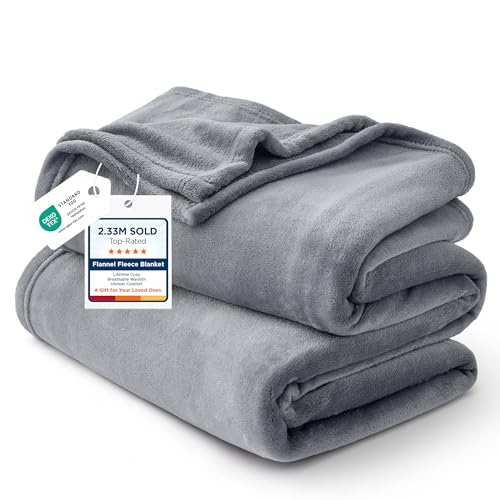
Bedsure Fleece Bed Blankets Queen Size Grey
Our badge: Best Reference for Standard Weight
The Bedsure Fleece Bed Blanket — queen, 3.19 pounds, upgraded flannel fleece finished against fading and shedding — is the standard-weight reference: divide its feel by its layers and you know what a two-layer tie blanket in quality standard fleece becomes. Makers ordering yardage online use finished blankets like this as their only reliable specification, because fleece classes are otherwise described in adjectives.
Strengths
- Verified weight and finish to anchor yardage decisions.
- Demonstrates anti-pill-class surface behavior across washes.
- Itself a perfectly good blanket if the project timeline collapses.
Trade-offs
- A reference product, not a fabric source.
- Single color; no print guidance.
- Queen scale exceeds most tie projects.
| Color | Grey |
| Size | Queen (90″ X 90″) |
| Weight | 3.19 pounds |
Use it as the wash-test control and the hand-feel target, and keep it as the household’s spare when the handmade one is in the laundry. Choose it to calibrate standard classes. Skip it if you shop yardage in person with confidence.
Best for: Calibrating anti-pill and blizzard purchases / Not suited for: Sourcing fabric itself
Choose it as the benchmark; skip it if your hands are trained. Check on Amazon

Bedsure GentleSoft Sherpa Fleece Throw Blanket for Couch
Our badge: Best Reference for Sherpa
The Bedsure GentleSoft Sherpa Fleece Throw Blanket for Couch — 220 GSM flannel over 260 GSM sherpa — is the sherpa-class reference: its two faces show exactly the contrast a plush tie blanket aims for, and its GSM figures give shoppers rare, concrete numbers to compare against bolt descriptions. At 50 by 60 inches it also models the classic throw footprint.
Strengths
- Dual-texture target with stated fabric weights.
- Shows sherpa pile depth that ties well versus pile that overwhelms.
- Award-recognized fleece quality in finished form.
Trade-offs
- Reference only; the craft still needs yardage.
- Sherpa class is the slowest to tie — the reference cannot teach that, only experience can.
- Warmth level exceeds many recipients’ needs.
| Color | 01 – Grey |
| Size | Throw (50″ X 60″) |
| Weight | 2.03 pounds |
Compare sherpa bolts against this blanket’s pile: similar depth ties beautifully; deeper piles need the long-fringe treatment from the plush review above. Choose it as the plush benchmark. Skip it if your project is microfleece-scale.
Best for: Calibrating plush and sherpa yardage / Not suited for: Lightweight project benchmarking
Choose it for the plush target; skip it for baby projects. Check on Amazon
Comparison Table
| Pick | Class | Surface Longevity | Best Project | Check price on Amazon |
|---|---|---|---|---|
| Anti-Pill Fleece (prose-only) | Premium standard | Excellent | Keepsakes | Check price on Amazon |
| Blizzard Fleece (prose-only) | Standard | Good | Volume, learning | Check price on Amazon |
| Microfleece (prose-only) | Light | Good | Baby blankets | Check price on Amazon |
| Plush and Sherpa Fleece (prose-only) | Plush | Very good | Statement gifts | Check price on Amazon |
| Bedsure Fleece Bed Blankets Queen Size Grey | Reference | Maker-rated anti-fade/shed | Calibration | Check price on Amazon |
| Bedsure GentleSoft Sherpa Fleece Throw Blanket for Couch | Reference | Durable dual-face | Calibration | Check price on Amazon |
How to Choose the Best Fleece for a Tie Blanket
Decide the Blanket’s Lifespan First
A blanket for a semester of dorm life and a blanket for a newborn’s whole childhood are different specifications. Lifespan picks the class: blizzard for seasons, anti-pill for years, plush for the dramatic decade. Buying down for a keepsake is the false economy this craft punishes most reliably.
Run the Bolt Tests
Scrunch for recovery. Stretch a corner gently for resistance without distortion. Hold the bolt to light for thin patches. Rub the surface briskly with a dark sleeve to preview shedding and pilling behavior. Feel both faces, because both will show. Five minutes of testing predicts five years of blanket.
Widths and Yardage, Done Properly
Fleece bolts come in craft-standard widths that cap your blanket’s width after fringe; throws are the natural product. For each layer, buy your finished length plus twice the fringe length plus trimming margin. Buy both layers at the same visit, check print scale against blanket size (giant prints need big blankets), and photograph bolt labels for reorder insurance.
Print With Solid, Texture With Texture
The reliable designs: print plus coordinating solid; smooth plus plush in tonal colors; two solids in a deliberate contrast. The unreliable ones: print plus print, and identical whites that are not identical. Fringe interleaves the layers every inch around the blanket — design for the edge, not just the field.
Class-Specific Tying Adjustments
Microfleece: shorter fringe, lighter knots. Standard classes: the classic four-to-five-inch fringe, snug double knots. Plush and sherpa: longer fringe, slower tying, rotary cutting. Write your class’s adjustments on the project card so a group project ties consistently from corner to corner.
Fleece Anatomy: Pile, Stretch, and the Direction Nobody Checks
Fleece is a knitted fabric with a brushed surface, and three of its properties decide every tie blanket made from it. First, pile direction: fleece has a nap that runs one way, and two layers cut with their naps opposed will look like different colors under room light and feel different under the hand. Run your palm down each cut before pinning; the smooth direction is with the nap, and both layers should agree. Second, stretch: fleece stretches more across its width than along its length, so the two layers must be oriented the same way or the blanket will twist gently forever, one layer always relaxing further than the other. Third, the brushed surface that makes fleece soft also makes it cling to itself, which is a gift during tying — the layers stay registered — and a nuisance in the wash, where fleece collects every loose fiber in the load. None of this is visible on the bolt, which is why experienced makers handle fleece with their palms as much as their eyes. The same handle-first discipline governs woven choices in Best Fabric For Blankets: fabric is a physical material with a grain and a temperament, and the makers who learn each type’s temperament stop being surprised by their finished blankets.
Anti-Pill, Microfleece, and Plush: Grading the Shelves
The fleece wall of a fabric store is really four products wearing one name. Standard fleece is the workhorse — mid-weight, warm, inexpensive, and prone to pilling across its first year of hard use. Anti-pill fleece is treated or constructed to resist exactly that, and for a blanket destined for weekly washing it is worth its modest premium many times over. Microfleece is the thin, smooth member of the family: it ties into a lighter, more drapey blanket that suits warm climates, lap use, and recipients who dislike bulk, though its knots are less forgiving of sloppy cutting because there is less material in each strip. Plush and minky-style fleeces are the luxury shelf — deep pile, dramatic softness, and a tendency to shed cut fibers across the workspace and to make fringe that looks lush and behaves a little wildly. None of these is the best fleece; each is the best fleece for a named blanket. A child’s workhorse blanket wants anti-pill standard weight; a grandmother’s lap blanket wants microfleece’s lightness, judged by the standards in Best Blankets For Elderly; a couch showpiece can carry plush. Grade the shelves by the blanket’s job description, written down before the shopping trip, and the wall of fleece becomes a shortlist.
How to Tie a Fleece Blanket That Survives Its Life
Layer wrong sides together on a flat surface, smooth from the center outward, and trim both layers into one true rectangle with selvages removed. Cut corner squares equal to fringe length. Cut fringe at even one-inch intervals with the sharpest tool you own. Tie double knots with metronome consistency — the blanket’s edge should look like a rhythm, not a narrative — and check tension every few knots against the first corner, which sets the standard. Stretch diagonally both ways to seat everything, inspect for any missed or single knots, and wash the blanket before it leaves your hands. For group projects, demonstrate one corner completely and let it travel with the blanket as the reference standard.
Problem: Pilling after a few washes — A class issue, mostly: blizzard ages this way under hard use. Wash inside-out on gentler cycles to slow it, and buy anti-pill for the next keepsake.
Problem: Fringe curls into tight rolls — Some fleece curls after cutting, especially when stretched during cutting. Cut without pulling the fabric, and let the first wash relax the fringe.
Problem: Knots feel lumpy and uneven — Inconsistent fringe width or tension. Template the cuts, tie against a finished reference corner, and slow down at the start rather than correcting at the end.
Problem: The blanket skews diagonally — Layers shifted during cutting. Pin or clip generously, trim after layering, and square against a table edge or cutting mat grid.
Cutting Fleece Cleanly: Tools, Marking, and the One-Session Rule
Fleece forgives many things but not a ragged cut. Its knitted structure means a dull blade does not slice so much as tear its way through, leaving each fringe strip with a chewed edge that knots into a lumpy, homemade-looking border. The professional setup is a rotary cutter, a self-healing mat, and a long ruler — fleece is the fabric rotary cutters were born for — or, failing that, genuinely sharp dressmaker’s shears used on a hard, flat surface. Mark before cutting: the corner squares first, then the fringe lines, with chalk or tape, because fleece’s slight stretch makes freehand lines wander. Cut both layers together, clipped against creep, and cut the entire perimeter in one session; fleece re-spread on another day never quite matches its first position, and mismatched fringe lengths along one edge are the signature of a two-session cut. Work the corners with special care — they are where the geometry concentrates, where beginners’ blankets pucker, and where a recipient’s eye lands first. Ten extra minutes of setup buys the difference between a blanket that looks made and one that looks attempted, and no tying skill downstream can fully repay a cutting debt.
Static, Pilling, and Other Fleece Behaviors to Plan Around
Three fleece behaviors surprise new makers, and all three are manageable once expected. Static is the famous one: polyester fleece builds charge in dry winter air, crackling off the couch and clinging to everything. It is a comfort nuisance rather than a defect, reduced by indoor humidity, by washing fleece separately from the cottons that donate lint to it, and by choosing anti-static finished fleeces where the problem is chronic. Pilling is the second: tiny fiber balls form where friction concentrates — the center of the blanket, the fringe roots — and while anti-pill constructions resist it, no fleece is immune across a decade. A fabric shaver restores appearance in minutes and belongs in the same drawer as the good scissors. The third behavior is heat sensitivity: fleece glazes under a hot iron and can scorch in an overheated dryer, emerging with a rough, papery hand that no washing reverses. Keep fleece away from irons entirely and dry it on low. Plan around these three and fleece’s reputation for cheapness dissolves; ignore them and even premium fleece will look tired within a year, through no fault of its own. A fourth behavior deserves a sentence of its own: fleece does not breathe like a natural fiber, so a fleece tie blanket is a cold-weather and air-conditioning tool, not a summer cover — recipients in warm climates are better served by the lighter fleece classes or by flannel pairings, and gift-makers shipping blankets south should weigh that climate honesty as heavily as the print. None of these behaviors is a reason to avoid fleece; they are the owner’s manual of the material, and a maker who has read it chooses classes, washes, and recipients with the confidence that separates the blankets people keep from the blankets people quietly re-gift. Keeping is the metric. A tie blanket’s success is not measured at the giving but at the hundredth wash, on somebody’s couch, with its fringe still even and its pile still soft — and every decision in this guide exists to buy exactly that outcome. Keep the standard in view while you shop and the fleece wall stops being a wall of sameness: it becomes a set of distinct tools, each labeled by its behavior, waiting for the maker who knows which job is theirs. Be that maker on your next project, and the blanket that comes off your table will carry the evidence in every even strip of its fringe. Evidence, in a handmade object, is just care made visible — and fleece, chosen well, makes care visible for a remarkably long time. That is the whole case for learning this one material properly, and it is a stronger case than its price tag would ever suggest. Learn it once, and every fleece decision after — blankets, garments, pet layers, charity kits — gets faster and better at the same time. Speed with judgment is the definition of craft, and fleece — humble, synthetic, everywhere — turns out to be an excellent place to acquire it. Acquire it, and the next bolt you unroll will feel less like a purchase and more like a plan — a plan with a recipient, a season, and a hundred washes already accounted for.
Fleece Classes for Special Recipients
For chemo and hospital blankets, softness and washability rule: anti-pill or microfleece in gentle colors, sized for a lap and a treatment chair, washed before giving, with fragrance-free care — comfort only, offered with love and no medical promises. For dorm blankets, blizzard in school colors survives the communal laundry and the floor. For grandparents, plush classes in manageable throw sizes give warmth without weightlifting, echoing the light-layer logic of our elderly blanket guidance. For pets and the blankets they will claim, blizzard again — the class whose price forgives. Matching class to recipient is the maker’s real skill; the tying is the easy part, which is precisely why this craft belongs to everyone.
Washing a Fleece Tie Blanket Without Ruining Its Softness
Fleece leaves the store at maximum softness and declines from there at a rate set mostly by laundry habits. The enemies are heat and company: hot water and high dryer heat glaze the brushed fibers into a rougher hand, while washing with towels and cotton loads the pile with lint that mats into it permanently. Wash fleece with its own kind — other fleeces and soft synthetics — in cool or warm water, turn plush blankets inside out, and dry on low until just dry rather than baking them crisp. Fabric softener is a false friend here; it coats the fibers, dulls the hand, and reduces the slight water resistance that helps fleece shed spills, so skip it and let the fabric’s own texture do the work. Shake the blanket out before washing to release hair and crumbs, and again after drying to restore the fringe’s order. A fleece tie blanket washed this way keeps its essential softness for years; washed carelessly, it becomes the scratchy, pilled object that gives the whole craft an unfair reputation among recipients who never felt a good one.
Storing Yardage and Finished Blankets
Store fleece yardage rolled or folded loosely away from sunlight, which fades prints unevenly, and keep project layers together with their measurements written on a card — future you will not remember the fringe plan. Finished tie blankets store like all fleece: clean, dry, and uncompressed enough to keep their loft. For donation stockpiles, bag finished blankets individually with a care card; presentation is part of the gift, and shelters and hospitals appreciate the professionalism. Review stored fleece annually if you keep a stash; polyester is patient, but prints go out of season and recipients’ interests move on.
Fleece Tie Blankets for the People Who Actually Receive Them
Tie blankets are given more than they are kept, so recipient analysis is not a nicety — it is the design brief. For a child, the fleece should be anti-pill, mid-weight, and printed with something whose appeal will survive longer than a single school year, because the blanket will; the fringe will be chewed, dragged, and washed into softness, and the right fleece treats all of that as normal service. For a college student, the tie blanket is dorm infrastructure — couch, bed topper, stadium layer — and a generously sized standard fleece in school or favorite colors earns daily use, judged by the same standards as the working throws in Best Cozy Blankets For Couch. For a pet, choose the smoothest, tightest fleece on the shelf, because it releases hair in the wash instead of warehousing it, the property that matters most in Best Pet Blankets For Couch as well. For a handmade-gift skeptic — the relative who donates craft projects — choose plush fleece and impeccable cutting, because the blanket’s only chance is to feel manufactured-good at first touch. And for the maker themselves, the honest recommendation is to finally use the good fleece: the number of tie blankets made for everyone else, from sale remnants, while the maker’s own couch wears a worn-out manufactured throw, is one of the quiet scandals of the craft world.
Fleece vs. Every Other Blanket Fiber: Why It Won the Tie Blanket
It is worth understanding why fleece owns this craft, because the reasons predict where it will fail. Fleece won because it does not fray — a knitted polyester edge can be cut and left raw forever — because it is warm at low weight, because it is cheap enough to buy in blanket quantities without anxiety, and because it washes without shrinking, fading dramatically, or needing ironing. Its weaknesses are the mirror of those strengths: it is a plastic textile that can feel clammy in warm weather, it builds static, it pills when quality is low, and it will never have the breathable, natural hand of the cotton that yarn makers choose in Best Cotton Yarn For Blankets. Makers who want the tie format with a natural-fiber soul should look at the flannel and cotton pairings honestly, accepting fray and shorter life as the price. Makers who want a blanket that survives a decade of children should accept fleece’s synthetic nature as the price of indestructibility. The craft has room for both decisions; what it punishes is choosing without knowing which price you are paying. Even the wearable branch of the family, the garments surveyed in Best Hooded Blankets For Adults, runs on the same bargain — fleece’s practicality in exchange for its unmistakable synthetic character.
Group Projects and Charity Blankets: Fleece at Scale
Tie blankets are the rare craft that scales to a roomful of volunteers, and fleece is the reason: no sewing skill, no machines, no fraying edges while beginners learn. Organizers of charity and school projects should standardize ruthlessly — one fleece type, one size, pre-cut kits squared and clipped before the event — because the quality of a hundred blankets is decided at the cutting table, not at the tying tables. Buy fleece by the bolt for consistency, favor anti-pill mid-weight for recipients who will wash the blankets hard, and choose colors and prints that read as cheerful rather than leftover. Quality control is a friendly final station: check each blanket’s corners, re-tie loose knots, trim fringe to evenness, and wash or at least shake out finished blankets before donation, since recipients deserve a blanket that arrives as a gift rather than as a project. The group’s other lesson is economic: at scale, the difference between bargain fleece and anti-pill fleece is the difference between blankets that survive a shelter’s laundry for a season and blankets that serve for years, and donors funding the fabric should hear that arithmetic plainly. Few charitable objects deliver as much warmth per dollar and per volunteer-hour as a well-specified fleece tie blanket, which is why the craft endures in scout troops, hospital auxiliaries, and dormitories long after trendier projects fade.
Common Buying Mistakes
Buying Blizzard for an Heirloom
The blanket will be loved and will look tired doing it. Keepsakes deserve anti-pill. The savings are small; the years are long.
Skipping the Bolt Tests Online and In Store
Thin, limp, or shed-prone bolts announce themselves to hands and eyes. Five minutes of testing prevents a blanket-long disappointment.
Mismatching Classes Between Layers
A plush top over a microfleece bottom ties unevenly and wears unevenly. Unless the contrast is the design, keep layers in the same class family and weight.
Cutting Plush With Standard Fringe
Bulky knots strangle short fringe into lumps. Plush classes need length. Adjust the pattern to the fabric, not the reverse.
Forgetting That Prints Have Scale
A giant character print on a baby blanket becomes one ear and an eye. Match print scale to blanket dimensions at the bolt, with the fabric spread, not folded.
Pairing Two Prints Because Both Were on Sale
Sale fleece is chosen by price and regretted by combination: two busy prints tied together produce a blanket that is loud on both sides and restful on neither, and clashing pile directions make even the colors argue. The consequence is a blanket that lives folded in a closet despite being warm and well-tied. The better move is the classic discipline — one print, one coordinating solid, matched in type and weight — and to let sales choose within that discipline rather than instead of it. A blanket used daily in a modest pairing beats a spectacular pairing used never.
Final Recommendation
Default to anti-pill fleece for any tie blanket with a future, blizzard for blankets with a mission and a budget, microfleece for the smallest recipients, and plush when the gift should land like a hug from a bear. Test every bolt, size with fringe math, tie double knots at one consistent tension, and wash before giving. Calibrate against finished references like the Bedsure blankets if the classes feel abstract — fleece is a tactile language, and fluency comes from handling the good stuff. The right class, honestly chosen, is 90 percent of a tie blanket that gets kept.
To sum up the fleece decision in one discipline: name the blanket’s job, pick the fleece class that serves it, verify quality with your hands in the store, and cut like the finished object matters — because to its recipient, it will. Fleece rewards that modest rigor disproportionately: it is an inexpensive, forgiving material that becomes a decade-long blanket when it is chosen and cut with intent, and a disappointing one when it is grabbed by color and price alone. The difference is never the sewing, since there is none. It is the choosing, and the choosing is entirely learnable in one careful shopping trip. Take the trip seriously: bring the recipient’s name, the blanket’s job, and your three store tests, and leave with fleece whose weight, pile, and quality you can defend strip by strip. Then cut it flat, tie it evenly, and give it away without apology — a well-chosen fleece tie blanket needs none, and the pile of them in shelters, dorm rooms, and family couches across the country is the evidence.
Frequently Asked Questions
How can I tell good fleece from bad fleece in the store?
Use three tests. Rub a cut edge briskly between your fingers: poor fleece sheds fibers immediately and keeps shedding. Stretch a corner gently and release it: good fleece recovers its shape, tired fleece stays slightly bagged. Hold a single layer up to the light: thin, uneven fleece shows blotchy density, and blotchy density becomes cold spots and early wear in the blanket. Finally, trust the category label — anti-pill fleece from a reputable line is a meaningful claim, while unbranded bargain fleece is a lottery ticket with fringe.
Should both layers be the same type of fleece?
Ideally yes, or close cousins. Two layers with different stretch and thickness tie into a blanket that ripples at the edges and wears unevenly, because one layer is always working harder. A print paired with a solid of the same fleece type and weight is the classic, reliable construction. If you deliberately mix — a plush face with a standard back, for a showpiece — pin and square obsessively, cut together, and accept a little edge character as the price of the design.
Does fleece need to be washed before tying?
Fleece does not shrink meaningfully, so pre-washing is about cleanliness and lint rather than dimensions: a quick wash removes store dust and the loosest surface fibers, and it proves the two layers’ colors are fast together before they are permanently knotted. Wash the layers separately for that first cycle. After the blanket is made, it washes as one object for life — warm or cool water, low drying heat, and no iron, ever, because fleece and hot irons are enemies.
Why does my fleece fringe look messy?
Almost always cutting, not tying: strips of uneven width, cut with dull shears, through layers that shifted. The rescue for a finished blanket is limited to trimming the fringe to a uniform length with sharp scissors, which tidies more projects than makers expect. The prevention, next time, is the full discipline — flat surface, layers clipped together, marked lines, sharp tools, one cutting session. Fringe is the blanket’s handwriting; it pays to write it carefully.
What type of fleece is best for tie blankets?
Anti-pill fleece for blankets meant to last, blizzard fleece for budget and bulk projects. Both cut without fraying and knot securely; they differ mainly in how their surfaces age through washing.
How can I tell good fleece at the store?
Scrunch it and watch it recover smoothly, stretch a corner gently, hold it to the light for thin spots, and rub the surface to preview shedding. Good fleece has body, even density, and a clean release.
Is sherpa fleece good for tie blankets?
Yes, with adjustments: longer fringe for its bulky knots, rotary cutting, and patience. The result is exceptionally warm and plush. It is a premium project, not a beginner one.
How much fleece do I need?
Per layer: your finished blanket length plus twice your fringe length plus a trimming margin, at a bolt width that gives your finished width plus the same allowances. Most throw projects land in the one-and-a-half to two-yard range per layer.
Why does my fleece blanket pill?
Pilling is fiber migration under friction, fastest in standard blizzard-class fleece washed hard and often. Gentler cycles slow it; anti-pill classes resist it by construction.
Can I mix a print fleece with a solid fleece of a different class?
You can, but expect uneven tying and aging unless the weight difference is the deliberate design (plush over smooth is the classic). For most blankets, matched classes behave best.


