Where to buy
Check the latest price, availability and delivery on Amazon. Orders are placed on Amazon. We may earn a commission from qualifying purchases.
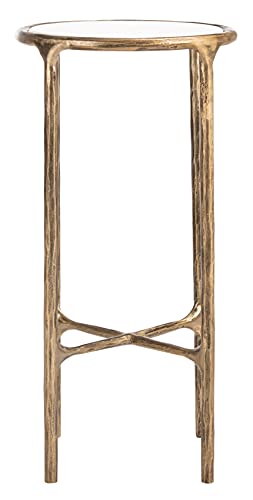
- Best for small spaces overall: SAFAVIEH Couture Jessa Tall Round End Table, Brass and White Marble — Check on Amazon
- Vovonusy Narrow C-Shaped End Table with Storage Bag — Check on Amazon
- SAFAVIEH Couture Valentia Round Marble Accent Table, Green — Check on Amazon
- SAFAVIEH Lori End Table with Two Storage Drawers, White Birch — Check on Amazon
- Kate and Laurel Talcott Two-Tier Side Table, Solid Mango Wood, Natural — Check on Amazon
- Kate and Laurel Aja Round Side Table, Mango Wood, Walnut Brown — Check on Amazon
Footprints in this guide run from 10 to 15 inches — and the two marble picks pack 24 to 35 pounds into theirs, so small never means flimsy.
Read the full guide ↓
Disclosure: As an Amazon Associate, dailyhomedecorating.com earns from qualifying purchases. Links to Amazon on this page are affiliate links; they cost you nothing extra. Listing details such as price and availability change often, so check the current Amazon listing before you buy.
The hunt for the best end table for small spaces under $1000 is a hunt for square inches that behave. Small spaces — the box-room corner, the reading nook, the gap between a loveseat and the wall, the landing that wants a lamp — punish furniture that is merely small-ish. A table earns its place here only if its footprint is genuinely tiny, its height is honest about the seat it serves, and ideally its form cheats space somehow: sliding under the sofa, stacking a second tier upward, or rounding away the corners that steal circulation. A generous budget helps because the best small-space tables are engineered objects — real marble in a 12-inch disc, a C-frame that borrows the sofa’s own footprint, solid wood tiers in 14 inches of depth.
There is also a psychology to small spaces. A cramped corner furnished with a flimsy, apologetic table still feels cramped; the same corner with one dense, beautiful, perfectly sized piece feels curated. Weight matters inversely to intuition: a small table should often be heavy for its size, so it stays planted and feels permanent, while the pieces meant to move — the slide-under, the accent — should be light enough to relocate without a decision. This guide sorts its six picks along exactly that line.
Our short answer: the tall Jessa in white marble for the classic small-space job — 12 inches square, 24 high, fully assembled, and heavy enough to trust. The Vovonusy C-table is the clever alternative that slides under the sofa and stores its surface in space you already own. The Valentia compresses solid marble into 10 inches, and the Lori and Talcott stack storage vertically instead of spreading it across your floor. Every review leads with dimensions, because in a small space the dimension is the destiny. If the small space sits inside a whole small home, our apartment guide, best end table for small apartments under $1000, covers the wider floor plan, and the general guide to the best end table under $1000 covers standard rooms.
In this guide
Quick Picks: best end table for small spaces under $1000
Every pick below sits under the $1000 ceiling at the time of writing — check price on Amazon on the live listing before you buy, because prices and stock move.
| Buyer type | Pick | Why it stands out | Link |
|---|---|---|---|
| Best for small spaces overall | Jessa Tall Marble End Table | brass-finish metal frame; white marble top; fully assembled; 24 lb; model SFV9504C | Check on Amazon |
| Best slide-under design | Vovonusy C-Shaped End Table | C-shaped slide-under frame; side storage bag; model VO-ET-P | Check on Amazon |
| Smallest footprint | Valentia Green Marble Accent Table | solid green marble throughout; sculptural pedestal; 35 lb; model SFV9704C | Check on Amazon |
| Best storage in shallow depth | Lori Two-Drawer End Table | two storage drawers; scalloped apron; fully assembled; 15 lb; model AMH6576A | Check on Amazon |
| Best two-tier space saver | Talcott Two-Tier Side Table | 100% solid mango wood, handcrafted in India; two tiers, lower shelf 20.25″W x 12.5″D; 50 lb stated maximum; 12.2 lb; model 221942 | Check on Amazon |
| Most movable accent | Aja Round Side Table | mango wood with walnut brown finish, handcrafted in India; slanted geometric legs; 7.45 lb; model 221950 | Check on Amazon |
How we chose these best end table for small spaces under $1000 picks
The series verification standard applied first — brand, model number and dimensions confirmed against maker or retailer listings — because small-space buying tolerates no dimensional surprises: a table listed loosely can arrive two inches too wide for the only gap it was bought for. Then small-space criteria ranked the field. Absolute footprint came first, measured in both dimensions, with every pick here at 15 inches or less on its short side. Space-cheating form came second: slide-under frames, two-tier stacking and round tops that return circulation space all scored as genuine engineering, not styling.
Density was judged deliberately. For fixed picks, we favoured heavy-for-size tables — marble at 24 to 35 pounds in footprints of 10 to 12 inches — because they resist knocks in tight quarters where everything gets bumped. For movable picks, we required the opposite: light enough to relocate one-handed, and we say which is which in every review. Height was matched to seat type rather than a single standard, since small spaces serve everything from low lounge chairs to standard sofas. No static prices appear anywhere in this guide: check price on Amazon on the live listing. The $1000 ceiling is best understood here as permission to buy the engineered answer rather than the approximate one.
1. Jessa Tall Marble End Table — Best for small spaces overall
Who it suits: the classic small-space gap: 12 inches beside a sofa or chair that still deserves a real, finished surface.
The tall Jessa is what happens when a maker takes small spaces seriously: a genuine white marble top, 12 inches across, carried at a full 24 inches high on a brass-finish frame — no shrinking of height to match the footprint, no apology in the materials. It arrives fully assembled and weighs 24 pounds, which in a 12-inch disc means density you can feel every time a drink lands. It fits the sliver between sofa and wall, the corner beside a reading chair, the bedside gap in a box room — all the places a standard table mocks you by almost fitting. Style it with a single glass or a small stack of two books; the marble does the rest.
Pros
- 12-inch footprint with full 24-inch height — no proportion compromise
- Genuine marble top; 24 lb density stays planted when bumped
- Fully assembled: unbox, place, done
Honest limitation: The top is a one-drink-and-a-phone surface. If the small space must also store things or hold a lamp, this table needs a partner rather than a promotion.
Choose it if your gap is around a foot wide and the job is a drink at perfect height. Skip it if you need storage or a lamp platform in the same footprint — read on to the Lori and Talcott.
The tall Jessa’s small-space virtue compounds over time: because it fits almost anywhere, it is the table that never becomes obsolete when furniture moves. Today’s sofa sliver is tomorrow’s bedside gap and next year’s hallway moment, and a fully assembled marble disc serves all three without modification. Its care routine is a coaster and a wipe — the smallest tables should ask the least, and this one asks almost nothing while looking like the most considered object in the room.
Check the Jessa Tall Marble End Table on Amazon and compare the current listing measurements with your sofa arm height before ordering.
2. Vovonusy C-Shaped End Table — Best slide-under design
Who it suits: sofa and bed edges in small rooms, where the only free space is the space under the seat itself.
The Vovonusy plays the cleverest trick in this guide: its C-shaped frame slides under a sofa or bed, so the tabletop hovers over the seat edge while the base occupies floor you were not using — the footprint is effectively borrowed, not spent. At 11.8 inches wide and 24.4 high it parks a drink, a remote or a laptop within hand’s reach in rooms where a freestanding table would block the walkway, and the side storage bag corrals the remote and reading material off the cushions. When the room needs to open up — guests, exercise, a child’s floor game — the whole thing lifts away in seconds. It is not heirloom furniture and does not claim to be; it is a spatial solution, and in a small space that is the higher virtue.
Pros
- Slide-under C-frame uses the sofa’s footprint instead of new floor
- Storage bag keeps remotes and magazines off the seat
- Moves away instantly when the room needs to change
Honest limitation: A cantilevered top has limits: keep loads light and centred, expect less planted feel than a marble pedestal, and do not let children treat it as a pull-up bar.
Choose it if your floor is full but your sofa edge is free, and flexibility beats permanence. Skip it if you want a fixed, weighty, styled surface that anchors a corner.
Judge the Vovonusy after a month, not a day: the habit it creates — drink, remote and book parked at the sofa’s edge, floor entirely clear — rewires how a small room feels at its most crowded hour, the evening. The storage bag quietly becomes the remote’s legal address. Its limits stay as stated: light loads, centred, no climbing. Within those limits it is the only pick here that can make a room feel larger while it is being used, because the space it occupies was never really yours to begin with.
Check the Vovonusy C-Shaped End Table on Amazon and compare the current listing measurements with your sofa arm height before ordering.
3. Valentia Green Marble Accent Table — Smallest footprint
Who it suits: the smallest possible footprint with the largest possible presence: a 10-inch disc of solid green marble for a curated corner.
Ten inches. That is the Valentia’s entire claim on your floor — a 10-inch round of solid green marble on a sculptural pedestal, 17.5 inches tall and an astonishing 35 pounds. In small-space terms it is a paradox that works: the footprint of a plant pot with the stability of a bollard, so it can stand in circulation-adjacent spots where a light table would be kicked into a new postcode weekly. The green stone turns a leftover corner into the room’s most deliberate moment, holding a single drink beside a low chair with total composure. It stores nothing, holds almost nothing, and justifies itself entirely — the correct purchase when the space is small but the standards are not.
Pros
- Smallest footprint here: 10 inches, with 35 lb of immovable stone
- Solid green marble throughout — a corner becomes a focal point
- Ideal height for low lounge and reading chairs
Honest limitation: At 17.5 inches it is too low for standard sofa arms, and the top fits one drink, not a working surface. Marble wants coasters and quick wipes after acidic spills.
Choose it if your corner is tiny, your chair is low, and you want the object to be art. Skip it if you need height, storage or surface — three things this sculpture proudly refuses.
The Valentia’s ownership experience is about permanence in miniature. Small spaces often accumulate provisional furniture — things bought to fill a gap until something better appears. A 35-pound block of green marble ends that cycle for its corner: nothing better is coming, because the object is already the best version of itself. It also anchors arrangements around it; a chair placed beside the Valentia looks chosen, and a small room with one chosen corner reads as designed rather than compromised.
Check the Valentia Green Marble Accent Table on Amazon and compare the current listing measurements with your sofa arm height before ordering.
4. Lori Two-Drawer End Table — Best storage in shallow depth
Who it suits: small spaces that still need storage: two drawers stacked into a footprint only 13 inches deep.
The Lori’s small-space logic is vertical. Its footprint is 18.1 inches wide but only 13 deep — a wall-hugging rectangle — while its storage stacks upward into two drawers and its height stretches to 26.8 inches, the tallest here. That makes it the pick for the small space that must work: the bedside in a box room, the sofa end in a narrow sitting room, anywhere the table is also the storage. The scalloped apron and white birch finish keep the tall form light visually, it arrives fully assembled, and at 15 pounds one person can slide it into gaps that defeat heavier furniture. Small spaces rarely need more table than this; they need exactly this table, in exactly the gap measured for it.
Pros
- Two drawers of storage in a 13-inch-deep footprint
- Tallest pick here — suits high arms and bedsides
- Fully assembled and light enough to thread into tight gaps
Honest limitation: Drawers hold small essentials only, and the light build is happiest wall-backed. The farmhouse detailing is a style commitment in a stark minimal nook.
Choose it if your small space must store as well as surface, and depth is your scarcest dimension. Skip it if your gap is under 13 inches deep, or you want a low, sculptural accent instead.
The Lori rewards the small-space owner who thinks in systems: assign the top drawer to the seat it serves, the lower to the room’s overflow, and the narrow table quietly replaces a storage unit the floor plan could not fit. Its height is a further system advantage — at 26.8 inches it is the rare shallow table that also works at bedside height, so one purchase can serve the two tightest spots in a small home across its lifetime, just never at the same time.
Check the Lori Two-Drawer End Table on Amazon and compare the current listing measurements with your sofa arm height before ordering.
5. Talcott Two-Tier Side Table — Best two-tier space saver
Who it suits: narrow rooms where a second tier replaces the shelf, the bookcase and the second table you have no floor for.
In a small space, horizontal thinking is the enemy, and the Talcott thinks in tiers. One footprint — 22 inches wide, just 14 deep — carries two solid mango wood surfaces: the top for the lamp and drink, the lower shelf (about 20 by 12.5 inches) for the books, basket or plant that would otherwise demand their own furniture. Handcrafted in India, it brings real wood warmth to rooms that risk feeling like storage units, and its stated 50 lb maximum is honest about the combined load. The rectangle sits flush to wall or sofa with no wasted curve, and floor pads protect hard floors when tight quarters mean frequent nudges. Assembly is three steps — the last small-space courtesy.
Pros
- Two tiers: shelving and table in one 14-inch-deep footprint
- Solid mango wood, handcrafted — warmth small rooms need
- Flush rectangular form wastes no corner space
Honest limitation: Open tiers display their contents, so the system works only if the stored things look calm. At 12.2 pounds it belongs backed against furniture, not freestanding mid-room.
Choose it if you need shelf space and table space in a single narrow footprint. Skip it if your stored items need hiding, or your gap is narrower than 14 inches.
The Talcott’s tiers invite a discipline small spaces need: top tier for use, lower tier for storage, nothing on the floor. Kept to that rule, the table absorbs the book pile, the basket and the plant that otherwise colonise the room’s edges, and the space reads as calm rather than stored-in. The handcrafted mango grain earns its place in this calculation too — in a room with very few objects, each object’s surface quality is a large share of the room’s total beauty.
Check the Talcott Two-Tier Side Table on Amazon and compare the current listing measurements with your sofa arm height before ordering.
6. Aja Round Side Table — Most movable accent
Who it suits: corners, landings and between-chair gaps where a 15-inch round, featherweight table can go anywhere and look intentional.
The Aja is small-space versatility in its purest form: a 15-inch round top of mango wood in a walnut brown finish, on slanted geometric legs, weighing 7.45 pounds. It is the table you carry — genuinely, with one hand, without thinking — to whichever corner currently lacks a surface: beside the bath chair, in the hallway landing with a plant, between two seats when guests arrive. The round form returns circulation space that square corners steal, the handcrafted grain makes it a designed object rather than a stopgap, and at 23 inches it meets most seats at a useful height. It will never be the room’s anchor. It will, repeatedly, be the room’s solution.
Pros
- 15-inch round: no corners, easy circulation in tight rooms
- 7.45 lb — the most movable table in this guide
- Handcrafted mango wood looks deliberate in any corner
Honest limitation: Featherweight means no leaning and no heavy loads; the top holds a curated few objects only. If the spot is permanent and bumped often, choose marble density instead.
Choose it if your small space changes roles often and the table must change with it. Skip it if you need a fixed, planted, storage-bearing table for one permanent spot.
The Aja’s long-term role in a small home is the understudy that plays every part: plant stand when the light moves, drink table when guests squeeze in, bedside when the box room becomes a nursery or an office. Its handmade finish means it never looks like the cheap stopgap its weight might suggest. Owners of small spaces learn to value objects by placements per year; by that measure the Aja, at under eight pounds and fifteen inches, may be the hardest-working pick in this guide.
Check the Aja Round Side Table on Amazon and compare the current listing measurements with your sofa arm height before ordering.
Comparison table: best end table for small spaces under $1000 at a glance
Read this table footprint-first: every pick is 15 inches or less on its short side. Then note the weight column’s split personality — the marble picks are heavy on purpose, the movers are light on purpose, and choosing between those philosophies is the real small-space decision.
| Pick | Dimensions | Key specification | Link |
|---|---|---|---|
| Jessa Tall Marble End Table | 12″W x 12″D x 24″H | brass-finish metal frame; white marble top; fully assembled; 24 lb; model SFV9504C | Check on Amazon |
| Vovonusy C-Shaped End Table | 11.8″W x 15.8″D x 24.4″H | C-shaped slide-under frame; side storage bag; model VO-ET-P | Check on Amazon |
| Valentia Green Marble Accent Table | 10″W x 10″D x 17.5″H | solid green marble throughout; sculptural pedestal; 35 lb; model SFV9704C | Check on Amazon |
| Lori Two-Drawer End Table | 18.1″W x 13″D x 26.8″H | two storage drawers; scalloped apron; fully assembled; 15 lb; model AMH6576A | Check on Amazon |
| Talcott Two-Tier Side Table | 22″W x 14″D x 26″H | 100% solid mango wood, handcrafted in India; two tiers, lower shelf 20.25″W x 12.5″D; 50 lb stated maximum; 12.2 lb; model 221942 | Check on Amazon |
| Aja Round Side Table | 15″W x 15″D x 23″H | mango wood with walnut brown finish, handcrafted in India; slanted geometric legs; 7.45 lb; model 221950 | Check on Amazon |
Materials, build quality and care in this price range
Small-space furniture lives or dies by two specifications that larger furniture can fudge: exact dimensions and appropriate density. Every pick here publishes precise measurements from its maker, and this guide repeats them in every review, because a small-space purchase made on approximate numbers is a return waiting to happen. Density is the subtler spec. The marble picks concentrate 24 to 35 pounds into footprints of 10 to 12 inches, producing the planted, permanent feel that tight quarters need — a table brushed daily must not travel. The wooden movers invert the logic at 7 to 15 pounds, light enough that repositioning is a whim rather than a project.
Materials follow the same deliberate split. Genuine marble — white in the tall Jessa, green in the Valentia — gives the smallest tables the greatest presence, at the cost of coaster discipline and prompt wiping of acidic spills. Solid mango wood, in the Talcott and Aja, brings warmth and handmade variation at minimal weight. The Lori’s painted finish brightens dark corners and wipes clean. The Vovonusy’s engineered frame is the honest exception: its material serves its mechanism, the slide-under trick that no solid construction performs as lightly.
Care in small spaces is mostly placement. Felt pads protect floors where tables are nudged often; stone wants a coaster within reach or it will not be used; and a small table’s top should be wiped as part of the room’s daily reset, because on a tiny surface one ring is not a detail — it is a third of the view.
Matching these picks to real rooms
The reading nook: the Valentia beside a low chair if the nook is a destination, the tall Jessa if the chair is standard height. One drink, one book, one perfect corner — the formula does not improve with additions.
The loveseat wall: the Lori or Talcott filling the end gap with storage the room otherwise lacks, drawers for the small kit or tiers for the books. Measure the depth first; the Lori’s 13 inches wins the shallowest walls.
The flexible room: the Vovonusy parked at the sofa for the evening and lifted clear for the morning, the Aja auditioning in whichever corner the day creates. Small spaces that change function need furniture that changes with them, and these two are the guide’s designated movers.
How to choose the right end table for your room
Measure in three dimensions, then distrust almost. Record width, depth and the height of the seat arm the table will serve. In small spaces a half-inch decides success, so prefer listings with exact published dimensions from the maker — every pick here has them — and leave a small clearance rather than planning a friction fit.
Cheat the footprint honestly. Three legitimate cheats exist. Slide-under frames borrow the sofa’s footprint. Tiers stack a second surface into the same floor area. Round tops return the corner space to circulation. A small-space table should use at least one; a merely shrunken standard table uses none and serves badly.
Choose your weight philosophy. Fixed spot, frequent bumps: go dense — marble at 24 to 35 pounds in a tiny footprint cannot be casually displaced. Changing spot, flexible room: go light, and accept the discipline of light loads. The failure mode is the middle — a medium table too heavy to move happily and too light to trust.
Keep the top honest. Small surfaces collapse visually under clutter faster than large ones. If the spot must store, buy storage — drawers in a shallow depth exist, as the Lori proves. If the spot is pure surface, edit it to the drink, the book, the object, and let the material carry the beauty. For whole-room planning in compact homes, pair this guide with best end table under $700 for tighter budgets and best console table under $1000 for the wall you are not using yet.
What the $1000 ceiling should actually buy you
A small-space buyer’s $1000 ceiling should buy engineering: the compression of real materials and full function into footprints that approximate furniture cannot survive. Genuine marble at 12 inches square and full serving height, drawers inside 13 inches of depth, a second tier inside 14 — these are manufacturing achievements, and they are what the premium is actually for. The ceiling should also buy density where density matters, because a small table in a tight room is bumped more often than a large one in a spacious room, and a 35-pound accent answers bumps differently from a 7-pound one.
What the ceiling should not buy is shrinkage for its own sake. A merely smaller version of a standard table — lower, lighter, storage deleted — serves a small space worse than a standard table serves a normal room. Judge every candidate by whether its smallness is designed: a borrowed footprint, a stacked tier, a rounded return of circulation space, a footprint matched to a measured gap. Designed smallness is worth the premium; accidental smallness is worth a return label.
Spending less than the ceiling: where the value sits
Small-space value is measured per square inch, and by that measure the engineered picks justify the ceiling best. A 12-inch footprint that serves at full height, in genuine marble, fully assembled, concentrates more function and more material into its square foot than any standard table concentrates into four. The storage picks run the same calculation vertically: the Lori’s drawers and the Talcott’s tiers buy storage volume without buying floor, which in a small home is the only currency that is truly scarce. Even the Vovonusy, the least expensive idea here, earns its place by the same arithmetic — its effective footprint is borrowed from the sofa, so its cost per inch of new floor is effectively zero.
The false economy in small spaces is the approximate table: cheap, small-ish, and wrong by an inch, destined to be replaced by the exact table that should have been bought first. Two purchases cost more than one premium one, in money and in the months lived with the obstruction. Measure precisely, buy the engineered answer once, and let the unspent remainder of the ceiling fund the one thing small spaces always need after furniture — better light, which makes every exact inch look larger.
Placement, setup and the first week with your table
Small-space setup is a precision exercise. Measure the gap a final time with the skirting board and any rug edge accounted for — both steal fractions that matter at this scale. Place the table before surrounding pieces settle, because the smallest object is the hardest to insert last. Fit felt pads, check stability with a deliberate nudge from the direction traffic actually comes from, and confirm the top’s height against the seat by sitting down and reaching for it; the reach test catches what the tape measure rationalised.
In the first week, defend the surface. Small tops clutter at triple speed, so assign the table its single job in words — drinks only, lamp and book, charging point — and relocate everything else to the storage the room does have. If the table is a mover, note where it lands most evenings; that landing spot is its true home, and arranging the room around that discovery is the final, free improvement every small space eventually makes.
Long-term ownership: pairs, longevity and when to upgrade
Small spaces change purpose more often than large ones — the nook becomes a nursery corner, the landing becomes a desk, the reading chair gains a floor lamp and loses its table to the bedside. Furniture that survives these rotations is furniture with a single, clear talent and the dimensions to practise it anywhere: the 12-inch disc, the 13-inch-deep drawers, the featherweight round. When a second small table joins, buy the opposite talent — density if the first was movable, mobility if the first was stone — and the pair will cover every configuration the home invents.
Longevity in miniature is about resisting the provisional. Small spaces attract stopgap purchases, and stopgaps accumulate into rooms that never feel finished. One engineered, honestly materialled table ends the cycle for its corner: marble that cannot date, solid wood that can be refreshed, a frame whose trick never stops being useful. Upgrade only when the space’s job changes outright. Until then, the best small-space table is the one you stop thinking about — because it fits, because it works, and because the corner it serves has quietly become the best small place in the home.
Common mistakes to avoid
Buying small-ish instead of small. A 20-inch table in a 13-inch gap is not a compromise, it is an obstruction. Small-space furniture must be chosen by the tape measure, at the exact dimension, every time.
Shrinking height along with footprint. Many small tables are also low, which strands them beside standard sofa arms. The right small table keeps full serving height in a tiny footprint — check both numbers, not just the flattering one.
Forgetting circulation. In tight rooms, corners cost hips and shins. Round tops and pedestals give space back to the people moving through it; a square table in a walkway taxes every passer-by.
Expecting one tiny table to do everything. A 12-inch drink table cannot also be the storage, the lamp stand and the bookshelf. Assign the small table one job, do it beautifully, and give the other jobs to tiers, drawers or another wall.
Placing a light table in a bump zone. Featherweight tables belong in calm corners. Where traffic brushes past daily, density is safety — choose the marble picks and let physics keep the peace.
Final recommendation
For the classic small-space job, buy the tall Jessa marble table: twelve inches of footprint, a full serving height, genuine stone, and the density to stay exactly where you put it. If your floor is truly full, the Vovonusy C-table’s borrowed footprint is the smarter piece of engineering. Both prove the small-space principle — the right table is not the smallest you can find, but the one whose every inch is deliberate.
Measure your gap to the half-inch, decide whether the spot is fixed or flexible, then check price on Amazon for the finalists. Under a $1000 ceiling, small spaces stop being a compromise category: marble, solid wood and clever frames all fit — as long as the tape measure, not the photograph, makes the final call.
Delivery, inspection and returns: a practical checklist
Small-space delivery has one rule above all: the box must fit the route the table will. Measure doorways and turns against the packaged piece’s likely dimensions — a fully assembled 12-inch marble disc travels anywhere, while a two-tier table arrives at close to its finished 22-inch width. For the stone picks, plan the carry: 24 to 35 pounds is one careful person on the flat, two on stairs, and the table should be lifted, never dragged, into its final position to protect both the base and the floor.
Inspect at miniature scale. On a 10 or 12 inch top, a single chip is a large percentage of the view, so examine edges in daylight and photograph anything that is damage rather than natural veining. Stability-test in the exact spot, on the exact floor surface, with a nudge from the direction of passing traffic — a table stable on the kitchen’s hard floor may rock on the bedroom’s rug pile. Then run the reach test from the seat it serves. Small-space purchases fail on fractions, and every fraction is checkable in the first hour, while the return label is still a simple thing rather than a regret.
Frequently asked questions
What is the smallest useful end table footprint?
Around 10 to 12 inches for a drink table beside a chair — the Valentia and tall Jessa in this guide prove the format with solid marble. Below that, stability and usefulness fall away. If the table must hold a lamp or store items, plan on 13 to 15 inches of depth with drawers or tiers instead.
Are C-shaped tables sturdy enough?
For their intended job — a drink, a remote, a laptop at the sofa edge — yes, provided loads stay light and centred on the top. They trade the planted feel of a pedestal for the ability to borrow the sofa’s footprint and move away instantly. Do not let children climb or pull up on them.
Should a small-space table be heavy or light?
Both, deliberately. A fixed table in a bump-prone spot should be heavy for its size — dense marble is ideal. A table that must move between roles should be light enough to carry one-handed. Avoid the unhappy middle: too heavy to move gladly, too light to trust.
How tall should an end table for a small space be?
The same rule as any room: level with the seat arm it serves, or just below. Small footprint must not mean shrunken height — the tall Jessa holds a full 24 inches on a 12-inch footprint, which is the correct small-space engineering.
Can a small end table include storage?
Yes, if the storage stacks vertically. The Lori fits two drawers into a 13-inch depth, and the Talcott adds a full lower tier inside 14 inches. In small spaces, storage should always grow upward, never outward.
Can a small end table hold a lamp?
Only if the top diameter exceeds the lamp’s base with room to spare — which excludes the 10 and 12 inch marble picks here. For lamp duty in a small space, choose a 15 inch or wider top such as the Aja’s, or mount a wall or floor lamp and keep the small table for drinks and books.
What do I do if my gap is between standard sizes?
Buy down, never up. A table an inch narrower than the gap looks intentional; a table forced into a wider claim becomes a daily obstruction and a return risk. If the gap is truly irregular, a round top forgives more than a square one, because its widest point passes corners a rectangle cannot.
Where else can a small end table work besides beside a sofa?
Beside a bed in a box room, in a hallway landing with a plant, next to a bath or reading chair, or in an entryway as a key-and-post landing. The narrow and shallow picks here were chosen partly for this portability between roles — a small table rarely stays in its first job for long.
How do I keep a tiny table from looking lost?
Give it presence through material or company: a dense stone piece holds its own anywhere, while a light wooden accent gains stature from a deliberate pairing — one object on top, a plant or lamp beside it, and clear floor around it. Emptiness nearby is what makes a small table look intentional rather than leftover.
Is a pedestal or a four-leg table better in a tight corner?
A pedestal usually wins in corners: one central footprint leaves the floor edges free, the form reads calmly against skirting boards, and there are no rear legs to collide with the wall when the table is nudged. Four legs win where the floor is uneven and the table is wide enough to need the spread — which is why the wider picks here keep their legs and the narrow marble picks use pedestals and compact frames.
How much weight can a small end table really hold?
Only what its maker states, and the honest makers here state it plainly — 50 pounds for the Talcott’s tiers, for example, against the marble pieces’ density-based stability for drinks and books. Where no capacity is published, keep loads modest, centred and well inside the top’s edges, and never use any small table as a step, a seat or a climbing aid.
Should I buy one small table now or save for a pair?
Buy the one the measured gap demands now, and live with it for a month. Small spaces reveal their second need slowly — a bedside here, a landing there — and the second purchase, made with that knowledge and matched in material to the first, will be righter than any pair bought on a guess.
Related guides
Keep planning the room with these companion guides on this site:


