Disclosure: Daily Home Decorating participates in the Amazon Services LLC Associates Program. As an Amazon Associate, we earn from qualifying purchases.
Jobsite table saws are portable, useful, and notoriously difficult to keep clean. Their compact cabinets leave little room for large dust chutes, and many models eject a mix of chips and fine dust below the table. A basic bag can catch coarse debris; a shop vacuum can improve capture at a dust port; and a dedicated extractor can add better filtration, automatic filter cleaning, and tool-triggered operation. The right setup depends on the saw’s ports, the work being done, and how often you need to move the system.
For a contractor who regularly uses a portable saw indoors, a dust extractor with tool activation and compatible hose adapters is usually the most flexible option. The Bosch VAC090AH, DEWALT DWV010, and Makita VC4210L are examples with published HEPA filtration and automatic filter-cleaning features. For occasional outdoor cuts, a correctly fitted collection bag may be a simpler, lower-cost way to catch larger chips. Neither option makes dust disappear: connect the machine as its manufacturer directs, keep filters and bags maintained, and clean remaining dust with a method appropriate for the material.
This guide compares five products from verified Amazon Creator API records and explains where each part fits. We have not conducted side-by-side airflow or capture testing, so “best for” descriptions refer to use cases and documented features, not measured performance rankings. Product specifications, included hoses, and bundles can change. Confirm the current listing and the manual for your exact saw and extractor before buying.
Quick answer: match the collector to the saw and work
Begin by locating every dust outlet on your saw. Some jobsite models have a lower cabinet port and a separate port on the blade guard. A single vacuum hose connected only at the rear may not collect dust escaping near the guard. The DEWALT DWE7491RS manual, for example, describes both a rear port and a guard port and recommends a Y connector for best results. Verify your own model rather than assuming all jobsite saws share the same setup.
- Frequent indoor cutting: consider a dust extractor with tool activation, a suitable filter system, and a hose that fits your saw.
- Occasional outdoor work: a compatible bag or simple shop-vac setup may collect coarse chips without the cost or bulk of a large extractor.
- Two saw ports: check whether the saw maker recommends a Y fitting and whether the extractor can maintain useful airflow through the combined hose.
- Fine dust and extended work: prioritize effective filtration, sealed bags, filter cleaning, and safe cleanup; a “HEPA” label alone does not certify the entire work process.
High CFM on a vacuum specification sheet does not guarantee excellent capture at the blade. Hose diameter, restrictions, leaks, filter condition, port design, and the saw’s airflow path all affect results. Buy a connected system, not a single impressive number.
How jobsite-saw dust collection works
A table saw produces dust both above and below its table. The blade carries material through the cut and throws chips into the cabinet; a guard-mounted outlet may capture some of the debris above the table. The lower port draws dust from the cabinet. On saws with both outlets, connecting both may improve collection, but only when the manufacturer-approved fittings preserve sufficient airflow and do not interfere with safe operation.
A dust bag simply stores debris that reaches the outlet. It is straightforward and mobile, but it usually offers less containment of fine particles than a well-maintained extractor with a suitable filter and bag. A shop vacuum is compact and commonly has a flexible hose, but its narrow hose may clog with larger chips and its filter can load quickly during long sessions. A dust extractor is designed to work with power tools and may include automatic filter cleaning, tool activation, anti-static hose features, and higher-capacity bags.
A central dust collector can move larger volumes through wider ducting in a shop, but it is generally less portable and may need a custom connection for a jobsite saw. For a mobile setup, a dedicated extractor or compact wet/dry vac is usually easier to move from one site to another. Whatever you choose, keep hose routing clear of the saw stand, operator’s feet, blade controls, and workpiece path.
Dust capture is not the same as eliminating exposure. Fine wood dust can remain airborne or settle on benches and floors. Use ventilation, suitable cleanup procedures, and protective equipment as appropriate to the material and local requirements. Avoid blowing settled dust around with compressed air. Follow the saw and collector manuals for filter changes and cleanup.
Dust collection products to compare
1. Bosch VAC090AH — best feature-rich option for a regular jobsite setup

Tool activation, automatic filter cleaning, and included HEPA filter.
View on Amazon
Bosch lists the VAC090AH as a 9-gallon dust extractor with automatic filter cleaning, HEPA filtration, and power-tool activation. Its official specifications list maximum airflow of 150 CFM and maximum static water lift of 97.3 inches. Those are extractor-side figures, not a promise that a particular jobsite saw will capture all dust. Hose size, connectors, filter state, and whether the saw has one or two collection ports matter in a real setup.
Good fit: a user who wants a portable extractor with automatic filter cleaning and power-tool activation for recurring work. Check first: the included hose length and adapter size against your saw, the shop’s available electrical circuit, and whether the saw needs a Y connector. Bosch says the included hose is about 9.85 feet; make sure that reach is enough without routing a loop where it can snag.
The HEPA filter is a valuable feature, but filtration depends on the extractor being correctly assembled with compatible bags and filters. Replace parts as instructed and avoid treating an extractor as a substitute for task-specific dust controls. Review the Bosch product page and technical data for current inclusions and operating details.
2. DEWALT DWV010 — best for tool-triggered use with a portable saw setup
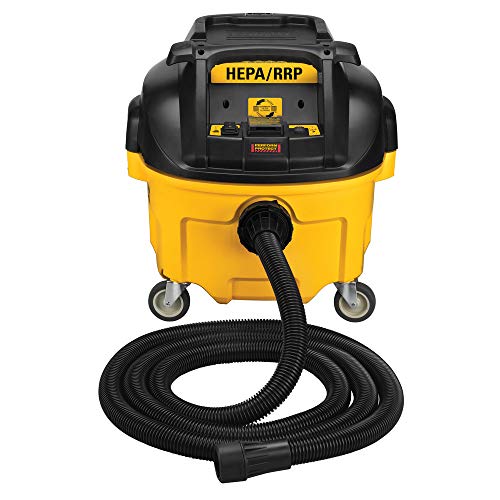
Automatic filter cleaning, tool activation, and anti-static hose.
View on Amazon
DEWALT describes the DWV010 as an 8-gallon HEPA extractor with a 15-amp motor, automatic filter cleaning, power-tool actuation, and a 15-foot anti-static hose. The official overview gives airflow figures of 150 and 155 CFM in different sections, so consult the current manual and treat those values as manufacturer specifications rather than a guaranteed capture rate at a saw blade. The universal hose connector may simplify a mobile setup, but the saw port can still require a reducer or branch connector.
Good fit: a contractor who values an extractor that starts and stops with a connected tool and a longer hose for moving around a work area. Check first: the extractor’s power draw alongside the saw, branch-circuit capacity, actual hose cuff dimensions, and current filter/bag bundle. DEWALT notes that its EPA RRP rule statement applies only when specified DWV9330 filters are used; that does not mean every saw-and-extractor combination automatically meets every dust-control regulation.
The DEWALT manual explains the tool-control switch and AirLock connection system. Read the manual for startup and cleaning steps and use compatible accessories. The manufacturer’s DWV010 page lists included components and current specifications.
3. Makita VC4210L — best for a larger-capacity extractor with quieter operation

Automatic filter cleaning, HEPA filter, and tool-activated power outlet.
View on Amazon
Makita’s VC4210L is an 11-gallon wet/dry HEPA dust extractor with automatic filter cleaning and a tool-activated outlet. The official product literature lists 148 CFM airflow, 92 inches of water lift, and a working sound level of 60 dB(A). The larger container and included 13-foot anti-static hose can suit a shop that also connects planers, routers, and sanders, though the extractor weighs about 35 pounds and is less convenient to carry than a small vac.
Good fit: a user who wants one mobile extractor for a jobsite table saw and other tools, and who values the larger tank and documented filtration features. Check first: how often the saw will be moved, available storage, hose cuff compatibility, and whether a suitable adapter is included. Accessories may be required to connect each tool; Makita explicitly advises referring to each tool’s manual for attachment and adapter requirements.
Makita lists a two-stage filtration design and a HEPA filter, but the filtration rating applies to the specified filter, not to a leaking connection or an unsealed bag. Inspect the complete setup and maintain it according to the instructions. See Makita’s VC4210L product details and its official product overview for the published specifications.
4. POWERTEC 75074 table-saw dust bag — best simple collector for coarse chips

Replacement-style collection bag listing for compatible 2-1/2-inch saw ports.
View on Amazon
A collection bag is the simplest option in this group. The verified marketplace listing describes a universal table-saw dust bag designed for 2-1/2-inch dust ports and names several saw brands. POWERTEC’s original 75074 product documentation describes a table-saw bag with a hook-and-loop closure at the opening and a bottom zipper for emptying. Check the exact SKU and compatible saw models before purchase; the Amazon listing title includes a spelling error and marketplace variants can be combined.
Good fit: a homeowner who primarily wants to catch larger chips during occasional cuts and prefers not to roll a vacuum around a small work area. Limit: a bag is not a HEPA extractor, and it should not be treated as fine-dust containment. Empty it before it becomes overfilled, inspect seams and closure, and follow the saw maker’s instructions for a bag attachment.
A dust bag can also make cleanup easier, but it does not actively draw dust from the guard area unless the saw’s airflow path is designed for it. If a bag fills quickly or dust escapes around the base, consider adding a compatible vacuum at the port or selecting an extractor suited to the saw. Never close or modify an outlet in a way that blocks airflow or creates a new hazard.
5. POWERTEC 70124 universal dust port — best for a custom port connection

2-1/2-inch nominal port with a flange for workshop-machine connections.
View on Amazon
This component is not a vacuum or a collector; it is a port that can help connect a woodworking machine to a 2-1/2-inch inside-diameter hose. POWERTEC lists an angled ABS port, a flange, and four pre-drilled mounting holes. It may help in a custom cabinet or an accessory setup, but it is not a universal snap-on adapter for every jobsite saw. The flange opening and mounting footprint need a suitable surface, and modifying the saw cabinet could affect warranty, guarding, or safe operation.
Good fit: an experienced shop owner building a compatible cabinet or fixture around a stationary machine. Not a quick fix: someone who expects to attach it to a jobsite saw without checking the factory port dimensions or mounting method. Measure the inside and outside diameter, compare flange dimensions, and avoid drilling or cutting the saw unless its maker permits that modification. POWERTEC’s 70124 product page gives the current dimensions and intended connections.
Dust bag, shop vacuum, or extractor?
| Option | Best use case | Main trade-off |
|---|---|---|
| Collection bag | Occasional cuts where catching chips is the priority | Limited fine-dust containment; needs frequent emptying |
| Wet/dry shop vac | Mobile, occasional work with a compatible port and suitable filter | Small hoses may clog; filters can load quickly |
| Dust extractor | Frequent tool-connected work and higher filtration needs | Cost, weight, bags, filters, and hose matching |
| Central dust collector | Fixed shop with multiple machines and wider ductwork | Less portable and often needs custom adapters for a jobsite saw |
The useful distinction is how each option handles chips, fine dust, and movement. A simple bag is light and inexpensive but does little to filter airborne fines. A shop vac is flexible, but a small diameter hose can clog if the saw sends larger chips through the outlet. A dust extractor typically adds features intended for powered tools, such as automatic filter cleaning, tool activation, or more effective filter and bag systems. A central collector can serve an entire shop but is often excessive for a single portable saw.
Do not choose purely by tank size. A larger container means fewer interruptions to empty, but it also adds weight and storage demands. If the saw moves between rooms or sites, a lighter extractor with enough hose reach may be more useful. If you mostly work in one shop, a larger extractor or fixed collector may be reasonable.
How to match a collector to your jobsite saw
1. Identify the saw’s collection ports
Check your saw manual and look for the lower cabinet outlet, blade-guard outlet, and any supplied reducer. Some saws have one port; others separate collection above and below the table. Record the nominal diameter of each port and whether the manual recommends a Y-fitting or a second hose. Do not assume the port is exactly the size printed on a marketing page; molded fittings can taper or use a proprietary cuff.
If the saw has two ports, a Y connector can combine them, but the connection must preserve enough airflow at both branches. A restrictive or poorly fitted Y can make capture worse. Follow the saw manufacturer’s arrangement and avoid routing a hose where it can snag, block the stand, or interfere with the workpiece. For example, the DEWALT DWE7491RS manual discusses its guard and rear collection ports and recommends connecting a vacuum to both with a Y connector for best results.
2. Match hose diameter and cuff shape
Port diameter is only one part of fit. A hose can be the right nominal size but still fail to grip because of its cuff shape, taper, or locking features. Measure the port opening and the hose cuff at the point of connection. Use a manufacturer adapter or a purpose-made reducer when needed. Avoid tape and improvised sleeves that can come loose, narrow the passage, or leave a leak.
Long hoses and sharp bends add resistance. If the extractor sits a few feet away, plan a route with smooth bends and enough slack to move the saw without pulling a connection loose. For a jobsite saw on a rolling stand, keep the hose clear of the stand’s folding and locking parts. A hose that works in a stationary test may become a tripping or snag hazard once the stand is moved.
3. Consider the material and duty cycle
Cutting untreated dimensional lumber produces chips and fine wood dust. Sheet goods may create a different dust load; composite materials and coatings can add hazards that require specific controls. If your work involves silica-containing material, chemical-treated wood, or an unknown coating, consult the material safety information and applicable rules instead of treating a standard shop vac as sufficient protection.
For occasional weekend cutting, a dust bag or shop vacuum may be enough for coarse cleanup. For repeated cuts indoors, a filtered extractor with tool activation can reduce the need to manually switch the vacuum and may help keep the filter from clogging as quickly. Choose bags and filters that are specifically compatible with the extractor. A HEPA filter’s stated efficiency does not guarantee whole-system capture if air bypasses a seal or the tool’s port leaks.
4. Check electrical capacity and tool activation
A tool-triggered vacuum outlet is convenient, but both machines still draw power. Check the extractor and saw nameplates and follow circuit requirements in their manuals. Do not assume a single outlet or extension cord can safely handle both under every condition. Some extractors offer a power-management dial or a delayed shutoff; learn how the controls work before putting them into regular service.
Tool activation is not a substitute for safe switching or lockout procedures. Keep the extractor controls accessible, inspect cords and plugs, and disconnect equipment before clearing blockages or servicing filters. For cordless saws, automatic activation may not work the same way as with corded tools, so verify the product’s trigger method.
5. Budget for filters, bags, and adapters
Ownership cost includes more than the machine. Check replacement filter prices, disposable or fleece bag sizes, hose cuffs, Y fittings, and adapters. If you make frequent cuts, an easily available bag can matter more than an extra gallon of tank capacity. If the saw has two collection ports, account for the cost of the correct branch fitting and any extra hose.
Make a short compatibility list before purchase: saw model, port diameters, number of outlets, extractor hose size, required adapters, filter and bag model numbers, and electrical requirements. This reduces the risk of ordering a collector that is powerful but incompatible with the saw’s ports.
Practical setup and maintenance checks
Start with the connection recommended in both manuals. Make sure the collector’s filter and bag are installed, seals are seated, and the hose does not collapse or kink. Secure loose hose sections so they do not pull on the saw or fall across an operator’s path. If a machine has tool activation, test the switch without a workpiece and make sure the extractor starts and stops as expected.
After a short test, look at where dust still escapes. Visible chips around the guard may point to a disconnected upper port, a full bag, poor fit, or a hose restriction. Fine dust that remains in the air is harder to assess by eye, so maintain the specified filter and consider room ventilation and cleanup. Do not make changes to a guard or saw housing that the manufacturer has not approved.
Empty bags before they are packed tight, because a full bag can reduce airflow. Clean or replace filters according to the manual rather than striking them against a hard surface or blowing them out in an occupied area. Check hoses for splits and fittings for looseness. A cracked adapter can leak and reduce suction without obvious noise.
For jobsite cleanup, avoid dry sweeping or compressed-air blowdown that redistributes fine dust. Use a vacuum and filter suited to the material and follow workplace requirements. OSHA’s woodworking guidance describes dust and machine-guard hazards; the right control depends on the process and material. Review OSHA’s woodworking hazards overview for general information, and consult current local regulations for professional work.
Common dust-collection mistakes
- Buying by CFM only: CFM alone does not predict capture at a saw. Port design, hose diameter, bends, filter state, and leaks matter.
- Assuming the same port on every saw: jobsite models vary, and some have separate upper and lower outlets.
- Using an adapter that narrows the line too sharply: a poor reducer can restrict flow or disconnect during movement.
- Expecting a bag to filter fine dust like an extractor: bags primarily simplify chip collection and disposal.
- Ignoring two-port collection: dust can escape at the blade guard even if the lower cabinet port is connected.
- Forgetting filters and bags in the budget: consumables influence long-term cost and performance.
- Routing hoses through the operator’s path: hoses should not catch on the stand, foot controls, or workpiece.
- Assuming HEPA alone means regulatory compliance: compliance depends on the complete tool, accessory, work practice, and applicable rule.
When a different setup makes more sense
A compact wet/dry vacuum may be more practical if portability and occasional cleanup matter more than automatic filter cleaning. A stationary dust collector may be better for a fixed workshop with multiple machines and wide ducting. A bag can be the simplest choice for outdoor work where coarse chips are the main nuisance and dust exposure is managed appropriately. Use the right option for your space rather than buying a large extractor by default.
If you are choosing the saw itself, our portable table saw guide, benchtop table saw guide, and home-shop table saw guide compare different formats. Dust collection should be considered alongside portability, stand design, blade guard ports, and the material you cut.
Frequently asked questions
What is the best dust collection for a jobsite table saw?
For frequent indoor work, a compatible dust extractor with suitable filtration, a well-fitted hose, and connection to the saw’s recommended ports is a strong starting point. For occasional outdoor cutting, a collection bag or shop vacuum may be simpler. Match the system to your saw and material.
Is a shop vacuum enough for a jobsite saw?
It can collect chips and some dust when its hose fits the saw and its filter and bag are appropriate. Check hose diameter and clog risk, particularly if the saw ejects large chips. A standard vacuum setup is not automatically equivalent to a dust extractor or a regulated control system.
Does a jobsite saw need two dust hoses?
Some saws have a lower cabinet port and a separate guard port. Follow the manual for your model; some manufacturers recommend connecting both through a Y fitting. A single hose may leave dust escaping at the unused outlet.
Does a HEPA extractor make a saw dust-free?
No. A HEPA filter applies to the filter’s performance under specified conditions. Leaks, poor port connection, a full bag, an open guard port, or residual airborne dust can still affect collection. Maintain the entire system and use appropriate cleanup and ventilation.
What hose size fits a jobsite table saw?
There is no single size for every saw. Check the saw’s manual and measure the outlet and the extractor cuff. You may need a reducer, manufacturer adapter, or Y connector, especially when the saw has both upper and lower ports.
Are dust collection bags effective?
A bag can collect coarse chips and make emptying easier, but it generally provides less fine-dust containment than a properly sealed extractor with suitable filtration. Follow the bag and saw instructions and do not overfill it.
Can I connect the upper and lower ports with a Y fitting?
Only if the saw manufacturer recommends or permits that configuration and the fitting is compatible. Use a suitable Y connector without obstructing the blade guard or restricting airflow excessively. Route both hoses so they cannot snag or interfere with cutting.
How often should extractor filters be cleaned?
Follow the extractor’s manual. Some models automatically pulse-clean filters during use; others require periodic cleaning or replacement. Empty bags and maintain filters as instructed, and do not clean them in a way that spreads fine dust into occupied areas.
What is the difference between a dust extractor and a dust collector?
Terms vary by brand, but portable extractors are designed to connect to individual power tools and often use narrower hoses and filtration features. Shop dust collectors usually use larger ducts and serve stationary machines. Choose based on portability, airflow needs, and tool connections.
Bottom line
The best dust collection for jobsite saws is a compatible system that reaches the saw’s collection ports, maintains useful airflow, filters the material you cut, and does not interfere with safe operation. For regular portable work, compare the Bosch VAC090AH, DEWALT DWV010, and Makita VC4210L based on hose fit, electrical demands, consumables, and mobility. For basic chip collection, a table-saw bag or a correctly fitted dust port may be enough, but they are not substitutes for filtered extraction when fine-dust control matters.
Before ordering, check the exact saw manual, measure every port and cuff, decide whether you need a branch fitting, and include bags and filters in the cost. The machine and its connection accessories work as one system; compatibility and maintenance are as important as the extractor’s headline airflow rating.
Sources: Bosch VAC090AH specifications; DEWALT DWV010 specifications; Makita VC4210L details; POWERTEC 70124 dimensions; OSHA woodworking hazards.
Certain content that appears on this site comes from Amazon. This content is provided “as is” and is subject to change or removal at any time. Product examples and images are supplied through Amazon Creators API; confirm specifications and availability on the current listing.