Best Benchtop Table Saws: How to Choose a Compact Shop Saw
A benchtop table saw gives a small workshop a fixed cutting surface without committing to a full-size stationary machine. The saw sits on a workbench, cabinet, or dedicated base; it can be removed or stored when the shop needs to change tasks. That flexibility is useful for home repair, small furniture parts, shelving, and occasional ripping, but a compact footprint also means less table support, a smaller fence system, and more responsibility for planning how stock enters and leaves the blade.
The best benchtop table saws are chosen by the stock you actually cut, the stability of the mounting surface, the fence and guard system, and the space available for safe infeed and outfeed. This guide focuses on conventional compact table saws intended to sit on a bench or compact base. It distinguishes them from miniature craft saws and jobsite saws built around transport and stands. This is research-based buying guidance, not a hands-on product test; verify exact model specifications, package contents, and permitted accessories in current manufacturer material before buying.
Affiliate disclosure: DailyHomeDecorating.com may earn a commission from qualifying purchases through links in this article. This does not change the price you pay.
Amazon product examples to compare

ASIN: B09XWSNRV9
ASIN: B08F9RFJ2K

ASIN: B0842QDW95
Certain content that appears on this site comes from Amazon. This content is provided “as is” and is subject to change or removal at any time. Product examples and images are supplied through Amazon Creators API; confirm specifications and availability on the current listing.
Table of contents
- Quick fit check
- What “benchtop” means
- Benchtop, jobsite, portable, and mini saws compared
- How to choose a benchtop table saw
- Mounting, support, and shop layout
- Safety and setup
- Maintenance and accuracy
- Frequently asked questions
Quick fit check: is a benchtop saw right for you?
A benchtop model is a reasonable fit if you need a table saw for occasional or small-shop work, have a sturdy surface where the machine can be secured, and can support the material on both sides of the blade. It can be stored or moved between uses, and may cost less than a heavy stationary saw. It is less suitable when the work involves frequent full-sheet handling, long heavy lumber, deep ripping in dense stock, or production-level repeatability.
Before choosing a model, answer four questions:
- What are the most common stock dimensions and cut types?
- Where will the saw sit, and can it be bolted or clamped securely?
- How will long pieces remain level through the entire cut?
- Can dust collection, power access, and safe operator clearance fit the room?
If you cannot make a stable support plan, a larger or heavier machine is not a shortcut. Consider a circular saw with a guide, a track saw, or a miter saw for the cuts that match those tools better. A table saw is designed for controlled ripping and related operations within its manual limits; it is not ideal for every board or panel.
What “benchtop table saw” means
In ordinary product listings, “benchtop” can refer broadly to a compact saw that does not have a full cabinet base. Some models are bare machines intended to be set on a bench; others include folding legs or attach to a stand and are marketed as jobsite saws. These categories overlap in size and use. For this guide, a benchtop saw is a compact woodworking table saw whose main body is intended to be supported on a bench, work surface, or compact base rather than installed as a heavy stationary cabinet machine.
Read product descriptions carefully. A product title may say “compact,” “portable,” “tabletop,” or “jobsite” even when the machine can function on a benchtop. The category label does not tell you whether a stand is included, where the mounting points are, how much support the table has, or whether the fence rails telescope. Use the model number and manual to understand the actual machine.
Not the same as a miniature hobby saw
A mini table saw is made for small stock such as model parts, craft materials, and thin sheets. Its blade, fence, throat opening, and guards are scaled for those tasks. It should not be treated as a smaller construction saw. For miniature applications, see our mini table saw guide, which focuses on craft-scale capacity and safe small-part handling.
Not always the same as a jobsite saw
A jobsite saw emphasizes transport, rapid setup, and worksite mobility. It may include a folding or wheeled stand and a larger rip capacity than a compact bare benchtop saw. Some jobsite saws can be placed on a bench if the manual allows it, but their rails and stand still need operating room. Our portable table saw guide covers stand and transport details; here the emphasis is on stable bench placement and repeatable use in a compact shop.
Benchtop, jobsite, portable, and mini saws compared
| Type | Typical priority | Main tradeoff | Questions to ask |
|---|---|---|---|
| Benchtop compact saw | Small footprint and removable storage | Less table area and often shorter support | Can it mount securely, and how will stock be supported? |
| Jobsite saw | Transport and setup for site work | Stand and rail footprint; can be heavier than the bare tool | Is the stand included, and does it lock solidly? |
| Portable contractor-style saw | More capacity or support with mobility | More weight and room required | Do power and floor space match the machine? |
| Mini craft saw | Very small components and hobby work | Limited depth and stock capacity | Is this specific tool rated for your material and operation? |
| Stationary cabinet or hybrid saw | Dedicated shop work and large support systems | Cost, installation, electrical needs, and permanent footprint | Can the shop accommodate the complete operating envelope? |
These labels are not standardized across every brand. Compare the manual, table dimensions, fence movement, base mounting, blade capacity, and included accessories. A compact saw with a good fence and secure base may be more useful than a larger machine that cannot be arranged safely in the available room.
How to choose among benchtop table saws
1. Start with the cut list, not the product photo
Write down the materials, thicknesses, and operations you plan to do. Ripping boards, cutting narrow strips, crosscutting with a miter gauge, and beveling each impose different demands. Note the widest stock you expect to rip and the maximum depth at 90 and 45 degrees. If sheet goods are involved, include their size and handling plan; a small table does not safely support an entire sheet by itself.
Separate regular cuts from rare ones. If you need to cut a full sheet only once a year, consider breaking it down with a track or circular saw and using the benchtop saw for final sizing. Buying the largest machine for an uncommon operation can crowd a small shop and still leave the panel difficult to control.
2. Evaluate the fence system
The rip fence needs to lock predictably and stay aligned with the blade. Look for a rigid lock, readable scale, simple adjustment, and low side-to-side movement. Rack-and-pinion rails can make width adjustments convenient, while a simpler fence can still work if it locks securely and is easy to verify. The design name alone is not proof of accuracy.
Check the fence’s usable range and whether rails extend beyond the saw body. A rail extension can add capacity but may consume the workbench or shop aisle. If you intend to use a fence for narrow stock, plan a safe push device and keep hands well away from the blade line. Do not place a loose auxiliary fence or jig near a moving blade unless the saw manual and a proven setup support that operation.
3. Check the table and mounting points
A smooth, flat table helps the work slide consistently. Inspect the table size around the blade, miter slots, throat plate, and fence rails. Look for secure mounting points and the correct fastener details in the manual. Do not assume that any bench is suitable; the top must be flat enough, sturdy enough, and stable under feed pressure.
Some compact saws use aluminum tables to reduce weight; others use heavier cast or steel surfaces. Material alone does not determine performance. A light saw needs a secure base so it cannot shift or tip. A heavier saw may reduce vibration but requires a stronger bench and safe lifting plan.
4. Compare depth and blade compatibility
Confirm blade diameter, arbor, speed rating, kerf, tooth design, and material rating in the saw manual. A benchtop saw may accept a smaller blade than a full-size cabinet saw, reducing the range of compatible products and cut depth. Check the 90-degree and bevel cut depth rather than relying on blade diameter alone.
Do not use a dado stack, molding head, or specialty cutter unless the manual explicitly allows it and the required insert, arbor length, and guard arrangement are available. Some compact saws prohibit dado sets entirely; others allow a limited configuration. Never assume a dado accessory fits because the arbor diameter matches. Our dado-compatible table saw guide explains how to check the manual and accessory system.
5. Decide corded or battery power
Many benchtop saws are corded, which keeps the machine ready without a battery platform. Cordless options can help when power access is limited, but check the exact battery requirements, included pack, charger, and compatibility. Battery runtime depends on stock, blade, and feed rate; claims based on light cuts may not represent repeated ripping.
Confirm voltage, current draw, and circuit requirements. Use an extension cord only if the manual permits it and specifies the right size. Keep the cord clear of the feed path and avoid sharing a heavily loaded circuit with dust extraction or another high-power tool without checking the circuit capacity.
6. Review guards, riving knife, and switch
Check that the saw includes an effective blade guard, riving knife or splitter, anti-kickback components where applicable, and a switch that is easy to reach from the operating position. Ask whether the guard can remain installed for the intended cuts. A machine that encourages removing protections for routine work is a poor fit. Parts availability matters too: confirm you can replace damaged guards, inserts, and push sticks.
7. Plan dust, sound, and cleanup
Benchtop saws may have a small dust port, an adapter, or limited collection design. Confirm the hose diameter and whether the collection path interferes with mounting or storage. A shop vacuum can help contain chips, but it may not capture all fine dust. Plan ventilation and suitable respiratory protection according to the material and local guidance. Noise can be significant in an enclosed room; hearing protection is a practical part of the setup.
8. Look at the whole package
Listings vary: a saw may come with a blade, fence, miter gauge, guard, push stick, and wrenches, while a bare tool may omit important components. Check the exact SKU, included accessories, warranty, support contact, and return policy. If the machine will be mounted to a bench, consider whether a mobile base or dedicated stand is available. Add these costs before comparing it with a jobsite saw bundle.
Product examples and fit notes
Manufacturer product pages illustrate why model details matter. These are reference examples, not tested rankings or a claim that every item is a strict benchtop design. Confirm current availability, package, and stand requirements for the exact model before choosing.
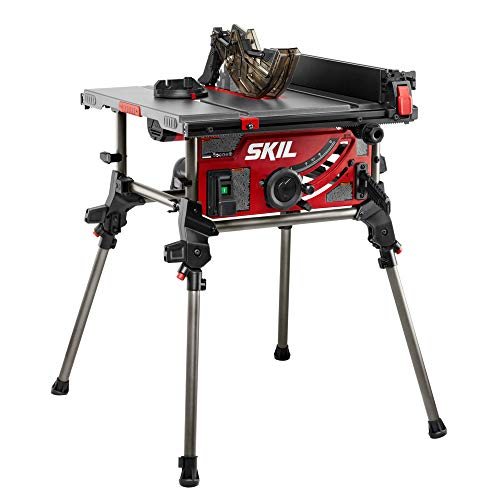
- SKIL TS6308-00: SKIL describes this as an 8-1/4-inch compact table saw with a 15-amp motor, rack-and-pinion fence rails, and an aluminum table. The manufacturer says its folding saw stand is sold separately. That distinction is important for a buyer comparing a compact body with a ready-to-use station.
- DEWALT DWE7485: DEWALT markets this 8-1/4-inch tool as a compact portable jobsite saw, with rack-and-pinion rails and a modular guard system. It can be evaluated as a compact bench-mounted option only after confirming the manual’s setup and mounting instructions; it is not a stationary cabinet saw.
- Bosch GTS15-10: Bosch describes this as a 10-inch jobsite saw with a wheeled stand, Smart Guard components, and a 32-1/8-inch right rip capacity. It demonstrates how an included stand changes the footprint and overall setup compared with a bare benchtop machine.
These examples span compact and jobsite-oriented designs. They are not interchangeable: blade diameter and rip capacity differ, and each requires its own compatible accessories and safe setup. Verify specifications from the exact regional product page and current manual; do not transfer a capacity or accessory claim from one model to another.
Mounting, support, and shop layout
Secure the saw to a stable base
Follow the mounting instructions in the manual. Use the specified holes, fasteners, and base arrangement; do not drill the saw housing or attach it in a way that blocks vents, adjustment controls, or access to the switch. Check that the bench does not flex under feed pressure. If the bench has wheels, lock them before use and verify that the entire assembly cannot move.
Plan infeed and outfeed support
Long stock needs level support before it reaches the blade and after it leaves. Set roller stands or auxiliary tables at the same height as the saw surface, positioned so they support the stock without forcing it sideways or upward. A helper may be needed for long or awkward boards, but the operator must remain in control of the feed and cannot rely on someone else to steer the piece.
For sheet goods, plan a safe way to carry, lift, and support the panel before starting the saw. A compact table may not provide enough surface to stabilize a full sheet. Break down large panels with a suitable guided saw when necessary, then perform manageable cuts on the table saw. Keep the offcut from falling or pinching the blade.
Keep the operating space clear
Measure the full length of the board and the travel of the fence rails. Clear the feed path of cords, stools, doors, clamps, and stored tools. The operator should be able to stand comfortably, see the cut, reach the switch, and move away without stepping over obstacles. Leave space for dust hoses and for the workpiece to pass without contacting a wall.
Safety and first-use setup
A table saw can cause severe cuts and kickback injuries. Read the exact manual and get instruction before operating. Keep the blade guard and riving knife installed as directed, use eye and hearing protection, wear fitted clothing, and tie back long hair. Do not wear gloves near a rotating blade. Keep hands out of the cut line and use an appropriate push stick or push block when the cut requires hands to stay farther from the blade.
- Unplug the saw before assembly, alignment, or blade changes.
- Check that the saw is secured to a stable bench or approved stand.
- Inspect the blade, guard, riving knife, throat plate, fence, miter gauge, switch, and cord.
- Set the guard and riving knife according to the manual for the operation.
- Use a push device for narrow stock; do not improvise a hand position close to the blade.
- Keep the work flat on the table and against the fence during a rip cut.
- Use a miter gauge, sled, or approved fixture for crosscutting; do not trap an offcut between the rip fence and blade.
- Wait for the blade to stop before removing offcuts or reaching near the cutting area.
OSHA’s woodworking table-saw resource describes guarding, push sticks, and kickback hazards. It is workplace guidance and not a replacement for the operator manual or training. Do not bypass a guard, riving knife, switch, or other safety device. If the stock binds or moves unpredictably, stop the saw and wait until the blade stops before investigating.
Maintenance and accuracy
Dust and resin can collect on the table, fence, and adjustment mechanisms. Disconnect power before cleaning or servicing. Use only cleaning and lubrication methods approved by the manufacturer. Keep the table surface free of debris and avoid wax or lubricant that can contaminate workpieces or create a slippery feed surface unless the manual allows it.
Check fence alignment, blade parallelism, miter slot alignment, bevel stop, and blade height mechanism periodically. Transport or bench removal can disturb settings. Make a test cut in scrap after adjustments, then measure the result with a reliable square or gauge. If the fence lock slips or the blade wobbles, stop use and repair the saw before continuing.
Inspect the blade for dullness, damage, missing teeth, pitch buildup, and vibration. Replace or sharpen it according to the manufacturer’s guidance. A dull blade increases feed effort and heat; forcing the stock is not a safe way to compensate. Store the machine so it cannot fall, and protect the blade and accessories from impact.
Common benchtop buying mistakes
- Confusing benchtop with miniature. Craft-scale saws are for smaller material and have very different capacities.
- Assuming a stand is included. Verify exact package contents and budget for a stable base.
- Buying by motor amperage alone. Fence, table support, blade, and intended stock also matter.
- Ignoring rail and board clearance. A compact body may still need a long operating footprint.
- Using a fence scale without checking alignment. Calibrate the saw according to the manual and test on scrap.
- Planning full-sheet cuts on a tiny table. Make a safe handling and support plan before buying.
- Assuming every saw accepts dado stacks. Check the manual and insert requirements for the exact model.
- Removing the guard for convenience. Choose a machine and setup that support safe operation with guards in place.
Research method and primary sources
This guide uses manufacturer product information and manuals to describe representative compact and jobsite configurations, and OSHA material for general table-saw hazards. It does not claim to have measured cut quality, tested fences, or compared saws hands-on. Product lines and specifications may change, so use the model-specific manual and live manufacturer page as the authority before purchase and operation.
- SKIL TS6308-00 official product page
- SKIL SFS0001 stand compatibility page
- DEWALT DWE7485 official product page and manual access
- Bosch GTS15-10 official product page and manuals
- OSHA eTool: table-saw hazards and controls
Frequently asked questions
What is the main advantage of a benchtop table saw?
It provides table-saw functions in a compact machine that can be mounted on a bench or stored when not in use. This can suit a small shop or occasional projects, provided the base is stable and stock is supported safely.
Is a benchtop table saw the same as a jobsite saw?
Not always. A jobsite saw is designed around transport and rapid setup, often with a folding or wheeled stand. Some jobsite models can sit on a bench, but compare the exact mounting instructions, rails, stand package, and footprint.
Can a benchtop table saw cut plywood?
It may cut plywood within its capacity, but a full sheet can be difficult to handle on a small table. Plan support, help, and a safe path. Many users break down the sheet with a guided circular or track saw before making smaller cuts at the table saw.
Can I mount a compact saw to any workbench?
No. The bench must be stable, sufficiently strong, flat enough for the saw, and compatible with the manufacturer’s mounting instructions. Secure the saw so it cannot shift or tip, and keep vents and controls unobstructed.
Are benchtop table saws accurate enough for furniture?
Some can make repeatable cuts for small projects when the fence and blade are aligned, the stock is supported, and the blade is appropriate. Verify results with test cuts. A compact saw may need more careful setup and may be less convenient for wide panels than a larger machine.
Do benchtop table saws accept dado blades?
Compatibility varies. Some models explicitly prohibit dado sets; others allow a specified diameter and stack width with an approved insert. Check the exact manual for arbor length, blade diameter, maximum width, and guard requirements. Do not rely on another model’s instructions.
Is a benchtop table saw good for a beginner?
It can be suitable if the user reads the manual, receives instruction, keeps safety components installed, and starts with manageable cuts. Compact dimensions do not eliminate kickback or blade-contact risks. A stable base and adequate material support are essential.
Should I buy a 10-inch or 8-1/4-inch benchtop saw?
Compare actual cut depth, blade availability, fence range, table size, accessories, and the stock you plan to cut. A larger blade is not automatically a better fit if the saw’s base or support is too small for your work.
How do I control dust from a benchtop saw?
Use the manufacturer’s dust port and a compatible extractor, keep the work area ventilated, and clean up with suitable equipment. Port design does not capture all airborne dust. Follow guidance for the material and wear appropriate respiratory protection.
What should I do if the saw moves on the bench?
Stop the saw and disconnect power before adjusting the setup. Secure it using the manufacturer’s mounting instructions and recheck stability. Do not continue cutting with a machine that shifts, rocks, or tips under feed pressure.
Final decision
Choose a benchtop table saw by its fence, secure mounting, guard system, blade limits, usable table area, and compatibility with your stock. Plan long-board and sheet support before buying, and include the stand, blade, dust connection, and other required parts in the total cost. Set the machine up according to its manual, verify alignment on scrap, and use safe workholding for every cut.
This article provides general buying guidance. The current manual for your exact saw and accessories governs assembly, compatibility, and operation.