Where to buy
Check the latest price, availability and delivery on Amazon. Orders are placed on Amazon. We may earn a commission from qualifying purchases.
- Best overall: Lepro LED Desk Lamp, Metal, 9.5W 800lm — Check on Amazon
- Airlonv LED Desk Lamp with Clamp, 17-Inch Bar — Check on Amazon
- Lampat Dimmable LED Desk Lamp with USB Charging Port — Check on Amazon
- LEPOWER LED Desk Lamp, 800LM, 50 Lighting Modes — Check on Amazon
See 2 more Amazon options
- LEPOWER Metal Desk Lamp with Flexible Gooseneck (E26) — Check on Amazon
- Lepro Small Desk Lamp with Clamp, USB Powered — Check on Amazon
Read the full guide ↓
Disclosure: As an Amazon Associate, dailyhomedecorating.com earns from qualifying purchases. Links to Amazon on this page are affiliate links; they cost you nothing extra. Listing details such as price and availability change often, so check the current Amazon listing before you buy.
The best desk lamps under $40 are real desk lamps, and that sentence is worth saying out loud because it is not true of every category at every price. Forty dollars is the tier where desk lighting stops being a compromise: while researching this guide in November 2026 we found metal-bodied lamps, a 17-inch clamp-on light bar wide enough for two monitors, stepless dimming, fifty combinations of color temperature and brightness, and one lamp with a USB charging port in its base — all genuinely positioned under the line. Nobody in this guide is a toy, a night light wearing a desk lamp’s title, or a full-price product photographed to look cheaper than it is. If your desk is lit by a bare ceiling bulb or the glow of your own monitor, every pick below is a serious upgrade.
What this guide will be straight with you about is the spec sheet, because desk lamp listings are written in a dialect of marketing that needs translating. The lumen figures are the makers’ own numbers, measured by methods nobody publishes, with no common standard standing behind them — an “800 lumen” lamp from one brand is not guaranteed to light your desk like an “800 lumen” lamp from another. “Eye-caring” is a claim, not a certification: the American Academy of Ophthalmology is explicit that screen and reading strain is a comfort problem, not eye damage, and that the fixes are brightness matching, glare control and regular breaks — things a good lamp helps with mechanically, not magically. The USB ports charge at 5V and one to two amps, which is a slow top-up, not fast charging. And most of these lamps have integrated LEDs, which means when the light source eventually dies, the lamp dies with it. We will flag each of those realities where it applies, product by product.
So this guide covers the six honest shapes a desk lamp takes under $40: a metal base-standing lamp that does everything well, a wide clamp-on bar for big desks, a classic preset lamp with a charging port, a wide-panel lamp with the finest control in the group, a bulb-based metal lamp you can keep for decades, and a small USB clip-on for desks with no space to spare. For most people we would begin with the Lepro metal lamp, because it pairs the strongest claimed output in the group with a metal body — check price on Amazon for the current listing. If your desk is wide or your surface is full, the Airlonv clamp bar is the better spend. Below you will find a quick picks table, detailed notes on all six products, a comparison table, a buying checklist, an honest account of what the numbers on the box do and do not mean, the mistakes shoppers make at this price, and answers to the questions that come up again and again.
Quick Picks
Short on time, or comparing several options at once? Each row below names a buyer type and the product that suits it, with a link to the listing.
| Buyer type | Pick | Why it stands out | Link |
|---|---|---|---|
| Best overall | Lepro LED Desk Lamp, Metal, 9.5W 800lm | Metal body, the strongest claimed output here, 25 light combinations — check price on Amazon | Check on Amazon |
| Best for wide desks | Airlonv LED Desk Lamp with Clamp, 17-Inch Bar | A wide bar on a clamp — even light across two monitors, zero desk footprint | Check on Amazon |
| Best with USB charging | Lampat Dimmable LED Desk Lamp | Named preset modes anyone can use, plus a 5V/2A USB port in the base | Check on Amazon |
| Best fine control | LEPOWER LED Desk Lamp, 800LM, 50 Modes | Five color temperatures times ten brightness levels, with memory | Check on Amazon |
| Best bulb-based lamp | LEPOWER Metal Desk Lamp, Gooseneck (E26) | All-metal lamp that takes a standard bulb you choose and can replace forever | Check on Amazon |
| Best for tiny desks | Lepro Small Desk Lamp with Clamp | A USB-powered clip-on gooseneck that uses no desk surface at all — check price on Amazon | Check on Amazon |
How These Picks Were Chosen
The first filter was the budget itself, applied honestly. Every product below is a real Amazon listing positioned at or under $40 in the United States in the configuration this guide recommends. Prices in this category move constantly, so we chose products whose normal positioning sits comfortably under the line rather than products that only dip under it during a brief sale. The LEPOWER panel lamp sits toward the upper end of this tier, while the other picks sit toward the lower and middle parts of the band — check the current price on Amazon for each listing before you buy.
We did not use these products ourselves. We read the maker listings and specification pages, compared claimed output, color temperature ranges, dimming systems, mounting styles and charging ports, and cross-checked the listings against independent roundups that verified buy-box presence and live prices in the same period. Where a spec matters and the maker does not publish it — CRI is the usual absentee at this price — we say so in the review rather than guess, and the buying checklist below tells you what to look for on the listing before ordering.
One filter deserves its own paragraph, because it shaped the whole list: we treated every brightness figure as a maker’s claim, because that is what it is. There is no common measurement standard enforced across desk lamp listings, no independent body certifying that one brand’s 800 lumens equals another’s, and the number that actually reaches your paperwork — illuminance, measured in lux — depends on the lamp’s height, angle and distance from the desk as much as on its output. So we weighted the things you can verify from a listing and a photograph: how wide the light source is, how finely it dims, how far its color temperature range runs, how it mounts, and what its body is made of. A wide bar at a claimed 600 lumens will light a desk more evenly than a pinpoint head at a claimed 800, and the reviews below argue in those terms.
The 6 Best Desk Lamps Under $40
Lepro LED Desk Lamp, Metal, 9.5W 800lm
Who it suits: Most people, most desks — anyone who wants one good lamp for reading, paperwork and screen work without learning a control panel or giving up desk space to a clamp.
This is the lamp the rest of the guide is measured against, and its headline surprise is the material. Under $40, desk lamps are plastic almost by definition; the Lepro’s arm and shade are metal, which is why it feels like office equipment rather than an accessory, and why it survives being knocked, dragged and re-aimed daily in a way plastic joints do not. The light itself is a panel of 72 LEDs behind a diffuser, rated by the maker at 800 lumens from 9.5 watts — the strongest output claim among the base-standing lamps here — with five color modes and five brightness levels combining into 25 settings, worked by touch controls on the base. The maker’s specification data puts the five color temperatures at roughly 3000K, 3500K, 4000K, 5000K and 6500K, which is the full useful span: warm evening light at one end, cool daylight at the other. Check price on Amazon for the current listing. It has a rating record in the thousands and, per the listing, thousands bought in the past month — the kind of sales volume that keeps a model, its parts and its support alive.
Two honest qualifications belong here. The first is the base: the listing’s own specification table lists the base material as plastic, so “metal lamp” means a metal arm and shade on a plastic base — still a clear step up from an all-plastic lamp, but not the full-metal object the title implies. The second is the dimming: five brightness steps are coarse at the low end, so walking the brightness down to exactly match your screen at midnight is a hop between presets rather than a slide, and if fine low-end control is your priority the Airlonv and LEPOWER below both do it better. There is no USB charging port, and Lepro does not publish a CRI figure for this lamp, so if certified color accuracy matters to your work, read the section on what $40 does not buy before ordering. None of that dethrones it: this is the most complete desk lamp in the guide.
- Metal arm and shade at a price where rivals are plastic — the build-quality pick of the tier.
- Maker-rated 800 lumens with five color modes and five brightness levels: 25 combinations.
- Compact footprint and a diffuser panel that spreads light instead of spotlighting it.
Honest limitation: The base is plastic despite the metal billing, the five brightness steps are coarse at the low end, and there is no USB port or published CRI figure.
Choose it if you want the best all-round lamp here and your desk has room for a small base. Skip it if you need stepless dimming, a charging port, or a clamp mount — all three exist below.

Airlonv LED Desk Lamp with Clamp, 17-Inch Bar
Who it suits: Owners of wide desks and dual-monitor setups, and anyone whose desk surface is already full — the lamp clamps to the edge and takes no surface at all.
Every other lamp in this guide is a point of light; the Airlonv is a line of it. Its head is a 17-inch bar carrying 100 LEDs, mounted on a flexible gooseneck that rises from a clamp, and that geometry is the whole argument: a wide bar held above the desk throws an even pool across a keyboard, a mouse and paperwork on both sides, where a small round head gives you a bright circle and dark corners. The controls are the finest here alongside the LEPOWER — stepless dimming from 1 to 100 percent, so you can walk the brightness down until screen and desk match instead of hopping between presets, and a color temperature range that runs the full 2700K to 6500K span. Check the current price on Amazon before you buy. It currently sits at the top of Amazon’s desk lamp best-seller rankings, which matters practically: listings with that volume tend to stay in stock, stay supported, and keep their reviews meaningful. For a two-monitor desk, this is the pick, and it is not close.
The clamp is both the feature and the condition. It needs a desk edge it can bite — a solid top of reasonable thickness — and it is the wrong tool for a glass desk, a top with a deep decorative edge profile, or a standing desk whose rear edge is occupied by a cable tray. It is also corded, powered through a USB adapter, with no battery option, and like every lamp here its light source is integrated: the bar is not a bulb you can swap. One more honesty note: no independent tester in our research had put a light meter on this exact model, so its ranking rests on its verified listing specifications and the well-established physics of wide bars, which favor even coverage over peak brightness claims. If your desk can take a clamp, that trade is worth it.
- A 17-inch, 100-LED bar lights a wide desk evenly — the dual-monitor pick of the guide.
- Stepless 1–100% dimming and a full 2700K–6500K color range.
- Clamp mounting uses zero desk surface; the gooseneck aims the bar where you work.
Honest limitation: It needs a clampable desk edge — glass tops and occupied rear edges rule it out — and it is corded only, with a non-replaceable integrated light source.
Choose it if your desk is wide, your monitors are many, or your surface is full. Skip it if your desk cannot take a clamp — the Lepro metal lamp stands on its own base.

Lampat Dimmable LED Desk Lamp with USB Charging Port
Who it suits: Anyone who wants light without a learning curve — shared family desks, bedside desks, gift purchases — and anyone whose power strip is full but whose phone still needs charging.
The Lampat is the elder of this guide: a design that has been selling for roughly a decade, which in this category is a credential in itself. Instead of Kelvin numbers it offers four named modes — Reading, Studying, Relaxation and Bedtime — crossed with five brightness levels, worked from a touch panel on the base, with a one-hour auto-off timer for the lamp you fall asleep under. The named-mode approach sounds like a simplification and is, deliberately: most people do not think in color temperatures, they think “bright for homework, soft for bedtime,” and this lamp speaks that language. Its second distinction is in the base: a USB charging port, rated 5V/2A on the current listing. Read that number honestly — 5 volts at 2 amps is 10 watts, a steady top-up that will charge a phone over a work session or overnight, not the fast charging your phone’s own modern adapter delivers, and there is no USB-C Power Delivery here. As a way to retire one wall wart from a crowded strip, though, it is genuinely useful, and it is the only charging port in this guide. Check price on Amazon for the current listing.
The trade-offs are age and material. The body is plastic, in a guide where the Lepro offers metal construction, and the design’s preset system is coarse: five brightness steps and four fixed modes cannot fine-walk brightness to match a screen the way the stepless lamps can, and the color temperatures behind the named modes are the maker’s choices, not yours. The touch panel that lights up charmed reviewers a decade ago and now simply dates the lamp. None of that stops it being the easiest lamp here to hand to a parent, a child or a houseguest and have it understood in ten seconds — and for a bedside desk, the Bedtime mode plus the auto-off timer is a combination nothing else in this guide quite matches.
- Four named modes times five brightness levels — the simplest controls in the guide.
- A 5V/2A USB charging port in the base, plus a one-hour auto-off timer.
- A decade-long sales record; the gift-safe, anyone-can-use-it pick — check price on Amazon.
Honest limitation: The body is plastic, the preset steps are coarse, and the USB port’s 10 watts is a slow top-up — not fast charging by any modern phone standard.
Choose it if simplicity, a timer and a charging port top your list. Skip it if you want metal construction or stepless control — the Lepro and Airlonv cover those.
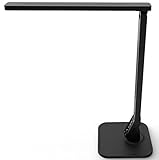
LEPOWER LED Desk Lamp, 800LM, 50 Lighting Modes
Who it suits: Long-hours desk workers who actually adjust their light — people who want warm and dim at 10 p.m. and cool and bright at 10 a.m., set precisely, from the same lamp.
If the Lepro is the best all-rounder, the LEPOWER is the control freak’s pick, and the arithmetic is the reason: five color temperatures crossed with ten brightness levels makes fifty lighting modes, the deepest menu in this guide, worked from a touch panel with a memory function that restores your last setting when you switch back on. The head is a panel the maker describes as twice the width of its standard lamps, rated at 800 lumens from 12 watts, on a 360-degree flexible gooseneck, and the maker claims a lighting area of up to 50 inches — treat that as a coverage claim rather than a measurement, but the underlying point is real: a wider panel spreads the same output over more desk, which is what even, low-glare light actually is. The listing also carries an RG0 claim under the IEC 62778 photobiological standard, which concerns blue-light hazard classification of the light source. It sits toward the upper end of this tier — check the current price on Amazon before you buy.
That RG0 badge deserves the honest paragraph, because it is doing marketing work. RG0 is a real classification, and a lamp whose maker has sought it is not nothing — but it classifies the light source’s blue-light hazard under test conditions; it is not a promise that your eyes will not tire, and no lamp can make that promise. The ophthalmology guidance is consistent: strain at a desk comes from glare, from a screen much brighter than the room around it, and from hours without a break, and the fixes are mechanical — match the brightness, kill the glare, look away regularly. Buy this lamp for its fifty modes and wide panel, which genuinely help with the first two; do not buy it as eye protection in a box. Its practical costs are a base noticeably larger than the others here — around 7.5 inches across per reviewer measurements, which is real estate on a small desk — and the absence of a USB charging port.
- Fifty lighting modes — five color temperatures times ten brightness levels — plus memory.
- A double-width panel (maker’s description) for broad, even coverage from 12 watts.
- Touch controls and a flexible 360-degree gooseneck on a stable, full-size base.
Honest limitation: The base is the largest here at roughly 7.5 inches across, there is no USB port, and the RG0 “eye-caring” badge is a maker certification claim about the light source — not a guarantee against eye strain.
Choose it if you adjust your light often and want the finest control under $40. Skip it if your desk is small — its base is the greediest here — or you need a charging port.
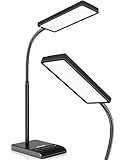
LEPOWER Metal Desk Lamp with Flexible Gooseneck (E26)
Who it suits: Buyers who distrust integrated LEDs and feature lists — anyone who wants a lamp that is a well-made metal object, whose light comes from a standard bulb they choose, replace and upgrade forever.
This is the analog answer in a digital guide, from the same brand as the panel lamp above and built on the opposite philosophy. The lamp itself is metal — shade, gooseneck and weighted base — with a simple on/off switch and an E26 socket, and everything electronic about it is the bulb you screw in. That inverts the usual compromises. Brightness and color temperature are not presets here; they are whatever bulb you buy, from a dim 2700K filament-style LED for evening reading to a bright 5000K daylight bulb for paperwork, and if your needs change, swapping in a different bulb changes the lamp. Dimming, likewise, is the bulb’s job: fit a dimmable bulb on a dimmer and it dims; the lamp itself does not. And when the light source eventually fails — the failure that retires every integrated lamp in this guide — you replace a bulb in thirty seconds instead of replacing a lamp. Check price on Amazon for the current listing. As a physical object it is the most satisfying thing here: heavy, simple, and with almost nothing in it to break.
The honesty notes are about what is not in the box and what is not on the spec sheet. The standard listing is the lamp only — allow for an E26 LED bulb if you do not have one, and check the listing’s configuration before ordering, because the lamp on its own is not a working light until a bulb is fitted. There are no modes, no timer, no memory and no USB port; the gooseneck, like every gooseneck, will hold a position for years and very slowly sag over a longer horizon; and the lamp’s reach is a compact desk’s reach, not a wide bar’s. What you are buying is the oldest bargain in lighting: a durable holder for a light source, in an era when the light source usually dies holding the holder hostage. For a reading chair, a workbench or a bedside desk, that bargain is hard to beat.
- All-metal construction with a weighted base and a flexible gooseneck.
- Takes any standard E26 bulb — you choose the brightness and color temperature, and replace it forever.
- Almost nothing electronic to fail; the simplest, longest-lived design in the guide.
Honest limitation: The bulb is not included in the standard listing, and there is no built-in dimming, color adjustment or timer — every smart behavior has to come from the bulb you fit.
Choose it if you want a lamp for the long term and like choosing your own light. Skip it if you want modes and dimming out of the box — that is the LEPOWER panel lamp or the Lepro.
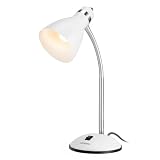
Lepro Small Desk Lamp with Clamp, USB Powered
Who it suits: Dorm rooms, shared desks, headboards and shelves — anywhere the desk surface itself is too precious to spend on a lamp base.
The smallest lamp here sits at the most accessible end of this tier, and its spec sheet reads like a deliberate trade rather than a cut-down. It clips to a desk edge, shelf or headboard — the clamp fits surfaces up to about two inches thick — and throws its light from a flexible gooseneck, so the whole lamp occupies the few square inches its clamp bites and nothing else. The maker rates it at 460 lumens from 5 watts, with three color modes and ten brightness levels, which is finer brightness control than the full-size Lepro above manages. It runs on USB power, which cuts both ways in ways worth spelling out: it will live happily on a laptop port, a monitor’s USB socket or a power bank, which makes it the only lamp here that works where there is no spare wall outlet at all — and it will only ever be as bright as the port feeding it allows. Its rating record is the deepest in this guide, in the many thousands, which makes it one of the most proven purchases on the page for its position at the accessible end of this tier — check price on Amazon for the current listing.
The limitations are printed on the listing itself, to the maker’s credit: the AC adapter is not included, and the lamp is not rechargeable — it is a corded lamp whose cord happens to end in USB, so if your only USB source is a weak laptop port, expect the top brightness levels to be theoretical. Four hundred and sixty maker-claimed lumens lights a work zone — a book, a laptop, a notebook — not a whole desk, and dual-monitor owners should be looking at the Airlonv bar instead. The three color modes are fixed stops rather than a range you can slide through. None of this is a flaw so much as a definition: this is a task light for one person’s pool of work, priced like a textbook accessory, and for a student or a renter it may be the most sensible purchase in the guide.
- Clamp-on gooseneck that uses no desk surface — fits edges up to about two inches thick.
- USB powered: runs from a laptop, monitor port or power bank where outlets are scarce.
- Three color modes with ten brightness levels — the most accessible pick in this tier; check price on Amazon.
Honest limitation: No AC adapter is included and it is not rechargeable, so brightness depends on the USB source feeding it; its 460 claimed lumens light a work zone, not a whole desk.
Choose it if space is the problem and your lighting job is one book or one laptop. Skip it if you need to light a full workstation — step up to the Airlonv bar or the Lepro metal lamp.

Comparison Table
| Product | Type | Best use | Link |
|---|---|---|---|
| Lepro LED Desk Lamp, Metal, 800lm | Base-standing LED panel | The all-round desk lamp for most people | Check on Amazon |
| Airlonv LED Desk Lamp with Clamp | Clamp-on light bar | Wide and dual-monitor desks, full surfaces | Check on Amazon |
| Lampat Dimmable LED Desk Lamp | Base-standing preset lamp | Simple controls, a timer and phone top-ups | Check on Amazon |
| LEPOWER LED Desk Lamp, 50 Modes | Base-standing wide panel | Fine, precise control of color and brightness | Check on Amazon |
| LEPOWER Metal Desk Lamp (E26) | Bulb-based gooseneck | A metal lamp you can keep and re-bulb for decades | Check on Amazon |
| Lepro Small Desk Lamp with Clamp | USB clip-on gooseneck | Dorms, headboards and desks with no surface to spare | Check on Amazon |
How to Choose a Desk Lamp Under $40
- Start with the mount, not the light. A base needs a clear circle of desk — up to about 7.5 inches across for the LEPOWER — while a clamp needs a biteable edge of solid material up to roughly two inches thick. Glass desks, occupied rear edges and tiny desks each rule options in or out before brightness enters the conversation.
- Read lumens as a rough neighborhood, not a measurement. These are maker figures with no common standard behind them. Treat 450–800 claimed lumens as “the normal range for a desk lamp,” and weight the width of the light source and the fineness of the dimming more heavily than the headline number.
- Match the dimming style to your habits. Stepless dimming (Airlonv) suits people who tune light to a screen; ten levels (LEPOWER, Lepro clamp) suit people who adjust often; five levels or named presets (Lepro, Lampat) suit people who set it once and forget it.
- Check the color temperature span, in Kelvin. A full 2700K–6500K range covers warm evenings and cool task light in one lamp. Named modes hide the numbers behind the maker’s choices — fine, unless you know you want a specific temperature.
- Interrogate the USB port before valuing it. Lamp ports run at 5V/1A to 5V/2A — five to ten watts. That is a top-up for a phone on the desk, not fast charging, and no lamp here offers USB-C Power Delivery. A port is a bonus, never a reason to choose a lamp.
- Decide how you feel about integrated LEDs. Five of these six lamps have light sources that cannot be replaced; when the panel dies, the lamp is done. The E26 LEPOWER metal lamp is the exception, and it trades every electronic feature for that permanence.
- Ask who publishes a CRI — and accept the answer. Most makers at this price do not publish color rendering figures at all. If your work is color-critical, that silence is information; see the section below on what $40 does not buy.
- Check what powers it, and what is in the box. USB-powered lamps may ship without an AC adapter (the Lepro clamp does not include one), and bulb-based lamps may ship without a bulb (the LEPOWER metal’s standard listing). Check the current price on Amazon and confirm what is included, so you know what else you need to buy.
- Keep the packaging for a week. A lamp’s real test is your desk at your working hours — glare on your screen, reach across your papers, heat and bulk where your hands live. Judge it there, not under shop lighting in the first five minutes.
The Lumens Problem: Read the Numbers Like a Skeptic
Every desk lamp listing on Amazon leads with a lumen figure, and almost none of those figures can be compared with each other. Lumens measure a light source’s total output, and measuring them properly takes an integrating sphere and a method; what a listing prints is the maker’s own number, produced by the maker’s own process, under no shared standard and no independent check. One brand’s 800 and another’s 600 may describe the same pool of light — or not — and there is no way to know from the listings. This is why the reviews above argue from geometry instead: the width of the panel, the height of the head, the spread of the diffuser. What lands on your paperwork is illuminance, in lux, and it falls with distance — a modest lamp twelve inches above the page lights it harder than a mighty one three feet away, which is also why an adjustable arm or gooseneck is worth more than a bigger number.
The same skepticism applies, kindly, to “eye-caring.” It is not a regulated term. Some of its ingredients are real — diffusers that hide the bare LED points, DC dimming that avoids visible flicker, RG0 classification of a light source under IEC 62778 — and the better lamps here have some of them. But the American Academy of Ophthalmology’s position is that digital eye strain is discomfort, not damage, and that relief comes from setup: a screen no brighter than the room demands, light that does not reflect off the display, and the 20-20-20 habit of looking at something twenty feet away for twenty seconds every twenty minutes. A good lamp under $40 genuinely delivers the first two. No lamp at any price delivers the third, and any listing that promises to protect your eyes is selling you the one thing it cannot ship.
What $40 Buys — and What It Still Doesn’t
It is worth pausing on how much of the desk lamp problem $40 now solves, because the honest answer is: most of it. At this tier you get metal construction, light wide enough for two monitors, color temperature across the full useful range, dimming fine enough to match a screen, memory functions, timers and even a charging port — specifications that belonged to a higher tier a decade ago. The floor of the category has also risen: the most accessible pick in this guide has ten brightness levels and a rating record in the thousands. If your need is a well-lit desk for reading, writing and screen work, this guide is not a waiting room for a more expensive purchase; it is the destination, and the guides at the next tier — Best Desk Lamp Under $100 — are for people with a specific extra need, not a general one.
What $40 does not buy is verification and luxury. Color accuracy is the clearest gap: CRI figures at this price are unpublished or unverified, and the lamps with independently certified high-CRI output, flicker performance tested to standards like IEEE 1789, and wide, engineered light fields live at two to four times this budget. Build luxury is the second gap — machined arms with counterbalanced joints that hold any position for a decade, rather than goosenecks that very slowly relax. Smart features are the third: no lamp here talks to a phone, a voice assistant or a sunrise schedule. And sheer design is the fourth; these are good-looking tools, not furniture. If none of those four gaps touches your work, spend the forty with confidence. If color-critical work is your living, believe the gap and budget accordingly.
Will It Fit Your Desk?
Mounting decides more desk lamp regrets than brightness does, so walk the three questions before ordering. First, the surface: a base-standing lamp needs a flat, clear patch — about 4 inches across for the Lepro metal lamp’s base, nearer 7.5 for the LEPOWER panel — that stays clear, because a base under a pile of papers is a lamp waiting to be knocked. Second, the edge: both clamp lamps here bite edges up to about two inches thick, but the edge must be solid — particleboard with a hollow core, glass, and tops with deep rounded profiles all make poor jaws, and a clamp lamp on a bad edge sags exactly the way its reviews complain about. Third, the power: the Lepro clamp wants a USB source with real output, the Airlonv wants its adapter near an outlet, and the bulb-based LEPOWER wants a wall socket and a bulb you may need to buy. Five minutes with a tape measure and a look at your power strip settles all three, and it is the cheapest five minutes in the purchase.
Position matters as much as fit. Put the lamp on the opposite side from your writing hand so your hand’s shadow falls away from the page; keep the head above and slightly behind your screen’s plane for desk work so the light washes the desk without reflecting off the display; and if the lamp lights a shared or family desk, favor the models whose heads angle down into a pool — the goosenecks here — over anything that spills light horizontally into someone else’s eyes. Every lamp in this guide can do the basics of that setup; the differences are in how much desk each one lights while doing it.
Common Buying Mistakes
- Comparing lumen numbers across brands as if they were measured the same way — they were not, and the wider, better-aimed lamp usually wins the desk.
- Buying “eye protection” instead of a setup: a lamp cannot fix a screen blazing in a dark room, and no listing badge substitutes for brightness matching and breaks.
- Paying for a USB port as if it were a fast charger. Five to ten watts tops up a phone; it does not charge one in an hour, and it should never be the deciding feature.
- Ordering a clamp lamp for a desk with no clampable edge — glass, hollow-core or deeply profiled tops — then blaming the clamp.
- Forgetting the missing pieces: the adapter the USB lamp does not include and the bulb the E26 lamp does not include — check what is in the box before ordering.
- Choosing a pinpoint head for a wide desk, then working in a bright circle surrounded by dark — the problem a bar or wide panel exists to solve.
- Assuming integrated LEDs are replaceable. On five of these six lamps the light source is the lamp; when it dies, you are shopping again.
- Judging color temperature from a listing photo. Screens lie about light; check the Kelvin range in the specifications, or choose a lamp whose range is wide enough that the exact stops do not matter.
Final Recommendation
- Most buyers: Lepro LED Desk Lamp, Metal, 9.5W 800lm.
- Wide desks and dual monitors: Airlonv LED Desk Lamp with Clamp, 17-Inch Bar.
- Simple controls and a charging port: Lampat Dimmable LED Desk Lamp.
- Finest light control: LEPOWER LED Desk Lamp, 800LM, 50 Modes.
- Buy-it-for-decades simplicity: LEPOWER Metal Desk Lamp with Flexible Gooseneck (E26).
- Tiny desks and dorms: Lepro Small Desk Lamp with Clamp, USB Powered.
Our top two are the Lepro metal lamp for the majority of desks — metal where rivals are plastic, the strongest claimed output here; check price on Amazon — and the Airlonv clamp bar for wide or crowded desks, because even light across the whole work surface is the thing a desk lamp is actually for. If your household runs on simplicity, take the Lampat and its named modes; if you run on control, take the LEPOWER and its fifty. And if you finished this guide realizing your real requirement is certified color accuracy or a counterbalanced arm, believe yourself and take the step up deliberately rather than buying twice. For everyone else: measure your desk edge or your clear patch, check the live price and what is included in the box on the listing, and order the lamp that matches the desk you actually have.
Frequently Asked Questions
How many lumens do I actually need in a desk lamp?
Enough to light your work zone to roughly the brightness of the room’s task lighting — for reading and paperwork, a few hundred lux on the page is the usual working range, and a lamp claiming 450 to 800 lumens, positioned a foot or so above the desk, generally gets there. Treat the lumen figure as a rough neighborhood rather than a measurement, because makers measure their own numbers without a common standard; the width of the light source and how close you can position it matter as much as the headline figure.
Is a USB charging port on a desk lamp worth having?
As a bonus, yes; as a reason to buy, no. Lamp ports deliver 5V at 1 to 2 amps — five to ten watts — which tops up a phone across a work session or overnight and retires one wall wart from a crowded strip. It is not fast charging, it is not USB-C Power Delivery, and it will not rescue a dying phone in twenty minutes. The Lampat is the only lamp in this guide with one, and it earns its place on its modes and timer first.
Clamp or base — which is better?
Neither; they answer different desks. A clamp frees the entire surface and suits wide, full or tiny desks, but needs a solid edge up to about two inches thick to bite — glass and hollow-core tops need not apply. A base works on any flat desk, moves in seconds and asks only for a clear patch of surface, from about four inches across to seven and a half depending on the lamp. Measure the desk you have, and the question answers itself.
What color temperature is best for studying and working?
Neutral to cool light — roughly 4000K to 5000K — is the conventional choice for paperwork and screen work because it renders print contrast crisply, while warm light around 2700K to 3000K suits evening reading and winding down. The evidence that any temperature “boosts focus” is thin; comfort and preference rule. The practical answer is a lamp with a range — everything in this guide spans warm to cool — so the lamp can follow the hour instead of your having to choose once, forever, at checkout.
Do “eye-caring” desk lamps really protect your eyes?
No lamp protects your eyes, and the American Academy of Ophthalmology is clear that screen and reading strain is discomfort rather than damage. What a good lamp genuinely does is mechanical: it raises the room’s light so your screen stops being the only bright thing in it, it diffuses the source so you are not staring at bare LED points, and it lets you match brightness instead of enduring it. Add the 20-20-20 break habit and you have the whole honest program — the badges on the box are, at best, pointers toward lamps that do the mechanical parts well.
Integrated LED or a lamp that takes a bulb — which lasts longer?
The bulb-based lamp, and it is not close. Integrated LEDs are rated for tens of thousands of hours, but the driver electronics usually set the real lifespan, and when any part of the light source fails the whole lamp is replaced. A metal E26 lamp like the LEPOWER gooseneck has almost nothing in it to fail: when the bulb dies you replace it in thirty seconds. The trade is features — the bulb lamp has no modes, dimming or timer of its own. Choose permanence or convenience with your eyes open.