Where to buy
Check the latest price, availability and delivery on Amazon. Orders are placed on Amazon. We may earn a commission from qualifying purchases.
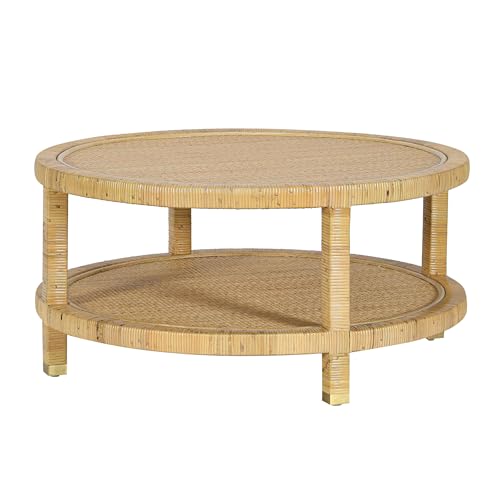
- Best overall for small spaces: TOV Furniture Amara Natural Rattan Coffee Table (TOV-OC21035) — Check on Amazon
- Poly & Bark Forma Coffee Table in Walnut — Check on Amazon
- Nathan James Asher Mid-Century Coffee Table, Glass Top, Rustic Oak Shelf, Gold — Check on Amazon
- Wayshome 100% Solid Oak 2-Tier Coffee Table, Walnut Colour, 39.37 Inch — Check on Amazon
See 2 more Amazon options
- Walker Edison Colt Solid Wood Rectangular Coffee Table, 48 Inch, Espresso — Check on Amazon
- SAFAVIEH Couture Torryn Burl Coffee Table, Walnut Burl (SFV5805A) — Check on Amazon
Read the full guide ↓
Disclosure: As an Amazon Associate, dailyhomedecorating.com earns from qualifying purchases. Links to Amazon on this page are affiliate links; they cost you nothing extra. Listing details such as price and availability change often, so check the current Amazon listing before you buy.
The best coffee table for small spaces under $1000 is a geometry problem before it is a shopping problem. In a small space — a compact living room, a snug den, a seating corner in an open-plan home — the table competes for the same floor as walking, playing, exercising and simply breathing, and every inch of footprint has to justify itself twice: once as surface, once as the space it denies everything else. The good news hidden in this guide’s $1000 ceiling is that premium money buys small-space intelligence, not just smaller furniture: a triangular solid-walnut plan that returns a corner to the room, a round woven top with no point to catch a shin, tempered glass that spends no visual space at all, and a two-tier oak table whose second shelf doubles its usefulness without doubling its footprint. This guide ranks six premium tables by how much living they return per square foot.
The TOV Amara leads on pure geometry: a 32.8-inch circle, no corners, no orientation, light enough to shift in seconds, and rated by its maker for a surprising 165 pounds. The Poly & Bark Forma follows with solid American walnut in a triangular plan purpose-built for awkward seating groups. The Nathan James Asher uses a glass top to make a 39-inch table feel like half that in a tight room, and adds a shelf. The Wayshome packs two solid-oak tiers into a sub-40-inch footprint for small spaces that need storage more than they need air. The Walker Edison Colt is the narrow-room specialist, a genuinely large surface only 24 inches deep and under 16 inches high. And the SAFAVIEH Torryn closes the guide as the considered exception: 45 inches of designer burl for the small space that is small by proportion, not by desperation. Every pick is a real listing positioned under $1000 — check the current price on Amazon before you buy.
Our short answer: measure your walkways first, then choose. Most small spaces should start with the Amara’s circle or the Forma’s triangle — the two shapes designed to give floor back. If the room’s problem is darkness rather than floor, start with the Asher. If it is clutter, start with the Wayshome. The method behind these rankings is set out in Best Coffee Table For Small Apartments Under $1000, and the lower-tier version of the same geometry lesson lives at Best Coffee Table For Small Spaces Under $700.
In this guide
Quick Picks
Short on time? Name your small space’s scarcest resource — floor, light, storage or calm — and take the table that returns it.
| Best for | Pick | Why it stands out | Link |
|---|---|---|---|
| Best overall for small spaces | TOV Amara Rattan, Round | A 32.8-inch corner-free circle that keeps every walkway open and still rates for 165 pounds | Check on Amazon |
| Best compact solid walnut | Poly & Bark Forma, Walnut | A triangular solid-walnut plan that tucks a point away and returns floor to the room | Check on Amazon |
| Best visual-lightness pick | Nathan James Asher, Glass and Gold | Glass that spends no visual space at all, with a shelf in a 39-by-20 footprint | Check on Amazon |
| Best compact with storage | Wayshome Solid Oak 2-Tier | Two solid-oak tiers in under 40 inches — storage density no other pick matches | Check on Amazon |
| Best slim-depth large surface | Walker Edison Colt, 48 Inch | A full serving surface only 24 inches deep and under 16 inches high, for narrow rooms with big sofas | Check on Amazon |
| Best for small-but-formal rooms | SAFAVIEH Couture Torryn Burl | Designer presence at 45 inches for the small room that is formal rather than cramped | Check on Amazon |
How These Picks Were Chosen
Small-space grading used a single ruthless metric: usefulness returned per square foot of floor surrendered. Footprints were compared not by headline width but by plan shape — circles and triangles return circulation that rectangles spend — and by what the footprint contains: a second tier, a shelf, or nothing but air beneath a slab. Visual mass was scored alongside physical mass, because in a small space a table you can see through is functionally smaller than its measurements.
We did not hands-on test these tables. We compared maker specifications: dimensions and plan shape; height against low small-space seating; weight, spanning 17.6 to 95 pounds, because small-space furniture is rearranged furniture; stated capacities, from the Asher’s 99 pounds to the Wayshome’s roughly 300, read as build guidance; materials, honestly labelled from solid walnut and oak to the Torryn’s veneer and the Asher’s engineered-wood shelf; and delivery form, including the Torryn’s fully assembled arrival, which in a small space means the room must be ready before the box is. Every pick also had to clear a premium bar — this is an under-$1000 guide, so small never means flimsy here.
A candour note on the two large picks: the Colt and the Torryn are in a small-spaces guide for narrow and formal rooms respectively, with their conditions stated in their reviews, not as defaults. If your tape measure disagrees with their inclusion, trust the tape — the four compact picks are the guide’s centre of gravity.
Best Coffee Table for Small Spaces Under $1000: All 6 Picks Reviewed in Detail
TOV Furniture Amara Natural Rattan Coffee Table (TOV-OC21035)
Who it suits: Small spaces with through-traffic, curved seating, children or pets — anywhere a corner is a hazard and a circle is a relief.
The Amara is the texture pick: a 32.8-inch round table with a hand-woven rattan and cane top and brass-capped legs, standing 15.9 inches high, weighing 25.8 pounds and rated by the maker for up to 165 pounds, a strong figure for a woven design. Round is a functional choice as much as a stylistic one: there are no corners to catch shins in a walkway, circulation flows around it in tight seating groups, and the woven surface brings warmth that glass and polished wood cannot. TOV describes the Amara line as blending natural charm with a touch of glamour, and the brass caps are exactly that junction. The candour points matter: rattan and cane are natural materials with texture, so mugs and glasses sit less dead-flat than on a milled top, a tray is the sensible everyday surface, and woven tops ask for gentler cleaning than laminate. There is no shelf, so storage lives elsewhere.
For small spaces the circle is not a style; it is a traffic system. People, children, dogs and robot vacuums all flow around the Amara without a negotiation, knees find no corner in the dark, and the table works at any rotation, so it never needs squaring to the sofa after it is bumped. Its 165-pound maker rating answers the worry that woven means fragile, and a tray answers the flatness question. In the smallest rooms in this guide’s audience, no other pick returns this much calm per square foot.
- Round hand-woven rattan and cane top; brass-capped legs; no corners.
- 32.8-inch diameter x 15.9 inches; 25.8 lb; maker rates it for up to 165 lb.
- Works at any rotation; serve drinks on a tray.
Honest limitation: The woven cane surface is textured, so drinks are best served on a tray; there is no storage shelf, and natural rattan needs gentler, drier cleaning than wood or glass tops.
Choose it if circulation, corners and calm are your small space’s scarcest resources. Skip it if you need a flawlessly flat top without a tray, or in-table storage.
Poly & Bark Forma Coffee Table in Walnut
Who it suits: Awkward seating groups, corner sofas and small rooms where a rectangle’s fourth corner is the problem.
The Forma is the purest material story in this guide: solid American walnut for both the top and the legs, in a slim triangular profile that reads as mid-century without turning into a costume. At 38.5 inches wide, 23 inches deep and 17 inches high it is deliberately compact for a premium table, and at 17.6 pounds it is light enough to reposition alone when you vacuum or rearrange seating. The maker rates it for up to 100 pounds, which covers trays, books and laptops with room to spare, though like every solid-wood top it wants coasters and prompt attention to spills, because the listing notes it is not stain resistant. Walnut grain varies from board to board, and the maker cautions that natural solid wood can develop minor variations with humidity changes, so expect character rather than showroom uniformity. Assembly is minimal compared with flat-pack tables in lower tiers, and the triangular footprint tucks into seating groups that a full rectangle would crowd.
The Forma’s triangle is the second great small-space shape: set its long side to the sofa and the plan sheds its far corner — exactly the corner a rectangle wastes blocking the room’s diagonal path. That it does this in solid walnut, at 17.6 pounds, makes it the premium mover’s pick: the table for the small space that is also a guest room, a workout corner and a Friday-night cinema, rearranged weekly without a second person or a second thought.
- Solid American walnut; triangular plan; model LR-640-WAL.
- 38.5 x 23 x 17 inches; 17.6 lb; rated up to 100 lb.
- Long side to the sofa returns the room’s diagonal path.
Honest limitation: Solid walnut is not stain resistant and can show humidity-related variation over time; the triangular top offers less usable rectangular surface than its width suggests, and there is no shelf or enclosed storage.
Choose it if your seating group is awkward, your room reconfigures weekly, and you want solid walnut doing it. Skip it if you need storage, or a full rectangular surface for games and projects.
Nathan James Asher Mid-Century Coffee Table, Glass Top, Rustic Oak Shelf, Gold
Who it suits: Small, dark rooms where visual space is scarcer than floor space, and tidy owners who will maintain glass.
The Asher is the visual-lightness pick: a crystal-clear tempered glass top over a rustic oak floating shelf, carried on slim brass-toned steel legs, measuring 39 by 20 by 18 inches and weighing 31 pounds. Glass does a job no wood top can: it lets the rug and the room show through, so the table occupies its footprint physically without occupying it visually, and the lower shelf still provides real storage for books, blankets and pillows. The maker publishes a 99-pound weight limit and backs the table with a lifetime manufacturer warranty, the strongest coverage statement in this guide, alongside a money-back guarantee described by the brand. Assembly is estimated by the maker at about 30 minutes with a screwdriver, with two people recommended. The honest costs are maintenance and material candour: glass shows fingerprints, dust and mug rings immediately, the shelf is engineered wood rather than solid timber, and the listing notes the top is not stain resistant, so coasters and a microfibre cloth become daily tools.
The Asher cheats measurement honestly: 39 by 20 inches on the floor, almost nothing in the eye. In a small dark room that difference is the whole purchase, because the rug, the floorboards and the light all survive the table’s arrival. Its shelf then claws back real storage without adding visual bulk. The small-space conditions are domestic, not spatial — wipe the glass, curate the shelf, respect the 99-pound limit — and for the right household they are cheaper than square feet.
- Tempered glass top; rustic oak engineered-wood shelf; brass-toned steel legs.
- 39 x 20 x 18 inches; 31 lb; 99 lb limit; lifetime manufacturer warranty as listed.
- See-through top preserves light in small, dark rooms.
Honest limitation: Glass demands near-daily wiping to look its best, the lower shelf is engineered wood rather than solid wood, and the 99-pound limit is the joint-lowest in this guide, so it is a display-and-living surface, not a heavy-load table.
Choose it if light and visual space matter more than timber, and your household keeps surfaces tidy. Skip it if wiping will lapse, or the household is at the climbing stage — choose oak or rattan.
Wayshome 100% Solid Oak 2-Tier Coffee Table, Walnut Colour, 39.37 Inch
Who it suits: Small spaces with a storage deficit — books, games and blankets that currently live on the floor.
The Wayshome is the storage-and-substance pick: a two-tier table built, by the maker’s account, from 100 percent North American FAS-grade oak, offered in walnut colour and natural finishes and in three widths, with the 39.37-inch version detailed here measuring 39.37 by 19.68 by 17.32 inches. The open lower shelf is the practical heart of the design, taking laptops, remotes, baskets and throws off the top surface while keeping them reachable from the sofa. The maker publishes a maximum weight recommendation of about 300 pounds, by far the highest figure in this guide, and describes rounded corners as a deliberate family-friendly detail. The brand states it covers returns and replacements for furniture defects within one year of purchase, which matters more at this tier than at budget prices. Solid oak also means real grain variation and real weight in daily handling, and the open shelf means whatever you store stays visible, so baskets are part of the system rather than an accessory.
Judge the Wayshome vertically. Its footprint is the joint-largest of the compact picks, but its second tier means the room gains a shelf’s worth of storage inside a footprint it was already spending — the highest storage density in this guide, in solid oak. For the small space whose floor is lost to piles rather than furniture, that trade wins outright. Tape its outline, walk the route, and if both pass, its solidity becomes a virtue: one permanent, capable piece instead of three flimsy ones.
- 100% FAS-grade solid oak; two tiers; rounded corners.
- 39.37 x 19.68 x 17.32 inches; maker maximum about 300 lb.
- Highest storage density here — a shelf inside the footprint.
Honest limitation: All storage is open, so clutter stays on display unless you use baskets; solid oak is heavy to move for cleaning, and the one-year defect coverage is shorter than the lifetime coverage offered by one rival here.
Choose it if clutter, not floor, is what your small space actually lacks room for. Skip it if the tape test fails on walkways, or visual solidity would crowd the room — choose the Asher.
Walker Edison Colt Solid Wood Rectangular Coffee Table, 48 Inch, Espresso
Who it suits: Narrow rooms with a long, low sofa, where depth is the constraint but gatherings still need surface.
The Colt is the big-surface pick: at 48 inches wide by 24 inches deep it is the largest top in this guide, in a low 15.75-inch profile that suits deep sofas and sectionals where a taller table would feel perched. Walker Edison positions it as a modern farmhouse solid-wood rectangular table in an espresso finish, with a top about 1.4 inches thick, and at 27 pounds it is surprisingly movable for its footprint, which helps when the room doubles as a play space, a workout space or a guest room. The scale is the argument: board games, craft projects, a laptop plus notebooks, and serving trays for a group all fit at once without the Tetris that smaller tables demand. The trade for that scale is room: a 48-by-24 footprint needs honest clearance on all sides, and in a small seating group it will dominate rather than anchor. Assembly is required, and the espresso finish, while forgiving of everyday scuffs, shows dust readily in bright light.
The Colt’s small-space case is dimensional, not visual: 24 inches deep is genuinely shallow for a 48-inch table, and 15.75 inches high slides its presence under the sightline of a low sofa. In a narrow room with a long wall and a long sofa, it serves gatherings that the compact picks cannot, while its 27 pounds keep it movable. Its condition is length: the room must have the wall and the walkway to spare along its long axis, or its shallowness saves nothing.
- Solid wood top, espresso, about 1.4 inches thick.
- 48 x 24 x 15.75 inches; 27 lb — large surface, shallow depth.
- For narrow rooms with long sofas; check the long-axis walkway.
Honest limitation: The 48-by-24-inch footprint overwhelms compact seating groups, there is no lower shelf or enclosed storage, and the dark espresso finish shows dust and light scratches more readily than mid-tone finishes.
Choose it if your room is narrow but long, your sofa is large, and gatherings need a real surface. Skip it if your room is short as well as narrow, or storage outranks surface for you.
SAFAVIEH Couture Torryn Burl Coffee Table, Walnut Burl (SFV5805A)
Who it suits: Small but formal living rooms and snug libraries where one designer piece should anchor a composed scheme.
The Torryn is the statement pick: a sculptural, softly rounded rectangle, 45 inches wide by a generous 32 inches deep and 15 inches high, wrapped in walnut burl veneer whose swirling grain is the entire point. SAFAVIEH’s Couture line is its designer tier, and the construction underneath the veneer is mango wood with manufactured wood, which the maker states plainly and which this guide repeats plainly: you are buying the burl figure and the silhouette, not a solid-burl slab, which does not exist at any sane price. At 95 pounds it is by far the heaviest table here, and it arrives fully assembled, so the effort moves from building to placing: decide the spot before delivery, because nudging 95 pounds across a rug is a two-person job. The maker rates it for up to 100 pounds. The deep top suits large sectionals and rooms that need a genuine centrepiece, and the low profile keeps sightlines open across an open-plan space.
The Torryn is here for the small room with big-room manners: the snug library, the formal sitting room, the compact space designed rather than endured. At 45 by 32 inches it will be the room, and in a composed scheme that is the intent — one superb surface, everything else quiet. In a working small space with traffic, toys or a sofa bed, it is the wrong purchase at any budget, and this guide’s tape test will tell you which small space yours is before money moves.
- Walnut burl veneer over mango wood and manufactured wood; fully assembled.
- 45 x 32 x 15 inches; 95 lb — a permanent placement.
- For composed, formal small rooms only.
Honest limitation: At 95 pounds it is effectively fixed once placed, the surface is veneer rather than solid burl, and the wide, deep footprint needs a large seating group to look proportionate rather than stranded.
Choose it if your small room is formal and composed, and one anchor piece is the design plan. Skip it if traffic, children, sofa beds or frequent rearrangement define your small space.
Comparison Table
| Product | Size and material | Verdict | Link |
|---|---|---|---|
| TOV Amara Rattan, Round | 32.8 inches in diameter by 15.9 inches high; hand-woven rattan and cane with brass-capped legs, over wood and engineered wood | A 32.8-inch corner-free circle that keeps every walkway open and still rates for 165 pounds | Check on Amazon |
| Poly & Bark Forma, Walnut | 38.5 inches wide by 23 inches deep by 17 inches high; solid American walnut top and legs | A triangular solid-walnut plan that tucks a point away and returns floor to the room | Check on Amazon |
| Nathan James Asher, Glass and Gold | 39 inches wide by 20 inches deep by 18 inches high; tempered glass top, rustic oak engineered-wood shelf and brass-toned steel frame | Glass that spends no visual space at all, with a shelf in a 39-by-20 footprint | Check on Amazon |
| Wayshome Solid Oak 2-Tier | 39.37 inches wide by 19.68 inches deep by 17.32 inches high; 100% North American FAS-grade solid oak | Two solid-oak tiers in under 40 inches — storage density no other pick matches | Check on Amazon |
| Walker Edison Colt, 48 Inch | 48 inches wide by 24 inches deep by 15.75 inches high; solid wood | A full serving surface only 24 inches deep and under 16 inches high, for narrow rooms with big sofas | Check on Amazon |
| SAFAVIEH Couture Torryn Burl | 45 inches wide by 32 inches deep by 15 inches high; burl wood veneer over mango wood and manufactured wood | Designer presence at 45 inches for the small room that is formal rather than cramped | Check on Amazon |
How to Choose a Coffee Table for a Small Space
- Measure walkways, not just walls. A small space fails at its paths: door to sofa, sofa to kitchen, bed to bathroom at night. Keep a clear route of roughly 30 inches where you can, 14 to 18 inches between sofa and table, and let those numbers — not the catalogue photo — set your maximum footprint.
- Choose shape before size. Circles (Amara) and triangles (Forma) return circulation that rectangles spend; glass (Asher) returns light. In small spaces the right shape at 39 inches lives larger than the wrong shape at 33. Start with the plan, then check the inches.
- Exploit height and depth. Low tables (the Colt at 15.75 inches, the Torryn at 15) keep sightlines open across a small room; shallow depth (24 inches or less on every pick here) protects legroom. Tall, deep tables are how small rooms become storage units with seating.
- Make the footprint multitask. A second tier (Wayshome), a shelf (Asher) or a top that hosts trays, work and dining in turn turns surrendered floor into infrastructure. A storageless slab in a small space must justify itself purely as surface — some do, many do not.
- Keep it movable. Small spaces are rearranged spaces. The 17.6-to-31-pound picks here move by one person for cleaning, guests and sofa beds; the 95-pound Torryn is a vow. Match weight to how often your room changes its mind.
- Tape it, walk it, sit with it. Painter’s tape at true size, a full evening lived around the outline, and a midnight walk past it in the dark will catch every bad fit in this guide before a box is opened. In small spaces this test is not a tip; it is the method.
- Check the live price last. With fit proven, check the current price on Amazon, confirm it sits at or under $1000 for the finish you want, and verify the delivery terms suit your building.
The Geometry of Small: Circles, Triangles, Glass and Tiers
Small-space furniture design is applied geometry, and the four shapes in this guide each solve a different equation. The circle minimises perimeter conflict: for a given surface it presents the shortest, smoothest boundary to passing legs, which is why the Amara feels smaller than rectangles of similar area and why round tables anchor conversation — every seat is equidistant, no head of the table exists. The triangle, the Forma’s plan, is the corner-solver: seating groups are full of dead corners where a rectangle’s far point serves nothing, and shedding that point returns the room’s diagonal, the longest and most-used path in any small space. Rectangles remain the surface-maximisers — the Colt and Wayshome use them deliberately, one shallow for narrow rooms, one tiered for storage density — and should be chosen when surface or storage, not circulation, is the binding constraint.
Above the floor plan, two more dimensions decide how large a table feels. Height governs sightlines: every pick here sits between 15 and 18 inches, and the lower half of that range keeps a small room’s horizon unbroken from sofa to window, which the brain reads as space. Visual permeability governs light: glass, open tiers and woven cane let a room’s limited light reach the floor, while a solid block absorbs it. This is not mysticism — a dark, solid table in a small north-facing room measurably reduces the lit floor area, and the Asher’s entire value proposition rests on returning it. When you compare picks, compare them in this order: plan shape, height, permeability, and only then the tape-measure inches, because two tables with identical dimensions can differ by a room’s worth of felt space.
The last small-space principle is reversibility. Large rooms forgive permanent decisions; small ones compound them. A light, compact, honestly made table — the Forma or Amara pattern — can migrate to a bedroom, a hallway or the next home when the room’s needs change, which over a decade is worth more than a few extra inches of surface today. Buy the pick whose second life you can already picture, and a small space stops being a constraint on quality: it becomes the reason your furniture is the most considered in the building.
Common Buying Mistakes
- Measuring the wall and forgetting the walkway. Tables fail small spaces at knee height, in the dark, on the way to the kitchen. Walk the taped outline at midnight before ordering.
- Defaulting to a rectangle. In a tight seating group a circle or triangle of similar size lives noticeably larger. Shape is the first decision, not the last.
- Buying a solid block for a dark room. It absorbs the light the room cannot spare. Glass, tiers and weave exist precisely for this floor plan.
- Ignoring the second life. A 95-pound assembled designer table in a small rented room is a commitment few small spaces survive unchanged. Match permanence to your horizon.
- Skipping storage in a space with none to spare. If the table stores nothing and the room has no shelves, the floor becomes the storage. The Wayshome’s tier prevents it by design.
- Serving drinks straight onto woven cane, or without coasters on walnut, oak and burl. Small spaces mean close quarters and daily contact; trays and coasters are the maintenance.
- Chasing the smallest table instead of the fittest one. A table too small for the sofa looks lost and works worse. Proportion — roughly two-thirds of the sofa’s length where the room allows — still governs.
Final Recommendation
- Most small spaces: TOV Furniture Amara Rattan Coffee Table
- Compact solid walnut: Poly & Bark Forma Coffee Table in Walnut
- Dark, tight rooms: Nathan James Asher Glass Coffee Table
- Storage density: Wayshome 100% Solid Oak 2-Tier Coffee Table
- Narrow rooms, big sofas: Walker Edison Colt Solid Wood Coffee Table, 48 Inch
- Formal small rooms: SAFAVIEH Couture Torryn Burl Coffee Table (SFV5805A)
For most small spaces, begin with shape: the Amara’s circle for circulation and calm, the Forma’s triangle for awkward corners and weekly rearrangement — in solid walnut, at a weight that keeps the room yours. The Asher solves the dark room, the Wayshome solves the cluttered one, the Colt solves the narrow room with the big sofa, and the Torryn, honestly labelled, solves the formal room that happens to be small. Measure the walkways, tape the plan, check the current price on Amazon, and spend your $1000 where small spaces feel it most: on geometry that gives the room back.
Small Spaces Beyond the Living Room: Dens, Corners and Open Plans
Not every small space in this guide’s audience is a living room, and the picks reorder themselves instructively in the other settings readers describe. In a home-office den, the table doubles as a printer stand’s neighbour and a meeting surface: the Wayshome’s tier swallows the paper and the spare cables, and its oak solidity suits a working room, while the Asher’s glass keeps a small office feeling uncluttered under deadline. In a reading corner — one chair, one lamp, one small wall — the Amara’s circle is the natural partner, close, corner-free and warm, with the Forma’s triangle as the choice when the corner is literally triangular, tucked between a corner sofa’s arms. In a bedroom sitting area, low and calm governs: the Colt’s 15.75-inch profile or the Amara’s soft weave keep the room’s restful sightlines, and storage matters less than serenity.
Open-plan homes pose the subtlest small-space problem: the seating zone is a small space drawn on a large floor, with no walls to tell the furniture where the room ends. There the table must define the zone without fencing it — the Torryn’s sculptural weight genuinely earns its place by anchoring an island of seating, the Colt’s long low plane draws the zone’s axis, and the compact picks work when the zone itself is intimate. The transferable lesson is that small is a property of the seating group, not the building: measure the group, its paths and its light, and the right pick follows in any setting.
The Two-Table Alternative — and Why This Guide Still Ranks Singles
Experienced small-space dwellers often propose a rival strategy: two small tables, or a nesting pair, instead of one coffee table — pushed together for gatherings, separated for everyday life, one exiled to a corner when floor is needed. The strategy is sound, and readers should know why this guide nevertheless ranks single tables. First, the keyword and the budget: under $1000 buys one excellent table at the material level this guide verifies — solid walnut, solid oak, tempered glass — while splitting it across two pieces usually steps each piece down a material tier. Second, stability and surface: a single table offers one continuous, level plane for trays, games and laptops, where a pushed-together pair offers a seam exactly where the mug wants to be. Third, visual calm: one resolved object reads as design in a small space, where two small ones can read as clutter even when they are beautiful.
Where the two-table logic does win is in homes whose seating is genuinely dispersed — a chair across the room that no central table can serve — and there this guide’s compact picks adapt gracefully: the Amara or the Forma as the central table leaves budget and floor for a small side table beside the far chair, inside the same under-$1000 envelope if the live prices cooperate. Treat that as a variation on the rankings rather than a rival to them, check both live prices on Amazon before committing, and the small space gets a system instead of a compromise.
Maintaining Calm: The Daily Two-Minute Reset for Small Spaces
Small spaces do not stay calm by accident; they stay calm by a reset so short it survives tired evenings. Design yours around the table you choose. The tray rule comes first: everything that lives on the top — remotes, coasters, the current book — lives on one tray, so the surface clears in a single lift and the table returns to being furniture instead of storage. The address rule comes second: every object in the seating zone has a home that is not the table — the Wayshome’s tier, the Asher’s shelf, a basket beside the sofa for the storageless picks — because in a small space an object without an address becomes visual noise at exactly the distance you sit from it. The wipe rule comes third and takes seconds: glass and wood alike stay premium-looking in close quarters only if the day’s rings leave with the day.
Run nightly, that routine is why some small rooms feel designed at any budget and others feel crowded at twice the spend. It is also the final argument in this guide’s rankings: the picks that support the reset — a shelf to receive, a shape that clears, a surface that wipes — outrank, in a small space, any amount of additional material luxury that fights it.
A Final Small-Space Check: Sit in Every Seat
Before any order, run the cheapest test in this guide from the furniture you already own: sit in every seat in the small space, one by one, with the taped outline on the floor. From the sofa, check reach and legroom. From the side chair, check whether the table still serves you or only serves the sofa — small spaces often discover, too late, that the second seat was designed out. From the doorway, check the first impression: a small room is read in one glance, and the table is most of what the glance contains. If the outline passes from every seat, the pick is right-sized in the only sense that matters, and the material you chose it for can be enjoyed without a daily negotiation with the room.
Frequently Asked Questions
What is the best coffee table shape for a small space?
Round and triangular plans return the most living per square foot: the Amara’s circle removes corners and orientation entirely, and the Forma’s triangle sheds the wasted far corner of a rectangle. Rectangles win only when surface or storage is the binding constraint — the Colt’s shallow 24-inch depth for narrow rooms, the Wayshome’s second tier for storage. Let your room’s scarcest resource choose the shape.
How small should a coffee table be in a compact living room?
Smaller is not automatically better: a table around two-thirds of the sofa’s length, at or just below seat height, with 14 to 18 inches of legroom, looks and works right at most scales. The compact picks here span 32.8 to 39.4 inches. What makes a table feel small is shape, height and transparency as much as inches — which is why the 39-inch glass Asher can live larger than a 35-inch solid block.
Is a round coffee table better than a rectangular one for small rooms?
For circulation and safety, usually yes: no corners, no orientation, flow on every side — the Amara’s case. Rectangles return more usable surface and, in the Wayshome’s case, storage. Households that eat, work and play at the table may rationally choose the rectangle and protect its walkways with placement; households whose table is a landing zone should take the circle.
Can a small space have a coffee table with storage?
Yes, and it is often the smartest spend in the room: the Wayshome’s solid-oak lower tier and the Asher’s shelf add a storage layer inside a footprint already surrendered. Keep open storage basketed or curated, because in a small space it is permanently on view. For the same principle at a lower spend, see Best Coffee Table For Small Spaces Under $400.
Are glass coffee tables a good idea in small, busy homes?
Tempered glass is the furniture-standard, heat-treated material, and in a small dark room its light-returning quality is unmatched — the Asher’s reason for ranking here. Its limits are a 99-pound capacity, the joint-lowest in this guide, and the need for regular wiping. Busy households with climbing-age children will usually be happier with the oak or rattan picks; tidy households gain the most from glass.
What should I measure before buying a coffee table for a small space?
Four things: the taped footprint against your walkways, keeping roughly 14 to 18 inches between sofa and table; the seat height, so the table lands at or just below it; the delivery path, especially for the assembled 95-pound Torryn; and the rearrangement destination — where the table goes when the room becomes a guest room or a workout space. The light, compact picks exist for buyers whose fourth answer matters.


