Disclosure: As an Amazon Associate, dailyhomedecorating.com earns from qualifying purchases. Links to Amazon on this page are affiliate links; they cost you nothing extra. Prices and availability change often, so check the current Amazon listing before you buy.
Laying out is a discipline disguised as doing nothing. The sun moves, the shade migrates, the book slides, the drink warms — and the chair underneath it all decides whether the afternoon is a restoration or a slow negotiation with discomfort. The best chairs for laying out understand the assignment: a recline that goes genuinely flat or weightlessly back, a surface that breathes instead of sticking, support that holds the whole body rather than a few protest points, and — for the beach and the park — a carry weight that respects the walk between the car and the perfect spot.
This guide reviews six chairs for the horizontal arts: two zero-gravity recliners for the deepest rest, two backpack beach chairs for the shore, the lightest beach chair in the pool for the long walk, and a weatherproof Adirondack for the yard where laying out is a season-long address. Each is judged on recline, surface, support, and logistics. The senior-specific version of this brief — where the rise matters as much as the recline — is covered in Best Beach Chairs For Senior Citizens, and the indoor equivalent in Best Chairs For Lounging.
Where to Buy
Every pick below is sold on Amazon, where you can check the current price, color options, and availability before you buy.
- Best Choice Products Zero Gravity Chair with Canopy Shade — Check on Amazon
- Lafuma Futura Air Comfort Padded Zero Gravity Patio Recliner Chair — Check on Amazon
- Tommy Bahama Easy-Out Backpack Beach Chair — Check on Amazon
- Rio Beach 4-Position Lace-Up Backpack Beach Chair — Check on Amazon
- Coleman Utopia Breeze Lightweight Beach Chair — Check on Amazon
- POLYWOOD Modern Adirondack Chair — Check on Amazon
In this guide
Quick Picks
| Pick | Badge | Why it earns its place |
|---|---|---|
| Best Choice Products Zero Gravity Chair with Canopy Shade | Best Overall | Lockable zero-gravity recline with a canopy, headrest, and tray — the complete laying-out station for yard, pool, and campsite. |
| Lafuma Futura Air Comfort Padded Zero Gravity Patio Recliner Chair | Best Premium | Padded AirComfort fabric on an even clip suspension — the smoothest, most breathable deep recline in this guide. |
| Tommy Bahama Easy-Out Backpack Beach Chair | Best for the Beach | Four recline positions, backpack carry, hardwood arms, and a storage pouch — in a two-pack for couples and friends. |
| Rio Beach 4-Position Lace-Up Backpack Beach Chair | Best Budget | Lace-up suspension that conforms to your body, an adjustable pillow, and backpack straps at a friendly price. |
| Coleman Utopia Breeze Lightweight Beach Chair | Best Lightweight | At about five pounds with a relaxed backrest and a carry bag, it is the chair for the long walk to the quiet end of the beach. |
| POLYWOOD Modern Adirondack Chair | Best for the Yard | A contoured, waterfall-front Adirondack in all-weather HDPE that lives outside permanently — laying out with zero setup, forever. |
Key Takeaways
- Recline geometry is the whole category: zero gravity for distributed rest, four-position beach reclines for the shore, the Adirondack’s fixed laid-back angle for the yard.
- Surfaces decide the second hour: breathable mesh, padded air fabric, and lace-up suspension beat vinyl and canvas that stick and pool sweat.
- Shade is equipment, not luck — a canopy chair or a planned umbrella turns a good recline into an all-afternoon one.
- Match the chair to the carry: twenty pounds is nothing at the patio door and everything at the far end of the beach.
- Rising matters: practice the exit from any deep recline at home, and let seat height guide seniors and stiff joints to the right picks.
How These Picks Were Chosen
The pool was audited for horizontal honesty. Chairs needed a recline worth the name — a mechanism or a geometry that lets the body actually lay out rather than merely lean — a surface engineered for long skin contact in warm weather, and support distributed along the body rather than concentrated at two rails. Upright camp and dining chairs, however excellent elsewhere, were excluded; this keyword is about the recline.
The final six divide by territory: the patio and campsite (the two zero-gravity chairs), the carried beach (Tommy Bahama, Rio, Coleman), and the permanent yard (POLYWOOD). Capacities run from 240 to 250 lb among the portable picks, and each review names its logistics — weight, carry style, and the rise — as plainly as its comforts.
Specifications come from the verified pool, and sun-safety notes are kept to ordinary beachcraft: shade, water, and timing, recommended as comfort rather than medicine.
The 6 Best Best Chairs for Laying Out — Reviewed
Best Choice Products Zero Gravity Chair with Canopy Shade
Our badge: Best Overall
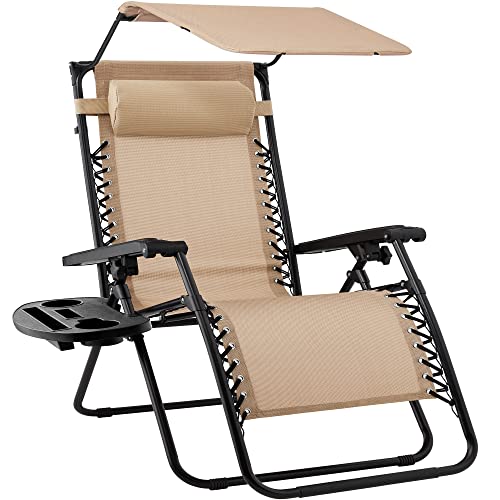
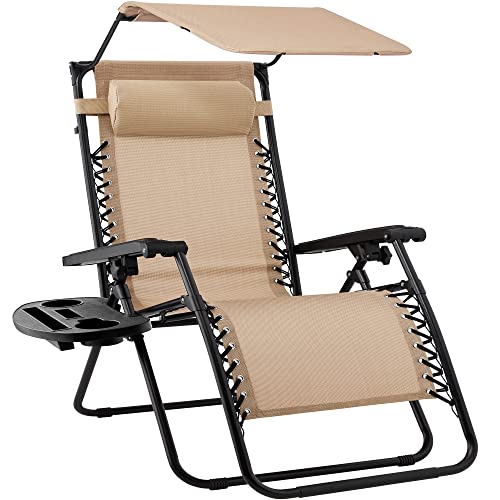
The Best Choice Products Zero Gravity Chair with Canopy Shade is the complete laying-out station: a smooth, lockable recline that glides into the zero-gravity position on replaceable elastic cords, UV-resistant textilene mesh on a steel frame rated to 250 lb, an adjustable canopy that shades your face and book, a removable headrest pillow, and a detachable tray with two cup holders, a phone mount, and a tablet holder. It folds for storage and serves patio, pool, beach base camp, and campsite without changing its nature.
Strengths
- True zero-gravity distribution — the whole body rests, not just the back.
- Canopy plus headrest plus tray: shade, support, and supplies in one chair.
- Lockable recline holds your chosen angle indefinitely.
Trade-offs
- At 20.5 pounds it travels by car and short carries, not long beach walks.
- 250 lb capacity ceiling.
- The canopy shades the head; the rest of you still needs a sun plan.
| Color | Beige |
| Size | Standard |
| Dimensions | 34 x 27 x 49 inches |
| Weight | 20.5 pounds |
Zero gravity earns its name honestly in this chair: with the legs raised to the heart’s level and the back taking its share, pressure stops pooling at the seat and the lower back, and the body’s whole length becomes the cushion. The textilene breathes through the contact points, so the second hour feels like the first — the specific failure of padded loungers in July. Set the canopy once, angle it as the sun moves, and the chair becomes a small, shaded room of one’s own at the pool’s edge.
Choose the Best Choice chair if your laying out happens where a car can reach. Skip it for walk-to beaches — the backpack chairs below exist for those.
Best for: Patio, pool, and car-camping lay-outs / Not suited for: Long beach carries

Lafuma Futura Air Comfort Padded Zero Gravity Patio Recliner Chair
Our badge: Best Premium
The Lafuma Futura Air Comfort Padded Zero Gravity Patio Recliner Chair is the connoisseur’s recline: a breathable, padded AirComfort seat, Lafuma’s patented elastomer clip suspension — even, continuous support with no cords to stretch or lace — a removable headrest, foot glides, and an HLE steel frame that moves through multiple positions into zero gravity with a smoothness cheaper mechanisms imitate badly. It folds flat enough to live in a closet and travel in a car.
Strengths
- AirComfort padding cushions without trapping heat — the premium surface for long lays.
- Clip suspension stays even for years; no cords to replace.
- The recline mechanism’s glide is the finest in this guide.
Trade-offs
- Premium price in the category.
- About 18 pounds — car-portable, not walk-portable.
- An elegant chair that deserves better than being left out in storms.
| Color | Taupe Grey |
| Size | Medium |
| Dimensions | 32.7 x 25.5 x 46 inches |
| Weight | 18.077905484 pounds |
The Lafuma’s argument is in the second summer: cord-suspended chairs soften unevenly as their lacing ages, so the chair you loved becomes a chair with a sag in it; the clip system distributes your weight the same way in year three as on day one, which is why Lafuma owners replace their chairs out of boredom rather than failure. The padded fabric adds the other half of the premium case — no mesh imprint on skin, no hard frame lines through a swimsuit — making it the chair for readers, nappers, and sunset-watchers whose lays are measured in hours.
Choose the Lafuma if laying out is a serious pleasure and the budget allows the best version of it. Skip it if your beach is a hike away.
Best for: Premium patio and poolside reclining / Not suited for: Walk-in beaches

Tommy Bahama Easy-Out Backpack Beach Chair
Our badge: Best for the Beach
The Tommy Bahama Easy-Out Backpack Beach Chair is the beach’s own answer: a lightweight aluminum frame with four recline positions adjusted by a pinch-free Easy-Out mechanism — including the lay-flat position serious sun-seekers require — solid hardwood arms sealed with marine-grade polyurethane, a cup holder, a storage side pouch, and backpack straps that put the carry on your shoulders. It comes as a two-pack, because laying out is so often a two-person sport.
Strengths
- Four positions including flat — the full beach repertoire.
- Backpack carry frees hands for the cooler and the umbrella.
- Pinch-free adjustment is kind to every hand, at every age.
Trade-offs
- The 12.8-inch seat height is low; rising takes effort from stiff knees and hips.
- Sold as a two-pack — more than a solo beacher needs.
- Beach-chair recline is low and laid back by design; upright sitters should note it.
| Color | 2-pack Blue Tropical Leaves |
| Size | 35.43″x24.69″ x 25.20″ |
| Dimensions | 35.43 x 24.69 x 25.2 inches |
| Weight | 10 pounds |
The Tommy Bahama understands beach geometry: low to the sand so the legs stretch out at the waterline’s level, reclined so the sun and the view share your attention, and portable so the perfect spot — the quiet one, past the crowds — is reachable. The hardwood arms are more than handsome; they are the push points for rising, wide and solid where plastic arms flex. Couples standardize on the two-pack and stop negotiating whose chair is whose by the second summer.
Choose the Tommy Bahama if your laying out happens on sand, with company. Skip it if low seats defeat you — the zero-gravity pair keeps you higher, and the seniors’ guide linked above maps that trade in full.
Best for: Beach days for two, with a real flat position / Not suited for: Low-seat strugglers

Rio Beach 4-Position Lace-Up Backpack Beach Chair
Our badge: Best Budget
The Rio Beach 4-Position Lace-Up Backpack Beach Chair delivers the beach brief at a friendlier price: a rust-proof aluminum frame at eight pounds, four pinch-free recline positions, a lace-up suspension seat that flexes to conform to your body — with a nautical look that has made it a shoreline classic — a large adjustable pillow, wide molded arms, a cup holder, and a backpack strap with a large storage pouch. Capacity is 240 lb, and the seat height is 11 inches.
Strengths
- Lace-up suspension conforms like a hammock with manners.
- Eight pounds on your back — the long walk stays pleasant.
- Adjustable pillow and a generous storage pouch complete the kit.
Trade-offs
- 11-inch seat height is the lowest here; rising is the price of the style.
- 240 lb capacity is the guide’s floor.
- Lacing needs an occasional tension check across seasons.
| Color | Navy |
| Size | 1 Pack |
| Dimensions | 25 x 24.75 x 10.16 inches |
| Weight | 8 pounds |
The Rio’s lace-up seat is its thesis: instead of a flat sheet of fabric, the suspended lacing gives under your weight in a curve that matches the body’s, which is why these chairs have been rented, sold, and resold on American beaches for decades. The pillow adjusts to the recline angle — upright for the book, back for the nap — and the whole kit folds into a backpack that leaves your hands for everything else the beach requires. For the budget beacher who walks to their spot, it is the correct default.
Choose the Rio if the walk is long and the budget is sane. Skip it if you need height or capacity beyond its numbers.
Best for: Budget beach laying with a conforming seat / Not suited for: Capacity or height needs above its specs

Coleman Utopia Breeze Lightweight Beach Chair
Our badge: Best Lightweight
The Coleman Utopia Breeze Lightweight Beach Chair is the minimalist’s beach chair: about five pounds on a steel frame rated to 250 lb, a relaxed backrest with full seat support, a low profile that stretches your legs toward the water, a mesh cup holder, a seatback pocket, and an included carry bag. It is the chair for the far end of the beach — the quiet stretch past the lifeguard stands that only walkers reach — and for the yard’s spontaneous half hour in the sun.
Strengths
- Featherweight carry with a bag included — distance stops being a factor.
- Relaxed, leg-friendly geometry for casual laying out.
- 250 lb steel frame: stronger than its weight suggests.
Trade-offs
- A low, relaxed sit without the multi-position recline of the chairs above.
- Minimal padding; the towel is part of the system.
- Seat height around ten inches — the rise is a young person’s, or a practiced one.
| Color | Yellow |
| Size | 29.5 x 10.7 x 3.5 inches |
| Dimensions | 29.5 x 10.7 x 3.5 inches |
| Weight | 6 pounds |
The Coleman makes a philosophy of enough: enough support, enough comfort, almost no weight, and a price and simplicity that make it the household’s second and third chair — the one in the car all summer, the one lent without anxiety, the one that goes to the lake, the concert lawn, and the campsite’s sunny corner. Laying out does not always need machinery; sometimes it needs a light chair, a long beach, and an afternoon with nothing in it. For the campsite version of that afternoon, Best Camp Chairs For Bad Backs covers the structured end of outdoor sitting.
Choose the Coleman if you walk far and lay out casually. Skip it if you want positions, padding, or a high seat.
Best for: Long walks and spontaneous sun / Not suited for: Recline connoisseurs

POLYWOOD Modern Adirondack Chair
Our badge: Best for the Yard
The POLYWOOD Modern Adirondack Chair is laying out as a permanent address: a contoured seat with a waterfall front, wide armrests, and the Adirondack’s classic laid-back angle, built from genuine POLYWOOD HDPE lumber with ColorStay UV protection and marine-grade stainless hardware — fade-resistant, weatherproof, and cleanable with soap and water. It never needs painting, staining, or storage; it simply lives where you lay out, ready in every season.
Strengths
- Zero setup, zero storage, zero refinishing — the chair is always already there.
- Contoured seat and waterfall front make the fixed angle genuinely comfortable.
- All-weather build shrugs off sun, rain, and poolside chlorine alike.
Trade-offs
- The angle is fixed; there is no recline to adjust because the geometry is the recline.
- At 34 pounds it is placed, not carried.
- The classic low Adirondack sit asks the usual effort on rising.
| Color | Black |
| Size | 32.11in. x 29.25in. x 34.66in. |
| Dimensions | 32.13 x 29.25 x 34.68 inches |
| Weight | 34 pounds |
The Adirondack’s genius is that its single angle is the right one: seat low and tipped, back laid away, arms wide enough for a book and a glass at once — a geometry refined over a century of porches. POLYWOOD’s contribution is permanence: the chair that never needs carrying in, covering, or refinishing gets used on every fine evening, including the unplanned twenty minutes that folding chairs never serve because they are in the garage. Around a fire pit, on a deck, at a lake house, it is the laying-out chair as landscape. Sturdier-seated readers comparing outdoor builds will find its heavy-duty cousins in Best Patio Chairs For Big Guys.
Choose the POLYWOOD if your laying out has a permanent home outdoors. Skip it if your sun moves and your chair must follow.
Best for: Yards, decks, and fire pits — permanent laid-back seating / Not suited for: Anywhere the chair must travel
Comparison Table
| Pick | Color | Dimensions | Weight | Check price on Amazon |
|---|---|---|---|---|
| Best Choice Products Zero Gravity Chair with Canopy Shade | Beige | 34 x 27 x 49 inches | 20.5 pounds | Check price on Amazon |
| Lafuma Futura Air Comfort Padded Zero Gravity Patio Recliner Chair | Taupe Grey | 32.7 x 25.5 x 46 inches | 18.077905484 pounds | Check price on Amazon |
| Tommy Bahama Easy-Out Backpack Beach Chair | 2-pack Blue Tropical Leaves | 35.43 x 24.69 x 25.2 inches | 10 pounds | Check price on Amazon |
| Rio Beach 4-Position Lace-Up Backpack Beach Chair | Navy | 25 x 24.75 x 10.16 inches | 8 pounds | Check price on Amazon |
| Coleman Utopia Breeze Lightweight Beach Chair | Yellow | 29.5 x 10.7 x 3.5 inches | 6 pounds | Check price on Amazon |
| POLYWOOD Modern Adirondack Chair | Black | 32.13 x 29.25 x 34.68 inches | 34 pounds | Check price on Amazon |
How to Choose the Best Chairs for Laying Out
Choose your recline family first
Zero gravity (Best Choice, Lafuma) distributes weight along the whole body and suits long, still lays at home base. Multi-position beach chairs (Tommy Bahama, Rio) trade depth of recline for carry-ability and a lay-flat option. Fixed-geometry chairs (POLYWOOD, Coleman) offer one well-judged angle with zero machinery. The families are not better and worse; they are answers to where you lay out and how you get there. Decide the territory, and the family chooses itself.
Read the surface like a dermatologist of comfort
You will be in contact with this surface, in heat, for hours. Breathable mesh sheds heat and dries fast; padded air fabrics cushion while they breathe; lace-up suspension conforms and ventilates; solid HDPE wipes clean and asks for a towel as its cushion. The surface that sticks, pools, or imprints will shorten every lay by an hour — choose the one your skin would choose.
Plan the shade as part of the chair
A canopy covers a face; an umbrella covers a chair; a tree covers a schedule you do not control. Serious laying out pairs the recline with a shade plan sized to the hours you intend — and re-aims it as the sun moves, because shade is a direction, not a place. The Best Choice chair builds the first layer in; the others ask you to bring it, and the honest shopper prices the umbrella into the beach chairs’ true cost.
Weigh the carry honestly
Every chair in this guide lists its weight; your walk lists its distance. Twenty pounds across a patio is nothing; twenty pounds across four hundred yards of sand is a workout that will quietly decide how often the chair gets used. Backpack straps change the arithmetic by moving the load to your shoulders — the beach chairs’ essential feature — and the lightest chairs (Coleman, Rio) exist for the walkers. Buy for the carry you actually make.
Rehearse the rise
Deep reclines and low seats share a cost: the exit. Before the first beach day, practice at home — return the recline to upright, plant your feet, use the arms — and if the maneuver is a struggle in the living room, it will be a performance on the sand. Seniors and stiff joints should weight the higher, arm-strong options and the seniors’ guide linked at the top, where the rise gets its own full analysis.
How Do You Lay Out Comfortably All Afternoon?
Set up once, properly: chair angled so the sun crosses you rather than cooking one side, shade aimed for the hours ahead, water within reach, and the book, towel, and sunscreen staged before you recline — because a laying-out session is measured by how rarely it is interrupted. Change position on the sun’s schedule, not your discomfort’s: small angle adjustments every half hour keep pressure and exposure distributed, and the recline’s whole range exists to be used across the afternoon rather than set once and endured.
Time the lay like the regulars do: the late morning and the long afternoon, with the fiercest midday sun spent in shade, in the water, or at lunch. Hydrate from the chair’s own cup holder rather than by intention. And let the exit be graceful — sit up slowly, let the world settle, stand when ready — because an afternoon’s restoration should not end with a head-rush on the sand.
Problem: Your lower back aches after an hour’s lay — Your recline is concentrating pressure. Go flatter or more zero-gravity, add the headrest pillow under your knees if your chair allows the improvisation, and change angles more often.
Problem: The chair sticks to you — The surface is wrong for your climate. A towel layer helps today; a mesh, air-fabric, or lace-up chair solves it permanently.
Problem: You keep losing the shade — The sun moves about a hand’s width per hour across your setup. Re-aim the canopy or umbrella at each position change, or set up in the shade’s future path rather than its present one.
Problem: Sand gets everywhere in the mechanism — Rinse beach chairs after every trip, work the recline through its range while rinsing, and let them dry open. Grit in a hinge is a season-shortener.
Problem: You fall asleep and wake up roasted — Set a phone timer when you recline with intent to nap, and let the canopy or umbrella be the default, not the exception. The best lay includes waking up comfortable.
The Laying-Out Kit Around the Chair
The chair is the platform; the kit makes the afternoon. A towel sized to the chair — as cushion, as sweat management, as the marker of your territory — a water bottle that lives in the cup holder, sunscreen staged where your hand falls, and a small bag for the book, phone, and glasses that keeps them off the sand and out of the sun’s direct fire. Households that lay out often keep the kit packed with the chair, because the difference between a spontaneous hour in the sun and an abandoned intention is usually logistics, not desire. The chairs in this guide with trays, pouches, and pockets were designed by people who understood this: the afternoon should assemble itself.
Laying Out Through the Seasons
Each season re-deals the laying-out hand. Spring wants the yard chairs first — the POLYWOOD’s permanent readiness wins the season’s first warm Saturday without a single trip to the garage. Summer is the beach chairs’ reign, with the zero-gravity pair ruling the patio and the pool. Autumn returns the fire pit, where the Adirondack’s angle and a blanket recreate the summer lay at a cooler temperature, and the recliners serve the low, golden light. Even winter has its chapter in sun-room and south-window form, where a Lafuma by the glass gives the season’s scarce sun a worthy seat. A household with one chair from two of these families is equipped for the whole year’s light — which is, in the end, what laying out is for.
Laying Out With a Group
Laying out is often a group activity wearing a solitary costume, and the chair fleet matters as much as the chair. The classic failure is the gradient: one magnificent recliner, two adequate chairs, and a towel on the sand for whoever lost the morning’s unspoken auction. The households that lay out well standardize at a level everyone is happy to occupy — the two-pack pattern of this guide’s beach pick, a pair of matching zero-gravity chairs on the patio — because a fleet of equals turns the afternoon into company, while a fleet with a throne turns it into a rotation negotiation. Guests change the arithmetic again: the sturdy, simple spare — the Coleman pattern — kept for visitors means nobody’s grandmother gets the broken chair, and the permanent yard seating in Best Teak Patio Sofas Loveseats territory covers the crowd that outnumbers the recliners. Buy the fleet, not the throne, and the laying out becomes what it was always supposed to be: the whole party, horizontal, at peace.
The Reading Lay and the Nap: Two Disciplines
Reading and napping look identical from across the yard and are opposites in their furniture demands. The reader needs the head raised and supported at book angle, light over the shoulder or the page lit by the sun’s angle, and a surface that holds the position for a chapter without sliding — the recliners’ lockable angles and the beach chairs’ upright positions serve exactly this, and the headrest pillows in this guide earn their existence here. The napper needs the opposite: the flattest, most distributed position the chair owns, shade over the whole body rather than the face alone, and a surface that breathes through an hour of stillness. The chairs that serve both disciplines are the ones with range — multiple positions, honest extremes — which is why this guide weights position counts and lock quality as heavily as it does. Choose your discipline before you choose your chair, or better, choose the chair whose range covers both, because the afternoon rarely announces in advance which one it intends to be. Sitters whose backs have opinions about the nap should cross-check with Best Chairs For Hip Arthritis, where the recline-and-rise questions get their most careful treatment.
The Science of Doing Nothing, Taken Seriously
There is a reason the laying-out afternoon restores what a nap on the sofa does not, and it is mostly geometry plus light. Outdoors, the reclined body in moving air regulates its temperature the way it was designed to — the breeze doing what no fabric can — while the eyes, given a horizon instead of a ceiling, rest at their far focus for the first time all day. The chairs in this guide are, in that light, instruments for arranging three variables: the body’s angle, the sun’s access, and the breeze’s path. Zero gravity optimizes the first; canopies and position changes manage the second; mesh, suspension, and open frames serve the third. A laying-out setup that attends to all three produces the specific, recognizable state the regulars chase — warm but not hot, still but not stiff, drowsy but not asleep — and it is worth noticing that none of the three variables is about the chair’s price. They are about its geometry, its surface, and its placement, which is why a well-chosen Rio at the right angle on the right sand outperforms a premium recliner parked carelessly in full glare.
Placement deserves the last word, because it is the variable owners neglect. The chair belongs where the afternoon’s shade will be, not where the morning’s is; where the breeze crosses rather than stalls; where the ground is level enough that the recline’s balance works as designed; and — the social variable — where the day’s company and quiet are in the proportion you actually want. Move the chair twice in its first week and learn your own territory’s light. After that, the laying out takes care of itself, which is, after all, the entire point of the exercise: an afternoon so well arranged that nothing remains to be done about it, in a chair that asks nothing, in the sun that does the rest.
Laying Out Indoors: The Winter Chapter
When the weather closes the patio, the laying-out habit does not have to close with it — it migrates, and the chairs that migrate best are the ones this guide chose for their geometry rather than their address. The Lafuma and the Best Choice recliner both serve indoors without apology: set by the brightest window, angled to the winter sun’s low path, they recreate the summer lay in the one room the season cannot take. The ritual changes its details — a blanket replaces the towel, tea replaces the cold drink, the book gets the lamp’s help by four in the afternoon — but the essentials survive translation intact: the distributed recline, the unhurried hour, the deliberate nothing. Households in northern climates tell this guide’s researchers, in effect, that the winter window lay is not a substitute for the real thing but a discipline of its own, the one that carries the habit — and the body it restores — through to April.
There is a furnishing lesson inside the migration: a chair bought for one territory that serves two is worth more than its price, and a chair imprisoned in one season is a storage problem with a recline. When you choose between this guide’s near-equals, let the second territory break the tie — the recliner that also serves the sunroom, the beach chair light enough for the park’s summer concerts, the Adirondack that hosts the fire pit in October and the first coffee of March. Laying out, pursued across the whole calendar, stops being a summer activity and becomes what its devotees always claimed it was: a way of arranging rest itself, in every month, under whatever sky is available.
A Short Defense of the Horizontal Afternoon
Every guide in this program is, in its way, about getting something done — posture improved, work supported, babies fed, tables accompanied. This one is about the opposite, and it is worth saying plainly, in a culture that treats rest as a rounding error, that the laying-out afternoon is not time stolen from the life but one of the places the life happens. The conversations that occur at recline angle are different from the ones at table angle — slower, longer, more honest. The books finished outdoors stay finished in the memory differently from the ones skimmed indoors. The body’s account, kept in tension all week, is settled in these hours in a currency no standing desk can mint. A chair that serves those hours well is not leisure equipment in the dismissive sense; it is the furniture of restoration, and it deserves the same seriousness of selection as the desk chair that serves the earning hours — arguably more, since the earning hours would find a way regardless, and the restoring ones happen only where they are invited.
So consider this guide’s six chairs an invitation, engineered six ways. Choose the one that fits your territory, your carry, your company, and your skin; place it where the light and the breeze conspire in your favor; keep its kit beside it and its surface honest; and then do the hardest part, which is nothing, at length, on purpose, as often as the season allows. The chairs will hold up their end. They were built, every one of them, for exactly that.
One practical ritual deserves promotion from the maintenance notes to a habit of its own, because it quietly determines how many seasons any of these chairs actually serves: the end-of-day reset. Thirty seconds, no more — the recliner returned to its stored angle, the cushion shaken back to shape, the towel taken in rather than left to mildew in place, the beach chair folded while the day’s sand is still loose enough to shake free. Chairs do not mostly die in dramatic failures; they fade through a thousand small neglects, each one invisible, their sum total a chair that by its third summer sags, smells, and resists in ways its owner cannot quite name. The reset is the counter-ritual, cheap enough to survive tiredness and valuable enough to compound: the chair that is put away properly every evening is, measurably, a younger chair every spring. Build the thirty seconds into the laying-out ritual itself — the last act of the afternoon, performed at recline’s end — and the season’s equipment will repay the courtesy for years.
And when the first perfect afternoon arrives — the angle right, the breeze cooperating, the hour unspooling exactly as designed — resist the urge to improve anything. The setup is finished; that is what finished feels like. Laying out is the one project in the house whose completion is measured by how completely its owner can stop working on it.
The season is shorter than it feels in June and longer than it feels in August. Buy early, set up once, and spend the whole of it horizontal.
That is the whole curriculum: angle, surface, placement, and time. The chairs supply the first two; the season supplies the rest.
Common Buying Mistakes
Buying an upright chair and calling it a lounger
If it does not recline or lay back by design, it is not for laying out, whatever the listing’s photographs imply. The recline is the product; everything else is accessories.
Ignoring the chair’s weight until the beach walk
The walk is part of the product. Weigh your route as carefully as your chair, and let backpack straps and low pounds win when the distance is real.
Choosing a padded lounger for a hot, humid climate
Padding traps the heat that mesh and suspension release. In serious summer, breathability is not a preference — it is the difference between the first hour and the third.
Forgetting that the sun moves
A fixed setup in moving light is a timed exposure. Canopies, umbrellas, and re-aiming are not fussiness; they are the afternoon’s operating system.
Skipping the rise rehearsal
Low and deep chairs collect their toll at the exit. Rehearse at home; if the rise defeats you there, choose higher and stronger-armed before the beach chooses for you.
Final Recommendation
For most laying out, the Best Choice Products Zero Gravity Chair with Canopy Shade is the answer: true zero-gravity rest, built-in shade, and a tray that holds the afternoon together, anywhere a car can reach. For the beach itself, the Tommy Bahama two-pack carries the day — and for the finest recline in the guide, the Lafuma, compared on its Check on Amazon listing. Walkers take the Rio or the Coleman; yards take the POLYWOOD and never think about chairs again. Choose your territory, mind the surface and the shade, and lay out like you mean it.
Frequently Asked Questions
What is the difference between zero-gravity chairs and regular recliners?
A zero-gravity recliner raises your legs to about heart level while the back reclines, spreading your weight along the chair’s whole length so no single point — seat, lower back — carries the load. A regular recliner mostly tilts the back. For long lays, the distributed version is noticeably easier on the body, which is why two of this guide’s six picks use it.
Can I lay out flat in a beach chair?
In the right ones, yes: the Tommy Bahama’s four positions include a lay-flat setting, and the Rio reclines through four positions toward flat. True flatness is a beach-chair specialty — the zero-gravity chairs instead offer the suspended, legs-raised position, which most sitters find more comfortable than flat for long sessions.
Which chair is best for a bad back when laying out?
The zero-gravity pair, for their distributed support — with the rise rehearsed and the caveat that comfort is not treatment. This program’s camp-chair guide covers back-focused outdoor sitting in depth, and persistent pain belongs with a professional rather than a product page.
How do I stop my chair from rusting or fading?
Rinse salt and sand off after beach use, dry before storing, and choose materials built for the exposure — rust-proof aluminum frames, UV-stable fabrics, and HDPE lumber like the POLYWOOD’s, which is engineered to live outside permanently. Chairs stored dry outlast chairs stored damp by years.
What chair should a senior choose for laying out?
One whose rise they have rehearsed successfully: usually a higher recliner with strong arms over the lowest beach chairs, with the full analysis in this program’s seniors’ beach guide. Comfort in the lay matters, but the exit decides whether the chair gets used.
Is an Adirondack chair really for laying out?
It is the original: a fixed, laid-back geometry refined for a century of porches and lake shores, with a wide seat and arms that hold your book and your drink. It will not adjust, fold, or travel — and for the yard it calls home, it needs to do none of those things.


