Disclosure: As an Amazon Associate, dailyhomedecorating.com earns from qualifying purchases. Links to Amazon on this page are affiliate links; they cost you nothing extra. Prices and availability change often, so check the current Amazon listing before you buy.
The best chairs for hip arthritis are judged, when your hips are stiff and sore, by two moments: getting into the chair and getting out of it. The deep, low, soft chairs that furnish most living rooms fail both moments at once — they drop you below the angle your hips can comfortably bend to, swallow you in cushioning you must climb out of, and offer nothing solid to push against on the way up. The best chairs for hip arthritis reverse every part of that: a seat at a height your feet and hips can manage, firm support that does not collapse under you, arms that bear weight, and — in the finest of them — a powered lift that does the hardest part of standing for you.
This guide reviews six chairs and one honestly labeled add-on chosen on those mechanics: a power lift recliner, a full-body massage recliner, two zero-gravity recliners that spread pressure along the whole body, a glider with an ottoman, and a massage pad for an existing chair. The framing throughout is comfort and ease of use — furniture can make sitting and standing easier and more comfortable, and this guide recommends it for exactly that; it cannot treat arthritis or any medical condition, and your care team’s guidance outranks anything on this page. For the broader comfort-seating picture, see Best Chairs For Lounging, and for outdoor equivalents, Best Beach Chairs For Senior Citizens.
Where to Buy
Every pick below is sold on Amazon, where you can check the current price, size options, and availability before you buy.
- MCombo Power Lift Recliner Chair — Check on Amazon
- Real Relax SL-Track Full Body Massage Chair — Check on Amazon
- Best Choice Products Zero Gravity Chair with Canopy Shade — Check on Amazon
- Lafuma Futura Air Comfort Padded Zero Gravity Patio Recliner Chair — Check on Amazon
- Costzon Nursery Glider with Ottoman — Check on Amazon
- COMFIER Shiatsu Neck and Back Massager with Heat — Check on Amazon
In this guide
Quick Picks
| Pick | Badge | Why it earns its place |
|---|---|---|
| MCombo Power Lift Recliner Chair | Best Overall | A counter-balanced power lift that helps you stand, a 140-degree recline, an extended footrest, and a 350 lb rating — the complete sit-to-stand answer. |
| Real Relax SL-Track Full Body Massage Chair | Best Premium | SL-track massage from neck to hips, zero-gravity recline, airbags, and lower-back heat — full-body comfort sessions at home. |
| Best Choice Products Zero Gravity Chair with Canopy Shade | Best for Reclining | Lockable zero-gravity recline on elastic-cord suspension spreads your weight along the whole chair, indoors or out. |
| Lafuma Futura Air Comfort Padded Zero Gravity Patio Recliner Chair | Best Portable Recline | Padded AirComfort fabric on an even clip suspension — the smoothest reclined rest that still folds and travels. |
| Costzon Nursery Glider with Ottoman | Best with Ottoman | A gentle glider with a matching ottoman, high weight capacities, and storage pockets — motion and feet-up comfort. |
| COMFIER Shiatsu Neck and Back Massager with Heat | Best Add-On | Not a chair — a shiatsu pad with compression and heat that upgrades a sound existing chair’s comfort. |
Key Takeaways
- Judge chairs by the two hard moments — sitting down and standing up. Seat height, seat firmness, arm strength, and lift assistance decide both.
- Avoid the deep-and-low trap: seats that drop your hips below your knees demand the most from the joints that have the least to give.
- Recline is pressure management: zero-gravity positions spread weight along the body instead of concentrating it at the seat.
- The COMFIER is an add-on pad for an existing chair, labeled as such — comfort for a chair whose sit-to-stand already works.
- Comfort framing only: no chair treats arthritis. Persistent or worsening symptoms belong with your care team.
How These Picks Were Chosen
The audit applied the sit-to-stand test to the whole pool. Chairs were scored on seat height and firmness (can the sitter arrive and depart without a struggle?), arm design (is there something solid at push height?), mechanical assistance (lift, glide, recline systems that change the body’s angle gradually), and pressure distribution (does the chair spread load or concentrate it at the hips?). Low sling seats, deep soft sofas-in-chair-form, and anything requiring a climb were excluded regardless of their other charms.
The survivors divide the solutions: powered assistance for standing, massage and zero gravity for full-body rest, portable recline for the garden and the road, gliding motion for the evening, and a pad for the chair you already own and can already use. User-height and weight limits are stated per chair, because fit is not a detail in this category — it is the product.
Specifications come from the verified pool. Comfort language is kept strictly to comfort, ease, and support, and every medical question this keyword raises is directed, in the article and here, to the professionals who should answer it.
The 6 Best Best Chairs for Hip Arthritis — Reviewed

MCombo Power Lift Recliner Chair
Our badge: Best Overall
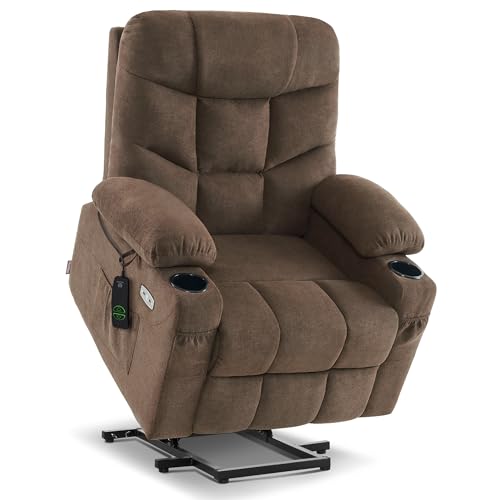
The MCombo Power Lift Recliner Chair is built around the hardest moment: a counter-balanced lift mechanism, worked by two buttons, that raises and tilts the chair to help you stand, and lowers you just as gradually when you sit. Between those moments it is a proper recliner — three positions from sit to a 140-degree recline, an extended footrest lengthened by 4.7 inches so your feet are supported without the edge pressing your calves, two cup holders, USB-A and USB-C charging, and large side pockets. It is rated to 350 lb, sized for users roughly 5’1″ to 5’9″, and deliberately simple: a single motor with no massage or heat, which the maker notes means fewer parts to fail.
Strengths
- Powered lift assistance for standing — the category’s defining help, done smoothly.
- Extended footrest supports the full leg without a pressure edge.
- Simple, reliable mechanism with cup holders, charging, and pockets at hand.
Trade-offs
- Sized for users 5’1″ to 5’9″; taller sitters should look at the recline options below.
- Needs 15.7 inches of clearance behind and reaches 72.4 inches long fully reclined — measure the room.
- No massage or heat; assistance and reliability are its whole brief.
| Color | Brown |
| Size | Medium |
| Dimensions | 37.8 x 33.5 x 40.9 inches |
| Weight | 112.4 pounds |
The MCombo’s dignity is in its gradualness: the lift does not launch or dump, it accompanies — rising at a pace your body sets by holding or releasing the button, pausing anywhere. Sitting down, the hardest part for stiff hips is often the last six inches of descent, and the lift owns those too, lowering you under power rather than letting gravity drop you into the seat. The fabric cleans with a dry or damp cloth, and the chair plugs into a standard outlet. For the reader whose current chair has become an obstacle course, this is the purchase that returns the living room’s best seat to them.
Choose the MCombo if standing from a standard chair has become the day’s hard moment. Skip it if you are taller than its range or want massage — the Real Relax below is that chair.
Best for: Sit-to-stand assistance with dignified, gradual power / Not suited for: Users above 5’9″ or massage seekers

Real Relax SL-Track Full Body Massage Chair
Our badge: Best Premium
The Real Relax SL-Track Full Body Massage Chair is the full-session chair: an SL-track mechanism whose robotic hands travel from neck to hips with three intensity levels, eight auto modes with voice broadcast, airbag massage at the shoulders, arms, calves, and feet, lower-back heating, foot rollers, a zero-gravity recline, Bluetooth speakers, and a pause button and child lock for household safety. It suits users up to 240 lb and roughly 5.1 to 6.1 feet tall, in sessions of ten to thirty minutes.
Strengths
- Neck-to-hip track coverage — the hips are on the itinerary, not an afterthought.
- Zero-gravity recline spreads pressure before the massage even starts.
- Airbags, heat, and foot rollers complete a full-body comfort session.
Trade-offs
- 240 lb capacity and a defined height range bound its audience.
- At 132 pounds and shipped in two boxes, it is a permanent installation.
- No lift assistance — standing is unaided, so it suits sitters whose rise is manageable.
| Color | Black |
| Size | 1 Count (Pack of 1) |
| Dimensions | 52 x 27 x 43 inches |
| Weight | 132.2773572 pounds |
The Real Relax’s role in this guide is the rest chair, not the transfer chair: the place you go for a scheduled half hour of full-body comfort, where the zero-gravity position unloads the seat’s pressure points and the track works the whole back and hip line at the intensity you choose. Households that own one tend to build the day around its sessions the way earlier generations built around a bath — as the reliable reset. Its honest boundary is the rise: if standing is your difficulty, the MCombo’s lift is the priority purchase and this chair is the second chair, not the first.
Choose the Real Relax if your rise is fine and your rest deserves the full treatment. Skip it if standing assistance is the need — buy the lift first.
Best for: Full-body comfort sessions in zero gravity / Not suited for: Anyone who needs help standing
Best Choice Products Zero Gravity Chair with Canopy Shade
Our badge: Best for Reclining
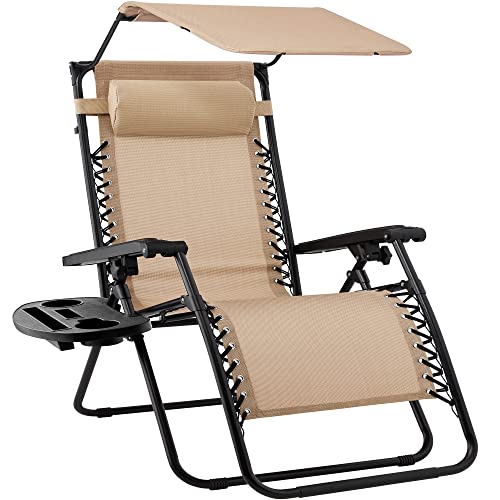
The Best Choice Products Zero Gravity Chair with Canopy Shade offers the recline version of pressure relief at an accessible position: a lockable zero-gravity system on replaceable elastic cords, settling you into a position where weight spreads along the chair’s full length — legs raised, seat pressure shared with the back — on UV-resistant textilene over a steel frame rated to 250 lb, with an adjustable canopy, a removable headrest pillow, and a detachable tray with cup holders and device mounts.
Strengths
- Full-length weight distribution takes the seat’s pressure off the hips entirely.
- Lockable at your angle — find the comfortable position and keep it.
- Works indoors and out, folding for storage between seasons.
Trade-offs
- 250 lb capacity ceiling.
- Rising from full recline is a two-step: return upright first, then stand with the frame’s help.
- At 20.5 pounds it is movable, not portable.
| Color | Beige |
| Size | Standard |
| Dimensions | 34 x 27 x 49 inches |
| Weight | 20.5 pounds |
For hips, the zero-gravity position’s gift is subtraction: with the legs elevated and the back taking its share, the seat stops being a pressure point and becomes one surface among many. Campers and garden sitters with stiff hips have sworn by these chairs for years for exactly that reason, and the canopy-and-tray completeness makes this one a genuine rest station rather than a seat. Practice the rise at home first — unlock, return to upright, feet planted, push from the frame — and by the third time it is a routine rather than a maneuver.
Choose the Best Choice chair if reclined rest is your hips’ favorite arrangement and your rise from upright is sound. Skip it if you need standing assistance — that is the MCombo, indoors.
Best for: Reclined, distributed rest indoors or out / Not suited for: Lift-assistance needs

Lafuma Futura Air Comfort Padded Zero Gravity Patio Recliner Chair
Our badge: Best Portable Recline
The Lafuma Futura Air Comfort Padded Zero Gravity Patio Recliner Chair refines the same zero-gravity idea: a breathable, padded AirComfort seat suspended by Lafuma’s patented elastomer clips — even support with no cords to sag — a removable headrest, foot glides, and an HLE steel frame reclining through multiple positions into zero gravity. It folds for travel between patio, garden, campsite, and the houses of family who need a good chair to appear when you visit.
Strengths
- Clip suspension distributes pressure evenly and stays even for years.
- Padded, breathable fabric is kind at every contact point.
- Folds and travels — the good chair goes where the sitter goes.
Trade-offs
- Premium position among recliners.
- About 18 pounds: portable by car, not by hand over distance.
- Like all recliners here, rising means returning upright first.
| Color | Taupe Grey |
| Size | Medium |
| Dimensions | 32.7 x 25.5 x 46 inches |
| Weight | 18.077905484 pounds |
The Lafuma’s distinction is evenness: cord-laced recliners concentrate support at their lacing points and soften unevenly, while the clip system spreads load continuously, so the pressure map your hips feel in month one is the map they feel in year three. For a sitter who notices pressure — and stiff hips make connoisseurs of us all — that consistency is the product. Its portability has a social dimension too: it is the chair adult children keep in the car for a parent’s garden visits, appearing wherever the family gathers.
Choose the Lafuma if you want the finest portable recline. Skip it if a powered lift is the actual need — different tool, indoors, above.
Best for: Even, premium reclined rest that travels / Not suited for: Standing-assistance needs

Costzon Nursery Glider with Ottoman
Our badge: Best with Ottoman
The Costzon Nursery Glider with Ottoman serves the sitter whose hips prefer motion and elevation in an upright chair: a smooth, quiet glide on a solid wood base, thick padded cushions, an ergonomic backrest and armrests solid enough to push on, side storage pockets, and a matching ottoman that raises your feet and legs to the chair’s level. The chair is rated to 396 lb and the ottoman to 375 lb — the sturdiest ratings in this guide.
Strengths
- Ottoman elevation plus gentle glide: comfort without reclining machinery.
- High capacities and a solid wood base inspire confidence.
- Pockets keep the seated hour self-sufficient.
Trade-offs
- No lift assistance; the rise is yours, aided by its arms.
- Two pieces take the most floor space in this guide.
- Glide motion should be stilled — feet planted, glide settled — before standing.
| Color | Brown |
| Size | 2 Piece Set |
| Dimensions | 28.5 x 29.5 x 39.5 inches |
| Weight | 40.22 pounds |
The glider’s case is the evening: an upright-enough chair for conversation and television, with the ottoman removing the legs’ weight from the hips’ accounts and the glide giving stiff joints the micro-movement that stillness denies them. Many sitters find the combination — feet up, gentle motion, arms to push on — the most sustainable long sit in this guide short of the lift chair. It is marketed for nurseries; its second career in living rooms and bedrooms, including the nursing context in Best Chairs For Nursing Mothers, is long and honorable.
Choose the Costzon if you want upright comfort with elevation and motion. Skip it if standing needs power — the MCombo again.
Best for: Upright evenings with feet up and gentle motion / Not suited for: Powered-assistance needs

COMFIER Shiatsu Neck and Back Massager with Heat
Our badge: Best Add-On
The COMFIER Shiatsu Neck and Back Massager with Heat is included as what it is — a pad, not a chair — for the reader whose current chair already passes the sit-to-stand test and simply needs to be kinder: shiatsu neck nodes adjustable from the wired controller, four deep-kneading back nodes with upper, lower, full-back, and spot modes, rolling massage, gentle heat, three levels of air compression at the waist and hips, and three levels of seat vibration, under a 15-minute auto shutoff, for users roughly 5’3″ to 6’0″. The maker notes FSA and HSA eligibility.
Strengths
- Compression and kneading add real comfort to a sound existing chair.
- Adjustable neck nodes and an intensity flap personalize the session.
- Moves between chairs — the living room’s today, the office’s tomorrow.
Trade-offs
- It cannot fix a chair that is too low, too soft, or armless — the geometry problems come first.
- Corded; about 19 pounds in place.
- The heat is intentionally mild.
| Color | Gray |
| Size | 1 Count (Pack of 1) |
| Dimensions | 30 x 17 x 18 inches |
| Weight | 17.63698096 pounds |
The honest ordering matters: if your chair traps you, replace the chair — the MCombo exists for you. If your chair serves you and the day’s stiffness is the complaint, the COMFIER’s sessions are a genuine pleasure layered onto a working seat, and its compression — a gentle squeeze rather than a knead — is a sensation many sitters prefer around the hips and waist. Buy it in that order and it will be loved; buy it instead of a needed lift chair and it will be blamed unfairly.
Choose the COMFIER if your chair is right and your evenings want more comfort. Skip it if the chair itself is the problem.
Best for: Comfort sessions on an already-suitable chair / Not suited for: Fixing a trapping chair
Comparison Table
| Pick | Color | Dimensions | Weight | Check price on Amazon |
|---|---|---|---|---|
| MCombo Power Lift Recliner Chair | Brown | 37.8 x 33.5 x 40.9 inches | 112.4 pounds | Check price on Amazon |
| Real Relax SL-Track Full Body Massage Chair | Black | 52 x 27 x 43 inches | 132.2773572 pounds | Check price on Amazon |
| Best Choice Products Zero Gravity Chair with Canopy Shade | Beige | 34 x 27 x 49 inches | 20.5 pounds | Check price on Amazon |
| Lafuma Futura Air Comfort Padded Zero Gravity Patio Recliner Chair | Taupe Grey | 32.7 x 25.5 x 46 inches | 18.077905484 pounds | Check price on Amazon |
| Costzon Nursery Glider with Ottoman | Brown | 28.5 x 29.5 x 39.5 inches | 40.22 pounds | Check price on Amazon |
| COMFIER Shiatsu Neck and Back Massager with Heat | Gray | 30 x 17 x 18 inches | 17.63698096 pounds | Check price on Amazon |
How to Choose the Best Chairs for Hip Arthritis
Start with the rise, not the sit
Every chair feels acceptable in the first minute of sitting. The discriminating test is the exit: can you stand from it without rocking for momentum, hauling on furniture, or negotiating with your hips? If the honest answer is no, the chair fails this keyword regardless of its comforts — and the solutions ladder upward from firm, high seats with strong arms, to gliders with push points, to the MCombo’s powered lift. Buy for the exit and the sit takes care of itself; buy for the sit and the exit collects its debt daily.
Respect the height and firmness numbers
Your seat should let your feet rest flat with your hips at or slightly above your knees — the geometry that asks least of the hip joint at both arrival and departure. Soft, deep cushions defeat that geometry by sinking you below it; firm support that holds its height is the comfort feature in this category, whatever the showroom’s plush instinct says. Where a maker’s stated user-height range exists — the MCombo’s 5’1″ to 5’9″ — treat it as a hard boundary, not a suggestion.
Decide between assistance and rest
This guide contains two different products wearing one category: assistance chairs (the lift, the glider’s arms) that help you change position, and rest chairs (the massage chair, the zero-gravity recliners) that make a position worth staying in. Most households need the first before the second, and many eventually own both — the lift chair as the daily seat, the recliner as the scheduled rest. Name your primary need before shopping and the category stops being confusing.
Plan the room around the chair’s mechanics
Lift recliners need clearance behind and length in front when reclined — the MCombo’s 15.7 inches and 72.4 inches are typical of the class. Massage chairs need a permanent footprint and a nearby outlet. Zero-gravity chairs need a practiced rise and a stable floor. Measure the room, walk the path from chair to door, and confirm the chair’s full range before it arrives; furniture this purposeful deserves a prepared place.
Keep your care team in the loop
A new chair changes how you move through your day, and the professionals managing your arthritis — physician, physiotherapist, occupational therapist — can often advise on seat heights and transfer techniques specific to you, sometimes with a precision no guide can match. Bring them the question; bring this guide’s candidates as options. Their guidance outranks this page wherever the two differ, and the best purchase is usually the one they would have recommended.
How Do You Make Sitting and Standing Easier at Home?
Arrange the chair’s world as carefully as the chair. A firm side table at push height beside the chair gives the rising hand a second support; the path from chair to bathroom and bed should be clear, lit, and free of the rugs that slide. Keep the seated hour’s needs — water, phone, remote, medication organizer, reading — within reach on that table, because every unnecessary rise avoided is comfort banked, and every rise taken should be for a reason, not for a forgotten glass. In the evening, a small ritual helps: return the recliner to upright before you intend to stand, plant your feet under your knees, lean slightly forward, and use the arms — or the lift — in one unhurried motion.
Outdoors and away from home, the same principles travel: the higher, firmer camp and garden chairs in Best Camp Chairs For Bad Backs apply their back logic to hips equally, and a portable recliner like the Lafuma lets you bring your own good seat to family gardens rather than accepting the lowest chair on the patio.
Problem: You dread the last six inches of sitting down — That descent is the lift chair’s home ground. Until one arrives, choose the highest, firmest seat in the house and back into it slowly, hands on the arms, rather than dropping the final distance.
Problem: Your favorite chair is too low but otherwise loved — Furniture risers made for chairs can add height safely when fitted correctly and rated for the load; verify stability afterward, and never improvise with loose blocks. If the chair is also too soft, height alone will not save it.
Problem: Recliners feel wonderful but strand you — Always return fully upright before rising, and practice the sequence at home until it is automatic. If stranding persists, your daily chair should be the lift, with the recliner reserved for supervised rest.
Problem: Your hips stiffen during long sits — Change position on a schedule rather than on a complaint: recline angle shifts, a glide’s gentle motion, or a stand-and-walk each hour. The chair that offers the most positions — lift, recline, footrest — offers the most relief valves.
Problem: A family member keeps moving your chair’s settings — Powered chairs with simple two-button controls reset fastest. A small note of your preferred positions, kept in the side pocket, ends the daily re-negotiation.
The Household Around the Chair
A comfort chair this purposeful changes the household’s choreography, and planning for that is part of the purchase. Family should know how the lift works — and that it is not a toy, a rule the Real Relax’s child lock enforces mechanically. The chair’s place becomes a small territory: its table, its lamp, its charging cable, arranged once and respected. Visitors should be offered the other seats without ceremony; the good chair’s owner has usually earned it the hard way. None of this is indulgence. It is the domestic logistics of comfort, and households that arrange it once enjoy it daily, while households that improvise it re-pay its cost in small frictions forever. The living-room version of the same planning appears in Best Sofas For Older Adults, for families furnishing for comfort across generations.
When Comfort Shopping Should Pause
This guide’s last responsibility is its clearest: some hip symptoms are not shopping problems. New or rapidly worsening pain, pain that wakes you at night, a hip that gives way, swelling, fever alongside joint pain, or any fall — these deserve prompt professional attention, and a new chair, however good, is not the response. Likewise, if standing has become unsafe rather than merely difficult, an assessment — and possibly mobility aids beyond furniture — comes before any purchase in this guide. Comfort matters enormously, and this article exists to serve it; it serves it best by knowing its boundary and saying so plainly.
Taking Comfort With You: Visits, Gardens, and Days Out
The home chair solves the home; the week also contains other people’s houses, gardens, restaurants, and waiting rooms, most of them furnished at exactly the low, soft standard this guide warns against. The portable end of this guide’s own selection — the Lafuma above all — exists for that gap: the chair that travels in the car and appears at the family garden, the picnic, the grandchild’s recital hall, so that a day out does not have to be paid for in the evening. Households that plan for a stiff-hipped member keep the portable chair in the car permanently, the way they keep a spare tire: unglamorous, unmissed until the day it is everything. The same foresight applies indoors when visiting — a firm cushion carried along can raise a too-low sofa by the crucial inches, and asking for the dining chair instead of the deep armchair is a small social sentence with a large physical return. The outdoor half of this strategy, for the yard and the shore, is the world of Best Chairs For Laying Out, whose higher recliners suit hips that rise carefully.
The Money Conversation, Held Honestly
Comfort equipment for stiff joints sits at the intersection of furniture and necessity, and its prices deserve plain speech. The lift chair is the expensive pick in this guide, and also — for the sitter who needs it — the one whose value is least deniable: it replaces human assistance at the two moments that gate every seated pleasure, twice a dozen times a day, for years. Divided by transfers, its cost falls below almost any other daily service a household buys. The recliners and the glider occupy the middle, and the pad the least — but the honest ordering is by need, not by price: buy the assistance first if assistance is the problem, the rest chair second, the pad as the pleasure it is. Households should also check the practical avenues — the COMFIER’s maker notes FSA and HSA eligibility for that product, and similar programs, insurers, or local aging-services organizations sometimes assist with lift furniture; your care team and pharmacist will know what applies to you. None of that changes the furniture advice. It simply acknowledges that the right chair, bought at the right time, is among the highest-return purchases a household in this situation can make, and that finding the funding path is part of buying it well.
Living With the Lift Chair: The First Month
Owners of a first lift chair go through a predictable month, and knowing it in advance smooths the whole adoption. Week one is mechanical: learning the buttons’ rhythm, discovering that the chair’s pace is deliberate and that fighting it — shifting weight against its motion — helps nothing, and finding the exact positions for television, for reading, for the afternoon rest, which the household quickly memorizes as “position one, two, and three” whether the chair names them or not. The standing transfer improves daily in this week, not because the chair changes but because the sitter’s trust in it does: the full weight committed to the lift, rather than half-held back in the old defensive crouch, is what makes the mechanism feel smooth.
Weeks two and three are social: the chair becomes the household’s acknowledged best seat, visitors must be diplomatically steered to the other furniture, and grandchildren require the household’s rule about the buttons, stated once and enforced kindly. The chair also starts changing the day’s shape in this period — the sitter stays up later in comfort, hosts longer, reads more — because the tax on every seated hour has quietly fallen. Week four is when owners typically say the thing this guide hears in every version of the story: they should have bought it a year earlier. The hesitation was never really about money; it was about admitting the need, and the chair’s ordinariness once installed — it is, after all, just a good recliner that also helps you stand — retires the hesitation completely. If you are reading this guide at the “merely difficult” stage, the first month’s testimony is offered as the answer to the only real question: earlier is kinder, and the chair will feel like furniture, not equipment, by the time the month is out.
A Note for the People Who Love the Sitter
Much of this guide’s audience is not the sitter but the sitter’s family — adult children researching for a parent, partners tired of watching the nightly negotiation with the sofa — and their role deserves a direct word. The gift of a comfort chair is a delicate one: it says “I see that standing has become hard,” which the recipient may not yet have said aloud to themselves. The households that navigate it best frame the chair as what it also genuinely is — the best seat in the house, an upgrade, a comfort — and let the assistance arrive as a feature rather than a verdict. They involve the sitter in the choosing wherever pride allows, because a chair chosen is a chair used, and they measure the room and the doorway as their own contribution to the surprise. And they understand the deeper transaction: the lift chair is not really about the chair. It is about the parent remaining the host of their own living room, the partner remaining independent at the day’s two hardest moments, the household’s geography staying whole. Buy it early, frame it kindly, install it completely — table, lamp, charger, and all — and then simply enjoy the sight of someone you love, seated in comfort, rising like it was nothing. That sight is the product. Everything in this guide is just the instructions for obtaining it.
Measuring Success: The Four-Week Check-In
However you buy, give the purchase a fair trial and a written verdict, because comfort equipment this purposeful deserves better than a first impression. Week one is for mechanics: the chair placed, its clearances confirmed, its controls learned, the rise and the sit rehearsed until they are boring. Keep a simple daily note — not a medical record, just a line: how the morning’s first stand felt, how the evening’s last one did, and whether the chair was used as intended or worked around. Week two usually shows the pattern: the dreaded moments getting quieter, the chair’s positions becoming habits, the household settling around the new geography. If a specific complaint survives two honest weeks — a pressure point, a transfer that still fights, a control that confuses — address that complaint specifically: a cushion, a repositioning, a call to the maker’s support, in that order.
By week four the verdict should be measurable in the only currency that matters: the number of times a day the chair’s owner chooses it without thinking, and the number of activities — the long visit, the card game, the television evening — that have quietly returned to the schedule. Those returns are the product working. If they have not come, the chair is wrong for this body, whatever its reviews said, and the return or exchange path is a success of the process rather than a failure of the purchase: fit is personal, the trial was the method, and the next chair starts from evidence instead of hope. Comfort this important is worth the discipline of a fair trial — and the honesty, at the end of it, to act on what the trial showed.
Finally, a practical word about timing that families consistently wish they had heard earlier: buy the comfort chair before it is urgently needed, not after. Bought early, it is furniture — chosen calmly, compared honestly, delivered and learned at leisure, its assistance discovered as a pleasure rather than prescribed as a remedy. Bought late, in the pressured week after a fall or a hospital discharge, the same chair arrives as equipment, and the sitter’s relationship with it starts from the worst day rather than an ordinary one. The difference costs nothing but foresight: the chair is the same, the price is the same, and the season of enjoying it is longer. If this guide has a single sentence to underline, it is that one — comfort bought early is a gift; comfort bought late is a rescue, and the household that can choose should always choose the gift.
Common Buying Mistakes
Buying the deepest, softest chair in the store
Plush is the enemy in this category: deep soft seats drop your hips low and tax them at every arrival and exit. Firm, high, and armed beats soft, low, and sprawling, every day of the week.
Ignoring the maker’s height range
A lift chair sized for 5’1″ to 5’9″ serves a 6’1″ sitter badly and a 4’11” sitter not at all. The range is the product’s honesty; shop inside it.
Skipping the room measurements
Recliners recline into space that must exist. Measure behind, in front, and the doorway the chair arrives through, before the truck does.
Expecting a massage pad to solve a transfer problem
The COMFIER comforts a sitter whose chair already works. If standing is the problem, the lift is the answer and the pad is a later pleasure.
Waiting until standing becomes a crisis
The lift chair bought while standing is merely difficult transforms daily life; bought after a fall, it arrives as equipment. Earlier is kinder, cheaper in every currency, and this guide urges it without apology.
Final Recommendation
For most readers, the MCombo Power Lift Recliner Chair is the answer: gradual powered assistance for the two hardest moments of the day, a real recliner between them, and a simple mechanism built to be relied on. For scheduled full-body rest, the Real Relax is the premium companion — review its Check on Amazon listing for its session features. For the garden and the road, the Lafuma’s recline travels; for upright evenings, the Costzon glides. Buy for the exit first, keep your care team close, and let the best seat in the house be yours again.
Frequently Asked Questions
What chair height is easiest for stiff hips?
The height that lets you sit and stand with your feet flat and your hips at or slightly above knee level — for most adults, a seat in the higher range of standard chairs, held firm rather than sinking. The exact number is personal, which is why this guide favors chairs with stated user-height ranges and, above all, the lift chair’s powered range of heights.
Is a lift chair worth it?
If standing from a regular chair has become difficult, a lift chair is usually the single most life-improving furniture purchase available — it returns independence at the two moments that gate every seated activity. The MCombo’s simple single-motor design keeps the cost and the failure modes down, which is the correct shape of worth in this category.
Are zero-gravity chairs good for hips?
For rest, many sitters find them excellent: the recline spreads weight along the whole body, so the seat stops concentrating pressure at the hips. They do not help you stand — you return upright and rise unaided — so they suit sitters whose rise is manageable and whose need is comfortable, distributed rest.
Can a massage chair replace my regular chair?
It is a session chair, not an all-day seat: ten-to-thirty-minute comfort sessions, then back to your daily chair. Households in this guide’s world typically pair a daily chair (often the lift) with a session chair (the massage chair or a recliner) rather than asking either to do both jobs.
What if I am taller than the lift chair’s range?
Shop the recliners and glider in this guide by their dimensions, prioritize the highest firm seat with strong arms, and discuss options with your care team — taller lift models exist in the wider market, and fit outranks any single recommendation here. Never buy a lift chair outside its stated range; the mechanism’s geometry assumes it.
When should I talk to a doctor instead of buying a chair?
Promptly, for new or worsening pain, night pain, swelling, fever with joint pain, instability, or any fall — and routinely, whenever a chair purchase is really a mobility decision. Your care team can advise on seat height and transfers for your specific joints, and their advice outranks this guide wherever they differ.


