Where to buy
Our picks for the best bookshelf under $700 — check the latest price, availability and delivery on Amazon. Orders are placed on Amazon. We may earn a commission from qualifying purchases.
- Best overall: Tribesigns 72-Inch Tall 6-Tier Library Bookcase — Check on Amazon
- Sauder Barrister Lane Cubby Bookcase — Check on Amazon
- Nathan James Theo 6-Shelf Wall-Mount Bookcase — Check on Amazon
- Bush Home Salinas 5 Shelf Bookcase — Check on Amazon
See 2 more Amazon options
- Tribesigns 6-Tier Arched Bookshelf — Check on Amazon
- Tribesigns 6-Tier Corner L-Shaped Bookshelf — Check on Amazon
Read the full guide ↓
Disclosure: As an Amazon Associate, dailyhomedecorating.com earns from qualifying purchases. Links to Amazon on this page are affiliate links; they cost you nothing extra. Listing details such as price and availability change often, so check the current Amazon listing before you buy.
Finding the best bookshelf under $700 sounds like a generous brief, and in one sense it is: at this ceiling you are no longer limited to the wobbly flat-pack towers that dominate the budget shelves. You can afford real width, a proper closed back, thicker boards, adjustable shelves from an established furniture brand, or a genuine design piece with an arched top that changes how a whole living room feels. But a higher budget creates its own trap. The bookshelf market under $700 is crowded with oversized library walls, industrial ladder frames, cubby organizers and statement arches that all photograph beautifully and behave very differently once they are loaded with forty pounds of hardcovers, a row of board games and the storage baskets every household accumulates. The wrong choice at this price is not a cheap mistake you shrug off; it is a large, heavy piece of furniture you will look at, and work around, for years.
So this guide treats the under-$700 budget as a quality filter rather than a spending target. Every pick below sits comfortably inside the ceiling — check price on Amazon for the current figure on the finish you want — and each one earns its place for a different reason: one for sheer library capacity, one for cubby organization, one for a modern wall-mounted ladder profile, one for traditional adjustable shelving from a long-established maker, one for design impact, and one that turns a dead corner into storage. We compared shelf counts, dimensions, per-shelf weight limits, back construction and anchoring hardware, because those are the specifications that decide whether a bookshelf is still straight and useful in five years. Readers working with a tighter ceiling should also see our companion roundup in Best Bookshelf Under $400, where the same priorities are applied at a lower tier.
Our short answer: for most living rooms, start with the Tribesigns 72-inch library bookcase — six full tiers, a real particleboard back instead of flimsy cardboard, and a footprint that stays modest for its capacity. If your shelves must organize as much as they store — baskets, bins, games, vinyl, display pieces — the Sauder Barrister Lane cubby design is the smarter shape. If your room leans modern, the Nathan James Theo ladder or the Tribesigns arched bookcase will do more for the space than any conventional tower. And whatever you choose, plan the wall anchor before the box arrives: every tall pick in this guide ships with anti-tip hardware, and using it is not optional decoration. The detailed reviews below explain exactly who each bookshelf suits, where each one falls short, and how to measure your wall so the first order is the only order.
In this guide
Quick Picks
In a hurry? This table matches each bookshelf to the job it does best under $700.
| Buyer type | Pick | Why it stands out | Link |
|---|---|---|---|
| Best overall | Tribesigns 72-Inch Tall 6-Tier Library Bookcase | Six wide tiers, closed particleboard back and a 132 lb total capacity in a 35-inch width | Check on Amazon |
| Best for cubby organization | Sauder Barrister Lane Cubby Bookcase | Ten cubbies — eight small, two large — plus a gallery top for display | Check on Amazon |
| Best modern ladder | Nathan James Theo 6-Shelf Bookcase | Wall-mounted industrial frame, 55 lb per shelf, modular — line up two or more | Check on Amazon |
| Best traditional adjustable | Bush Home Salinas 5 Shelf Bookcase | Three adjustable shelves, 50 lb per shelf, farmhouse finish from an established brand | Check on Amazon |
| Best statement design | Tribesigns 6-Tier Arched Bookshelf | 77-inch arched silhouette that works as decor first and storage second | Check on Amazon |
| Best for corners | Tribesigns 6-Tier Corner L-Shaped Bookshelf | L-shaped footprint and anti-drop panels turn a dead corner into six tiers | Check on Amazon |
How These Picks Were Chosen
We started with the budget itself. Under $700 is the ceiling for this guide, not a target, so we required every candidate to be a real, currently listed bookshelf that fits the ceiling in its standard finishes — check price on Amazon, because finish and size options move listings around. Designer solid-wood library cases that start above the ceiling were excluded, however lovely, as were no-name towers with no stated weight limits: at this budget, a manufacturer that will not publish a per-shelf capacity is telling you something.
We did not hands-on test these bookcases. Instead we compared the specifications that predict long-term behavior. Shelf load limits came first, stated per shelf and in total, because a bookshelf fails by sagging long before it fails by falling. Back construction came second: a closed particleboard back adds racking resistance that an open frame or a thin cardboard sheet cannot, and it keeps books from sliding through. Third came dimensions — width, depth and height against standard 8-foot ceilings, 12-inch paperback depth and the reality that a 72-inch case must fit through a doorway flat-packed and stand up in the room. Fourth, adjustability: fixed shelves suit uniform paperbacks, while adjustable shelves earn their keep the day a tall art book, a board-game box or a storage basket enters the house. Finally, we checked anchoring: every tall pick here includes anti-tip hardware or is designed to wall-mount, and we treated that as a requirement, not a bonus.
We also deliberately mixed formats. A household whose problem is a thousand paperbacks needs a different answer from a household whose problem is visual chaos — toys, games, remotes, chargers and display pieces with no home. Cubbies, ladders, arches and corner units are not gimmicks; they are different tools. The reviews below are organized so you can match the format to your actual clutter before you fall for a photograph.
The 6 Best Bookshelves Under $700
Tribesigns 72-Inch Tall 6-Tier Library Bookcase
Who it suits: Serious readers and living-room libraries — anyone whose first requirement is maximum honest book capacity in a standard footprint, with a closed back and a clean modern profile.
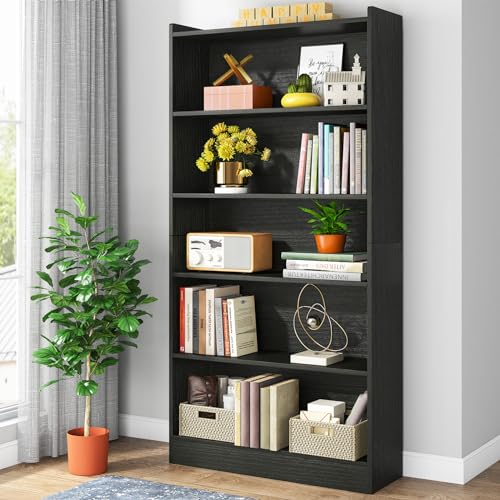
Most tall bookcases in this price band make you choose between capacity and construction. Open industrial frames carry weight well but let books drift backward and collect dust from behind; traditional closed cases look finished but often hide thin backs and modest load ratings. This Tribesigns library case is the rare design that refuses the trade. It stands 72.04 inches tall and 35.43 inches wide with six tiers, and — the detail that sold us — its back panels are selected particleboard rather than the flimsy cardboard sheet that is the quiet shame of flat-pack furniture. A real back does three jobs: it stiffens the whole case against sideways racking, it stops books being pushed through the rear, and it gives the unit a finished, library-like face that reads as furniture rather than scaffolding. In a living room, that difference is visible from across the room.
The numbers deserve honest reading, because they define how this case should be loaded. Each shelf is rated at 22 pounds, for a 132-pound total across the unit. That is a display-and-paperback rating, not a textbook rating: a full 35-inch row of hardcovers can exceed a single shelf’s limit faster than most people expect, so the loading pattern matters. Spread heavy reference books across the bottom tiers, keep the longest unbroken rows of hardcovers low, and let the upper shelves carry paperbacks, decor and lighter display pieces. Loaded that way, six tiers at this width hold a genuinely large home library — several hundred volumes — while the case stays well inside its engineering. The E1 particleboard shelves have a water-resistant melamine-style finish, so a wipedown with a damp cloth is all the maintenance the surface asks for, and the included anti-tipping hardware should be installed the same day the case is built, before the first book goes on.
Assembly is the standard flat-pack exercise: labeled panels, a methodical hour or so for one person, less with a helper for the lift into place. At roughly 78 to 83 pounds in the box, plan the carry if stairs are involved. Once standing, the white finish version brightens a room and pairs easily with modern and Scandinavian schemes; darker finishes in the same line suit traditional rooms. For shoppers comparing formats, the open-frame alternative in this guide is the Nathan James Theo ladder bookcase, which trades the closed back for a lighter wall-mounted profile — but for a primary living-room library, the closed-back Tribesigns is the more complete piece of furniture.
- Six tiers at 35.43″W x 11.81″D x 72.04″H — full library capacity in a standard footprint.
- Closed particleboard back panels for stiffness, dust control and a finished look.
- 132 lb total capacity (22 lb per shelf) with anti-tipping hardware included.
Honest limitation: The 22 lb per-shelf rating is modest — this is not the case for dense rows of heavy textbooks on every tier; heavy loads must be planned low and spread out.
Choose it if you want the most complete, finished library case under the ceiling. Skip it if your collection is mostly heavy reference volumes — look at the 50-plus lb per-shelf picks below instead.
Sauder Barrister Lane Cubby Bookcase
Who it suits: Households whose shelves must organize, not just store — families with baskets and games, collectors with mixed-size display pieces, and anyone who finds uniform open shelves visually chaotic.
An open shelf is a line; a cubby is a category. That is the whole argument for the Barrister Lane, and it is a strong one. Sauder’s design divides its wide, low frame — 53.15 inches wide, 47.52 inches tall, 12.13 inches deep — into ten cubby holes: eight smaller compartments and two large ones, with a flat gallery top that works as an extra display surface for plants, framed photos or a soundbar-adjacent decor row. Each cubby becomes a decision you make once — this one for board games, this one for a fabric basket of chargers, this one for vinyl, this one for the good hardcovers — and then the room stays organized because everything has an address. Sauder even builds the concept into the furniture with an ID label-tag system on the cubbies, a small touch that families and shared households genuinely use. The Scribed Oak finish and the barrister styling — a nod to the stacking glass-front cases of old law offices — give it a warm, traditional presence that flatters living rooms far more than a utility cube organizer has any right to.
The low, wide stance carries practical advantages that tall towers cannot match. At under four feet tall, there is no tip-over geometry to fear in the same way — though anchoring is still wise with climbers in the house — and every cubby is reachable by every member of the household, including children fetching their own books and grandparents who should not be stretching to a 70-inch top shelf. The top surface sits at a height that works under windows, under wall-mounted televisions and along the back of a sofa as a console. Engineered wood construction keeps it inside the budget comfortably — check price on Amazon — and Sauder backs it with a 5-year limited warranty, a meaningful signal from a company that has made American flat-pack furniture for generations.
Be clear about what it is not. Ten fixed cubbies mean fixed openings: a very tall art book or an oversized board-game box that fits neither the small nor the large compartments has nowhere to go, so measure your two or three bulkiest items against the cubby dimensions on the listing before ordering. And as a bookcase in the narrow sense, its total linear shelving is less than a six-tier tower’s — this is an organizer that also holds books, not a maximum-capacity library. Households whose clutter is the problem will not care. Households whose thousand paperbacks are the problem should look at the Tribesigns library case above or browse Best Bookshelf Under $1000 if the collection demands a step up in scale.
- Ten cubbies (eight small, two large) with ID label tags and a gallery display top.
- Low, wide 53.15″W x 12.13″D x 47.52″H stance — reachable by all ages, fits under windows.
- Engineered wood in Scribed Oak with a 5-year limited warranty from Sauder.
Honest limitation: Fixed cubby openings cannot adapt to oversized items, and total book capacity is lower than a tall tower’s.
Choose it if your living room needs categories and calm more than raw capacity. Skip it if you need maximum linear shelving for a large book collection.
Nathan James Theo 6-Shelf Wall-Mount Bookcase
Who it suits: Modern and industrial interiors, renters and owners who like a light visual footprint, and anyone planning a modular wall of shelving that can grow one unit at a time.
The Theo takes the opposite construction philosophy from the closed library case, and in the right room it is the better answer. A matte metal frame in black carries six reclaimed-oak-finish laminate shelves, 30 inches wide, and the whole ladder-style unit mounts to the wall. Wall mounting changes the physics in your favor: instead of a freestanding tower that must resist tipping by weight and strap, the Theo is fixed to the structure of the room, and each shelf is rated at 55 pounds — the strongest per-shelf figure in this guide alongside the Bush. Rows of hardcovers that would worry the Tribesigns library case sit comfortably here. The open sides and back keep the profile visually light, so a tall shelving unit does not visually shrink a smaller living room the way a solid case can, and the modular design is explicit: Nathan James intends you to line several Theos up along a wall to build a library run, buying one now and adding a second when the collection — or the budget — grows.
The details are well judged. Anti-tip hardware is included even though the design is wall-mounted, the laminate shelves shrug off the ring marks and dusting that punish raw wood, and assembly is quoted by the maker at around 40 minutes with a Phillips screwdriver. The industrial pairing of oak-look shelves and black frame sits naturally with leather sofas, black metal lighting and the modern farmhouse-to-industrial spectrum that dominates current living rooms; a white-frame variant exists in the same line if your room runs brighter — check the current listing options on Amazon.
The honest trade-offs follow from the open design. There is no back, so books need bookends on the outer runs or they will drift, and dust reaches the wall behind. Wall mounting itself is a commitment: you need studs or proper anchors where the unit must go, and renters must check their lease before drilling — a point we return to in the mistakes section. Shelf depth on ladder designs also narrows the effective storage for very deep items compared with a full-depth case. None of this diminishes the Theo for its intended job: strong, handsome, expandable shelving that looks like a design choice rather than a storage apology.
- Six shelves at 55 lb per shelf — the joint-strongest rating in this guide.
- Wall-mounted metal frame, 30 inches wide, with anti-tip hardware included.
- Modular by design — line up multiple units for a full library wall.
Honest limitation: Open back and sides need bookends and gather dust; wall mounting requires studs or anchors and a lease that allows drilling.
Choose it if you want strength, a modern profile and room to expand. Skip it if you cannot drill into the wall or want a closed, finished back.
Bush Home Salinas 5 Shelf Bookcase
Who it suits: Traditional and farmhouse living rooms, mixed collections of books and taller objects, and buyers who value an established brand’s standards testing and support.
Every guide needs a pick for the reader who does not want a design statement — who wants a proper bookcase, from a proper furniture company, that adjusts to their things and lasts. The Salinas is that pick. Bush Furniture has made ready-to-assemble furniture in the United States for over sixty years, and the Salinas 5 Shelf Bookcase shows the habits that longevity teaches: two fixed shelves for structural strength, three adjustable shelves that move to fit tall art books, binders, baskets and display pieces, and a 50-pound rating on every shelf. The unit measures 32 inches wide, 12 inches deep and 63 inches tall — a slightly lower, friendlier height than the 72-inch towers, which suits rooms where a very tall case would crowd the wall, and it is tested to meet ANSI/SOHO quality standards for safety and performance, a line item most marketplace brands cannot offer.
The styling is modern farmhouse done with restraint: the Cape Cod Gray finish of this listing (the Salinas line offers other finishes — check the current options on Amazon) pairs with the collection’s simple lines to sit comfortably beside linen sofas, wood floors and both coastal and country schemes. At 68 pounds it is a substantial piece once built, with the planted feel that lighter towers lack. Adjustability is the daily-use advantage you will feel most: the day a shelf must swallow a 13-inch cookbook collection, a board-game stack or a row of storage baskets, you move a shelf instead of starting a pile on the floor — which is where bookshelf dissatisfaction actually begins.
Limitations, plainly: five shelves at 32 inches wide is less total storage than the six-tier Tribesigns, and the 63-inch height gives up the top tier entirely. The farmhouse look is also a commitment — in a strongly modern room it will read as the odd piece out, where the Theo or the arched Tribesigns would blend. And like all wide flat-pack cases, assembly is a two-coffee job best done with the panels laid out and the instructions actually read. Within its intent, though, the Salinas is the guide’s most conventionally dependable bookcase: strong shelves, real adjustability, standards testing, and a brand that will still exist when you need a replacement part.
- Three adjustable plus two fixed shelves, each rated to 50 lb.
- Tested to ANSI/SOHO standards; from Bush Furniture, an established US maker.
- 32″W x 12″D x 63″H farmhouse profile in Cape Cod Gray.
Honest limitation: Less total capacity than the six-tier picks, and the farmhouse styling will not blend into a strictly modern room.
Choose it if you want adjustable, standards-tested dependability in a traditional look. Skip it if you need maximum capacity or a contemporary profile.
Tribesigns 6-Tier Arched Bookshelf
Who it suits: Design-led living rooms where the bookshelf is a focal point — display-heavy households, curated shelves of books plus objects, and anyone furnishing a modern, transitional or soft-minimalist space.
Some furniture stores things; this one also finishes the room. The Tribesigns arched bookcase rises 77.16 inches — the tallest pick in this guide — and finishes in a soft arch that echoes the arched doorways and curved furniture dominating current interiors. At 31.5 inches wide and 11.81 inches deep, its footprint is ordinary; its effect is not. Six open tiers of engineered wood (MDF) give you a full bookcase worth of storage, but the silhouette means the shelves read as a display piece: the top arch frames whatever you place there like a niche in a much more expensive built-in. In black, as listed here, it anchors a light room with real contrast; the same design language works in the styled, object-led shelves that living rooms increasingly are — part library, part gallery.
Function keeps pace with form more than skeptics expect. The MDF construction is dense and stable, the open tiers accept tall objects that closed cubbies refuse, and the included anti-tipping kit addresses the one non-negotiable fact of a 77-inch unit: it must be anchored, full stop, especially with children or large pets in the home. The smooth finish wipes clean with a damp cloth, and the open design means no doors to align and no back panel to trap dust behind books. Positioned on a living-room wall it also works as a room-dividing display in open-plan spaces, where its finished silhouette looks intentional from behind in a way a raw-backed case never does — though the open back means bookends earn their keep here too.
The compromises are honest ones. An arch is a strong stylistic commitment: if your room is traditional or farmhouse, the Salinas or the Sauder will belong and this will argue. The top tier’s usable height is shaped by the curve, so the very top shelf suits display pieces better than a uniform row of tall hardcovers. And while six tiers is generous, design-led pieces in this class prioritize looks over published heavy-load engineering — load it as a display-led bookcase, heaviest books low, rather than as a textbook vault. For the household that wants its storage to be seen, none of that is a deterrent; this is the pick guests will ask about.
- 77.16″H arched silhouette — the guide’s true statement piece.
- Six open MDF tiers at 31.5″W x 11.81″D, with anti-tipping kit included.
- Works as display, library or open-plan room divider.
Honest limitation: The arched top tier suits display better than tall uniform rows, and the look commits the room to a modern direction.
Choose it if you want storage that doubles as the room’s focal point. Skip it if your style is traditional, or your top priority is heavy-load engineering.
Tribesigns 6-Tier Corner L-Shaped Bookshelf
Who it suits: Anyone with a dead corner and a storage problem — smaller living rooms, apartments, and rooms where the straight walls are already fully committed to sofas, media and doors.
Every living room has one: the corner where two walls meet and nothing quite fits, occupied by a plant of diminishing health or a lamp that lights nothing. This Tribesigns is built precisely for that square footage. Its L-shaped frame wraps the corner with six tiers of shelving, standing 64.9 inches tall, turning the least useful patch of the room into a vertical store for books, baskets, plants and display pieces. Corner placement is also structurally kind: a unit braced by two walls, properly anchored, is inherently steadier than a freestanding tower mid-wall, and the design adds anti-drop panels on the shelves so books and objects do not slide off the open sides — the detail that separates a corner shelf designed for books from a plant stand pressed into service.
In practice, the corner case solves layouts the straight picks cannot. When the long wall must hold the sofa and the short wall holds the media console, the corner is the only library address left, and six tiers there can absorb the overflow that otherwise becomes floor piles: the paperback backlog, the children’s books that migrate downstairs, the photo albums, the board games that fit nowhere. The wood-grain finish keeps it warm rather than industrial, and at 64.9 inches it stays below the visual horizon of the room — storage that does not loom. It also pairs naturally with a primary case: many households will run the Tribesigns library tower as the main library and this corner unit as the satellite for display and overflow, a combination still comfortably inside a combined under-$700-per-piece budget — check price on Amazon for each.
Its limits are geometric. Corner shelves are shallower in usable rectangular space than their dimensions suggest — the deep corner point is awkward for square objects, so plan the corner tiers for round, small or display items and keep long book rows on the straight runs. Capacity per tier is display-grade rather than heavy-library-grade. And a corner unit is only as good as the corner: if yours is interrupted by a vent, a window frame or a door swing, measure before ordering. For the right corner, though, this is the only pick in the guide that adds storage without taking a single inch of usable wall.
- L-shaped six-tier design built for corners, 64.9 inches tall.
- Anti-drop panels keep books and objects on the open shelves.
- Wood-grain finish; ideal satellite or sole case for tight layouts.
Honest limitation: The deep corner point wastes square-object space, and per-tier capacity is display-grade, not heavy-library-grade.
Choose it if your walls are full but your corner is empty. Skip it if you have open wall space for a full-width library case instead.
Comparison Table
| Product | Format | Size (W x D x H) | Best use | Link |
|---|---|---|---|---|
| Tribesigns 72-Inch 6-Tier Library | Closed-back tower | 35.43″ x 11.81″ x 72.04″ | Primary home library | Check on Amazon |
| Sauder Barrister Lane Cubby | 10-cubby low wide | 53.15″ x 12.13″ x 47.52″ | Organization and family storage | Check on Amazon |
| Nathan James Theo 6-Shelf | Wall-mount ladder | 30″ wide, 6 shelves | Modern rooms, expandable walls | Check on Amazon |
| Bush Home Salinas 5 Shelf | Traditional adjustable | 32″ x 12″ x 63″ | Mixed books and tall objects | Check on Amazon |
| Tribesigns 6-Tier Arched | Arched display case | 31.5″ x 11.81″ x 77.16″ | Statement display storage | Check on Amazon |
| Tribesigns Corner L-Shaped | Corner unit | 64.9″ tall, L-shaped | Dead corners, overflow | Check on Amazon |
How to Choose a Bookshelf Under $700
Start with the load, not the look. Estimate your library honestly: a foot of hardcovers weighs roughly 15 to 20 pounds, paperbacks about half that. Multiply by the feet you own and you have the total your shelves must carry — then check it against per-shelf ratings, not just totals, because books concentrate weight shelf by shelf. If your collection is heavy, the 50-to-55-pound-per-shelf picks (the Theo and the Salinas) are your shortlist. If it is mostly paperbacks and display, the higher-capacity formats open up. Shoppers whose budget is the binding constraint rather than the ceiling should cross-check Best Bookshelf Under $300 before assuming they must spend near $700 at all.
Measure three things before anything else. The wall width the case may occupy, including a margin for baseboards — shelf depths around 12 inches assume the case sits close to the wall, and thick baseboards push it out. The ceiling height against the case height, remembering you must tilt a tall flat-pack upright in the room, which needs more clearance than the finished height. And the shelf openings against your tallest items: fixed shelves and cubbies demand that check, adjustable shelves forgive it. Depth matters more than shoppers expect — 11.8 to 12.1 inches across all six picks here suits standard books perfectly; oversized art books and deep storage boxes are the exception that needs verifying.
Then decide the format by the job. Closed-back tower for a primary library. Cubbies when the room’s problem is categories and clutter. A ladder when the wall is modern and the collection will grow. Adjustable traditional when your objects vary in height. An arch when the room needs a focal point. A corner unit when the walls are spoken for. Format first, finish second, brand third — in that order, a bookshelf purchase almost never goes wrong. Finally, treat anchoring as part of the purchase: locate the stud, confirm the kit is in the box, and install it during assembly, not after the shelves are loaded.
Sizing a Bookshelf to the Room, Not the Photograph
Product photographs are shot in lofts with twelve-foot ceilings and no baseboards, which is why so many bookshelves arrive looking smaller than expected and then dominate the room they were meant to serve. A more reliable method is to build the shelf in tape first. Mark the case’s width and height on the wall with painter’s tape, then live with the outline for a day. You will immediately see whether a 72-inch tower crowds a window frame, whether a 53-inch-wide cubby case leaves the wall balanced or lopsided, and whether the top of an arch will sit comfortably below a picture rail or fight with it. Tape is also the honest way to test the low-and-wide versus tall-and-narrow question: in rooms with low ceilings or a long sofa wall, width reads as calm; in rooms with height and little floor, a tower reads as architecture.
Proportion runs the other way as well. A single narrow 30-inch ladder case on a twelve-foot wall looks lost, which is exactly the situation the Theo’s modular design answers — two units with a deliberate gap, or three in a run, turn shelving into a wall system. Conversely, the wide Sauder cubby case is a complete composition by itself and wants to be the only shelving on its wall. Think in wall compositions, not in units: sofa plus case, console plus case, or case alone as the feature. The Tribesigns library bookcase at just over 35 inches wide is the flexible middle — substantial alone, pairable with a matching second unit later, and narrow enough to leave room for art or a floor lamp beside it.
Finally, plan the shelf styling load before the furniture arrives, because a bookshelf is only half books in most living rooms. Reserve roughly a third of your shelf length for objects, baskets and breathing room, and buy capacity for the total, not for the books alone. Households that skip this arithmetic end up with a case that is technically big enough and visually exhausting — every shelf packed edge to edge. The formats in this guide handle that mixed load differently: cubbies pre-divide it, open ladders display it, closed towers absorb it. Choosing the format that matches your real ratio of books to objects is the last sizing decision, and the one that most determines whether you still like the wall in a year.
Common Buying Mistakes
Buying by photograph instead of by load rating. A shelf that sags in month three was usually overloaded on day one. Match your heaviest row to the per-shelf figure, and put that row at the bottom.
Skipping the wall anchor. Tall cases and climbing children or pets are a known hazard combination. Every tall pick here includes hardware; the mistake is leaving it in the bag. Anchor into a stud, not just drywall, wherever the design allows.
Forgetting the tilt-up. A 72-inch case assembled flat needs well over 72 inches of diagonal clearance to stand up. Assemble in the room, near the final wall, and check ceiling and light fixtures first.
Ignoring baseboards and vents. A case pushed out an inch by a baseboard cannot anchor flush and rocks on carpet edges. Measure the wall as it is, not as the floor plan imagines it.
Choosing fixed shelves for a mixed collection. If your shelves must hold games, baskets and tall books alongside paperbacks, fixed openings will defeat you — that is the adjustable Salinas’s whole argument, or the cubby Sauder’s.
Spending the whole budget on one piece when two smaller ones fit the room better. Under $700 buys one large case or, often, a main case plus a corner satellite — check price on Amazon for combinations before defaulting to a single tower. Readers planning a full wall should also see Best Bookcase Under $700, where the same formats are compared from a bookcase-first angle.
Assembly and Anchoring: What to Expect on Day One
Every pick in this guide is flat-pack or frame-and-shelf furniture, and the ownership experience is set in the first two hours. Budget an unhurried afternoon, a clear floor, and a second person for any case over 70 inches or 60 pounds — the Tribesigns tower and the Bush Salinas both qualify. Lay panels out against the instructions before driving a single cam lock; flat-pack errors compound, and the time to discover a reversed side panel is before the back goes on, not after. Build the case in the room where it will live, close to its wall, because a finished 72-inch case is an awkward object to carry through doorways, and its tilt-up arc needs the ceiling clearance you measured earlier.
Anchor as the final assembly step, while the case is empty and the stud finder is already warm. Mark the stud through the case’s anchor point, drive the strap or bracket hardware as the maker directs, and only then begin loading — heaviest shelf first, at the bottom, working upward. Keep the hex keys and any spare shelf pins in a labeled bag taped to the case’s underside or back; the household that can find its furniture tools in year three is the household that still likes its furniture in year three. Wipe the finished case down, check it for level on its adjustable feet or shims if your floor runs out, and photograph the loaded result — both for the satisfaction and because a dated photo is the easiest way to notice a shelf beginning to sag a year later, while the fix is still a load redistribution rather than a replacement.
Final Recommendation
For most households, the Tribesigns 72-inch library bookcase is the buy
: six tiers, a real closed back, and a finished presence that justifies its place in the living room, at a position comfortably inside the under-$700 budget — check price on Amazon. If your home’s problem is clutter rather than books, take the Sauder Barrister Lane and its ten cubbies. If your room is modern and your collection growing, take the Theo and add a second when you need it. Traditional rooms and mixed-height objects point to the Salinas; design-led rooms to the arch; full walls to the corner. Whichever you choose, anchor it, load the heavy rows low, and the bookshelf you buy under $700 this year should still be earning its wall a decade from now. For the next tier up in scale and budget, our guide to Best Bookshelf Under $1000 covers the library-wall territory above this ceiling.
Frequently Asked Questions
How many books does a 6-shelf bookcase under $700 actually hold?
It depends on width and format, but a 35-inch six-tier case holds several hundred volumes in a paperback-and-hardcover mix. Load matters more than count: respect the per-shelf weight rating — 22 lb per shelf on the Tribesigns library case, 50 to 55 lb on the Salinas and Theo — and distribute hardcovers across lower tiers.
Is it worth spending close to $700 on a bookshelf?
Only if the extra money buys construction you will use: a closed back, adjustable shelves, standards testing or a design you genuinely want to look at for years. Every pick in this guide sits inside the ceiling, and several sit well inside it — check price on Amazon rather than assuming the most expensive option is the best one for your room.
Do I really need to anchor a bookshelf to the wall?
Yes, for any tall case — and it is essential with children or pets in the home. All the tall picks here include anti-tip hardware or wall-mount by design. Anchor into a stud where possible, install during assembly, and never load a tall unanchored case.
What shelf depth do books actually need?
Standard hardcovers and paperbacks need about 11 to 12 inches, which is why every pick here sits between 11.81 and 12.13 inches deep. Oversized art and coffee-table books can need more; measure your largest volumes and check them against the listing dimensions.
Fixed or adjustable shelves — which is better?
Adjustable shelves (like the Salinas’s three movable shelves) suit mixed collections of books, baskets and tall objects. Fixed shelves and cubbies suit uniform books and organized categories, and often feel sturdier. Match the choice to what your shelves must actually hold.
Can two smaller bookshelves beat one large one?
Often, yes. A main case plus a corner unit can fit awkward rooms better than a single wide tower, spread load across two walls, and still stay within an under-$700-per-piece budget. Modular designs like the Theo are built to grow exactly this way.


