Where to buy
Check the latest price, availability and delivery on Amazon. Orders are placed on Amazon. We may earn a commission from qualifying purchases.
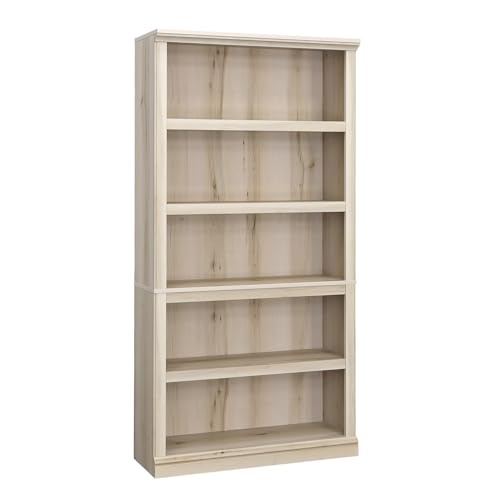
- Best overall: Sauder Select 5-Shelf Bookcase, Pacific Maple — Check on Amazon
- Nathan James Theo 5-Shelf Ladder Bookcase, Walnut/Black — Check on Amazon
- Sauder International Lux Bookcase, Satin Gold with Glass Shelves — Check on Amazon
- VASAGLE CUSTOS 6-Tier Bookshelf, Cloud White — Check on Amazon
See 2 more Amazon options
- Sauder 5-Shelf Bookcase with Doors, Chalked Chestnut — Check on Amazon
- Furinno Luder 5-Cube Bookcase, White — Check on Amazon
Read the full guide ↓
Disclosure: As an Amazon Associate, dailyhomedecorating.com earns from qualifying purchases. Links to Amazon on this page are affiliate links; they cost you nothing extra. Listing details such as price and availability change often, so check the current Amazon listing before you buy.
Four hundred dollars is the point where a bookshelf stops being a compromise and starts being furniture. Below that line, most bookcases are thin particleboard towers that bow in the middle within a year, wobble every time you pull a book out, and look exactly as cheap as they were. At the best bookshelf under $400 level, something better happens: the shelves get thick enough to carry real hardcovers, the frames pick up metal reinforcement or proper joinery, the finishes stop peeling at the corners, and the designs — ladder frames, glass-and-brass display cases, bookcases with actual doors — start to look like pieces you chose rather than pieces you settled for. This guide is about spending that budget where it counts, and about being honest concerning where even a $400 ceiling still forces trade-offs.
We looked at the under-$400 field the way a heavy reader actually uses it. A bookshelf is not a plant stand that occasionally holds a paperback. It is a load-bearing structure that may carry a hundred pounds or more of books, it is usually the tallest freestanding object in the room, and it is the piece of furniture your guests’ eyes land on first. So the questions that matter are structural before they are decorative: How much weight does each shelf genuinely hold? Do the shelves adjust for tall art books and storage boxes? How deep are they — deep enough for a standard hardcover with room to spare, or so deep that books disappear into shadow? Does the unit anchor to the wall? And does the design still make sense when it is full, not just in the styled photo where it holds three books and a vase?
Our short answer: for most living rooms, the Sauder Select 5-Shelf in Pacific Maple is the safest pair of hands in this price band — wide, deep, adjustable, and built by a company that has been making bookcases for decades. If your taste runs modern, the Nathan James Theo ladder shelf and the gold-and-glass Sauder International Lux are the two design-led picks that still behave like real bookcases. The VASAGLE CUSTOS earns its place for narrow walls, the Sauder with doors solves the visual-clutter problem, and the little Furinno Luder cube is the honest budget anchor of the list. If your budget is tighter than this guide assumes, our companion roundup of the Best Bookshelf Under $300 covers the next rung down.
In this guide
Quick Picks
Six bookcases, six different jobs. Match the row to your room and your reading habits.
| Buyer type | Pick | Why it stands out | Link |
|---|---|---|---|
| Best overall | Sauder Select 5-Shelf Bookcase, Pacific Maple | Wide 35-inch frame, three adjustable shelves, deep shelves for big books | Check on Amazon |
| Best modern ladder design | Nathan James Theo 5-Shelf Ladder Bookcase | Wall-mounted metal frame, 50 lb per shelf, shallow footprint | Check on Amazon |
| Best for display | Sauder International Lux Bookcase, Satin Gold | Tempered glass shelves on a brass-tone frame — a display case that holds books | Check on Amazon |
| Best narrow 6-tier | VASAGLE CUSTOS 6-Tier Bookshelf, Cloud White | Only 9.4 inches deep and 23.6 wide, with adjustable shelves and an anti-tip kit | Check on Amazon |
| Best with hidden storage | Sauder 5-Shelf Bookcase with Doors, Chalked Chestnut | Doors hide the clutter shelves; open shelves above for display | Check on Amazon |
| Best budget cube | Furinno Luder 5-Cube Bookcase, White | Low, simple cube storage that doubles as a room divider or TV-height surface | Check on Amazon |
How the picks for the best bookshelf under $400 were chosen
Every pick in this guide had to clear the same bar. First, the product had to be a real, currently listed bookcase from an identifiable brand, with a verifiable Amazon listing and manufacturer specifications we could cross-check — dimensions, shelf count, materials and rated shelf capacity all come from the manufacturer’s own published specs, not from review-roundup folklore. Second, the street price had to sit comfortably under the $400 ceiling of this guide, with most picks landing far below it; we do not print static prices because they change constantly, so check price on Amazon for the current figure. Third, the design had to survive being loaded: we favoured thick shelves, metal reinforcement, enclosed backs or cross-bracing, and included anti-tip hardware.
We also deliberately mixed formats. A single “best” bookcase does not exist, because a 35-inch-wide traditional case, a wall-hugging ladder shelf and a low cube unit solve different problems. What this list gives you is the strongest verified example of each format under $400, with the honest limitation of each stated plainly. Where a format’s weakness matters — glass shelves and heavy encyclopedias, shallow shelves and oversized art books — we say so in the review rather than in a footnote.
Finally, safety. A tall bookcase is a tip-over risk in any home, and every tall pick here either ships with an anti-tip kit or is designed to mount to the wall. Use the hardware. It takes ten minutes and it is the difference between furniture and hazard, especially in homes with children or large dogs — a point we return to in our family-focused guide to the Best Bookshelf For Families Under $400.
What the under-$400 budget actually buys you
It helps to know what changes as you climb from the bargain shelf to this tier, because the differences are structural rather than cosmetic. At the lowest prices, bookcases are built from thin particleboard — often barely half an inch — held together with cam locks, with a cardboard-thin back panel stapled on for the photo. They work, briefly, for light loads. The under-$400 tier buys you four concrete upgrades. First, shelf thickness and span engineering: shelves get closer to three-quarters of an inch and spans get braced, which is what stands between a shelf and the slow banana-curve sag that ruins cheap cases. Second, real hardware: metal frames, proper wall-mounting systems and included anti-tip kits replace hope as the stability strategy. Third, adjustability: peg-and-hole adjustable shelving, once a premium feature, is standard at this level on the better designs. Fourth, finish quality: the laminates and veneers here survive a damp cloth, a dragged bookend and a house move without peeling at the edges.
What $400 does not buy is equally worth knowing. It does not buy solid hardwood construction — every pick in this guide is engineered wood, metal, glass, or a combination, because a solid-oak bookcase of this size costs several times the budget. It does not buy unlimited loads: even the strongest pick here, the Theo at 50 lb per shelf, is a domestic bookcase, not library stack shelving. And it does not buy immunity from physics — a tall, narrow, fully loaded case still needs its wall anchor. Shoppers who understand those boundaries tend to be delighted with this tier; shoppers who expect heirloom furniture at flat-pack prices are the ones writing angry reviews. Set the expectation at “well-engineered, good-looking, decade-capable with sensible loads” and the under-$400 field delivers it.
One more budgeting note: the sticker is not the whole spend. Fabric bins for a cube unit, bookends for open ladder shelves, and the correct wall fixings for your wall type are small extras that make the difference between a bookcase that works and one that merely stands there. They are also cheap compared with replacing a sagging shelf — or a fallen one.
Detailed reviews
1. Sauder Select 5-Shelf Bookcase, Pacific Maple — best overall
Who it suits. Anyone who wants one substantial, conventional bookcase that will hold a serious collection and not embarrass the room: living rooms, home offices, spare-room libraries. If you own hardcovers, binders and a few storage boxes and you want them all on one wall, this is the default recommendation.
The details. The Select is a big case by flat-pack standards: 35.28 inches wide, 13.23 inches deep and 69.76 inches tall, in engineered wood with a light Pacific Maple finish. Five shelves give you five full-width rows; three of them adjust, so you can open up a tall bay for art books, atlases or board games and tighten the others down for paperbacks. The 13-inch-plus depth is the quiet advantage here — standard hardcovers sit with their spines near the front edge instead of getting lost, and there is room for standard storage baskets behind a front row of books. Sauder rates its adjustable shelves at 25 lb each, which is honest mid-duty capacity: fine for books, not a place to stack a complete run of encyclopedias on one adjustable shelf. Assembly uses Sauder’s slide-on mouldings, which genuinely do speed things up, and the enclosed back panel keeps the unit square and stops books sliding out the rear.
Pros. The widest and deepest case in this roundup, so it swallows a real library. Three adjustable shelves make the interior flexible in a way fixed-shelf rivals are not. The Pacific Maple finish is light and neutral — it brightens a room instead of darkening it, and it pairs with both pale Scandinavian schemes and warmer traditional ones. Sauder is a long-established US furniture maker with a real warranty and replacement-part support, which matters more for a 90-pound piece of furniture than for almost anything else in the flat-pack world.
Honest limitation. It is heavy — around 90 lb in the box — and it is a two-person assembly and a two-person move. The engineered-wood construction, while well executed, is still engineered wood: overload an adjustable shelf well past its rating and it will eventually sag. And the traditional styling, though inoffensive, will not satisfy anyone chasing a gallery look.
Choose it if you want maximum, flexible book storage from a proven maker. Skip it if your wall is narrower than about 40 inches, or you want a statement piece rather than a workhorse.
2. Nathan James Theo 5-Shelf Ladder Bookcase, Walnut/Black — best modern ladder design
Who it suits. Modern and industrial interiors, and anyone whose books share shelf space with plants, ceramics and framed prints. The Theo is the pick for people who look at a traditional bookcase and see a wall of brown.
The details. The Theo pairs engineered-wood shelves in a brown walnut finish with a matte black metal frame in a leaning ladder profile, roughly 24 inches wide, about 12 inches deep and 72.5 inches tall. Five fixed shelves climb the frame, each rated by Nathan James at a genuinely strong 50 lb — the best per-shelf figure in this roundup, and the reason this slim unit can carry hardcovers that would worry lighter ladder shelves. The key structural fact is that the Theo is designed to mount to the wall: the frame fixes at the top, which turns the usual ladder-shelf wobble into a non-issue and makes it one of the most stable tall units here once installed. The open sides and back keep it visually light, so a wall of shelving does not eat the room.
Pros. The strongest shelves in the list relative to its size. The wall-mounted design is properly stable, not freestanding-and-hoping. The walnut-and-black combination reads as intentional design at a price where most rivals read as storage. Nathan James sells the Theo in several finishes and in pairs, so you can build a matched wall of two or three units that looks like one built-in run.
Honest limitation. Wall mounting is not optional decoration — it is the design. Renters who cannot drill should look at the freestanding picks instead. The shelves are fixed, so tall-item flexibility is limited, and at about 24 inches wide each unit holds fewer books per row than the Sauder Select; serious libraries will want two.
In daily use, the Theo’s shallow depth turns out to be a feature rather than a compromise. Standard novels and trade hardcovers sit nearly flush with the shelf edge, so the whole library is visible at a glance — no dark second row hiding behind the first, which is what happens in deep cases. The open design also makes it the easiest unit here to dust and the happiest beside a radiator or in a bright room, where enclosed cases can trap heat against book spines. Styling-wise it rewards the current habit of mixing books with objects: a shelf of vertical books, a shelf with a horizontal stack and a plant, a shelf of ceramics. Because the frame is visually light, even a fully loaded Theo reads as decoration rather than storage, which is precisely why it anchors so many modern living-room schemes — and why pairs of them, mounted side by side, are a common substitute for a built-in library wall at a fraction of the joinery cost.
Choose it if you want modern looks without giving up load capacity, and you can anchor to studs or solid wall. Skip it if you cannot drill, or you need adjustable shelves.

3. Sauder International Lux Bookcase, Satin Gold — best for display
Who it suits. Anyone whose shelves are as much gallery as library: collectors, decorators, and living rooms where the bookcase is meant to be looked at. If your shelves hold a curated mix of books, glassware, sculpture and photos, this is your pick.
The details. The International Lux stands 30 inches wide, 14.49 inches deep and 70.87 inches tall, with a satin-gold metal frame carrying five shelves of safety-tempered glass. The glass does two things no wood shelf can: it lets light pass through the whole unit, so displayed objects are lit from above and below, and it makes the case visually disappear against the wall, leaving your objects floating on brass rails. Sauder rates the unit’s shelves at up to 35 lb, which is display-and-paperback territory rather than full-hardcover territory, and the frame’s open design suits it to a wall where it can be seen from the side as well as the front.
Pros. Genuinely elegant — the only pick here that guests will ask about. Tempered glass is stronger and safer than standard glass, and it wipes clean in seconds. The deeper 14.5-inch footprint keeps it stable, and the open frame suits room-divider placement in open-plan spaces better than any enclosed case.
Honest limitation. Glass is honest about dust: expect to wipe the shelves regularly, and expect fingerprints if children use it. The 35 lb shelf rating means full rows of heavy hardcovers belong on the Sauder Select instead. And brass-tone finishes are a commitment — it will fight with chrome-and-black schemes.
Choose it if display matters as much as storage and your collection leans decorative. Skip it if your shelves are floor-to-ceiling hardcovers, or you hate dusting.
4. VASAGLE CUSTOS 6-Tier Bookshelf, Cloud White — best narrow six-tier
Who it suits. Narrow walls, hallways, and anyone who needs height rather than width: six tiers in a footprint barely two feet wide. It is also the natural pick for white, bright, minimalist rooms.
The details. The CUSTOS measures 23.6 inches wide, just 9.4 inches deep and 63.3 inches tall, in particleboard and MDF with a cloud-white finish. Six tiers stack a lot of storage into a slim column, and several of the shelves adjust between three height positions, so the column can mix tall vases, standard hardcovers and paperback rows. VASAGLE rates each shelf at 22 lb, with a 154 lb total for the unit — paperback-and-decor ratings, honestly stated. An anti-tip kit is included in the box, and the slot-in back panel and H-shaped structure keep the narrow tower from racking side to side.
Pros. The shallowest full-height pick here: at 9.4 inches deep it fits walls and landings where a 13-inch case would jut. Six tiers beat five for sheer row count. The white finish disappears against pale walls, making a small room feel less furnished, not more. Adjustable shelves at this size are uncommon.
Honest limitation. The 9.4-inch depth is a real constraint: large-format art books and deep storage boxes will overhang or not fit, and 22 lb per shelf rules out dense hardcover runs — spread heavy books across tiers or choose the Sauder Select. The white finish also shows scuffs more than wood tones.
The CUSTOS also deserves credit for how it behaves in the rooms it is bought for. In a hallway it is shallow enough to walk past without turning sideways; on a landing it turns dead vertical space into a working mini-library; in a bedroom it holds the bedtime stack, a water carafe and a small plant on top without crowding the bedside. The adjustable shelves matter at this scale more than on the big cases, because a narrow column cannot waste four inches of air above a row of paperbacks — you set the spacing tight and the column holds a surprising amount. Owners of small homes often buy one, then a second a year later when the collection grows; the plain white finish makes the pair look planned rather than accumulated.
Choose it if your wall is narrow or your hallway needs storage. Skip it if your collection is mostly oversized or heavy books.
5. Sauder 5-Shelf Bookcase with Doors, Chalked Chestnut — best with hidden storage
Who it suits. Anyone whose shelves hold two kinds of things: the books and objects they are proud of, and the binders, games, cables and clutter they are not. The doors exist for the second kind.
The details. Built on the same 35.28-inch-wide, 13.23-inch-deep, 69.76-inch-tall frame as the Select, this version closes its lower shelves behind a pair of doors in a warm Chalked Chestnut finish. Open shelves above handle display and everyday books; behind the doors, adjustable shelving swallows the visual noise — board games, photo boxes, office supplies, the printer paper, the router. For living rooms that double as offices and playrooms, that split personality is the whole point: the room reads tidy even when your storage is not.
Pros. Hidden storage is the feature no open shelf can fake, and it also keeps dust off stored items and keeps toddler hands and pet noses out. The full-width, full-depth frame gives you Select-class capacity. The chestnut finish is warm and forgiving of scuffs.
Honest limitation. Doors cost you display space — roughly the lower half of the case is invisible, so if everything you own is beautiful, buy the open Select instead. It shares the Select’s weight and two-person assembly. Door alignment takes a few patient minutes during setup to get the gaps even.
Choose it if your shelves mix display with real-life clutter. Skip it if you want everything visible and styled.
6. Furinno Luder 5-Cube Bookcase, White — best budget cube
Who it suits. First apartments, kids’ rooms, dorms and anyone who needs low, simple storage now and would rather spend the rest of the budget on books. Also genuinely useful as a low room divider or a TV-height surface in a small living room.
The details. The Luder is a five-cube open bookcase, 15.8 inches wide, 9.4 inches deep and 52 inches tall, in Furinno’s simple engineered-wood construction with a white finish. The cube format suits fabric bins, baskets and stacked paperbacks, and the 52-inch height keeps everything reachable — including by children — and keeps the top surface usable for a lamp, a plant or the TV remote fleet. It is light, flat-packed small, and one person can assemble and move it without planning the afternoon around it.
Pros. The lowest-cost way into this list by a wide margin — check price on Amazon, but expect a fraction of the $400 ceiling. Low height means no tip-over drama of the tall towers (anchor it anyway if children climb). Cube openings take standard fabric bins, turning open shelves into tidy closed storage for a few dollars more. It is the easiest pick here to resell, donate or move to another room when your needs change.
Honest limitation. This is light-duty furniture: thin panels, modest load tolerance, and a finish that will not survive a decade of moves. The 9.4-inch cube depth limits book sizes, and five cubes hold a fraction of what the Sauder Select holds. Buy it as a starter or a supplement, not as a library.
Choose it if budget or a low profile is the priority. Skip it if you need a tall, high-capacity, long-term bookcase.
Assembly and setup notes for this roundup
None of these bookcases arrives assembled, and the setup experience differs enough to be worth planning around. The two big Sauder cases — the Select and the doored version — are the heavyweight jobs: boxes around 90 lb, a couple of hours of methodical work for one person or half that for two, and a strong argument for assembling in the room where the case will live, because a finished 35-inch-wide, 70-inch-tall bookcase does not enjoy doorways and stair turns. Sauder’s instructions are among the clearest in flat-pack, parts are labelled, and the slide-on mouldings forgive small misalignments. The doored model adds a final step — hanging and levelling the doors — that rewards patience with a small screwdriver adjustment rather than force.
The Nathan James Theo is a different kind of job: the frame itself goes together quickly, but the wall-mounting step is the real work. You need to find studs or fit proper wall anchors rated for the load, level the frame before fixing, and accept that the shelf positions are then permanent. Measure twice, because moving a mounted ladder shelf six inches to the left means new holes. The International Lux assembles like a metal-framed etagere — frame first, glass last — and the glass panels, while tempered, should be laid on a soft surface during the build and handled by their edges; two people make the tall frame far easier to keep square while the shelves drop in.
The two VASAGLE units and the Furinno Luder are the lightweights: smaller boxes, simpler hardware, and realistic one-person builds well under an hour for the Luder and around an hour for the six-tier CUSTOS. With all three, the included anti-tip strap is part of assembly, not an optional extra — fit it while the unit is empty and the wall is easy to reach. Across the whole roundup, three habits pay off: build on a rug or blanket to protect both floor and finish; do not fully tighten every fixing until the unit is standing and square; and load the shelves gradually over the first day, heaviest books lowest, checking for any wobble with a gentle push before you fill the top shelf.
Comparison table
| Pick | Size (W x D x H) | Shelves | Standout strength | Watch out for | Link |
|---|---|---|---|---|---|
| Sauder Select 5-Shelf | 35.28 x 13.23 x 69.76 in | 5 (3 adjustable) | Capacity and depth | Heavy; traditional look | Check on Amazon |
| Nathan James Theo | ~24 x ~12 x 72.5 in | 5 fixed | 50 lb per shelf; modern look | Must wall-mount | Check on Amazon |
| Sauder International Lux | 30 x 14.49 x 70.87 in | 5 glass | Display elegance | 35 lb shelf rating; dust | Check on Amazon |
| VASAGLE CUSTOS 6-Tier | 23.6 x 9.4 x 63.3 in | 6 (several adjustable) | Narrow and shallow | 22 lb per shelf | Check on Amazon |
| Sauder Bookcase with Doors | 35.28 x 13.23 x 69.76 in | 5, lower behind doors | Hidden storage | Less display space | Check on Amazon |
| Furinno Luder 5-Cube | 15.8 x 9.4 x 52 in | 5 cubes | Price and low profile | Light-duty build | Check on Amazon |
How to choose a bookshelf under $400
Measure the wall, then measure your books. Width and height are obvious; depth is where buyers go wrong. Standard hardcovers need roughly 10–11 inches of shelf depth to sit comfortably; oversized art and coffee-table books need 12–13. A 9.4-inch-deep shelf like the CUSTOS or Luder is fine for paperbacks and standard novels but will leave big books overhanging. Match the case to the collection you actually own, not the one in the listing photo.
Read the per-shelf weight rating, not the total. A bookcase “holding 300 lb” with 25 lb shelves is a 25 lb bookcase where it matters. A full row of hardcovers on a 35-inch shelf can weigh 30–40 lb, so put the heaviest rows on fixed bottom shelves, spread dense sets across adjustable shelves, and treat ratings like the Theo’s 50 lb per shelf as the genuine heavy-duty signal.
Adjustable shelves are worth real money. Collections are not uniform: paperbacks, trade hardcovers, atlases, storage boxes and board games all want different shelf heights. Fixed shelves waste vertical inches on short books and refuse tall ones entirely. If you buy one upgrade under $400, buy adjustability.
Plan the anchor before the books. Every tall bookcase should be fixed to the wall with its anti-tip kit or mounting hardware. Check what your wall is made of — studs, masonry or plasterboard each need different fixings — and confirm the kit is in the box before assembly day. In homes with children, this step is not optional, and our guide to the Best Bookshelf For Small Spaces Under $400 covers placement tricks for tight rooms once the unit is safely up.
Decide open, closed or mixed. Open shelves display; doors hide; cubes organise with bins. Most real homes need a mix, which is why the doored Sauder exists on this list. Be honest about how much of your shelf content is display-worthy.
Think about the second room. A bookcase bought for the living room often ends its life in a bedroom, office or hallway. Neutral finishes and standard proportions (the Select, the CUSTOS) migrate easily; strong statements (the gold Lux) commit you. Under $400, versatility is a feature.
Understand the materials you are choosing between. Engineered wood — particleboard or MDF with a laminate or veneer finish — is the default at this price, and the better makers (Sauder is the benchmark in this roundup) execute it well: dense boards, clean edges, finishes that shrug off daily use. Its enemies are water standing on the surface and point loads beyond the rating. Metal-framed designs like the Theo trade the enclosed look for rigidity and the strongest per-shelf ratings in the class. Glass, as in the Lux, is a display material first and a book material second. None of these is “fake wood” in the dismissive sense; they are different engineering answers, and the right one depends on whether your priority is capacity, looks or lightness.
Check the warranty and parts support. A bookcase is one of the few flat-pack purchases you may still own in fifteen years, and the difference between brands shows up in year three, not week one: a cam lock fails, a shelf pin goes missing in a move, a door hinge tires. Established makers publish warranties and sell or send replacement parts; no-name listings often cannot be contacted at all. Under $400, buying the brand with a support desk is one of the smartest uses of the budget — it is a large part of why three of the six picks here come from one long-established manufacturer, and why every pick had to be a verifiable, currently listed product rather than a marketplace mystery.
Organising and styling a full-size bookcase
A bookcase earns its keep twice: once as storage, once as the visual anchor of the room. The organisational system that works for real collections is zoning. Give the most reachable shelves — roughly waist to eye level — to the books you actually pull down weekly. Put the heavy reference sets low, where their weight helps stability and your arms thank you. Reserve the top shelf for light things: paperbacks, plants, the display objects that are currently out of rotation. And leave one shelf, or part of one, deliberately unassigned; collections grow, and a bookcase with no slack in it becomes a bookcase with books stacked horizontally on top of other books within a year.
Within a shelf, the classic arrangements each solve a problem. Strict by-author or by-series order suits working libraries where finding matters more than looking. Grouping by size keeps tall books from wasting vertical space beside short ones and lets you set adjustable shelves at efficient heights. Colour grouping is pure styling — effective in living rooms, maddening in a study where you can never find anything. Most good home libraries quietly use a hybrid: order within categories, categories zoned by shelf, and one or two styled bays with horizontal stacks, a plant and an object breaking up the vertical rhythm. Bookends matter more than people expect on open designs like the Theo and the Lux, where a half-empty row will lean and eventually warp book spines; a heavy bookend at each working row is cheap insurance.
Finally, leave breathing room. A shelf filled to ninety percent looks calm and reads as a collection; a shelf at a hundred and ten percent, with books wedged diagonally into the last gap, reads as overflow and stresses the shelf besides. The under-$400 cases in this guide are generously sized precisely so that a normal household library can sit at that calm ninety percent — if yours cannot, the honest fix is a second unit (the Theo and CUSTOS are both designed to pair), not tighter wedging.
Common mistakes when buying a bookshelf
Buying by height alone. A 72-inch tower with 9-inch shelves holds fewer usable books than a 63-inch case with deep, adjustable ones. Capacity is width × depth × usable shelf spacing, not the tallest number in the title.
Ignoring shelf sag. Long, thin shelves bow under hardcovers — sometimes within months. Thick shelves, shorter spans, metal frames and honest load ratings are the defence. If a listing hides its per-shelf capacity, assume the worst.
Skipping the anti-tip kit. The single most common and most dangerous shortcut. Tall, loaded bookcases are top-heavy by physics; anchor them, every time, especially the narrow towers.
Forgetting the skirting board and the doorway. Cases sit a half-inch off the wall because of baseboards, which matters for wall-mounting hardware; and a 90 lb flat-pack still has to come through your door and up your stairs. Check the box dimensions on the listing if your access is tight.
Styling first, loading later. A shelf arranged with three books and a candle in the photo may behave very differently under 150 lb of real library. Load gradually, heaviest at the bottom, and re-check for wobble with the case full, not empty.
Final recommendation
For most people, the answer is the Sauder Select 5-Shelf Bookcase: it holds the most, adjusts the most, and comes from the maker with the longest track record in this class — the definition of a safe under-$400 buy. If your room leans modern and your walls can take fixings, the Nathan James Theo gives you stronger shelves and a far lighter visual footprint for the same wall. Everything else on the list is the right answer to a specific question — narrow wall, display wall, clutter wall, tiny budget — and each review above tells you plainly which question it answers. Whichever you choose, do the three things that separate satisfied owners from disappointed ones: measure your largest books before ordering, anchor the finished unit to the wall before loading it, and load the heaviest rows at the bottom. A bookcase bought that way, at this budget, is not a stopgap. It is the piece the rest of the room gets arranged around, and it should still be earning its floor space a decade from now.
Care and longevity: making an under-$400 bookcase last
The difference between a flat-pack bookcase that lasts three years and one that lasts fifteen is mostly owner behaviour. Keep standing water off laminate surfaces — a plant saucer and a coaster under the water glass are the whole secret — and dust with a dry or barely damp cloth rather than soaking spray cleaners into the edges, where moisture swells engineered board. Once a year, check the fixings: cam locks and frame bolts relax a fraction over time and seasons, and a quarter-turn with the original Allen key restores the rigidity the case had on day one. Re-check the wall anchor at the same time, especially after any redecoration that had the case pulled forward.
When you move house, empty the case completely and, if the design allows, remove adjustable shelves and doors before lifting; a loaded or half-loaded case twists in transit and loosens its own joints. Keep the hardware bag and the shelf pins — tape them inside a door or to the underside of a fixed shelf — because the pins are always the part that vanishes. Follow those habits and every pick in this guide, including the little Furinno, should give you years well beyond its price; ignore them and even the sturdiest case here will loosen, sag and date itself before its time.
FAQ
How much weight can a bookshelf under $400 hold? It varies by shelf, not just by unit. In this roundup, per-shelf ratings run from about 22 lb on the slim VASAGLE CUSTOS to 50 lb per shelf on the Nathan James Theo. Put heavy hardcover rows on fixed or bottom shelves and respect the per-shelf figure.
What shelf depth do I need for hardcover books? Most hardcovers are 9–11 inches deep, so a shelf depth of 11–13 inches is comfortable. Shallower 9.4-inch shelves suit paperbacks and standard novels; oversized art books need the deeper cases like the Sauder Select.
Do I really need to anchor a bookcase to the wall? Yes. A loaded tall bookcase is top-heavy, and tip-over is a recognised household hazard, particularly for children who climb. Every tall pick here includes an anti-tip kit or is designed to wall-mount — use it.
Are glass shelves strong enough for books? Tempered glass shelves like the Sauder International Lux’s are rated for moderate loads (35 lb here) — fine for paperbacks and display, but full rows of heavy hardcovers belong on wood or metal-framed shelves.
How many books does a 5-shelf bookcase hold? Roughly, a 35-inch shelf holds 25–35 standard books depending on thickness, so a wide five-shelf case like the Sauder Select can hold well over a hundred volumes plus display pieces. Narrower units hold proportionally fewer per row but claw some back with a sixth tier.
Can I put a bookcase on carpet? Yes, but thick pile makes tall cases less steady. Compress the carpet by standing the case in place before loading, use the anti-tip kit without exception, and consider a thin hardboard sheet under the base on very deep pile.
What is the best way to stop shelves sagging? Keep per-shelf loads within the maker’s rating, put the heaviest rows on fixed bottom shelves, store very heavy sets vertically across two shelves rather than one, and choose shorter spans or metal-framed designs if your collection is mostly hardcovers.
Is it worth spending close to $400, or is a cheaper bookshelf fine? Cheaper cases work for light, temporary storage. The under-$400 tier buys thicker shelves, better hardware, adjustability and finishes that survive moves — worth it for a main living-room piece you will load heavily and keep for years. If your budget is genuinely tight, a basic case now and an upgrade later beats no storage at all.


