Where to buy
Check the latest price, availability and delivery on Amazon. Orders are placed on Amazon. We may earn a commission from qualifying purchases.
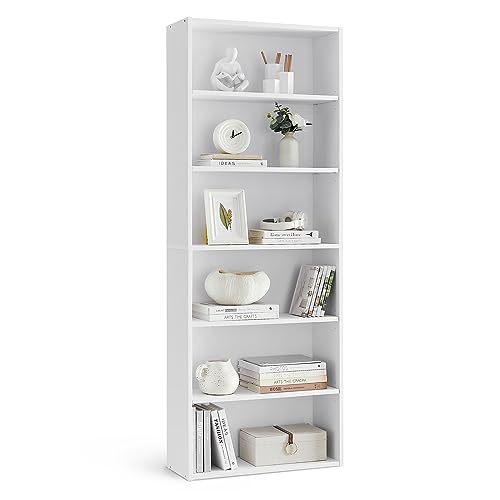
- Best overall for modern homes: VASAGLE Custos Collection 6-Tier Bookcase, Cloud White — Check on Amazon
- Tribesigns 72-Inch 6-Tier Bookcase, White — Check on Amazon
- LEYAOYAO 7-Cube 3-Tier Bookcase with Legs, Natural — Check on Amazon
- HSH 3-Tier Solid Wood Bookshelf, Natural — Check on Amazon
- Furologee 5-Tier Ladder Shelf with Drawer, Black Oak — Check on Amazon
See 1 more Amazon option
- Furinno Luder 5-Tier Bookcase with Door Cabinet, White — Check on Amazon
Read the full guide ↓
Disclosure: As an Amazon Associate, dailyhomedecorating.com earns from qualifying purchases. Links to Amazon on this page are affiliate links; they cost you nothing extra. Listing details such as price and availability change often, so check the current Amazon listing before you buy.
The best bookcase for modern homes under $150 has to pass a test that older furniture never faced: it will be photographed. Modern interiors are built on restraint — flat-front cabinetry, low sofas, negative space on the walls — and a bookcase is the largest storage object most living rooms contain, so it either carries the scheme or quietly wrecks it. The failure modes are specific. A case with fussy mouldings reads as a period intruder. A warm orange-toned finish fights the cool palette modern rooms run on. Visible cam locks, chunky plastic feet and busy hardware announce “flat-pack” from across the room. And a case that is all open shelving, loaded with real life, turns the modernist promise of calm into a wall of visual noise.
This guide was curated the way a modern room is curated: ruthlessly. We looked for clean lines and flush construction, finishes in the modern register — cloud white, natural wood, matte black — and silhouettes that read as architecture rather than furniture clutter: plinth bases, cube grids, ladder profiles, gallery-scale white cases. Every pick below earns its place visually first and functionally second, but none is a sculpture that cannot hold books; each carries real shelving capacity, verified dimensions and a construction we could defend. If your modern room is also a small one, the compact-lens version of this guide is our Best Bookcase For Small Apartments Under $150 roundup; if you want the wider field without the modern filter, start with the main Best Bookcase Under $150 guide.
The short answer: the white VASAGLE Custos is the modern default — six tiers, adjustable shelves, a footless plinth base and a finish that disappears into a white wall while its contents do the talking. The Tribesigns is the gallery option for a full library wall. The LEYAOYAO and the HSH bring the natural-wood warmth that keeps modern rooms from feeling like showrooms, the Furologee ladder is the sculptural accent, and the little Furinno Luder proves that the most modern feature of all might be a door: modern calm is mostly clutter you cannot see.
It is worth being precise about what “modern” asks of a bookcase, because the word covers three different rooms in current practice. The minimalist room wants the case to vanish: white, planar, plinth-based, its presence felt only as order. The organic modern room — Japandi, Scandi, warm minimalism — wants the case to bring the nature in: natural wood, low lines, texture over colour. The industrial modern room wants structure on show: black steel, honest boards, a silhouette with engineering in it. This guide deliberately fields picks for all three dialects rather than pretending they are one style, and the reviews name the dialect each case speaks. A minimalist case in an organic room looks sterile; an industrial case in a minimalist room looks like scaffolding. Match the dialect first, and the individual product choice becomes almost obvious.
There is also a budget truth specific to modern furniture: the modern look is the cheapest look to fake badly and the hardest to fake well, because there is nowhere for poor quality to hide. Ornate furniture forgives — a carving distracts from a wobble. A flat white panel forgives nothing: a bowed shelf, a chipped corner, a misaligned door all publish themselves. That is why this guide stayed with established makers whose panel quality and finish consistency are proven at scale, and why the reviews are frank about maintenance — in modern rooms, upkeep is part of the aesthetic, and a case that cannot be kept clean cannot be kept modern.
In this guide
Quick Picks
| Pick | Bookcase | Modern style | Size (W × D × H) | Amazon |
|---|---|---|---|---|
| Best overall | VASAGLE Custos 6-Tier, Cloud White | Minimalist panel case | 23.6 × 9.4 × 63.3 in | Check on Amazon |
| Best gallery wall | Tribesigns 72-Inch 6-Tier, White | Architectural, floor-to-near-ceiling | 72 in tall, 6 tiers | Check on Amazon |
| Best low profile | LEYAOYAO 7-Cube 3-Tier, Natural | Scandi-boho cube grid | Low, wide, on legs | Check on Amazon |
| Best natural material | HSH 3-Tier Solid Wood | Japandi wood and black steel | 3 tiers, low | Check on Amazon |
| Best accent piece | Furologee 5-Tier Ladder, Black Oak | Sculptural leaning profile | 55.6 in tall, narrow | Check on Amazon |
| Best hidden storage | Furinno Luder 5-Tier with Door | Clean white, closed section | 12 × 9.3 × 52 in | Check on Amazon |
How These Picks Were Chosen
Modern is a discipline, not a colour, so we judged on five criteria. Line: straight, flush, uninterrupted — plinth bases, flat panels, grids and ladders; nothing with turned posts, crown moulding or rustic distressing made the cut. Palette: cloud white, natural wood, matte black and black oak — the finishes that sit comfortably beside modern upholstery and metal. Hardware discretion: concealed or minimal fixings; a modern case should look assembled by intent, not by Allen key. Proportion: silhouettes that respect modern rooms — tall and planar, or low and horizontal — rather than the in-between heights that read as accidental. Styling tolerance: the case must look good at real-world fill levels, because a design that only works empty, or only works stuffed, fails modern rooms either way.
Function was not sacrificed to the filter. Every pick holds a genuine book load, every tall pick anchors, and the two panel cases adjust their shelves. We excluded glass-door curios (modern rooms borrow light; they do not display through it), farmhouse-crossbuck designs (a different guide’s aesthetic), and chrome-and-glass etageres whose moment has passed. As throughout this batch, no prices are printed — check price on Amazon; the picks were selected against the under-$150 ceiling in the keyword. Readers whose modern scheme runs warmer and more traditional may prefer the cherry and rustic finishes in the main roundup; readers furnishing a whole modern wall should also see our Best Bookshelf For Modern Homes Under $150 guide for wider formats.
Best Bookcase for Modern Homes Under $150: The 6 Picks
VASAGLE Custos Collection 6-Tier Bookcase, Cloud White (ULBC166T14)
Who it suits: The modern default — white or light-grey rooms, low-profile sofas, anyone who wants the bookcase to provide the order and the books to provide the colour.
The Custos in cloud white is a study in subtraction: six tiers of flat white panels, adjustable shelves, and a footless plinth base that makes the case read as a piece of the wall rather than an object in front of it. That plinth is the modern detail — no legs, no shadow gap full of dust, just a clean block that meets the floor the way built-in joinery does. At 23.6 inches wide, 9.4 inches deep and 63.3 inches tall it is sized for real rooms rather than showrooms, and the adjustable shelves let you compose the facade: a tall gap for art books and a vase, tight rows for paperbacks, one deliberately empty shelf — negative space is a styling material, and this is the only construction here that lets you manufacture it on demand. The white finish is a true neutral white rather than a cream, so it sits correctly beside modern whites instead of arguing with them.
Pros:
- Plinth base and flat panels — the most architectural silhouette here
- Adjustable shelves let you compose spacing like a gallery
- True neutral white matches modern palettes without warming them
- Six tiers in a two-foot footprint
Honest limitation: White flat-pack shows scuffs and dust sooner than wood tones, and the 9.4-inch depth keeps oversized art books at the edge. In a very warm, wood-heavy room the white can read stark — the same case in rustic brown is in our main roundup for exactly that home.
Choose it if you want one case that makes a modern room look finished. Skip it if your scheme is warm traditional — or your household is hard on white finishes.
Living with it: Style it in the modern rhythm — roughly two-thirds books, one-third objects and air. A horizontal stack of two or three books with one object on top reads as a still life; a vertical row broken by a leaning frame reads as a gallery. Keep one shelf near eye level deliberately underfilled; visitors will read the whole case as curated because of that single act of restraint. A melamine sponge handles the scuffs of book corners in seconds, and the plinth base means the floor line stays crisp without ever moving the case to vacuum.
Tribesigns 72-Inch 6-Tier Bookcase, White
Who it suits: Modern rooms with a serious library — the floor-to-near-ceiling white wall of books that turns a collection into the room’s architecture.
Scale is this pick’s whole argument. At 72 inches with six open tiers, the Tribesigns stops being furniture and becomes a wall treatment: in white, against a white wall, the frame nearly vanishes and the books themselves become the texture — the look that modern libraries, studios and reading rooms are built around. The open format suits the modern styling grammar of repetition: long runs of spines, rhythmic gaps, a single object per shelf at most. It is the pick for the room where the sofa is low, the art is large, and the bookcase wall is the third major element. Assembly is a methodical bolt-together, and at this height the wall anchor is part of the design, not an afterthought — plan the stud before you plan the styling.
Pros:
- Maximum capacity — six full tiers at 72 inches
- White-on-white makes the books the visual texture
- Open shelves suit modern repetition styling
- Anchors a large, minimal room the way built-ins would
Honest limitation: It commits the wall. This is not a case you rearrange on a whim, white shows dust at this scale honestly, and rooms under eight-foot ceilings should measure the stand-up diagonal before ordering.
Choose it if the library wall is the design statement. Skip it if you rent short-term or rearrange often — the VASAGLE gives the same palette in a more mobile form.
Living with it: Resist filling it completely in the first week. Modern scale looks best at about eighty percent — leave the top shelf light (it is above sightlines and reads as air), group books by size rhythm rather than subject for the facade, then re-sort by subject within groups where only you will know. A low plant at the base and nothing on top of the case keeps the architecture clean; the moment objects colonize the top, a library wall becomes storage again.
LEYAOYAO 7-Cube 3-Tier Bookcase with Legs, Natural
Who it suits: Scandi, boho and Japandi rooms — anywhere the modern scheme runs warm, low and horizontal, with plants and texture doing the work that colour does elsewhere.
The cube grid is modernism’s oldest storage idea, and the LEYAOYAO executes it in the current dialect: seven cubes in two sizes across three low tiers, natural wood finish, short legs lifting the grid off the floor so the piece floats the way modern low furniture should. The two cube sizes are the styling engine — large cubes for art books, baskets and a record player or speaker; small cubes for a single object, a small stack, a plant — so the facade composes itself into the asymmetric rhythm that modern rooms prefer over strict symmetry. Low and wide, it sits under windows and wall art without competing, doubles as a media console in a pinch, and its top surface becomes a styled shelf of its own. In a modern room that risks feeling cold, this is the warmth injection that does not break the discipline.
Pros:
- Cube grid in two sizes — self-composing modern facade
- Low horizontal profile suits windows, art walls and media walls
- Natural wood warms minimalist schemes
- Legs lift the piece — light, and easy to clean beneath
Honest limitation: Capacity is sideboard-scale, not library-scale, and open cubes mean the styling is always on display — messy contents will read as messy, so budget for a couple of baskets. The legs that make it float also make it the wrong choice against a wall that needs a flush fit.
Choose it if your modern room needs warmth and a low line. Skip it if you need maximum book capacity — that is the Tribesigns’ job.
Living with it: Treat each cube as a frame. One object per small cube, books laid horizontally in one large cube and standing in another, a woven basket in a third for the remotes and chargers — the grid rewards this kind of editing and punishes stuffing. Rotate one cube’s contents seasonally (the plant moves, a new object arrives) and the whole piece feels redecorated for free. It pairs beautifully with a low modern sofa: match the case’s top line to the sofa’s back line and the room’s horizontals align.
HSH 3-Tier Solid Wood Bookshelf, Natural
Who it suits: Japandi and organic-modern rooms, and anyone who believes the most modern material choice is an honest one — real wood, black steel, nothing pretending to be anything else.
The HSH pairs solid wood shelves in a natural finish with a black metal frame — the material palette of half the modern interiors published in the last five years, at a price that palette rarely visits. Solid wood is doing more than looking right here: the grain is unique to each board rather than a repeated printed pattern, the edges can be maintained instead of merely endured, and the shelves carry a full row of hardcovers on a board that will not creep into a bow over the years. The three-tier, low format suits the modern preference for horizontal calm — under a window, beneath a large artwork, along the wall behind a low sofa — and the open frame keeps the wood visually light. This is the pick for the room where every object was chosen, and the bookcase has to survive that scrutiny at close range.
Pros:
- Solid wood shelves — real grain, repairable, no printed pattern repeat
- Black steel and natural wood: the current modern palette in one piece
- Low profile preserves sightlines and wall art
- Boards that will not bow under a full hardcover row
Honest limitation: Three tiers is a deliberate constraint — this is a composed piece, not a warehouse. Solid wood also asks for coasters under plants and prompt attention to spills, the small tax honest materials charge.
Choose it if material honesty is your modern. Skip it if you need six tiers of storage — or a finish you can ignore completely.
Living with it: Style it sparsely and let the grain work: books on two shelves, one shelf given to a single sculptural object and air. The black frame echoes black-framed art and lighting beautifully, so repeat it once elsewhere in the room — a floor lamp base, a picture frame — and the case locks into the scheme. Oil or wax the shelves if they ever look thirsty; five minutes returns the depth that made you buy real wood in the first place.
Furologee 5-Tier Ladder Shelf with Drawer, Black Oak
Who it suits: The modern room that needs one sculptural moment — a narrow wall, an entry, the space beside a fireplace — where a rectangular case would be furniture and a ladder is an object.
The ladder profile is the modern accent silhouette: five tiers that step back as they rise, in black oak with a black metal frame, finishing in a fabric drawer at the base. At 55.6 inches tall and narrow enough for wall slivers other cases cannot use, the Furologee works where modern rooms actually have gaps — beside the media wall, at the end of a hallway, flanking a window in a pair. The stepping profile is functionally kind to styling: deep lower shelves for books and the drawer (remotes, chargers, the household small-stuff that ruins modern calm), shallow upper shelves that naturally limit themselves to one object each. Black oak is the connoisseur’s black — softer than gloss, warmer than matte paint, and it photographs as texture rather than void.
Pros:
- Sculptural leaning profile — an accent, not just storage
- Narrow footprint fits modern rooms’ leftover slivers
- Fabric drawer hides the small clutter modern rooms banish
- Black oak finish reads as texture, not flat black
Honest limitation: A ladder’s upper shelves are shallow by design — this is display-first storage, and a serious book collection will overflow it. Leaning profiles must be secured as the maker directs; treat the wall fixing as part of the silhouette.
Choose it if you need a styled accent with real storage inside it. Skip it if you need a primary library — ladders are punctuation, not paragraphs. For the same accent logic at other budgets, see our Best Bookcase For Modern Homes Under $100 picks.
Living with it: Style a ladder by altitude: weight and books low, objects getting lighter and fewer as the shelves rise, one perfect thing at the top. The drawer swallows the daily small clutter that otherwise colonizes modern surfaces, which is the unglamorous reason this piece keeps a room looking styled on a Wednesday, not just in the photograph. In pairs, two ladders flanking a window or console create the symmetry modern rooms love without buying a wall unit.
Furinno Luder 5-Tier Bookcase with Door Cabinet, White
Who it suits: Minimalists with real lives — the modern room that must absorb chargers, paperwork, games and household overflow without any of it entering the visual field.
Every modern room has a secret: the calm is curated, and the clutter went somewhere. In most under-$150 bookcases there is no somewhere — every shelf is a display shelf, so real life is always on stage. The Luder breaks that rule with a door cabinet section inside a clean white case about 12 inches wide, 9.3 inches deep and 52 inches tall: open tiers above for the edited display, a closed door below for the unedited reality. The proportions suit modern rooms precisely because the case is narrow and planar — it slips into the leftover wall beside a door or media unit and contributes order without demanding attention. White-on-white, it is the quietest pick in this guide, and quiet is a modern virtue.
Pros:
- Closed cabinet — the clutter valve modern rooms require
- Clean white planar design, narrow footprint
- Open tiers above for a tight, edited display
- Light and easy to place or move as the scheme evolves
Honest limitation: The 9.3-inch depth suits paperbacks and media, not art books, and the light build is for everyday loads. It is a precision instrument for calm, not a bulk store.
Choose it if hidden storage is the missing piece of your modern room. Skip it if your collection is large-format — the VASAGLE and Tribesigns carry that load.
Living with it: Keep the open tiers almost monastic — a short row of books with matching neutral spines, one plant, one object — because the door below is doing the heavy lifting invisibly. That contrast is the whole effect: guests see a serene white case; you know the household’s small chaos is filed behind the door. It also works beautifully as a pair flanking a low media console, doubling the hidden storage while keeping the wall composition symmetrical.
Modern Finishes, Decoded
Cloud and pure whites (VASAGLE, Tribesigns, Furinno) are the architecture finishes: they borrow the wall’s colour and give the volume to the contents. Their discipline is housekeeping — dust shows as a grey film within two weeks — and their reward is light: a white case in a dim corner genuinely raises the room’s brightness. Natural wood (LEYAOYAO, HSH) is the warmth finish, and the distinction between printed wood-look and real grain matters most at conversational distance: printed patterns repeat visibly across wide panels, while real boards never repeat. Both picks here were chosen to survive close inspection — the LEYAOYAO by keeping panels small (cubes break the pattern), the HSH by using actual timber.
Black oak and matte black (Furologee, the HSH’s frame) are the graphic finishes: they draw the outline of the furniture rather than its surface, which is why they pair so well with pale rooms — the case becomes a line drawing against the wall. Their discipline is dust of the opposite kind: pale dust on black reads instantly, so black accents want a weekly pass with a duster. Rustic brown, the finish of our main roundup’s top pick, sits at modern’s warm border — acceptable in organic-modern rooms with other warm elements, out of place in a cool minimalist scheme. The rule that governs all of it: one case, one finish family, repeated at most twice elsewhere in the room. Modern rooms are edited, and the bookcase — the biggest object — sets the edit.
Comparison Table
| Bookcase | Silhouette | Finish | Storage character | Best modern room | Amazon |
|---|---|---|---|---|---|
| VASAGLE Custos 6-Tier | Plinth panel case | Cloud white | Adjustable, 6 tiers | Minimalist living room | Check on Amazon |
| Tribesigns 72-Inch | Gallery wall | White | Maximum open capacity | Library / studio | Check on Amazon |
| LEYAOYAO 7-Cube | Low cube grid | Natural wood | Cubes in two sizes | Scandi / boho | Check on Amazon |
| HSH 3-Tier | Low open frame | Solid natural wood | Composed, 3 tiers | Japandi | Check on Amazon |
| Furologee Ladder | Leaning ladder | Black oak | Display + drawer | Accent walls, entries | Check on Amazon |
| Furinno Luder | Narrow panel case | White | Open + door cabinet | Minimalist | Check on Amazon |
How to Choose a Bookcase for a Modern Home
Choose the silhouette before the finish. Modern rooms are composed in shapes first: a tall planar case, a low horizontal grid, a ladder accent. Decide which shape your wall is missing — most modern rooms need exactly one tall element and benefit from keeping everything else low — then choose the finish that serves it. A perfect finish on the wrong silhouette still looks wrong every day.
Match whites like you mean it. “White” furniture spans warm cream to blue-white, and two wrong whites side by side read as a mistake rather than a scheme. If your walls and existing furniture run warm, a natural wood case (LEYAOYAO, HSH) sidesteps the problem entirely; if they run cool and bright, the cloud-white VASAGLE and the Tribesigns sit correctly. When in doubt, wood is the peacemaker of modern palettes.
Budget for negative space. A modern bookcase at one hundred percent capacity is a contradiction. Count your books honestly, then buy the case that holds them at about seventy to eighty percent — the remaining air is not waste, it is the design. This is the practical reason this guide favours six-tier cases for modern rooms even when four tiers of books is the reality.
Give clutter one closed door. Unless your household genuinely owns nothing unstylish, plan the hiding place at purchase time: a door cabinet (Luder), a drawer (Furologee), or baskets that match the scheme (LEYAOYAO). Modern calm is an editorial decision renewed daily, and it needs infrastructure.
Anchor tall cases invisibly. Safety hardware should disappear: straps behind the case, into a stud, tensioned before styling begins. A modern room’s clean lines are no excuse to skip the step — they are a reason to do it neatly. Low picks (LEYAOYAO, HSH) reduce the need but in homes with children, anchor anyway.
Respect the room’s existing lines. Modern interiors are built on a few strong horizontals and verticals — the sofa back, the media console, the window heads. A bookcase that aligns with one of them (the LEYAOYAO’s top matching the console’s height, a tall case meeting the door head line) looks built-in; a case at a random in-between height looks parked. Measure your room’s key heights before choosing between the low and tall picks here — five minutes with a tape measure is the cheapest interior design you will ever do.
Plan the cable and clutter map. Modern rooms increasingly ask the bookcase to host a speaker, a lamp, a charging point. Open frames pass cables invisibly; panel cases need a planned route (along the back edge, down a corner) or the facade grows a wire. Decide where powered objects will live before assembly, place the case near the outlet that serves them, and the finished room will look wireless even when it is not.
Styling a Modern Bookcase: The Working Rules
Three habits separate a styled modern case from a stored one. First, edit by colour rhythm, not rainbow: group books so the facade reads in calm blocks — neutrals together, one saturated cluster as an accent — or turn the most chaotic spines inward only if you can live with yourself afterwards; grouping is the honest version. Second, vary the geometry: vertical rows, one horizontal stack, one leaning frame, one object alone; the eye reads variety of arrangement as curation and sameness as storage. Third, light it like a gallery: a case near a window or under a picture light looks twice as expensive as the same case in a dark corner, and a small plant at the top edge softens the architecture without breaking it. Restyle seasonally rather than constantly — modern rooms reward commitment, and a case that changes weekly never settles into the room.
Consider the five-year photograph. Modern rooms get re-photographed by life constantly — the listing photos when you move in, the video calls, the pictures friends take. A bookcase with a plain silhouette and an honest finish looks current in all of them, across palette changes you cannot predict yet. The picks in this guide were chosen from that permanent modern — flat planes, grids, real wood, air — precisely so that the case you buy for this apartment is still the right case for the next one, and the one after that. Trends will offer you a sage-green fretwork bookcase soon enough. Decline it with confidence.
Common Buying Mistakes
Buying “modern” ornament. Geometric fretwork, gold-tone everything and novelty shapes date faster than any other style. The modern that lasts is plain, proportioned and well finished — the picks above, not the themed ones.
Matching the case to the sofa exactly. Identical finishes across every piece flatten a room into a showroom set. Contrast — white case, warm sofa; wood case, pale upholstery — is what makes each piece look chosen.
Filling every shelf in week one. Capacity anxiety leads to stuffing, and stuffing is the end of modern. Buy the bigger case, fill it slowly, let it breathe.
Forgetting the top of the case. A tall case’s top surface is visible from every seated position. Keep it empty or give it exactly one low object; a skyline of clutter up there undoes the whole scheme.
Skipping the anchor for the look. A strap is invisible from the front and priceless in an accident. Modern discipline includes the discipline of installing safety hardware properly.
A word about how these picks behave together, because modern homes rarely buy one piece in isolation. The white VASAGLE and the white Tribesigns share a palette but not a role — one is a composed case, the other a wall — and using both in one room works if the Tribesigns takes the library wall and the VASAGLE serves a secondary spot, ideally in a different finish to avoid a matched-set look. The LEYAOYAO and the HSH are natural partners: same warmth, different geometry, one for the media wall and one for the reading corner. The Furologee is the universal accent — it can join any of these schemes in black oak the way a black frame joins any gallery. And the Luder is the piece nobody photographs and everybody needs, the quiet white box that absorbs the household’s visual noise. Buying in that order — anchor case, warmth, accent, secret — builds a modern room that stays modern on an ordinary Tuesday, which is the only test that matters.
Finally, a note on longevity in the modern idiom. Styles cycle, but the objects in this guide were chosen from the part of modern design that has not changed in decades: flat planes, honest materials, grids, and air. A plinth-based white case was correct in a 1960s interior and will be correct in a 2040s one. That is the real value proposition under $150 — not that these cases imitate expensive modern furniture for a season, but that they belong to the permanent version of the style, the one that does not expire.
One more modern discipline the picks were screened for: silence. Modern rooms are quiet rooms, and furniture contributes noise in ways listings never mention — a case that creaks when a book is pulled, a door that clicks, shelves that drum when a speaker sits on them. Panel cases with backs and plinth bases are the quietest constructions here, which is part of why the VASAGLE headlines; the Luder’s door is felt-lined by its own simplicity rather than hardware; open steel frames can sing faintly under a subwoofer, so speaker placement belongs on the floor or a stand, not the NUMENN-style frame, in a media room. None of this appears in a dimension table, and all of it appears in the third week of ownership — which is precisely when modern rooms either settle into their calm or start quietly irritating the people who designed them.
And a word on buying modern furniture online, since every pick here is bought from a photograph: judge the listing by its worst image, not its best. Look for the photo taken at an angle, in a real room, where the edge banding, the back panel and the hardware are visible. Makers with nothing to hide publish those photographs; makers styling around a weakness publish only the hero shot. All six picks in this guide come from brands whose listings survive that scrutiny — real rooms, visible construction, dimensions that match their own diagrams — which in the modern idiom, where there is nowhere for a flaw to hide, is the strongest quality signal available before the box arrives.
Notice what this guide never asked you to do: buy a “statement” piece. In modern rooms the bookcase’s job is rhythm and order, repeated quietly across six shelves — the statement is the room itself, composed of light, proportion and restraint. Every pick here understands that assignment, which is why none of them will embarrass you when the rest of the room changes around them.
Final Recommendation
Buy the VASAGLE Custos in cloud white if you want the modern default: architectural plinth base, adjustable shelves to compose with, and a finish that hands the visual stage to your books. Choose the Tribesigns 72-inch when the library wall is the room’s ambition. Warm the scheme with the LEYAOYAO or the solid-wood HSH, punctuate it with the Furologee ladder, and give it a secret with the Luder’s door. Modern is not a price band; it is an editing standard — and every case here meets it under $150.
Frequently Asked Questions
What colour bookcase works best in a modern living room?
Neutral white and natural wood are the two safe modern answers, for opposite reasons: white disappears into the architecture and lets the books show; natural wood adds the warmth minimal rooms need. Black works as an accent (a ladder, a frame) rather than a whole wall. Match the temperature of your existing palette — cool rooms take white, warm rooms take wood — rather than chasing a trend.
Open or closed bookcases for a modern look?
Mostly open, honestly edited — that is the modern library look — but with at least one closed element somewhere in the room for the objects that break the spell. That is why this guide includes a door-cabinet case and a drawer ladder alongside the open designs: pure open storage is a styling commitment few households can sustain daily.
How do I stop a modern bookcase looking cluttered?
Fill to about three-quarters, group books into calm colour blocks, vary vertical rows with one horizontal stack, and give every shelf at most one non-book object. Then close the door — literally, if your case has one — on everything else. Clutter is rarely a quantity problem; it is a variety problem, and editing variety is free.
Can a bookcase work as a room divider in an open-plan modern space?
Yes — low, open designs work best: the LEYAOYAO cube grid divides without darkening, and open frames can be styled from both sides. Keep the divider low (three tiers) to preserve sightlines and light, anchor or weight it appropriately since it lacks a wall, and style both faces rather than giving it a “back.”
Are white bookcases hard to keep looking good?
They ask for a weekly dust and a melamine sponge for scuffs — five minutes of maintenance in exchange for the brightest, most architectural look in this guide. In high-traffic family rooms, natural wood hides more; in adult modern rooms, white’s upkeep is a fair trade. Choose with your household’s reality, not its aspirations.
What should I put on top of a tall modern bookcase?
Nothing, or one low, quiet object — a shallow bowl, a small plant that trails rather than towers. The top line of a tall case is part of the room’s architecture; keeping it clean is what separates a library wall from a storage unit. If you need the storage, you need a bigger case, not a skyline.
Is a white bookcase or a wood bookcase more timeless?
Both outlast trends when the silhouette is plain; both date instantly when it is fussy. White reads as architecture and survives palette changes around it — repaint the walls and the case still belongs. Wood reads as furniture and survives style changes — minimal today, traditional tomorrow. The genuinely risky buy is the fashion finish of the moment (grey-wash five years ago, sage today); the picks in this guide deliberately avoid all of them.
How tall should a bookcase be in a modern room?
Either clearly low (at or below the sofa-back and console line, roughly under 40 inches) or clearly tall (63 inches and up, approaching the door heads). The awkward zone is the middle — 45 to 55 inches of case that aligns with nothing. Two picks here are deliberately low, three are deliberately tall, and the narrow Luder earns its middle height by being an accent piece rather than a wall element.
How do I integrate a bookcase with a media wall?
Let the screen own the centre and the bookcase own the flank. A low cube case under or beside the media unit keeps the wall’s horizontal line unbroken; a tall white case on the perpendicular wall balances the composition without competing with the screen. Keep powered objects — speakers, consoles — on the case’s lowest, most ventilated shelves, route cables behind the case’s back edge, and resist putting the television on the bookcase itself: screens outgrow shelves, and a case that fits this year’s TV rarely fits the next one.
Related guides: the full field — Best Bookcase Under $150; compact modern rooms — Best Bookcase For Small Apartments Under $150; tighter budget — Best Bookcase For Modern Homes Under $100; open formats — Best Bookshelf For Modern Homes Under $150; shared family rooms — Best Bookcase For Families Under $150.