Disclosure: As an Amazon Associate, reviewstook.com earns from qualifying purchases. Links to Amazon on this page are affiliate links; they cost you nothing extra. Listing details such as price and availability change often, so check the current Amazon listing before you buy.
Waking up to a voice or a favorite station is a habit that never quite went away. A phone can play music, but a bedside radio does it without notifications, without a screen and without draining a battery overnight. The best alarm clocks with a radio let you wake to a morning show, a news bulletin or a buzzer, and they keep working when the internet is down.
This guide is for listeners who want clear reception and dependable dual alarms, for couples who wake at different times, and for people curious about internet radio at the bedside. We compare five models: two Sangean wooden-style clock radios, a compact Sony, a Sangean internet radio and an Emerson SmartSet. You will see how they differ in tuning, display and alarm options, and what each one asks you to give up. Everything described comes from the makers’ listings.
Quick Comparison
| Product | Best for | Main point | Link |
|---|---|---|---|
| Sony ICF-C1 | A compact AM/FM bedside radio | Dual alarms and simple controls | Check on Amazon |
| Sangean RCR-22 | Sound and reception from a wooden cabinet | Digital AM/FM tuning with an auxiliary input | Check on Amazon |
| Sangean RCR-5 | Listeners who want a flexible digital radio | AM/FM with a broad alarm setup | Check on Amazon |
| Sangean WFR-28 | Internet radio at the bedside | Streams stations over Wi-Fi as well as FM | Check on Amazon |
| Emerson SmartSet CKS1900 | People who dislike resetting clocks | Automatic time set and dual alarm | Check on Amazon |
In this guide
How These Options Were Chosen
We looked at manufacturer listings and published specifications and favored brands with a long record in clock radios. We have not used these radios ourselves, so we cannot tell you how a unit pulls in your local stations. Reception depends on your location, the building and the antenna, and no listing can promise it.
We kept the list varied: a compact Sony, two Sangean cabinets, one internet radio and an Emerson model aimed at easy setup. Check the current listing before you buy, since radio models are sometimes updated or replaced without much notice.
The Best Alarm Clocks With a Radio

Sony ICF-C1 AM/FM Clock Radio
The ICF-C1 is a long-running Sony clock radio that appeals because it is compact and not fussy. It offers AM and FM tuning, two alarms and a snooze function, so each person in a bedroom can set a separate time. The display is a clear digital readout intended to be read from the pillow.
This is a practical choice for a nightstand where space is limited. The controls are straightforward, so you can change a station or silence the alarm without hunting for the right button in the dark.
The compromise is that it is a basic radio. It has no internet streaming, and you should check the listing for backup battery details and for any USB or phone features. If you want wireless audio or a rich app, look elsewhere.
Choose it if you want a familiar brand and a small footprint. Skip it if you expect the radio to double as a speaker for your phone.
Sangean RCR-22 Wooden Cabinet Digital AM/FM Clock Radio
Sangean makes radios for people who care about reception, and the RCR-22 follows that tradition in a wooden cabinet. The cabinet is chosen for sound quality, since a wooden box can give a warmer voice than a thin plastic shell. Its listing describes digital AM and FM tuning, an auxiliary input and alarm features for waking to the radio or a buzzer.
The auxiliary input helps if you want to plug in a phone or a small player and use the cabinet as a better speaker than the one in your device. For a listener who likes talk radio, this is a more satisfying sound than a tiny, tinny clock.
The trade-off is size. It is larger than the Sony, and the wood finish is a style you either like or do not. Read the listing to see how the display behaves at night and whether there is a dimmer.
Choose it if sound quality matters to you. Skip it if you need a travel-sized radio.

Sangean RCR-5 Digital AM/FM Clock Radio
The RCR-5 is another Sangean digital clock radio, often discussed as a flexible bedside choice because it combines presets with a detailed alarm setup. The maker positions it as a clock radio with precise tuning, so finding a station is quicker and easier than turning an old analog dial.
It suits a shopper who listens to several stations through the week, since stored presets let you choose a morning station and a weekend one without retuning. The alarm system is more flexible than the plainest models, which helps if your schedule changes.
Because it has more features, it asks for more patience at setup. Spend ten minutes with the manual, then you rarely need it again. Check the listing for the power options and for whether the radio has a backup battery that keeps the time through an outage.
Choose it if you like preset stations and a flexible alarm schedule. Skip it if you want the simplest possible knob-and-switch design.
Sangean WFR-28 Internet Radio with FM
The WFR-28 is for people who want stations from around the world, not only the ones their antenna can catch. It connects over Wi-Fi to internet radio services and also receives FM, so it works as a normal radio when the network is down. Check the listing for the exact services supported, as streaming platforms change, and for features such as Bluetooth and USB.
It is a good answer for anyone with poor local reception. A building with thick walls can make AM almost useless, while a stream is not affected by the same problem. It also suits an expat or a language learner who wants a station from home.
The trade-offs are cost of setup and complexity. You must join it to your network, and the menu is deeper than that of a basic clock. An alarm that depends on a network stream may fail if the connection drops, so look for a backup tone.
Choose it if variety matters. Skip it if you only want a quick AM/FM wake-up.
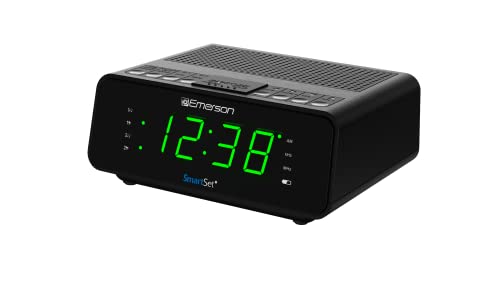
Emerson SmartSet Alarm Clock Radio CKS1900
Emerson built its SmartSet line around one idea: the clock sets itself, so there is less to do after a power outage or a change to daylight saving time. The CKS1900 pairs that feature with an AM/FM radio and a dual alarm, according to the listing, and is aimed at shoppers who find clock settings annoying.
It is a sensible gift or a spare-room clock, because the person using it does not need to read a long manual. The display is generally easy to read, and listings often mention a dimmer, but check the one you are ordering.
The weakness is that its sound and tuning are those of a mainstream clock radio. It will not match the Sangean cabinet for richness, and you should not expect a lot of advanced features.
Choose it if you value easy setup. Skip it if audio quality is your main reason for buying a radio.
Best for Couples with Different Wake Times
The Sony ICF-C1 and the Emerson CKS1900 both list dual alarms, which lets each person set a separate time. The Sony is the smaller of the two, so it fits more easily on a crowded nightstand.
Best for Listeners Who Want Sound Quality
The Sangean RCR-22 is the pick when voices and music matter. Its wooden cabinet and auxiliary input mean it can also act as a modest speaker for other devices.
Best for Poor Reception
The Sangean WFR-28 solves the problem by streaming stations over Wi-Fi. If your walls block AM and weaken FM, a network stream gives you a reliable source, as long as the network stays on.
Best for Hassle-Free Setup
The Emerson SmartSet is designed to set its own time. That is useful after outages and daylight saving changes, and it makes the clock easy to hand to a relative who dislikes menus.
How to Choose
Decide first whether you need a radio at all. Many people choose a radio alarm because they like a particular station, and if that station is also available online, an internet model may serve you better. If you only need a clock that rings, a model without a radio is simpler.
AM, FM and reception
FM usually sounds clearer, while AM carries talk and sports stations that are unavailable on FM in some regions. Good reception depends on the antenna and the room. Try moving the radio, extending the wire antenna and keeping it away from chargers and routers, which can add noise. Digital tuning helps you lock onto a station, but it cannot create a signal that is not there.
Dual alarms and presets
Dual alarms let two people share a clock or let one person set a weekday and weekend time. Presets store favorite stations so the alarm always turns on the same one. Check whether the radio can wake you to a buzzer if the station fails, since a weak signal at six in the morning could mean silence.
Display and dimming
A dimmable display is important in a dark bedroom. Some models offer a few levels; others have a single brightness. A model with a temperature readout may be useful if you want that information at a glance, but it is not essential.
Phones, USB and Bluetooth
Some radios include a USB port for charging a phone, an input for playing audio from a device, or Bluetooth. Not every model has them, so read the listing. These features are convenient, but they are secondary to the radio and the alarm.
Common mistakes
Do not judge reception from a showroom. Do not forget to check whether the radio has a battery backup. And do not buy a model with a complicated menu if you will rarely adjust it.
Installation, Safety and Legal Notes
Use the power adapter that comes with the radio and follow the maker’s instructions. Keep it away from water, heat and the edge of the nightstand. If you want a dedicated outlet or any change to the wiring in your bedroom, hire a licensed electrician rather than doing it yourself.
Internet radios need your Wi-Fi password, so use a secure network and read the privacy information that the maker provides. Remember that listening rules for broadcasts vary by location, and check local noise rules if you live in an apartment.
Care and Troubleshooting
| Problem | What to check |
|---|---|
| Static or hiss | Reposition the radio and the antenna, and move it away from other electronics |
| Alarm plays nothing | Check that the radio source is selected and the volume is up |
| Time resets after an outage | Fit a backup battery if the radio has a slot for one |
| Internet stream drops | Check the network and use a buzzer as a backup |
Dust the speaker grille with a soft brush and wipe the case with a dry cloth.
How the Wake-Up Sequence Actually Works
Shopping lists for clock radios tend to focus on band support and display size, but the part that matters at 6 a.m. is what the clock does when the alarm time arrives. There are several approaches, and they feel quite different in practice.
The simplest is a straight radio alarm. At the set time, the radio turns on at the volume you last chose and plays whatever station is tuned. This is pleasant when everything works and unpleasant when the station is playing an ad at full blast. Some models add a gradual rise, where the volume starts low and increases over a minute or so. That suits light sleepers who dislike being jolted, but a heavy sleeper may need the volume to arrive faster.
A second approach is a tone or buzzer option. Many clock radios let you choose between radio and buzzer, and a few let you set both so the buzzer is a backup. Since radio stations can drop out, change formats or fade during storms, a backup tone is a sensible safeguard if you have to be up at a fixed time. If a model lacks one, you might keep a phone alarm set a few minutes later.
The third element is snooze behavior. A snooze button usually gives you a fixed interval, often nine minutes, after which the radio resumes. Look for a big, easy-to-hit snooze bar on top, because fumbling for a small button in the dark is irritating. Some people prefer a clock with a separate sleep timer, which plays the radio for a set period as you fall asleep and then shuts off.
- Check whether the volume at wake-up can be set independently from the daytime listening level.
- Look for a backup buzzer if you cannot afford to oversleep.
- Confirm that snooze and the alarm-off control are easy to tell apart by touch.
- Decide whether you want a sleep timer for falling asleep to music or talk radio.
Power Outages, Backup Batteries and Keeping the Time
A clock radio is plugged in all night, which means a brief power cut can reset it or stop the alarm. The solution is battery backup, and it is a feature worth checking before you buy. Most backups use a small battery, often a 9-volt or a couple of AAA cells, to preserve the clock and alarm settings. It keeps the time and the alarm armed, but it rarely powers the radio itself. If the power is out at wake-up time, many clocks will sound a buzzer from the backup while the radio stays silent. Others only retain the clock setting and will not ring at all.
Because details vary, read the manual or product questions to see exactly what the backup does. Also replace the battery once a year as a habit, since a dead cell gives you a false sense of safety. Some modern clocks use a rechargeable or memory-saving capacitor that holds the time for a few hours rather than days. That is fine for a quick flicker, but not for an overnight outage.
Daylight saving time is another detail. Some models adjust automatically using a radio-controlled time signal or an internet connection, while others require manual changes twice a year. If you have ever arrived late to work after the clocks changed, a clock that adjusts itself may be worth a little extra.
Placement, Interference and Antenna Tricks
Where you put the radio matters almost as much as which one you buy. FM reception depends on the telescoping or wire antenna, and AM relies on an internal ferrite bar that must be oriented correctly. Plugging the clock into an outlet near other electronics can add noise, especially chargers, LED lamps, dimmer switches and Wi-Fi routers. If you hear buzzing or hiss, moving the clock a few feet away or plugging it into a different outlet often cleans things up.
Try these steps before deciding that the radio itself is poor:
- Stretch the FM wire out fully, ideally along a window or wall, rather than leaving it coiled.
- Rotate the whole clock to find the best AM direction, since the internal antenna is directional.
- Place the clock away from the bed frame, headboard metal and large appliances.
- Keep it a few feet from phone chargers and routers.
Light is a separate placement concern. Even with a dimmer, a bright display can bother a light sleeper, so position the clock to the side of the pillow rather than directly in your line of sight. If you plan to put it on a nightstand with a lamp, make sure the cord is long enough to reach without strain.
Matching the Clock to the Sleeper
Different people need different things from a clock radio, and a good match is more important than a long feature list. Heavy sleepers often benefit from a loud speaker with a strong buzzer backup and, in some cases, a bed shaker accessory sold separately. Light sleepers do better with a gradual volume rise and a dimmer that fully darkens the display.
Older users often value large, high-contrast numbers, simple dials instead of menus, and physical preset buttons they can feel. Shift workers may want two alarms, one for weekdays and one for weekends, or a model that lets you set separate alarm times and stations. Households where two people share a bedroom might look for a dual-alarm clock so each person can choose a different time and source without waking the other.
Finally, think about how you use radio during the day. If you plan to carry it between rooms, prioritize weight and a built-in handle. If the clock will sit permanently on one nightstand, a larger cabinet with a bigger driver often sounds richer, which is a strong reason to prefer a wooden or heavier body for music and talk.
Living With a Radio Alarm: The First Month
The first month with a radio alarm clock teaches you things no specification sheet mentions. In week one, most owners discover their real relationship with presets. A clock that makes saving a station a small ceremony will end up with exactly one station saved, the one it arrived tuned near, while a clock with friendly preset buttons accumulates a small dial of favourites within days. Watch your own behaviour honestly: if you only ever wake to one station, preset depth is a feature you can stop paying for, and the simpler clocks in this guide move up your personal ranking. If you drift between news, music and talk across the week, presets become the feature that decides whether the clock feels like yours.
Week two is when the volume ramp reveals itself. Waking to radio is a negotiation between the station’s own loudness, which varies between a whispered overnight presenter and a cheerful breakfast show, and the clock’s set volume. Owners who wake startled usually blame the clock when the true culprit is a station whose morning programme is produced louder than its night one. The fix is to set the alarm volume while listening to the actual programme you will wake to, at the actual hour, rather than calibrating against the calm station you listen to at midnight. The clocks here with gradual wake settings forgive some of that difference, but no ramp can fully civilise a station that changes personality at six in the morning.
By week four, the clock has either become furniture, in the best sense, or a small daily negotiation. Furniture status is achieved when setting, snoozing and silencing the alarm are all done by touch in the dark without a thought. Negotiation status means a menu is involved, or a button whose function changes with context, or a display that must be studied. The models in this guide were chosen partly on this test, because an alarm clock is used at the two least competent moments of the human day: half asleep at night and barely awake in the morning. Everything else, sound quality included, is secondary to surviving those two moments gracefully.
How the Five Picks Sound and Behave Differently
The Sony ICF-C1 is the minimalist of the group: a compact cube whose radio is honest rather than lush, and whose appeal is that it does the classic job, wake to a station, tell the time, occupy almost no nightstand, with the reliability of a design refined over many generations. It suits the sleeper who wants radio as a function, not a hobby. The Sangean RCR-22 moves to the opposite pole of the same idea: a wooden cabinet built for sound, the clock for people who actually listen in bed, to evening concerts and late programmes, and who want the morning news delivered with a voice that sounds like a person rather than a telephone.
The Sangean RCR-5 splits the difference, a digital tuner with a cleaner, more modern bedside manner, good reception and a footprint that suits smaller nightstands. The Sangean WFR-28 changes the question entirely by adding internet radio: the dial becomes the world’s stations, local reception problems evaporate, and in their place arrive the new dependencies of Wi-Fi and menus. It is the right answer for the listener whose station is far away, whose valley defeats FM, or whose mornings want a specific voice from another city. The Emerson SmartSet attacks a different pain, the setup itself, with automatic time setting that removes the most hated ritual of clock ownership, and it suits households that lose power often or simply refuse to reprogramme a clock twice a year.
Comparing the five as radios, the honest axes are these: how they sound at low volume in a quiet room, how they hunt and hold a weak station, and how their controls behave in the dark. Cabinet size and speaker design set the first; tuner quality and antenna arrangement set the second; button layout sets the third. A clock can win one axis and lose another without being a worse clock, which is why this guide resists crowning a single winner and instead maps each model to the sleeper it serves best.
Reception: The Bedroom Is Not a Radio Laboratory
Bedrooms are difficult radio environments. They sit upstairs or at the back of the house, they are full of metal, in bed frames, springs and radiators, and the listener’s own body becomes part of the antenna system the moment a hand approaches the clock. A station that booms in clearly at noon may fray at the edges at dawn, when atmospheric conditions and the station’s own power pattern shift. Before blaming any clock in this guide, spend one evening mapping your room: move the clock along the nightstand, rotate it, extend its wire antenna along different paths, and note where your chosen station sits most comfortably. Ten minutes of this geography is worth more than any tuner specification.
The wire antenna deserves respect rather than tidiness. Coiled neatly behind the clock, it is an ornament; run along the back of the nightstand or up toward the window, it is an antenna. Many reception complaints are really antenna storage decisions. Internet radio abolishes the problem, which is the WFR-28’s quiet superpower, but it trades geography for network: a router rebooting overnight, a congested Wi-Fi band at the far end of the house, can silence an internet alarm as surely as a valley silences FM. The resilient household setup, whichever clock you choose, is a backup: a buzzer alarm set a few minutes later, or a phone across the room, standing guard over the one morning that cannot be missed.
AM deserves a specific word, because talk and sports listeners still live there. AM reception is plagued by household electronics: chargers, LED bulbs and dimmers all broadcast interference that a bedside clock picks up faithfully. If your AM station buzzes, hunt the interferer by switching off suspect devices one at a time before concluding the clock is deaf. Often the culprit is the phone charger plugged into the same socket strip, and moving it a metre away restores the station. No clock in this guide can out-engineer a noisy room; the room must be helped.
Two Sleepers, One Clock: Household Diplomacy
Shared bedrooms turn alarm choice into diplomacy. Dual alarms, present across much of this range, solve the schedule problem but not the taste problem: one partner wakes gently to voices, the other is dragged from sleep by anything softer than a brass band. The workable compromise is usually asymmetry, the radio alarm set for the lighter sleeper and the earlier riser, and a second, personal method, a vibrating wearable or a phone under a pillow, for the deeper sleeper, so the room is not filled with a volume calibrated to its most unconscious occupant. Where both partners rise together, radio is at its diplomatic best, because a shared station becomes a small joint ritual rather than one person’s noise imposed on the other.
Weekend settings are the second diplomatic frontier. A clock that forces you to remember to disable Friday’s alarm has caused more Saturday resentments than any other feature in the category. Models with weekday and weekend patterns, or with alarm schedules that can be set once and forgotten, protect the lie-in automatically. When you test a new clock, set up its whole week, workdays, rest days, the one early shift, and live with the pattern for a fortnight before judging it. A clock whose weekly rhythm matches the household’s real rhythm disappears from attention; one that must be negotiated nightly will be resented nightly, however good its radio sounds.
Guests change the diplomacy again. A visitor confronted with an unfamiliar clock radio faces a small puzzle at the exact moment they are tired. Hosts do guests a kindness by choosing clocks whose alarm can be set with one obvious sequence, and by leaving the guest room clock on a sensible station at a sensible volume rather than on the host’s own dawn chorus. The Emerson’s automatic time and the Sony’s simplicity both shine in the guest room for this reason: they ask nothing of the stranger.
When the Radio Alarm Is the Wrong Tool
Honesty requires naming the sleepers radio does not serve. The very deep sleeper who sleeps through voices and music alike needs escalation, not fidelity: a loud buzzer, a bed shaker, a light-based system, or the dedicated loud clocks covered elsewhere in this series. Radio can be the pleasant first stage of such a system, but alone it is a hope rather than a plan. The shift worker sleeping through daylight faces the opposite problem: the radio that would wake them also fills a room they are trying to keep dark and quiet for the hours before, and a silent vibrating method respects the household better.
There is also the sleeper whose mornings are already spoken for. If a phone alarm, a smart speaker routine or a partner’s schedule reliably does the waking, a radio clock’s alarm becomes its least important feature, and the purchase should be judged as what it then is: a bedside radio with a clock attached. That reframing flatters the Sangean models particularly, since their listening quality leads the group, and it is a more honest basis for choosing than pretending an unused alarm matters. Buy the clock for the job it will actually do in your house, and every model in this guide has a house where it is the right one.
Keeping a Radio Clock Young
Radio clocks age in three places: the display, the buttons and the tuner. Displays dim unevenly over years, which matters less than owners fear because the alarm does not care. Buttons, especially the snooze bar that takes a daily slap, wear first mechanically; a clock whose snooze can also be triggered by a broad press anywhere on its top ages more gracefully than one dependent on a small exact button. Tuners drift least of all in the digital models here, which is one quiet argument for digital tuning in a product expected to serve a decade: there is nothing to wander off station while you sleep.
The environment does the rest of the ageing. Dust in a speaker grille muffles the morning news slowly enough that owners blame the station; a soft brush during the monthly room clean prevents it. Sunlight on a south-facing nightstand yellows cabinets and can trouble displays; a few centimetres of repositioning is the whole cure. Power surges are the sudden death of bedside electronics, and a clock that has survived years deserves the small protection of a surge-protected socket, particularly in storm country and in homes where the power flickers often enough that the SmartSet’s automatic resetting has become a familiar friend.
Treat the clock as a decade appliance and the buying logic sharpens: favour the model whose controls you can operate half asleep, whose sound pleases you at the volume you actually use, and whose reception strategy, antenna or internet, matches your room’s geography. Do that, and a radio alarm clock becomes what it has quietly been for generations of households: the first voice of the day, arriving from a box that asks almost nothing in return.
The Nightstand Ecosystem: What the Clock Shares Its World With
No clock lives alone on the nightstand, and its neighbours shape its success. The phone charger is the most consequential neighbour: it radiates the interference that troubles AM, it competes for sockets, and its cable wanders across the clock’s buttons in the dark. Give the clock the socket nearest the bed and the charger the farther one, and route cables behind rather than across. A glass of water is the second neighbour to plan around, because a clock knocked while reaching for water at 3 a.m. is a clock whose alarm gets accidentally cancelled by a flailing hand. Place the clock where the water is not, even if that means the less photogenic corner of the nightstand.
Books, glasses and medication complete the ecosystem. A clock with a large, stable snooze top tolerates being the thing your hand finds among them; a clock with small, precise controls does not. This is the unglamorous heart of alarm clock design, and it is why experienced owners test a new clock by setting it in the dark, with their eyes closed, before the return window closes. The specifications will all have been true; the question is whether the clock fits the physical reality of your particular crowded, dark, half-asleep world.
One last neighbourly consideration: the clock’s own light in a shared ecosystem of sleep. It is worth settling this in the first week, while the clock can still be moved, exchanged or re-angled without the inertia of habit making a small glare into a permanent grievance neither sleeper mentions until it has soured a hundred mornings. A display that suits the person who bought the clock may glare at the partner whose side it faces, and the civilised solutions are angle and dimming rather than argument. Turn the clock a few degrees toward its owner’s side, use the lowest comfortable brightness, and let the radio, which both sleepers agreed on, be the clock’s public face while its light stays a private one. Small courtesies of placement, repeated nightly, are what separate a clock the household loves from one it merely tolerates.
Radio Alarms for Particular Lives
Parents of teenagers discover a use for the clock radio that marketing never mentions: it is the alarm that cannot be argued with, silenced by a notification setting, or left in another room. A clock radio in a teenager’s room, set to a station the household can hear stirring, gives parents evidence of waking that a phone alarm never provides. Shift-working households run the pattern in reverse, using the clock’s radio at low volume as a mask and a marker, the familiar station telling the day-sleeper’s brain that the household is proceeding normally and they may stay asleep. The same box serves both tricks because radio is public sound: it fills a room rather than a pair of ears.
Older listeners, meanwhile, are the clock radio’s oldest constituency, and their needs explain several design choices in this guide. Large digits, a tuning system that stays where it was left, a volume dial with real travel, and a station that arrives without menus: these are not nostalgic features but accessibility features. When buying for an older relative, favour the model whose radio can be operated by memory and touch, set it up for them completely, station, volume, alarm, and write nothing down, because a clock that needs instructions has already failed its user. Set up kindly, a radio clock can serve for years without its owner ever meeting its menu system, and that is a legitimate definition of good design.
Students in shared houses land on a simpler virtue: a clock radio is cheap to replace, impossible to forget to charge, and wakes the room rather than the individual, which in a house of shared lectures is often the point. Across all these lives, the pattern repeats. The clock radio endures not because it is the most advanced way to wake, but because it is a public, plugged-in, single-purpose object in a world of private, battery-hungry, multi-purpose ones, and some mornings call for exactly that.
Frequently Asked Questions
Are radio alarm clocks still made?
Yes. Sony, Sangean and Emerson all list current models, though lineups change, so check availability.
Do I need an alarm clock with an internet radio?
Only if you want stations beyond what your antenna can receive. A standard AM/FM radio is simpler and works without a network.
What happens if the radio station fails at wake-up time?
Many clocks let you pick a buzzer as the alarm source. That is a safer option on important mornings.
Can I charge my phone from these radios?
Some models include a USB port, but the ones above vary, so check the listing before assuming it.
Why is the AM signal so weak indoors?
AM is affected by electronics and building materials. Moving the radio or rotating it often helps.
Is a dimmer important?
If you are sensitive to light in the bedroom, yes. Choose a model with several brightness levels or an off option.
Will a clock radio still wake me if the power goes out?
Only if it has battery backup that also drives a buzzer. Many models keep just the time and alarm setting in memory, and the radio stays silent until power returns. Read the manual to see what the backup does, and replace the battery about once a year.
Can I set different alarm times for weekdays and weekends?
Some clock radios offer a weekday and weekend mode, or two separate alarms you can assign to different days. Basic models have only one daily alarm. If you work irregular shifts, look for dual alarms or a day-of-week setting before ordering.
How do I get better FM reception from a clock radio?
Extend the antenna wire fully and run it along a window or wall. Move the clock away from chargers, routers and LED lamps, and try a different outlet. If the signal is still weak, a small external antenna or a model with a stronger tuner may help.
Is a clock radio a good choice for a heavy sleeper?
It can be, if it has a loud speaker, a fast-rising volume and a backup buzzer in case the station fails. Placing it across the room forces you to get up. Some people also add a vibrating bed shaker accessory to improve results.
Bottom Line
For a small, simple radio, the Sony ICF-C1 is a dependable pick, and the Sangean RCR-22 offers more sound. The RCR-5 suits listeners who like presets, the WFR-28 solves weak reception with streaming, and the Emerson SmartSet makes setup painless. Match the radio to your reception and your habits, then check the listing for power and backup details.