Disclosure: As an Amazon Associate, dailyhomedecorating.com earns from qualifying purchases. Links on this page are affiliate links; they cost you nothing extra. Prices and availability change often, so check the current Amazon listing before you buy.
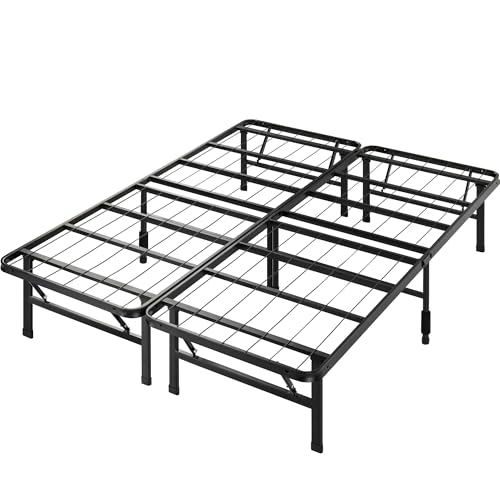
Hunting the best affordable bed frames usually begins in a specific moment: a mattress on the floor of a first flat, a guest room furnished against a deadline, a growing teenager whose childhood bed has become a negotiation. The frame has to arrive quickly, assemble without drama, hold its silence through the night and leave enough of the budget intact for the bedding that makes a room feel finished. Three verified queen-size frames anchor this guide — two from Zinus, the value specialist whose SmartBase designs reshaped the budget end of the market, and one from NEW JETO built around underbed storage — and between them they cover the main ways a modest frame earns its keep: height for storage, a low platform profile for modern rooms, and straightforward steel dependability.
Affordable needs defining before any shopping starts, because the word hides two different products. One is a frame engineered down to a sensible price by simplifying assembly and shipping it flat in a compact box. The other is a frame built down to a price by thinning steel, spacing supports too widely and hoping the buyer never moves house. The first kind serves for years and survives reassembly; the second announces itself within months through squeaks, sagging and stripped bolts. Everything in this guide belongs to the first kind, and the buying sections explain how to tell the two apart in any listing, so the method outlasts these particular picks.
Key Takeaways
- All three picks are queen size, need no box spring, and ship flat for easy delivery into flats and spare rooms.
- The Zinus Rumi stands fourteen inches tall, turning the space beneath the bed into real storage for boxes and seasonal bedding.
- The Zinus Joseph sits lower at ten inches with wooden slats, suiting modern low-profile rooms and thicker mattresses.
- The NEW JETO frame matches the fourteen-inch height with a heavy-duty brief aimed at buyers who prioritise sturdiness on a budget.
- Silence is engineered, not accidental: tight joints, centre support and correct assembly matter more than brand at this tier.
- Measure mattress thickness against frame height before ordering, because total bed height decides whether getting in and out feels natural.
In this guide
Quick Picks: Best Affordable Bed Frames at a Glance
| Pick | Height | Support style | Known for |
|---|---|---|---|
| Zinus Rumi Metal Bed Frame | 14 inches | Steel SmartBase platform | Storage height with quick assembly |
| Zinus Joseph Platforma Bed Frame | 10 inches | Wood slat support | Low modern profile |
| NEW JETO Metal Bed Frame | 14 inches | Steel platform with storage space | Heavy-duty value build |
The three badges describe three rooms. The Rumi belongs in the flat where the bed must double as a linen cupboard, its fourteen inches of clearance swallowing storage boxes whole. The Joseph belongs in the room styled around low, calm lines, where a tall frame would crowd the proportions and a slatted base gives the mattress a slightly softer welcome. The JETO belongs in the household that reads “heavy duty” first and aesthetics second — a guest room, a rental, a teenager’s den — anywhere the frame’s job is to be forgotten while it works. None of the three requires a box spring, which quietly removes an entire second purchase from the budget.
Where to buy is straightforward: each frame below links to its Amazon listing, where the size variant, current bundle and delivery options can be confirmed. Bed frames are the classic wrong-variant purchase — a full ordered where a queen was needed — so confirm the size in the listing title before checkout. Every frame here was verified against catalogue data before inclusion, and each appears with its official product image beside its review.
How Did We Choose These Affordable Frames?
Five tests shaped the shortlist. Structural honesty came first: steel gauge, the number and spacing of support legs, and whether a centre rail exists to carry the middle of a queen span, because a queen is wide enough to sag without one. Second, assembly reality — how many parts, whether the tools are included, and whether one person can build it in a reasonable evening without a second pair of hands or a engineering degree. Third, noise behaviour, judged by joint design: frames that bolt together at many points with locking hardware stay quieter than frames relying on a few friction fits. Fourth, mattress compatibility across foam, hybrid and innerspring designs, since slat spacing decides whether a foam mattress is properly supported or slowly escapes between gaps. Fifth, the storage and height equation — what the clearance under each frame actually fits in real boxes, not marketing photographs.
The wider context is that budget frames have improved enormously in a decade. Flat-pack engineering, once a compromise, now produces bases stronger than the assembled furniture many households grew up with, because the designs are tested for shipping abuse as well as sleeping. Zinus in particular built its name on that shift, compressing entire bed bases into boxes one person can carry upstairs. The picks below lean on that maturity: they are inexpensive because they are efficiently made and shipped, not because corners were cut where sleepers would feel them.
Zinus 14 Inch Rumi Metal Bed Frame — Storage Height, Small Budget
Badge: Best overall affordable frame
| Spec | Detail |
|---|---|
| Size | Queen |
| Height | 14 inches, with generous underbed clearance |
| Support | SmartBase steel platform, no box spring needed |
| Assembly | Quick assembly design, eco-friendly packaging |
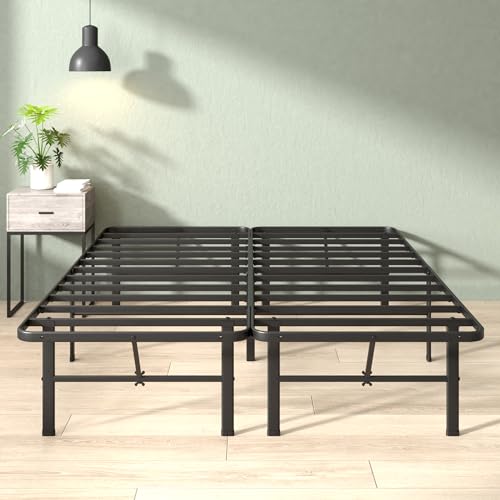
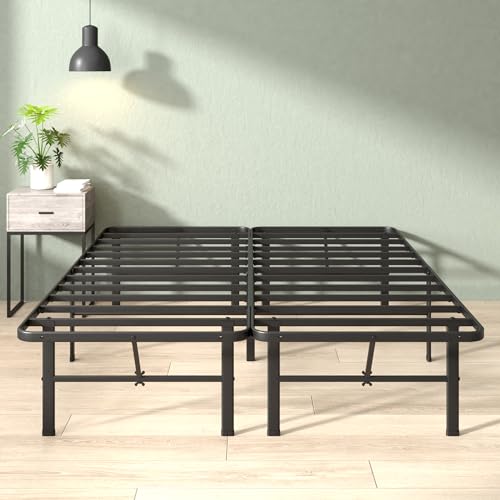
The Rumi understands the assignment of a budget frame in a small home: hold the mattress properly and turn the dead space underneath into the storage the flat does not have. Fourteen inches of height means standard storage boxes, suitcases and the winter duvet all slide beneath without force, which in a studio or a box-room guest bed is worth more than decorative headboard styling. The SmartBase platform spreads support across a steel grid rather than a few slats, so foam and hybrid mattresses sit on a surface that feels uniformly firm, and the whole structure assembles quickly because Zinus designs the joints to locate themselves rather than demand measurement.
In daily use the Rumi’s virtues are absence of event: no squeak announcing a turned shoulder, no flex when someone sits on the edge to tie shoes, no drama when the bed is dragged a foot to the left for cleaning. The black steel disappears visually under bedding, which lets the room’s textiles do the decorating — a sensible division of labour at this budget. Buyers furnishing a first home often purchase this frame twice, once for their own room and once for the guest bed, which is about the strongest endorsement a budget product can earn.
Strengths
- Fourteen-inch clearance converts underbed space into genuine storage
- SmartBase platform supports foam mattresses evenly
- Fast, forgiving assembly suited to one person
Trade-offs
- Tall stance plus a thick mattress may sit high for shorter sleepers
- Industrial steel look offers no decorative warmth on its own
- No headboard included; buyers wanting one must add it separately
Best for: small homes and first flats needing storage and simplicity together. / Not suited for: rooms styled around a low, platform-bed silhouette.
Zinus Joseph 10 Inch Metal Platforma Bed Frame — the Low-Profile Option
Badge: Best for modern low rooms
| Spec | Detail |
|---|---|
| Size | Queen |
| Height | 10 inches |
| Support | Wood slat support on a steel structure, no box spring needed |
| Assembly | Flat-pack with included fittings |
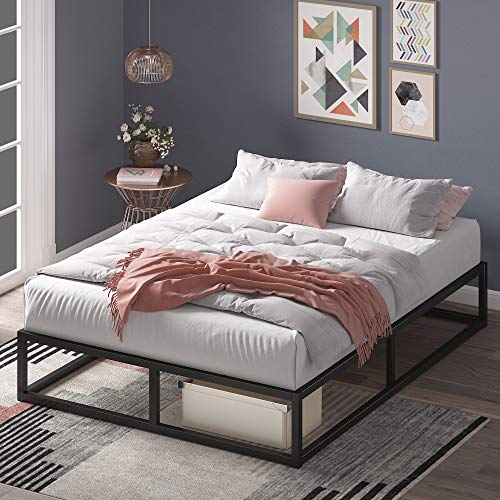
The Joseph answers a different brief: keep the bed low, calm and modern. Ten inches of frame height pairs with a thick mattress to land the sleeping surface at a natural sitting height, and in rooms with low ceilings, sloping eaves or a deliberately grounded aesthetic, that proportion matters more than storage volume. The wooden slats give the base a fraction of flex that steel grids do not, a feel many sleepers describe as less board-like, particularly under slimmer mattresses. The steel structure underneath keeps the whole arrangement honest, so the slats are a comfort feature rather than a structural gamble.
This is the frame for the room photographed for a rental listing or styled for calm: bedding drapes to a pleasing length, the bed reads as furniture rather than equipment, and the lower stance makes the whole room feel larger. Storage still exists beneath — ten inches fits shallow boxes and shoe organisers — but it is a bonus rather than the headline. Assembly follows the same flat-pack logic as its sibling, with the slats rolling or slotting into place across the frame.
Strengths
- Low profile flatters modern rooms and low ceilings
- Wood slats add a touch of give under the mattress
- Sturdy steel structure beneath the softer surface
Trade-offs
- Less underbed storage than the fourteen-inch rivals
- Slat spacing should be checked against very soft foam mattresses
- Low stance can be harder for anyone with limited mobility
Best for: style-led rooms, thick mattresses and low ceilings. / Not suited for: buyers whose priority is maximum underbed storage.

NEW JETO Metal Bed Frame — Heavy-Duty Value With Storage Space
Badge: Best budget pick for demanding use
| Spec | Detail |
|---|---|
| Size | Queen |
| Height | 14 inches |
| Support | Steel mattress foundation, no box spring needed |
| Assembly | Easy assembly design |
The JETO pitches itself plainly: a heavy-duty steel foundation, fourteen inches tall, with storage space underneath and easy assembly, at the value end of the market. That plainness is its appeal for the rooms where frames work hardest — the teenager’s room that hosts wrestling matches, the rental property that cannot be supervised, the guest bed that takes the overflow of every family gathering. The steel structure is built to be leaned on, sat on, jumped near and generally treated as infrastructure, and the tall clearance keeps the storage dividend of its fourteen-inch rivals.
Buyers choosing between the JETO and the Rumi are really choosing emphasis: the Rumi leans toward refined assembly and brand track record, the JETO toward an overtly heavy-duty brief. Either will hold a queen mattress without a box spring and keep quiet when assembled carefully and tightened fully — the universal secret of budget steel frames, which reward a patient first build and a bolt check after the first fortnight. As a spare-room or first-rental purchase, it is the kind of sensible, unglamorous buy that frees budget for the mattress itself, which is where money sleeps best.
Strengths
- Heavy-duty positioning suits rentals, teens and guest rooms
- Fourteen-inch height preserves full underbed storage
- Simple steel design assembles without specialist tools
Trade-offs
- Plainer finish and styling than the Zinus pair
- Brand track record is shorter than the category leaders
- Utilitarian look needs bedding to soften it
Best for: hard-working rooms where durability outranks décor. / Not suited for: buyers furnishing a styled primary bedroom.
How Do You Choose the Right Affordable Frame for Your Room?
Start with arithmetic, not aesthetics. Add the frame’s height to your mattress thickness and compare the total against your knees: a sleeping surface somewhere around the height of a chair seat suits most adults, while totals far above that turn bedtime into a small climb and totals far below make rising awkward for older joints. Next, inventory what must live under the bed. Measure your storage boxes before ordering, because fourteen inches of frame height delivers less usable clearance than the number suggests once rails and mattress support are accounted for — and discovering that on assembly day is a particular flavour of annoyance.
Then match the base to the mattress. Foam and latex mattresses need closely spaced support — a solid platform or slats with modest gaps — because they conform and can squeeze between wide spacings over time, voiding warranties and comfort alike. Hybrid and innerspring mattresses are more forgiving but still prefer even support to a few crossbars. Finally, think about the room’s future: a frame bought for a spare room today may become a teenager’s daily bed tomorrow, and the heavy-duty brief ages better across that journey than the purely decorative one. The three picks divide these decisions cleanly — storage height, low profile, or rugged value — which is why the shortlist is short.
How Do You Assemble a Budget Frame So It Stays Silent?
Silence is built, not bought. Assemble on the floor the bed will occupy, so the frame settles into the room’s real geometry, and lay out every bolt before the first one is turned. Tighten in stages, working around the frame the way a wheel’s bolts are tightened, rather than fully fixing one corner and forcing the rest to agree. Leave final tightening until the frame is square and standing, then add the mattress and sit on every edge before declaring victory. A fortnight later, revisit each bolt with the same tool and take up the small slack that new joints always develop; that single habit prevents most of the squeaks blamed on budget frames.
Felt pads and a rug do more acoustic work than any upgrade. Pads under each leg protect floors and kill the tiny movements that become night noises, while a rug beneath the bed absorbs the rest. If a squeak does appear months later, hunt it methodically: pressure each corner, listen, and tighten or pad the joint that answers. Keep the spare bolts and the Allen key in a labelled bag taped beneath the frame, and the next house move — the moment budget frames either prove themselves or fall apart — becomes a calm hour rather than an archaeology dig.
What Mistakes Do Budget Frame Buyers Make?
The classic error is buying the frame before the mattress, then discovering the pair’s combined height turns the bed into a climbing wall or a low futon impression. Second comes ignoring slat spacing under a foam mattress, a mistake that takes months to announce itself as a sagging valley. Third, shoppers chase the tallest frame for storage and then buy boxes too tall for the real clearance. Fourth, many assemble hastily, skip the fortnight bolt check, and condemn a good frame as squeaky when it was merely under-tightened. Fifth, buyers forget the headboard question until delivery day: these are platform bases, and anyone wanting a headboard should confirm bracket compatibility or plan a wall-mounted alternative. Each mistake is cheap to avoid and mildly expensive to live with, which is the entire economics of this category in one sentence.
How Does a Frame Affect the Mattress You Already Own?
A mattress is only as good as its foundation, and budget frames illustrate the point kindly. A worn or widely spaced base lets a foam mattress hammock, which the sleeper experiences as back discomfort wrongly blamed on the mattress. Even, close support restores the surface the manufacturer designed. Height changes feel as well: raising a mattress on a fourteen-inch frame makes the bed feel more formal and eases getting up, while the Joseph’s lower stance makes the same mattress feel more relaxed and lounge-like. Anyone pairing a new frame with an older mattress should rotate the mattress when the frame arrives, so wear patterns start fresh on the new support, and should expect the first nights to feel subtly different as the mattress settles onto an honest base.
Final Recommendation: Which Affordable Frame Should You Buy?
Most buyers should start with the Zinus Rumi: its storage height, platform support and painless assembly solve the commonest version of this problem in one purchase. Choose the Zinus Joseph when the room’s proportions or a thick mattress call for a lower stance and a slatted feel. Choose the NEW JETO when the bed will work hard — rentals, teenagers, bustling guest rooms — and rugged simplicity outranks finish. All three free their owners from buying a box spring, and all three leave budget where it belongs: in the mattress and the bedding. Complete the room with help from mattress toppers for extra comfort, affordable sheets that wash well, pillows for side sleepers and bedspreads and quilts to finish the look, and compare against the dedicated steel guide in metal bed frames compared.
Room by Room: Where Each Frame Earns Its Place
The first flat is the Rumi’s natural habitat. A young renter with one room doing triple duty as bedroom, wardrobe overflow and occasional office needs the bed to store the season that is not being worn, and fourteen inches of clearance quietly replaces a chest of drawers the floor plan cannot fit. The Joseph shines in the styled spare room of a settled house, where guests should feel the room was designed rather than assembled, and where a low bed keeps a small space feeling airy. The JETO belongs wherever turnover is high: the short-let property, the au pair’s room, the teenager whose furniture budget must survive contact with reality.
Think also about who makes the bed. Tall frames lift the mattress to a height where changing sheets is kind to backs — a consideration that matters in guest rooms used by older relatives and in any room serviced by someone with a bad knee. Low frames suit households that sit on the bed to read, dress children or fold laundry at its edge. Neither is a luxury distinction; both are the kind of daily ergonomics that decide whether a cheap purchase feels clever or merely cheap by the second month.
How Long Should an Affordable Frame Last, and What Kills It Early?
A well-chosen steel platform frame should serve through several mattresses, which is another way of saying a decade is a reasonable expectation when the basics are respected. The early killers are consistent across brands: bolts left loose until joints fret and elongate their holes, frames dragged sideways while loaded, which twists legs and rails, and mattresses far heavier than the design brief, such as thick hybrids on frames bought for foam. Moving house is the other danger point — a frame partially dismantled and transported assembled will arrive bent; a frame fully broken down, with its bolts bagged and its rails bundled, arrives ready for a second life.
Care is nearly free. An annual bolt check, a wipe of the steel, felt pads replaced when they flatten, and a rug or floor protection under the legs cover almost everything. Slatted models appreciate a glance at the slats each time the mattress is rotated, since a single cracked slat quietly transfers its load to its neighbours. Treated this way, the budget frame becomes the least dramatic object in the bedroom, which is the highest praise furniture at this price can honestly earn.
Styling a Budget Frame So the Room Looks Intentional
A plain black steel frame disappears under the right bedding, and that invisibility is a styling tool. Let a duvet or bedspread drape long on the sides and the frame vanishes entirely, leaving the textiles to carry the room’s colour and pattern. On the taller frames, a valance or a storage box arrangement with matching lids keeps the underbed zone looking deliberate rather than exposed. The Joseph’s lower stance pairs naturally with layered throws and a bench or trunk at the foot, proportions that read as designed. Headboard hunger can be answered without touching the frame: a wall-mounted panel, a tall cushion arrangement, or a painted arch behind the bed all supply the visual anchor at a fraction of a furniture purchase.
Lighting and proportion finish the job. Bedside lamps at the height of the raised sleeping surface, a rug that extends visibly on both sides, and curtains hung to emphasise the room’s height all move attention away from the frame’s price and toward the room’s composition. This is the deeper sense in which these frames are affordable: they ask the decorator’s eye, rather than the wallet, to do the remaining work — and most rooms are more interesting for it.
Steel Grid or Wooden Slats: Which Support Suits Your Mattress?
The two support styles in this guide feel different because they are different, and the choice deserves more than a shrug. A steel grid platform, as on the Rumi and the JETO, presents the mattress with an unyielding, even plane. Firm mattresses feel firmer on it, foam mattresses keep their designed profile exactly, and there is nothing to flex, bow or eventually crack. The sensation is honest and slightly austere — sleepers who like a bed that pushes back choose it deliberately. A slatted base, as on the Joseph, interposes a series of wooden flex points between frame and mattress. Each slat yields a little under load, which softens the surface feel by a degree and can take the hard edge off a very firm mattress.
Durability arguments run in both directions and mostly cancel out. Grids have no individual components to fail but concentrate stress at their welds; slats distribute stress and can be replaced individually if one ever cracks. Warranty language is where the difference becomes practical: foam mattress makers specify support spacing because a mattress sagging between wide gaps is a support failure, not a mattress failure. Measure the gap on any slatted frame you consider, compare it with your mattress maker’s requirement, and let that number — not a photograph — settle the question.
Buying for Children, Teenagers, Guests and Renters
Children graduating to a queen-sized bed — usually because a sibling inherits the small room, or a tall teenager simply outgrows a single — need a frame that forgives climbing, bouncing-adjacent behaviour and the occasional fort built across it. The JETO’s heavy-duty brief fits that life, and its height gives growing collections of boxes and sports kit somewhere to go. Teenagers add a second requirement: the bed becomes seating for friends, a desk substitute and a phone-charging station, so edge strength and silence under shifting loads matter more than styling.
Guest beds follow the opposite logic. They sleep strangers of every size, often older relatives, and they must feel solid and sit at a kind height. The Rumi’s platform and storage make it the default guest choice, with the mattress budget protected by the frame’s modest cost. Renters, finally, should weigh the moving test above all: a frame that one person can carry in a flat box, assemble without wall fixings and dismantle without damage is worth more across three tenancies than a marginally prettier frame that travels badly. All three picks pass that test, which is no accident — portability is the quiet design brief of this entire category.
Delivery Day and the First Fortnight
When the box arrives, check the size on the label against your order before opening anything; queen and full frames are confused in warehouses often enough to make the check worthwhile. Inventory the parts against the instruction sheet while the packaging is still at hand, because a missing bolt is a five-minute message on day one and a weekend problem on day twenty. Photograph the assembled frame before the mattress goes on — a thirty-second habit that settles any later question about how a joint was meant to sit.
The first fortnight asks for two small acts of maintenance already mentioned but worth repeating as a ritual: retighten every bolt after roughly two weeks of sleeping, when new joints have settled into their working positions, and rotate the mattress once so it beds evenly onto its new support. After that, the frame should vanish from your attention entirely. A bed base that never asks to be thought about again has done the whole of its job, and at this end of the market that quiet competence — not chrome, not carving — is the true luxury on offer.
What Separates a Good Cheap Frame From a Bad One?
Hold three listings side by side and the differences announce themselves to a trained eye. Leg count and placement come first: a queen frame standing on four corner legs alone is asking its rails to span too far, while the designs here distribute load through additional legs and a centre line, which is what keeps the middle of the bed honest in year three. Joint design comes second: look for bolts that pass through both members and lock, rather than hooks and friction slots that loosen by design. Third comes the support surface itself — the spacing of slats or grid members, stated or measurable from the photographs — because that spacing is the mattress’s working environment for a decade.
Shipping weight is a surprisingly honest signal in this category. Steel is steel, and a frame that must hold two adults and a hybrid mattress cannot be built from foil; a suspiciously light queen frame has found its savings in the metal. Packaging tells a parallel story: brands that engineer compact, protective boxes, as Zinus does with its reduced packaging, are usually the same brands that engineered the frame inside them. None of these signals requires expertise — only the habit of reading a listing for structure instead of adjectives, a habit worth more than any single recommendation on this page.
The Total Cost of a Bed, Honestly Counted
Affordability should be counted across the whole bed, not the frame alone. A platform frame deletes the box spring from the bill. A durable frame deletes its own replacement from the five-year plan. A frame with storage deletes a piece of furniture from a small flat. Against those savings, the false economies stand out clearly: the ultra-cheap frame replaced twice, the mismatched frame that ruins a mattress’s comfort and warranty, the tall frame whose unusable clearance bought nothing. The three picks here were chosen because their whole-life arithmetic works — modest outlay, no second purchase required, no early replacement expected — leaving the largest share of any bedroom budget for the mattress and textiles that bodies actually touch.
There is also a resale and hand-me-down economy to acknowledge. Flat-pack steel frames move between flats, siblings and spare rooms with an ease upholstered furniture cannot match, and a frame that begins in a first apartment often ends its career holding a guest bed in a family home. Buying the slightly better budget frame is frequently buying that second career as well. It is a modest form of sustainability, achieved not by slogans but by steel, bolts and designs that come apart as willingly as they went together.
Floors, Walls and Neighbours: Living With a Steel Frame
Steel frames interact with the room around them in ways worth a moment’s planning. On hard floors, unprotected legs can wander a few millimetres with every bed-making tug until the frame leans against a wall it then taps all night; felt or rubber pads end the migration and the tapping together. On carpet, the same legs settle in and stay, but the pile hides dropped bolts during assembly, so build on a sheet if the room allows. Downstairs neighbours hear a bed through its legs, and pads plus a rug are a courtesy as much as a comfort measure — one more reason the acoustic habits in the assembly section pay rent every night.
Wall clearance deserves the same forethought. Leave a finger’s width between frame and wall so bedding can be tucked and the frame cannot knock plaster when the bed is climbed into enthusiastically. In very small rooms the tall frames pull double duty as the room’s main storage, which makes a small discipline worthwhile: a labelled box map, kept in a phone note, so the underbed archive stays an asset instead of becoming the place things go to be forgotten until the next move.
When Should You Upgrade Beyond a Budget Frame?
Honesty requires naming the point where this category stops being the answer. A primary bedroom being furnished for a decade, in a house rather than a flat, may eventually want the presence of a real furniture piece — upholstered, wooden, integrated with a headboard — and no steel platform pretends to that role. Couples with very different schedules may want the motion isolation engineering of heavier furniture. And anyone whose mattress maker demands a specific foundation should follow the maker. The budget frame’s triumph is that it serves everyone else — which is most bedrooms, most of the time — without apology, and serves as the spare-room answer even in houses whose main bedroom eventually graduates.
Until that graduation day, the wisest spending order in a bedroom is mattress first, bedding second, frame third — provided the frame clears the structural bar this guide describes. The three picks clear it in three different shapes. Choose by height and duty, assemble with patience, tighten twice, and then spend your attention on the parts of the bed you can actually feel.
A Short History of the Flat-Pack Bed Base
It is worth understanding why these frames exist at all, because the history explains their strengths. The traditional bed base was furniture: made locally, delivered assembled, and priced like the carpentry it was. Flat-pack design moved the intelligence from the workshop to the drawing board, so a base could be manufactured precisely, shipped in a box one person can carry, and assembled by its owner with a single tool. Zinus pushed the idea furthest in the bed category, proving that a steel foundation folded into a carton could outperform the wobbling assembled frames it replaced. The result is the market this guide shops in, where the cheapest sensible frame is also, structurally, a rather good one.
That history carries a buyer’s lesson: in flat-pack categories, brand process matters more than brand prestige. The makers who design for shipping abuse, parts accuracy and idiot-proof joints produce frames that assemble true and stay quiet; the makers who merely copy the silhouette produce the squeaky disappointments that give budget furniture its reputation. Every signal in the earlier section — leg count, joint design, support spacing, honest weight — is really a way of asking which kind of maker produced the listing in front of you.
Matching the Frame to the Mattress You Will Buy Next
Few people keep a mattress and a frame on the same replacement cycle, so a wise frame purchase anticipates the next mattress rather than only fitting the current one. Platform support with close, even spacing is the safest bet across that future, because it satisfies foam, latex and hybrid designs alike, whereas widely spaced slats quietly exclude the foam mattresses that dominate modern shopping. Height cuts the other way: a tall frame bought for today’s slim mattress may tower under tomorrow’s thick hybrid, so households planning a mattress upgrade should run the combined-height arithmetic for the mattress they intend, not only the one they own.
There is a comfort interaction to anticipate as well. A mattress that felt perfect on a shop floor’s solid base will feel a touch softer on slats and exactly as designed on a steel grid, so buyers who fell in love with a very firm mattress should lean toward the grid designs, while buyers softening a firm mattress can let the Joseph’s slats help. None of this requires precision instruments — only the awareness that frame and mattress are one system, purchased in two transactions, and that the frame half of the system is decided on this page.
Moving House With a Flat-Pack Frame: a Field Guide
The move is where this category proves its worth, so treat dismantling as part of the product. Work in reverse order of the instructions, bag bolts by joint rather than in one handful, and tape the bag to the largest rail. Bundle long members together with the slats or grid sections protected between them, and the frame travels in a car rather than demanding van space. At the new home, resist assembling on day one among the boxes; a clear floor and a rested builder produce the quiet frame, while a midnight build among chaos produces the squeak that gets blamed on the brand. Reassemble, tighten in stages, sleep, and retighten at the fortnight mark as if it were new — because to its joints, it is.
Households that move often develop one more habit worth copying: they keep the instruction sheet, photographed on a phone, and the Allen key taped beneath the frame. With those two artefacts preserved, a budget frame becomes genuinely portable furniture, serving three or four homes across its life. That portability, more than any single specification, is why the flat-pack steel frame has become the default bed base of a renting generation — and why choosing a well-made one, rather than the absolute cheapest listing on the page, pays its small premium back at every single move.
Frequently Asked Questions
Do these frames really not need a box spring?
Correct — each is a platform foundation designed to support the mattress directly, with steel grids or slats doing the work a box spring once did. Adding a box spring on top would raise the bed awkwardly and can void the frame’s intended geometry. This is also where much of the affordability comes from: one purchase does two jobs. Check your mattress warranty’s foundation requirements, since some specify maximum slat spacing, and confirm the frame you choose satisfies them.
Will a fourteen-inch frame make my bed too high?
It depends on the mattress it carries. Fourteen inches of frame under a slim eight-inch mattress lands at a comfortable, chair-like total; the same frame under a fifteen-inch pillow-top creates a bed that shorter adults and children mount with effort. Do the addition before ordering, compare it with the height of a dining chair you sit on comfortably, and remember that the tall frames exist to buy storage — if you do not need the storage, the lower Joseph may simply suit your room better.
How do I stop a metal frame from squeaking?
Most squeaks are loose joints announcing themselves, so begin with a full bolt check, tightening evenly around the frame. Add felt pads under the legs, confirm the centre support legs touch the floor squarely, and make sure the mattress is not rubbing a wall or headboard. A frame assembled carefully and rechecked after two weeks of use usually stays quiet for years; persistent noise after tightening points to a specific joint, which a washer or a pad of felt between the metal faces almost always silences.
Can one person assemble these frames alone?
Yes, and they are designed with that assumption. The boxes are liftable by one adult, the parts are sized for solo handling, and the instructions proceed in an order that never requires the frame to be held and bolted simultaneously. Allow an unhurried hour, work on a clear floor, and keep the packaging until the bed has survived its first night — after that, the flat-pack box can be stored under the bed itself in case of a future move.
Are budget steel frames strong enough for heavier sleepers?
The frames here are steel structures with centre support, built for queen loads, and the heavy-duty JETO brief exists precisely for demanding use. Heavier households should prioritise correct assembly, even weight distribution and a mattress rated for their needs, and should check the manufacturer’s stated capacity on the listing for the specific size. What budget frames do not forgive is misuse — standing on the bed, dragging it loaded across rooms — which shortens any frame’s life regardless of tier.
Can I attach a headboard to one of these frames?
Often, yes, with the right brackets, but it is not automatic. Many platform frames accept bolt-on headboard brackets sold for the purpose, while others are designed to stand free and pair with a wall-mounted headboard instead. Decide which look you want before ordering, check the listing for bracket compatibility, and remember that a freestanding frame plus a wall-mounted panel is a perfectly respectable combination that many styled bedrooms use deliberately, since it lets each piece be changed independently.
How much weight can a queen platform frame hold?
Capacities vary by model and are stated by manufacturers in their listing details, so treat that figure as the authority for the exact frame you buy. As a category, steel platform frames with centre support are built for two adults plus a substantial mattress, and the heavy-duty designs here sit at the reassuring end of the budget spectrum. What shortens any frame’s life is concentrated, dynamic load — jumping, standing, dragging — rather than the static weight of sleepers it was designed around.
Is a taller frame or a lower frame better for older relatives?
For most older sleepers, a total sleeping height near chair-seat level is the kindest target, because sitting down and standing up from the bed mimic the chair motion their knees already trust. That usually argues for the fourteen-inch frames under a moderate mattress, or the ten-inch Joseph under a thick one. Avoid very low totals that demand a deep knee bend, and consider that a firm edge — which platform frames provide — gives hands something trustworthy to push against when rising.
What should I put under the bed for storage?
Low, lidded boxes on smooth bases slide best under the fourteen-inch frames, and soft zippered bags suit bedding and out-of-season clothing. Keep frequently needed items at the edges and archives at the centre, label the ends that face outward, and leave a small air gap rather than packing the space solid, which keeps dust management sane. Under the ten-inch Joseph, reserve the space for shallow organisers, shoes and flat storage rather than bulky boxes.
When does a very cheap frame become a false economy?
A bargain stops saving money when it creates a second purchase, a damaged mattress or a bedroom nobody sleeps well in. Warning signs include support made from a few widely spaced bars, no centre leg under a queen span, fasteners that feel soft during assembly, and listings that avoid stating any capacity at all. Add the hidden costs honestly: a separate foundation bought later because the mattress sags, replacement hardware, floor repairs from narrow feet, and the sheer disruption of dismantling a failed frame mid-year. Compare that total with the modest step up to a frame with a proper grid or closely spaced slats, centre support and clear specifications, like the three picks in this guide. Longevity is the real discount in this category. A frame that serves quietly through two mattresses costs less per year than a flimsier one replaced twice, even before counting better sleep. Cheap is a virtue only when the engineering underneath the bedding is complete; below that threshold, the saving is simply deferred spending wearing a disguise.
What slat spacing suits a foam mattress on a budget platform?
Foam needs frequent, even support so it cannot dip between the supports and develop a permanent valley. As a practical starting point, look for narrow gaps between slats or a close steel grid, then confirm the exact maximum spacing your mattress maker specifies, because that warranty wording outranks any general rule in a guide. If a frame’s slats sit wider apart than the mattress allows, the pairing is wrong even if both products seem sturdy individually. Closely spaced wooden slats with a centre rail, or the dense grids on the metal picks above, give foam the continuous platform it expects. Hybrid mattresses tolerate slightly more variation thanks to their coil cores, yet they still reward even support. Before ordering, measure or find the stated gap, check whether slats are fixed or roll out loosely, and confirm they cannot bow or slip under load. Getting this one dimension right protects the most expensive item in the bed stack: the mattress itself, night after night.
Buy the frame that fits the room you have, the mattress you own and the life you actually lead, and the affordable end of this market will not disappoint you. Storage height, a low calm profile or heavy-duty plainness — the three picks divide the honest options between them, and any of the three will hold a bed quietly for years while the money saved does more visible work elsewhere in the room.
One More Consideration: Twins, Doubles and the Rest of the House
Although every pick in this guide is the queen variant, the same designs are sold in smaller and larger sizes, and the logic of the choice travels with them. A single or double version of a tall storage frame transforms a child’s or student’s room in the same way, while a king version of a low platform demands even more respect for centre support, since the span widens again. Households furnishing several rooms at once often standardise on one design across sizes, which simplifies spare parts, assembly knowledge and the eventual game of musical bedrooms that growing families play. When in doubt, buy the size the room’s next five years need rather than the size this month’s occupant requests, because frames outlast phases — and a well-chosen budget frame, quietly tightened and sensibly used, will outlast several.
One final habit separates the households that love their budget frames from those that merely own them: they chose the frame as part of a system, not as an isolated bargain. The mattress was measured, the boxes were measured, the room’s ceiling and the sleepers’ knees were consulted, and the bedding was allowed to do the decorating while the steel did the holding. Follow that order with any of these three frames — Rumi for storage, Joseph for the low calm line, JETO for hard work — and the affordable end of the market will feel, every single night, like the smart end.
The last word goes to the guest who sleeps in the spare room and never knows what held the bed up. That anonymity is the budget frame’s whole art: money saved invisibly, sleep delivered completely, and a room whose budget went where eyes and skin could appreciate it. Choose well from these three, tighten twice, and join the large, quiet majority of households whose affordable frames simply never give them a reason to think about bed frames again.