Disclosure: As an Amazon Associate, dailyhomedecorating.com earns from qualifying purchases. Links to Amazon on this page are affiliate links; they cost you nothing extra. Prices and availability change often, so check the current Amazon listing before you buy.
The best portable hot tubs for winter are the ones still running in February — and that sentence contains the whole discipline of this guide. A portable hot tub in winter faces a physics exam that summer never sets: heat bleeding into freezing air through every surface, pumps and plumbing lines exposed to the one element that destroys them, covers loaded with snow, and owners whose enthusiasm must survive a robe-clad dash across a frozen deck. Most inflatable tubs are fair-weather products wearing a four-season costume. The ones in this guide were chosen for the specific technologies and habits that make winter operation real: automatic freeze protection, serious insulation, and owners who learn the winter craft.
The pool’s winter answer is led by the two SaluSpa models, whose Freeze Shield systems — automatic heating that protects pump and liner when temperatures drop — exist precisely for this keyword. The Intex follows as the shoulder-season and milder-winter option, ranked with its limits stated in plain language. Three prose-only picks complete the map: an insulated hard-shell portable for owners graduating beyond inflatables, a winterized indoor soaking strategy for the nights no portable should run, and the winter-storage strategy itself — because for some households the best winter decision for a portable tub is a dry shelf and a spring restart, and a guide that cannot say so is selling something. The regional companion is Best Hot Tubs For New England, and the value frame is Best Bang For Your Buck Hot Tubs.
Where to Buy
Every linked pick in this guide is sold on Amazon, where you can check the current price, delivery options, and listing details before you buy. Winter buyers: order before the season if you can — setup, site prep, and a shakedown week in mild weather are worth more than any feature on the box.
- Coleman SaluSpa Miami Energy-Efficient AirJet Inflatable Hot Tub — Check on Amazon
- Bestway SaluSpa Cancun Energy-Efficient Inflatable Hot Tub — Check on Amazon
- INTEX 28425EH PureSpa Bubble Massage Spa Set — Check on Amazon
- Insulated hard-shell portable spa (prose-only pick — see review)
- Indoor deep-soak strategy for storm nights (prose-only pick — see review)
- Winter-storage strategy for fair-weather portables (prose-only pick — see review)
In this guide
Quick Picks
| Pick | Badge | Why it earns its place |
|---|---|---|
| Coleman SaluSpa Miami AirJet Inflatable Hot Tub | Best Overall | Freeze Shield plus efficient insulation — the portable built for this exact keyword. |
| Bestway SaluSpa Cancun Inflatable Hot Tub | Best Compact | Same freeze protection in the smaller volume that recovers heat fastest. |
| INTEX 28425EH PureSpa Bubble Massage Spa Set | Best for Mild Winters | The roomiest portable for shoulder seasons and gentler climates, limits stated. |
| Insulated hard-shell portable spa | Best Premium | Prose-only: the one-piece step up for owners done with inflatable limits. |
| Indoor deep-soak strategy | Best for Storm Nights | Prose-only: the guaranteed soak when the portable is snowed in or shut down. |
| Winter-storage strategy | Best for Deep-Freeze Regions | Prose-only: sometimes the best winter plan for a portable is a dry shelf. |
Key Takeaways
- Freeze protection is the keyword’s dividing line: automatic systems that guard pump and liner separate winter-capable portables from summer products.
- Insulation — walls, cover, and a ground barrier beneath — decides the winter electricity bill more than the heater does.
- Continuous gentle heating beats crash-and-reheat: freeze risk and energy waste both live in the cold hours.
- The cover is winter equipment: snow load management and seam care are weekly duties, not details.
- Every portable owner needs a written deep-freeze trigger — the forecast or outage length at which the tub gets drained, decided before it is needed.
- Portability is itself a winter feature: the tub that can move to shelter, or store entirely, owns options no fixed spa has.
How These Picks Were Chosen
Scoring began with freeze resilience, because winter kills portable tubs in exactly one way — water freezing where it should flow — and everything else is comfort. The SaluSpa pair’s Freeze Shield put them in a class of two within the pool: an automatic function that engages heating to protect the pump and liner in cold weather, backed by insulated walls and covers their makers rate as substantially more heat-retentive than comparable models. Between them, the Coleman took the overall badge on its all-round winter specification; the Bestway’s identical protection in the same footprint earned the compact slot on finish and listing differences. The Intex was included with its condition printed on its sleeve: the verified pool data names no automatic freeze-protection system for it, so it is recommended for mild winters and shoulder seasons, or for attended operation with a strict drain trigger.
The prose-only picks exist because winter honesty requires them. The pool contains no hard-shell portable, no indoor tub is a portable hot tub, and no product at all represents the storage strategy — yet a guide to winter portables that omitted the graduation option, the storm-night fallback, and the storage decision would fail its readers at exactly the moments of highest stakes. All three are described as strategies and formats, with no invented products. Excluded: the cold plunge pod (cold-plunge framing only — and winter is the one season nobody needs help getting cold), the baby tubs, and the faucet trim kit in the pool data, which is not a tub. The New England guide covers the regional version of this discipline; this guide generalizes it to any winter, anywhere.
The 6 Best Portable Hot Tubs for Winter — Reviewed

Coleman SaluSpa Miami Energy-Efficient AirJet Inflatable Hot Tub
Our badge: Best Overall
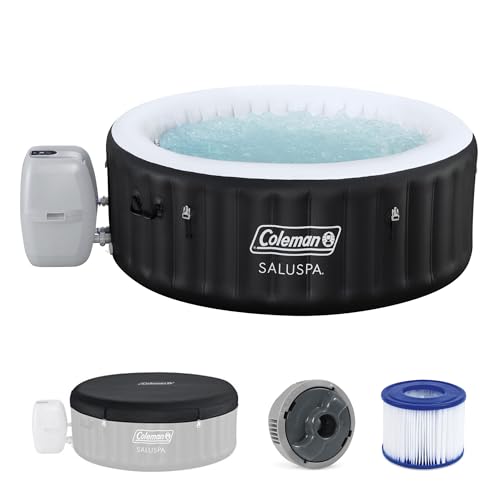
The Coleman SaluSpa Miami Energy-Efficient AirJet Inflatable Hot Tub is the portable this keyword was invented for. Freeze Shield automatic heating stands guard over its pump and liner when temperatures fall; EnergySense insulated walls and cover hold the heat the system makes, rated up to 40% more efficient than similar models; 120 AirJets deliver the soak; and a power-saving timer lets you schedule warmth up to 40 days ahead, so the tub peaks for your evening ritual instead of idling at maximum through every working day. In winter terms, that is protection, economy, pleasure, and planning in one 71-inch circle.
Strengths
- Freeze Shield: automatic cold-weather protection for pump and liner.
- Insulated walls and cover attack winter’s dominant cost — heat loss.
- MaxHold beams and Tritech layers hold pressure and shape through freeze-thaw cycles.
Trade-offs
- Freeze Shield protects against cold weather, not indefinite deep-freeze neglect — the owner’s trigger plan still matters.
- Two-to-four-person scale; winter groups rotate rather than gather.
- Holding 104 degrees through a cold snap costs real electricity even with good insulation.
| Color | Black |
| Size | Energy Efficient 2.0 |
| Dimensions | 71 x 71 x 26 inches |
| Weight | 101.2 pounds |
Winter craft with the Miami is a learnable routine with five habits. Keep it heated continuously — the system’s protection and your pipes both assume it. Work the timer so peak temperature coincides with your soak window and a moderated setback covers the rest, rather than letting the water crash cold and reheating through the full gradient daily. Treat the cover as roofing: brush snow before load builds, keep the center seam from icing, and never force a frozen cover open. Keep the path short, cleared, and sanded, with robes staged at the door — winter soaking is a logistics sport. And write your trigger now: the forecast depth or outage duration at which you will drain rather than trust, taped inside the pump housing where February-you will find it.
The ChemConnect dispenser earns a winter mention: cold-season owners test less willingly, and a dispenser that keeps chlorine distributing evenly between tests narrows the window in which winter water can drift. It does not replace testing — standing water in January is still standing water — but paired with the routine discipline in Best Hot Tubs For Families, it makes the routine survivable at ten below. Site the tub by the placement rules in Best Place For Hot Tubs, with the winter amendments: out of the roof’s shed line, out of the wind’s main road, within a short dash of the door.
Best for: Winter-serious couples and small households in genuinely cold climates / Not suited for: Unattended properties or owners unwilling to run the winter routine
Choose it if February soaking is the dream and you will do the five habits. Skip it if your winters include long absences — the storage strategy below is your honest pick.

Bestway SaluSpa Cancun Energy-Efficient Inflatable Hot Tub
Our badge: Best Compact
The Bestway SaluSpa Cancun Energy-Efficient Inflatable Hot Tub carries the identical winter arsenal as the Miami — Freeze Shield, insulated walls and cover, 120 AirJets, ChemConnect, heating to 104 degrees — in the same 71 by 26-inch footprint with a grey wicker finish. Its winter distinction is thermal agility: a compact volume reheats faster after a cover-off soak, recovers quicker from a cold snap’s setback, and suits the short, hot, deliberate winter session that cold-climate owners naturally adopt.
Strengths
- Full Freeze Shield protection — no winter feature deleted for size or finish.
- Smaller volume: faster recovery, lower hold cost through cold months.
- Wicker finish keeps winter patios looking furnished, not industrial.
Trade-offs
- Pool data lists placeholder dimensions; features confirm 71 x 26 inches — verify on the listing.
- Compact thermal mass also means faster cooling during long cover-off soaks.
- Same deep-freeze judgment calls as any inflatable, Freeze Shield notwithstanding.
| Color | Grey Wicker |
| Size | Energy Efficient 2.0 |
The Cancun’s winter personality suits the tucked-away site: the corner under a porch roof where snow load halves, the sheltered patio where the wind check passes, the small yard where a bigger tub would crowd the woodpile and the walkway that must stay clear. Under partial shelter its cover burden lightens, its heat holds easier, and the dash from the door can shrink to a few steps — the geometry that decides whether winter soaking is a ritual or a resolution. The Florida guide’s lanai logic in Best Hot Tubs For Florida is the same insight in a warm accent: shelter is the cheapest performance upgrade in any climate.
Choose between the Cancun and the Miami on finish, availability, and included extras; the winter substance is shared, and pretending otherwise would waste your deliberation. Spend the saved deliberation on the site and the trigger plan, which is where winter outcomes are actually decided.
Best for: Sheltered compact sites and short-session winter soakers / Not suited for: Exposed, unsheltered sites in severe wind and cold
Choose it if your site is small and sheltered. Skip it if your site is a wind-scoured deck — no compact inflatable wins that fight; move the site or graduate to the hard-shell strategy.

INTEX 28425EH PureSpa Bubble Massage Spa Set
Our badge: Best for Mild Winters
The INTEX 28425EH PureSpa Bubble Massage Spa Set enters a winter guide with its condition stated first, because winter is where honesty matters most: the verified pool data names no automatic freeze-protection system for this spa. What it offers instead is the pool’s roomiest portable — 210 gallons, four-person space, Fiber-Tech structure, an energy-efficient cover, hard water treatment, and saltwater-ready care — for the large share of winter that is merely cold rather than dangerous: the mid-Atlantic and Pacific Northwest winters, the southern cold snaps, and everywhere the shoulder seasons stretch from October to April.
Strengths
- Roomiest portable here — winter groups and families fit without rotation.
- Efficient cover and complete care systems simplify the cold-season routine.
- Saltwater-ready design suits a gentler winter chemistry.
Trade-offs
- No named freeze protection: hard freezes demand heated, attended operation or draining.
- Largest volume is the slowest to heat and the costliest to hold in deep cold.
- Bubble massage only.
| Color | Tan |
| Size | 4-Person |
| Dimensions | 22.25 x 25.375 x 32.75 inches (package); spa outer 77 x 28 inches per features |
| Weight | 99.66 pounds |
Operating the Intex through a mild winter is a forecast-driven craft. Keep it heated and circulating through ordinary cold; watch the forecast the way sailors do; and when a genuine hard freeze approaches — sustained temperatures well below freezing, especially with wind — make the call early: either commit to attended full-heat operation with daily checks, or drain, dry, and shelter the system until the snap passes. The mistake is the middle path of hoping. Water’s expansion does not negotiate, and pumps crack on the coldest night of the year with a reliability that would be admirable in any other context.
For households in truly cold regions, the Intex’s winter role is the shoulder-season anchor of a two-strategy year: outdoors from the first thaw to the first hard freeze, stored through the deep months, with the indoor strategy below covering the gap. That is not a demotion — it is the pattern the New England guide blesses for exactly this equipment class, and it stretches the spa’s lifespan by sparing it the season most likely to kill it.
Best for: Mild-winter regions and shoulder-season soakers in cold ones / Not suited for: Unattended operation through hard freezes anywhere
Choose it if your winter is cold but not arctic, or your calendar is honestly three-season. Skip it if January where you live is a serious month — the SaluSpas above were built for your January.
Insulated Hard-Shell Portable Spa
Our badge: Best Premium
This pick is prose-only: the pool contains no hard-shell portable, so the graduation format is described, not listed. Between the inflatable and the permanent spa sits a one-piece class — rotationally molded or acrylic portables with real insulation, integrated seating, and plug-or-hardwired power — that keeps the portable’s essential freedom (no construction, movable by a crew, sellable when life changes) while deleting the inflatable’s winter weaknesses: no air pressure to lose, insulation that does not depend on a cover alone, and shells that shrug off the season’s bumps.
Strengths
- Insulated rigid shell holds winter heat at a fraction of inflatable losses.
- No inflation, no punctures, no pressure checks in the cold.
- Still relocatable — the portable idea, matured.
Trade-offs
- Heavier and costlier than any inflatable; delivery is a crew event.
- Freeze protection varies by model — verify the specific system’s cold rating when shopping.
- Repairs are component events, not patch-kit moments.
| Type | Prose-only — hard-shell portable format, no pool product |
| Format | One-piece insulated spa, portable placement |
| Best pairing | Proven winter soakers upgrading from inflatables |
Shop this format with winter questions first: What is the insulation story — full foam, perimeter, or thermal blanket — and what does the maker claim for operating temperatures? What does the control system do automatically in a freeze, and what does it assume the owner will do? How does the cover seal, and what does a replacement cost? The tier framing for the step up lives in Best Hot Tubs Under $6000, and the owners who make this graduation successfully are almost always inflatable graduates — people whose winter log tells them exactly which limitations they are paying to delete.
Best for: Proven cold-climate soakers ready to retire inflatable compromises / Not suited for: First-time buyers still testing the habit
Choose this format after a winter or two of data. Skip it as a first purchase — its premium buys out problems you have not yet confirmed you have.
Indoor Deep-Soak Strategy for Storm Nights
Our badge: Best for Storm Nights
The second prose-only pick is a strategy, stated plainly: the most reliable winter hot water is indoors. A deep fresh-fill soaking tub — the insulated, double-wall kind reviewed across this series — cannot freeze, cannot lose power to a storm, cannot be buried by the nor’easter, and asks for no chemistry and no cover discipline. As a winter plan it is not a compromise but a complement: the outdoor portable owns the clear, starry, sub-freezing evenings that make winter soaking magical, and the indoor soak owns the storm nights, the outage nights, and the evenings when the dash across the deck simply loses to the couch.
Strengths
- Weatherproof by architecture: the soak happens regardless of the forecast.
- Zero winter systems: no freeze risk, no standby cost, no chemistry.
- Pairs with any portable to make the household’s soaking calendar unbreakable.
Trade-offs
- It is not a portable hot tub and offers no jets or outdoor ritual.
- Requires a bathroom renovation-scale decision if the tub is not already there.
- Fresh-fill means a drawn bath’s wait and water use each time.
| Type | Prose-only — strategy pick, no pool product |
| Format | Insulated indoor soaking as the winter complement |
| Best pairing | Households with both a portable and a bathroom plan |
The two-venue household is the quiet endgame of many cold-climate soaking stories in this series — the New England guide builds its whole recommendation around it — because it converts winter from a threat to a variety. Practical note for planners: if a bathroom project is anywhere on your horizon, the insulated soakers are reviewed in depth under Best Hot Tubs Under $2000 and the premium tier guide, with heat-retention as the winter-relevant criterion. Choose the indoor tub for insulation first and drama second; February rewards the order.
Best for: Cold-climate households wanting a guarantee behind the portable’s magic / Not suited for: Anyone whose winter plan must be a single product
Choose this strategy if your winters include storms that cancel plans. Skip it only if your climate’s winter is a rumor — in which case the Intex above is your whole answer.
Winter-Storage Strategy for Fair-Weather Portables
Our badge: Best for Deep-Freeze Regions
The final prose-only pick is the decision some guides are afraid to recommend: put the portable away. In the coldest regions — where January means weeks below zero, where outages ride ice storms, where the dash to the tub crosses a genuinely hostile yard — storing a portable hot tub dry and indoors for the deep months is not surrender. It is the strategy that guarantees the tub survives to give you April through November, year after year, instead of dying heroically in its first February.
Strengths
- Eliminates freeze risk, winter energy cost, and outage anxiety entirely.
- Extends the tub’s lifespan by sparing it its most destructive season.
- Frees the household from every winter routine duty for the stored months.
Trade-offs
- No outdoor soaking in the deepest months — the trade is explicit and total.
- Requires dry indoor storage space and a careful drain-dry-store procedure.
- Spring restart needs an inspection and a patient first fill.
| Type | Prose-only — strategy pick, no pool product |
| Format | Seasonal drain, dry, and indoor storage |
| Best pairing | Deep-freeze regions and absence-prone households |
Execute storage like a ritual and it pays compound interest. Drain fully, run the maker’s purge for the pump and lines, dry every surface including the filter housing, and let the liner air until it is genuinely dry — stored damp is stored mildewed. Deflate without forcing cold-stiffened material; if the tub has been outside in the cold, warm it before folding. Store indoors, off concrete, away from rodent temptation and sharp shelving. In spring, inspect before inflating, flush the first fill if anything smells doubtful, and let the season begin. Owners who store well routinely double their inflatables’ service lives — the arithmetic that makes this strategy a pick rather than a footnote, and the same seasonal realism that governs even the garden’s smallest water systems, down to Best Solar Bird Bath Water Pumps.
Best for: Deep-freeze regions, snowbird households, and lifespan maximizers / Not suited for: Anyone whose winter soaking is the point of owning the tub
Choose this strategy if your February is truly arctic or your house sits empty in winter. Skip it if the winter ritual is why you came — the Miami was built for you, and it is waiting at the top of this list.
Comparison Table
| Pick | Type | Freeze answer | Winter strength | Check price on Amazon |
|---|---|---|---|---|
| Coleman SaluSpa Miami | Inflatable spa | Freeze Shield automatic | Full winter operation | Check price on Amazon |
| Bestway SaluSpa Cancun | Inflatable spa | Freeze Shield automatic | Compact, fast recovery | Check price on Amazon |
| INTEX PureSpa | Inflatable spa | None named in pool data | Mild winters, shoulders | Check price on Amazon |
| Hard-shell portable | Prose-only format | Model-dependent, verify | Insulated graduation | Check price on Amazon |
| Indoor deep-soak | Prose-only strategy | Architecture | Storm-night guarantee | Check price on Amazon |
| Winter storage | Prose-only strategy | Elimination | Lifespan and zero risk | Check price on Amazon |
How to Choose the Best Portable Hot Tubs for Winter
Make freeze protection the first filter
Before jets, before capacity, before finish: does the system automatically protect its pump and liner when the temperature falls? If the answer is a named system like Freeze Shield, the tub is a winter candidate. If the answer is silence, the tub is a mild-winter or attended-operation product, whatever the marketing season says. This single question sorts the entire category honestly.
Stack the insulation: walls, cover, and ground
Heat escapes in three directions and winter owners must defend all of them: insulated walls for the sides, a fitted, healthy cover for the top — the largest loss surface — and an insulating barrier under the tub, because a portable sitting on frozen ground or a cold slab donates heat downward all winter. The ground layer is the one buyers forget and the cheapest to add at setup.
Plan the electrical reality of winter
A winter portable is a continuous electrical commitment. The circuit must be reliable, the connections weather-protected, and the outage plan written. If your property loses power often and long in winter, your honest options narrow to attended operation with a fast drain trigger, or storage. No product feature repeals an unreliable grid.
Choose the site like a winter native
Short dash from the door, shelter from the prevailing wind, clear of the roof’s shed line, on a surface that will not become an ice rink at the entry point. The placement guide in Best Place For Hot Tubs gives the general geometry; winter adds the ice-path and snow-load amendments that decide February satisfaction.
Decide your strategy before the season decides for you
Operate, complement, or store — pick one in autumn, write the trigger points down, and stage what the strategy needs (storage space cleared, indoor option ready, drain hose located). Winter punishes improvisation and rewards the household that made its decisions in October.
How Do You Run a Portable Hot Tub Through Winter?
The operating rhythm, distilled: keep the water heated and circulating continuously; never let a filled portable sit cold in freezing weather. Work the timer so peak heat meets your soak hour. Test and balance weekly even when the water looks innocent — winter water is standing water with better PR. Brush the cover after every snowfall, inspect its seam and skirt weekly, and keep the area around the pump housing clear so the equipment breathes and can be reached. After each soak, close the cover fully and latch it against wind; a cover lifted by a storm gust at 3 a.m. is a freeze event by dawn.
Know the two emergencies cold. In a power outage: cover stays on, undisturbed — the water’s thermal mass is a battery measured in hours to days depending on insulation and temperature — and if the outage stretches toward your written trigger, drain while draining is still easy. In a deep-freeze forecast beyond your system’s comfort: decide the day before, not the night of. Draining a portable in a gale at midnight is the tuition this guide exists to help you avoid.
Problem: The water temperature keeps sagging overnight — Heat loss is winning somewhere: check the cover’s fit and waterlogging first, then wind exposure, then the ground barrier. Fix the loss before blaming the heater.
Problem: Ice is forming at the waterline — The set temperature is too low for the conditions or circulation has faltered. Raise the set point, verify the pump is cycling, and treat persistent ice as a trigger-plan conversation, not a quirk.
Problem: The cover is frozen shut — Warm water along the seam, patience, no prying. Prevent recurrence by drying the seam at closing and keeping meltwater from pooling where it can refreeze.
Problem: A cold snap is coming and you are traveling — The honest options are a trusted house-sitter briefed on the tub, or draining before you leave. An unattended portable in a hard freeze is a wager, not a plan.
The Winter Energy Ledger, Honestly Kept
Winter running costs frighten buyers out of proportion because they are imagined rather than itemized. The drivers are knowable: the gap between your set temperature and the air, the insulation stack’s quality, wind exposure, cover-off hours, and your electricity rate. A well-insulated Freeze Shield portable on a sheltered site, timer-managed to its household’s rhythm, spends its winter money in a steady, budgetable stream — very different from the horror stories, which almost always trace to a dead cover, an exposed site, or a tub held at maximum through a working week nobody soaked in. The discipline that governs the ledger is the same one in Best Hot Tubs Under $2000: price the season, not the day, and let insulation do the quiet work.
One counterintuitive mercy: winter owners soak more, not less, when the system is set up well. The contrast ritual — cold air, hot water, steam in the floodlight — is the product’s finest hour, and households that reach February with a running tub tend to describe the season as the reason they bought it. The energy ledger, kept honestly, is usually the price of the best evenings of the year, and most owners pay it gladly with the cover brushed and the timer set.
Spring Restart: Bringing a Wintered Portable Back
Whether the tub ran all winter or slept in storage, spring deserves a ritual. For stored tubs: inspect the liner and seals before inflation, check the pump housing for uninvited tenants, inflate and fill, then run a full sanitizing cycle before the first soak — treat the first fill as a system flush if the water or smell gives any doubt. For winter-run tubs: spring is the deep-clean moment — filter replacement, a cover inspection with replacement on evidence, a water change to reset the chemistry baseline, and a walk-around of hoses, seals, and the electrical connection after a season of freeze-thaw. Both rituals end the same way: the first soak of the season, taken deliberately, in the yard you now know in all four of its seasons — which was the point of buying a portable for winter in the first place.
Common Buying Mistakes
Believing “four-season” marketing without a freeze system
The words on the box are not a technology. If no automatic freeze protection is named, the tub’s winter is attended or mild — full stop. Buy the named system or buy the honest season.
Setting up in autumn without a shakedown
A tub first filled in November teaches its lessons in the cold. Set up in mild weather, learn the routine while mistakes are cheap, and meet winter as a practiced owner.
Letting the water sit cold “to save money”
Cold-sitting a filled portable in freezing weather risks the pump and liner to save a modest heating sum — the worst trade in the category. Heat it, or drain it; there is no third state.
Ignoring the ground barrier
A tub on frozen ground bleeds heat downward all season. The insulating base layer is the cheapest winter upgrade that exists, and skipping it taxes every single soak.
Having no outage or travel plan
Winter emergencies arrive on winter’s schedule. The trigger plan — who, what, at what threshold — must exist before the first storm, or the storm will write it for you.
Final Recommendation
The best portable hot tub for winter in this pool is the Coleman SaluSpa Miami Energy-Efficient AirJet Inflatable Hot Tub: Freeze Shield standing guard, insulation holding the line, and a timer that lets the tub live on your schedule. The runner-up is its Bestway sibling — Check on Amazon — for sheltered compact sites. Own the Intex proudly if your winter is mild, store bravely if your February is arctic, and keep the indoor soak behind you for the storm nights either way. The best portable hot tubs for winter are not the ones with the most features — they are the ones whose owners matched product, site, and strategy before the first frost, and are still soaking, unbothered, in February.
The Winter Soak Itself: Making February the Best Month
All of this guide’s discipline exists to purchase a specific experience, and it is worth describing what the discipline buys, because owners who know the prize keep the routine. A winter soak at full heat, in falling snow or under a black January sky, is a sensory event no other season can stage: the contrast between air that stings the shoulders and water that holds the body at spa temperature, steam rising through the light, the yard’s silence under snow. Couples and families build winter traditions around it — the Friday soak, the snow-day rule that the tub is the day’s destination, the New Year’s immersion — and those traditions, not the equipment, are what owners describe when they say the purchase changed their winters. The craft that sustains it is mostly choreography: robes and towels staged warm at the door, the path lit and sanded, drinks that survive the temperature, a soak length governed by comfort rather than bravado, and the cover closed within a minute of exit so the water’s heat bank is spent on people, not on the night.
Safety’s winter chapter is short and absolute. Alcohol and very hot water compound each other’s effects on judgment and circulation; winter’s cold shock on exit is its own argument for a seated minute at the edge before standing. Children in winter soaks follow the family guide’s rules with the addition of the dash: their heat budget includes the walk back, and the adult’s job is to end the soak before the accounting turns. None of this dims the ritual; it is what allows the ritual to be a tradition rather than a story with an ending nobody wanted.
Troubleshooting the Mid-Winter Spa: A Diagnostic Ladder
When a winter portable misbehaves, the season tempts owners toward panic or toward the drain valve, and both are usually premature. Work the ladder instead. First, power and protection: is the circuit live, the protection system reporting normally, the pump cycling as it should? A surprising share of “failures” are a tripped outdoor outlet after a storm, diagnosed in a minute with a lamp or a phone charger. Second, flow: a filter loaded with a season’s debris restricts circulation, and restricted circulation reads as weak jets, slow heating, and temperature complaints that mimic heater failure — clean or swap the filter before indicting anything expensive. Third, the cover: waterlogged or snow-loaded covers explain most mysterious temperature sag, and they announce themselves by weight before they announce themselves by sight. Fourth, chemistry: winter water that clouds or foams is usually a routine gap, not an equipment event, and the test kit arbitrates. Only after the ladder should the drain decision or the service call enter the conversation — and by then it enters as information, not as fear. Owners who climb the ladder calmly discover that winter spas are more reliable than their reputation, because most of their failures were never really theirs.
Choosing Your Winter in Advance: A Decision Calendar
Everything this guide recommends can be compressed into a calendar, and households that pin it up in September rarely improvise in January. September: choose the strategy — operate, complement, or store — and order what it needs while shelves are stocked and delivery is unhurried. October: site work and setup; the ground barrier down, the tub placed and filled in mild weather, the routine learned across a shakedown fortnight, the trigger thresholds written and posted at the pump. November: the first cold test — a genuine freeze survived with the system reporting normally converts autumn’s theory into winter confidence; covers, paths, and robe stations finished before they are needed. December through February: the operating rhythm itself — weekly tests, snow discipline, the timer tuned to the household’s real hours, and the trigger honored without debate on the nights it speaks. March: the honest review — what the energy ledger actually said, what the cover endured, what the strategy cost and returned — recorded while memory is fresh, because next September’s decisions deserve this March’s data. Owners who run the calendar discover that winter stops being the season their spa survives and becomes the season it was, all along, actually for.
What Winter Does to Water Chemistry
The season reaches inside the tub as well as around it, and winter water behaves differently enough to deserve a keeper’s attention. Cold air over hot water drives evaporation at a rate summer never matches — the steam rising off a January soak is the tub’s volume leaving visibly — so levels drop faster, and each top-up with fresh water dilutes the chemistry the owner balanced last week. Sanitizer demand, meanwhile, falls with the bather load of a household that soaks in shorter, more deliberate sessions, while the long cover-closed weeks between holiday gatherings let small drifts compound unnoticed. The practical synthesis: test on the calendar, not on the water’s appearance, because winter water looks innocent longest precisely when it is drifting; top up before the level reaches the jets’ or the heater’s comfort line, since low water in a heated system is an equipment risk and not merely a chemistry one; and expect the winter drain-and-refill, when it comes, to feel overdue by the water’s behavior rather than by the schedule — the season concentrates everything it touches, including the case for fresh water. Owners who learn winter chemistry’s tempo stop being surprised by February’s cloudiness, because they can name its parents: evaporation, dilution, and time.
Frequently Asked Questions
Can you really use an inflatable hot tub all winter?
Yes, with the right model and routine: a named freeze-protection system, continuous heating, a healthy cover, and an owner who manages snow and watches forecasts. The SaluSpa picks in this guide are built for exactly that; models without freeze protection should be limited to mild winters or stored.
What is Freeze Shield and why does it matter?
It is an automatic heating function on the SaluSpa models that engages to protect the pump and liner from cold-weather damage when temperatures drop. It matters because freeze damage is how portable tubs die in winter — protection that works while you sleep is the difference between a season and a loss.
Should I keep my portable hot tub heated all winter?
If it is filled and outdoors in freezing weather, yes — continuous moderated heating is both the energy-sane and equipment-safe strategy. Letting filled water sit cold invites freeze damage; if you do not want to heat it, drain and store it.
How can I lower winter running costs?
Defend the three loss surfaces: a fitted, healthy cover; insulated walls; and a ground barrier beneath. Shelter the site from wind, timer-manage peak heat to your soak window, and keep the cover brushed and sealed. Insulation discipline beats heater size every time.
What should I do before a major cold snap or storm?
Verify heating and circulation, secure the cover, clear the area, and review your trigger plan. If the event exceeds your system’s comfort — extreme cold or a long outage risk — draining early, in daylight and calm, is the professional move.
When is storing the tub the right winter choice?
When your region’s deep-freeze is prolonged, when the property sits empty, or when you know the routine will not be kept. A stored tub loses a season of soaking and gains years of life — for many households that is the best trade on this page.


