Disclosure: As an Amazon Associate, dailyhomedecorating.com earns from qualifying purchases. Links to Amazon on this page are affiliate links; they cost you nothing extra. Prices and availability change often, so check the current Amazon listing before you buy.
The search for the best bang for your buck hot tubs usually starts after a sticker-shock moment: a jetted spa’s purchase price is only the opening bid, and the delivery, electrical work, cover, chemicals, filters, and standby heating that follow can rival it over a few years. Value in soaking is not the cheapest vessel — it is the most soak per dollar of total ownership. That is the lens for this guide, and it comes with a transparency note: the verified product pool for this topic contains no jetted outdoor hot tubs. Its closest honest fit is a set of fresh-fill soaking tubs, and for value-focused readers that turns out to be the most interesting comparison in the category, because a fresh-fill tub’s running costs are close to zero.
The six picks below were ranked on total cost of ownership, not ticket price: what the tub costs to buy, what it costs to install, what it costs to run for a decade, and how much soaking quality survives that accounting. A steel alcove tub that installs in an afternoon and never needs a chemical is worth more, dollar for dollar, than a feature-stacked spa whose pumps and heaters age expensively. Readers who do want the jetted format should compare these numbers against the tiers in Best Hot Tubs Under $2000 and Best Hot Tubs Under $6000 — the value logic is the same even when the format differs.
Where to Buy
Every pick in this guide is sold on Amazon, where you can check the current price, delivery options, and listing details before you buy. With value purchases especially, confirm what is included in the box — drain, overflow, hardware — because an included drain kit is real money saved.
- Empava 59 Inch Freestanding Bathtub — Check on Amazon
- BOOTZ INDUSTRIES Steel Bathtub with Right-Hand Drain — Check on Amazon
- KINGSTON BRASS 60-Inch Alcove Acrylic Bathtub — Check on Amazon
- Fine Fixtures Acrylic Alcove Soaking Bathtub — Check on Amazon
- DeerValley 55″ Acrylic Freestanding Bathtub — Check on Amazon
- FerdY Tahiti 55″ Acrylic Freestanding Bathtub — Check on Amazon
In this guide
Quick Picks
| Pick | Badge | Why it earns its place |
|---|---|---|
| Empava 59 Inch Freestanding Bathtub | Best Overall | Deep soak, anti-slip floor, drain included — the most complete package per dollar. |
| BOOTZ INDUSTRIES Steel Bathtub | Best Budget | Steel durability at the entry tier, in the standard alcove footprint. |
| KINGSTON BRASS 60-Inch Alcove Acrylic Bathtub | Best Alcove Value | 58.2 gallons of soak in a no-surprises three-wall installation. |
| Fine Fixtures Acrylic Alcove Soaking Bathtub | Best for Easy Installation | Drain included, pre-fixed flange, no mortar bed required. |
| DeerValley 55″ Acrylic Freestanding Bathtub | Best Compact | Freestanding style and a real soak in a 55-inch footprint. |
| FerdY Tahiti 55″ Acrylic Freestanding Bathtub | Best for Couples | One-or-two-person soaking with double-wall heat retention. |
Key Takeaways
- Bang for your buck is a ten-year calculation: purchase, installation, energy, consumables, and repairs — not the ticket price alone.
- Fresh-fill soaking tubs delete the spa’s recurring costs entirely: no sanitizer, filters, standby heating, or pump repairs.
- Included hardware is hidden value — a tub with drain and overflow in the box saves a separate purchase and a second delivery.
- Standard alcove footprints are the cheapest installations because the plumbing and walls already exist.
- Heat retention is a running-cost feature: double-wall acrylic reduces the hot water each soak consumes.
- The value trap is the opposite of the luxury trap — the cheapest vessel with a short service life costs more per year than a mid-priced tub that lasts.
How These Picks Were Chosen
We scored the verified pool on a value rubric rather than a luxury rubric. First, completeness: does the box include the drain and overflow, or does the real price start after checkout? Second, installation cost: alcove replacements that reuse existing walls and plumbing scored ahead of formats needing new electrical work or structural checks. Third, running cost: every pick here is a fresh-fill tub, so the running-cost line is water and water heating only — no pick carries a pump, a heater element, a control board, or a filter cartridge that will need replacing in year four. Fourth, durability of the shell material, because a tub’s value is its price divided by its years.
Two pool products were excluded on value grounds that might surprise: the largest premium tub in the pool is a wonderful soak but its 82-gallon fills make it the most expensive pick per bath in water and heating, which is the opposite of this keyword; and a faucet trim kit that appears in the pool data is not a tub at all and is flagged in the sources file. The walk-in combo was also set aside — it is the right purchase for a specific need, covered in Best Tubs For Seniors, but its installation and jetted systems carry costs this keyword’s reader is trying to avoid. What remains is a ladder from a steel budget staple to a couple-sized insulated soaker, every rung defensible on cost-per-soak.
Method honesty: prices change constantly and this guide prints none. “Value” here is argued from verified construction, included components, capacities, and ownership structure — the durable facts — rather than from a price snapshot that would be stale within the month. Check the current listings through the links and run the same arithmetic with live numbers before you buy.
The 6 Best Bang for Your Buck Hot Tubs — Reviewed

Empava 59 Inch Freestanding Bathtub
Our badge: Best Overall
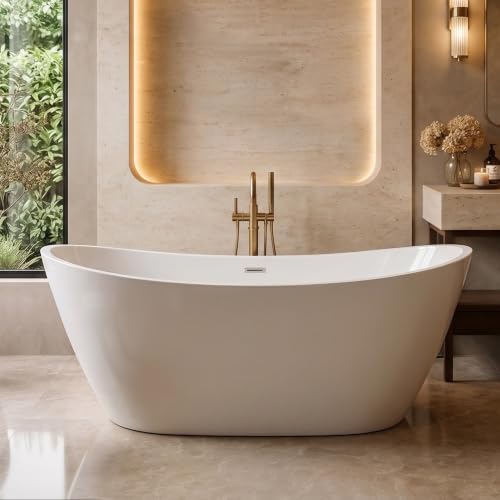
The Empava 59 Inch Freestanding Bathtub tops a value list by being complete. The drain and overflow are in the box, the certification is in order, the floor is textured against slipping, the back is shaped for support, and the double-wall shell holds the heat you paid to put in the water. Many tubs beat it on one axis; few match its whole package without adding purchases around it, and package completeness is what value means in practice.
Strengths
- Drain and overflow included — no hidden second purchase to make it work.
- Double-wall acrylic keeps heat in, cutting the hot-water cost of every soak.
- 45-gallon capacity is economical per fill while still soaking 15 inches deep.
Trade-offs
- Freestanding format still needs an external faucet, the one added cost to plan for.
- Mid-size footprint will not stretch out a very tall bather.
- Freestanding placement costs more to plumb than an alcove swap if no floor drain line exists.
| Color | White |
| Size | 59 Inch |
| Dimensions | 59.1 x 29.5 x 26.8 inches |
| Weight | 66.1 pounds |
Run the ownership arithmetic the way this guide recommends. Purchase: one tub, one faucet. Installation: a freestanding set with adjustable leveling feet — the feet matter to value because a properly leveled tub drains completely, and complete drainage prevents the residue buildup that shortens a finish’s life. Running: 45 gallons of heated water per soak, no standby draw, no consumables. Decade horizon: the shell is acrylic over reinforcement with no mechanical systems to fail; the realistic maintenance is the mild cleaning routine in Best Cleaner For Bath Tubs. Compare that ledger with any jetted appliance’s — pumps, seals, control boards, covers — and the Empava’s value case makes itself.
The soaking quality is not a compromise made for the spreadsheet. Fifteen inches of depth with ergonomic back support is a genuine soak, and the anti-slip floor is a feature spa shoppers pay trim-level money to approach. At 66.1 pounds the tub is also cheap to handle: two people can place it precisely, which keeps installation hours — a real cost line — low. Value is often decided in these unglamorous logistics, and the Empava wins most of them.
Choose this pick when you want one purchase that ends the project. Its only structural caveat is the freestanding faucet; if your bathroom already has an alcove and no appetite for new plumbing lines, the alcove picks below beat it on installed cost while conceding some soaking polish.
Best for: Buyers who want the most complete, lowest-running-cost soak in a single purchase / Not suited for: Bathrooms where an alcove swap is the only affordable installation
Choose it if the budget covers one freestanding installation done properly. Skip it if installation cost is the binding constraint — start with the steel pick instead.

BOOTZ INDUSTRIES Steel Bathtub with Right-Hand Drain
Our badge: Best Budget
The BOOTZ INDUSTRIES Steel Bathtub with Right-Hand Drain is the value floor of this guide: an American-made steel alcove tub in the standard 60-inch footprint, from a maker whose pitch is durability and value in plain language. Steel is the traditional budget material for a reason — it is rigid, it is repairable, and a well-kept enamel-over-steel tub serves for decades in exactly the slot where the old tub came out.
Strengths
- Steel construction delivers rigidity and long service at the entry tier.
- Standard 30 x 60 alcove footprint makes it a direct replacement in most bathrooms.
- At 50 pounds it is the lightest pick here — the cheapest tub to move and set.
Trade-offs
- Steel conducts heat away faster than insulated acrylic, so soaks cool sooner.
- Enamel can chip if struck, and chipped steel needs prompt touch-up to prevent rust — see Best Rust Remover For Tubs.
- Right-hand drain only in this configuration; confirm your plumbing side.
| Color | White |
| Dimensions | 61 x 31 x 18 inches |
| Weight | 50 pounds |
The value argument for steel is a lifecycle argument. This is the tub landlords and budget renovators have specified for generations because the failure modes are slow and visible rather than sudden and electronic. There is nothing to program, nothing to plug in, and nothing proprietary to replace. In a rental property, a first home, or a bathroom that must be finished this month at a controlled cost, that predictability is worth more than features. The made-in-USA manufacturing is also part of the practical picture for replacement parts and support.
Know the material’s honest limits before you buy. A steel tub rings louder under a shower and feels cooler to the first touch; its water loses heat faster than a double-wall acrylic’s, so long soaks may want a top-up. Enamel chips are the one maintenance duty: a dropped heavy object can chip through to steel, and the chip must be touched up before moisture turns it into a rust spot. Households willing to accept those terms get the lowest total cost in this guide; households who soak long and often will recover the price difference of acrylic in comfort within a season or two.
Installation is the other half of its value. Fifty pounds, a standard footprint, and a right-hand drain mean a plumber’s routine replacement — measure your drain side twice, because handedness is the one way this simple purchase goes wrong.
Best for: Budget renovations, rentals, and first homes needing a durable standard tub at the lowest total cost / Not suited for: Long-soak enthusiasts who will feel the faster heat loss
Choose it if the project budget is firm and the bathroom is a standard alcove. Skip it if soaking is a daily long ritual — acrylic’s heat retention earns its premium there.

KINGSTON BRASS 60-Inch Alcove Acrylic Bathtub
Our badge: Best Alcove Value
The KINGSTON BRASS 60-Inch Alcove Acrylic Bathtub is where the value curve bends: acrylic’s warmth and quiet over steel, a generous 58.2-gallon capacity, and a three-wall alcove installation with tile flange and integral apron — at the part of the range where you are still plainly paying for tub rather than for styling. For a family bathroom renovation, this is the specification that survives scrutiny from both the bather and the budget holder.
Strengths
- 58.2-gallon capacity and 14-inch depth give a full family-bathroom soak.
- Acrylic with fiberglass and resin reinforcement: warmer and quieter than steel.
- Tile flange and integral apron keep installation and finishing costs predictable.
Trade-offs
- Drain kit is not included — add it to the true purchase total.
- Right-hand drain configuration only; verify before ordering.
- At 95 pounds it is a firmer two-person lift than the steel pick.
| Color | Glossy White |
| Size | 60 inch (L) x 30-11/16 inch (W) x 22-1/16 inch (H) |
| Dimensions | 60 x 30.69 x 22.06 inches |
| Weight | 95 pounds |
Capacity is a value feature families feel daily. At 58.2 gallons, this tub bathes a child with room to play, an adult with water over the lap, and does both in the footprint the bathroom already has. The acrylic surface cleans with mild products — important in a family bathroom where the tub is cleaned often and by different people — and it will not chip-rust the way enamel over steel can, removing the one recurring repair the budget pick carries. Over a decade of family use, that difference quietly closes much of the price gap between the two materials.
The installation story is deliberately boring, which is praise. Three-wall alcove, tile flange to keep water out of the wall cavity, apron front so no extra finishing carpentry is needed. Boring installations are cheap installations, and they stay cheap because there are no surprises behind the walls. The single line item to remember is the drain kit: it is not in the box, so a true bang-for-buck comparison adds it to this pick’s total before judging it against the drain-included Empava and Fine Fixtures.
For households comparing against the jetted world, note what this tub replaces: a family that soaks together twice a week gets that ritual here with a water bill and a wipe-down, versus a spa’s chemistry shelf and electricity draw — the same trade examined for couples in Best Two Person Hot Tubs For Sale.
Best for: Family bathroom renovations wanting acrylic comfort and real capacity at a controlled installed cost / Not suited for: Buyers who need a left-hand drain or a drain kit in the box
Choose it if the alcove is standard and the soak is a family routine. Skip it if your drain is left-handed — the next pick covers that side.

Fine Fixtures Acrylic Alcove Soaking Bathtub
Our badge: Best for Easy Installation
The Fine Fixtures Acrylic Alcove Soaking Bathtub competes on the cost line most buyers forget to price: the installation itself. The drain is included, the tile flange is pre-fixed, no mortar or plaster bed is required, and the legs adjust for leveling. Each of those details is a small invoice that never arrives, and together they make this the cheapest alcove tub to own from day one even before its accessible positioning in the range.
Strengths
- Drain included and pre-fixed tile flange shorten the parts list and the labor.
- No mortar or plaster required; adjustable legs simplify leveling.
- Sloped lumbar support and a toiletries ledge add daily comfort at no extra cost.
Trade-offs
- This configuration is left-hand; right-hand bathrooms need the mirrored variant.
- Standard soaking depth rather than a deep-soak design.
- Alcove format only — no freestanding placement flexibility.
| Color | White |
| Size | 60″ x 30″ – Left Hand |
| Dimensions | 30 x 60 x 21.5 inches |
| Weight | 65 pounds |
Installation economics deserve a paragraph of their own, because they are where “cheap tubs” become expensive projects. A tub that needs a mortar bed needs the mortar, the mixing, the setting time, and the skill to bed it evenly; a tub with adjustable legs and no mortar requirement removes all four. A pre-fixed flange removes the fiddly sealing step that causes the most expensive alcove failure — water behind the wall. An included drain removes a second order, a second delivery wait, and the risk of an incompatible thread. Fine Fixtures has essentially pre-paid the annoyance costs of alcove installation, and at 65 pounds the tub is also the easiest alcove unit here to get through the house and into position.
The bathing experience is honest mid-range: sloped lumbar support that makes the sit comfortable and the rise easier, a ledge that keeps toiletries in reach, and an acrylic surface described as resistant to salts and oils — a small, real benefit for households that use bath salts, since salt residue is one of the quiet finish-killers discussed in Best Salt Water Hot Tubs For Sale. It will not out-soak the deep models, but nothing about it feels like a penalty box either.
For a value buyer with a left-hand alcove, this is arguably the smartest money in the guide: the savings are in the project, not just the product. Pair it with the steel pick as the two ends of the alcove value argument — steel wins the ticket, Fine Fixtures wins the install.
Best for: Left-hand alcove renovations where total project cost matters more than ticket price / Not suited for: Right-hand alcoves or buyers wanting a deep-soak interior
Choose it if your drain is left-hand and you are pricing the whole job. Skip it if the configuration is wrong — never plan a bathroom around the wrong hand.
DeerValley 55″ Acrylic Freestanding Bathtub
Our badge: Best Compact
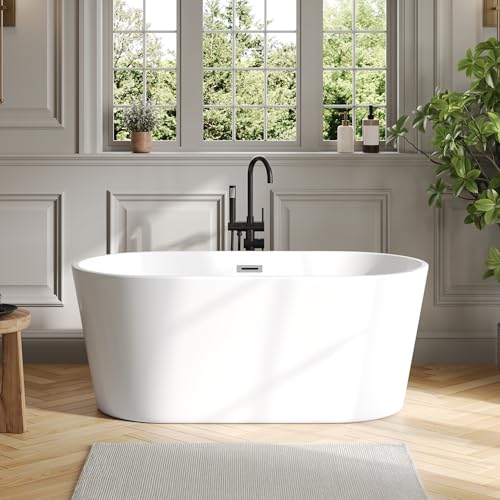
The DeerValley 55″ Acrylic Freestanding Bathtub brings freestanding style into value territory. Its design brief — maximize the interior soak within a 55-inch exterior — is a value brief: you pay for the smallest tub that still delivers the experience, and you house it in bathrooms where bigger tubs would force renovation spending. For apartments and smaller homes, that restraint is the bargain.
Strengths
- Compact footprint avoids the renovation costs larger tubs trigger.
- Center drain and integrated overflow included in the box.
- Smooth acrylic surface resists stains and keeps cleaning cheap and chemical-light.
Trade-offs
- Verified pool data lists no weight for this model — confirm on the listing before floor planning.
- 55 inches is a solo soak for most adults.
- Freestanding faucet is a separate purchase, as with all freestanding picks.
| Color | White |
| Size | 55 Inch |
| Dimensions | 55.12 x 29.53 x 22.05 inches |
The value logic of small freestanding tubs is underappreciated. A household that wants the freestanding look often assumes it must also buy the 67-inch version and the bathroom remodel to hold it. The DeerValley delivers the silhouette and the soak at a size that fits the bathroom as it stands — no wall moves, no floor reinforcement conversations, no second mortgage on the project. Its included stainless overflow cover and chrome-finished drain are the kind of corrosion-resistant fittings that keep a budget tub from generating small replacement costs in year three.
The model line offers 55, 59, and 67 inches, and the value advice is to measure twice and buy the largest that fits without renovation: the price steps between sizes are small compared with the daily difference in soaking room, and a tub is a decade-long purchase. The 55-inch reviewed here is the honest apartment answer. Sellers of value should also note the support commitment in the verified features — dedicated pre- and post-purchase support is worth real money on a plumbed fixture, because questions answered free are service calls avoided.
Against the jetted comparison that frames this whole guide: an inflatable or entry portable spa can appear cheaper on the ticket while consuming its purchase price again in filters, chemicals, and replacement covers across a few seasons, a pattern detailed in Best Portable Hot Tubs For Winter. A rigid acrylic tub’s costs end at installation. That is the deepest sense in which this modest tub is a value pick.
Best for: Apartments and small bathrooms wanting freestanding style without renovation spending / Not suited for: Bathers who need length or a two-person interior
Choose it if the room is small and the style matters. Skip it if two bathers or a tall frame are in the picture — size up within the line or across this list.

FerdY Tahiti 55″ Acrylic Freestanding Bathtub
Our badge: Best for Couples
The FerdY Tahiti 55″ Acrylic Freestanding Bathtub closes the list with the couple’s value case. A two-person hot tub is among the most expensive ways to soak together; the Tahiti’s ergonomic oval is designed to fit one or two bathers in 55 inches of fresh water, with double-walled insulation keeping a shared soak warm and a pre-installed drain reducing the installation bill. Per couple-soak, over a decade, very little on the market competes with it.
Strengths
- Interior shaped to fit one or two bathers — two-person soaking at solo-tub cost.
- Double-walled, fiberglass-insulated construction holds heat for shared soaks.
- Pre-installed drain and integrated overflow trim the installation parts list.
Trade-offs
- 14-inch water depth is comfortable, not plunge-deep.
- Two adults in 55 inches is close quarters; larger couples should size up.
- Alternative drain finish kits are sold separately if you want to match hardware.
| Color | Brushed Nickel Drain |
| Size | Tahiti 55″ |
| Dimensions | 55.31485 x 30.90545 x 23.42515 inches |
| Weight | 72.84 pounds |
Value for couples has a hidden multiplier: usage. A soaking appliance two people enjoy gets used twice as often as a solo one, and cost-per-use is the denominator that decides real value. The Tahiti’s ergonomics — sloped lumbar support at both ends of the experience, a toe-tap drain that ends the soak without a dripping reach — are designed to keep the ritual pleasant enough to stay a ritual. The cUPC certification is the unglamorous trust mark that the fixture meets plumbing code expectations, protecting the renovation’s resale legitimacy.
Heat retention deserves its value framing again: double walls with fiberglass insulation mean the water you heated at minute one is still the water warming you at minute forty, for two bodies that displace and cool it faster than one. Couples stepping down from a spa’s running costs will also appreciate that a shared soak here costs one 55-inch fill, not a 300-gallon standby system kept hot all week for two evening uses.
The Tahiti is available in 55, 59, and 67-inch lengths, and the same size-up advice applies: buy the largest the room fits, because the couple that soaks weekly will bless the extra inches every time. At the 55-inch size reviewed, it is the value pick for two-person soaking in a modest bathroom.
Best for: Couples who soak together regularly and want the lowest cost per shared soak / Not suited for: Couples who need generous personal space or maximum depth
Choose it if the soak is a two-person ritual. Skip it if either bather is tall — the 67-inch class elsewhere in this series fits better.
Comparison Table
| Pick | Format | Dimensions | Drain included | Check price on Amazon |
|---|---|---|---|---|
| Empava 59 Inch | Freestanding | 59.1 x 29.5 x 26.8 inches | Yes | Check price on Amazon |
| BOOTZ Steel | Alcove, right drain | 61 x 31 x 18 inches | Check listing | Check price on Amazon |
| KINGSTON BRASS Alcove | Alcove, right drain | 60 x 30.69 x 22.06 inches | No | Check price on Amazon |
| Fine Fixtures Alcove | Alcove, left drain | 30 x 60 x 21.5 inches | Yes | Check price on Amazon |
| DeerValley 55″ | Freestanding | 55.12 x 29.53 x 22.05 inches | Yes | Check price on Amazon |
| FerdY Tahiti 55″ | Freestanding | 55.31485 x 30.90545 x 23.42515 inches | Pre-installed | Check price on Amazon |
How to Choose the Best Bang for Your Buck Hot Tubs and Soaking Tubs
Price the whole project, not the product
Build the real budget in four lines: the vessel, the parts it does not include (drain kits, faucets, electrical work), the installation labor, and the first year of running costs. Value rankings routinely invert when line two is honest — a tub with an included drain and a pre-fixed flange can beat a cheaper bare tub by the time both are holding water. For jetted spas, add the pad, the cover, the delivery grade (curbside versus placed), and the electrician before comparing anything.
Divide by years, then by uses
A tub’s true price is its total cost divided by years of service and weekly uses. A durable shell used four times a week for fifteen years delivers thousands of soaks; a flimsy vessel used twice a month and replaced in five years delivers a few hundred, often at a higher cost each. This is why this guide favors boring construction — steel, reinforced acrylic — over feature lists: features depreciate, shells endure.
Count the systems that can fail
Every pump, heater, control board, and air blower is a future repair invoice with a date you do not choose. Fresh-fill tubs have zero such systems. If you buy jetted, value means standard, widely serviced components and a warranty you have actually read. If you buy simple, value means the absence of the question. Neither is automatically right — frequent jet users get their money’s worth — but the count should be a conscious decision, not a surprise in year five.
Let heat retention do quiet work
Insulation is the rare feature that pays you back every single use. Double-wall acrylic and insulated shells reduce the energy in every fill and eliminate the mid-soak hot top-up that wastes the most water. In a spa, a quality cover does the same job for standby heat. When two options are close on price, the better-insulated one is almost always the better value by the end of the first winter.
Match capacity to your real household
Oversizing is the most common value leak: water, heat, chemicals, and space all scale with gallons, while enjoyment plateaus at the size your household actually uses. A couple does not need a six-person spa; a solo soaker does not need 82 gallons. The tier discussions in Best Hot Tubs Under $6000 make the same point at the premium end — the right size at the right tier is the value play at every level.
Time the purchase to the project, not the promotion
Seasonal promotions tempt buyers to purchase the vessel months before the bathroom is ready, and the storage that follows is where value quietly leaks: freight items stored in garages get dented, return windows expire while the box sits unopened, and the model chosen in haste may not match the drain position the plumber eventually confirms. The better sequence is to fix the format, the size, and the drain handing first, order when the room is measured and the installer is booked, and let any discount be a bonus on the right tub rather than the reason for the wrong one. A modest saving on a tub that fits is worth more than a large saving on a tub that almost fits.
How Much Does a Soaking Habit Actually Cost to Run?
For a fresh-fill tub, the running cost per soak is the water in the tub and the energy to heat it from your supply temperature to bathing temperature. Smaller, insulated tubs minimize both; the household variables are your water rate, your heater’s efficiency, and how hot you soak. There are no other lines: no standby, no chemistry, no filtration electricity, no consumables. Budgeting is therefore trivially predictable — multiply your per-soak estimate by your weekly frequency and you have the year.
For a standing-water spa, add standby heating (the dominant cost, running every hour of every day), filtration cycles, sanitizer and balancing chemicals, filter cartridges on a replacement cycle, a cover every few years, and a repairs reserve for pumps and heaters. None of these are reasons not to own one — they are the honest denominator in the bang-for-buck fraction, and owners who budget them in advance are the ones who still call their spa a bargain in year seven.
Problem: A “cheap” tub project keeps growing — The parts-not-included trap: drain kits, faucets, and flange work. Fix the budget with the four-line method above before ordering, and prefer picks with hardware in the box.
Problem: Running costs surprise you after a spa purchase — Standby heating was never in the mental budget. Meter the circuit for a month, insulate or replace a tired cover, and lower the standby temperature between soak days if your usage allows.
Problem: The budget tub feels cold during long soaks — Single-wall and steel shells shed heat. Fill slightly hotter within safe limits, keep the room door closed, and consider it the known trade of the budget tier — or step to double-wall acrylic next time.
One household variable deserves its own line because it quietly reorders the per-soak math: how your home heats water. A large tank heater filling a mid-size tub is drawing on stored hot water made at the tank’s steady efficiency, while a small tank stretched by a very large fill runs cold mid-soak and then reheats at recovery speed, the most expensive way to make hot water. Tankless systems invert the problem — endless hot water, but at a flow rate that makes big fills slow. None of this changes which tub is the value pick; it changes which size is the value pick for your house, and it is worth one honest test fill of your current tub before you size up.
Problem: The value pick is out of stock in your drain configuration — Alcove tubs are handed: a left-drain bathroom cannot accept a right-drain tub without replumbing that erases the saving. Wait for the correct handing, or choose the other alcove pick in this guide; never let a discount talk you into moving plumbing to suit a tub.
Problem: Freight and delivery fees erase the savings — Tubs are freight items. Compare delivered totals, not product prices, and check whether the listing’s delivery is curbside or threshold before assuming.
The Ten-Year Ledger: Where Soaking Money Actually Goes
Stretch the horizon and the category’s economics reorder themselves. In year one, purchase and installation dominate every format. By year five, a jetted spa’s cumulative consumables, energy, and first repairs commonly rival a simple soaking tub’s entire installed cost. By year ten, the simple tub has asked for little beyond water and cleaning, while the spa has typically consumed a cover, a set of filters many times over, and at least one significant component repair. None of this makes the spa a bad purchase — its owners bought jets, capacity, and outdoor living, and many would pay again. It makes the spa a purchase whose value must be justified by use of those specific features, because on soaking alone the arithmetic belongs to the simple tub.
This is also why the strongest value signal in any listing is construction plainly described: shell material and reinforcement, included hardware, certifications. Marketing adjectives depreciate instantly; a fiberglass-reinforced shell and a cUPC mark are still working in year ten. The picks in this guide were chosen to be legible in exactly those terms, so that a reader with live prices can finish the calculation we deliberately left open.
There is also a resale line in the ledger that value advice often misses. A permanent, certified, well-installed soaking tub reads to buyers and appraisers as a bathroom upgrade; a tired portable spa reads as the next owner’s removal project. Households planning to sell within the decade should count that difference: the simple tub’s cost is partly recovered in the listing, while an aging spa’s remaining value is often zero or negative once haul-away is priced in. It does not change the arithmetic for a forever home, but for a five-to-ten-year home it can be the deciding line in the whole comparison.
When Paying More Is the Actual Bargain
Value discipline cuts both ways: there are upgrades that repay themselves so reliably that refusing them is false economy. Heat-retaining construction is the first — it pays back every soak. A drain and overflow included in the box is the second — it pays back at installation. The correct size is the third: one size up, bought once, beats a decade of cramped soaks or a premature replacement, and the price steps within a model line are small next to a second purchase. Certification and support are the fourth: a plumbed fixture is the wrong place to save the cost of accountability.
Conversely, the upgrades that rarely repay are cosmetic finishes with functional twins, capacity beyond the household, and electronic features on a vessel whose job is to hold hot water still. The premium tier has its own honest bargains — Best Hot Tubs Under $6000 argues them — but they are bargains of experience, not of arithmetic. Know which kind you are buying, and the bang-for-buck question answers itself.
Common Buying Mistakes
Comparing ticket prices instead of delivered, installed totals
The cheapest product line often hides the most expensive project. Freight, parts, and labor invert rankings; buyers who skip the four-line budget discover the real ranking from invoices. Price the project, then choose.
Ignoring running costs entirely
A spa’s standby heating and chemistry are a second purchase made monthly. Owners who budget only the ticket feel ambushed by their own appliance. Count the decade, not the day.
Buying capacity the household never uses
Every unused gallon is heated, treated, and housed forever. The consequence is a value ratio that never recovers. Size for the soaking you actually do weekly, with a modest margin for guests.
Choosing the absolute cheapest shell
A thin, short-lived vessel replaced in five years costs more per soak than a mid-priced shell that lasts fifteen. Durability is a value feature; the divide-by-years math punishes flimsy construction hardest.
Forgetting the faucet and drain in freestanding budgets
Freestanding tubs need an external faucet, and some tubs ship without drain kits. Discovering either at installation time adds rush shipping and plumber idle time to the bill. Read the “what’s included” line as part of the price.
Final Recommendation
On a pure cost-per-soak basis over a decade, the winner of this guide is the Empava 59 Inch Freestanding Bathtub: complete in the box, insulated, economical per fill, and free of every recurring cost that makes spa ownership expensive. The runner-up, for projects where the ticket itself must be minimized, is the BOOTZ steel alcove tub — Check on Amazon and confirm the right-hand drain fits your bathroom. Between those poles, the KINGSTON BRASS and Fine Fixtures alcove tubs own the family-renovation middle, and the FerdY owns the couple’s calculation. The best bang for your buck hot tubs question, answered honestly, is a ledger — and every pick above was chosen to win it.
Frequently Asked Questions
What makes a hot tub good value rather than just cheap?
Total cost of ownership divided by years and uses. A good-value tub pairs a durable shell with low installation cost, included hardware, heat retention, and minimal running costs. Cheap tickets with short lives, missing parts, or hungry standby heating lose on the full ledger.
Are soaking tubs really cheaper to run than hot tubs?
Yes, structurally: a fresh-fill tub consumes only the water and heat of each soak, with no standby heating, chemicals, filters, or pump repairs. A hot tub’s costs run continuously whether or not anyone soaks. The trade is jets, group capacity, and always-ready water.
Is a steel tub a false economy?
Not if its limits suit you. Steel is durable and inexpensive, with two honest costs: faster heat loss during long soaks and enamel chips that need prompt touch-up. For standard bathrooms and moderate soak lengths, it remains one of the best value specifications available.
What hidden costs should I budget for with any tub?
Freight delivery, drain kits and faucets where not included, installation labor, and — for alcove swaps — the possibility of subfloor or wall repair once the old tub is out. For spas, add electrical work, a pad, a cover, and the first year of chemistry.
Does a bigger tub ever count as better value?
Only when the household uses the size: a couple that soaks together nightly gets value from a two-person interior, and a tall bather gets value from length. Capacity beyond real use is a recurring cost with no return.
How long should a value tub last to justify its price?
A reinforced acrylic or steel shell should be planned as a ten-to-fifteen-year fixture. If a candidate’s construction suggests a much shorter life, its price must be dramatically lower to win the divide-by-years comparison — it rarely is.
Is a used hot tub ever the smart value buy?
Occasionally, but the discount must survive honest accounting. A used spa arrives with a cover near the end of its life, filters due for replacement, an unknown water-care history inside the plumbing, no warranty, and moving costs that can rival a new inflatable’s entire ticket — plus the risk that a pump or heater fails in its first season with you. It can make sense from a known seller, at a price that leaves room for a new cover and one component repair, and only after a wet test under power. For most households, the same money in a new simple soaking tub or a new inflatable buys certainty instead of someone else’s maintenance history.


