Disclosure: As an Amazon Associate, dailyhomedecorating.com earns from qualifying purchases. Links to Amazon on this page are affiliate links; they cost you nothing extra. Prices and availability change often, so check the current Amazon listing before you buy.
Choosing the best hot tubs for airbnb is a business decision wearing a leisure costume. The best hot tubs for airbnb have to survive guests who have never read a manual, delight people who booked partly for the listing photos, hold temperature through back-to-back stays, and stay sanitary under a cleaning routine your turnover team can actually repeat at speed. A home hot tub forgives; a rental hot tub invoices. This guide ranks six options for hosts, three of them verified inflatable spas you can buy today and three hard-shell types described honestly in prose, because the verified pool for this site contains inflatable models only. Between them they cover the real host spectrum, from a first listing testing whether a tub lifts bookings to a premium property where the spa is the headline amenity.
The economics deserve one clear paragraph. A hot tub at a rental is not an expense, it is a rate and occupancy instrument, but only when it works every single stay. A tub that is cloudy on arrival, cold by evening, or locked behind confusing controls generates the reviews that quietly tax every future booking. Hosts should therefore rank reliability, cleanability, and idiot-proof controls ahead of jet counts, and should budget the unglamorous companions from day one: a proper cover, a water-care system a cleaner can run, a GFCI-protected supply, and local rules checked before the first guest, because some jurisdictions and insurers treat rental spas as a distinct category. Hosts furnishing the rest of the outdoor space may also like Best Solar Bird Bath Water Pumps for the garden side of a guest-ready property.
Start with the Quick Picks to place your property on the spectrum, then read the reviews for the host-specific details: turnover cleaning, cover handling, freeze and energy behavior, and what guests will do wrong. The buying guide turns hosting requirements into checks, and the how-to sections build the between-stay routine that keeps a rental spa an asset instead of a review risk. If your interest is personal rather than commercial, the guidance in Best Hot Tubs For Sale covers the wider market from a homeowner’s angle.
Where to Buy
The three linked picks are sold on Amazon, where you can check current price, availability, and delivery before ordering. Begin with the INTEX 28425EH PureSpa Bubble Massage Spa Set, whose insulated cover and four-person size suit most listings, and confirm it through its Check on Amazon link. The other linked picks are the Coleman SaluSpa Miami Energy-Efficient AirJet Inflatable Hot Tub — Check on Amazon — and the Bestway SaluSpa Cancun Energy-Efficient Inflatable Hot Tub — Check on Amazon. The remaining three picks are hard-shell spa types described in prose without links, because no hard-shell model sits in the verified pool; compare current listings for those types on Amazon and through local spa dealers, where delivery, placement, and warranty support are part of the purchase.
In this guide
Quick Picks
| Pick | Badge | Why it earns its place |
|---|---|---|
| INTEX 28425EH PureSpa Bubble Massage Spa Set | Best Overall | Four-person inflatable with an energy-efficient insulated cover, hard-water treatment, and saltwater-system readiness for easy guest water. |
| Coleman SaluSpa Miami Energy-Efficient AirJet Inflatable Hot Tub | Best for Cold Climates | Freeze Shield protection, EnergySense insulation, and a ChemConnect dispenser that simplifies between-guest water care. |
| Bestway SaluSpa Cancun Energy-Efficient Inflatable Hot Tub | Best Budget | 120 bubble jets and the same Freeze Shield and energy package in a wicker-look finish that photographs well for listings. |
| Hard-Shell Acrylic Spa (Type) | Best Premium | The permanent, plumbed spa a luxury listing deserves, with durability and jets no inflatable matches. |
| Rotomolded Plug-and-Play Spa (Type) | Best Durability per Dollar | A one-piece, dent-resistant shell that shrugs off guest treatment and runs on a standard outlet in many models. |
| Wood-Fired Hot Tub (Type) | Best for Rustic and Off-Grid Listings | No electricity, fast wood heating, and a story guests retell, at the cost of hands-on hosting. |
Key Takeaways
- For rentals, reliability and turnover cleaning outrank jet counts and styling every time.
- Inflatable spas are the low-risk way to test a hot tub’s effect on bookings before committing to a hard-shell install.
- Water care must be a system a cleaner can run in minutes: dispenser-based sanitizing, test strips at every turnover, and a cover that actually gets used.
- Check local rules, insurance, and electrical requirements for rental spas before purchase, not after the first guest.
- Freeze protection and insulation decide winter operating costs in cold markets; both appear in the linked picks for a reason.
- Set house rules in the listing and at the tub: shower first, no glass, cover replaced, maximum temperature respected.
How These Picks Were Chosen
Linked picks come from the verified supplement pool for this site, with specifications and features drawn from the manufacturers’ own listings and reproduced in the spec boxes. Host-focused selection weighted four things: how fast and reliably the spa returns to temperature between stays, how simple its water care is for a turnover team, how well its cover and insulation control running costs, and how gracefully it tolerates beginners. The three hard-shell types are prose-only because the pool contains no hard-shell spa; they are described qualitatively, with no invented specifications, because for many established rentals they are honestly the right answer and a guide that hid them would serve hosts badly.
Filtered out were novelty and party formats with no cover discipline, spas whose controls require an app and an account a guest will never create, and any setup that depends on the host living next door to rescue it. Also excluded was the cold-plunge entry in the supplement pool: a cold plunge is not a hot tub, and presenting it to hosts as one would be a category error, however good it is at its own job.
The framing throughout is operational, not medical. A rental hot tub is an amenity and a comfort, and hosts should describe it that way in listings, avoiding health claims entirely and posting clear safety rules instead: temperature limits, no unsupervised children, no use after drinking, and out-of-order honesty on the rare day the water is not right.
The 6 Best Hot Tubs for Airbnb — Reviewed

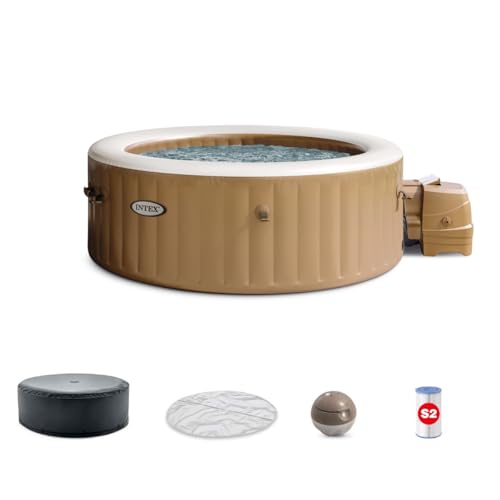
INTEX 28425EH PureSpa Bubble Massage Spa Set
Our badge: Best Overall
The INTEX 28425EH PureSpa Bubble Massage Spa Set is the most complete inflatable package here for a rental. It seats four, holds 210 gallons, heats across a 68 to 104 degree Fahrenheit range, and arrives with the accessory hosts actually need: a high-density, thermal-resistant insulated cover that Intex credits with improving energy efficiency substantially by cutting heat loss. The Fiber-Tech beam construction gives the walls a firmness guests do not expect from an inflatable, the built-in hard water treatment system keeps water gentler on skin and on the spa itself, and the set is saltwater-system ready, which matters because saltwater care is the closest thing inflatable spas have to low-effort water.
Strengths
- Insulated energy-efficient cover included, the single biggest running-cost feature a rental can have.
- Hard water treatment built in and saltwater-system ready for gentler, simpler guest water.
- Fiber-Tech construction feels solid to guests and holds its shape across a season of stays.
Trade-offs
- Inflatable format still asks hosts to monitor air pressure and protect the shell from sharp objects and pets.
- Four-person rating is a friendly four; two couples will find it cozy.
- Bubble massage is air-jet comfort, not the directional hydrotherapy of a hard-shell spa.
| Color | Tan |
|---|---|
| Size | 4-Person |
| Weight | 99.66 pounds |
For turnover reality, the Intex behaves well. The cover is light enough that guests actually replace it, which is the whole energy game, and the control unit is a physical panel rather than an app, so a guest can be talked through it by message in one sentence. Between stays, the routine is test, dose, wipe the waterline, rinse the filter, and check the cover is seated, a sequence a cleaner can learn in one shadow shift. Hosts in hard-water areas will feel the built-in treatment system in fewer scale complaints and kinder water feel, a detail guests describe in reviews as the water feeling soft without knowing why.
Durability across a season is the honest question with any inflatable, and the Intex’s beam construction and cover discipline are its answers. Keep it on a smooth, level base, keep the area swept, store a patch kit with the spare filters, and it will carry a listing through its test year. If the tub proves itself in bookings, the hard-shell types below are the upgrade path; if it does not, you have learned that at inflatable prices, which is exactly the right order of operations for a business.
Best for: hosts testing or running a mid-range listing who want a complete, covered package / Not suited for: luxury listings promising a permanent spa experience
Choose the Intex as the default rental starting point. Skip it if your listing’s rate already promises hard-shell luxury. Check on Amazon

Coleman SaluSpa Miami Energy-Efficient AirJet Inflatable Hot Tub
Our badge: Best for Cold Climates
The Coleman SaluSpa Miami Energy-Efficient AirJet Inflatable Hot Tub is the cold-market host’s inflatable. Its Freeze Shield automatic heating protects the pump and liner from cold-weather damage, its EnergySense insulated walls and cover are designed to keep water warmer with less energy than comparable spas, and its MaxHold fabric beams and three-layer Tritech shell are built for puncture resistance and air retention. The 120 AirJets give guests the bubbling soak they pictured when they booked, the digital panel heats to 104 degrees Fahrenheit, and the ChemConnect dispenser meters chlorine evenly, which quietly solves the most common rental water problem, the sanitizer spike and crash caused by handful dosing.
Strengths
- Freeze Shield protection for year-round operation in cold markets.
- ChemConnect dispenser makes between-guest sanitizing consistent and teachable.
- Energy-efficient insulation package and a power-saving timer that can schedule heat days ahead.
Trade-offs
- 71-inch footprint seats four at most, and two generously.
- Inflatable walls still need pressure checks on a turnover schedule.
- Cold-climate running costs remain real even with good insulation; price them into the rate.
| Color | Black |
|---|---|
| Size | Energy Efficient 2.0 |
| Dimensions | 71 x 71 x 26 inches |
| Weight | 101.2 pounds |
Hosts in ski and mountain markets will recognize the feature list as a winter survival kit. Freeze Shield is the difference between a spa that rides out a cold snap between guests and a burst pump discovered by the next arrival, and the power-saving timer lets a host bring the water up for a Friday check-in without heating an empty tub all week. The dispenser’s steady chlorine feed also means the water a cleaner tests at noon behaves like the water guests enter at six, which is the consistency five-star reviews are actually made of.
Set expectations in the listing honestly: an inflatable spa in January is a delightful soak with real limits, and guests told the truth in advance review the experience they were promised. Keep the base insulated, the cover disciplined, and a spare pump-side filter in the owner’s closet. Hosts comparing winter strategies across climates will find the state-specific guides in this lot, Best Hot Tubs For Minnesota and Best Hot Tubs For Colorado, useful companions to this one.
Best for: cold-climate hosts who need freeze protection and simple water care / Not suited for: large groups or hosts unwilling to monitor an inflatable weekly
Choose the Coleman where winters are real. Skip it if your market is warm year-round and the Bestway’s value appeals more. Check on Amazon

Bestway SaluSpa Cancun Energy-Efficient Inflatable Hot Tub
Our badge: Best Budget
The Bestway SaluSpa Cancun Energy-Efficient Inflatable Hot Tub brings the same essential rental package as the Coleman, 120 bubble jets, Freeze Shield protection, EnergySense-style insulated construction, MaxHold beams, a three-layer Tritech shell, and a ChemConnect chlorine dispenser, in a grey wicker-look finish that was clearly designed with listing photos in mind. It seats two to four, heats to 104 degrees Fahrenheit from an easy digital panel, and its pump inflates the spa itself, keeping setup in the realm of an afternoon rather than a project. For a host adding a first amenity on a budget, it is the complete argument in one box.
Strengths
- Full cold-climate and energy feature set at the budget end of the linked picks.
- Wicker-look finish photographs as a designed amenity, not a temporary one.
- ChemConnect dispensing and simple panel controls suit turnover routines.
Trade-offs
- Two-to-four person sizing is intimate for groups; set listing capacity honestly.
- Like all inflatables, it needs pressure checks and protection from sharp edges and claws.
- Pool data lists no usable dimensions or weight for this model; confirm them on the Amazon listing before planning placement.
| Color | Grey Wicker |
|---|---|
| Size | Energy Efficient 2.0 |
The Cancun’s rental case is presentational as much as mechanical. Guests book with their eyes, and a spa that looks like garden furniture rather than camping equipment lifts the whole listing’s perceived tier. Mechanically it asks the same of a host as the Coleman: level ground, an insulated base if your climate is cold, cover discipline, and a turnover test-and-dose habit. The Freeze Shield backing means a budget choice does not have to be a seasonal one, and the power-saving timer keeps an occasionally booked property from heating water for nobody.
Hosts should be candid in the listing about size, because the fastest route to a mediocre review is a four-person promise kept to a two-person reality. Market it as a couples’ soak and it will be reviewed as a generous one. Pair it with the robe and towel thinking in Best Robes For Outdoor Hot Tubs, since the walk from spa to door is where a budget amenity either feels considered or feels cheap.
Best for: budget-conscious hosts and couples-focused listings / Not suited for: group houses or premium-rate promises
Choose the Cancun for looks and value in one package. Skip it if your listing sleeps six and the spa must too. Check on Amazon
Hard-Shell Acrylic Spa (Type)
Our badge: Best Premium
A hard-shell acrylic spa is what established luxury rentals graduate to: a permanent, plumbed, insulated cabinet spa with molded seats, directional jets, a proper filtration cycle, and a locking insulated cover, installed on a reinforced pad with a dedicated electrical supply. Described here in prose because no such model sits in the verified pool, it is nonetheless the benchmark the inflatables are measured against. For guests it feels like the spas they know from resorts; for hosts it offers the durability, water capacity, and multi-guest room that a flagship amenity needs, plus serviceability through a local dealer network.
Strengths
- Durability, capacity, and jet comfort no inflatable can match.
- Permanent installation reads as luxury in photos and in person.
- Dealer service and parts support suit an income-producing asset.
Trade-offs
- Purchase, pad, and electrical work make this a capital project, not a test.
- Repairs need technicians, not a patch kit and a spare pump.
- Water volume raises chemical and heating costs per turnover.
Hosts choosing this type should buy the cover, the steps, and the water-care system as seriously as the spa, and should negotiate the service relationship before the first booking rather than during the first fault. Turnover cleaning is faster per guest than an inflatable in one respect, since filtration and sanitizing are more automated, and slower in another, since a larger volume punishes neglect more visibly. Put the spa’s rules in the house manual, photograph the control panel for the listing’s arrival instructions, and the premium spa will justify its rate premium the way it should: silently, every stay.
Best for: high-rate listings where the spa is the headline amenity / Not suited for: hosts testing demand or properties without pad and electrical capacity
Choose the hard-shell type when the business case is proven. Skip it while the tub is still an experiment.
Rotomolded Plug-and-Play Spa (Type)
Our badge: Best Durability per Dollar
A rotomolded plug-and-play spa is the host’s middle path: a one-piece rotationally molded shell, light enough to place without a crane, tough enough to shrug off the knocks rental life delivers, and in many models able to run on a standard outlet before being converted to a higher-voltage supply later. It lacks the acrylic spa’s sculpted luxury and jet count, and it is described here in prose for the same pool reason as the pick above, but as a business asset it is arguably the sweet spot: permanent, durable, comparatively simple, and far harder for a guest to damage than an inflatable.
Strengths
- One-piece shell tolerates bumps, weather, and enthusiastic guests.
- Simpler placement and electrical path than a full acrylic installation.
- Permanent feel in photos without flagship capital outlay.
Trade-offs
- Seating and jets are simpler than acrylic spas at the same size.
- Finishes are utilitarian; styling must come from the setting.
- Still a heavy, plumbed appliance when it does need service.
For rural and mountain rentals where dealer visits are slow and winters are hard, the rotomolded type’s toughness is a strategy, not a compromise. It also suits hosts who watched an inflatable prove the demand and want the next step without underwriting a luxury install. Stage it with good steps, a cover lifter a guest can operate without instructions, and landscaping that hides the utilitarian cabinet, and guests will remember the soak, not the shell material.
Best for: proven listings wanting durability without flagship cost / Not suited for: design-led luxury listings
Choose rotomolded for the working upgrade. Skip it if the listing sells sculpted luxury.
Wood-Fired Hot Tub (Type)
Our badge: Best for Rustic and Off-Grid Listings
A wood-fired hot tub, a soaking barrel or tub heated by a submerged or external wood stove, is the storyteller of this list. It needs no electricity, heats a large volume of water surprisingly fast once the fire is established, and suits off-grid cabins, glamping sites, and rustic properties where a humming electric spa would break the spell. It is included in prose as a type because it is a real and beloved rental category, and because its hosting demands are the opposite of the other picks: this tub is an experience the host operates, not an appliance the guest runs.
Strengths
- No electrical supply needed; works off-grid and in remote settings.
- Guests remember and review the ritual of a fire-heated soak.
- Simple water systems can be drained and refilled between stays without complex chemistry.
Trade-offs
- Someone competent must light, stoke, and judge the fire and temperature.
- Fire safety, local burn rules, and insurance need explicit attention.
- Temperature control is an art; overshooting is easy for beginners.
Hosts who succeed with wood-fired tubs build the fire into the hosting product: the tub is lit before arrival, the temperature is checked by the host, and guests are invited to enjoy rather than to operate, unless the property is explicitly a hands-on retreat with clear instruction and supervision norms. Water is often managed by freshness rather than chemistry, which means a drain-and-refill rhythm and a water source that can sustain it. In the right setting, no electric spa at any price buys the reviews a wood-fired soak under stars will earn; in the wrong setting, it is a liability with a chimney.
Best for: cabins, glamping, and off-grid listings with hands-on hosting / Not suited for: self-check-in city properties or absentee hosts
Choose wood-fired for character and independence from the grid. Skip it if your operation runs on automation.
Comparison Table
| Pick | Format | Capacity Note | Host Strength | Check price on Amazon |
|---|---|---|---|---|
| INTEX PureSpa | Inflatable | 4-person, 210 gallons | Insulated cover, saltwater ready | Check price on Amazon |
| Coleman SaluSpa Miami | Inflatable | 2-4 person, 71 in | Freeze Shield, ChemConnect | Check price on Amazon |
| Bestway SaluSpa Cancun | Inflatable | 2-4 person | Looks, value, Freeze Shield | Check price on Amazon |
| Hard-Shell Acrylic Spa (Type) | Permanent | Large, varies | Luxury and durability | Check price on Amazon |
| Rotomolded Plug-and-Play (Type) | Permanent | Mid-size, varies | Toughness per dollar | Check price on Amazon |
| Wood-Fired Tub (Type) | Stove-heated | Large, varies | Off-grid character | Check price on Amazon |
How to Choose the Best Hot Tubs for Airbnb
Start With the Business Case, Not the Brochure
Estimate honestly: how much rate premium and how many extra nights will a spa plausibly add at your property, against purchase, energy, water care, and your cleaner’s extra minutes per turnover. If the numbers only work at flagship rates, buy the flagship once; if they work as a test, start inflatable and let a season of bookings argue for the upgrade. The worst purchase is the middle one made on hope, too expensive to be an experiment and too fragile to be an asset.
Design the Turnover Before You Buy the Tub
Write the between-stay routine first: test the water, dose or check the dispenser, wipe the waterline, rinse the filter, inspect the cover and shell, photograph the result. Then choose the spa whose care fits inside that routine with the staff you actually have. Dispenser systems like ChemConnect, saltwater readiness, and automated filtration exist to compress this routine; a spa that needs an hour of chemistry per turnover will quietly stop receiving it by the third month.
Check Rules, Insurance, and Power Early
Some jurisdictions regulate rental spas, some insurers price them, and some properties simply lack the electrical capacity or the pad a permanent spa needs. Confirm all three before ordering, and put GFCI protection and a level, load-bearing base on the project list regardless of type. An inflatable on a standard outdoor outlet is the fastest compliant start in most places, which is another reason it leads this guide for new hosts.
Plan for Cold, Heat, and Absence
Your spa must survive the week you are not there: a freeze snap, a heatwave, a guest who leaves the cover off. Freeze protection, insulated covers, and power-saving timers are absence features as much as climate features. In hot markets the mirror problem applies, since water left hot and untreated between stays degrades fast; a spa that can idle safely at a lower temperature and recover for check-in is worth more than a faster heater.
The Between-Stay Routine That Keeps a Rental Spa Review-Proof
At every turnover, test sanitizer and pH with fresh strips and record the result where the cleaning team can see the trend, because drifting numbers announce problems days before cloudy water does. Dose or verify the dispenser, run the bubbles or jets briefly to circulate, wipe the waterline where guest oils collect, rinse the filter, and skim anything the cover let in. Check the cover’s underside, the steps, and the path lighting while you are there, and restock the poolside rules card if it has wandered. Weekly, or per your water-care system’s instructions, shock the water and clean the filter properly; on a schedule set by use, drain and refill rather than chasing tired water with chemistry. The routine in Best Shock For Hot Tubs and the testing discipline in Best Filtration System For Hot Tubs adapt well to rental use with the volumes scaled to your spa.
Guest-facing setup matters as much as chemistry. Leave the water at temperature with the cover on, the steps placed, towels and robes staged, and one short instruction card that covers the panel, the temperature limit, and the cover rule. Guests who understand a spa in twenty seconds treat it well; guests who must experiment will eventually press the combination that empties your evening into a support message.
Problem: Water is cloudy at check-in — Test and shock per your system, run filtration, and if the water cannot be made right, close the spa honestly for that stay and message the guest before arrival; a closed spa disappoints, a dirty one disgusts.
Problem: Energy bills spike in winter — Audit cover discipline first, then insulation and idle temperature settings, and use the power-saving timer so the spa heats for bookings, not for the calendar.
Problem: Guests keep leaving the cover off — Make the cover easier to replace than to leave off: a lifter on hard-shell spas, a light cover on inflatables, and a friendly rule in the arrival message with the reason attached, which is warmth and cleanliness for their evening soak.
Problem: The inflatable loses pressure between stays — Check for slow leaks at seams and the valve, confirm the base has not shifted, and add a pressure check to the turnover list so a soft wall is your discovery, not a guest’s.
What a Hot Tub Does to a Listing, Honestly
A spa changes a property’s search life before it changes its soak life. It adds a filter guests can select, a photo that stops thumbs, and a reason to choose your place over the identical one without bubbles. That visibility is why the photograph discipline matters: shoot the spa steaming at dusk with the cover off and the setting styled, because that single image will sell more nights than the amenity list beneath it. But the same visibility raises the promise, and review mathematics are unforgiving: a spa that delights adds a sentence to good reviews, while a spa that disappoints becomes the review. Hosts should therefore launch the amenity only when the routine behind it is ready, soft-launch it to a few stays if possible, and resist advertising a spa that is still being learned. The properties that win with hot tubs treat them as operations, not ornaments.
Liability, Safety, and the Rules Guests Actually Follow
Keep this simple, visible, and consistent. Post the maximum temperature and keep the spa at or below it. Require showers before soaking, ban glass anywhere near the water in favor of the unbreakable cups you provide, and state plainly that children are supervised at all times and that the spa is not for use after drinking. Maintain the cover, the steps, and the path as safety equipment, not décor. Check what your insurer and local rules require for rental water features and follow it in writing, and keep a basic log of water tests and maintenance; if anything ever goes wrong, the log is the difference between a host who ran a system and a host who owned a tub. None of this belongs in medical language, and your listing should make comfort claims only. Guests follow rules that are short, explained, and obviously connected to their own good evening, so write the rules that way.
Common Buying Mistakes
Buying for the Listing Photo Only
A beautiful spa with no turnover routine behind it becomes a review liability within a month. Buy the system, cover, dispenser, test strips, and cleaner minutes, not just the tub.
Underestimating Winter in Cold Markets
Hosts in cold states who buy a summer-grade inflatable meet Freeze Shield’s absence in the first cold snap. Match freeze protection to your climate from the start.
Promising More Capacity Than the Spa Has
A two-to-four-person inflatable sold as a group amenity manufactures disappointment. State real capacity and let couples’ listings enjoy the intimacy framing instead.
Skipping the Rules and Insurance Check
Discovering an insurer’s or a city’s rental-spa requirements after installation is the expensive order. Paper first, purchase second.
Hand-Dosing Sanitizer by Guess
Guessed chemistry swings between cloudy and harsh, and guests feel both. Use a dispenser system and strips at every turnover, and keep the log.
The Turnover Checklist: Water Edition
Professional hosts run the spa between stays from a written checklist, and the water lines of that checklist deserve to be quoted in full because they are where reviews are quietly won. Test and record the sanitizer, pH, and alkalinity on arrival at the property, not from memory of the last stay. Shock or oxidize per the system’s routine if the readings or the previous party’s size suggest it, and skim and inspect the waterline, where lotions and the last guests’ evening leave their signature. Run the filter cycle long enough to polish, rinse the filter if the stay was heavy, and check the cover’s underside, which guests see at closest range and cleaners forget most reliably. Set the temperature to the listing’s promised figure, photograph the spa area for the turnover record, and leave the printed house rules, maximum occupancy, shower-first request, no glass, children supervised, where the spa itself will speak them. The whole sequence is under half an hour in practiced hands, and it converts the spa from the listing’s biggest variance into its most reliable delight.
Two habits separate the checklist’s professionals from its amateurs. The first is the log: dated readings and actions, kept at the property, which turns any guest dispute about the water into a document rather than an argument, and which shows the host patterns, the filter aging, the sanitizer appetite of big weekends, months before they become complaints. The second is the spare: a second filter, a backup test kit, and the cleaner’s number all present at the property, because a rental spa’s emergencies happen exclusively on check-in day, and the host who has staged the spares solves them in the turnover window instead of in a panic across three phone calls.
Pricing the Spa: What a Hot Tub Earns a Listing
Hosts consistently underprice or overprice the spa’s contribution, and a clear-eyed paragraph helps. A well-kept hot tub typically supports a nightly premium and, more importantly, occupancy in the shoulder and winter weeks when comparable listings sit empty, because the spa converts a property from a place to sleep into a place to be. Against that revenue stand the true costs this guide has itemized throughout: energy, chemistry, filters, the turnover minutes, accelerated cover and component wear, and the occasional damage deposit conversation. The honest arithmetic for most properties in cold or scenic markets favors the spa clearly, and for warm, urban, short-stay markets favors it narrowly or not at all, which is why the inflatable picks in this guide matter: they let a host test the spa’s economics for a season at a fraction of a hard-shell commitment, measure the premium and the pain in their own booking data, and then decide about permanence with evidence. The listings that regret their hot tubs are rarely the ones that ran the numbers; they are the ones that bought the photograph and discovered the chemistry later.
Photographing and Describing the Spa in the Listing
The spa earns its premium in the listing before it earns it in the water, and the presentation deserves the same professionalism as the chemistry. Photograph it in its best honest state: cover off, water clear and steaming in cool air, the surrounding station, robes, hooks, lighting, composed as the guest will actually find it, because a photograph that promises a resort and delivers a corner teaches guests to distrust every other claim the listing makes. Shoot it at dusk if the property allows, since a spa’s romance is a twilight phenomenon, and include one photograph of the view from inside the water, the shot that sells the soak rather than the object. In the text, describe the spa with the specifics guests actually filter on: how many it seats comfortably, whether it is private to the unit or shared, the hours or quiet rules that govern it, and the one or two house rules that protect it, stated warmly as care rather than as law. Hosts sometimes hide the rules until arrival for fear of scaring bookings, and learn instead that guests respect what was promised plainly and resent what was sprung, a pattern as reliable in hot tubs as in every other line of the listing.
Accuracy is also a defensive asset. A spa described precisely, its size, its setting, its few rules, generates reviews that praise it, because expectations were set where the water could meet them, while a spa oversold in the gallery generates the listing’s most damaging sentence, the hot tub was not as pictured, which future guests read as a verdict on the host’s honesty generally. The properties that win with spas treat the listing page as the first act of hospitality, and like all hospitality it begins with telling the truth beautifully.
When the Spa Breaks: The Host’s Contingency Craft
Every rental spa eventually fails on a guest’s weekend, a heater silent on a Friday evening, a pump that quits mid-stay, and the host’s handling of that weekend decides whether the story becomes a refund demand or a review praising the recovery. The craft has three moves, rehearsed in advance. First, speed of acknowledgment: the guest who finds a cold spa and reaches a human within the hour, with a plan already moving, forgives what the guest who messages into silence until morning does not. Second, a standing arrangement with a local spa technician who takes the host’s calls as a retainer customer rather than a stranger, made in the quiet season before it is needed, because the middle of a breakdown is the worst showroom in which to shop for loyalty. Third, a compensation gesture scaled to the loss and offered before it is demanded, a night discounted, a future stay credited, presented as the host’s own disappointment rather than as a settlement. Hosts who run these three moves report the paradox this whole guide has been circling: the spa is the listing’s largest risk and, handled professionally, its most reliable generator of the reviews that mention the host by name.
Final Recommendation
For most hosts, the top pick is the INTEX 28425EH PureSpa Bubble Massage Spa Set: the insulated cover, hard-water treatment, and saltwater readiness make it the most complete and forgiving rental starter in the pool. The runner-up is the Coleman SaluSpa Miami, whose Freeze Shield and ChemConnect dispenser suit cold markets and lean cleaning teams; find it through its Check on Amazon link. Budget and couples’ listings should look at the Bestway Cancun, proven listings ready to invest should price the hard-shell and rotomolded types seriously, and rustic off-grid properties should consider whether a wood-fired tub is the amenity their guests will actually write home about.
Frequently Asked Questions
Is an inflatable hot tub good enough for an Airbnb?
For many listings, yes, especially as a first season’s test. The linked inflatables offer real heat, real bubble massage, insulated covers, and in two cases freeze protection, at a fraction of a permanent install. The honest limits are capacity, durability across years, and luxury feel, which is why this guide also covers the hard-shell upgrade path.
How do hosts keep rental hot tub water safe and clear?
With a system, not heroics: a dispenser or saltwater setup for steady sanitizer, test strips at every turnover, shock on a schedule, filters rinsed at turnover and cleaned weekly, and a drain-and-refill rhythm set by use. The routine section above lays out the full sequence.
What temperature should a rental hot tub be set to?
At or below the commonly used maximum of 104 degrees Fahrenheit, with many hosts choosing a slightly lower default for safety and energy, and the limit posted at the tub. Guests should be able to lower the temperature easily and raise it only to the stated cap.
Does a hot tub really increase bookings?
It commonly improves search visibility and conversion because guests filter for it and listings photograph better with it, but the size of the effect depends on market, season, and how many competing listings already offer one. Treat the first season as the experiment that measures your property’s actual return.
What rules should hosts set for guest hot tub use?
Shower first, no glass, cover replaced after use, children supervised, no use after drinking, and a stated maximum soak temperature. Keep the list short, explain the reason in a friendly line each, and place it both in the listing and at the tub itself.
How often should a rental spa be drained?
Far more often than a home spa, because bather load per gallon is much higher. Many hosts work on a rhythm of a few stays or a few weeks, adjusted by test results and water feel, rather than the months a private tub might go. When in doubt, fresh water is cheaper than a bad review.


