Disclosure: As an Amazon Associate, dailyhomedecorating.com earns from qualifying purchases. Links to Amazon on this page are affiliate links; they cost you nothing extra. Prices and availability change often, so check the current Amazon listing before you buy.
People searching for the best blankets for allergies are rarely shopping for luxury. They are shopping for sleep in a bedroom that works against them: dust collects in bedding, pollen rides in on hair and pets, and a blanket that cannot be washed hot, often, and without falling apart quietly becomes part of the problem. The best blankets for allergies are therefore chosen on hygiene engineering first — smooth or tightly woven surfaces that release dust in the wash, materials that tolerate frequent laundering, construction without deep crevices for debris, and drying that completes fully so nothing goes back on the bed damp. This guide makes no medical claims and does not promise symptom relief; allergy management belongs with your clinician. What a blanket can honestly do is be easy to keep genuinely clean, and that is the standard applied to every pick below.
Six blankets from the verified pool meet that standard in different ways: a washable cotton waffle that breathes, a smooth cooling comforter that resists pet hair and snags, an open cotton knit that washes as one piece, and fleece options whose smooth faces release dust and hair better than deep pile. Deep sherpa and faux fur were deliberately excluded here because their piles hold debris and complicate washing — the opposite of what this keyword needs. Related hygiene-first reading includes Best Blankets For Dust Mite Allergies for the encasement and hot-wash routine and Best Blankets For Allergy Sufferers for the sufferer-focused bedroom system, plus bedroom completion ideas from Black Friday Throw Pillow And Blanket Deals and Best Throw Pillows Under $75.
Where to Buy
Every pick in this guide is sold on Amazon, where you can check the current size, color, and availability before you buy. Start with the lead pick, the Bedsure Cooling Cotton Waffle Blanket for Hot Sleepers, and use its Check on Amazon listing to confirm care details. The remaining picks are the REST Evercool Cooling Comforter Blanket for Hot Sleepers — Check on Amazon; the Bearaby Cotton Hand-Knit Weighted Blankets for Adults — Check on Amazon; the Bedsure Fleece Bed Blankets Queen Size Grey — Check on Amazon; the Elegear Double-Sided Cooling Blanket for Hot Sleepers — Check on Amazon; and the Exclusivo Mezcla Soft Large Fleece Throw Blanket for Couch — Check on Amazon. Check price on Amazon for each in your exact size.
In this guide
Quick Picks
| Pick | Badge | Why it earns its place |
|---|---|---|
| Bedsure Cooling Cotton Waffle Blanket for Hot Sleepers | Best Overall | Washable cotton blend, breathable weave, no deep pile to trap debris. |
| REST Evercool Cooling Comforter Blanket for Hot Sleepers | Best for Pet Owners | Smooth surface resists pet hair and snags and washes clean easily. |
| Bearaby Cotton Hand-Knit Weighted Blankets for Adults | Best Premium | One-piece cotton knit with no fill, feathers, or loose fibers to manage. |
| Bedsure Fleece Bed Blankets Queen Size Grey | Best Budget | Smooth fleece that releases dust in the wash and dries fast and fully. |
| Elegear Double-Sided Cooling Blanket for Hot Sleepers | Best for Hot Sleepers | Cooling face with a natural cotton reverse, both washable and quick to dry. |
| Exclusivo Mezcla Soft Large Fleece Throw Blanket for Couch | Best Compact | Light throw for chairs and travel that can be washed after every outing. |
Key Takeaways
- Frequent, complete washing matters more than any fiber claim; choose blankets whose care labels fit your routine.
- Smooth and tightly constructed surfaces release dust, pollen, and hair better than deep pile or loose weaves.
- Avoid feather and down fills and heavy embellishments if your clinician has flagged them for your household.
- Dry blankets fully before returning them to the bed; damp bedding undermines the whole hygiene effort.
- Own two blankets per bed so a clean one is always ready while the other is in the wash.
- Keep pets’ bed access and bedroom dust control as part of the same conversation with your clinician.
How These Picks Were Chosen
Each pool blanket was scored on cleanability: Can it be machine washed without special handling? Does its surface release debris or hoard it? Does it dry completely in a normal home routine? Does its construction include fills, piles, or crevices that complicate hygiene? Cotton and smooth synthetics scored highest; deep-pile and faux fur options were excluded despite their comfort, and wool was excluded because its gentle-care contract conflicts with frequent washing for most households. Weighted options were included only in the bead-free knit form, since a one-piece washable construction is easier to keep clean than multi-layer bead systems. Only verified specifications are used, and no medical benefit is claimed for any product.
The 6 Best Best Blankets for Allergies — Reviewed

Bedsure Cooling Cotton Waffle Blanket for Hot Sleepers
Our badge: Best Overall
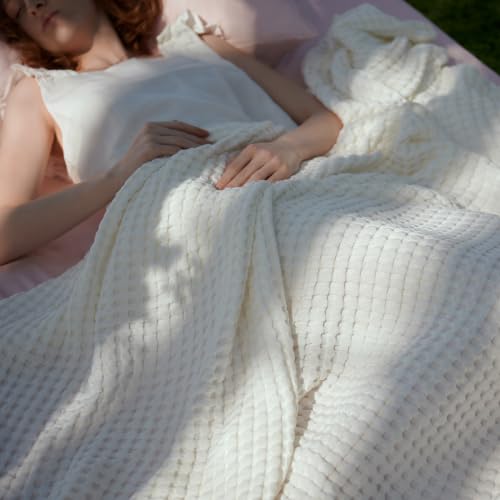
The Bedsure Cooling Cotton Waffle Blanket for Hot Sleepers leads because cotton tolerates the washing rhythm allergy households actually keep, and its waffle weave — while textured — is an open, honest structure that rinses clean rather than trapping debris in pile. The cotton and bamboo-derived rayon blend breathes and wicks, covers a queen bed fully, and feels pleasant against skin without loose fibers. It suits anyone building a washable, breathable bed system.
Strengths
- Cotton blend washes routinely and dries completely.
- No fill, pile, or feathers to complicate hygiene.
- Breathable weave suits warm sleepers and summer.
Trade-offs
- Waffle texture is more textured than a flat sheet-smooth blanket.
- Light warmth for winter without layering.
- Ivory color shows soil, which at least makes washing timely.
| Color | 01 – Ivory |
| Size | Queen (90″ X 90″) |
| Dimensions | 16.535433054 x 12.598425184 x 22.834645646 inches |
| Weight | 3.8 Pounds |
Rotate two of these if your household washes bedding weekly: one on the bed, one in the laundry pipeline, no gaps. The weave’s pockets give it more presence than a flat blanket and help it stay in place, and the fabric softens with washing instead of degrading. Follow your clinician’s guidance on wash temperature for your household’s needs and the blanket’s care label together, choosing the routine both can sustain. Choose it as the cleanable cotton standard. Skip it only if you need a completely flat, smooth surface, in which case the REST pick is next.
Best for: Washable cotton comfort on a weekly rhythm / Not suited for: Deep-winter warmth alone
Choose it for breathable hygiene; skip it for heavy warmth. Check on Amazon

REST Evercool Cooling Comforter Blanket for Hot Sleepers
Our badge: Best for Pet Owners
The REST Evercool Cooling Comforter Blanket for Hot Sleepers brings the smoothest surface in the guide: a silky, cool-to-touch fabric that resists snags, pilling, and — critically for animal households — pet hair, which brushes and washes off instead of embedding. It is machine washable and dryer friendly, covers full and queen beds, and suits hot sleepers who also manage a dusty, pet-shared bedroom.
Strengths
- Smooth face sheds hair and dust instead of holding them.
- Durable knit resists snags from claws and laundry.
- Cooling comfort for warm sleepers in shared, busy beds.
Trade-offs
- Smooth fabric slides more than fleece on slick sheets.
- Cooling feel is wrong for cold sleepers.
- Synthetic feel will not please natural-fiber purists.
| Color | Cool Gray |
| Size | Full / Queen (90″x90″) |
| Dimensions | 90 x 90 x 0.01 inches |
| Weight | 5.5 pounds |
For pet households, the winning routine is simple: shake the blanket outdoors, wash on schedule, and enjoy a surface that returns to clean without lint-rolling heroics. Because no flat sheet is required over it, there is one less textile layer collecting dust on the bed. Pair it with washable pillow protection and a hard-floor bedroom cleaning rhythm for the full hygiene picture discussed in Best Blankets For Pet Hair, where hair management gets its own deep dive. Choose REST for smooth, shed-resistant cleanliness. Skip it for cozy warmth.
Best for: Pet-shared beds and smooth-surface hygiene / Not suited for: Cold sleepers
Choose it to keep hair and dust washable; skip it to stay toasty. Check on Amazon
Bearaby Cotton Hand-Knit Weighted Blankets for Adults
Our badge: Best Premium
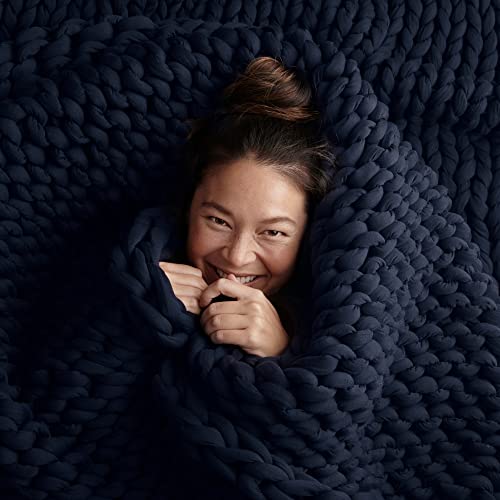
The Bearaby Cotton Hand-Knit Weighted Blankets for Adults is the premium hygiene pick for a subtle reason: it contains nothing but cotton yarn. No down, no loose fill, no bead compartments, no separate cover system collecting dust at the seams — just a hand-knit, machine-washable, one-piece blanket whose open loops rinse and dry with airflow. It suits adults who enjoy weighted comfort as a preference and want the simplest possible materials list.
Strengths
- Single-material cotton construction, nothing hidden inside.
- Open knit breathes and airs out easily between washes.
- No fill to shift, leak, or harbor debris in compartments.
Trade-offs
- Heavy to wash; requires machine capacity and patience.
- Open loops catch pet claws and jewelry.
- One-sleeper size and premium positioning.
| Color | Midnight Blue |
| Size | 15 lbs (40”x72”) |
| Dimensions | 71.99999992656 x 39.9999999592 x 0.01181102361 inches |
| Weight | 15 pounds |
The cotton is OEKO-TEX Standard 100 certified per its maker, which speaks to tested material standards, though this guide claims no health outcome from it. Air the Bearaby draped in moving air between washes and its freshness holds up well; wash it when your routine calls for it, with room in the machine for the knit to move. Choose it for premium material simplicity. Skip it if heavy laundry handling is impractical in your home.
Best for: Material minimalists who enjoy weighted comfort / Not suited for: Light-laundry households
Choose it for one-piece cotton purity; skip it for effortless washing weight. Check on Amazon

Bedsure Fleece Bed Blankets Queen Size Grey
Our badge: Best Budget
The Bedsure Fleece Bed Blankets Queen Size Grey proves that a hygiene-first blanket need not be a specialist purchase. Smooth flannel fleece releases dust and hair in the wash far better than pile fabrics, dries quickly and completely, covers a queen bed, and tolerates the frequent-washing life without shedding apart. It suits families outfitting several beds on the same cleanable standard.
Strengths
- Smooth face with no pile to trap debris.
- Fast, complete drying after every wash.
- Full coverage and easy layering at an accessible tier.
Trade-offs
- Synthetic fabric; natural-fiber fans should look above.
- Warmth can build for hot sleepers in summer.
- Static in very dry air can attract dust between washes.
| Color | Grey |
| Size | Queen (90″ X 90″) |
| Dimensions | 94.48818888 x 86.61417314 x 0.0399999999592 inches |
| Weight | 3.19 pounds |
Buy it in pairs per bed and the allergy-household system runs itself: wash, dry fully, remake, repeat, with no day spent waiting for the only blanket. Its grey color forgives the interval between washes visually while the smooth surface does the real hygiene work. Choose it for scalable, washable value. Skip it for summer cooling.
Best for: Multi-bed households and frequent washing / Not suited for: Hot summer sleeping
Choose it for cleanable value; skip it for cooling. Check on Amazon

Elegear Double-Sided Cooling Blanket for Hot Sleepers
Our badge: Best for Hot Sleepers
The Elegear Double-Sided Cooling Blanket for Hot Sleepers pairs a smooth Arc-Chill cooling face with a one hundred percent Egyptian cotton reverse, giving hot sleepers two washable, breathable surfaces and no pile anywhere. It suits warm bedrooms where a dusty, heavy blanket would be doubly unwelcome.
Strengths
- Two smooth, pile-free faces that wash clean.
- Cooling contact feel plus natural cotton breathability.
- Light weight dries fast and travels between rooms.
Trade-offs
- Minimal insulation for cold sleepers.
- Smooth faces slide on smooth sheets.
- Cooling side is a specialist feel not everyone loves.
| Color | Light Grey |
| Size | Full/Queen (79″ x 86″) |
| Dimensions | 86.61417314 x 78.7401574 x 0.0399999999592 inches |
| Weight | 3.25843223236 pounds |
Use the cotton side on mild nights and the cooling side when the room is warm; both sides rinse free of the day’s dust in a normal wash, and the light build means it is dry and back on the bed the same day. That turnaround is a hygiene feature in itself during pollen season, when outdoor air loads every textile in the house. Choose it for cool, clean versatility. Skip it for winter.
Best for: Hot sleepers in pollen and dust season / Not suited for: Cold bedrooms
Choose it for fast-turnaround cleanliness; skip it for warmth. Check on Amazon

Exclusivo Mezcla Soft Large Fleece Throw Blanket for Couch
Our badge: Best Compact
The Exclusivo Mezcla Soft Large Fleece Throw Blanket for Couch handles the exposure points beyond the bed: the reading chair, the car, the waiting room, the relative’s sofa. A light, smooth throw that can be washed after every significant outing keeps outside dust and pollen from migrating onto the bed, and its anti-static finish helps it release debris instead of clinging to it.
Strengths
- Light enough to wash after outings without a second thought.
- Smooth both sides; nothing for debris to hide in.
- Long throw cut for real reclining coverage.
Trade-offs
- Light warmth only.
- Throw width, not full-bed coverage.
- Single color in this listing.
| Color | Forest Green |
| Size | Throw XL (50″ x 70″) |
| Dimensions | 70 x 50 x 0.04 inches |
| Weight | 1.55 pounds |
Keep this throw by the door or in its chair, not on the bed, and launder it on its own rhythm. Households managing a child’s comfort items across settings — home, school, grandparents — will recognize the system from Best Blankets For Daycare: dedicated, labeled, washable pieces that do not wander between clean and unclean roles. Choose it as the mobile hygiene layer. Skip it as a bed blanket.
Best for: Chairs, travel, and wash-after-use routines / Not suited for: Primary bed coverage
Choose it for portable cleanliness; skip it for the bed itself. Check on Amazon
Notice what the comparison really ranks: not softness, but how completely each blanket can be washed, dried, and returned to the bed the same day. In an allergy-conscious home that turnaround is the product. A blanket that needs two days to air dry will be washed half as often as one that comes out of the dryer ready, whatever the intention at purchase. Duplicates solve the gap when you love a slower-drying blanket — wash one while the other is on the bed — but if budget or storage allows only one blanket per bed, drying speed and label tolerance for frequent washing should outrank every other feature in this table.
Humidity is the invisible variable in every allergy-conscious bedroom, and blankets sit at its center. Bedding absorbs moisture from sleepers and room air nightly; in a humid room or season, a blanket that dries slowly between uses becomes a reservoir no washing schedule can outrun. Help it: air the bed daily with covers folded back, give the room airflow, and in persistently damp homes consider that the fastest-drying blankets in this guide are not a preference but a necessity. In dry winter air the problem inverts — static, dust in suspension, and irritated airways — and smooth natural-fiber layers plus ordinary room humidity management feel gentler. Either way, the blanket cannot compensate for a room working against it, which is why this guide keeps returning to the system: surface, wash, dry, air, store. Get those five verbs right and almost any blanket from this list performs; neglect the drying and airing, and the most expensive construction will disappoint you by spring.
A note on shared and inherited bedding, because allergy-conscious households receive both. Hand-me-down blankets, blankets from a previous home, and blankets returning from college dorms or storage units should all re-enter through a full wash and complete dry before touching a bed, whatever their history claims. Quarantine the unknown textile for one laundry cycle rather than debating its past. The same courtesy applies in reverse: if you lend a blanket to a household with pets, smoke, or different sensitivities, expect to wash it on return without taking offense. Textiles carry their environments faithfully — that is precisely why they matter for allergies — and a household rule of wash-on-entry, applied cheerfully to everything, removes both the burden and the awkwardness from every individual case.
Comparison Table
| Pick | Size | Weight | Color | Check price on Amazon |
|---|---|---|---|---|
| Bedsure Cooling Cotton Waffle Blanket for Hot Sleepers | Queen (90″ X 90″) | 3.8 Pounds | 01 – Ivory | Check price on Amazon |
| REST Evercool Cooling Comforter Blanket for Hot Sleepers | Full / Queen (90″x90″) | 5.5 pounds | Cool Gray | Check price on Amazon |
| Bearaby Cotton Hand-Knit Weighted Blankets for Adults | 15 lbs (40”x72”) | 15 pounds | Midnight Blue | Check price on Amazon |
| Bedsure Fleece Bed Blankets Queen Size Grey | Queen (90″ X 90″) | 3.19 pounds | Grey | Check price on Amazon |
| Elegear Double-Sided Cooling Blanket for Hot Sleepers | Full/Queen (79″ x 86″) | 3.25843223236 pounds | Light Grey | Check price on Amazon |
| Exclusivo Mezcla Soft Large Fleece Throw Blanket for Couch | Throw XL (50″ x 70″) | 1.55 pounds | Forest Green | Check price on Amazon |
How to Choose a Blanket for an Allergy-Conscious Bedroom
Put the care label at the center of the decision
If a blanket cannot be washed as often and as thoroughly as your household’s clinician-guided routine requires, it is the wrong blanket regardless of fiber marketing. Read care instructions before purchase, confirm your machine can handle the blanket’s wet weight, and confirm you can dry it completely in your space and climate.
Prefer smooth, simple construction
Flat weaves, smooth fleece, and one-piece knits release debris in water and air. Deep pile, faux fur, heavy fringe, and multi-layer embellishment all work against cleanability. Save those textures for rooms and uses where hygiene is less pressing.
Think beyond the blanket to the bed system
Pillows, mattress protection, curtains, carpets, and pet routines all load the same air. A washable blanket is one component; encasements, washable pillow covers, hard floors where practical, and regular damp dusting complete the picture your clinician can help you prioritize.
Buy duplicates of the winner
The cleanest blanket is the one that is actually clean on the bed tonight. Duplicates remove the temptation to stretch intervals, and identical spares keep texture and feel predictable for sensitive sleepers.
Distinguish dust, dust mites, pollen, and pet dander in your plan
An allergy-conscious bedroom works better when you know which burden you are mainly managing, because the blanket strategy shifts slightly with each. Household dust argues for smooth surfaces and frequent shaking and washing of everything on the bed. Dust mites, which live where warmth, humidity, and skin scales collect, argue for hot-enough washing where the care label allows it, thorough drying, and keeping bedroom humidity moderate — and for encasements on pillows and mattresses, which do heavier mite-duty than any blanket can. Pollen argues for changing and washing the top layer more often in season and for not drying bedding outdoors on high-pollen days. Pet dander argues for the designated-blanket system and disciplined washing described elsewhere in this guide. None of this is medical treatment, and persistent symptoms belong with a clinician; it is household hygiene, aimed at making the bed a lower-burden place to spend eight hours.
Read care labels for the wash you will actually do
A blanket that tolerates frequent warm washing and complete machine drying is, for an allergy-conscious home, a better blanket than a theoretically superior fiber that demands rare, gentle, air-dry-only care you will postpone. Before buying, picture your real laundry: machine size, drying options, how many loads a full bed reset creates, and whether anyone in the household will actually run a special cycle for one blanket. If the honest answer is no, choose the blanket whose label matches the routine you already keep. Also check whether the blanket dries evenly; thick, dense constructions that stay damp in the center come out of the dryer smelling fresh and go back on the bed still holding moisture, which undoes the point of washing them.
How Often Should You Wash Blankets in an Allergy-Conscious Home?
Follow your clinician’s guidance for your household; a common practical rhythm is weekly washing for the blanket layer that touches skin, with pillow protection washed alongside and heavier or decorative layers washed less often but aired regularly. Wash new blankets before first use to remove loose fibers and finishing residues. Shake blankets outdoors before washing to reduce the debris load on your machine, wash with adequate water and a full rinse, and dry completely — a blanket put away or put on the bed while still damp trades one problem for another. During high-pollen periods, avoid drying bedding outdoors where it can collect the very pollen you washed out, and shower or at least change out of outdoor clothes before bed if your clinician has flagged nighttime exposure for your household.
Keep the bedroom itself in the routine: damp-dust hard surfaces, vacuum with attention to the bed’s perimeter, wash curtains on a seasonal rhythm, and keep the blanket’s storage clean and closed rather than draped over a dusty chair. None of this is medical treatment; it is household hygiene, maintained consistently, which is the honest contribution bedding can make.
Problem: Blanket still feels dusty after washing — Shake it outdoors first, avoid overloading the machine, add an extra rinse, and check that detergent is fully rinsing out; residue itself holds dust and irritates skin.
Problem: Blanket takes forever to dry — Choose lighter constructions for the weekly layer, spin thoroughly, and dry with airflow and space; a blanket that cannot dry fully in your home is the wrong weekly blanket for your home.
Problem: Pet hair survives every wash — Shake and lint-roll before washing, wash pet-used blankets separately, clean the machine’s filter, and prefer smooth surfaces like the REST pick for pet-shared beds.
Problem: Skin feels irritated by a new blanket — Wash before use, rinse extra, simplify detergent choices per your clinician’s advice, and switch to smooth cotton constructions if fleece textures bother you.
The Bedroom Dust System Around the Blanket
Bedrooms accumulate dust where air is still and textiles are many. Reducing textile load where it does not cost comfort — washable instead of dry-clean-only curtains, a washable blanket instead of a decorative pile, minimal stuffed items on the bed — lowers what your cleaning routine must handle. Hard flooring or diligently vacuumed low-pile flooring beats deep carpet beside the bed for the same reason smooth blankets beat sherpa here: there is simply less for dust to live in. Treat the blanket choice as the anchor of that system and the rest of the room becomes easier to keep.
Blankets for Allergy-Conscious Guest and Travel Sleep
Guests with sensitivities appreciate a freshly washed, smooth blanket far more than a luxurious dusty one, so keep a dedicated guest set washed, fully dried, and stored in a closed, clean place. For travel, carry your own light washable throw — the Exclusivo in this guide exists for exactly that role — so the layer touching you is one whose history you know, and wash it when you return before it rejoins household bedding. Hotels and relatives’ homes vary; your own clean layer is the controllable variable, a comfort point travelers also raise in Best Blankets For Boats when sleeping in unfamiliar, enclosed spaces.
The rest of the bedroom either supports or sabotages your blanket routine, so audit it once, honestly. Upholstered headboards, heavy curtains, carpet, and open shelving full of textiles all hold dust close to where you breathe all night; you do not need to strip the room bare, but moving the biggest reservoirs — the rarely washed decorative cushions, the stuffed animals on a child’s bed, the pile of spare blankets on a chair — out of the sleeping zone makes the washing you do on the bed itself count for more. Keep spare bedding in closed storage rather than on open shelves, vacuum the mattress surface when sheets are off, and let the bed air with covers folded back for a while each morning instead of making it tightly the moment you rise; mites thrive in warm, damp, undisturbed bedding, and a daily airing is a free, effortless countermeasure. A small, consistent routine beats an occasional heroic deep clean that nobody can sustain.
Children’s beds deserve the same system in miniature, with extra discipline about soft toys and spare blankets that migrate in from the living room. Choose one washable blanket per child’s bed plus a duplicate, keep lovable extras washable too, and wash the whole set on the same rhythm so nothing becomes the forgotten reservoir. For shared households — flatmates, multigenerational homes — agree the routine in writing if necessary: whose blankets wash when, what lives on beds during the day, and the pet policy. Allergy-conscious bedding fails socially more often than it fails technically; the blanket was fine, but three different habits around it were not. Align the habits, keep the products simple and duplicated, and the bed becomes the easiest room in the house to keep comfortable.
Laundry logistics, planned once, remove the last excuse. A full allergy-conscious bed reset — sheets, blanket, pillowcases, and the day’s top layer — should fit your machines in a predictable number of loads; if it does not, the blanket is too bulky for your household, whatever its other virtues, and a thinner or duplicate strategy belongs on the bed instead. Wash blankets as the first load of the reset so they get the longest drying window, and never let a washed blanket wait damp in the machine while other loads queue — set it drying, then proceed. Households that sequence the reset this way finish it in a morning; households that wash in random order discover the blanket still damp at bedtime and sleep under the unwashed spare, quietly defeating the entire exercise.
Keep the standard humane. Perfection — every textile, every week, without exception — is not available to households with jobs, children, illness, and weather, and chasing it produces the guilt that kills routines. The standard that works is a floor, not a ceiling: the skin-contact layer washed on rhythm, the bed aired daily, spares stored closed, and everything else improved gradually as energy allows. Miss a week and the correct response is simply to wash this week, not to declare the system broken. Allergy-conscious bedding is a practice measured in seasons of slightly easier nights, and the households that sustain it are the ones that built it to survive their real lives.
One more system upgrade costs nothing and pays weekly: the ten-minute morning reset. Fold the covers back to air, shake the top blanket, open the room’s air path while you dress and make coffee, and remake the bed loosely rather than sealing it tight. That small ritual dries the night’s moisture, discourages the conditions dust mites favor, and gives you a daily look at the state of your bedding — the fraying seam and the thinning patch announce themselves during resets, not during midnight failures. Pair it with a monthly mattress vacuum and a quarterly review of what is stored on and under the bed, and the bedroom’s whole dust economy improves without a single additional purchase. Systems beat products in this category every time, and the morning reset is the system in its smallest, most repeatable form.
Children leaving for college, relatives moving in, a partner arriving with their own beloved bedding — every household merger is a textile merger, and allergy-conscious homes should run it deliberately. Incoming blankets wash before their first night, the house rules about pets and day layers get stated once and kindly, and duplicates get bought for any bed now in nightly use. What you are protecting is not fussiness; it is the accumulated calm of a system that took months to tune. Mergers handled this way take a week to settle. Mergers handled by drift take a season of mysteriously worse nights and a detective story nobody enjoys solving.
Write your system down, finally, in five lines, and keep it where a partner, a housesitter, or a future you can find it: what washes when, in what, what the spares are and where they live, what the pet rule is, and what never goes on the bed. Five lines is the difference between a routine and a rumor. Households change, memories blur, and the written system is what survives both.
Teach the system to anyone who shares or maintains the home — a partner, a cleaner, a housesitter — in the same five written lines, because an allergy routine understood by one person and improvised by everyone else is only a routine on the days the right person makes the bed. The five minutes spent explaining why the spare lives in a closed box and why the day’s clothes never touch the pillows will be repaid every week for years, in nights that stay predictable no matter whose hands prepared them. Consistency, in the end, is a team sport, and the bed is where the whole household plays it.
Revisit your choices when life changes the inputs: a new pet, a new baby, a move to a more humid climate, a washer replaced by a smaller one. Each change quietly alters which blanket in this guide serves you best, and the household that re-runs the simple tests — washable completely, dryable completely, smooth against the sleeper, duplicated in the cupboard — after every such change never drifts far from a bed that works. Allergy management is not a purchase completed once; it is a light, ongoing calibration, and blankets chosen for their honesty rather than their promises make that calibration easy to keep.
Common Buying Mistakes
Believing fiber marketing over washability
A miracle fiber you cannot wash weekly loses to humble fleece you can. Judge by the care label and your real routine.
Choosing deep pile for the allergy bedroom
Sherpa and faux fur are wonderful elsewhere and wrong here. Their piles hold exactly what you are trying to remove.
Washing without drying fully
Damp bedding invites mustiness and undoes the wash. Build drying time and capacity into the purchase decision.
Owning only one blanket per bed
Single blankets stretch wash intervals. Duplicates are the unglamorous secret of consistently clean bedding.
Expecting a blanket to treat allergies
Bedding supports hygiene; it does not diagnose or treat. Keep medical decisions with medical professionals and be skeptical of products promising cures.
A Room-by-Room Plan Beyond the Primary Bed
The primary bed gets the attention, but allergy burden is cumulative across every textile you rest on, so extend the same logic room by room at a pace you can sustain. Children’s beds come next, with duplicates and a strict wash rhythm, because small beds are washed least and hugged most. The guest bed matters more than its use suggests: it sits undisturbed for weeks collecting dust, then hosts a visitor — possibly a sensitive one — for eight hours; a washable blanket, washed before guests arrive rather than after the last visit months ago, is basic hospitality. Sofa blankets and reading throws are the quiet reservoir most households forget entirely; they are used against faces, shared with pets, and washed almost never. Put them on the same rotation as bed blankets, even at a slower rhythm, or keep one designated washable throw per seat. Finally, the car blanket and the travel blanket should re-enter the house through the laundry, not onto a bed. None of this requires special products — the smooth, washable picks in this guide serve every one of these posts — it requires only that the system, once built for the bed, be allowed to govern the whole house’s resting textiles.
Measure success by sustainability, not by a single heroic clean. An allergy-conscious home is not the one that deep-cleaned in January; it is the one whose ordinary Tuesday still includes a bed that was aired, blankets on a known wash rhythm, spares in closed storage, and a floor that gets vacuumed with the bedroom door routine. If the system slips during a busy month, restart at the bed and rebuild outward rather than attempting everything at once and abandoning it again. And keep the boundary this guide has maintained throughout firmly in view: household hygiene supports comfort, and persistent, severe, or worsening symptoms deserve a clinician’s assessment and plan. The blankets here earn their place by making the hygiene easy enough to actually happen, week after week — which, for this category, is the only performance claim that matters.
Final Recommendation
Build the bed around the Bedsure Cooling Cotton Waffle Blanket for Hot Sleepers in duplicate for washable cotton reliability, and use the smooth runner-up where pets share the bed — Check on Amazon for the REST Evercool’s current options. Keep the routine weekly, dry everything fully, and let consistency do the work.
Frequently Asked Questions
Should bedding dry indoors or outdoors in pollen season?
Outdoor drying is lovely for freshness and terrible timing during high-pollen weeks if pollen is one of your burdens: a blanket dried on a line comes back carrying exactly what you washed off. In season, machine dry completely or dry indoors with airflow, and shake bedding indoors rather than on a balcony. Outside pollen season, line drying is a genuine pleasure and reduces dryer wear — the rule is seasonal, not absolute, and it should follow your own symptom pattern and your clinician’s advice rather than a calendar.
Do I need special detergent for an allergy-conscious wash?
What matters most is a complete wash, a full rinse, and complete drying — detergent marketing matters less. Many households do well with a fragrance-free detergent used in the correct dose, because excess detergent leaves residue that holds moisture and odor. Avoid adding scented boosters to bedding if fragrance bothers anyone in the bed, and run an occasional extra rinse if blankets come out feeling coated. If a specific product has been recommended for your household by a clinician, follow that over general laundry advice.
What blanket material is easiest to keep clean?
Smooth fleece, flat cotton weaves, and smooth cooling fabrics are the easiest: they release dust and hair in the wash and dry completely. Deep pile, faux fur, and feather fills are the hardest to keep genuinely clean at home.
How often should I wash my blanket?
Many allergy-conscious households wash the skin-contact layer weekly, guided by their clinician’s advice and the blanket’s care label. Whatever interval you choose, consistency and complete drying matter more than occasional heroic deep cleans.
Should I wash bedding before guests with allergies visit?
Yes — wash the guest bed’s blanket and sheets shortly before arrival, not after the previous guest, and ask your visitor, kindly and in advance, whether they have bedding needs you can meet, such as a pet-free room or fragrance-free laundry. Keep the guest set stored closed between visits so the wash stays meaningful. It is a small courtesy that guests with allergies remember disproportionately, because they so rarely get to sleep in a bed that was prepared with them in mind.
Are weighted blankets a problem for allergies?
Multi-layer bead blankets are harder to wash thoroughly, which is why this guide includes only the one-piece cotton knit weighted option. If washing weight is impractical, a light blanket serves hygiene better.
Should I avoid wool blankets?
Wool’s gentle, infrequent washing conflicts with frequent-wash routines for many households, and some people are sensitive to wool itself. If you love wool, discuss your routine with your clinician and keep a washable layer between skin and wool.
Does a smooth blanket really collect less dust?
Smooth surfaces give dust and hair less structure to cling to and release them more completely in washing and shaking. The benefit is practical cleanability, not a medical guarantee, and it compounds with a clean bedroom routine.
What else in the bedroom should I wash regularly?
Pillow covers and protectors, sheets, washable curtains, and any throw that migrates onto the bed. Mattress and pillow encasements, where your clinician recommends them, reduce how much debris reaches the bedding at all.


