Disclosure: As an Amazon Associate, dailyhomedecorating.com earns from qualifying purchases. Links to Amazon on this page are affiliate links; they cost you nothing extra. Prices and availability change often, so check the current Amazon listing before you buy.
The best fabric for tie blankets is fleece — but that answer is the beginning of the decision, not the end of it. A tie blanket (two layers of fabric, edges cut into fringes and knotted together, no sewing anywhere) lives or dies on how its fabric behaves under scissors and knots: it must cut cleanly without fraying, stretch just enough to tie without tearing, hold its knots without slipping loose in the wash, and feel soft on both faces since both layers show. Fleece does all of that, which is why it owns this craft. But fleece is a family, not a fabric — anti-pill plush fleece, blizzard fleece, microfleece, and sherpa all tie differently, wash differently, and suit different recipients, from a baby shower gift to a dorm-room staple to a fundraiser table of fifty blankets.
This guide explains the fabric decision completely: the fleece types ranked for tie blankets, the non-fleece alternatives and when they make sense, how much fabric to buy for every common size, and the cutting and tying technique that separates a blanket that lasts from one that unravels by spring. The finished-blanket picks below are fleece blankets from our verified pool, included so you can feel exactly what a good fleece hand and weight are before you buy yardage — a calibration tool crafters genuinely use. The fleece-specific companion guide is Best Fleece For Tie Blankets; for the wider fabric landscape, see Best Fabric For Blankets.
Where to Buy
Fleece yardage is sold by fabric stores and online fabric retailers, by the yard, in widths that determine your blanket’s maximum size. The finished fleece blankets referenced in this guide are sold on Amazon, where you can check the current price and specifications to calibrate the weight and softness you want in yardage. Start with the benchmark hand-feel, the Bedsure Fleece Bed Blanket — Check on Amazon. The other reference blankets: Bedsure GentleSoft Sherpa Fleece Throw Blanket — Check on Amazon; Exclusivo Mezcla Fleece Throw Blanket — Check on Amazon. The fabric-type picks themselves are prose-only, described in their review blocks.
In this guide
Quick Picks
| Pick | Badge | Why it earns its place |
|---|---|---|
| Anti-Pill Plush Fleece (prose-only) | Best Overall | The tie-blanket standard: soft, stable, cuts clean, knots hold, and it stays smooth for years. |
| Blizzard Fleece (prose-only) | Best Budget | The workhorse fleece for fundraisers, classrooms, and first projects — forgiving and affordable. |
| Microfleece (prose-only) | Best Lightweight | Thinner, drapier ties for baby blankets and warm-climate gifts. |
| Double-Sided and Sherpa Fleece (prose-only) | Best Premium | Maximum plush for statement gifts — with cutting and tying caveats. |
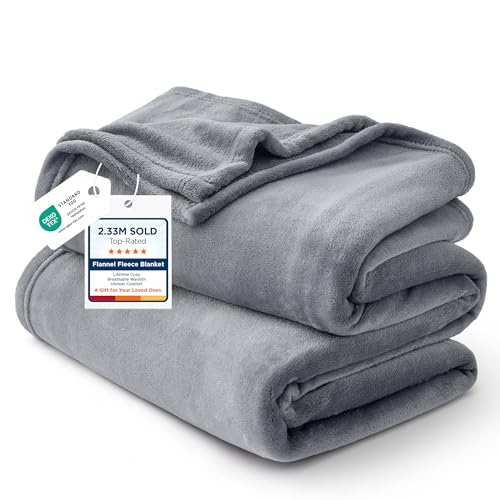
| Bedsure Fleece Bed Blankets Queen Size Grey | Best Reference Blanket | Feel the target: medium-weight plush fleece, finished to resist shedding and fading. |
| Exclusivo Mezcla Soft Large Fleece Throw Blanket for Couch | Best Lightweight Reference | The brushed flannel hand that microfleece yardage should approximate. |
Key Takeaways
- Fleece wins because it does not fray: cut edges stay clean with no hemming, which is the entire premise of a no-sew blanket.
- Anti-pill fleece is worth its small premium for any blanket meant to be kept; blizzard fleece wins for volume projects.
- Buy two coordinating pieces — a print and a solid — each the full blanket size, plus a few inches of margin.
- Standard fleece width makes a throw up to roughly 48-54 inches wide after fringe; plan sizes around the bolt, not against it.
- Knot tension decides durability: snug, consistent double knots survive washing; loose singles do not.
How These Picks Were Chosen
We ranked fabric types by tie-blanket performance: cut cleanliness, knot behavior (grip without tearing), wash survival, softness on both faces, and availability in the widths and prints the craft needs. The three finished blankets from the verified pool are included as tactile references — their verified weights and constructions let you calibrate what medium plush fleece and light brushed fleece actually feel like before ordering yardage — and they are labeled as references, not as fabrics. Non-fleece options (flannel, cotton) are discussed in the buying guide with honest warnings rather than ranked, because their fraying changes the craft fundamentally. No product specifications are invented for the prose-only fabric types.
The 6 Best Best Fabric for Tie Blankets — Reviewed
Anti-Pill Plush Fleece
Our badge: Best Overall
Anti-pill fleece is the fabric experienced tie-blanket makers buy when the blanket matters. It is a medium-weight polyester fleece treated and constructed to resist the little surface balls that make cheap fleece look tired within a season. For tie blankets its virtues compound: the stable surface cuts into clean fringe that does not curl into worms, the slight stretch lets knots seat snugly without tearing the fringe roots, and the finished blanket keeps its soft, new look through the years of washing a beloved blanket receives.
Strengths
- Best long-term appearance of any fleece class — the gift that still looks gifted in year three.
- Clean cutting and reliable knots; fringe stays defined rather than fuzzy.
- Widest quality print selection, since this is the craft market’s premium tier.
Trade-offs
- Highest yardage tier among standard fleeces.
- Slightly stiffer hand than ultra-plush variants until washed.
- Prints sell out seasonally; buy when you see the pattern you love.
Choose anti-pill for wedding, baby, graduation, and memorial blankets — the ones with emotional tenure — and for any blanket you will photograph. Wash the finished blanket before gifting to remove the store finish and let the knots settle into their final softness. Choose it when the blanket is a keepsake. Skip it for bulk charity production, where blizzard’s economics rule.
Best for: Keepsake and gift tie blankets / Not suited for: Bulk production on a budget
Choose anti-pill for blankets that must last; skip it for volume.
Blizzard Fleece
Our badge: Best Budget
Blizzard fleece is the craft-store workhorse: a medium-weight, slightly less refined fleece sold in enormous print variety at the friendliest tier, especially on sale. It ties beautifully — the same no-fray cutting and knot-friendly stretch as its premium cousins — and its blankets are warm, soft, and entirely respectable. Its compromise is surface longevity: with heavy washing it pills sooner, trading years of pristine looks for accessibility today.
Strengths
- The volume choice: classrooms, scout troops, charity drives, and first attempts.
- Huge print library including licensed and seasonal designs.
- Ties, knots, and washes perfectly well for everyday blankets.
Trade-offs
- Pills earlier than anti-pill fleece under frequent washing.
- Hand-feel varies more between bolts; feel before you buy when possible.
- Thinner bolts occasionally appear in the class — check weight in hand.
For a first tie blanket, blizzard is the correct teacher: mistakes are affordable and the result is genuinely good. Service organizations making blankets by the dozen standardize on it for sound economic reasons. Choose blizzard for learning and volume. Skip it for the once-a-decade keepsake.
Best for: Beginners, groups, and charity production / Not suited for: Heirloom gifts
Choose blizzard to learn and to give widely; skip it for heirlooms.
Microfleece
Our badge: Best Lightweight
Microfleece is the thin, fine end of the family: lighter, drapier, with a short dense pile that ties into smaller, neater knots and a finished blanket that folds small and feels cool enough for warm climates. It is the right fabric for baby tie blankets (where two layers of standard fleece can be too warm and bulky), for travel blankets, and for recipients in warm regions who find regular fleece stifling.
Strengths
- Lightest, drapiest tie blankets — baby and warm-climate appropriate.
- Fine fringe and tidy knots suit smaller blanket sizes elegantly.
- Dries fastest after washing of any fleece class.
Trade-offs
- Less warmth and plushness — the winter blanket brief fails here.
- Thinner fringe tears more easily if knots are yanked rather than tied.
- Fewer prints than the mainstream fleece classes.
Tie microfleece with a gentler hand and slightly shorter fringe for proportion. It also layers beautifully as the top face over a standard fleece bottom when you want one plush side and one sleek side. Choose microfleece for babies and warm places. Skip it for cold-climate comfort blankets.
Best for: Baby blankets, travel, and warm climates / Not suited for: Maximum winter warmth
Choose microfleece for lightness; skip it for deep warmth.
Double-Sided and Sherpa Fleece
Our badge: Best Premium
At the plush frontier sit double-sided fleeces and sherpa-faced fabrics: thick, lofty, and luxurious, producing tie blankets with real presence. They come with craft caveats an honest guide must state. Thick fabrics make bulky knots that can look lumpy if fringe is cut too short; sherpa’s curly pile hides fringe definition; and the finished blanket is heavy and very warm. Managed well — longer fringe, patient tying — they make the most impressive gifts in the category.
Strengths
- Maximum plush and warmth; statement-gift material.
- Single-fabric interest on both faces reduces the two-print coordination problem.
- Forgiving of minor cutting unevenness, which the pile conceals.
Trade-offs
- Bulky knots need longer fringe and slower tying.
- Heavy finished blankets; not for babies or frail recipients.
- Premium yardage tier and slower cutting through thickness.
Cut with a sharp rotary cutter, extend fringe length beyond your usual, and tie a test corner before committing to the whole perimeter. Choose plush classes for dramatic gifts to adults. Skip them for first projects and small blankets.
Best for: Premium adult gifts and cold climates / Not suited for: Beginners, babies, or small sizes
Choose plush for drama; skip it for first attempts.

Bedsure Fleece Bed Blankets Queen Size Grey
Our badge: Best Reference Blanket
The Bedsure Fleece Bed Blanket — queen size, 3.19 pounds of upgraded flannel fleece — is in this guide as a calibration standard: this is approximately the weight, softness, and finish a good anti-pill or quality blizzard fleece delivers in a finished blanket. If you are ordering yardage sight unseen, handling a blanket like this in a store (or owning one) teaches your hands what to accept and what to reject at the fabric counter.
Strengths
- Medium plush weight that represents the tie-blanket target zone.
- Maker-rated resistance to fading and shedding — the anti-pill promise in product form.
- True large dimensions show how fleece behaves at blanket scale.
Trade-offs
- It is a finished blanket, not yardage — a reference, not a material.
- Grey solid only; no help on print selection.
- Buying a reference makes sense for serious makers, not one-time crafters.
| Color | Grey |
| Size | Queen (90″ X 90″) |
| Weight | 3.19 pounds |
It also serves as the control in your wash tests: if your handmade blanket emerges from laundry rougher than this one does, your fabric class — not your technique — is the likely difference. Choose it as the maker’s benchmark. Skip it if your hands already know fleece.
Best for: Calibrating yardage purchases and wash expectations / Not suited for: Anyone needing actual fabric
Choose it to learn the target feel; skip it if you know fleece. Check on Amazon

Exclusivo Mezcla Soft Large Fleece Throw Blanket for Couch
Our badge: Best Lightweight Reference
The Exclusivo Mezcla Soft Large Fleece Throw Blanket for Couch — brushed flannel fleece, 50 by 70 inches, 1.55 pounds — calibrates the light end: this smooth, brushed, anti-static hand is what microfleece and light blizzard yardage should feel like, and its finished size demonstrates the throw proportions most tie blankets target.
Strengths
- Light brushed hand that defines the microfleece target.
- Anti-static finish shows the comfort details quality fleece includes.
- Throw XL dimensions model the standard tie-blanket footprint.
Trade-offs
- Again a finished product — reference and spare blanket, not fabric.
- Its lightness is the floor of the range, not the standard.
- Solid color only.
| Color | Forest Green |
| Size | Throw XL (50″ x 70″) |
| Weight | 1.55 pounds |
Between this reference and the Bedsure above, a maker can bracket the entire fleece spectrum by touch. Choose it to calibrate light yardage. Skip it if your project is a heavy winter blanket.
Best for: Calibrating lightweight fleece purchases / Not suited for: Heavy-blanket benchmarking
Choose it for the light target; skip it for plush projects. Check on Amazon
Comparison Table
| Pick | Class | Weight Feel | Best Project | Check price on Amazon |
|---|---|---|---|---|
| Anti-Pill Plush Fleece (prose-only) | Premium fleece | Medium plush | Keepsakes | Check price on Amazon |
| Blizzard Fleece (prose-only) | Standard fleece | Medium | Volume and learning | Check price on Amazon |
| Microfleece (prose-only) | Light fleece | Light | Babies and travel | Check price on Amazon |
| Double-Sided and Sherpa Fleece (prose-only) | Plush fleece | Heavy plush | Statement gifts | Check price on Amazon |
| Bedsure Fleece Bed Blankets Queen Size Grey | Reference blanket | 3.19 pounds (queen) | Calibration | Check price on Amazon |
| Exclusivo Mezcla Soft Large Fleece Throw Blanket for Couch | Reference blanket | 1.55 pounds (throw) | Calibration | Check price on Amazon |
How to Choose the Best Fabric for a Tie Blanket
Confirm It Is Really Fleece, and Which Kind
Read the bolt label: polyester fleece in its classes (anti-pill, blizzard, micro, plush) is the craft’s material. Flannel — despite the similar name and soft hand — is a woven cotton that frays, and a tie blanket in flannel unravels at every fringe. If a non-fleece look tempts you, understand you are changing crafts: woven fabrics need hemming, which means sewing, which means it is no longer a tie blanket.
Size the Yardage to the Blanket, With Fringe Math
Your finished blanket is smaller than your fabric: fringe consumes several inches on every side, and squaring the layers trims more. As working method: decide the finished size, add twice your fringe length plus a trimming margin to both dimensions, and buy that. Standard fleece bolts make throws most naturally; bed-size tie blankets require the widest bolts or seamed panels, which is why throws dominate the craft. When in doubt, buy a little extra — fleece remnants become pillows and pet blankets, never waste.
Coordinate Print and Solid Like a Designer
The classic formula is one print layer and one solid layer pulled from the print’s secondary color. Two prints fight; two solids look flat unless textures differ (a plush against a smooth). Hold the bolts together in store light, check them in daylight if the store allows, and remember the fringe shows both layers interleaved — that mixed edge is the design’s signature.
Feel for Weight and Recovery
Good tie fleece has body: scrunch it and it recovers without staying creased; stretch a cut edge gently and it resists without tearing. Limp, papery fleece makes a blanket that feels cheap by Christmas. When ordering online, order a single test piece for a small project before committing to a bed-size purchase.
Match Fabric Class to Recipient
Babies: microfleece or the softest anti-pill, in gentle prints, sized small. Kids: blizzard or anti-pill in their current passion’s print. Adults and keepsakes: anti-pill or plush. Charity volume: blizzard on sale. The recipient’s washing machine will judge your choice weekly — choose for the laundry, not the reveal.
Yardage Math: Buying Enough Fabric the First Time
Tie blankets consume more fabric than their finished size suggests, because the fringe is cut from the blanket’s own dimensions: a fringe of four to five inches on every side means the finished body is eight to ten inches smaller than the cut in each direction. Plan backward from the finished size you want — lap, throw, or bed scale — and add the fringe allowance plus a small margin for squaring the edges, since fabric off the bolt is rarely perfectly straight. For a standard adult throw, most makers land on one and a half to two yards of each of the two layers, and the layers must match in cut size even when their patterns tempt you to improvise. Buy both layers in the same trip, from the same bolt when possible: fleece widths and dye shades vary between bolts and between stores, and a return trip for “the same” fabric is where mismatched pairs are born. Keep the offcuts — the corner squares and edge trimmings are your test material for washing experiments and your repair stock for the blanket’s whole life. Makers coming from yarn crafts will recognize the discipline: it is the fabric version of the dye-lot margin that Best Cotton Yarn For Blankets insists on, and it prevents the same heartbreak in a different medium.
Fabric Weight and Hand: Matching the Blanket to Its Job
Not every tie blanket has the same job, and fabric weight should follow the assignment. A child’s blanket gets dragged, washed weekly, and used as infrastructure; it wants a durable mid-weight fleece that survives the laundry without thinning, in a print that forgives evidence. A lap blanket for an older adult wants warmth at the lowest possible weight, with a soft hand that arthritic fingers can manage and no stiffness at the ties — the recipient analysis in Best Blankets For Elderly is the right lens for that purchase. A couch throw for adults can carry the plushest, heaviest fabrics in the store because its life is stationary and its washing occasional, and it will be judged against the working throws in Best Cozy Blankets For Couch every evening. A pet’s tie blanket — a genuinely popular project — wants the tightest, smoothest fleece that releases hair in the wash, the same property prized in Best Pet Blankets For Couch. Naming the job before touching the bolt turns fabric selection from a texture tasting into a decision, and it is the step beginners skip and veterans never do.
How to Make a Tie Blanket That Lasts: Cutting and Tying
Lay the two layers wrong sides together, smooth them flat on the largest surface you have, and trim them into one exact rectangle, removing selvages. Cut a square from each corner equal to your fringe length — four to five inches is the standard working range — so the corners tie without bunching. Cut fringe around all sides at even intervals, roughly an inch wide, keeping cuts straight and consistent; a rotary cutter and mat make this fast and clean, while sharp fabric scissors reward patience. Tie corresponding top and bottom fringes together with snug double knots, working around the blanket in order and keeping tension consistent — tight enough to hold through washing, never so tight the edge puckers into a ruffle. Alternate knot styles (overhand, or the loop-through variation) only deliberately as a design, not accidentally through inattention. When finished, stretch the blanket gently on the diagonal both ways to seat the knots, then wash it before use or gifting.
Problem: The edges pucker and curl — Knots are too tight or fringe lengths vary. Loosen your hand, measure fringe with a template, and remember fleece relaxes after the first wash.
Problem: Knots come undone in the wash — Single knots or slippery fabric. Double-knot throughout, and seat knots by stretching the blanket before its first wash.
Problem: The two layers shift and misalign — Pin or clip layers together before cutting, work on a flat surface, and trim to one rectangle after layering, not before.
Problem: Fringe looks ragged — Dull scissors or uneven widths. Use a rotary cutter or freshly sharpened shears and a cardboard template for width consistency.
Problem: The blanket is smaller than planned — Fringe math was skipped. Next time, add twice the fringe length plus trim margin to your target dimensions before buying.
Cutting Tools and Workspace: The Unglamorous Half of Quality
More tie blankets are ruined by cutting than by tying. Dull scissors chew fleece edges into a ragged fringe that no knot can tidy, and cutting on a carpet or a bed introduces the wavering lines that make a finished blanket look improvised. The reliable setup is modest: a flat, hard surface large enough for the full cut; sharp fabric shears or a rotary cutter with a mat; a yardstick or tape for marking; and painter’s tape or chalk to mark the corner squares and the fringe lines before any cutting begins. Cut both layers together, pinned or clipped against shifting, because two layers cut separately will differ by enough to show at the ties. Work in good light and cut the whole perimeter in one session — fringe cut across two days, with the fabric re-spread between, rarely matches itself. None of this requires a craft room; it requires refusing to cut fleece on your lap, which is the single most common beginner shortcut and the one with the most visible consequences.
Washing and Living With a Tie Blanket
Tie blankets wash like the fleece they are: cool to warm water, gentle-to-normal cycles, low drying. The first wash is a settling event — knots snug into place and the fabric softens — so always wash before gifting. Over years, the failure modes are pilling (a fabric-class issue, chosen at purchase) and knot loosening (a technique issue, preventable at tying). A loosened knot can be re-tied in seconds, which is the craft’s quiet advantage over sewn blankets: every repair is a knot, not a seam. Keep tie blankets out of high-heat drying, which ages polyester surfaces, and expect a well-made anti-pill blanket to outlast the recipient’s current interests, decor, and possibly address.
Knot Craft: Tension, the Double Knot, and the Edge That Lies Flat
The tie itself is a small piece of engineering with three variables: how tight, how many knots, and in which direction the fringe is worked. A single overhand knot tied loosely will creep open across a season of washing; the standard double knot — tied firmly, with the second knot snugged against the first — survives years. Consistency matters more than maximum tightness: fringe tied at mixed tensions makes an edge that ripples, tight here and slack there, and the eye reads the ripple as carelessness even when every knot is secure. Work around the blanket in one direction, keep both layers’ strips paired correctly at corners, and pause every side to lay the blanket flat and check the edge’s line. If a section ripples, the fix is immediate and cheap — untie and re-tie that stretch — while after the blanket is finished and washed, the same fix costs ten times the patience. Makers tying with children should assign the adults the corners, where geometry concentrates, and let small hands own the long straight runs, where enthusiasm outruns precision without consequence.
Tie Blankets as Gifts and Group Projects
Few handmade gifts scale like tie blankets: no machine, no skill barrier, an afternoon’s work, and a result that looks generous and feels personal. That is why they anchor baby showers, dorm send-offs, hospital and shelter donations, and classroom service projects. Group production tips from experienced organizers: pre-cut kits assembly-line style (one team cuts, one ties), standardize on blizzard fleece bought on sale, include a care card with each blanket, and photograph every finished piece before donation — the makers will want the memory. For personal gifts, the print is the personalization: choose the recipient’s team, hobby, animal, or fandom, pair it with its perfect solid, and the blanket says you know them. That thoughtfulness, more than the fabric tier, is what gets a tie blanket kept for a decade.
Beyond Fleece: When Other Fabrics Earn a Place in a Tie Blanket
Fleece dominates tie blankets for sound reasons — it does not fray, it cuts cleanly, and its edges need no finishing — but it is not the only fabric that can be tied, and knowing the alternatives sharpens the fleece decision itself. Flannel ties acceptably and gives a lighter, more breathable blanket for warm climates and summer camps, at the cost of edges that fray and soften with washing; many makers accept the rustic edge as part of the aesthetic. Cotton fabrics fray honestly and need either wider fringe tied tighter or an acceptance that the blanket is a shorter-lived object. Double-layer constructions mixing one fleece side with one flannel or cotton side produce a blanket with a warm face and a cool face — genuinely useful for recipients who run warm — though the two layers stretch differently and the cutting must be done with both pinned and squared together. What does not work, despite frequent attempts, is any fabric with significant stretch in both directions, slippery satins, or anything stiff enough to fight the knot; the tie is a mechanical joint, and it demands fabric that holds a knot without creeping loose. The wearable end of the no-sew world, surveyed in Best Hooded Blankets For Adults, shows where these fabric instincts lead when the blanket is designed to be worn rather than spread — the same softness, the same washability, cut for a body instead of a bed.
Printing, Panels, and Licensed Fabrics: Design Decisions That Age Well
The fabric store’s most dangerous aisle is the licensed and novelty prints, because a tie blanket is a multi-year object being chosen in a moment of enthusiasm. Team colors, fandoms, and seasonal prints make superb gifts when the recipient’s attachment is deep and durable; they date badly when the enthusiasm is a child’s current semester. The veteran’s pattern is to put the bold print on one side and a coordinating solid on the other, so the blanket has a loud face and a quiet face and survives changes in taste by being flipped. Panel prints — the large pre-designed scenes — need their own warning: they are printed to a fixed size that may not match your fringe math, and cutting fringe through the scene’s border can amputate the design; measure the panel, plan the finished size around it, and let the fringe fall in the panel’s margins. For group and charity projects, solids and classic patterns in the organization’s colors outlast any novelty, wash without fading drama, and photograph as intentional rather than improvised. Design for the blanket’s fifth year, not its first photograph, and the fabric decision will still look wise when the blanket has been washed a hundred times.
Repairing a Tie Blanket: Loose Knots, Torn Fringe, and Second Chances
A tie blanket is the most repairable blanket in any house, because its structure is its fasteners: a knot that loosens can be re-tied, a fringe strip that tears can be re-cut from the blanket’s margin if caught early, and a section that has gone slack can be opened and re-worked without disturbing the rest. Keep the original offcuts for exactly this — a torn strip replaced with a scrap of the same fabric disappears, while one replaced with a near-match advertises itself forever. Wash-related damage follows a pattern worth knowing: fringe mats and twists when a tie blanket is washed with towels and jeans, whose hardware and heavy fabrics beat the knots; wash tie blankets with other soft bedding, shake the fringe out straight before drying, and the edge will look made rather than survived. When a beloved blanket’s body finally thins after years of service, its second career is honorable and obvious — pet blanket, car blanket, picnic layer — because a tied edge never unravels catastrophically the way a hem does. Few manufactured blankets offer that graceful a decline, and it is part of what the fabric choice buys: not just a blanket, but a blanket whose entire lifecycle, from first cut to final demotion, stays in the maker’s hands.
Common Buying Mistakes
Buying Flannel by Mistake
The names confuse everyone once. Flannel frays; fleece does not. A flannel tie blanket begins unraveling immediately. Read the bolt, not your memory of the word.
Under-Buying Fabric
Forgetting fringe math produces a lap blanket where a throw was planned. Add fringe and trim allowances before the cut, every time.
Choosing Two Busy Prints
The fringe interleaves both fabrics at every edge; two prints become visual static. One print, one solid is a rule because it works.
Tying Single, Loose Knots
They feel finished and wash apart. Double knots with consistent, snug tension are the entire durability of the craft. Slow down; it is the only step that matters structurally.
Skipping the Pre-Gift Wash
Store finishes and loose fibers belong in your laundry, not the recipient’s first cuddle. Wash, dry, fold, then give.
Buying Fabric by the Photograph in an Online Listing
Fleece bought online arrives with surprises that the bolt never delivers: pile direction that makes one side look darker, prints scaled far larger or smaller than the thumbnail suggested, and weights described with adjectives instead of numbers. The consequence is a blanket whose two layers clash in scale or sheen despite sharing a color name. The better move for a first project is to buy in person, where hands can judge weight and prints can be judged at full size; online, order a small cut first for any fabric you have not handled, exactly as a yarn maker swatches before committing to a blanket’s worth of yardage.
Final Recommendation
Buy anti-pill fleece when the blanket is meant to be kept, blizzard when it is meant to be many, microfleece when it is meant for a baby or a warm place, and plush when it is meant to wow — always one print with one solid, always with fringe math done before the cut, always double-knotted with even tension. Calibrate your hands on finished fleece like the Bedsure and Exclusivo references if yardage shopping feels abstract, and wash the finished blanket before it meets its person. That is the whole craft, done properly: the right fleece, honestly sized, tied like you mean it.
One last piece of counsel before the questions: a tie blanket is often a maker’s first textile project, and its forgiving nature is the point — but forgiving is not the same as thoughtless. The blankets that get kept for a decade are the ones where the fabric was chosen for a named recipient and a named job, cut on a flat surface with sharp tools, and tied at an even tension all the way around. None of that requires talent. It requires deciding that a simple project deserves the same respect as a complicated one, because the recipient will never know how simple it was — only how well it was made. Choose the fabric the way this guide has argued throughout — by job, by weight, by hand, by wash — and the simplest blanket in the house may end up the most loved one in it, which is a fair description of how tie blankets became a tradition in the first place. Traditions in craft are just techniques that kept working; the fabric knowledge in this guide is offered in that spirit, to be used, tested against your own projects, and passed along with the offcuts. If this is your first blanket, welcome to the craft — measure twice, cut once, tie evenly, and do not be surprised when the finished object is claimed by someone in the house before it is even washed. That claiming is the review every maker is actually working for, and no fabric choice matters more than the one that earns it. Earn it with the right weight for the job, the right print for the decade, and knots tied like you meant them — the whole craft is in those three sentences, and everything else in this guide is commentary. Commentary worth reading before the first cut, ideally — the fabric store will still be there after, and you will walk its aisles with better questions than you had this morning. Better questions, in fabric as in everything else, are what separate the blanket that gets made once from the maker who makes them for years. May your first be the start of the second kind — and may every recipient who receives one understand, without being told, exactly how much thought went into the fabric. They usually do — a well-chosen tie blanket communicates its care in the first touch, long before anyone counts the knots. Choose well, and nobody ever will need to — they will be too busy using the blanket, which was the point of every decision in this guide from the first yard onward.
Frequently Asked Questions
Do I need to wash the fabric before cutting?
For fleece, a pre-wash is optional but useful: it removes store sizing and any loose surface fibers, and it confirms the two layers behave the same in water before you marry them with a hundred knots. For flannel or cotton layers, pre-washing is close to mandatory, because their shrinkage would otherwise happen after tying and pucker the finished blanket. Wash the two layers separately the first time — dark fleece can shed tinted lint onto a pale partner — then together for the blanket’s whole life.
How wide should the fringe be?
Most successful blankets use strips around an inch wide and four to five inches long: narrower strips tear at the knot under real use, and much longer fringe tangles, mats, and turns the blanket’s edge into a fringe skirt rather than a border. Children tying their first blanket do better with slightly wider strips, which are easier for small hands to knot firmly. Whatever width you choose, choose it once, mark it, and cut consistently — fringe uniformity is the visible difference between a handmade blanket and a homemade-looking one.
Can I make a tie blanket with only one layer?
You can, and single-layer versions have their place as light summer throws and pet blankets, but know the trade: the classic two-layer construction is what gives a tie blanket its weight, warmth, and finished feel, and a single layer reads as a cut blanket rather than a made one. If lightness is the goal, pair one fleece layer with one flannel layer instead of dropping to a single layer — you keep the finished edge and the two-faced design while shedding half the insulation.
Why did my blanket come out smaller than I planned?
Almost always the fringe: makers plan from the cut size and forget the fringe is spent from it on all four sides. A blanket cut at sixty inches with five-inch fringe finishes near fifty inches of body. The fix is planning backward — decide the finished body size first, add twice the fringe length to each dimension, then add a squaring margin — and writing the three numbers on the fabric’s receipt before the first cut, because mid-project arithmetic is where good blankets shrink.
What is the best fabric for a no-sew tie blanket?
Fleece — specifically anti-pill fleece for keepsakes and blizzard fleece for budget and volume. Fleece does not fray, so cut fringe stays clean with no hemming, and its slight stretch makes knots that hold.
How much fleece do I need for a throw blanket?
Work backward from your finished size: add twice your fringe length (typically 4-5 inches per side) plus a trimming margin to each dimension, and buy two pieces — print and solid — at that size. Most makers buy in the one-and-a-half to two-yard range per layer for throws, adjusted by bolt width.
Can I use flannel or cotton for a tie blanket?
Not successfully as a true tie blanket: woven fabrics fray at every cut fringe and the blanket unravels. If you love a woven fabric, it needs hemmed edges — a sewn blanket, which is a fine but different project.
Why did my tie blanket’s knots come undone?
Single knots, loose tension, or slippery fabric. Re-tie with snug double knots throughout, then stretch the blanket diagonally to seat them before washing.
How do I wash a tie blanket?
Like fleece: cool-to-warm water, regular or gentle cycle, low-heat drying. Wash before first use or gifting to settle knots and remove finishes, and avoid high heat that ages the surface.
What size fringe should I cut?
Four to five inches long and about an inch wide is the standard working range for adult throws; shorter for baby blankets and microfleece, longer for thick plush fabrics whose knots need the extra length.


