Disclosure: As an Amazon Associate, dailyhomedecorating.com earns from qualifying purchases. Links to Amazon on this page are affiliate links; they cost you nothing extra. Prices and availability change often, so check the current Amazon listing before you buy.
Looking for the best mattresses for cots means solving a geometry problem before a comfort problem. A cot is not a small bed: it is a narrow, elevated frame — often around 30 to 32 inches wide and about 75 inches long, sometimes wider in the large camping models — with a fabric or slatted deck that flexes under you. A regular twin mattress is too wide, a queen is a fantasy, and a too-thin pad leaves you feeling every bar and buckle of the frame by 2 a.m. The right cot mattress has to fit the frame’s actual dimensions, cushion its hard points, and — for most cot owners — fold, roll, or pack away when the cot does, because cots live in guest corners, tents, cabins, and barracks, not in dedicated bedrooms.
Honesty about our pool, up front: it contains exactly two products that honestly serve cot duty — a tri-fold memory foam mattress built for exactly this life, and a low-profile twin hybrid suited to wide cots and camp decks. The remaining four picks are cot-pad types described in prose only, with shopping checklists instead of links, because inventing products to fill a list would waste your money faster than any thin pad could. Measure your cot before anything else in this guide: width between the rails, length, and whether the deck is fabric or rigid. Those three numbers decide which of the six picks below is even eligible for your frame. For the neighboring problems, see Best Portable Mattresses For Guests for the guest-room version of pack-away sleeping, and Best Blow Up Mattresses For Guests for the inflatable alternative.
Where to Buy
The two linked picks in this guide are sold on Amazon, where you can check the current price, size availability, and delivery options on the listing itself. Start with our top pick, the Milliard Trifold Mattress — Check on Amazon. The other linked pick is the Linenspa 8 Inch Hybrid Mattress — Check on Amazon. The remaining four picks — a narrow high-density foam cot pad, a roll-up travel pad, a shikibuton-style floor pad, and a self-inflating camp pad — are described in prose only below, with guidance on what to look for when you shop those types on Amazon. Treat each listing, not any roundup, as the final word on price and dimensions.
In this guide
Quick Picks
| Pick | Badge | Why it earns its place |
|---|---|---|
| Milliard Trifold Mattress | Best Overall | A 6-inch memory foam trifold that folds for storage and travel — the cot mattress in its natural form. |
| Linenspa 8 Inch Hybrid Mattress | Best for Wide Cots | Real coil support in a low profile, for wide cots, camp decks, and daybed-style frames that stay set up. |
| Narrow High-Density Foam Cot Pad (type — prose only) | Best True Cot Width | The made-for-cots pad in genuine narrow widths; shop by the checklist in its review. |
| Roll-Up Foam Travel Pad (type — prose only) | Best for Travel | Rolls to a cylinder for cars and closets; the lightest way to make any cot sleepable. |
| Shikibuton-Style Floor Pad (type — prose only) | Best Dual-Purpose | Works on a cot or directly on the floor — one pad, two guest solutions. |
| Self-Inflating Camp Pad (type — prose only) | Best for Outdoor Cots | Foam-and-air insulation for tent cots, where warmth from below matters as much as cushion. |
Key Takeaways
- Measure the cot first: width between rails, length, and deck type decide which mattresses are even eligible.
- Standard cots run narrow — roughly 30 to 32 inches wide; the linked picks here suit wide cots and camp setups, while the prose-only pads cover true narrow widths.
- Six inches of real foam is the comfort threshold over a cot frame’s bars and buckles; thinner pads are insulation, not mattresses.
- Folding and rolling designs earn their place because cots are occasional furniture — storage is half the product.
- Two picks here are verified products with links; four are types described in prose because our pool has no verified example to link.
How These Picks Were Chosen
The first filter was dimensional honesty. Every candidate was checked against real cot geometry: narrow frames around 30 to 32 inches wide, wide camping cots up to about 40 inches, lengths near 75 to 78 inches. The Milliard Trifold — 78 by 38 inches in its verified Twin XL variant, folding into thirds — fits wide cots and doubles as a floor and guest mattress, and its entire design brief is portable sleep. The Linenspa’s low 8-inch twin profile suits wide cots and rigid camp decks that stay assembled. No other pool product comes close to cot dimensions, so rather than dressing up queen mattresses as cot picks, the guide completes its six with the four cot-pad types that genuinely serve narrow frames, described qualitatively with checklists.
What was filtered out: every full-size mattress in the pool, however excellent, because width is a gate, not a preference; and inflatable air pads as linked picks, because the pool contains none (they are covered as a prose type and in our blow-up guest guide). Method: linked picks trace entirely to verified pool data, spec boxes reproduce verified specs only, and no static prices appear anywhere. For the prose-only types, we describe construction and selection criteria — never invented brands, models, or specifications.
The 6 Best Mattresses for Cots — Reviewed

Milliard Trifold Mattress
Our badge: Best Overall
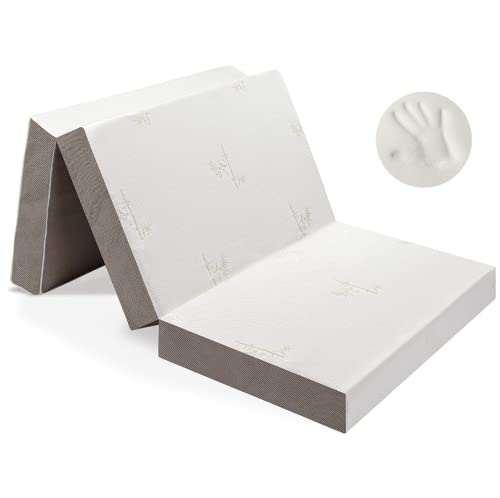
The Milliard Trifold Mattress is what a cot mattress wants to be when it grows up: 6 inches of high-density memory foam that contours to the body and relieves pressure points, in a tri-fold design that folds in seconds for storage and transport, with a removable, machine-washable cover. Its verified variant is Twin XL at 78 by 38 inches — a match for wide camping cots and cot frames, and a generous floor or guest mattress everywhere else.
Strengths
- Six inches of memory foam is real cushion over cot bars, buckles, and deck seams
- Tri-fold design stores in a closet corner and travels in a car without drama
- A washable cover suits the guest, camping, and sleepover duty cots actually serve
Trade-offs
- At 38 inches wide it overhangs a standard narrow cot — measure your frame; it suits wide cots best
- Foam folds have seams you may feel if you sleep exactly on a fold line
- Memory foam response is slow; restless sleepers will notice it
| Color | White |
| Size | Twin XL |
| Dimensions | 78 x 38 x 6 inches |
On a wide cot, the Milliard transforms the experience categorically: the cot stops being a compromise you apologize for and becomes a bed a guest can praise. The foam depth swallows the frame’s hardware, the length covers tall sleepers end to end, and when the visit ends the whole bed folds into a third of its footprint and leans in a closet. Between cot deployments it moonlights — floor bed for sleepovers, RV mattress, dorm topper, camping base — which is why it leads this guide despite the width caveat: no other pick here works so many jobs.
Care is the washable cover’s gift: unzip, wash, and the guest bed is genuinely fresh rather than febrezed. Store it folded in a dry space, let it breathe open for a few hours before a guest arrives, and rotate which fold faces up to distribute wear. If your cot is a wide model — or your “cot” is really a camp bed or daybed frame — this is the pick. If your cot is a true narrow military-style frame, read the prose picks below first; they exist for you.
Best for: Wide cots, camp beds, guest corners, RVs, and anyone who needs the bed to disappear afterward / Not suited for: Standard narrow cots under about 36 inches wide
Choose it if your frame’s width allows. Skip it — and shop the narrow pads below — if it does not. Check on Amazon
Linenspa 8 Inch Hybrid Mattress
Our badge: Best for Wide Cots
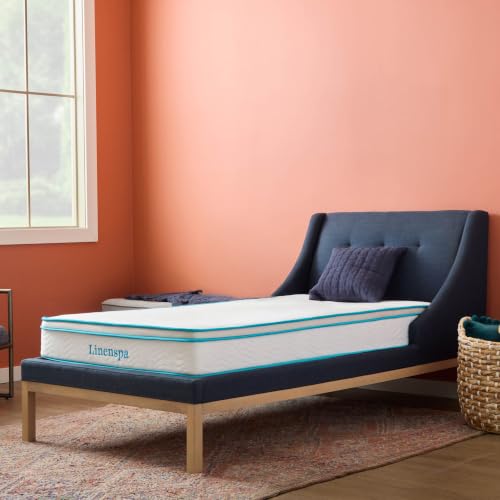
The Linenspa 8 Inch Hybrid Mattress serves the cot setups that stay assembled: the wide camping cot in a cabin, the camp deck bed, the daybed-frame cot in a spare room. Its memory foam over steel coils gives real, spring-supported comfort in an 8-inch profile, verified in twin at 74 by 39 inches and a carry-friendly 36 pounds.
Strengths
- Coil support under foam comfort out-supports any foam pad of similar thickness
- Low profile keeps a cot setup from becoming top-heavy or tall
- Light for a hybrid, so seasonal setup and storage stay one-person jobs
Trade-offs
- It does not fold — this is for cots and decks that stay up, not pack-away kits
- At 39 inches wide it needs a genuinely wide cot or a rigid deck, not a narrow frame
- Allow 24 to 72 hours for expansion after unboxing
| Color | Mattress Only |
| Size | Twin |
| Dimensions | 74 x 39 x 8 inches |
| Weight | 36 pounds |
The Linenspa’s case is about sleep quality per setup effort. A cabin cot that hosts a summer of guests deserves better than a pad: the coil core keeps the surface supportive for back and stomach sleepers, the foam top keeps it kind to side sleepers, and the medium-firm feel is the crowd-pleasing middle. On a rigid camp deck or a wide cot with a supportive deck, it reads as a real bed that happens to be portable-adjacent — which is the right ambition for semi-permanent cot installations.
Its limits are honest: it will not fold into a closet, and it will not narrow itself for a slim frame. Buy it when the cot has a permanent address. Between seasons, store it flat under a bed rather than on its side, and the coils will hold their temper for years of guest duty.
Best for: Cabins, camp decks, wide cots, and spare-room cot setups that stay assembled / Not suited for: Pack-away travel kits and narrow frames
Choose it when the cot stays up. Skip it when the cot must disappear weekly. Check on Amazon
Narrow High-Density Foam Cot Pad (type — prose only)
Our badge: Best True Cot Width
This pick is a product type, described without a link because our verified pool contains no narrow cot pad to recommend honestly. The type is the classic made-for-cots foam pad: high-density foam, typically 4 to 6 inches thick, cut in genuine cot widths around 30 to 32 inches and lengths around 72 to 75 inches, often with a washable or water-resistant cover. It is the correct answer for the standard military-style and folding-frame cots the linked picks are too wide for.
Strengths
- Actually fits a narrow cot — no overhang, no trimming, no folded edges
- High-density foam resists bottoming out on frame bars better than soft foam of the same thickness
- Usually the most affordable route to a genuinely sleepable narrow cot
Trade-offs
- Four inches is the minimum; thinner versions are ground insulation wearing a mattress costume
- Quality varies enormously by maker, and we cannot verify a specific model for you here
- Foam pads store flat or rolled, but they do not fold as compactly as a trifold
Shop the type with this checklist: the listing should state foam density or at least describe the foam as high-density or firm support foam; thickness should be 4 inches or more for an adult; the cover should be removable or wipeable, because cot duty is dusty duty; and the dimensions should match your measured frame with no more than an inch of slack. In use, density is the whole story — press your knee into a sample area mentally via the reviews’ language: pads described as plush or soft will let a hip find the frame bar beneath by midnight, while a firm, dense pad distributes the load across the deck. Pair it with the cot’s own tension adjusted tight, and a narrow cot becomes an honest bed for a guest, a scout, or a seasonal worker.
Best for: Standard narrow cots in homes, barracks, shelters, and camps / Not suited for: Anyone whose cot is actually wide — the Milliard serves you better
Choose this type when your measured width says narrow. Skip it if you can fit a folding foam mattress instead. (Prose-only pick — no link, by design.)
Roll-Up Foam Travel Pad (type — prose only)
Our badge: Best for Travel
The roll-up travel pad is the cot mattress as luggage: a foam pad — often memory foam over a support layer, sometimes with a non-slip base and carry straps — that rolls into a cylinder and goes where the cot goes. It belongs in this guide for the cot owners whose cot is not furniture but equipment: the road-trip cot, the in-law-visit cot, the festival and field-work cot that lives in a vehicle.
Strengths
- Rolls to a fraction of its open size; the only pick here that truly travels light
- Carry straps and a storage bag are common in the type, keeping the kit self-contained
- Works on cots, decks, and floors, so one pad covers every improvised bed on a trip
Trade-offs
- Rollable foam is usually thinner than foldable foam — expect 3 to 4 inches, with the comfort ceiling that implies
- Needs a few hours unrolled to lose its curl memory before the first night
- Not a long-term nightly bed for a heavier adult
Shop the type by prioritizing the base layer: a pad with a firm support foam beneath a thinner comfort layer will out-sleep a uniform soft roll of the same thickness, because the support layer is what stands between your hip and the cot’s crossbar. Check the rolled diameter against your vehicle’s cargo reality, confirm the cover can be cleaned — travel pads meet interesting floors — and unroll it at home once before the trip, both to air it and to learn its setup while nobody is tired. Used within its brief — a week here, a weekend there, on frames and floors that would otherwise be unsleepable — the roll-up pad is the highest-value travel sleep upgrade in this guide.
Best for: Travelers, road crews, and anyone whose cot lives in a vehicle / Not suited for: A permanent guest bed or nightly adult use
Choose this type when the cot moves with you. Skip it for a fixed guest corner. (Prose-only pick — no link, by design.)
Shikibuton-Style Floor Pad (type — prose only)
Our badge: Best Dual-Purpose
The shikibuton-style pad — a thick, cotton-or-foam-filled Japanese-style floor mattress, usually 3 to 4 inches — earns its place by refusing to specialize: laid on a cot it cushions the frame; laid on the floor it is the guest bed itself, no cot required. For small homes where the cot is borrowed, rented, or hypothetical, one pad that serves both surfaces is the economical answer.
Strengths
- Dual-surface versatility: cot topper one night, floor bed the next
- Rolls or folds for storage and airs easily — the type is designed around daily put-away in its home tradition
- A firm, flat sleep character that back sleepers often prefer to soft foam
Trade-offs
- Firm and relatively thin: side sleepers may find hip pressure on a hard cot deck
- Cotton-filled versions need regular airing and sun to stay fresh and lofted
- On a cot it adds cushion but less deep support than the 6-inch foam picks
Shop the type by fill and care: foam-core versions are lighter and lower-maintenance; cotton versions are heavier, more traditional, and demand the airing routine that keeps them from compacting into a mat. Either way, confirm the width against your cot if cot use is primary, and treat floor use as the bonus it is. In small apartments this pad quietly replaces three products — cot mattress, guest bed, and kids’ sleepover mat — and its firm, honest sleep surface converts many guests who expected to merely endure the night. It is also the natural partner to the folding frames discussed in Best Mattresses For Sleeper Sofas, for homes assembling a whole guest system from compact parts.
Best for: Small homes, minimalist guest setups, and floor-sleeping households / Not suited for: Side sleepers needing deep cushion on a hard deck
Choose this type for versatility per stored inch. Skip it if you want plush. (Prose-only pick — no link, by design.)
Self-Inflating Camp Pad (type — prose only)
Our badge: Best for Outdoor Cots
The self-inflating camp pad — open-cell foam inside an air chamber that inflates itself when the valve opens — is the outdoor cot’s specialist. On a tent cot, the enemy is not only the frame’s bars but the cold air beneath the deck, which strips warmth from a sleeper all night; a foam-and-air pad insulates as it cushions, which no purely foam pad of travel weight can match.
Strengths
- Insulation from below: the foam-air core blocks the cold-air siphon under a tent cot
- Packs smallest of any pick here relative to the comfort it delivers
- Firmness adjusts with a breath or two of air — tunable in the field
Trade-offs
- Thinner in practice than foam mattresses; heavy side sleepers may bottom out on a bar
- Valves and seams are failure points — field repair is part of the ownership deal
- It feels like camping equipment, because it is: not a guest-room aesthetic
Shop the type by thickness and insulation rating as the maker states them, by valve quality (metal or robust plastic, replaceable), and by whether the surface fabric is quiet — crinkly pads announce every position change to the whole tent. Inflate it at home first, lie on it over the actual cot, and tune the air so your hip hovers just above the deck at full settle. For indoor cot duty this type is overkill with compromises; for a cot under canvas, it is the only pick in this guide designed for the conditions, and the difference shows up as sleep.
Best for: Tent cots, hunting and fishing camps, and cold-weather cot sleeping / Not suited for: Indoor guest rooms, where the foam picks serve better
Choose this type when the cot sleeps outdoors. Skip it for the spare bedroom. (Prose-only pick — no link, by design.)
Comparison Table
| Pick | Format | Best width fit | Packs away? | Check price on Amazon |
|---|---|---|---|---|
| Milliard Trifold Mattress | 6-inch folding memory foam | Wide cots (~38 in) | Folds in thirds | Check price on Amazon |
| Linenspa 8 Inch Hybrid Mattress | 8-inch foam + coils | Wide cots / decks (~39 in) | No — stays set up | Check price on Amazon |
| Narrow Foam Cot Pad (type) | 4-6 inch dense foam | Standard cots (~30-32 in) | Stores flat/rolled | Check price on Amazon |
| Roll-Up Travel Pad (type) | 3-4 inch layered foam | Most cots | Rolls with straps | Check price on Amazon |
| Shikibuton-Style Pad (type) | 3-4 inch filled pad | Most cots + floor | Rolls/folds | Check price on Amazon |
| Self-Inflating Camp Pad (type) | Foam + air chamber | Camp cots | Packs smallest | Check price on Amazon |
How to Choose the Best Mattress for Your Cot
Measure the Cot Like You Mean It
Three numbers govern everything: the inside width between rails, the usable length, and the deck type. Write them down before shopping, because cot naming is unreliable — “XL” and “wide” mean different things to different makers. A mattress may overhang a fabric-deck cot slightly without harm, but on a rigid frame, overhang becomes a tipping, sliding nuisance. When in doubt, size to the frame, not to the sleeper.
Match Thickness to the Deck
A taut fabric deck forgives: it has no hard points, so 4 inches of dense foam can sleep well. A slatted, barred, or buckled deck accuses: every hardware point prints through thin pads, and 6 inches of real foam — the Milliard’s specification — is the safe answer. Side sleepers need the thicker end of any range, because their hip concentrates the load that finds the bars.
Decide How the Bed Disappears
Cots are occasional furniture, so storage is a specification. Folding designs suit closets, roll-ups suit vehicles, flat pads suit under-bed storage, and a non-folding hybrid suits only cots with a permanent address. Choose the disappearance method your home actually has room for, or the mattress becomes the clutter it was bought to avoid. Our Best Portable Mattresses For Guests guide applies the same storage logic to full guest beds.
Weigh the Sleeper, Not Just the Cot
A child’s cot kit and a grown guest’s are different products wearing the same name. Heavier adults need density and thickness; children sleep happily on pads that would torture an adult hip. Buy for the heaviest regular user, and let everyone lighter enjoy the margin.
Plan the Warmth Layer Outdoors
Under a tent cot is moving cold air. Indoor picks ignore insulation; outdoor picks must not. If any of your cot’s nights happen under canvas, the self-inflating type or an added insulating layer under a foam pad stops being optional.
How Do You Make a Cot Sleep Like a Real Bed?
Start with the frame: tighten the deck tension, confirm every leg locks, and level the cot — a sagging or tilted cot defeats any mattress. Add the mattress centered, then dress it like a bed, not a camp kit: a fitted or tucked sheet that cannot slide, a real pillow at sleeping height, and bedding matched to the room’s temperature. A thin non-slip layer between mattress and deck stops the midnight migration that wakes light sleepers. Then manage expectations kindly: tell guests where the bathroom is, leave a small light, and let the bed itself — now genuinely cushioned — do the rest. Most cot complaints are really deck, bedding, or darkness complaints wearing a mattress costume.
Problem: You can feel a crossbar through the mattress — The pad is too thin or too soft for that deck; add density or thickness, or place a firm layer under the mattress to spread the bar’s load.
Problem: The mattress slides off the cot during the night — Add a non-slip mat between deck and mattress, and tuck the sheet under the frame rather than just the pad.
Problem: The cot sleeps cold outdoors — Insulate below: a self-inflating pad, or a closed-cell layer under your foam pad, blocks the under-deck air siphon.
Problem: The folded mattress smells stale at setup — Air it open for a few hours before guests arrive and wash the cover on schedule; stored foam needs breathing time.
Problem: The cot creaks with every turn — Tighten frame joints and check leg locks; a mattress cannot silence hardware, but a level, locked frame usually stops performing.
Cot Types and Their Mattress Matches
The folding fabric cot — the classic camp and emergency bed — pairs with dense foam pads and trifolds sized to its width, because its deck flexes as one surface. The rigid-deck camp cot and the wooden camp bed pair with anything flat, including the Linenspa hybrid, because the deck behaves like a platform. The military-style cot, narrowest of all, is the prose pad’s home ground. The daybed-frame cot — really a twin frame in a guest room — deserves a real mattress and gets the hybrid. Matching mattress to deck type, rather than to the word “cot,” is the whole skill this category teaches, and it transfers to every improvised bed a home assembles, from trundles and daybeds to the sofa beds in our live guide.
Guests on Cots: The Hospitality Layer
A cot bed is a promise a host makes: you will sleep properly here. Keeping it is mostly small things done in advance. Set the cot up before the guest arrives rather than assembling it apologetically at midnight. Make it with the same bedding standard as the main beds — washed sheets, a real duvet, a pillow you would accept yourself. Put a small surface within reach for a phone, glasses, and water, because a cot’s sleeper has no nightstand by default. And test the whole arrangement yourself for one nap before the season of guests: hosts who have slept on their own cot setup fix its flaws; hosts who have not, hear about them at breakfast. If cot duty is becoming a regular feature of your home, that is the signal to graduate the setup — a trifold on a wide frame, or the guest-room builds in Best Mattresses Under $600 — rather than apologizing more elaborately.
Bigger Guests on Cots: Load, Length, and Honesty
Every host eventually faces the guest the cot was not designed for: the tall brother-in-law, the heavy old friend, the teenager who grew nine inches since last summer. Cot hospitality for larger bodies is a solvable problem, but it is solved with honesty rather than hope. Start with the frame’s own limits — folding cots carry manufacturer load ratings, and the mattress cannot raise them. Then maximize what the mattress controls: thickness and density. A larger sleeper compresses foam further, so the 6-inch trifold’s margin matters more, not less, and on a barred deck a heavy hip will find hardware through a thin pad that a lighter guest slept on happily. Length matters as much as load: a 78-inch mattress on a cot serves a tall guest’s full frame, while a short pad exiles their feet to the frame’s end bar.
When the guest is both large and staying long, the kindest move is to upgrade the whole arrangement rather than the mattress alone: the widest cot you can borrow or buy, the thickest foam in this guide, a pillow with real loft, and floor space cleared so getting up from a low cot is dignified. The principles are the same ones our guide to Best Mattresses For Big And Tall applies to permanent beds — structure, depth, and verified capacity over hopeful labels — compressed into a folding frame. And if the honest assessment is that your cot cannot serve this guest well, a floor setup with the shikibuton or trifold directly on a rug is often the more comfortable and more respectful answer. Hosts are remembered for the sleep, not for the furniture category it happened on.
A Season of Cot Duty: Keeping the Kit Ready
Cots earn their keep in seasons — summer guests, holiday overflow, a renovation month, a new baby in the house — and a cot kit that is maintained between seasons performs like new at each debut. The routine is short. After each use, strip and wash the bedding and the mattress cover, air the mattress open for a full day in a dry room, and inspect the frame’s joints, leg locks, and deck tension while it is still assembled; five minutes with a wrench in daylight beats a midnight repair with a guest watching. Store the frame folded and the mattress in its designed format — folded, rolled, or flat — in a dry, off-the-floor space, with a breathable cover rather than sealed plastic, because trapped humidity is stored foam’s quiet enemy.
Before each season, reverse the process: set the cot up a day early, let the mattress breathe and fully relax, remake it with fresh bedding, and lie on it yourself for ten honest minutes. That single test catches the season’s surprises — a deck that has stretched, a fold that has taken a set, a cover that needs replacing — while they are still errands rather than emergencies. Households equipping or refreshing a whole guest kit often time the bedding half of it around Black Friday Bedding Deals 2026, which is also a sensible moment to replace the pillow, the one component whose freshness guests notice most and hosts replace least. Treated this way, a cot setup is not the household’s apology bed; it is a maintained piece of hospitality equipment with a service schedule, and it sleeps like it.
Cot Comfort Upgrades: Layering Without Ruining the Fold
A cot pad is a system with accessories, and the upgrades are worth their own map because the wrong layer can defeat the format. A thin foam or wool topper — an inch, no more — is the classic move for a pad that reads slightly firm: it softens the first contact without adding the bulk that stops a trifold from folding or a roll-up from rolling. A fitted cotton cover over everything protects the pad and washes in minutes, which in shared or institutional settings matters more than any comfort feature. Warmth layers go underneath, not on top: a closed-cell foam sheet or an insulated blanket beneath the pad blocks the deck’s cold and the ground’s chill, while the sleeper’s own insulation stays in the sleeping bag or bedding where it can loft. The discipline is thickness accounting — every layer is auditioned against the fold, the roll, or the storage bag before it earns a permanent place, because a cot kit that no longer packs is a cot kit that stops traveling.
Cots in Institutions: Camps, Cabins, and Care Settings
Organizations buy cots by the dozen and pads by the gross, and their criteria deserve translation for home buyers because they are durability criteria in uniform. Camps prioritize pads that survive indifferent storage, sun, and a summer of different sleepers weekly: dense foam, sealed or washable covers, and no mechanisms to break. Cabins and lodges add the shoulder seasons — a pad that insulates in October, not just July. Care settings, from home-health spare rooms to emergency family hosting, prioritize hygiene and transfer height: a pad thick enough to raise the deck to a sit-able level, with a cover that launders hot. The home buyer hosting a parent for a month after a hospital stay is, functionally, a care setting of one — and should buy like it: the wide trifold, the washable cover, the deck raised to chair height, and a clear path beside it. Institutional buyers also replace on schedule rather than on collapse, a habit worth stealing: a pad that has served five heavy seasons has earned retirement before it starts taxing backs.
Cot Pad Materials in Plain Terms: Density, Covers, and Claims
Cot pad listings speak a dialect worth translating. Density is the foam’s weight per cubic foot and the closest thing to a durability number the category offers: higher-density foam resists permanent compression season after season, while low-density foam feels plush in the store and packs out by the second summer — for a pad slept on nightly by an adult, density matters more than initial softness, because the pad has no coil unit to fall back on. “High-resilience” foam adds spring to the same story. Memory foam in a cot pad trades that spring for contour, with the familiar footnotes: slower in cold weather, warmer in still air, and at six inches — the Milliard’s format — genuinely mattress-like for the side sleeper. Covers divide into three honest families: basic polyester (cheap, adequate, noisy), cotton-rich (quieter, kinder, slower to dry), and washable zippered shells (the institutional favorite, and the home host’s best friend). Waterproof claims deserve a raised eyebrow and a home test before the first guest: run a cup of water over the closed cover and check the foam beneath. Finally, treat every “orthopedic” in this category as a marketing adjective rather than a specification — the specifications are density, thickness, and dimensions, and a pad that publishes all three is already behaving better than most.
A Cot Safety Checklist for Households
Cots are honest furniture, and their safety list is short enough to memorize. Legs locked and cross-braces seated before any pad goes down — a cot assembled to ninety percent is a trap with bedding on it. Weight kept within the frame’s stated capacity, which on older and inherited cots means a conservative guess rather than an optimistic one. The setup placed clear of heaters, cords, and the swing of doors, with a night path a half-asleep guest can walk without meeting the furniture. Kids kept from treating the deck as a trampoline, because the springs and hinges that make cots fold are exactly what jumping fatigues. And the pad itself inspected each season for the tear or the packed-out hollow that turns a safe cot into a sore morning. Five checks, twice a year, and the cot remains what it was bought to be: the household’s most reliable spare bed.
Common Buying Mistakes
Shopping by the Word Cot Instead of by Measurements
Cot dimensions vary by inches in every direction. A mattress bought by name and returned by tape measure wastes everyone’s week — measure first, then shop.
Buying a Pad Too Thin for a Barred Deck
Thin pads insulate; they do not cushion hardware. On a deck with bars or buckles, 6 inches of foam is the difference between a bed and an apology.
Ignoring the Storage Half of the Product
A cot mattress that cannot be put away becomes permanent clutter. Choose the fold, roll, or flat format your storage actually accommodates.
Putting a Heavy Adult on a Child-Spec Pad
Load decides comfort. Pads that delight a ten-year-old will bottom out under an adult hip on the first night — buy for the heaviest regular sleeper.
Forgetting Warmth Under an Outdoor Cot
Cold air beneath the deck steals heat all night. Indoor logic fails outdoors; insulate below the sleeper, not just above.
Final Recommendation
If your cot is a wide model, buy the Milliard Trifold Mattress: six inches of real memory foam, a washable cover, and a fold that makes the bed disappear — it is the cot mattress in its most complete form. The runner-up is the Linenspa 8 Inch Hybrid — Check on Amazon — for cots and decks that stay assembled and deserve coil support. If your cot measured narrow, skip both and shop the dense foam pad type by the checklist in its review; if it sleeps outdoors, the self-inflating type is your pick. Measure first, match the deck, and a cot stops being the bed nobody wants.
Frequently Asked Questions
What size mattress fits a standard cot?
Standard cots are roughly 30 to 32 inches wide and about 75 inches long, but sizes vary by maker and model. Measure your frame’s inside width and usable length, then match the mattress to those numbers — not to the word “cot” on a listing.
Can I put a regular twin mattress on a cot?
A twin is about 38 to 39 inches wide, so on a wide cot or a rigid deck it can work — the Linenspa in this guide is exactly that play. On a standard narrow cot it overhangs badly and will slide and tip; use a true cot-width pad instead.
How thick should a cot mattress be?
For an adult on a barred or buckled deck, around 6 inches of real foam is the comfort threshold. On a taut fabric deck, 4 inches of high-density foam can suffice. Thinner pads are insulation layers, not mattresses.
Is a trifold mattress comfortable enough for a week-long guest?
A quality 6-inch trifold like the Milliard is a genuine bed, not a pad — most guests sleep a week on one without complaint, especially with proper bedding and a level frame. Rotate which section sits at the hip across the stay to distribute wear.
How do I keep a cot mattress fresh between uses?
Wash removable covers on schedule, air the mattress open for several hours before and after guest duty, and store it dry — folded or rolled per its design, never in a damp space. A breathable storage bag beats a sealed plastic one.
What is the best cot setup for camping?
For car camping with a wide cot, the trifold’s comfort wins. For tent cots and cold weather, a self-inflating pad’s insulation matters more than foam depth. Match the mattress to the deck and the thermometer, in that order.


