Disclosure: As an Amazon Associate, dailyhomedecorating.com earns from qualifying purchases. Links to Amazon on this page are affiliate links; they cost you nothing extra. Prices and availability change often, so check the current Amazon listing before you buy.
The best blow up mattresses for camping are chosen in a tent, not a showroom — by campers who have learned that the ground is cold, sloped, and studded with exactly one rock per sleeping position, and that the difference between a camping trip and a survival story is often just the night’s sleep. Blow up mattresses promise a real bed in a stuff sack: inflate at the site, sleep at mattress height or pad height, deflate, and drive home. This guide treats that promise honestly. Our verified pool is a home-mattress pool, so the inflatable camping categories below are prose-only picks — real product families described qualitatively, with the features that matter and the failures to expect, and no invented specifications or links. The pool contributes two linked foam picks that experienced campers genuinely choose over air for basecamps and vehicle camping, and we label the division clearly. Whether you camp from a tent, a truck, or a festival field, the physics in this guide — insulation, pressure, punctures, pumps — will steer you right.
One truth before the picks: a blow up mattress is an air management system, not a cushion. Its comfort comes from pressure you set, its warmth (or lack of it) from the air inside it, and its reliability from seams and valves you cannot see in a product photo. Campers who understand that buy well and sleep well. Campers who buy “thick” and “cheap” learn it at 2 a.m., on a deflating bed, in the cold. Let this guide be the cheaper teacher.
Where to Buy
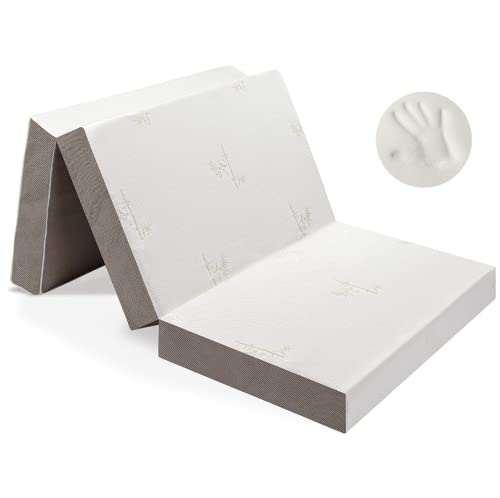
The two linked picks are sold on Amazon — check current price, size, and availability there before buying. Start with the Milliard Trifold Mattress, the folding foam bed that basecampers choose when they are done with leaks; confirm your size through this Check on Amazon link. The other linked pick: Best Price Mattress 6 inch Bed-In-A-Box — Check on Amazon (the truck-bed and long-stay foam option). The inflatable picks — a raised double-high air bed, a twin camping air mattress with a rechargeable pump, a backpacking air pad, and a self-inflating foam pad — are prose-only, with shopping guidance in their sections.
In this guide
Quick Picks
| Pick | Badge | Why it earns its place |
|---|---|---|
| Milliard Trifold Mattress | Best Overall | Folding memory foam: the basecamp bed that cannot leak, squeak, or lose pressure on the coldest night of the trip. |
| Raised Double-High Air Bed (prose-only) | Best for Comfort Campers | Real bed height for tent campers who dress, sit, and rise like humans — the glamping standard. |
| Twin Camping Air Mattress with Rechargeable Pump (prose-only) | Best for Families | One per camper, inflated in minutes from a battery pump — the festival and family-camp workhorse. |
| Best Price Mattress Full Mattress 6 inch Bed-In-A-Box | Best for Long Stays | Six inches of real foam for truck beds, wall tents, and week-long basecamps where air becomes a chore. |
| Backpacking Air Pad (prose-only) | Best for Packability | Packs to a water bottle’s size for campers who carry their bedroom on their back. |
| Self-Inflating Foam Pad (prose-only) | Best Insulation | Foam-core warmth and graceful failure — the cold-ground answer in pad form. |
Key Takeaways
- Insulation decides cold-weather camping sleep: bare air beds conduct your heat into the ground, so shoulder-season campers need foam cores or insulating layers.
- Top up air beds at bedtime, after the air inside cools — most “leaks” are just contracting air.
- Height is comfort and cost: raised beds are glorious in a tent and useless in a backpack.
- Every air bed eventually meets a sharp object; a repair kit in the tent is not pessimism, it is equipment.
- Foam picks never fail at 2 a.m., which is why basecampers and long-stay campers graduate to them.
- Vehicle campers should start with our sibling guide, Best Air Mattresses For Car Camping, where the same foam champion is fitted to cargo floors and truck beds.
How These Picks Were Chosen
Method, stated openly as in our car-camping guide: the verified pool contains home mattresses, two of which — a folding tri-fold and a slim foam slab — have genuine camping lives and are linked picks. The four inflatable families that define this keyword are covered as prose-only category guidance: what they are, who they serve, what to look for, how they fail. No ASINs, prices, or specifications are offered for them, because none can be verified from our pool. Selection criteria across all six: insulation adequacy, setup burden at a real campsite, durability against ground and gear, packed size versus trip type, and second-life value at home.
If you came here wanting a ranked list of inflatable models with buy buttons, this guide will disappoint you on purpose — and then, we hope, save your trip anyway with the category knowledge that actually determines whether a blow up mattress sleeps well.
The 6 Best Blow Up Mattresses for Camping — Reviewed

Milliard Trifold Mattress
Our badge: Best Overall
The Milliard Trifold Mattress tops a blow up mattress guide while containing no air, and every experienced camper reading this already knows why: it is the bed you graduate to. Six inches of high-density memory foam in a tri-fold design, with a removable machine-washable cover, it folds into the vehicle, unfolds onto a tent floor or platform, and delivers the same contouring, pressure-relieving sleep at the lake that it delivers in the guest room. No pump, no pressure, no patch kit, no 2 a.m. floor.
Strengths
- Failure-proof: foam cannot leak, and its comfort is identical on night one and night thirty
- Genuine memory foam sleep quality, a class above every inflatable
- Washable cover handles the dusty, muddy reality of camping life
Trade-offs
- It travels by vehicle only — folded bulk excludes backpacks absolutely
- Twin XL footprint in this listing: one camper’s bed, or a couple’s coziness test
- On frozen ground it still wants an insulating layer beneath, like everything in this guide
| Color | White |
| Size | Twin XL |
| Dimensions | 78 x 38 x 6 inches |
The Milliard’s camping habitats are the drive-up site, the family tent with a platform or a swept floor, the hunting camp, and the festival field where the car is twenty feet away. In those habitats its virtues compound nightly: no inflation ritual at a dark campsite, no pressure management as temperatures swing, no valve to lose. Campers with kids discover its second superpower — it is also the sleepover and guest mattress at home, so its cost-per-night collapses across the year in a way single-purpose camping gear cannot match.
Cold-weather protocol is simple: a closed-cell pad, a moving blanket, or even a layer of cardboard beneath it breaks the ground’s thermal bridge, and the foam does the rest. If your camping is vehicle-based and your air beds have betrayed you twice, this is the pick that ends the pattern.
Best for: drive-up campers, families, and basecampers who prioritize sleep over pack size / Not suited for: backpackers and back-seat-only vehicle campers
Choose it for the best sleep at any drive-up site; skip it if your campsite is a hike away. Check on Amazon
Raised Double-High Air Bed (Prose-Only Pick)
Our badge: Best for Comfort Campers
The raised air bed — a double-high inflatable that stands at roughly the height of a home mattress — is the glamping category’s foundation: you sit on it to dress, swing your legs over its edge in the morning, and sleep at a height where the tent’s cold floor layer matters less. Built-in pumps (mains or battery) inflate the chambered structure in minutes, flocked tops keep bedding in place, and internal beam construction gives the surface a surprising evenness. For campers with mobility considerations, older campers, and anyone whose tent is a palace, it is the blow up category’s most civilized product — described here qualitatively, with no linked model.
Strengths
- Real bed height: sitting, dressing, and rising are dignified, not athletic
- Chambered construction sleeps more evenly than simple air slabs
- Built-in pumps make setup a button press at the site
Trade-offs
- The most air volume in the guide means the most cold-night pressure change and the coldest core without insulation layers
- Heavy and bulky packed — vehicle camping only, and a big vehicle at that
- A puncture is a total failure; the repair kit is mandatory equipment
Shopping guidance: prioritize internal construction (coil-beam or I-beam designs sleep flatter than simple chambers), a pump that runs on battery or 12V rather than mains only, and a flocked, puncture-resistant top. Insulate it like you mean it — a blanket or insulated pad over the top, under the sheet, transforms its cold-weather manners, because all that internal air is a convection engine pulling heat downward. Set it on a groundsheet, clear the tent floor of anything sharper than a thought, and top it up at bedtime. Used so, it delivers the closest thing to a bedroom that a tent can hold.
Best for: glampers, older campers, and tent campers who value bed height and ease / Not suited for: cold-weather camping without insulation layers, or any trip involving a backpack
Choose it for tent luxury; skip it for minimal or cold-weather kits.
Twin Camping Air Mattress with Rechargeable Pump (Prose-Only Pick)
Our badge: Best for Families
The family-camping workhorse is the humble twin air mattress, one per camper, inflated by a rechargeable or battery pump that lives in the camping bin. Twins solve the couple’s-bed problems of camping — no shared surface to negotiate, no partner’s roll becoming yours, easy replacement when one eventually fails — and they stack, store, and lend gracefully. Modern versions add flocked tops, quick-release valves for fast deflation, and pumps that recharge by USB so the same battery culture as your lanterns and phones keeps the beds alive. A prose-only category pick; shop by the guidance here.
Strengths
- One bed per camper: personal firmness, personal failure domain, no shared deflation
- Rechargeable pumps inflate a family’s fleet in minutes, trip after trip
- Packs small, stores flat, doubles as home guest and sleepover duty
Trade-offs
- Thin profiles sleep cold and firm; kids forgive this, adults’ hips may not
- Valve and seam quality varies wildly in this category — the cheap end fails young
- Squeaking against tent floors is the category’s soundtrack without a blanket beneath
Shopping guidance: buy the pump as carefully as the mattress — a rechargeable pump with a full set of nozzles is the fleet’s heart, and a manual backup pump is its insurance. Choose mattresses with wide, quick valves (inflation and deflation both matter at a rainy pack-up), flocked tops, and repair patches in the box. Put a blanket or groundsheet under each bed, top up at bedtime, and assign each camper their own bed to care for — family camping runs on systems, and this is one of the good ones. For home guest duty, the same twins stack in a closet and deploy for the cousin weekend, which is why this category outsells everything else in camping sleep.
Best for: family camps, festivals, scout-style group camping, and home guest overflow / Not suited for: couples wanting one shared bed or campers needing real insulation
Choose it for fleet practicality; skip it for romantic or arctic ambitions.

Best Price Mattress Full Mattress 6 inch Bed-In-A-Box
Our badge: Best for Long Stays
The Best Price Mattress 6 inch Bed-In-A-Box is the long-stay camper’s answer: six inches of layered memory foam — contouring foam over support and high-density layers, green-tea infused, CertiPUR-US certified — in a full-size footprint, for the wall tent, the truck bed under a shell, the seasonal campsite, and the hunting or fishing camp where the bed stays made for a week or a season. At thirty pounds it hauls out for airing and cleaning between stays, and it never once asks for a pump.
Strengths
- Home-mattress foam comfort for camps measured in weeks
- Full-size footprint sleeps two — the long-stay couple’s foam option
- Light enough to remove, air, and store between seasons
Trade-offs
- Permanent space commitment in the vehicle or tent
- Must be kept dry — foam and a leaking tent are enemies
- Six inches is adequate, not luxurious, for heavier side sleepers
| Color | White |
| Size | 6 Inch |
| Dimensions | 75 x 54 x 6 inches |
| Weight | 30.42 pounds |
The economics of long stays flip the camping equation: an air bed’s nightly chores and failure risks, trivial for a weekend, compound into genuine friction across a month of nights, while a foam slab’s one-time placement cost amortizes to nothing. Camp hosts, seasonal workers, long-hunt parties, and slow travelers live in this math. Insulate beneath the foam on cold ground, protect it with a washable cover, ventilate the tent or shell regularly, and the setup becomes a small cabin’s bedroom rather than a campsite’s compromise.
Its home credentials — certified foams, a ten-year warranty — are unheard of in camping gear, and its second life as a guest or futon mattress mirrors the Milliard’s dual-use logic. If your camping is measured in weeks, this is the pick that respects the calendar.
Best for: long-stay basecamps, truck-bed campers, wall tents, and seasonal sites / Not suited for: weekend minimalists or anyone packing light
Choose it when the camp is a residence; skip it when the camp is a stop. Check on Amazon
Backpacking Air Pad (Prose-Only Pick)
Our badge: Best for Packability
At the opposite pole from the raised bed sits the backpacking air pad: an inflatable that packs to the size of a water bottle, weighs what a sandwich weighs, and inflates by breath or a tiny pump sack into a few inches of baffled air. Modern pads use horizontal or vertical baffles to stabilize the sleeper, reflective layers to return some heat, and fabrics that balance silence against durability. For the camper who carries the bedroom, this is the only category that exists — described here as prose-only guidance, because its virtues are measured in grams our pool does not trade in.
Strengths
- Packs and weighs almost nothing — the bed disappears into the pack
- Baffled designs sleep far better than their thickness suggests
- Inflation by breath or pump sack needs no batteries at all
Trade-offs
- Thin air is cold air: winter versions need real insulation ratings, and summer pads in autumn are a misery
- The most puncture-vulnerable pick in the guide — ground discipline is survival
- Narrow widths punish restless sleepers; you sleep on it, not in it
Shopping guidance: match the pad’s insulation rating to your coldest expected night, not your average one, and choose the wide version if you are a side sleeper — the weight penalty is small and the shoulder relief is real. A pump sack (which doubles as a dry bag) keeps moisture from your breath out of the pad’s interior, extending its life. Practice the home repair before the trip: a pad you cannot patch in the field is a pad you sleep under, on the ground, at the worst moment. Backpackers accept these terms because the alternative is not camping at all — and within its discipline, a good air pad sleeps astonishingly well.
Best for: backpackers, bikepackers, and minimalist campers who carry everything / Not suited for: vehicle campers, who can afford better sleep for free
Choose it when every gram is audited; skip it the moment a vehicle is involved.
Self-Inflating Foam Pad (Prose-Only Pick)
Our badge: Best Insulation
The self-inflating pad is the category that quietly wins cold-weather camping: an open-cell foam core inside an airtight shell, which expands when the valve opens and draws air in until the pad is nearly firm, needing only a breath or two to finish. The foam is the insulation — it breaks the air’s internal circulation that makes pure air beds cold — and it is also the insurance, because a punctured self-inflating pad degrades into a thin foam pad rather than a flat sheet of plastic on frozen ground. For tent campers in shoulder seasons, it is the thinking pick, offered here as prose-only guidance.
Strengths
- Foam-core insulation sleeps warm where air beds freeze their sleepers
- Graceful failure: a leak softens it, it does not erase it
- Valve control fine-tunes firmness precisely for side sleepers
Trade-offs
- Packs bigger than air pads — vehicle and short-carry camping, not ultralight
- Thinner than foam mattresses; hard ground still announces itself to bony hips
- Quality versions cost real money — this is buy-once gear
Shopping guidance: insulation rating first (the R-value scale; choose for your coldest nights, with margin), width second, valve quality third — a valve you can work with gloves in the dark is worth paying for. Two pads coupled side by side make a couple’s bed without the shared-air negotiations. Store the pad unrolled with the valve open, as makers advise, so the foam core keeps its loft for years. In a tent on cold ground, this is the category that separates campers who sleep from campers who endure — and it follows you home as a floor bed and a guest option, which softens its premium.
Best for: cold-weather and shoulder-season tent campers who value warmth and reliability / Not suited for: ultralight backpackers or plushness seekers
Choose it for warm, dependable ground sleep; skip it if packed size is your religion.
Comparison Table
| Pick | Type | Packed Size | Cold-Ground Behavior | Check price on Amazon |
|---|---|---|---|---|
| Milliard Trifold | Folding foam (linked) | Large — vehicle only | Good with a base layer | Check price on Amazon |
| Raised Double-High Air Bed | Inflatable (prose-only) | Large | Poor without top insulation | Check price on Amazon |
| Twin Air Mattress + Pump | Inflatable (prose-only) | Small | Poor — add blankets beneath | Check price on Amazon |
| Best Price Mattress 6″ | Foam slab (linked) | Permanent install | Good with platform insulation | Check price on Amazon |
| Backpacking Air Pad | Inflatable pad (prose-only) | Bottle-size | Depends entirely on its rating | Check price on Amazon |
| Self-Inflating Pad | Foam-core pad (prose-only) | Moderate roll | Best in guide | Check price on Amazon |
How to Choose the Best Blow Up Mattress for Camping
Start With How You Arrive
Vehicle, foot, or boat — the transport decides the category before preference gets a vote. Backpacks admit only air pads. Vehicles admit everything, and the choice becomes about nights and temperatures. Boats and remote camps admit what you can carry from the landing. Shoppers who skip this question buy raised beds for backpacking trips and pads for glamping, and both come home educated. Let the arrival choose the shortlist; let comfort rank it.
Insulation Is the Specification That Matters Most
Ground cold is the camping sleeper’s real enemy, and air is its accomplice: the air inside an uninsulated bed circulates, carrying your heat down all night. Foam cores interrupt that circulation; reflective and insulated air pads resist it; blankets beneath or above the mattress blunt it. For summer camping, almost anything works. For spring and autumn, insulation is the purchase — check ratings where the category offers them, and layer where it does not. The home version of this lesson appears in our Best Futon Mattresses For Sleeping guide, where floor sleepers fight the same thermal bridge.
Height, Width, and the Tent’s Real Dimensions
A raised bed in a low tent is a ceiling negotiation; a wide bed in a narrow tent is a wall press. Measure the tent’s floor and peak height against the mattress’s inflated dimensions, and remember that two twin beds often fit a family tent better than one queen — with better sleep politics included. Length matters for tall campers: a pad that ends at your calves is a cold, aching compromise, whatever its other virtues.
Pumps: Power, Noise, and Redundancy
Built-in pumps are convenience with a single point of failure; external rechargeable pumps serve a fleet and can be replaced alone; pump sacks and lungs never run out of battery. Choose by trip length and group size, and carry a backup inflation method on any trip where a dead pump means a ground night. Inflate with vehicle power or a power station, never by draining a starter battery at a remote site.
Durability Is a System, Not a Material
Thick vinyl helps, but ground discipline saves more mattresses: a groundsheet under the tent, a swept floor, a blanket under the bed, gear stored away from the sleep surface, and a repair kit in the tent — not the car, not home. Buy the bed whose failure you can repair at midnight with cold hands, and practice the repair once in daylight. Reliability in camping is a habit wearing a product costume.
How Do You Set Up Camp Sleep Properly?
Site first: pitch on the flattest, highest ground available — cold air and water both pool in dips — and orient the bed’s head slightly uphill if a slope is unavoidable. Clear the tent floor obsessively; the pebble you dismiss at setup is the one your hip interrogates all night. Lay the groundsheet, then any insulation layer, then the mattress. Inflate at setup for a leak check, then top up at bedtime when the trapped air has cooled to night temperature — the single habit that fixes most “deflation” complaints. Set firmness by lying on the bed, not by pressing a hand: an air bed should let a side sleeper’s hip sink without touching the ground, which feels softer at setup than most people expect. Keep the repair kit, a light, and water within reach, and vent the tent enough to manage condensation, which will otherwise rain your own breath back onto the bedding by dawn.
Problem: the bed is soft by 2 a.m. — top up at bedtime after cooling; check the valve is fully closed; if it recurs, find the leak with soapy water at home and patch it properly.
Problem: cold from below despite a thick air bed — thickness is not insulation; add a foam layer or insulated blanket between you and the mattress top, or beneath the mattress, and feel the difference in one night.
Problem: you roll into the middle or off the edge — overinflation makes air beds domed and unstable; let a little air out until the surface levels, and level the pitch if the ground slopes.
Problem: squeaking all night — a blanket or sheet between mattress and tent floor, and between mattress and sleeping bag, silences the vinyl chorus.
Problem: condensation on the bedding — vent the tent more, not less; two small openings beat one, and a battery fan moving air helps on still nights.
Camping Sleep and Temperature: The Physics Section
Three heat facts govern every pick in this guide. First, the ground is an infinite heat sink: it will take warmth from your bed all night at whatever rate your insulation allows, which is why the layer beneath you matters more than the blankets above. Second, air is a fluid: inside an uninsulated mattress it circulates in convection loops, which is why a thick air bed can be colder than a thin foam pad. Third, cooling air contracts: a bed inflated drum-tight at noon is a soft bed at midnight without leaking a molecule, which is why bedtime top-ups are ritual, not paranoia. Campers who internalize these three facts stop blaming products and start managing systems — and their sleep improves more than any upgrade could achieve. The same physics, gentler, governs vehicle camping in our sibling guide, and floor sleeping at home in the futon guide linked above.
Air Beds at Home: The Guest-Room Second Life
Most blow up mattresses spend more nights under guests than under stars, and buying with both lives in mind changes the ranking. The twin-with-pump fleet becomes the sleepover and cousin-weekend infrastructure; the raised bed becomes the guest room that is also an office; the foam picks become permanent guest beds that camp on weekends. Cost-per-night across both lives is the honest metric, and it favors durable, dual-purpose picks over single-trip bargains every time. If your camping is twice a year and your guests are monthly, buy the guest bed that camps. If your camping is monthly, buy the camp bed that guests can tolerate. Either way, refuse the single-purpose purchase at the cheap end — it is the only one guaranteed to be expensive.
Field Repairs and the 2 A.M. Deflation Protocol
Every inflatable eventually meets a sharp object, and the campers who sleep through the incident are the ones who rehearsed the response at home. The repair kit — patches matched to your mattress’s material, adhesive that cures in field conditions, a valve cap spare — weighs almost nothing and belongs in the same bag as the pump, permanently, not packed per trip by memory. Finding a leak in the field is a method, not a talent: inflate the mattress fully, press sections under load, and listen; a soapy-water wipe reveals the hiss as bubbles where ears fail. Patch on a clean, dry, deflated surface, weight the repair, and respect the adhesive’s cure time before re-inflating — a patch loaded too early fails by morning and takes the sleeper’s confidence with it. The 2 a.m. deflation itself has a protocol: top up once and note the time; a mattress soft again within the hour has a real leak, and the night’s remaining strategy is insulation and position — pad underneath if available, sleep on the least-deflated chamber, and save the repair for daylight and coffee.
Prevention remains cheaper than any protocol: a groundsheet or footprint under the tent, a swept tent floor, zippers and buckles kept off the surface, and pets’ claws respected as the puncture source they statistically are. Campers who camp with children should treat the mattress as furniture with rules — no bouncing is not cruelty, it is seam preservation — and households that host the same friends indoors will find the guest-duty version of these inflatables reviewed in the lot’s everyday air-mattress coverage, with Best Air Mattresses For Car Camping taking the vehicle-based branch of the family. Buy the repair kit with the mattress, rehearse once in the garden, and the worst night in this category becomes a story instead of a verdict. The same preparedness mindset governs the home side of the camping household: the futon-style floor bed that hosts overflow guests between trips is covered in Best Futon Mattresses For Sleeping, and the year-round bedroom upgrade that camping couples eventually prioritize is shopped most safely with the channel discipline of Best Place To Shop For Mattresses.
Altitude, Temperature, and the Physics of Air in the Field
Air obeys physics that campers ignore at their sleep’s expense. A mattress inflated firm at a warm trailhead softens by midnight as the air inside cools and contracts — the classic false leak that has sent a thousand good mattresses to the repair kit unnecessarily — while a mattress inflated soft at a cold evening camp turns drum-tight if the night warms or the sun hits the tent at dawn, stressing seams that never asked for the load. Altitude runs the same equation in reverse: air sealed at low elevation expands as you climb, so mountain campers inflate at camp, never before the drive. The field protocol that respects all three effects is simple — inflate to about ninety percent of firm at setup, top up by feel after the tent’s temperature settles for the night, and bleed a breath of air on any morning the sun will cook the tent while you hike. None of this requires instruments; it requires only remembering that the mattress is a weather instrument as well as a bed, and that half the “leaks” reported in this category are thermometers in disguise. Campers who internalize that stop patching good mattresses and start sleeping through the night — which was, from the first, the entire point of carrying the weight.
Storing the Inflatable: The Off-Season Decides Next Season
More camping air mattresses die in closets than on trails. The storage protocol that prevents it is short and non-negotiable. Clean before storing — grit left in the folds becomes abrasion, and moisture left in the fabric becomes mildew — then dry fully, in shade, with the valve open. Store unrolled or loosely folded with the valve open in a cool, dry place: the tight factory roll that shipped the mattress was a one-way trip, and re-creating it for a winter creases the material at exactly the points that will be flexed hardest next season. Keep the repair kit with the mattress, not with the camping gear generally, because the two will otherwise be in different boxes when both are needed. A midwinter check — unroll, inflate, leave overnight, deflate — costs twenty minutes and converts the spring’s first trip from a discovery exercise into a departure.
Households that camp seasonally should also date their inflatables, with a marker on the storage bag: age is the strongest predictor of seam behavior, and a five-year-old mattress that has served thirty nights owes nobody an explanation when it retires. Retire it to car-camping backup or donate the pump onward — and let the replacement be bought in the off-season sales, when this category’s prices do their annual softening and the prepared camper profits from everyone else’s calendar.
Group Camping and Shared Gear: The Communal Inflatable
Group trips add a social layer to inflatable ownership that solo campers never meet: shared gear, borrowed pumps, and the friend whose mattress knowledge begins and ends with jumping on yours. Groups that camp together repeatedly do well to standardize quietly — compatible pumps and valves across the fleet, a communal repair kit that travels with the group rather than with one forgetful member, and an explicit norm about whose mattress hosts the card game (nobody’s, is the durable answer). The borrower protocol deserves the same daylight: a lent inflatable returns inflated-tested or with its wounds confessed, and the lender who states that expectation in advance, cheerfully, will lend again. None of this is fussiness; it is how communal equipment survives to its third season, and the third season is where camping gear starts paying back its purchase price in memories per dollar.
The group context also argues for one deliberate redundancy: a single spare pad — even the humblest in this guide’s prose-only ranks — carried by the group as insurance. Somebody’s mattress will eventually fail on night one of four, and the spare converts a ruined trip into a funny story at the cost of one packed item. Buy it communally, store it with the repair kit, and let it be the most boring, most beloved object in the fleet.
Teaching Children to Camp: The Inflatable as First Bed
For many children, a camping air mattress is their first bed away from home, and the experience sets their relationship with the outdoors more durably than any single hike. The practicalities are simple and worth the paragraph: a child’s lighter body needs less inflation pressure — an adult-firm pad is a trampoline to a forty-pound sleeper — and a pad placed beside, not under, restless small sleepers survives the night better. Familiarity is the real equipment: the child who has slept on the pad in the living room treats the tent version as routine, while the child meeting it first at a dark campsite files the whole night under strange. Rehearse at home, inflate by the child’s verdict rather than the adult’s, and the first camping morning arrives with a rested recruit for the second trip.
Why Bother: A Brief Defense of Sleeping Well Outdoors
It is fair to ask why a guide lavishes this much method on an inflatable. The answer is the arithmetic of trips: campers do not remember the tenth-best view or the second-best meal with anything like the fidelity they remember the night they did not sleep — and its sequel, the day spent recovering from it. Sleep is the multiplier on every other hour outdoors. A camper who sleeps well hikes the extra mile, cooks the better breakfast, and books the next trip; a camper who does not, quietly stops camping. The mattress is where that fork in the trail is decided, which is why it deserved a guide with standards.
Common Buying Mistakes
Buying Thickness Instead of Insulation
A fourteen-inch uninsulated air bed is a taller cold bed. In shoulder seasons, campers freeze in proportion to their mattress’s air volume. Insulation rating and foam content are the warmth specs; height is a comfort spec. Buy them in that order.
Skipping the Groundsheet and the Sweep
Most punctures are born under the tent, not in it: the sharp pebble, the thorn, the forgotten tent stake. A groundsheet and a two-minute floor sweep prevent the majority of midnight deflations ever recorded.
Inflating Once and Forgetting
Air beds are pressure systems in a changing temperature field. The bedtime top-up is not maintenance for the paranoid; it is the product working as designed. Campers who skip it conclude their mattress leaks; it usually does not.
No Repair Kit in the Tent
A patch kit weighs nothing and decides whether a puncture is a story or a ruined trip. If the mattress did not include one, buy one before the first trip — and learn the repair at home, in daylight, with warm hands.
Matching the Mattress to the Wrong Arrival
Raised beds do not backpack and pads do not glamp. The most returned camping mattresses are good products bought for the wrong transport. Arrival first, always.
Final Recommendation
For vehicle-based campers, our recommendation is the foam rebellion: the Milliard Trifold Mattress sleeps better than any inflatable, fails never, and works at home between trips — with the Best Price Mattress as the long-stay, two-sleeper version of the same idea, Check on Amazon. Tent campers committed to air should buy by the physics: a self-inflating pad for cold ground, a raised bed for warm-weather luxury, twins with a good pump for family fleets, and the lightest baffled pad only when a backpack demands it. Whatever you choose: insulate beneath, top up at bedtime, carry the patch kit, and test the whole system in the backyard before the backcountry. The ground will do its worst regardless; your bed should be ready. For the bedding that completes the camp kit, Black Friday Bedding Deals 2026 is where the spare layers go on sale.
Frequently Asked Questions
Why does my camping air mattress feel deflated in the morning?
Usually because the air inside cooled and contracted overnight — physics, not a leak. Inflate at setup for a leak check, then top up at bedtime to night temperature. If the bed still loses significant pressure, test for leaks with soapy water at home and patch what you find.
How do I stay warm on an air mattress in a tent?
Insulate between you and the ground’s cold: a foam pad or insulated layer under or over the air mattress breaks the thermal bridge that bare air cannot. A sleeping bag rated for the temperature and a hat for the night complete the system. Thickness of air alone will not keep you warm.
What is the difference between an air bed and a self-inflating pad?
An air bed is a hollow inflatable — light and packable, but uninsulated and fully dependent on its shell. A self-inflating pad has a foam core that expands to fill the shell, adding insulation, fine firmness control, and graceful failure if punctured, at the cost of packed size.
Can I use a regular home air mattress for camping?
For warm-weather, vehicle-based camping, yes — with a groundsheet, insulation layers, and a repair kit. Its weaknesses (cold core, bulk, mains-powered pumps) are manageable at a drive-up summer site and decisive against it in cold weather or on foot.
How firm should a camping air mattress be?
Firmer is not better. Inflate until, lying in your sleep position, your hip sinks without touching the ground and the surface stays level — usually softer than a hand-press suggests. Overinflation causes doming, rolling, and seam stress.
Foam or air for camping — which is better?
Foam sleeps better, insulates better, and never fails suddenly, but packs large and travels by vehicle. Air packs small and light but insulates poorly and can fail completely. Self-inflating foam-core pads split the difference. Your transport and your season should decide, in that order.


