Disclosure: As an Amazon Associate, dailyhomedecorating.com earns from qualifying purchases. Links to Amazon on this page are affiliate links; they cost you nothing extra. Prices and availability change often, so check the current Amazon listing before you buy.
Hot sleepers know the choreography by heart: one leg out of the covers, a flip to the cool side of the pillow, a 3 a.m. relocation to the untouched half of the bed. If you are searching for the best mattresses for hot sleepers, the problem is not your thermostat — it is your mattress, which has been absorbing your body heat all evening and handing it back to you all night. Traditional memory foam is the worst offender, because dense foam insulates exactly where you press into it, but any mattress can sleep hot if its surface seals against your skin and its core gives heat nowhere to go.
The six mattresses in this guide attack heat with genuinely different physics: an open polymer grid that air flows through freely, phase-change and gel foams that absorb and dissipate warmth, copper particles that conduct heat away, graphite-infused adaptive foam, and coil cores that ventilate the whole bed. Cooling claims are the most exaggerated in the mattress industry, so we have been careful to describe mechanisms rather than repeat slogans — a mattress cannot refrigerate you, but the right one can stop actively heating you, and for most hot sleepers that difference is the whole night. Pair this guide with our broader look at Best Mattresses For Sleep if temperature is one of several problems, or with Best Mattresses Under $1000 if the budget is firm.
Where to Buy
Every pick here is sold on Amazon, where you can check current price, sizes, and trial terms on the listing. Start with our top pick, the Purple Mattress — Check on Amazon. The other five picks are the Sweetnight CoolNest Queen Mattress — Check on Amazon; the Tuft & Needle Original Legacy Mattress — Check on Amazon; the Lucid 10 Inch Gel Memory Foam Mattress — Check on Amazon; the Layla 10” Copper Infused Memory Foam Mattress — Check on Amazon; and the Sealy Dreamlife 12” Hybrid — Check on Amazon. Confirm current pricing on the listing itself, since mattress promotions change often.
In this guide
Quick Picks
| Pick | Badge | Why it earns its place |
|---|---|---|
| Purple Mattress | Best Overall | The GelFlex Grid’s open air channels make it the most temperature-neutral surface in this guide |
| Sweetnight CoolNest Queen Mattress | Best Cooling Foam Design | PCM foam, gel memory foam, and a ventilated cover stack three cooling mechanisms in one bed |
| Tuft & Needle Original Legacy Medium Firm Gel Foam Queen Mattress | Best Responsive Cooling | Graphite and gel in open-cell adaptive foam wick heat while keeping the feel bouncy, not swampy |
| Lucid 10 Inch Gel Memory Foam Mattress | Best Budget | Gel foam plus bamboo charcoal at the most accessible tier here |
| Layla 10” Copper Infused Memory Foam Mattress | Best for Couples With Different Thermostats | Copper conducts heat away, and the flippable design lets two sleepers negotiate firmness too |
| Sealy Dreamlife 12” Hybrid Mattress-in-a-Box | Best Hybrid Airflow | Encased coils ventilate the core while gel foam cools the surface |
Key Takeaways
- Cooling is a mechanism, not an adjective: look for open structures, gel or graphite infusions, phase-change materials, or coil airflow.
- Grid and hybrid designs move the most air; infused foams moderate heat at the surface but cannot match ventilation.
- Your bedding can sabotage any mattress — breathable sheets and a breathable protector are part of the cooling system.
- Foam softens as it warms, so a cooling mattress also holds its support character more consistently overnight.
- Hot sleeping is often a couple problem: motion isolation and dual comfort matter alongside temperature.
- Judge cooling over a full week of weather, not one mild night.
How These Picks Were Chosen
We filtered a verified product pool for named cooling mechanisms. Every pick had to explain where the heat goes: through an open grid, into gel or graphite infusions, along copper particles, into phase-change foam, or out through a coil core. We weighed the strength of the mechanism against the rest of the mattress — support, pressure relief, motion behavior, and durability — because a cool bed you cannot sleep on is a fan with delusions. We also considered trial length, since cooling can only be judged across real nights in your own room, and certifications as baseline hygiene.
Filtered out: mattresses whose only cooling claim was a “cool-touch” cover over otherwise conventional dense foam, very thin profiles with no room for a real cooling stack, and products whose verified specifications we could not confirm. Method honesty: this is a research guide built from manufacturer-verified specifications and documented features, not a thermal laboratory; where a maker quantifies a claim, we treat it as their claim, not our measurement. Readers whose heat problem rides along with side sleeping should also see Best Hybrid Mattresses For Side Sleepers, where airflow and shoulder relief intersect.
The 6 Best Best Mattresses for Hot Sleepers — Reviewed

Purple Mattress
Our badge: Best Overall
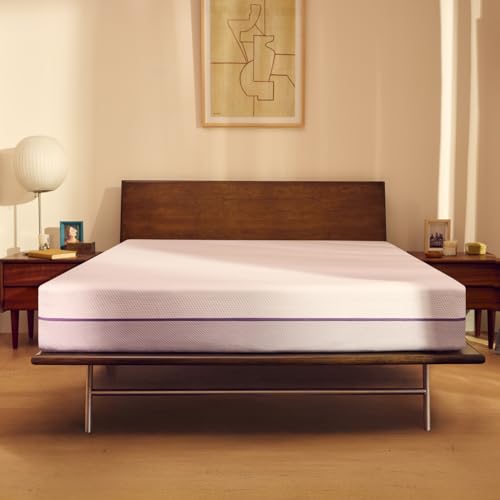
The Purple Mattress is the most convincing answer to hot sleeping in this guide because its cooling is structural. Two inches of the GelFlex Grid — a flexible polymer lattice — sit over the support layers, and the grid’s open geometry is mostly air: channels run through it, heat escapes sideways instead of accumulating under your body, and the material itself is temperature-neutral rather than heat-absorbing like foam. You do not sink into a warm mold of yourself; you rest on a responsive surface that cradles hips and shoulders while your spine stays aligned.
Strengths
- Open grid channels move air freely — the strongest cooling mechanism here
- Grid flexes at pressure points while supporting alignment, suiting all positions
- Instant response: no slow foam sink, no heat-soaked body impression
Trade-offs
- The grid feel is genuinely unusual — some sleepers never adapt to it
- At 100 pounds in queen per the pool specs, it is the heaviest pick here
- Premium positioning; budget shoppers should start with the Lucid
| Color | White |
| Size | Queen |
| Dimensions | 80 x 60 x 11 inches |
| Weight | 100 pounds |
The overnight thermal experience is the point. Foam beds warm progressively: the surface under your torso climbs toward body temperature and stays there, which is why hot sleepers migrate across the bed hunting for a cool patch. The Purple has no patch problem because there is no heat reservoir — move an inch and the grid under you is room temperature, and even staying still, the channels keep exchanging air with the room as you breathe and shift. Back, stomach, side, and combination sleepers are all served by the medium-firm feel, and the edge support foam keeps the perimeter stable for sitting.
Purple cites a 2025 SleepScore Labs study in its listing materials in which most participants felt more supported on the grid; we report that as the maker’s claim, and note the design’s two-plus decades of patents behind it. The mattress is made in the USA. What we can say from construction alone is that no other pick here gives heat as many exits.
Practical notes: the Purple is heavy, so plan a two-person setup and minimal future moving. Its responsiveness makes it a kind partner bed in one way — position changes are easy — though motion isolation differs from foam: movement ripples less than on coils but the surface is livelier than memory foam. Sheets should be breathable to avoid capping the grid’s airflow with a sealed synthetic layer; the best cooling mattress in the world cannot breathe through plastic-feeling bedding.
Durability expectations are strong: the grid does not fatigue like foam cells, and the base layers are conventional and proven. If heat is your primary sleep enemy and the budget reaches, this is the guide’s clearest recommendation.
Best for: hot sleepers of every position who want structural, all-night cooling / Not suited for: shoppers who love the classic memory foam hug or need a light mattress
Choose the Purple if heat, more than anything, is ruining your sleep. Skip it if you are devoted to foam’s slow contour. Check on Amazon
Sweetnight CoolNest Queen Mattress
Our badge: Best Cooling Foam Design
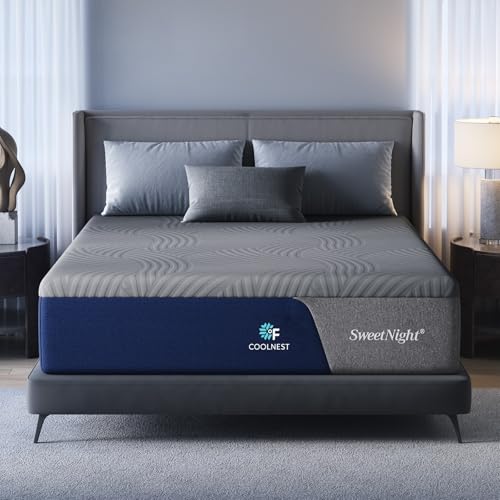
The Sweetnight CoolNest Queen Mattress is what happens when a foam maker treats cooling as a system rather than a sprinkle. Its CoolNest design layers phase-change high-resilience foam with gel-infused memory foam, wraps it in a 3D-woven ventilated cover, and builds the whole 14-inch mattress around a five-zone ergonomic support layout. Each element addresses a different stage of the heat problem: the cover ventilates, the PCM foam absorbs and releases heat to stabilize surface temperature, and the gel foam dissipates what gets through.
Strengths
- Three cooling mechanisms layered — cover ventilation, PCM foam, gel infusion
- Five-zone support keeps cooling from costing you spinal alignment
- Strong motion isolation for couples with different schedules
Trade-offs
- Fourteen-inch profile needs deep-pocket sheets and raises bed height
- Full expansion can take up to 72 hours
- Foam, however engineered, still ventilates less than the Purple’s open grid
| Color | Grey & Blue |
| Size | Queen (U.S. Standard) |
| Dimensions | 80 x 60 x 14 inches |
| Weight | 68.67 pounds |
Sweetnight quantifies parts of its system — the cover’s ventilation design and the PCM foam’s airflow are described with comparative figures in its materials — and we treat those as manufacturer claims rather than our measurements. What construction alone supports is the direction: more pathways for heat and moisture than a standard foam stack, arranged at every level of the bed instead of only the top inch. The practical result for hot sleepers is a surface that stays composed deeper into the night, with fewer of the escalating wake-ups that begin around 2 a.m. on basic foam.
The five-zone support deserves equal billing, because hot sleepers are still sleepers: the zones redistribute pressure from head to toe while keeping the lumbar region stable, and the design carries recognition from the American Chiropractic Association per the listing. Medium feel suits back and side sleepers best. The foams and cover are CertiPUR-US certified, and a 10-year protection plan is included.
Plan around the profile. Fourteen inches on a standard frame produces a tall bed; shorter sleepers and anyone with stiff joints should measure total height and consider a low-profile frame. Deep-pocket sheets are mandatory, and the expansion window is real — judge this mattress on day four, not day one.
For foam loyalists who run hot, the CoolNest is the most serious attempt in this guide to keep the foam feel and lose the foam furnace.
Best for: hot sleepers who love foam contouring and want zoned support with it / Not suited for: shoppers needing a low bed height or an instantly ready mattress
Choose the Sweetnight if you want foam’s hug without foam’s heat penalty. Skip it if your frame already sits high. Check on Amazon

Tuft & Needle Original Legacy Medium Firm Gel Foam Queen Mattress
Our badge: Best Responsive Cooling
The Tuft & Needle Original Legacy cools with chemistry inside a responsive foam: its T&N Adaptive foam is open-cell, infused with cooling gel and heat-conducting graphite, designed to wick heat away while delivering bounce-back support instead of memory foam’s slow sink. For hot sleepers who also hate feeling trapped — the combination that makes summer nights on foam miserable — this pairing of airflow and response is the point of the product.
Strengths
- Graphite and gel infusions conduct and disperse heat inside an open-cell foam
- Responsive, medium feel suits all positions and makes movement easy
- Cooling cover and ventilated layers support the foam’s work
Trade-offs
- Infusion cooling moderates heat rather than ventilating like grid or coils
- Maker advises allowing up to two weeks for full break-in and air-out
- Ten-inch profile is moderate for heavier sleepers
| Color | White |
| Size | Queen |
| Dimensions | 80 x 60 x 10 inches |
| Weight | 72 pounds |
Tuft & Needle’s layering is thoughtful: the Adaptive foam handles contour and heat, a Flex foam firms up progressively as you settle deeper — support that arrives in proportion to load — and a ventilated Release foam enhances pressure relief. The brand quantifies its airflow advantage against standard memory foam in its materials; as with all such figures we report the mechanism, not the marketing number, as the reason to buy. The mechanism is credible: open cells move air, graphite moves heat, gel absorbs it.
The feel will suit sleepers who found memory foam claustrophobic. You rest more on this mattress than in it, position changes are immediate, and the medium firmness is a genuine all-position compromise. Couples get moderate motion control — less isolation than dense memory foam, more than coils — and the cooling cover keeps the first-touch surface pleasant in a warm room.
The mattress is assembled in the USA, CertiPUR-US and GREENGUARD Gold certified, and lists a 100-night trial with a 10-year limited warranty. Note the maker’s break-in guidance: allow the full settling period before judging either firmness or temperature, because a compressed foam’s airflow and feel both change as it fully opens.
At 72 pounds it is a two-person setup, and rotations should be scheduled seasonally. For hot sleepers who want a normal-feeling bed that simply runs cooler and responds faster, this is the guide’s most balanced package.
Best for: hot sleepers who dislike memory foam’s sink and want responsive, cooler foam / Not suited for: shoppers wanting maximum contour or maximum ventilation
Choose the Tuft & Needle if heat and sluggish foam are your twin complaints. Skip it if you want the Purple’s structural airflow. Check on Amazon

Lucid 10 Inch Gel Memory Foam Mattress
Our badge: Best Budget
The Lucid 10 Inch Gel Memory Foam Mattress brings real cooling ingredients to the accessible end of the guide: three inches of gel-infused memory foam that draws heat from the body, plus bamboo charcoal that absorbs moisture and helps regulate temperature, over a transition layer and high-density base. Gel and charcoal are the two most proven foam-cooling additives, and Lucid stacks both where they matter — in and under the comfort layer you actually touch.
Strengths
- Gel infusion plus bamboo charcoal address heat and humidity together
- Layered build balances contour and support for back and combination sleepers
- Adjustable-base compatible, widening its usefulness beyond this purchase
Trade-offs
- Ten-inch profile is thinner than the premium picks for heavier sleepers
- Medium feel may be soft for strict stomach sleepers
- Additive cooling helps but cannot match grid or coil ventilation
| Color | White |
| Size | Queen |
| Dimensions | 79 x 59 x 10 inches |
| Weight | 57.9 pounds |
In humid climates, the charcoal earns its keep as much as the gel. Heat complaints and moisture complaints travel together: a surface that feels clammy by the third night is a surface whose foam is holding humidity against your skin. Charcoal’s absorption keeps the comfort layer fresher, and the gel handles the thermal side, so the Lucid performs above its tier in exactly the conditions — warm, damp nights — where budget foam usually fails first.
The construction is honest mid-market engineering: a real comfort layer with real depth, a transition layer that grades your descent so hips do not bottom out abruptly, and a base that keeps the spine’s line. It is CertiPUR-US certified, made in the USA with global and US parts, and backed by a 10-year limited warranty. At just under 58 pounds, it is manageable to set up and rotate without a production.
Guest rooms in warm houses are a natural home for this mattress, as are first apartments and rentals where the cooling budget is real but limited. Hot sleepers on a strict budget should start here and spend the savings on breathable bedding, which multiplies the mattress’s work.
Set expectations correctly — this is moderation, not air conditioning — and the Lucid is the guide’s value anchor for hot sleepers.
Best for: budget-conscious hot sleepers in warm or humid homes / Not suited for: heavier sleepers needing a deeper support core
Choose the Lucid if the budget is real and so is the heat. Skip it if you can reach the grid or hybrid tiers. Check on Amazon

Layla 10” Copper Infused Memory Foam Mattress
Our badge: Best for Couples With Different Thermostats
The Layla 10” Copper Infused Memory Foam Mattress cools by conduction: copper-gel particles in the memory foam condense under your body and form a thermal pathway that pulls heat through the foam and away. It is an elegant mechanism for couples, because it works hardest exactly where a body is pressing — each sleeper gets cooling proportional to their own heat load — and the flippable soft/medium-firm design lets the same couple negotiate firmness in the same purchase.
Strengths
- Copper particles conduct heat away and firm up under load for adaptive support
- Flippable two-sided firmness solves couples’ most common disagreement
- Cooling scales with body pressure, suiting partners who run at different temperatures
Trade-offs
- Conduction cools the foam, but the bed still ventilates like foam, not like a grid
- Flipping a 69-pound queen takes two people
- Neither side is extra-firm for stomach sleepers wanting maximum lift
| Color | Natural |
| Size | Queen |
| Dimensions | 80 x 60 x 10.5 inches |
| Weight | 69 pounds |
The dual personality deserves a strategy. Start on the medium-firm side if back support is a concern, or the soft side if pressure points dominate, and give each side a fair week before flipping — the trial runs 120 nights per the listing, and two free memory foam pillows are included in this queen listing. Many couples discover the real benefit is temporal: the side that suits you at 30 may not at 40, and the Layla absorbs that change without a new purchase.
Copper’s support behavior is the underappreciated half of the design. As particles condense under load they push back harder, so hips receive more support than shoulders automatically — a passive zoning effect that back and combination sleepers feel as a bed that seems to know where the weight is. For hot sleepers specifically, the same condensation creates the thermal pathway, meaning the heaviest, warmest contact points get the strongest cooling response.
The mattress is made in the USA and made to order per the maker, which they credit for fresher foam performance. Pair it with breathable sheets to keep the conduction path working — the copper can only move heat that reaches it.
For households negotiating two thermostats and two firmness opinions on one bed, nothing else in this guide offers as many levers.
Best for: couples with different temperature and firmness needs / Not suited for: solo shoppers who want maximum ventilation or extra firmness
Choose the Layla if your bed negotiations involve both heat and feel. Skip it if your preference is settled and singular. Check on Amazon

Sealy Dreamlife 12” Hybrid Mattress-in-a-Box
Our badge: Best Hybrid Airflow
The Sealy Dreamlife 12” Hybrid cools the old-fashioned way: with air. Seven inches of individually encased coils create a ventilated core that foam cannot imitate — every movement you make pumps a little air through the bed — while two inches of SealyComfort gel memory foam and a transition layer cool and cushion the surface. For hot sleepers who also want traditional bed behavior — lift, bounce, easy exits — this is the natural pick.
Strengths
- Coil core ventilates continuously, the most durable cooling mechanism there is
- Gel foam surface handles pressure and first-touch temperature
- Responsive support suits combination sleepers and stiff morning exits
Trade-offs
- Heaviest class here at just over 80 pounds in queen
- More motion transfer than the foam picks
- Surface gel layer still warms somewhat; the cooling lives in the core
| Color | Dreamlife |
| Size | Queen |
| Dimensions | 80 x 60 x 12 inches |
| Weight | 80.604164 pounds |
The hybrid’s cooling advantage compounds over years in a way infused foams cannot promise: coils do not fatigue out of their airflow, and the support character stays stable because steel does not soften with heat or time the way foam cells do. Hot sleepers who have watched a gel foam bed’s cooling fade across summers will appreciate a mechanism with nothing to fade. The encased design keeps motion transfer civilized for a coil bed, and the transition layer prevents the hard-shelf sensation under the hips.
Surface-Guard antimicrobial technology addresses the bacteria and allergen buildup that warm, humid sleep environments encourage, and the foams are CertiPUR-US certified. The 12-inch profile fits standard deep-pocket sheets and most frames; check weight capacity, since this is a substantial mattress.
For guest rooms in warm climates, spare beds in sun-baked rooms, and anyone whose hot sleeping comes with a preference for a bed that feels like a bed, the Sealy is the guide’s workhorse recommendation.
Rotate it seasonally, protect the surface, and its cooling and support will both be there in year five — a claim infused foams make less confidently.
Best for: hot sleepers who want airflow plus traditional responsive support / Not suited for: shoppers prioritizing motion isolation
Choose the Sealy if you want cooling that cannot wear out. Skip it if a partner’s movement is your main disturbance. Check on Amazon
Comparison Table
| Pick | Cooling mechanism | Feel | Size listed | Profile | Check price on Amazon |
|---|---|---|---|---|---|
| Purple Mattress | Open GelFlex Grid airflow | Medium-firm | Queen | 11 inches (specs) | Check price on Amazon |
| Sweetnight CoolNest | PCM + gel foam, ventilated cover | Medium | Queen | 14 inches | Check price on Amazon |
| Tuft & Needle Original | Graphite + gel open-cell foam | Medium | Queen | 10 inches | Check price on Amazon |
| Lucid Gel Memory Foam | Gel foam + bamboo charcoal | Medium | Queen | 10 inches | Check price on Amazon |
| Layla Copper Memory Foam | Copper conduction, flippable | Soft / Medium-firm | Queen | 10.5 inches | Check price on Amazon |
| Sealy Dreamlife Hybrid | Coil core airflow + gel foam | Medium-firm hybrid | Queen | 12 inches | Check price on Amazon |
How to Choose the Best Mattress for Hot Sleeping
Rank the mechanisms, not the adjectives
From strongest to gentlest: open structures that move air (grids, coil cores), then conductive and phase-change materials that move or absorb heat (copper, graphite, PCM), then gel infusions that moderate surface temperature, then “cool-touch” covers that feel cold for ninety seconds. Every pick in this guide sits in the top three tiers. Any product that cannot tell you where the heat goes is selling you a word.
Audit the whole sleep system
A cooling mattress under a waterproof plastic-feel protector and microfiber sheets is a sealed system again. Use a breathable protector, natural-fiber or moisture-wicking sheets, and a duvet weight matched to the season. The mattress does the heavy lifting; bedding decides whether the lift reaches you. Sale events like Black Friday Bedding Deals 2026 are the economical moment to rebuild the bedding side, and restful extras such as Best Throw Pillows Under $500 complete the room without adding heat to the bed itself.
Consider your partner’s thermostat
Two bodies double the heat load and often disagree about it. Designs that scale cooling with pressure, like the Layla’s copper, or that simply never accumulate heat, like the Purple’s grid, serve mixed-thermostat couples best. Separate duvets — the Scandinavian fix — solve the blanket war without touching the mattress decision.
Factor room reality
A west-facing bedroom in a hot climate asks more of a mattress than a shaded room in a mild one. The worse the room, the higher up the mechanism ranking you should shop. Ceiling fans and airflow across the bed multiply any mattress’s cooling; a sealed, still room defeats all but the structural designs.
Do not forget the pillow and the pajama problem
Hot sleepers routinely replace a mattress and keep the two smaller heat sources that were sabotaging it. A dense memory foam pillow is a heated brick with excellent marketing: it stores the heat of your head and neck — the body parts most sensitive to temperature — and returns it all night. If your pillow is conventional memory foam, trial a shredded, gel, latex, or otherwise ventilated alternative alongside the new mattress before blaming the bed for a warm head. Sleepwear is the second saboteur: synthetic pajamas wrap you in a personal insulation layer that no mattress can breathe through. Moisture-wicking or natural-fiber sleepwear, or simply less of it, routinely buys as much comfort as a tier of mattress cooling. We raise these because hot-sleeper budgets are finite: fix the cheap heat sources first, and the mattress tier you actually need may drop — or the premium mattress you buy may finally get to show what it can do.
The room’s smallest machine also matters: a ceiling fan or a quiet bedside fan moving air across the bed’s surface multiplies every cooling mechanism in this guide, because moving air is what carries the heat your mattress releases actually away. Structural designs like the Purple’s grid assume some air exchange with the room; give it that exchange and the whole system performs a tier higher than its specification.
Trial across weather, not days
Cooling judged during a cool snap is cooling unjudged. Use the trial across at least one warm stretch, keep notes on wake-ups, and remember that foam-based cooling can feel different in week six than week one as the bed fully breaks in.
How Should You Set Up a Bed That Sleeps Cool?
Unbox and expand the mattress fully before the first night — compressed foam ventilates poorly, and several picks here need one to three days to reach full loft and airflow. Fit a breathable protector, never a crinkly waterproof one, and choose sheets for the season: cotton percale and linen breathe; sateen and microfiber hold heat. Leave airflow paths open: a slatted or platform base lets the underside breathe better than a solid board in a warm room, and keeping the bed a few inches from a sun-baked wall helps more than it should.
Run the room like part of the system. A fan moving air across the bed’s surface multiplies the mattress’s work, whatever its mechanism. Wash bedding hot and often in summer — a clean, dry surface wicks better than a loaded one. Rotate the mattress seasonally to even wear, and air the bed each morning by pulling covers back for half an hour before making it, a habit that keeps moisture from accumulating in any foam. Convertible setups benefit from the same discipline, as readers of our Best Mattresses For Sleeper Sofas guide know.
Problem: the mattress felt cool in the shop’s description but warm at home — check the protector and sheets first; sealed bedding is the most common saboteur of cooling designs.
Problem: you are cool at midnight and hot at 4 a.m. — deep-night heat buildup points to foam heat storage; structural cooling (grid, coils) or a lighter duvet addresses the reservoir problem.
Problem: your partner radiates and you absorb it — separate duvets, a grid or hybrid surface that does not store shared heat, and maximum distance the bed size allows.
Problem: humidity makes everything clammy — charcoal-bearing or ventilated designs, a dehumidifier in damp climates, and morning airing of the bed.
Problem: the cooling feels weaker after a year — wash or replace the protector, check that dust has not sealed the cover’s ventilation, and rotate the mattress; foam cooling rarely dies, but bedding neglect smothers it.
The Physics of Sleeping Hot, Explained Simply
Your body sheds heat all night and needs to: a slight core temperature drop is part of falling and staying asleep. A mattress interferes when it insulates the contact surface — trapping a layer of warm, humid air against your back — or when it stores heat and returns it. Dense foam does both, which is why the classic memory foam bed is the hot sleeper’s nemesis despite being genuinely comfortable at first touch in a cool showroom. Every mechanism in this guide is a countermeasure to one of those two failures: ventilation defeats insulation, conduction and phase-change defeat storage, and gel infusions blunt both modestly.
This is also why “cool to the touch” is a weak promise. Touch coolness is a surface’s first ninety seconds; sleep is eight hours of continuous heat transfer. A mattress that wins the first minute with a chilly cover over dense foam loses the night. Shop for the eight-hour mechanism, and treat first-touch impressions — yours in a store or a listing’s adjectives — as the least reliable data in the category.
Room temperature interacts with all of this in a way worth quantifying in plain terms: every degree your bedroom sits above the mid-60s Fahrenheit is a degree your mattress must work harder to offset, because the temperature gradient that carries heat away from your body shrinks. A structural cooling mattress in a warm room still outperforms a basic foam in a cool one, but the household that pairs a good mattress with a fan and a sensible thermostat gets compounding returns. Conversely, no mattress in this guide — or anywhere — can fully compensate for a bedroom that stays in the high 70s with still air. Buy the mattress for the heat you generate; manage the room for the heat it generates; and be suspicious of any product that promises to solve both halves alone.
One more physical subtlety: pressure and heat are linked. Where your body presses deepest — shoulders, hips, lower back — blood flow and contact area concentrate, and those are precisely the zones that warm fastest and complain first. This is why zoned and pressure-scaled cooling designs are more than a gimmick: the Sweetnight’s zones and the Layla’s load-responsive copper both concentrate their cooling effort at the contact points generating the most heat. A uniformly “cooling” surface spends its budget evenly across square footage that is mostly not touching anyone.
Hot Sleeping Through the Seasons and Life Stages
Heat needs are not static. Summer in a top-floor apartment is a different problem from winter with the heating cranked, and many hot sleepers are really dry-air, over-duveted winter sufferers whose mattress gets blamed for a bedding decision. Life stages shift the thermostat too: hormonal changes, medications, pregnancy, and fever-prone children in the bed all rewrite a household’s heat profile, sometimes for a season, sometimes for years. The resilient purchases in this guide are the ones whose cooling is structural and permanent — grids, coils, conduction — because they serve the household across those changes without needing to be re-bought when the thermostat of the family moves. Adjustable bedding handles the seasonal swing; the mattress should handle the constant, which is your body’s own heat, every night of the year.
Guest rooms deserve a sentence of their own in a hot-sleeper guide, because the guest who sleeps hot in your spare room will rarely tell you — they will simply sleep badly and remember the visit accordingly. A cooling-capable guest mattress, whether the Lucid at the accessible end or the Sealy hybrid, is one of the highest-return hospitality purchases a household can make, and it doubles as your own refuge during heat waves when the spare room happens to be the cooler one. Households in genuinely hot climates often end up rotating themselves into the guest bed in August; buy it like you will sleep on it, because you will.
Finally, a word about expectations management, because cooling is where mattress marketing most outruns physics. No passive mattress lowers your body’s temperature; the best ones simply stop raising it, letting your own thermoregulation do the job it evolved to do. Judged by that honest standard, the difference between a heat-storing foam and the picks in this guide is not subtle — it is the difference between a bed that fights your physiology and one that gets out of its way. Set the expectation there, trial fairly, and the category becomes pleasantly free of disappointment.
Hot sleepers should finish their setup with the room itself, because the mattress is only one term in the heat equation. A breathable mattress under a heat-trapping protector, in a room whose air never moves, will still sleep warm — the chain is only as cool as its warmest link. Audit in order: the mattress’s exchange mechanism (grid, coils, or open foams), the protector’s breathability, the bedding’s fiber, and the room’s airflow, and fix the weakest link before blaming the strongest. The picks in this guide were chosen to make the mattress the strongest link in that chain — open grids, ventilated hybrids, charcoal bases — so that the sleeper’s remaining work is the cheap work: cotton or bamboo over synthetics, a protector that breathes, and air that moves. Do those, and the cool side of the bed stops being a place you visit and becomes the side you live on.
Common Buying Mistakes
Believing “cooling gel” settles the question
A gel sprinkle in otherwise dense foam moderates the first hour and stores heat by the fourth. Ask where the heat goes after the gel absorbs it.
Sealing the bed with the wrong protector
Waterproof plastic-style protectors undo cooling designs completely. Breathable protectors exist; use one.
Judging cooling during mild weather
Trial across a warm stretch or you have not trialed the feature you paid for.
Ignoring the partner variable
Two thermostats, one surface. Choose mechanisms that scale or ventilate, and solve blankets separately.
Buying a cooling mattress for a bedding problem
If the duvet is a winter weight in July, no mattress will save the night. Audit the whole stack first.
Hot sleepers should also keep a two-week temperature log during the trial — not of the room, but of themselves: how many times they woke, whether the waking felt thermal, and which side of the bed they migrated to. Memory compresses hot nights unfairly, and the log separates a mattress that genuinely sleeps cooler from one that merely felt novel in week one. Judge the finalist at the log’s end, in the warmest room conditions you can arrange during the trial, because a cooling mattress proven in mild weather has only passed the easy exam. The picks in this guide were chosen for the hard one.
Final Recommendation
For most hot sleepers, the Purple Mattress is the clearest answer: its open grid gives heat somewhere to go all night, every night, with no mechanism to wear out. Foam loyalists should take the Sweetnight CoolNest and its layered cooling system, and traditionalists the runner-up — Check on Amazon for the Sealy Dreamlife Hybrid, whose coil core ventilates the way beds did before foam forgot how. Budget shoppers lose the least with the Lucid. Whichever you choose, rebuild the bedding side breathably, trial across real heat, and judge by 3 a.m. — that is the hour this purchase is for.
Frequently Asked Questions
What type of mattress sleeps coolest?
Open-structure designs — polymer grids and coil hybrids — move the most air and store the least heat. Among foams, layered systems with phase-change material, gel, graphite, or copper outperform plain memory foam by a wide margin.
Does gel memory foam really sleep cooler?
Moderately. Gel absorbs and disperses surface heat, which helps the first part of the night; it cannot ventilate like coils or a grid. Gel works best combined with breathable covers and bedding, as in several picks here.
Why do I get hotter as the night goes on?
Foam stores heat progressively, so the surface under you warms toward body temperature over hours. Structural cooling — airflow through a grid or coil core — prevents that reservoir from forming.
Can bedding fix a hot mattress?
Bedding can help or sabotage, but it cannot fully rescue a heat-storing mattress. Breathable sheets and protectors are multipliers: they amplify a cooling mattress and merely soften a hot one.
Are hybrids good for hot sleepers?
Yes — the coil core ventilates continuously and does not soften with heat, so support and cooling both stay stable. The Sealy Dreamlife in this guide is the hybrid example.
How should couples with different temperatures choose?
Pick a surface that does not store shared heat — grid or hybrid — or one whose cooling scales with pressure, like the Layla’s copper design, and then solve blankets separately with two lighter duvets.


