Disclosure: As an Amazon Associate, dailyhomedecorating.com earns from qualifying purchases. Links to Amazon on this page are affiliate links; they cost you nothing extra. Prices and availability change often, so check the current Amazon listing before you buy.
At area-rug scale — the 5x7s, 8x10s, and 9x12s that anchor real rooms — the best material for area rugs stops being an abstract fiber debate and becomes a thoroughly practical one, because a material’s virtues and vices multiply with square footage. A fiber that is charming in a bath mat can be a maintenance regime at 8×10; a construction that vacuums in minutes at runner size becomes a weekly project when it covers a whole living room. The best material for area rugs is the one whose care, durability, and feel still make sense when the rug is the largest textile in the room and by far the hardest one to move.
This guide evaluates the main area-rug materials at scale — polypropylene, washable polyester systems, jute, plush synthetics, and printed low piles — and reviews six verified rugs, one per material strategy, with the trade-offs stated honestly at the size you will actually live with. For the broader fiber landscape beyond area rugs, see Best Material For Rugs; for the weather-exposed version of the same question, Best Material For Outdoor Rugs re-ranks everything completely.
Where to Buy
All six picks are sold on Amazon, where you can check the current price and availability and confirm the fiber content on the listing — at area-rug scale, that fiber line deserves a full read before the pattern gets a vote. Start with our top pick, the SAFAVIEH Madison Area Rug 8×10 — Check on Amazon. The other five are the Tumble Lisa washable rug (Check on Amazon), the Nuloom Rigo Handmade jute rug (Check on Amazon), the SAFAVIEH Hudson Shag (Check on Amazon), the Loloi Layla (Check on Amazon), and the Unique Loom Sofia (Check on Amazon).
In this guide
Quick Picks
| Pick | Badge | Why it earns its place |
|---|---|---|
| SAFAVIEH Madison Area Rug 8×10 | Best Overall | Polypropylene’s durability and stain resistance, proven at the classic 8×10 scale. |
| Tumble Lisa Washable Area Rug | 9×12 Living Room Bedroom Area Rug | Best Washable | A polyester chenille system that stays machine washable even at 9×12. |
| Nuloom Rigo Handmade | Best Natural Fiber | Hand-woven jute whose texture scales beautifully — with dry-care discipline. |
| SAFAVIEH Hudson Shag Rug 9×12 | Best Plush | Deep synthetic shag for comfort-led rooms that accept its care terms. |
| Loloi Layla Olive/Charcoal 7′-6″ x 9′-6″ Area Rug | Best Low-Maintenance | A printed surface that asks the least of its owner at near-8×10 size. |
| Unique Loom Sofia Collection Area Rug – Salle Garnier (7′ 1″ x 10′) | Best Traditional | Polypropylene pile with jute backing: classic looks, modern behavior. |
Key Takeaways
- At area-rug scale, care effort scales with size — choose the material whose routine you can sustain at 8×10, not at 2×3, because the rug you are buying is the large one and its Saturdays will be large too.
- Polypropylene remains the default for busy rooms: non-absorbent, durable, vacuum-friendly, and forgiving of the cleaning improvisation every busy household eventually practices.
- Washable systems are the exception that scales: the wash cycle does not care how big the rug’s room is, only that the rug was engineered to survive it.
- Jute rewards dry, calm rooms and punishes wet ones at any size; at large sizes the stakes rise, because a big natural rug dries slowly and forgives slowly.
- Deep pile is a comfort purchase with a cleaning mortgage that grows with every square foot, payable weekly, in vacuuming time and patience.
- Once the material is settled, coordinate the whole room around it with the practical help of Best Rugs For Living Room.
How These Picks Were Chosen
Each pick is a verified pool rug chosen to represent one material strategy at genuine area-rug scale — no accent sizes, no runners. We weighed the makers’ published construction and care data most heavily, because at this size the care instructions are the ownership experience. Fibers absent from the pool, wool chief among them, are treated in the guidance prose as honest comparisons without product claims. Where a material’s weakness grows with size — jute’s moisture sensitivity, shag’s vacuuming cost — the review prices that growth in plainly.
The 6 Best Best Material for Area Rugs — Reviewed
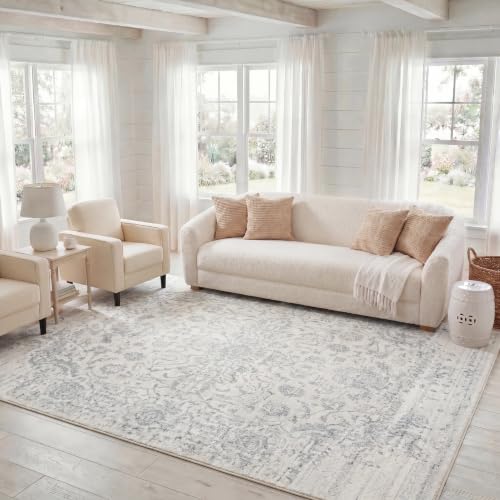
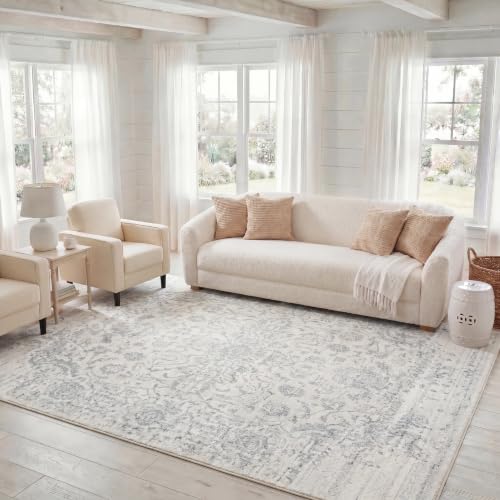
SAFAVIEH Madison Area Rug 8×10
Our badge: Best Overall
The SAFAVIEH Madison Area Rug 8×10 is what polypropylene looks like when every decision goes right at scale: a dense, low pile that keeps dirt near the surface across a full 8×10, fibers that refuse to absorb spills, low-shedding construction, and a vintage medallion pattern that hides the week between vacuums. It is the material answer most living rooms actually need.
Strengths
- Non-absorbent fiber makes large-area spill management realistic.
- Dense low pile vacuums fast even at 8×10, in minutes rather than a session.
- Built for high-traffic homes with kids and pets, per the maker.
Trade-offs
- Not machine washable; deep refresh is a careful extraction clean.
- Synthetic feel underfoot, however well executed.
- At 21.5 pounds, seasonal lifting is a two-person courtesy.
| Color | Silver/Ivory |
| Size | 8′ x 10′ (Rectangular) |
| Dimensions | 120 x 96 inches |
| Weight | 21.5 pounds |
Scale is where polypropylene quietly beats the prestige fibers for most households. A wool 8×10 is a treasure with a care contract; the Madison is a colleague — it shows up, takes the traffic, forgives the incidents, and asks for a vacuum and the occasional blot. Its OEKO-TEX certification closes the last common objection for floor-level households. If the room is a living room, family room, or bedroom with real traffic, this is the material benchmark the other five picks must argue against, and most households will find the argument unconvincing.
Best for: Busy living rooms and bedrooms at classic area-rug scale / Not suited for: Natural-fiber purists or washability-first buyers
Choose the Madison for the scale-proof default; skip it if your heart is set on natural texture. Check on Amazon

Tumble Lisa Washable Area Rug | 9×12 Living Room Bedroom Area Rug
Our badge: Best Washable
The Tumble Lisa Washable Area Rug | 9×12 Living Room Bedroom Area Rug challenges the oldest assumption in the category — that big rugs cannot be washed — with a polyester chenille construction that is spillproof on its face, machine washable in a standard household machine, and sold with its own cushioned pad on a corner-pocket system. At 9×12, that is not a feature; it is a different material philosophy.
Strengths
- True machine washability at the largest common area-rug size.
- Spillproof surface handles the daily incidents between washes.
- Included pad system engineered for the rug, not improvised under it.
Trade-offs
- Washing day is a planned event at this size.
- Chenille softness is pleasant, not luxurious.
- The system works best kept together as designed.
| Color | Midnight |
| Size | 9×12′ |
The material lesson is that “washable” is a construction, not a fiber: thin, flexible, backing-engineered builds like this one survive the machine that would destroy a conventional rug of the same fiber. For households whose area rug lives under children, pets, or dining chairs, that construction converts the rug’s worst days into laundry and extends its fresh-looking life beyond what any spot-clean regime achieves at this scale. The OEKO-TEX Standard 100 certification and the maker’s family-first design brief complete the case.
Bedrooms are the surprise second home for this pick — a washable 9×12 under a bed is a genuine quality-of-life upgrade during flu season and allergy season alike, a point the room-specific guidance in Best Area Rugs For Bedrooms develops further.
Best for: High-mess households wanting washability at full scale / Not suited for: Anyone who will not realistically run the wash
Choose the Tumble for scale-proof cleanability; skip it for heirloom texture. Check on Amazon
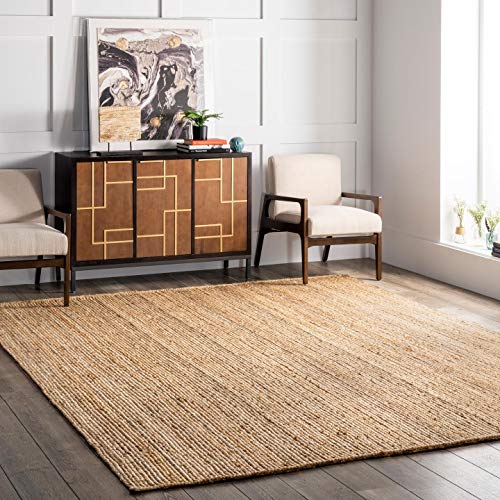
Nuloom Rigo Handmade
Our badge: Best Natural Fiber
The Nuloom Rigo Handmade makes the natural-fiber case at full scale: 100% jute, hand woven, in a large rectangular format whose warm, varied texture does what no print can — it makes a big room feel grounded and calm. Its slim 0.35-inch profile keeps it practical under furniture, and the maker positions it for high-traffic living with simple, dry care.
Strengths
- Authentic hand-woven jute character across a room-size canvas.
- Textured surface camouflages dry household soil gracefully.
- Slim profile suits under-furniture placement and door clearance.
Trade-offs
- Dry care only: gentle vacuuming, minimal-moisture blotting, no soaking, ever.
- Heavy in this size; placement is a commitment.
- Natural variation and some shedding are part of the material’s honesty.
| Color | Natural |
| Size | 9′ x 12′ (Rectangular) |
| Weight | 59.75 pounds |
At area-rug scale, jute’s bargain becomes explicit. You receive the most beautiful natural texture in the category across your whole room, and in exchange you accept a water discipline for the entire footprint: no wet mopping over it, no plant-watering accidents tolerated, pet water stations banished to hard floors, and a pad beneath to protect both parties. Households that run that discipline — and many calm, adult, design-led homes do — find jute at scale deeply satisfying. Households that cannot should admire it here and buy the Madison.
The maker’s care guidance is the contract in miniature: vacuum once or twice a week on the lowest power or with a handheld attachment, spot clean with mild detergent as needed, and let the texture do the rest.
Best for: Calm, dry, design-led living and dining rooms / Not suited for: Wet-prone, pet-water, or soak-clean households
Choose the Rigo for natural scale and texture; skip it where water lives. Check on Amazon

SAFAVIEH Hudson Shag Rug 9×12
Our badge: Best Plush
The SAFAVIEH Hudson Shag Rug 9×12 is polypropylene in its most indulgent form: a deep shag with a 1 3/4-inch pile across a full 9×12, in soft ivory-and-beige striations, OEKO-TEX certified. As a material statement it argues that synthetic fiber, given enough pile, can deliver the barefoot luxury people associate with natural rugs — at the price of the most demanding care in this list.
Strengths
- Unmatched plush comfort and warmth at area-rug scale.
- Synthetic fiber keeps it more forgiving than natural shag.
- Transforms the acoustics and feel of large, hard rooms.
Trade-offs
- Vacuuming is slow, suction-limited work across 108 square feet.
- Crumbs and small objects descend and vanish into the pile.
- Heavy, and early shedding and odor are normal per the maker.
| Color | Ivory/Beige |
| Size | 9′ x 12′ (Rectangular) |
| Dimensions | 144 x 108 x 1.75 inches |
| Weight | 53.5 pounds |
The scale math is the review: every care task a shag demands — slow vacuuming, shaking, brushing fibers back to life — is multiplied by the largest footprint in this guide. In a bedroom, where shoes and snacks rarely go and the plush is the entire point, that math can still win. In a family room it usually loses by February. Buy the Hudson with a room assignment, not a hope, and it will be loved; buy it as a default and it becomes the cautionary tale this guide exists to prevent.
Care, per the maker, is regular low-setting vacuuming, shaking out, and gentle brushing, with creases and early shedding expected to settle. A pad beneath adds cushion and keeps the big rug honest on hard floors.
Best for: Bedrooms and comfort-led, low-mess living rooms / Not suited for: Dining, family traffic, or low-patience cleaning routines
Choose the Hudson for plush at scale; skip it wherever food travels. Check on Amazon
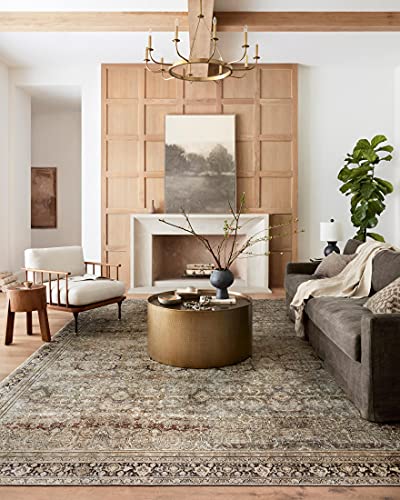
Loloi Layla Olive/Charcoal 7′-6″ x 9′-6″ Area Rug
Our badge: Best Low-Maintenance
The Loloi Layla Olive/Charcoal 7′-6″ x 9′-6″ Area Rug represents the printed construction: the design lives in ink on a very low base rather than in tall dyed fibers, which at area-rug scale produces the lowest-maintenance large rug in this pool. Dirt cannot descend into a print; it waits on the surface for a vacuum that needs one or two passes to take the whole room back.
Strengths
- Lowest care burden of any large rug here, week after week.
- Non-shedding power-loomed build keeps its looks without effort.
- Distressed vintage pattern forgives dust across a big footprint.
Trade-offs
- Printed flatness: no pile luxury for bare feet.
- Pad needed for grip and a hint of cushion.
- Spot-clean care for stains, as with most large rugs.
| Color | Olive / Charcoal |
| Size | 7’6″ x 9’6″ (Rectangular) |
| Dimensions | 114 x 90 x 0.13 inches |
| Weight | 6.61 pounds |
Printed rugs are sometimes dismissed as a compromise, but at scale the compromise runs the other way: the Layla’s owners spend their Saturdays doing something else. Its lightness for its size is a further material virtue — the under-rug cleaning that protects floors is a one-person job — and its olive-charcoal palette has the rare ability to anchor traditional and modern rooms alike. Where walls carry strong color, the coordination logic in Best Area Rugs For Yellow Walls shows how a quiet printed base earns its keep.
If your honest self-assessment says the rug will be vacuumed when someone remembers, this is your material: the one whose cleanliness degrades the slowest under benign neglect.
Best for: Busy households wanting a large rug with minimal upkeep / Not suited for: Barefoot-luxury seekers
Choose the Layla for effortless scale; skip it for plushness. Check on Amazon

Unique Loom Sofia Collection Area Rug – Salle Garnier (7′ 1″ x 10′)
Our badge: Best Traditional
The Unique Loom Sofia Collection Area Rug – Salle Garnier (7′ 1″ x 10′) pairs a 100% polypropylene pile with a jute backing — a hybrid material story that delivers a traditional French-inspired rug with modern manners. The pile gives you synthetic durability and cleanability; the backing gives the rug a settled, substantial lay on the floor.
Strengths
- Quarter-inch pile balances softness with easy vacuuming at scale.
- Jute backing adds stability and a traditional floor feel.
- Maker notes careful carpet-cleaner use is possible, dried immediately and evenly.
Trade-offs
- Backing dislikes soaking; keep wet cleaning rare and careful.
- Formal patterning will not suit every room.
- Spot cleaning is the everyday stain method.
| Color | Beige/Ivory |
| Size | 7’1″ x 10′ (Rectangular) |
| Dimensions | 120 x 85 x 0.25 inches |
| Weight | 15.17 pounds |
The Sofia teaches the final materials lesson of this guide: read the whole rug, not just the pile. Buyers fixate on the face fiber and ignore the backing that decides how the rug lies, grips, ages, and tolerates moisture. A polypropylene face over jute is a sensible, time-tested compromise — synthetic where life happens, natural where structure lives — provided the household respects the backing’s one rule about water. On hard floors, add a pad so the jute never grinds directly on the finish, and the compromise holds for years.
Best for: Traditional rooms wanting modern cleaning behavior / Not suited for: Soak-clean or chronically damp placements
Choose the Sofia for classic looks with a smart hybrid build; skip it for washable care. Check on Amazon
Comparison Table
| Pick | Material story | Size | Care at scale | Check price on Amazon |
|---|---|---|---|---|
| SAFAVIEH Madison | Polypropylene low pile | 8′ x 10′ | Vacuum and blot | Check price on Amazon |
| Tumble Lisa | Washable polyester chenille system | 9×12′ | Machine wash | Check price on Amazon |
| Nuloom Rigo | Hand-woven jute | 9′ x 12′ | Dry care only | Check price on Amazon |
| SAFAVIEH Hudson Shag | Polypropylene deep shag | 9′ x 12′ | Slow vacuum, shake, brush | Check price on Amazon |
| Loloi Layla | Printed low pile | 7’6″ x 9’6″ | Vacuum and spot clean | Check price on Amazon |
| Unique Loom Sofia | Polypropylene pile, jute backing | 7’1″ x 10′ | Vacuum and spot clean | Check price on Amazon |
How to Choose the Best Material for an Area Rug
Multiply care by square footage
Before choosing any material, perform the scale test: take the care routine the material demands at accent size and multiply it honestly by the area you are buying. Five minutes of vacuuming becomes twenty-five; a shake-out becomes a two-person expedition; a washable claim becomes a laundry day. Materials that survive this multiplication — synthetics, washable systems, prints — dominate area-rug sales for a reason. Materials that fail it can still be right, but only in rooms whose calm justifies the labor.
Let the room’s moisture map decide the naturals
Every room has a moisture map: the plant corner, the pet station, the door’s drip line, the dining chairs’ splash radius. Natural fibers belong only where that map is dry. At area-rug scale a single wet zone under a large jute rug is not a local problem — it is a mildew risk under a heavy, slow-drying textile. Draw the map honestly, and if water lives anywhere on it, the synthetic and washable picks are not a compromise; they are the correct engineering.
Treat pile height as a material decision
Fiber tells you what a rug is made of; pile tells you how that material will behave. The same polypropylene is a carefree flat print, a durable low pile, or a demanding shag depending on the height it is given. When comparing listings, read fiber and pile as one specification, and be suspicious of any material praise that ignores the construction carrying it.
Read the backing as a second material
Backings decide grip, floor safety, moisture behavior, and half of a rug’s lifespan. Cotton, jute, latex, TPE, and included pad systems each write different rules for the floor beneath. At area-rug scale, where the interface covers a hundred square feet, those rules matter more, not less. Flip the listing photos, read the backing line, and budget the pad the backing implies.
How to Care for Large Area Rugs by Material
Synthetics want rhythm: slow vacuuming weekly, edges and under-rug passes monthly, prompt blotting, and a deep clean — wash, careful extraction, or professional — when surface care stops restoring them. Washable systems want the machine on schedule and a thorough pre-vacuum so the wash fights stains, not grit. Jute wants dryness and gentleness: low-power vacuuming, minimal-moisture spot care, and immediate attention to any liquid that lands on it. Shag wants patience: low-setting vacuuming, outdoor shaking when size and strength allow, and brushing to keep fibers standing. Across all materials, drying is the step that decides success — a large rug dries slowly, so plan airflow and time whenever water is involved.
Problem: The big rug is clean on top but smells stale. — The backing and the floor beneath hold the story. Lift, clean both, air everything, and only re-lay when fully dry.
Problem: Traffic lanes look tired while the borders look new. — Rotate the rug if the room allows, deepen the lane vacuuming, and consider whether the material’s pile was too ambitious for the traffic.
Problem: A large natural rug got soaked in one corner. — Blot exhaustively, dry with airflow from both sides, and monitor for odor over the following week; speed in the first hours decides the outcome.
Problem: The washable rug will not fit the machine as expected. — Follow the maker’s folding and load guidance for large sizes, wash alone, and never force a load that stops the drum from turning.
Wool: The Material Not in This Pool, Honestly Assessed
No materials guide earns trust without addressing wool, the fiber area rugs were judged by for centuries. Wool’s virtues are real: resilient pile that recovers from furniture, natural stain resistance from its fiber structure, a hand and warmth synthetics still chase, and longevity measured in decades when cared for. Its costs are equally real: it wants gentle, specific cleaning, it sheds early, it fears moisture abuse and moths in storage, and at area-rug scale it commands the top of the market. Households that value heirloom character and will fund professional care should absolutely consider it — from makers who publish its specifications as carefully as the pool behind this guide publishes synthetics’. Households buying for traffic, kids, pets, and self-serve cleaning will find the modern synthetics in this list the more honest match, and there is no shame in that verdict; it is why the market moved.
The Ten-Year View: How Each Material Ages at Scale
Polypropylene ages by flattening slightly in lanes and otherwise holding its color and composure; its ten-year portrait is “much the same, a little calmer.” Washable polyester ages by cycles, staying fresh as long as the household keeps washing, with edges and print softening gradually. Jute ages by mellowing — color warms, texture relaxes — beautifully in dry rooms and tragically in damp ones. Shag ages by matting where life concentrates, which is why its decade belongs to calm rooms. Printed rugs age by fading almost imperceptibly and evenly, the most graceful decline in the list. Choose the aging curve you can love, because at area-rug scale you are not buying the rug in the photograph; you are buying the rug in year seven, and the material writes that portrait in advance.
Materials by Floor Type: What Lies Beneath Decides Half the Answer
An area rug never meets a room; it meets a floor, and the floor’s material edits the rug’s material shortlist in ways buyers rarely anticipate. On hardwood, the governing questions are grip, grit, and backing chemistry: the rug must not slide, must not let abrasive dust grind beneath it, and must never sit on a backing that reacts with the finish. That is why the hardwood-specific guidance in Best Area Rugs For Hardwood Floors reads like a backing-and-pad manual with patterns attached — at 8×10, the interface is a hundred square feet of negotiation between two materials, and the floor always has the stronger lawyer. Dense felt pads, natural backings kept dry, and washable systems with engineered pads all pass the hardwood test for different reasons; slick PVC-style backings and chronically damp naturals fail it.
On tile and stone, the calculus shifts to moisture and temperature: the rug is the warmth layer, and its material must tolerate the occasional wet footprint without holding that moisture against grout. Synthetics and washables win again, with cotton earning an honorable mention in bathrooms at small scale. On wall-to-wall carpet, an area rug is a wear shield and a design layer, and the material questions become creep, rippling, and pile compatibility — firmer, lower rugs behave, and a rug-to-carpet grip matters more than fiber prestige. On laminate and vinyl plank, add one caution: some rubber compounds can discolor resilient floors over long contact, so check backing compatibility and lift periodically, whatever fiber you choose. The through-line is that “best material” is a two-material answer — the rug’s and the floor’s, read together — and the households that read them together stop having the surprises that fill review sections with one-star mysteries.
Allergy and Air Considerations at Area-Rug Scale
A large area rug is the biggest dust reservoir in most rooms, which makes material choice an air-quality decision whether the buyer intends it or not. The physics are neutral: any rug captures particles that would otherwise circulate, and the material decides how completely cleaning can empty the reservoir. Low, dense synthetics and printed constructions empty almost fully with slow vacuuming, because nothing hides below suction’s reach. Washable systems empty completely on wash day, backing included — the only construction that can make that claim. Deep piles and natural fibers hold a fraction of their load through ordinary care, which calm households may never notice and sensitive households may notice nightly.
The practical guidance follows without any medical promises: sensitive homes should favor the constructions that empty most completely, keep the vacuuming rhythm strict, wash the washables on schedule, and treat the under-rug space as part of the system, since dust migrates downward through every construction eventually. Bedrooms deserve the strictest version of this discipline, because the sleeper spends eight hours at rug level; it is no accident that washable and low-pile picks recur in bedroom guidance. None of this argues against area rugs for sensitive homes — a hard floor’s dust does not vanish, it merely relocates to every other surface — it argues for choosing the reservoir you can actually empty, at the size you can actually maintain.
Common Buying Mistakes
Choosing material at accent-rug scale
A fiber you loved in a bath mat becomes a regime at 8×10. The better move is the multiplication test before you buy.
Ignoring the moisture map
One wet corner can ruin a large natural rug. The better move is to place naturals only on provably dry floor.
Reading fiber and ignoring pile
The same fiber in a shag and a print are different ownership experiences. The better move is to read them as one specification.
Forgetting the backing
The unseen half decides grip, floor safety, and moisture behavior. The better move is to read the backing line and budget its pad.
Buying heirloom care requirements on a self-serve budget
The mismatch ends in a tired rug and a resentful owner. The better move is honesty about who will clean it, and how.
One Rug, Three Rooms: A Worked Example
Abstract material advice becomes concrete the moment a single household shops for three rooms at once, so consider the common case: a living room with a dog, a dining room with children, and a bedroom with allergies in the family. The living room wants the dense synthetic — dirt at the surface, hair released to the vacuum, a pattern that hides the dog’s opinion of the garden. The dining room wants either the same synthetic in a chair-friendly low pile or the washable system, because its spill profile is the worst in the house and its chairs punish anything tall. The bedroom wants the construction that empties most completely and feels kindest at 6 a.m. — for many households the washable again, for others a low synthetic kept on a strict rhythm, and for the comfort-led, the shag with its terms accepted.
Notice what the example demonstrates: one household, three different right answers, and not a single decision made by pattern until the material shortlist for each room was settled. Notice also the budget logic that emerges — spend the washable premium where spills and sensitivities concentrate, let the proven synthetic carry the big calm rooms, and reserve any natural-fiber indulgence for the room whose moisture map and traffic genuinely permit it. That allocation, repeated across a whole home, is what “best material” means in practice: not a fiber, but a matching discipline, applied room by room at full area-rug scale.
Final Recommendation
For most rooms at area-rug scale, start with the SAFAVIEH Madison Area Rug 8×10: polypropylene’s durability and forgiveness are the scale-proof default. If your household’s mess level is the dominant fact, the runner-up is the Tumble Lisa (Check on Amazon), whose washability rewrites what a 9×12 can survive. Choose the material whose ten-year portrait you like, in the room whose moisture map allows it, and the rug will take care of the decade.
Blends, Hybrids, and Why the Label Rarely Tells the Whole Story
Modern area rugs increasingly refuse single-material labels, and the Sofia in this guide — synthetic pile over a natural backing — is the polite version of a trend that runs through the whole category. Blends exist because fibers have complementary virtues: one brings resilience, another brings hand-feel, a third brings cost control, and the construction marries them into something no single fiber achieves at the price. The buyer’s task is to read a blend the way an engineer reads a spec sheet: which fiber touches the room, which fiber touches the floor, and which fiber dominates the care instructions. The face decides cleaning and wear; the backing decides grip and moisture rules; the minority fiber in any blend usually explains the one surprising prohibition on the care label.
Two blend traps deserve naming. The first is the prestige blend, where a small percentage of a famous fiber lends its name to a rug that behaves like its majority fiber; buy the behavior, not the name. The second is the care trap, where a blend inherits the strictest rule of any component — a mostly synthetic rug with a natural backing still fears soaking, as the Sofia’s review notes — and owners who read only the face fiber learn the rule from a watermark. Read the full composition, let the strictest component set your care ceiling, and blends become what they should be: honest engineering, fairly priced.
Sustainability, Honestly: Natural, Synthetic, and the Long-Lived Rug
Material choice carries an environmental argument that deserves better than slogans. Natural fibers are renewable and biodegradable, and they arrive with farming and transport footprints of their own; synthetics are petroleum-derived and persistent, and they arrive with durability that can keep them out of landfills for a decade. The variable that dominates both ledgers is lifespan in service: a rug — any rug — that serves ten years beats three rugs that serve three, whatever they are made of. Washable systems extend service life by making deep cleaning free; durable synthetics extend it by refusing to wear; naturals extend it in the calm rooms where their care contract is kept.
The practical sustainability advice for area rugs is therefore unglamorous: buy the material matched to your room so it survives, maintain it on rhythm so it stays worth keeping, graduate tired rugs to calmer rooms instead of discarding them, and store any rug clean, dry, and rolled so its next chapter is possible. The greenest square foot in this guide is the one that never needs replacing, and every material here can be that square foot in the right room — which is, in the end, the same conclusion the durability evidence reaches by another road.
Cost of Ownership: The Material Math Nobody Does at Checkout
Area rugs are priced by the rug and paid for by the decade, and materials separate those two numbers dramatically. A budget synthetic that tires in three years of traffic can cost more per year of good looks than a mid-priced dense polypropylene that holds its portrait for eight. A natural rug’s true price includes the pad it demands, the gentle tools it prefers, and the professional attention its worst accident will eventually require. A washable system’s true price includes laundry time — real, but modest — and repays it by deleting the professional-cleaning line from the household budget entirely. None of this argues for buying the most expensive material; it argues for pricing the ownership, not the object.
Run the thought experiment before ordering: picture the rug in year five, in your room, with your household’s habits applied. What has it cost in cleaning, in products, in one professional visit or none, in the Saturday hours it consumed? Which material in this guide produces the year-five portrait you like at a labor price you accept? Buyers who ask those two questions almost never regret a material, because regret in this category is rarely about fiber quality — it is about the discovery, in month nine, of a care contract nobody mentioned at checkout. This guide’s reviews were written to mention it, for every material, at the scale you will actually live with it.
Reading a Listing Like a Materials Inspector
Everything this guide teaches condenses into a ninety-second listing audit that works on any area rug, in this pool or beyond it. First, find the fiber and read it completely — face and backing, percentages included; if a listing will not tell you the backing, treat that silence as information. Second, find the pile height and translate it into your cleaning life: under half an inch is a routine, over an inch is a relationship. Third, read the care instructions as a contract and check for the prohibitions, because the prohibitions are where materials confess their weaknesses — no beater bar, no soaking, no machine washing, professional only. Fourth, find the weight, and picture yourself and a partner carrying it up your stairs and flipping it on a Saturday; if the picture is implausible, the maintenance in the earlier steps will not happen, and the rug’s material virtues will not survive your reality.
Buyers who run that audit stop being surprised by rugs. The material stops being a word in a title and becomes a set of predictions — about Saturdays, spills, sunlight, and year seven — and predictions are what a purchase at this scale deserves. The six rugs in this guide passed the audit in six different ways, which is the final lesson: there is no single best material for area rugs, there are six honest answers to six different households, and the audit is how you find yours.
Frequently Asked Questions
What is the most durable material for a large area rug?
Dense, low-pile polypropylene leads for most households: it resists stains, tolerates constant vacuuming, and keeps dirt near the surface where cleaning reaches it, across the whole footprint. Durability at scale is as much about cleanability as about fiber strength, because the grit a rug cannot release becomes the abrasive that wears it from inside — a strong fiber holding dirt loses to a slightly weaker fiber that lets it go.
Is wool worth it for an area rug?
For calm rooms, heirloom intent, and owners who will fund proper care, yes. For traffic, kids, pets, and self-serve cleaning, modern synthetics are usually the more honest value at the same sizes. The deciding question is not whether wool is better — in several dimensions it plainly is — but whether your household will actually deliver the care regime its superiority assumes.
Can a 9×12 rug really be machine washed?
Only if it was engineered for it, like the washable system in this guide. Conventional large rugs must never be forced into a machine; construction, not size alone, decides. The engineered difference is a flexible, low-profile build with a backing designed to flex, drain, and dry — the same properties that make such rugs lie flat and grip well in daily use, which is why washability and good floor behavior so often arrive in the same product.
Does jute work in a living room?
Beautifully, in a dry one with disciplined care. Keep water sources off it, vacuum gently, and it will give years of texture. In damp or pet-water zones, choose a synthetic instead. The living rooms where jute thrives share a profile worth copying: no drinks station on the rug, plants on stands with trays, a door routine that keeps wet shoes on hard floors, and owners who treat the occasional spill as a five-alarm blot rather than a shrug.
What material is easiest to keep clean at 8×10?
Printed low piles and dense polypropylene tie at the top: both keep dirt at the surface and vacuum in minutes. Washable systems win on deep cleaning because the machine does the work. The honest tiebreaker is your own rhythm — the printed rug forgives irregular cleaning most gracefully, while the washable rewards a household that actually enjoys a periodic full reset of the room.
Which material is best for a dining room area rug?
Low, dense synthetics and washable systems lead, because dining combines chair traffic, falling food, and liquid spills in one footprint. The pile must let chairs glide and crumbs release; the fiber must forgive what falls. Natural fibers can work in calm, adult dining rooms with disciplined care, but the splash radius under a table is the hardest test in the house, and most households are better served by the constructions that treat it as routine.
Which material handles sunlight best?
Synthetic fibers generally hold color better in strong sun than natural ones, and busy, variegated patterns disguise the gradual, uneven fading that bright rooms produce. Whatever the fiber, rotating a large rug periodically evens the exposure, and no material should be asked to sit half in a sunbeam for a decade without that courtesy.
How much does backing material matter?
More than most buyers think. It governs grip, floor protection, and moisture behavior across the rug’s whole footprint. Read it, pad it correctly, and inspect it whenever you lift the rug. A backing that has gone slick, stiff, or crumbly is a rug nearing retirement whatever its face still promises, because the interface with the floor is where safety and floor protection actually live.


