Disclosure: As an Amazon Associate, dailyhomedecorating.com earns from qualifying purchases. Links to Amazon on this page are affiliate links; they cost you nothing extra. Prices and availability change often, so check the current Amazon listing before you buy.
The best camp chairs for bad backs exist because camping with a temperamental back is a negotiation most camp chairs lose in the first hour. The typical camp chair — a sling of fabric between four poles — holds you in a hammock curve that feels relaxing for ten minutes and then spends the evening quietly folding your spine into a C, with no back support worth the name and a seat edge that cuts circulation while it is at it. The best camp chairs for bad backs refuse that geometry: they hold you upright enough to sit for a fireside evening, support your lower back where it curves, give your arms something solid to push on when you stand, and still fold into a bag you can carry to the campsite.
This guide reviews six chairs chosen on back-comfort mechanics — back height and support, seat height and firmness, arm design, and the freedom to shift position — with capacities and dimensions from the verified pool. Comfort is the claim throughout: no chair here treats a back condition, and persistent pain deserves professional advice. What these chairs can do is stop the campsite from being the place your back dreads. For the same comfort logic at the beach and the ballfield, see Best Beach Chairs For Senior Citizens and Best Stadium Chairs For Bleachers.
Where to Buy
Every pick below is sold on Amazon, where you can check the current price, color options, and availability before you buy. Order before the season — the good camp chairs sell through when the weather turns.
- GCI Outdoor Freestyle Rocker Camping Chair — Check on Amazon
- ALPS Mountaineering Camp Chair — Check on Amazon
- Coleman Portable Camping Chair with 4-Can Cooler — Check on Amazon
- Best Choice Products Zero Gravity Chair with Canopy Shade — Check on Amazon
- Lafuma Futura Air Comfort Padded Zero Gravity Patio Recliner Chair — Check on Amazon
- Tommy Bahama Easy-Out Backpack Beach Chair — Check on Amazon
In this guide
Quick Picks
| Pick | Badge | Why it earns its place |
|---|---|---|
| GCI Outdoor Freestyle Rocker Camping Chair | Best Overall | Spring-action rocking keeps your back moving gently, with a 19.7-inch seat height and solid arms for easy standing. |
| Coleman Portable Camping Chair with 4-Can Cooler | Best Budget | A fully cushioned seat and back at an 18.1-inch height, rated to 325 lb — upright support at a household price. |
| Lafuma Futura Air Comfort Padded Zero Gravity Patio Recliner Chair | Best Premium | Padded AirComfort fabric on a clip suspension with true zero-gravity recline — the finest long-sit at the campsite. |
| ALPS Mountaineering Camp Chair | Best for Long Sits | A taller, padded back and a wider seat on a reinforced frame, built for entire evenings by the fire. |
| Best Choice Products Zero Gravity Chair with Canopy Shade | Best for Reclining | Lockable zero-gravity recline that spreads your weight along the whole chair, with a canopy and side tray. |
| Tommy Bahama Easy-Out Backpack Beach Chair | Best Portable | Four recline positions and backpack carry for walk-in sites, with a storage pouch for the evening’s necessities. |
Key Takeaways
- Back comfort at camp is geometry: a supportive back, a seat high and firm enough to keep your pelvis level, and arms you can push on.
- Movement helps as much as support — a rocker or a recline that lets you change position prevents the frozen posture that stiffens backs.
- Sling-style chairs are the enemy pattern; every pick here replaces the sling with structure, padding, or suspension.
- Seat height is a back feature: low chairs demand the most from your back and legs on every single rise.
- These are comfort recommendations, not treatment; persistent or radiating pain belongs in a professional’s care.
How These Picks Were Chosen
The pool was filtered against the sling-chair failure mode. Chairs needed at least one genuine back-comfort mechanism: a tall, structured back; cushioning that holds a shape; a suspension that distributes pressure; a rocking or reclining system that invites position changes; or a seat height that keeps the pelvis and the exit kind. Chairs that were merely light or merely cheap were excluded, because a bad back does not care about either at hour three.
The final six divide the solutions: a rocker for movement, a tall-backed chair for structured support, a cushioned classic for upright evenings, two zero-gravity recliners for full-length weight distribution, and a reclining backpack chair for walk-in campsites. Capacities range from 240 to 325 lb as stated by the manufacturers, and each review names its ceiling plainly.
Specifications come from the verified pool. Comfort language is kept to comfort — support, pressure distribution, ease of rising — because that is what furniture can honestly offer a back.
The 6 Best Best Camp Chairs for Bad Backs — Reviewed

GCI Outdoor Freestyle Rocker Camping Chair
Our badge: Best Overall
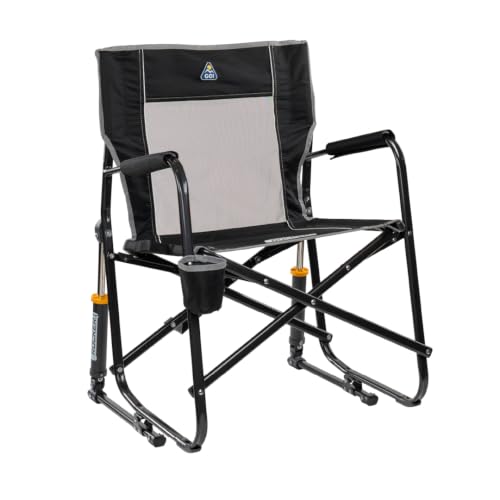
The GCI Outdoor Freestyle Rocker Camping Chair leads this guide because it attacks back stiffness from the direction most chairs ignore: motion. Its patented Spring-Action Rocking Technology lets you rock gently on any surface — campsite gravel, grass, hardpan — and that small, constant movement keeps your back from locking into the single posture that makes camp evenings end early. The seat height is 19.7 inches, the arms are solid with a beverage holder, the back is breathable mesh, and the steel frame holds up to 250 lb.
Strengths
- Gentle rocking distributes the evening’s sitting instead of freezing it.
- Standard seat height and solid arms make standing a push, not a project.
- Mesh back ventilates through warm nights by the fire.
Trade-offs
- 250 lb capacity is the ceiling in this guide’s lower half.
- Rocking needs a little space behind the chair at the fire circle.
- The mesh back offers airflow rather than cushioning.
| Color | Black |
| Size | Freestyle Rocker |
| Dimensions | 9.842519675 x 5.99999999388 x 35.6 inches |
| Weight | 11.8 pounds |
The Freestyle Rocker folds flat — about 4.9 inches thick — with Eazy-Fold setup that takes seconds, so it lives happily in a loaded car. At the campsite, its back support is dynamic rather than padded: the frame holds you upright, the mesh breathes, and the rock does the rest. Campers who fidget — and most backs make fidgeters of their owners — find this chair understands them.
For the rise, the combination of height, arms, and forward rock momentum is the kindest in this guide. That matters at camp, where you rise for the fire, the cooler, and the tent a dozen times an evening.
Choose the GCI if your back stiffens in stillness. Skip it if you are above its capacity or want a padded, reclining sit — the Lafuma below is that chair.
Best for: Restless backs that stay comfortable by moving / Not suited for: Users above 250 lb or padding-first sitters

ALPS Mountaineering Camp Chair
Our badge: Best for Long Sits
The ALPS Mountaineering Camp Chair is the structured-support pick: a wider-than-standard seat, a taller padded back in heavy 600D polyester, curved padded armrests, and a Pro-Tec engineered aluminum frame reinforced with steel tubes and connectors. Where sling chairs abandon your upper back, this back continues up and supports it, padded, through the whole evening — the difference between a chair you visit and a chair you inhabit.
Strengths
- Tall, padded back supports the full spine through long sits.
- Wider seat lets you shift position without leaving the support.
- Reinforced frame and heavy fabric are built for seasons of use.
Trade-offs
- Camp-chair height sits lower than the GCI; rising takes more effort.
- At 11 pounds it is a car-camping chair, not a backpacking one.
- No recline; support is upright only.
| Color | Deep Sea – New |
| Size | One Size |
| Dimensions | 18 x 24 x 36 inches |
| Weight | 11 pounds |
ALPS builds for people who use outdoor gear seriously, and the chair’s details — padded arms that meet your forearms, an attached cup holder, a fold-flat frame with a detachable back for packing — suit the camper whose evenings are long and whose back keeps score. The upright support posture is the right default for eating, cards, and conversation at the camp table, where the recliners in this guide cannot go.
It is also the chair most likely to still be in service in five seasons, which matters to backs in an indirect way: a familiar, trusted chair is one less variable on every trip.
Choose the ALPS if your camp evenings are upright and long. Skip it if you want to recline by the fire — that is the zero-gravity pair below. More upright-support thinking lives in Best Chairs For Back Posture.
Best for: Long, upright fireside evenings with full back support / Not suited for: Recline seekers or ultralight campers

Coleman Portable Camping Chair with 4-Can Cooler
Our badge: Best Budget
The Coleman Portable Camping Chair with 4-Can Cooler is the cushioned classic done right for backs: a fully cushioned seat and back — no sling, no sag — a generous 24-inch seat width, an 18.1-inch sitting height that keeps your pelvis level and your rises manageable, and support up to 325 lb, the highest capacity in this guide. A mesh cup holder, a side pocket, and the signature 4-can cooler pouch keep the evening’s supplies in reach, so you are not twisting to the cooler every twenty minutes.
Strengths
- Cushioned, structured seat and back replace the sling geometry entirely.
- 325 lb capacity and a wide seat welcome every camper.
- Cooler and pockets reduce the twisting and rising that tire backs.
Trade-offs
- Fixed upright geometry; no recline or rocking.
- Bulkier in the car than the ultralight picks.
- The cooler needs ice or packs.
| Color | Blue |
| Size | 24 inches x 18.1 inches x 7 inches |
| Dimensions | 8 x 7 x 38.25 inches |
| Weight | 8.2 pounds |
Coleman’s formula endures because it understands campsite ergonomics intuitively: sit at a proper height, on a cushion, with your drink cold and your book in the side pocket, and the evening takes care of itself. For a back that dislikes surprises, that predictability is the comfort. The chair folds into its carry bag and serves tailgates, patios, and tournaments between camping trips, so its cost-per-evening drops fast.
For campers buying their first back-conscious chair, this is the lowest-risk start: the geometry is right, the capacity is generous, and the price position leaves room in the budget for the sleeping pad that does the night shift of back care.
Choose the Coleman if you want upright, cushioned support on a budget. Skip it if you know you need recline or motion to stay comfortable.
Best for: Budget campers who want cushioned, upright support / Not suited for: Recline or rocking devotees
Best Choice Products Zero Gravity Chair with Canopy Shade
Our badge: Best for Reclining
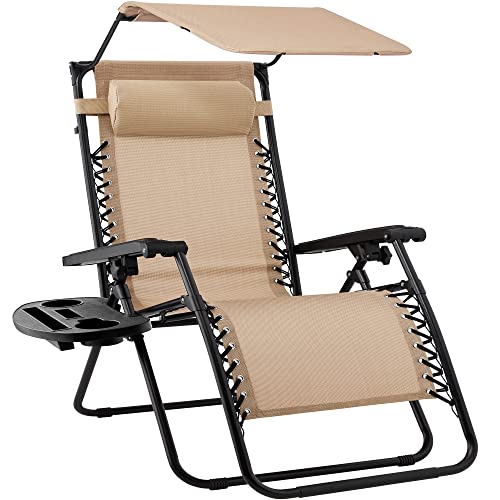
The Best Choice Products Zero Gravity Chair with Canopy Shade changes the sitting equation entirely: instead of holding you upright, its lockable zero-gravity recline — gliding on replaceable elastic cords — settles you into a position where your weight spreads along the chair’s full length, legs raised, back fully supported by UV-resistant textilene mesh on a steel frame rated to 250 lb. An adjustable canopy shades your face, a removable headrest pillow supports your neck, and a detachable tray carries drinks and devices.
Strengths
- Full-length weight distribution takes pressure off any single point.
- Lockable recline lets you choose and keep your most comfortable angle.
- Canopy, headrest, and tray make it a complete rest station.
Trade-offs
- At 20.5 pounds it is a car-camping chair only.
- 250 lb capacity ceiling.
- Recliners do not join the camp table; this is the rest chair, not the dinner chair.
| Color | Beige |
| Size | Standard |
| Dimensions | 34 x 27 x 49 inches |
| Weight | 20.5 pounds |
Many campers with difficult backs plan their evenings in two chairs: an upright chair for the fire and the meal, and a recliner for the long, quiet chapter after. This is the second chair perfected — the one you migrate to when the day is done, where an hour of full-length support resets what the trail and the upright chair spent. Rising is a two-step — unlock to upright, then use the frame — and becomes automatic by the second evening.
At home it serves patio and pool identically, so the purchase is not hostage to your camping calendar. The cords are replaceable, which extends the chair’s comfortable life well past the point where fixed-suspension loungers sag.
Choose the Best Choice chair if reclined rest is your back’s favorite language. Skip it for walk-in sites or as your only camp chair.
Best for: Car campers who rest best fully reclined / Not suited for: Walk-in sites or table seating

Lafuma Futura Air Comfort Padded Zero Gravity Patio Recliner Chair
Our badge: Best Premium
The Lafuma Futura Air Comfort Padded Zero Gravity Patio Recliner Chair is the connoisseur’s recline: a breathable, padded AirComfort seat, a patented elastomer clip suspension that supports evenly without cords to sag or lace, a removable headrest, foot glides, and an HLE steel frame reclining through multiple positions into zero gravity. Every contact surface is engineered, and the result is the smoothest long sit in this guide.
Strengths
- AirComfort padding cushions without trapping heat.
- Clip suspension gives even, maintenance-free support for years.
- Refined recline mechanism moves smoothly and locks surely.
Trade-offs
- Premium position in the range.
- About 18 pounds — car camping and base camps only.
- An elegant chair that deserves gentler handling than rough camp duty gives.
| Color | Taupe Grey |
| Size | Medium |
| Dimensions | 32.7 x 25.5 x 46 inches |
| Weight | 18.077905484 pounds |
Lafuma’s distinction is in the suspension: where cord-laced chairs concentrate support at the lacing points and soften unevenly with age, the clip system distributes your weight continuously, so the chair you sit in during season three feels like the chair from season one. For a back that notices pressure points, that evenness is the whole argument. The padded fabric adds the second layer of kindness — no mesh print, no hard frame lines through thin summer clothing.
Base-camp and RV campers get the most from it, since the chair’s weight never travels far, and at home it anchors the patio with the same completeness.
Choose the Lafuma if your camping style is base-camp and your back deserves the best recline in the guide. Skip it for walk-in sites or rough-and-tumble family duty.
Best for: Base campers who want premium, even reclined support / Not suited for: Walk-in sites or careless handling

Tommy Bahama Easy-Out Backpack Beach Chair
Our badge: Best Portable
The Tommy Bahama Easy-Out Backpack Beach Chair is the walk-in campsite’s answer: backpack straps for hands-free carry, a lightweight aluminum frame, four recline positions adjusted by a pinch-free Easy-Out mechanism, hardwood arms sealed with marine-grade polyurethane, a cup holder, and a storage side pouch — in a two-pack that seats you and your camping partner. The recline range is its back story: you are not sentenced to one angle for the whole evening.
Strengths
- Four recline positions let you tune the evening as your back requests.
- Backpack carry suits walk-in sites and festival camping.
- Pinch-free adjustments are kind to hands of every age.
Trade-offs
- The 12.8-inch seat height is low; rising takes more from back and legs.
- Beach-chair geometry sits lower and more reclined than table chairs.
- Two-pack purchase is more than a solo camper needs.
| Color | 2-pack Blue Tropical Leaves |
| Size | 35.43″x24.69″ x 25.20″ |
| Dimensions | 35.43 x 24.69 x 25.2 inches |
| Weight | 10 pounds |
The honest back assessment: this chair trades seat height for portability, and the trade is worth it only when the walk demands it. At a walk-in site, the alternative is often no chair at all — a log, a cooler, the ground — against which a reclining, arm-supported chair wins easily. The hardwood arms give you a push point for rising, and the recline’s upright position is genuinely sit-able for meals eaten from a plate on your knees.
The two-pack suits couples who camp together and beach together, and the chairs’ weather-sealed build tolerates the full outdoor calendar without complaint.
Choose the Tommy Bahama if your campsite is a walk away and your back prefers angle options to height. Skip it if rising from low seats is your known difficulty — the GCI and Coleman keep you higher. Walk-in campers comparing loads should also read Best Patio Chairs For Big Guys for the sturdy end of outdoor seating.
Best for: Walk-in campers who need carry-ability plus recline choices / Not suited for: Anyone who struggles with low seats
Comparison Table
| Pick | Color | Dimensions | Weight | Check price on Amazon |
|---|---|---|---|---|
| GCI Outdoor Freestyle Rocker Camping Chair | Black | 9.842519675 x 5.99999999388 x 35.6 inches | 11.8 pounds | Check price on Amazon |
| ALPS Mountaineering Camp Chair | Deep Sea – New | 18 x 24 x 36 inches | 11 pounds | Check price on Amazon |
| Coleman Portable Camping Chair with 4-Can Cooler | Blue | 8 x 7 x 38.25 inches | 8.2 pounds | Check price on Amazon |
| Best Choice Products Zero Gravity Chair with Canopy Shade | Beige | 34 x 27 x 49 inches | 20.5 pounds | Check price on Amazon |
| Lafuma Futura Air Comfort Padded Zero Gravity Patio Recliner Chair | Taupe Grey | 32.7 x 25.5 x 46 inches | 18.077905484 pounds | Check price on Amazon |
| Tommy Bahama Easy-Out Backpack Beach Chair | 2-pack Blue Tropical Leaves | 35.43 x 24.69 x 25.2 inches | 10 pounds | Check price on Amazon |
How to Choose the Best Camp Chairs for Bad Backs
Ban the sling from your campsite
The single most important decision is negative: no hammock-seat chairs. A sling guarantees a rounded spine, a tucked pelvis, and a seat edge pressing your thighs — the complete recipe for an aching evening. Every alternative in this guide — structured backs, cushions, suspensions, rockers — exists to break that geometry. If a chair’s product photo shows a smiling model sunk to their shoulder blades, your back has its answer.
Prioritize back height and shape
Your back needs contact, not just a chair behind it. Look for backs tall enough to support your shoulder blades — the ALPS pattern — shaped to meet your lower back rather than hovering behind it, and firm enough that you sit on the chair rather than in it. Padding should hold a shape; suspension should distribute pressure; mesh should be tensioned over a frame that holds your posture.
Treat seat height as a medical-free necessity
Whatever your back’s story, it shares one chapter with your knees: rising from low seats is the day’s hardest mechanical moment, multiplied by every fire-tending and tent trip. Standard-height chairs — the GCI at 19.7 inches, the Coleman at 18.1 — reduce that cost on every rise. Low chairs are not forbidden, but they should be chosen knowingly, for short sits, by people whose rises are easy.
Build movement into the evening
Stillness stiffens. A rocker builds movement into sitting itself; a recliner lets you change your shape completely; even an upright chair serves better when you stand, stoke, and stroll on a rhythm rather than waiting for stiffness to evict you. When you choose between two finalists, choose the one whose design invites the most position changes — your back will spend the evening thanking the invitation.
Match the chair to the campsite’s logistics
Car camping forgives weight and rewards comfort; walk-in sites tax every pound; festival camping wants carry systems. The most back-friendly chair that stays in the car helps no one, so let the site’s reality arbitrate between the GCI’s height, the recliners’ rest, and the Tommy Bahama’s backpack. Buy for the trips you actually take.
How Do You Set Up a Back-Friendly Campsite?
Arrange the fire circle like a living room: your chair on the flattest ground, at a distance from the fire where warmth reaches without roasting, with the cooler and the wood pile inside a standing trip’s easy arc rather than behind you — twisting to reach backward is the campsite motion backs hate most. Keep a headlamp on the chair’s arm or pocket so night rises are confident, and give your chair a small mat or a swept patch if the ground is rooty, because a chair that rocks unintentionally makes its sitter brace all evening.
Pace the sitting like you pace a hike: sit for the meal and the first fire chapter, stand for the washing up and the wood run, recline for the stars, and let the tent’s sleeping system — pad and pillow chosen with the same care as the chair — take the night shift. Camp backs fail on accumulations, not moments, and a day arranged in varied chapters rarely accumulates.
Problem: Your back locks up after the first fireside hour — You have sat frozen. Add motion: a rocker, a recline change, or a standing task every half hour, and check that your chair’s back is actually meeting your lower back.
Problem: The seat edge numbs your legs — The seat is too deep or too sling-like for you. A cushion to shorten the effective depth, or a structured chair like the Coleman, restores circulation.
Problem: Rising from your chair has become the trip’s dread — Your seat is too low. Move to a standard-height chair with solid arms, and use a forward rock or lean to build momentum.
Problem: The recliner is comfortable but you feel stranded in it — Return it fully upright before rising, plant your feet under your knees, and use the frame’s arms; if it still strands you, your evening chair should be an upright model.
Problem: Everything hurts by day three of the trip — Audit the night, not the chair: a thin sleeping pad undoes three good evenings. Back care at camp is a 24-hour system.
The Two-Chair Campsite: A System for Serious Backs
Experienced campers with difficult backs rarely ask one chair to do everything. They run a system: an upright chair for the table, the fire, and the social hours — the Coleman or the ALPS pattern — and a recliner for the rest chapter, the Best Choice or the Lafuma. Each chair does the job its geometry is honest about, and the camper migrates between them as the evening changes, which is itself the position variety backs thrive on. Car camping makes the system easy, and its cost is one extra bag in the vehicle.
If you buy one chair this season, buy the upright — it covers more of the day — and let the recliner be next season’s upgrade. The system thinking matters more than the system: a campsite arranged around your back’s real patterns, rather than around a single product’s promises, is what turns camping from an endurance event back into a pleasure.
Sleeping Is the Other Half of Camp Back Care
No chair, however good, can outwork a bad night’s sleep on the ground. The campers whose backs survive week-long trips invest in the sleeping pad with the same seriousness as the chair: thickness that keeps hips and shoulders off the ground’s pressure points, a pillow that holds the neck neutral, and a tent routine that includes a minute of gentle movement before the first fireside sit. Think of the chair and the pad as one purchase split across the day — the chair carries your back from breakfast to bedtime, the pad carries it back to breakfast — and budget for both halves honestly.
Camp Chairs Beyond the Campground
A back-friendly camp chair refuses to stay in its category, and its household résumé is worth considering before you buy, because it changes the value calculation entirely. The same chairs in this guide serve the sideline season — where the bleacher-adjacent criteria of Best Stadium Chairs For Bleachers meet camp comfort — the backyard fire pit, the fishing bank, the outdoor concert lawn, the drive-in, the tailgate, and the spare-seat duty at every family gathering where the house runs out of chairs. A rocker that saves your back at the campsite also saves it at a grandchild’s soccer game; a recliner bought for the campground becomes the patio’s most fought-over seat by June, in the territory mapped by Best Chairs For Laying Out.
This multi-duty reality argues for buying one tier better than the campsite alone would justify. The chair’s cost divides across fifty evenings a year instead of five, and the features that look like luxuries in the camping aisle — the smoother recline, the padded back, the sturdier frame — become the difference between the chair the family borrows constantly and the chair that lives in the garage. It also argues for the honest capacity and frame checks this guide insists on: multi-duty chairs meet more bodies, more surfaces, and more weather than any single-purpose seat, and they should be bought like it.
When the Back Belongs to Someone Else: Lending, Gifting, and Family Camps
Family camping distributes its chairs by arrival order, not by need, unless someone plans otherwise — so plan otherwise. The camper with the difficult back should have a named chair, the way they have a named sleeping bag, and the household’s other chairs can be the ordinary kind for the ordinary backs. This sounds like a small tyranny until you have watched the alternative: the person who most needs the supportive chair spending the weekend in the sling because a teenager claimed the good one at setup. Claim the chair, mark it if you must, and let the trip’s comfort be allocated deliberately.
Gifting follows the same logic in reverse: a back-friendly camp chair is one of the genuinely kind gifts for a parent or grandparent who camps, fishes, or watches sideline sports — the GCI and Coleman patterns in this guide are the usual choices, because their heights and arms suit the widest range of older bodies. The comfort-first criteria deepen for joints beyond the back, and readers shopping for a camper whose hips are the bigger concern will find the transfer-and-rise analysis in Best Chairs For Hip Arthritis directly applicable to camp seating. The principle in both directions is identical: comfort equipment works when it reaches the body it was chosen for, and a little household logistics is what gets it there.
Testing a Camp Chair Before the Trip
A camp chair should be auditioned at home, because the driveway test predicts the campsite with embarrassing accuracy. Set the chair up in the living room or the yard and sit in it for a full hour with a book — not five minutes, which every chair survives, but the length of a real fireside chapter. Notice what your back reports at minute forty: whether the backrest still meets your lower back or has let you slide into a slump, whether the seat edge is still polite to your legs, whether you have started the fidget cycle that means the chair’s geometry is spending your comfort. Then practice the rise five times. If the fifth rise is a negotiation, it will be a battle at the campsite after a day of hiking, and the chair should be exchanged now, in the land of free returns, rather than endured there.
Test the logistics in the same session. Fold and unfold the chair three times; a mechanism that fights you in the driveway will fight you harder in the dark with cold hands. Carry it the length of your street and back: that is a walk-in site in miniature, and your shoulders will file the correct report on its weight and its bag. Sit in it on grass, not just concrete, because campsite ground is soft and uneven, and a chair that plants confidently on the lawn plants confidently anywhere. Load it as you will use it — cooler beside it, book in the pocket, drink in the holder — and confirm the evening’s choreography works without twisting reaches.
Households with two campers should run the test as a pair, because chairs interact: heights that mismatch make conversation across the fire feel like talking between floors, and a shared preference discovered at home prevents the nightly chair negotiation that otherwise becomes a trip tradition. The hour you spend on all this is the cheapest insurance in camping. Backs file their complaints on the second night, when returns are impossible and the trip is young — the driveway test exists so the complaint gets filed at home, where it can still change the outcome.
Camp Chair Care: Making Comfort Last
The chair that supports your back in season five is the one that was stored correctly in seasons one through four, because camp chairs die of storage more than of camping. The end-of-trip ritual takes ten minutes and pays for years: shake and brush the sand and grit out of the fabric and the mechanism — grit in a recline joint or a rocking pivot is sandpaper with a season to work — wipe down the frame, and let the whole chair dry completely before it goes into its bag, because a chair bagged damp returns with mildew in the fabric and corrosion started at every fastener. Store it in the dry part of the garage or closet, hung or standing, not at the bottom of the gear pile where heavier boxes slowly bend the frame out of the geometry you bought.
Mid-season maintenance is lighter but real. Tighten what loosens — camp chairs live on folding joints, and a joint with play makes its sitter brace unconsciously all evening, which is back work disguised as sitting. Check the elastic cords on suspension chairs for fraying and replace them at the first sign, while the chair still supports evenly; a cord that fails at the campsite fails under load, at night, beside a fire. Treat fabric stains when they happen, because camp fabrics forgive the fast. None of this is devotion; it is the ordinary stewardship of the one piece of camp furniture your body has a relationship with. The campers whose backs trust their chairs year after year are not the ones who bought the most expensive chair — they are the ones whose chair was never asked to survive a winter of neglect, and whose back never had to find out what a degraded frame feels like at hour three of a fireside evening.
What to Do When the Chair Is Right but the Evening Still Aches
Sometimes the chair passes every test and the back still complains by the second night, and the honest troubleshooting order matters. Check the ground first: a chair on a slope or a root makes its sitter brace in ways that feel like the chair’s fault, and moving two feet sideways cures more camp backs than any purchase. Check the layers next — a cold evening tightens muscles, and the jacket you packed for midnight belongs on your shoulders at nine. Check the day: a back that carried a pack for six hours arrives at the fire pre-spent, and the recliner chapter should start earlier and run longer on hiking days. Only after ground, layers, and day have been acquitted should the chair itself stand accused — and if it is guilty, the two-chair system in this guide is the upgrade path. Camping comfort is a chain of small correct decisions; the chair is the biggest link, not the only one.
There is a final, quieter benefit to getting this purchase right that deserves naming: confidence. Campers with difficult backs often begin declining trips before they admit why — the invitation sounds wonderful, and the memory of the third evening sounds louder. A chair that has proven itself, at a campsite arranged with the care this guide describes, reverses that arithmetic. The trips get accepted again. The fire gets its full evenings. Whatever a good camp chair costs, that is what it actually buys, and it is why this guide treats a humble folding chair with the seriousness usually reserved for the tent and the boots.
Common Buying Mistakes
Packing the sling chair because it is light
Two saved pounds cost an evening’s comfort and the next morning’s stiffness. Weight matters, but geometry matters more; the chairs here prove you can have both within a few pounds.
Choosing a low chair for a back that hates rising
Every rise from a low seat is a lift your back performs. If rising is your difficulty, seat height is your first specification, ahead of padding, brand, and price.
Expecting one chair to do table, fire, and rest
Upright and reclined are different jobs. A chair compromised for both serves neither; choose for your dominant evening pattern, or run the two-chair system.
Ignoring capacity on soft ground
Uneven campsite ground concentrates loads. Choose a chair rated comfortably for you, with a frame that plants stably, rather than a chair at its limit on a slope.
Forgetting the sleeping pad in the budget
Backs keep the night’s score into the next day. If the budget forces a choice this season, a good chair plus a good pad beats a premium chair plus a bargain pad, every trip.
Final Recommendation
For most campers with difficult backs, the GCI Outdoor Freestyle Rocker Camping Chair is the answer: standard height, solid arms, and gentle rocking that keeps a back comfortable by keeping it moving. If your evenings are upright and long, take the ALPS; if they end in a recline, the Lafuma is the finest rest in the guide — compare it via its Check on Amazon listing. On a budget, the Coleman delivers the right geometry for the least money. Ban the sling, mind the height, move often — and let the campsite become a place your back looks forward to.
Frequently Asked Questions
What type of camp chair is best for back comfort?
One that replaces the sling with structure: a supportive, sufficiently tall back; a seat at a height that keeps your pelvis level and your rises easy; solid arms; and a way to change position — rocking, reclining, or simply standing without penalty. The GCI rocker and the ALPS in this guide represent the movement and structure approaches.
Are zero-gravity chairs good for camping with a bad back?
For the rest chapter of the evening, many campers swear by them, because the recline distributes weight along the whole body. They are heavy, so they suit car camping, and they do not replace an upright chair for meals and the fire. Judge them as the second chair in a system and they excel.
How important is seat height really?
Very. Rising is the most demanding motion of a camping day, and seat height sets its price. Standard heights around 18 to 20 inches, with arms to push on, spare both back and knees across a dozen rises an evening. Low chairs should be a deliberate choice, not a default.
Can a cushion fix my existing camp chair?
A cushion can improve a chair whose geometry is nearly right — adding seat padding or a little effective height. It cannot fix a sling, whose problem is shape, not softness. If your current chair folds you into a C, replace the chair; if it merely feels thin, a cushion is a fair experiment.
What else at camp affects my back besides the chair?
Your sleeping pad and pillow, how you arrange the site (twisting reaches are the enemy), how much you sit unbroken, and the loads you carry in. Back care at camp is a system; this guide’s campsite-setup section arranges the whole system around the chair.
When should back pain change my camping plans?
When pain is new, worsening, radiating, or accompanied by numbness or weakness, it deserves professional assessment before the trip, not a better chair during it. Comfort gear serves everyday aches and stiffness; anything beyond that is a clinician’s territory, and this guide recommends it without hesitation.


