Where to buy
Check the latest price, availability and delivery on Amazon. Orders are placed on Amazon. We may earn a commission from qualifying purchases.
- Best overall for bedrooms: TP-Link Tapo L930-5 RGBWIC Smart LED Light Strip, 16.4 ft — Check on Amazon
- Nanoleaf Essentials Matter Smart Multicolor Lightstrip, 16.4 ft (5 m) Smarter Kit — Check on Amazon
- Kasa Smart KL420L5 LED Light Strip, 50 Color Zones RGBIC, 16.4 ft — Check on Amazon
- Govee 100ft RGBIC LED Strip Lights (2 rolls of 50 ft), WiFi — Check on Amazon
See 2 more Amazon options
- Aqara LED Strip T1, 6.6 ft (2 m), RGB+IC with tunable white — hub required, sold separately — Check on Amazon
- Philips Hue Lightstrip Plus V4 Base Kit, 80 in — check price on Amazon; the full smart system costs more once the Bridge is added (see the review) — Check on Amazon
Read the full guide ↓
Disclosure: As an Amazon Associate, dailyhomedecorating.com earns from qualifying purchases. Links to Amazon on this page are affiliate links; they cost you nothing extra. Listing details such as price and availability change often, so check the current Amazon listing before you buy.
A bedroom asks a light strip to do the opposite of what most strips are sold for. The product photos show saturated color washing a gaming setup; a bedroom wants light that behaves like a dimmer on a timer — a slow brightening that stands in for an alarm, a warm wash behind the headboard that fades as you fall asleep, and a floor-level glow at 3 a.m. that lights the path to the bathroom without lighting up the room. So this guide judges the same six strips as our platform-first ranking in Best Smart Light Strip Under $100, re-scored on bedroom terms: whether its routines can run a wake-up and a wind-down, whether its white is real white or a blue-leaning mix your eyes will read as alerting, whether you can control it from the bed without hunting for a phone, and whether it stays obedient when the Wi-Fi hiccups at midnight.
Two definitions carry over, because they decide everything below. First, “smart” means the strip joins a platform — an app, a voice assistant, schedules and automations that run whether or not you are holding a remote; a strip with only a plastic infrared remote is not smart, whatever the box says. Second, two of these six picks are not complete purchases on their own. The Aqara T1 is a Zigbee strip that does nothing until paired with an Aqara hub sold separately — so a from-zero setup means buying the strip and a hub together, which pushes the working system over this guide’s budget. The Philips Hue Lightstrip Plus sits near the top of this budget on its own, but its full routine set, including the Wake Up automation this guide cares most about, sits behind the Hue Bridge, making strip plus Bridge a working system that sits over budget, stated here rather than discovered at checkout. Brightness figures are treated the same way throughout: Tapo rates its strip at 1,000 lumens, Nanoleaf’s listing states about 550 for white, Hue publishes 1,600 — all maker figures with no common standard, reported as claims and judged instead by construction: LED density, zone counts, and whether white comes from a dedicated channel or is mixed from red, green and blue.
One bedroom-specific warning belongs up front: what a strip does after a power cut matters in a room where people sleep. Some smart lights return at full brightness when power is restored — an unpleasant surprise at 3 a.m. — unless a power-loss recovery setting has been changed in advance; the Hue review below covers this in detail. And a second honesty note: no strip in this guide includes a motion sensor, and none replaces a reading lamp — the sensor is a separate purchase, and a strip’s glow is ambient light, not the focused beam you read by. What a strip does better than any lamp is disappear: light with no visible source, arriving and leaving on a schedule.
Quick Picks
Short on time? Each row names the bedroom job and the strip that suits it, with a link to the listing.
| Bedroom job | Pick | Why it stands out | Link |
|---|---|---|---|
| Best overall for bedrooms | TP-Link Tapo L930-5, 16.4 ft | Real white channel, circadian Auto-Biorhythm mode and sunrise scheduling, Apple Home, Alexa and Google, no hub — check price on Amazon | Check on Amazon |
| Best for phone-free control | Nanoleaf Essentials Matter Lightstrip, 16.4 ft | Matter over Wi-Fi, the densest layout in the guide (60 LEDs per meter), and a physical in-line controller for lights-out without a phone — check price on Amazon | Check on Amazon |
| Best budget color glow | Kasa Smart KL420L5, 16.4 ft | Fifty-zone RGBIC from a major brand at the budget end of this guide — color for the headboard wall, with honest limits on its white — check price on Amazon | Check on Amazon |
| Best for a whole-room wrap | Govee 100ft RGBIC (2 × 50 ft) | Enough footage for a ceiling perimeter and an under-bed run in the same room — the lowest cost per foot in the guide by a wide margin — check price on Amazon | Check on Amazon |
| Best day-night rhythm | Aqara LED Strip T1, 6.6 ft | Apple Adaptive Lighting shifts its tunable white across the day automatically — check price on Amazon for the strip, but a hub you may not own is mandatory | Check on Amazon |
| Best sunrise, with a toll | Philips Hue Lightstrip Plus V4, 80 in | The Wake Up routine behind the Bridge is the benchmark gradual sunrise — check price on Amazon for the strip; the working system with a Bridge sits over this budget | Check on Amazon |
How These Picks Were Chosen
The first filter was platform membership: every pick joins a real control platform. The Tapo, Kasa and Govee connect directly to 2.4 GHz Wi-Fi and speak to voice assistants with no hub; the Nanoleaf connects over Wi-Fi and Bluetooth and speaks Matter; the Aqara speaks Zigbee to an Aqara hub, which bridges it to Matter, Apple Home, Alexa and Google; the Hue runs in a limited Bluetooth mode out of the box and becomes a full platform citizen only behind its Bridge. Infrared-remote and Bluetooth-only strips were excluded — in a bedroom, a routine that needs you awake and holding a phone has failed at its only job.
The second filter was verification. Every pick below was pinned from at least two independent sources — a maker’s own store, a retailer’s listing, deal coverage — and where sources disagreed on configuration or availability, the disagreement is noted: the Govee 100-footer, for example, is sold in several lengths and in Wi-Fi and Bluetooth-only versions that are easy to confuse, so this guide is explicit about which configuration it means. Aqara’s hub requirement is likewise stated up front.
On top of those filters, each strip was re-examined for the bedroom specifically, from maker listings, specification sheets, manuals and owner reports: the routine set (can it ramp up at dawn and fade at night, on a schedule that runs without the phone?); the white channel (dedicated emitters on the Tapo, Nanoleaf, Aqara and Hue; mixed RGB white on the Kasa and Govee); the control paths at 2 a.m. (voice from the bed, a physical controller, an app’s minimum brightness); the failure modes (after a power cut, or when the router reboots); the footage and what that footage buys in coverage; and whether the strip can be cut — and whether the cut piece can ever be used again, which matters when one purchase is asked to cover a headboard run and an under-bed run as two pieces. Finally, the whole working system, hub included, was judged against the $100 line.
The 6 Best Smart Light Strips for Bedrooms Under $100
TP-Link Tapo L930-5 RGBWIC Smart LED Light Strip, 16.4 ft
Who it suits: Most bedroom buyers — anyone who wants one 16.4 ft run that can wake the room gently and dim it honestly at night, talks to whichever voice assistant is already on the nightstand, and needs no hub to do any of it.
Start with its position in the budget: this is a lower-priced complete kit in this guide — check the current price on Amazon. What makes this strip the bedroom pick is the combination of its white and its clock. The strip is RGBWIC: alongside the addressable color emitters — 50 color zones along the 5 meters, so gradients blend rather than band — sit dedicated white LEDs, which is why its whites come from a real white channel instead of a color mix. For a bedroom that distinction is the whole product: warm white from a dedicated channel reads as lamplight; mixed RGB white leans cold and blue, the opposite of what the last hour before sleep wants. Tapo rates the white output at 1,000 lumens — a maker’s figure, reported as one. The routine set is where it pulls ahead: the Tapo app carries Auto-Biorhythm, which tracks brightness and color temperature across the day, plus scheduled sunrise and sunset ramps, so the strip can brighten gradually before your alarm and warm and fade in the evening untouched. Control is the full hub-free set — Tapo app over 2.4 GHz Wi-Fi, Amazon Alexa, Google Home and Apple HomeKit — so “turn the bedroom down to ten percent” works from the bed, by voice, on any platform.
Sixteen point four feet is one bedroom zone, planned well: a headboard run with drops down both sides, or a full under-bed perimeter on a queen frame with length to spare — not both from one piece, because of the compromise coming. TP-Link sells no connectors for this strip; you may cut it shorter at the marked points but not cut and rejoin it around obstacles, and owners on Tapo’s own store report flicker after rejoining with third-party connectors. So the two-zone bedroom means two kits or one continuous route. The adhesive draws the store’s most repeated complaint, unreliable underneath surfaces, which is precisely where an under-bed install lives: budget for clips. The PU coating (IP44 protection against splashes) makes tight 90-degree turns stiff, per the same owner reports. And TP-Link runs two apps, Tapo and Kasa; this strip lives in Tapo, so a Kasa household inherits a second app. None of that touches the light or the routines — which is why it leads this guide: it is the only pick giving Apple, Alexa and Google households the same complete wake-and-wind-down answer as a complete, hub-free kit in the lower part of this budget.
- Real white plus addressable color: RGBWIC chips with dedicated white LEDs and 50 color zones over 16.4 ft.
- Routines built for a bedroom clock: Auto-Biorhythm circadian tracking plus scheduled sunrise and sunset ramps in the Tapo app.
- The broadest hub-free control in the guide — Tapo app, Alexa, Google Home and Apple HomeKit — check price on Amazon, on a PU-coated, IP44-protected strip.
Honest limitation: Cut to shorten only — TP-Link sells no connectors and does not support rejoining cut sections, so one kit is one continuous run; the adhesive is the weak point owners name most, especially under a bed frame, and the strip lives in the Tapo app, not the Kasa one.
Choose it if you want one strip that handles the wake-up ramp, the warm evening fade and voice control from the bed, complete in the box. Skip it if your plan needs one purchase split into separate headboard and under-bed pieces — that is the Aqara’s party trick, at hub prices — or if your household is standardized on the Kasa app.

Nanoleaf Essentials Matter Smart Multicolor Lightstrip, 16.4 ft (5 m)
Who it suits: Sleepers who want the phone out of the bedtime routine — anyone building a permanent bedroom install on the Matter standard, who values a physical controller on the cable for the last switch-off of the night.
This is Nanoleaf’s current 5-meter kit (model NF085K03-5ALS), in the upper part of this budget among complete purchases — check the current price on Amazon — buying density and a standard rather than footage. Three hundred LEDs at 60 per meter — the density figure is in the listing’s own spec fields — sit behind its color zones, and in a bedroom that density is not a luxury: you are almost always close to the strip, often at eye level with it, and sparse layouts show as separate dots where dense ones merge into a wash. The strip is RGBW with a real white component; the listing states a white brightness of about 550 lumens, a maker’s figure reported as printed — by construction, this is accent and atmosphere light, not a ceiling replacement. Control is the point of the product, twice over. It speaks Matter over Wi-Fi, joining Apple Home, Google Home, Alexa and SmartThings through the standard rather than a Nanoleaf cloud account, and unlike Nanoleaf’s earlier Thread-based strips it needs no Thread border router, because the radio is ordinary Wi-Fi with Bluetooth for setup. One honest qualification: platform use still requires that platform’s Matter controller — a HomePod, a Nest hub, a recent Echo — while the Nanoleaf app itself works hub-free.
The bedroom-specific prize is the in-line controller. Uniquely in this guide, the cable carries physical buttons, so the strip can be switched and dimmed by a partner half asleep, a guest, or you at 2 a.m. without a phone screen lighting up the room. Schedules and wake ramps run through whichever platform you join it to. The compromises are length discipline and app depth. The kit is one 5-meter strip: it trims at the marked lines, but there is no extension path we could verify, so a longer run means a second kit living as a second, independent light — two zones, two app entries, no single fade. And while Matter guarantees the basics everywhere — on, off, dim, color, temperature — the animated scene work lives in Nanoleaf’s app, as on every effects strip here. For a permanent bedroom install, though, the combination is unmatched in this tier: this density, a white channel, a physical controller, and a standard designed to outlive its maker’s priorities.
- Matter over Wi-Fi: joins every major platform through the standard, with no Thread border router and no hub needed for app control.
- 300 LEDs at 60 per meter — the densest layout in the guide — with an RGBW emitter set and a physical in-line controller for phone-free control.
- Upper-tier positioning in this budget for the 16.4 ft kit — check price on Amazon; trimmable at the marked lines.
Honest limitation: A single fixed 5 m kit with no verified extension path, so multi-zone bedrooms need multiple kits; the listing’s roughly 550-lumen white figure is a maker’s number and marks this as accent light; platform control needs a Matter controller, and the animated scenes live in Nanoleaf’s app.
Choose it if the install is permanent, the phone stays out of the bedtime routine, and you want the strip on Matter with density to spare. Skip it if your room needs more than 16.4 feet of connected glow or your budget is footage-first — the Govee below covers six times the length while sitting lower in this budget.

Kasa Smart KL420L5 LED Light Strip, 16.4 ft
Who it suits: Kasa households and budget-first buyers whose bedroom plan is color — a glow behind the headboard or the TV wall — and who understand, before ordering, that this strip’s white light is the wrong light for winding down.
The KL420L5 is the floor of the legitimate smart market. Sixteen point four feet of RGBIC strip with 50 color zones — the same zone count as the Tapo above — a protective PU coating, and Wi-Fi control through the Kasa Smart app with Amazon Alexa, Google Home and SmartThings voice support, no hub anywhere in the chain. TP-Link’s datasheet is unusually concrete: the strip cuts to size every 10 cm, the system draws 20.5 W at most, and the warranty is two years. On positioning, this sits at the budget end of this guide — check the current price on Amazon — offering branded, platform-connected RGBIC for notably less than the picks with a dedicated white channel. Schedules in the Kasa app can run a basic evening fade or morning ramp, and voice control from the bed works on Alexa, Google and SmartThings. One buyer’s note: crawls of this listing have at times shown no featured offer, so confirm an orderable offer on the listing before ordering.
The bedroom compromise is the white channel that is not there. The KL420L5 is RGBIC only: its whites are mixed from the color emitters and lean cool and slightly blue against a wall — acceptable as a colored glow, wrong as the light you read, dress or wind down by, because cool blue-leaning light is the alerting end of the spectrum at exactly the hour a bedroom wants the opposite. The Tapo above sits a step up in this budget to close precisely this gap, with a real white channel and a circadian mode; in a living room that difference is a nuance, in a bedroom it is close to the whole decision. There is no HomeKit support; Apple households should take the Tapo or the Nanoleaf. The cut rule is the usual one-way door — trim at the 10 cm marks and the offcut is waste — so a split headboard-plus-under-bed plan needs two kits. And the two-app split cuts the other way here: this strip lives in the Kasa app, so a Tapo household adding it inherits a second app. None of that dents its proposition on its own terms: color on a schedule, at the lowest honest price from a brand with a support desk.
- Fifty-zone RGBIC color with a PU coating, Wi-Fi app control and Alexa, Google and SmartThings voice — no hub.
- Budget-end positioning in this guide: the lowest-priced complete smart strip here — check price on Amazon — with a two-year warranty.
- Cuts every 10 cm per the maker’s datasheet; maximum draw 20.5 W.
Honest limitation: No white channel — whites are mixed RGB and read cool and blue-leaning, the wrong light for a wind-down; no Apple HomeKit; cut-off pieces cannot be reused; and the listing’s featured offer should be confirmed live, as crawls have shown it absent at times.
Choose it if you are a Kasa household, or the bedroom job is scheduled color glow at the lowest branded price. Skip it if the strip will be your evening white light (the Tapo) or you need Apple Home support (the Tapo or the Nanoleaf).
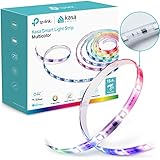
Govee 100ft RGBIC LED Strip Lights (2 rolls of 50 ft), WiFi
Who it suits: Whole-room bedroom projects — a ceiling perimeter plus an under-bed run in the same room, from one purchase — for buyers who understand that at this price the footage is the feature and the white light is atmosphere, not illumination.
One hundred feet changes what one purchase can cover, so start with what the box actually contains: two 50 ft rolls, one control box, one 24V adapter — both rolls feed from that single point, which dictates the bedroom layout before the adhesive does. The natural plan writes itself: position the control box behind the bed, run one roll along the headboard wall or ceiling edge, and run the second under the bed frame for the night-path glow — two zones, one box, one outlet. The strip is RGBIC with segmented DIY color, the Govee Home app’s scene library and music modes, schedules, and voice control through Alexa and Google Assistant over 2.4 GHz Wi-Fi. On positioning, this sits in the middle of this budget — check the current price on Amazon — and, bundling so much footage in one purchase, it is the lowest cost per foot in the guide by a wide margin. Confirm the exact Wi-Fi 100 ft configuration on the listing before ordering. A lookalike warning belongs here: Govee sells a near-identical Bluetooth-only sibling (model family H617) with no Wi-Fi and no voice control; the smart version is the Wi-Fi model, and the model number on the listing is the thing to check before ordering.
The compromises are written into the physics, and two of them bite harder in a bedroom. This strip is not cuttable: Govee’s RGBIC construction means cutting it kills sections permanently, so the 100 feet is deployed as-is — routed, coiled discreetly at the ends — and a buyer who needs an exact 14 feet behind the headboard should buy a cuttable strip instead. Its whites are mixed RGB and read cool; as an under-bed glow at low brightness that barely matters, but it cannot be the room’s warm evening light. There is no Matter and no HomeKit; the platform story is Govee’s app plus Alexa and Google — a real ecosystem, but a walled one. Density is the bulk-reel standard rather than the Nanoleaf’s 60 per meter, so in direct view the emitters show as points; this is cove, perimeter and under-bed light, judged from across the room, and for whole-room coverage at this tier that is the correct trade. The one-shot adhesive warning applies a hundredfold: a failed stick at this length is an afternoon, so clean the surface and plan the route from the single feed point. Judged on its own terms — the only pick that wraps a whole bedroom in scheduled, voice-controlled glow inside this budget — it has no competitor here.
- A hundred feet of RGBIC (two 50 ft rolls) with app scenes, schedules and Alexa/Google voice over Wi-Fi — enough for a perimeter and an under-bed run in one room.
- Mid-tier positioning in this budget for a very long kit — check price on Amazon — making it the lowest cost per foot in the guide; price varies by length and configuration.
- One control box and one 24V adapter feed both rolls — the layout starts at that single feed point.
Honest limitation: Not cuttable — cut sections die permanently, and excess length must be routed or coiled; no Matter or HomeKit; whites are mixed and cool, so it is a glow, not evening white light; both rolls hang off one feed point, and a Bluetooth-only lookalike model exists, so verify the Wi-Fi model number before buying.
Choose it if the bedroom project is whole-room coverage — perimeter plus under-bed — and footage is the priority. Skip it if you need to trim to an exact length, want warm real white for the wind-down, or will view the strip up close — the Tapo and Nanoleaf above are built for that.

Aqara LED Strip T1, 6.6 ft (2 m)
Who it suits: Aqara households — buyers who already run an Aqara hub for sensors and switches — and rhythm-keepers who want the one strip here that shifts its own white temperature across the day, in pieces that can be cut and rejoined around a bed frame.
Read the condition before the features, because it governs everything: the T1 speaks Zigbee 3.0 and does nothing — nothing — until it is paired with an Aqara Zigbee hub, sold separately, which no other brand’s hub can substitute for. For a buyer who owns that hub, the strip itself sits in the middle of this budget — check the current price on Amazon. For a buyer who does not, the honest system cost is strip plus hub, putting a from-zero setup over this guide’s budget. What the hub buys is, for a bedroom, genuinely distinctive. The strip is RGB+IC with a CCT white channel — tunable white from a dedicated component, not a mix — divided into addressable zones (ten across the 2 meters, per Aqara’s own materials). It supports Apple Home including Adaptive Lighting, which shifts white temperature across the day automatically — cooler and brighter in the morning, warm and dim in the evening — a feature almost no strip at any price offers, and the single most bedroom-shaped feature in this guide. It reaches Matter through a Matter-capable Aqara hub. And because it runs on Zigbee mesh rather than Wi-Fi, it stays responsive when the internet drops: the 2 a.m. command travels locally, hub to strip, even while the router is rebooting — the reliability argument no Wi-Fi pick here can match.
The strip also performs the category’s rarest trick, and a bed frame is exactly where it pays. Cut it at its 20 cm marks, and the cut piece can be reattached with standard 5-pin connectors and 5-core ribbon cable — Aqara states plainly that the strip loses its IP44 protection at the joint. So one purchase can become a headboard piece and an under-bed piece, routed around legs and posts. It extends with 1-meter kits — check price on Amazon for the extension kits — to a 10-meter maximum, and acts as a Zigbee mesh repeater. The compromises are the toll itself and the footage it buys. Six point six feet is the shortest strip in this guide — and, for the strip alone, among the highest in cost per foot here — sized for a headboard or bed base, not a room perimeter; reaching even 16 feet means roughly five extension kits and a system cost far beyond this guide. Aqara does not publish a lumen figure we could verify (a reviewer found third-party references to 600 lumens and flagged them as unstated by Aqara; we print neither as fact). Its Matter support is bridged, not native. And Aqara has announced a successor T2, so recheck the T1 listing’s availability when you buy. For the household already inside Aqara’s walls, none of this is a compromise: it is the natural bedroom strip, at a strip-only price, with Adaptive Lighting and the reattachment trick as bonuses. For everyone else, it is an over-budget system decision wearing a mid-tier strip label.
- RGB+IC with a dedicated tunable-white (CCT) channel, addressable zones, and Apple Adaptive Lighting that follows the day automatically.
- The reattachment exception: cut pieces rejoin with 5-pin connectors (the joint loses the IP44 protection, per Aqara) — one purchase can serve headboard and under-bed runs.
- Zigbee local control stays responsive when the internet drops; extends to 10 m with 1 m extension kits — check price on Amazon; acts as a mesh repeater.
Honest limitation: A hub is mandatory and sold separately — the realistic from-zero system sits over this budget once the hub is added; the strip alone is only 6.6 ft, and Aqara publishes no verified lumen figure for it.
Choose it if you already own an Aqara hub, or are deliberately starting an Aqara system and accept the total — especially if Adaptive Lighting and a split headboard/under-bed layout are the plan. Skip it if you do not own the hub — the Tapo gives you white, zones and three platforms as a complete kit in the lower part of this budget.

Philips Hue Lightstrip Plus V4 Base Kit, 80 in
Who it suits: Hue households and committed planners — buyers who already own a Hue Bridge and want the benchmark sunrise routine, or who accept that Hue’s full intelligence, Wake Up included, is a second purchase.
The strip itself sits at the top of this guide’s budget: the 80-inch base kit — check the current price on Amazon — and for a buyer who already owns a Bridge, that strip is the whole purchase — which is why it is here. What it buys is Hue’s RGBWW color quality with a real white component, a maker-rated output of 1,600 lumens (a first-party figure — the highest such figure in this guide), and the platform’s structural superpower: it extends. Forty-inch extensions click onto the base strip’s connector, up to 32 feet on the original supply, and — uniquely alongside the Aqara — a trimmed section can be reattached to another Lightstrip base with the included connector clip, softening the one-way cutting rule. For a bedroom, though, the headline is a routine. Behind the Bridge, Hue’s Wake Up automation fades the strip up gradually at a set time — the most polished gradual-sunrise implementation in consumer lighting. Out of the box, with no Bridge, it runs over Bluetooth in the Hue app: dimming, color and basic scenes within range of your phone, for a small number of lights. That is a real but deliberately limited mode; a sunrise that depends on your phone being in the room and in range is not the routine this pick is bought for.
Here is the toll, in full. The Hue Bridge — which unlocks Wake Up and the rest of the real routine set, out-of-home control, grouping with a house of Hue lights, entertainment sync, voice assistants and Matter — is sold separately; check price on Amazon for the Bridge. Strip plus Bridge is therefore well over this guide’s budget. It is a top-of-budget strip for Bridge owners and an over-budget system for everyone else, and both statements are printed because both are true. One bedroom-specific setting must be changed the day you install it: Hue lights return to full brightness when power is restored after an outage unless power-loss recovery is set to restore the previous state instead — leave the default in place and the first overnight power cut turns your sunrise strip into a 3 a.m. floodlight. The remaining compromises: the Plus shows one color along its whole length — no zones, no gradients — and it is the most expensive light in the guide per foot, with every 40 inches of growth another purchase. Hue’s adhesive carries the line’s well-documented owner complaints; plan clips or a channel. Judged as a strip for the already-converted, it is superb. Judged as an entry ticket, its price is the strip plus the toll, and the toll is most of another strip.
- The benchmark sunrise: Hue’s Wake Up routine behind the Bridge ramps light gradually at a set time.
- The growing strip: extendable from 80 inches to 32 feet, with offcuts reattachable to another base unit.
- Maker-rated 1,600 lumens with Hue’s RGBWW color and real white — a first-party figure, reported as one; Bluetooth control with no hub, the full platform behind the Bridge.
Honest limitation: Over budget as a system for new buyers: the strip sits at the top of this budget and the Bridge is an additional purchase, so the working system sits well over budget; it shows a single color along its length; its adhesive is the line’s most-complained-about component; and its default power-restoration behavior — full brightness after an outage — must be changed in settings for bedroom use.
Choose it if you own a Bridge, or your run will grow over years inside the Hue system and the Wake Up routine is the point. Skip it if $100 is your whole budget — every pick above it is a complete smart system inside the line.

Comparison Table
| Product | Format & length | Light & control | Best bedroom use | Link |
|---|---|---|---|---|
| TP-Link Tapo L930-5 | Coated strip, 16.4 ft, cut to shorten | RGBWIC, 50 zones, real white channel; Wi-Fi app + Alexa, Google, Apple Home | The complete hub-free wake-and-wind-down strip | Check on Amazon |
| Nanoleaf Essentials Matter Lightstrip | Strip, 16.4 ft, 60 LEDs/m, trimmable | RGBW with zones; Matter over Wi-Fi + Bluetooth, physical controller | Permanent installs; phone-free control at lights-out | Check on Amazon |
| Kasa Smart KL420L5 | Coated strip, 16.4 ft, cuts every 10 cm | RGBIC, 50 zones, mixed whites; Wi-Fi app + Alexa, Google, SmartThings | Scheduled color glow at the lowest branded price | Check on Amazon |
| Govee 100ft RGBIC | Two 50 ft rolls, one feed point, not cuttable | RGBIC segments; Wi-Fi app + Alexa, Google | Whole-room wrap: perimeter plus under-bed in one buy | Check on Amazon |
| Aqara LED Strip T1 | Strip, 6.6 ft, extendable to 32.8 ft | RGB+IC with CCT white; Zigbee via Aqara hub to Matter, Apple Home, Alexa, Google | Adaptive Lighting rhythm; split headboard/under-bed runs | Check on Amazon |
| Philips Hue Lightstrip Plus V4 | Strip, 80 in, extendable to 32 ft | Single-color RGBWW; Bluetooth app, full routines via Bridge | The Wake Up sunrise, for Bridge owners | Check on Amazon |
The Bedroom Day, Hour by Hour
It helps to walk the routine before choosing the hardware, because the six picks divide cleanly by which hours they serve. At wake time, the strip is an alarm clock made of light: the strongest implementations here are Hue’s Wake Up routine behind its Bridge and Tapo’s scheduled sunrise ramps, while Aqara’s Adaptive Lighting takes a different approach — rather than one dawn event, it keeps the white temperature matched to the time of day whenever the strip is on. The evening is where the white channel earns its money: a wind-down wants warm, dim, honest white, which the Tapo, Nanoleaf, Aqara and Hue produce from dedicated white emitters, while the Kasa and the Govee mix theirs from color and lean cool — schedule their color effects for the early evening, and keep the last hour warm on the picks that can do warm. At lights-out, the question is mechanical: can the last light be killed without a phone? The Nanoleaf’s physical controller can; voice control from the bed can on the other five. And at 3 a.m., none of these kits includes the motion sensor that makes a night path automatic — that is a separate purchase on every platform here, so plan the under-bed run to be switched by voice, by controller, or by a schedule that keeps it at a few percent all night.
Room shape refines the choice further. In a rented bedroom, where the install must come down clean and nothing can be wired in, the calculus shifts toward adhesive discipline and complete-in-box systems — the renter-specific scoring is in Best Smart Light Strip For Apartments Under $100. In a design-led bedroom, where the strip may be the only visible light source and there is no shade to forgive it, density and diffusion become the decision itself; the style-first shortlist in Best Smart Light Strip For Modern Homes Under $100 scores the finish of the light rather than the feature list. In a small bedroom you are always close enough to see the construction — dots read as dots at four feet, and a controller’s standby LED is a nightlight you did not order — which is why the shortlist in Best Smart Light Strip For Small Rooms Under $100 leans on density and short, complete kits instead of bulk footage. And if the bedroom job is genuinely one short run — a headboard, a vanity mirror — the honest step down exists: several of these same control systems appear at shorter lengths for less money, and Best Smart Light Strip Under $40 is worth reading before flagship money is spent on a five-foot problem.
How to Choose a Smart Light Strip for a Bedroom Under $100
- Start with the routine, not the strip. Decide what the light must do at 7 a.m. and at 11 p.m. — a gradual wake ramp (Tapo’s sunrise schedules, Hue’s Wake Up behind the Bridge), an all-day temperature rhythm (Aqara’s Adaptive Lighting), or simply scheduled color (all six). The routine picks the platform; the platform picks the strip.
- Ask where the white comes from. The Tapo, Nanoleaf, Aqara and Hue produce white from dedicated white emitters or channels; the Kasa and the Govee mix white from red, green and blue, and mixed white leans cold and blue — the alerting end of the spectrum, in the room where that matters most. If the strip will be your evening light, this question outranks every scene mode.
- Price the system, not the strip. Four picks here are complete in the box. Two are not: the Aqara needs its hub, which pushes a from-zero setup over this budget, and the Hue needs its Bridge for full routines, which does the same. Compare the cost of the working setup you will actually own.
- Plan zones as separate pieces, not one strip. A headboard run and an under-bed run are two pieces of light. Only the Aqara lets one purchase be cut and rejoined into both; the Tapo, Kasa and Nanoleaf shorten only; the Govee cannot be cut at all. Count kits, not feet, when the layout has two zones.
- Check the 2 a.m. control path. Voice from the bed, a physical controller (only the Nanoleaf has one), or an app — in that order of darkness-friendliness.
- Weigh footage against density — and read density before brightness. The six picks span a wide range in cost per foot; neither end is a scam, since the lower end buys coverage and the higher end buys density, white quality and ecosystem. Lumen figures are maker figures with no common standard — Tapo claims 1,000, Hue publishes 1,600, Nanoleaf’s listing states about 550 for white, Aqara publishes none we could verify. Density (60 LEDs per meter on the Nanoleaf) and zone counts (50 on the Tapo and Kasa) are checkable, and they decide what the light looks like from two feet away, which is bedroom distance.
- Treat the cloud as part of the product. Sengled’s strips lost their Alexa integration when its cloud failed — the hardware outlived the service. In a bedroom, where a dead routine means a dark wake-up, prefer strips with Matter, local control like the Aqara’s Zigbee path, or a maker whose app business is visibly healthy.
- Do not ask a strip to be a reading lamp or a motion sensor. Neither exists in these boxes; focused reading light and a sensor for the night path are separate purchases.
Common Buying Mistakes
- Buying color for a white-light job. A strip bought for its gradient shows that cannot produce warm, honest white will disappoint every single evening — check the white channel first.
- Calling a remote-control strip “smart”. If it cannot join an app, a voice assistant or an automation, it cannot run a wake-up routine.
- Assuming one kit covers headboard and under-bed. On most picks the cut piece is waste; only the Aqara rejoins its pieces.
- Assuming Matter means full features. On every pick here, Matter carries the basics; the gradients, segments and music modes stay in the maker’s app.
- Skipping the live-offer check. One pick here has shown no featured offer in crawls at times — confirm the model, the length and configuration, and an orderable offer at or under $100 before ordering, and check the current price on Amazon.
Final Recommendation
- Most bedrooms: TP-Link Tapo L930-5, 16.4 ft.
- Phone-free permanence: Nanoleaf Essentials Matter Lightstrip, 16.4 ft.
- Lowest branded price: Kasa Smart KL420L5, 16.4 ft.
- Whole-room wrap: Govee 100ft RGBIC (2 × 50 ft).
- Aqara households: Aqara LED Strip T1, 6.6 ft.
- Hue households: Philips Hue Lightstrip Plus V4, 80 in.
Our top two frame the bedroom decision. The Tapo is the complete answer for almost everyone: real white for the wind-down, a circadian mode and sunrise scheduling for the wake-up, three platforms, no hub, in the lower part of this budget. The Nanoleaf is the permanence answer: the densest light in the guide, a physical controller for a phone-free lights-out, and a connection standard built to outlive apps. Between them sit the value floor (the Kasa, color only), the footage play (the Govee, a whole room in one box), and the two gated ecosystems, each excellent inside its walls and honestly positioned at its gate — the Aqara as an over-budget system from zero with the rhythm feature nobody else matches, the Hue as an over-budget system with a Bridge and the benchmark sunrise. Decide the routine first, ask where the white comes from, count kits for your zones rather than feet, price the whole system including any hub, and set the power-recovery behavior on day one.
Frequently Asked Questions
Can a light strip actually work as a sunrise alarm?
Yes, with the right routine behind it. A gradual ramp over twenty to forty minutes is the mechanism, and the strongest implementations here are Hue’s Wake Up routine (which requires the Bridge — one more reason the Bridge toll is printed wherever Hue appears in this guide), Tapo’s scheduled sunrise ramps with its Auto-Biorhythm circadian mode, and Aqara’s Adaptive Lighting, which approaches the problem from the other side by keeping white temperature matched to the hour whenever the strip is on. What a strip cannot do is aim light at your face like a dedicated dawn simulator; mounted behind a headboard or along a ceiling edge, it raises the whole room’s light level instead, which most sleepers find gentler.
What makes a light strip “smart” rather than just remote-controlled?
Connection to a platform. A smart strip joins an app, a voice assistant and automations — schedules, scenes shared with other devices, control from outside the room — over Wi-Fi, Zigbee or Matter. A strip whose only control is an infrared remote or a same-room Bluetooth connection is a remote-controlled strip, whatever the box says, and in a bedroom the difference is the whole point: a routine that needs you awake and holding a phone has failed. Every pick here clears the platform bar; they differ in which platforms, and at what cost in hubs.
Do I need a hub for a bedroom smart light strip?
For four of these six, no: the Tapo, Kasa, Govee and Nanoleaf connect to your Wi-Fi directly (the Nanoleaf’s platform control needs a Matter controller such as a smart speaker you likely already own, but its app needs nothing). For two, yes, absolutely: the Aqara T1 works only through an Aqara Zigbee hub, and the Hue strips run in a limited Bluetooth mode until a Hue Bridge unlocks their full features, Wake Up included. The hub question is the first question, because it moves the true cost of the working system substantially — check the current price on Amazon for the hub or Bridge as well as the strip.
Why does the white channel matter so much in a bedroom?
Because of what mixed white is. RGB and RGBIC strips fake white by running red, green and blue together, and the result leans cold and blue — the alerting end of the spectrum — at exactly the hour a bedroom wants warm and dim. Strips with dedicated white emitters (the Tapo’s RGBWIC, the Nanoleaf’s RGBW, the Aqara’s CCT channel, Hue’s RGBWW) produce honest warm-to-daylight white from hardware, not arithmetic. In this guide the Kasa and the Govee mix their whites; do not ask them to be the last light you see.
What happens to these strips when the power goes out and comes back?
It depends on the platform, and it is worth setting deliberately rather than discovering. Hue lights, by default, return at full brightness when power is restored — in a bedroom, that can mean full light at 3 a.m. — unless power-loss recovery is set in the Hue app to restore the previous state; set it at install. For the other picks, behavior varies by app settings and firmware, so the rule is the same: after installing any smart strip in a bedroom, check its power-restoration setting once, on day one.
Can one strip cover both my headboard and under my bed?
Only if it can be in two pieces, and only one pick here truly can. The Aqara T1 cuts at 20 cm marks and its pieces rejoin with standard 5-pin connectors (losing the strip’s splash protection at the joint), so a headboard piece and an under-bed piece from one purchase is its signature layout. The Tapo, Kasa and Nanoleaf can only be shortened — the offcut is waste — so two zones mean two kits or one continuous route. The Govee 100-footer cannot be cut at all, but its two 50 ft rolls from one control box are the natural two-zone answer: one roll to the headboard wall, one under the bed, both fed from a single point.
Are smart light strips bright enough to replace a bedroom lamp?
As ambient and routine light, yes; as a reading lamp, no — and the claims need care, because the lumen figures in this category are maker figures with no common standard (Tapo claims 1,000 for its white; Aqara publishes none we could verify). In practice these strips wash headboards, coves and ceilings beautifully and read as glow rather than task light. Keep a lamp for reading; let the strip own the hours around sleep.