Where to buy
Check the latest price, availability and delivery on Amazon. Orders are placed on Amazon. We may earn a commission from qualifying purchases.
- Best for modern homes: GlowGarden Solar Up-and-Down Wall Sconce, 2-Pack
- Best overall value: HMCITY 120 LED Solar Wall Light, 2-Pack (Back Button, Daylight White) — Check on Amazon
- Aootek 120 LED Solar Motion Sensor Light, 2-Pack (Black, Daylight White) — Check on Amazon
- CLAONER 452 LED Solar Motion Sensor Light, 2-Pack — Check on Amazon
See 2 more Amazon options
- Aootek 120 LED Solar Motion Sensor Light, 4-Pack (Black, Daylight White)
- LIT-PaTH Outdoor LED Wall Lantern, 1-Pack (LT-WL01350K)
Read the full guide ↓
Disclosure: As an Amazon Associate, dailyhomedecorating.com earns from qualifying purchases. Listing details such as price and availability change often, so check the current Amazon listing before you buy.
A modern house judges its fixtures twice: once at night, when the light is on, and once at noon, when it is off and has to justify its shape against a flat, deliberate façade. Under $15 there is no outdoor wall light that was designed the way modern architecture is designed — no concealed fixings, no machined aluminum, no disciplined beam in a housing that reads as one quiet gesture. What $15 buys is solar hardware: a circuit board, a stamp-sized panel, a small battery and a bank of diodes in a molded ABS plastic shell. So the honest headline for a modern home is different from the headline of our general guide to the Best Outdoor Wall Light Under $15: there, the question is which solar light works best; here, the question is which of them does the least visual damage, where on the house each one belongs, and when the right answer is to spend this budget on the service areas and save the entry wall for a higher tier entirely.
One pick speaks the language. It is still a plastic solar accent with six LEDs, so check the current price on Amazon before judging it against this budget. The HMCITY 2-pack remains the best-value tool in the tier — check price on Amazon — and it earns its place in this version of the guide as the light to put where the architecture is not being judged: the side gate, the bin store, the garage’s working face. The Aootek designs add a reflector and a reachable button. The CLAONER, with 452 diodes marketed as a headline, is included as the tier’s clearest example of what a modern façade should refuse. One pick is a labeled near-miss — the Aootek 4-pack, which sits just above this budget tier, so check the current price on Amazon before counting it in — kept because repetition is a modern principle and four identical fixtures in a line read as intention in a way two never do. And the LIT-PaTH lantern closes the list as the reality check: the hardwired fixture we verified closest to this tier, aluminum and glass, priced above this budget — check price on Amazon — and a traditional lantern in form, which tells its own story about where designed exterior lighting actually starts.
Two warnings from the base research govern everything below, and they matter more on a modern house, not less. First, brightness claims in this category are maker numbers with no shared measurement standard — near-identical 120-LED lights are listed in different places at 800, 960, 1,200 and 2,200 lumens — so no lumen figure is printed as fact anywhere in this guide. If your rooms are small as well as modern, the companion guide to Best Outdoor Wall Light For Small Rooms Under $15 works through the same six products at small-house scale, and renters should start with Best Outdoor Wall Light For Apartments Under $15, where the no-drilling question comes first.
Quick Picks
Each row below names the modern-home job first and the product second, because in this budget tier the placement decision matters more than the product decision. Prices change often, so no static price is printed here; check the current price on Amazon for the exact pack and configuration named in each row.
| Modern-home job | Pick | Why it stands out | Link |
|---|---|---|---|
| Best for modern homes (check price) | GlowGarden Solar Up-and-Down Wall Sconce, 2-Pack | The only fixture here that speaks the language — up-and-down wall wash, warm white, no sensor on its face; check the current price on Amazon and buy only if it sits within this budget | Check on Amazon |
| Best value, for walls nobody judges | HMCITY 120 LED Solar Wall Light, 2-Pack (Back Button, Daylight White) | The proven budget motion light and the value end of this tier — check price on Amazon — and put it on the gate and the garage, not the entry elevation | Check on Amazon |
| Best wide coverage | Aootek 120 LED Solar Motion Sensor Light, 2-Pack (Black, Daylight White) | Reflector housing throws light sideways across wide flat walls and garage aprons; front button; check the current price on Amazon, as this pick moves in and out of this budget | Check on Amazon |
| Best for façade rhythm (near-miss) | Aootek 120 LED Solar Motion Sensor Light, 4-Pack (Black, Daylight White) | A near-miss just above this budget, stated plainly — check the current price on Amazon — but four identical fixtures in a line read as a design decision, and the larger pack keeps the per-light cost at the low end of the tier | Check on Amazon |
| Most LEDs, least modern (check price) | CLAONER 452 LED Solar Motion Sensor Light, 2-Pack | 452 diodes is a count, not a brightness figure, and the busiest face in the tier; check the current price on Amazon — buy only if it sits within this budget, and only if evenness matters more than looks | Check on Amazon |
| The hardwired reality check | LIT-PaTH Outdoor LED Wall Lantern, 1-Pack (LT-WL01350K) | Aluminum and glass, hardwired, priced above this budget — check price on Amazon — and a traditional lantern in shape, which is exactly the point: designed modern fixtures start higher still | Check on Amazon |
How These Picks Were Chosen
The product pool is the same six verified products as our base guide — an outdoor wall light, defined plainly, is a fixture that mounts on an exterior wall and lights the space in front of it, which excludes path stakes, string lights and indoor sconces with optimistic titles — and the verification standard is unchanged: a real, orderable Amazon listing tied to its exact configuration, with readers directed to check the current price on Amazon rather than rely on any printed figure, because prices in this category change often. A modern home adds three tests that the general guide does not apply, and every pick below was run through all three.
The silhouette test. Stand across the street at noon and look at the fixture, off. By this test the tier is mostly failures, because a solar motion light must show its panel to the sky and its sensor to the street, and its face is therefore a diagram of its function. The scoring below does not pretend otherwise; it ranks degrees of visual noise and matches each level to the walls that can absorb it.
The off-state test. Exterior lights spend most of their lives off, in daylight, at eye level. On a traditional house a black plastic box hides among shutters, trim and shadow lines; on a modern house with smooth render, large glass and no trim, there is nowhere for it to hide, and its material tells the truth — ABS plastic chalks and yellows under UV over the years in a way powder-coated metal does not, and a white or silver shell against dark cladding (or a black shell against white render) draws exactly the attention the architecture was designed to avoid. Placement is the only mitigation this tier offers: out of the primary sightline, aligned with a door head or a panel joint, repeated symmetrically or not present at all.
The light-quality test. When the fixture does switch on, what it emits is judged by modern standards too: warm, controlled, and aimed at a surface rather than sprayed at the street. Here the tier’s physics bite. Only the GlowGarden burns warm white, and only the GlowGarden aims its light at the wall itself, grazing the surface so texture does the work. Everything else is scored as what it is: a burst of cold light for a doorway, useful and unlovely in equal measure.
Underneath the three tests, the base filters still apply, in the same order: power architecture first (under $15 the hardwired fork is closed — the hardwired fixtures we verified sit above this budget — so every in-budget pick is solar, with solar’s dependence on a sunlit wall); sensor mechanism matched to the job (a PIR motion sensor and a photocell dusk-to-dawn switch are different devices, and listings blur them on purpose); modes you can actually reach after mounting; and pack value, because in this category the honest comparison is what a pack delivers for its place in the tier. We did not install these lights ourselves; we read the listings, manuals and specification pages, and we say so.
The 6 Best Outdoor Wall Lights for Modern Homes Under $15
GlowGarden Solar Up-and-Down Wall Sconce, 2-Pack
Who it suits: Modern homeowners who want the entry elevation to look designed at night — a wash of warm light on the wall itself — and who already have, or will separately provide, real working light for the doorstep.
This is the one pick in the tier that starts from the modern move. The fixture (maker model Swl-3030-6, sold under the GlowGarden name) carries six LEDs split three-up and three-down, so instead of throwing light outward at visitors it paints two fans of warm white onto the wall above and below itself. The silhouette is the quietest in this guide: a small sconce bar with no sensor dome, no reflector wings and no diode grid on display, because there is no motion sensor to house. It is sold as a 2-pack, which matters for this style of house more than most: a matched pair flanking a door, or a run of identical points along a garden wall, is how the effect is composed. Check the current price on Amazon for this 2-pack before judging it: the buying rule is the budget itself — only if it sits within the under-$15 tier is it a fair buy for the only modern gesture in the tier.
The limitations are the price of the gesture, and they are not small. Six LEDs produce accent light: enough to read the wall’s texture and mark the fixture’s rhythm along it, nowhere near enough to find a keyhole, read a house number, light a step or see a face — on a modern entry, this sconce is the composition layer, and a motion light or a wired fixture still has to do the work. The dusk-to-dawn mechanism spends the battery every night whether anyone is outside or not, so through short or cloudy winter stretches the charge gives out in the small hours and the wall simply goes dark; there are no modes to fall back on, because there are no modes. And the brand is a generic-label storefront rather than an established lighting maker, which matters in year two when a battery fades and you want the identical fixture again for the pair to stay a pair. Judged as jewelry for a wall whose working light is already solved, it is the only pick here a modern homeowner should put on the front of the house.
- The only up-and-down wall wash in the tier — the contemporary façade move — in warm white, the only warm color temperature among the six picks.
- The quietest silhouette here: no motion sensor, no diode grid, no reflector — a small bar that lets the lit wall be the object.
- Sold as a matched 2-pack, so a doorway pair or a rhythmic run along a garden wall keeps the composition symmetrical.
Honest limitation: Check price on Amazon and buy only if it sits within this budget. Accent output only, no motion sensor, the battery is spent every night regardless of need, and no specific IP rating could be verified, so give it a sheltered wall.
Choose it if the wall already has working light and what it lacks is composition. Skip it if it would be the entry’s only light, if your winters are long and dark, or if checking the current price on Amazon shows it has climbed past this budget — at that point the step up to the next tier is the better buy.
HMCITY 120 LED Solar Wall Light, 2-Pack (Back Button, Daylight White)
Who it suits: Modern homeowners with a clear-eyed division of labor: this light goes where the house works, not where it poses — the side gate, the garage’s service face, the bin store, the path to the meter.
The HMCITY is the reference product of the budget solar shelf and the best-value tool in this guide: 120 LEDs behind a frosted cover, a PIR motion sensor, a monocrystalline solar panel across the top face (maker-claimed conversion of up to 20.5%), and an ABS plastic housing, in the back-button, daylight-white 2-pack configuration. It sits at the value end of this tier — check price on Amazon — which is part of why it is so widely used on working walls. The housing is rated IP65, a laboratory dust-and-water-jet code: rain on a wall is well inside what it describes, but it is not a UL or ETL wet-location listing, and we could not verify a location certification for it. None of that changes in this version of the guide. What changes is the placement verdict, and it is a compliment of a kind: this is a well-made appliance, and a modern house has plenty of walls where an appliance is exactly right.
On the judged walls, the three modern tests score it without mercy. The silhouette is a wedge of visible technology — panel on the face, sensor below, frosted diode field between — reading at noon as security hardware, because that is what it is. And when it fires, the light is a cold burst: right for a returning teenager at the side gate, wrong for the composed entry of a house that chose its interior color temperatures deliberately. Two practical limits complete the picture. The mode button sits on the back face, against the wall, so the mode is chosen on mounting day and effectively never changed — choose the dim-with-boost setting before it goes up. And the whole device is a solar bet on its wall: shade it, face it north, tuck it under a deep canopy, and it undercharges and underperforms no matter the mode. Kept to the working walls, at the value end of this tier, it is the easiest recommendation in this guide. Put on the entry elevation, it is the thing visitors will remember about the façade — and not as lighting design.
- The tier’s proven default: three genuinely distinct modes covering security bursts and marker duty in one fixture.
- Sits at the value end of this tier — check price on Amazon — which is what funds the rest of the plan.
- IP65 ABS housing with a monocrystalline panel — the standard, best-selling construction of the category, with a deep owner record behind it.
Honest limitation: It looks like what it is — a plastic security appliance — and on a clean modern elevation that is a design cost, not a detail. Daylight white only in this configuration, the mode button is unreachable once mounted, output is a burst rather than steady light, and performance collapses on shaded walls.
Choose it if the mounting point is a working wall — gate, garage, service path — and you want the proven tool at the value end of the tier — check the current price on Amazon. Skip it if the wall is part of the house’s composed face; that is the GlowGarden’s job above, or a higher tier’s.
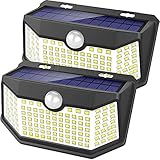
Aootek 120 LED Solar Motion Sensor Light, 2-Pack (Black, Daylight White)
Who it suits: Modern homes with wide, flat working walls — a broad garage elevation, a long driveway wall — where light needs to travel sideways, and owners who will actually use a mode button if it is reachable.
The Aootek (model AK06, in this black-shell, daylight-white 2-pack) answers the two most common complaints about the default design, and one of the answers has a modern use. The button moves to the front face: switching among its three modes — security (motion-triggered full brightness), permanent-on, and smart brightness control (dim all night, full power on motion) — is a fingertip job on the mounted light. Modern garages are exactly that problem: a broad, unbroken elevation where a narrow downlight leaves the edges dark. Construction is the class standard — IP65-rated ABS plastic, a maker-claimed 20.5% panel conversion — and a warm-white version of the same 2-pack exists on its own listing, which matters to this audience more than any other: it is the only way to get this hardware in a color temperature a modern exterior can live with. Its position in the tier needs care: this pick moves in and out of this budget, so check the current price on Amazon before counting it in. When it sits within the under-$15 tier it belongs here; when it sits above, treat it as a near-miss, and this review keeps both possibilities in view.
The modern scoring is a study in almost. The black shell is the right instinct — on dark cladding or a shadowed garage wall it recedes further than any light-colored housing in the tier — and the reflector gives its face a slightly more resolved, deliberate geometry than the flat diode fields around it. But it remains, at noon, a plastic wedge with a panel for a forehead, and its light at night is daylight white in this configuration: wide, cold and flat across the very wall it was meant to flatter. Like every solar pick here it carries an IP65 code rather than a wet-location listing. Bought within this budget for a working wall — or in its warm-white listing by an owner who refuses daylight white anywhere — it is the most capable motion light in the guide. Bought above this budget for the entry, it is the wrong light at the wrong tier position in the wrong color.
- Reflector housing with a claimed 270° spread — the pick for wide flat walls and garage aprons, where side-throw is the whole job.
- Front-mounted mode button: the fix for the back-button problem, and the reason this design suits owners who change modes with the seasons.
- A warm-white sibling listing exists — the only route to this hardware in a modern color temperature — and the black shell recedes best of the motion lights on dark walls.
Honest limitation: Its price moves in and out of this budget — check the current price on Amazon, and treat it as in-budget only when the live listing sits within the under-$15 tier. ABS plastic, maker-figure detection claims, and daylight white in this configuration.
Choose it if checking the current price on Amazon shows it within this budget, you need side-throw across a wide wall, or you will use the mode button more than once. Skip it if the live price sits above this budget and the wall is the entry — wait for it to come back into the tier, buy the warm-white listing, or step up a tier.

Aootek 120 LED Solar Motion Sensor Light, 4-Pack (Black, Daylight White)
Who it suits: Modern homeowners lighting a whole elevation or a run of garden wall, who understand the style’s first rule — repetition is what turns a fixture into architecture — and who need four matching points, not two.
This pick sits just above the guide’s budget, and the guide includes it anyway, with that near-miss status in the open: check the current price on Amazon before counting it in. The general case for it is pack value — the larger pack keeps the per-light cost at the low end of the tier, below the smaller packs’ per-light cost. The modern case is stronger and different. A contemporary façade is composed in repeats: identical windows, identical panels, identical lights at identical intervals. This is the only way the budget motion light can participate in a modern composition at all — not by being beautiful, but by being systematic. Its position just above the budget is instructive about the tier itself: even at its most favorable, this pack has tended to sit at or just above this budget line, and the family’s larger 6-pack is the option for houses whose composition needs six points — check price on Amazon for either pack.
The limitation is its tier position: sitting just above this budget, it is not strictly under $15, and if the budget is a hard line, the HMCITY 2-pack is the pick and this is a temptation to resist. The modern argument also cuts both ways, and honesty requires the other edge: repetition amplifies whatever it repeats. Four fixtures also means four panels, each needing its own patch of direct sun; a run along a wall that passes into shade will perform unevenly, and unevenness is the one thing a rhythmic composition cannot survive — the dead or dim point in the line announces itself. Four plastic housings will chalk in the sun together, on the same schedule, which at least keeps them matched. None of that dents the case where it applies: if the project is a whole elevation and the under-$15 budget is a guideline rather than a law, this is the most modern purchase in the tier — a system, bought as a system.
- The larger pack keeps the per-light cost at the low end of the tier — check the current price on Amazon.
- Four identical fixtures enable the one modern move available to this hardware: repetition at intervals, which reads as design rather than clutter.
- Identical AK06-family hardware to the 2-pack pick — reflector, front button, three modes — so a house can mix pack sizes without mixing designs.
Honest limitation: It sits just above this guide’s budget — check the current price on Amazon — and it has tended to stay at or just above the budget line rather than comfortably under it. One color temperature across four points, four panels each needing direct sun, and the class’s plastic construction throughout.
Choose it if the project is a run or an elevation, you need three or four points, and $15 is a guideline. Skip it if the budget is a hard line (buy the HMCITY 2-pack), or if only one wall is in full sun — a rhythm with a gap in it is worse than a single light.
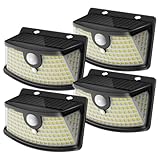
CLAONER 452 LED Solar Motion Sensor Light, 2-Pack
Who it suits: Honestly, in this version of the guide: almost nobody with a modern house — and it is included, scored and explained because it is the tier’s best-selling argument, and a modern homeowner deserves to hear why the argument fails their walls specifically.
The product itself is legitimate. The architecture is the proven one. Check the current price on Amazon before considering it, and the brand’s own range explains the caution: CLAONER’s other packs sit at and above this tier. So the buying rule is qualitative: the pick earns consideration only if checking the live listing shows the 2-pack sitting within the under-$15 budget.
Now the modern scoring, which is why this review exists. The headline number is the problem, twice over. A diode count is a census, not a brightness figure. Second, visually: four hundred fifty-two diodes are what the fixture’s face is. Where the modern discipline asks for a surface — smooth, quiet, one gesture — this design offers a grid of visible points, the busiest face in the tier, an object that at noon reads as a small electronic billboard screwed to your wall. It fails the silhouette test by the widest margin here and the off-state test outright: there is no placement on a composed elevation where a diode grid becomes discreet. Add the thinnest owner record in the guide (it is the newest listing), the class’s standard plastic and IP65 code rather than a certification, and that uncertain tier position, and the verdict writes itself. On a workshop wall or a rental’s side path, if it sits within this budget, it is a fair appliance. On a modern house, it is the counterexample that proves the tier’s rule: in this tier, more on the box means worse on the wall.
- The densest diode field in the tier — 452 LEDs — for the most even spread of light this architecture offers, if evenness is the priority.
- The standard, proven three-mode PIR architecture with an upgraded panel, from one of the category’s volume makers.
- Included with a clear buying rule: check the current price on Amazon and consider it only if it sits within this budget; the brand’s other packs sit at and above this tier.
Honest limitation: Check the current price on Amazon — the brand’s range suggests it may sit above this budget. The 452 count is marketing, not brightness, and the diode-grid face is the least modern object in this guide. Newest listing here, thinnest owner record.
Choose it if the wall is a workshop or utility face, checking the current price on Amazon shows it within this budget, and light evenness outranks looks. Skip it if the wall is visible from the street or the garden — on a modern elevation, every other pick in this guide does less damage.

LIT-PaTH Outdoor LED Wall Lantern, 1-Pack (LT-WL01350K)
Who it suits: Readers who came to this guide hoping $15 might reach a real fixture — wired, metal, permanent — and who deserve an honest account of where that thing sits relative to this budget, plus an honest note about its shape.
This is the hardwired reality check, carried over from the base guide because its position above this tier disciplines the whole guide. The light is 5000K daylight only, switched by your wall switch, on for exactly as long as you leave it on, indifferent to clouds, seasons and the direction the wall faces. It sits above this guide’s budget — check the current price on Amazon — and a 2-pack configuration is also sold for houses that need a matched pair. The conclusion is qualitative and firm: no hardwired fixture we could verify sits within this budget tier.
For a modern house, though, the reality check has a second layer, and it is the most useful sentence in this guide: even the wired floor is not modern. The LIT-PaTH is a lantern — a traditional form, with a cage-and-glass vocabulary drawn from carriage houses, not from the flat-plane architecture it would hang on. It passes the material test the solar picks fail (aluminum, glass, permanence) and fails the silhouette test in the opposite direction (a period costume on a contemporary wall). That is the tier’s real shape for this audience: under $15 buys solar appliances; stepping above this tier buys wired permanence in a traditional shape; the fixtures a modern house actually wants — slim up/down cylinders, recessed step lights, architectural bars with verified wet-location ratings — begin above that, which is why this guide keeps pointing at the step up. Buy it for a garage or a side door where permanence matters and style is not the brief. For the entry of a modern home, let its position above this tier do its real job — calibrating what you save for next.
- Aluminum housing and glass shade — the only metal-and-glass construction in this guide, and the hardwired option closest to this tier — check price on Amazon.
- Switch-controlled light all night, every night, with no sun, battery or sensor in the chain — the reliability solar cannot sell at any diode count.
- Included as the calibration point: its price, and its traditional shape, together show a modern homeowner exactly where their tier actually begins.
Honest limitation: It sits above this budget — check the current price on Amazon before planning around it. It needs a junction box, the integrated LED is not replaceable, 5000K is the only color temperature, and the lantern form is traditional, not modern.
Choose it if a junction box exists on a working wall and permanence outranks style. Skip it if the wall is the modern entry — save the money toward the architectural fixtures in the higher-tier guides instead.

Comparison Table
| Product | Type | Modern verdict | Link |
|---|---|---|---|
| GlowGarden Solar Up-and-Down Wall Sconce, 2-Pack — check live price | Solar dusk-to-dawn accent sconce, warm white, no motion sensor | The only modern gesture in the tier — wall grazing, quiet silhouette; accent only | Check on Amazon |
| HMCITY 120 LED Solar Wall Light, 2-Pack — check price on Amazon | Solar PIR motion light, 3 modes, IP65 ABS | The best tool here, on the wrong walls an eyesore — assign it to gates and garages | Check on Amazon |
| Aootek 120 LED Solar Motion Sensor Light, 2-Pack — check price on Amazon | Solar PIR motion light, reflector housing, front button | Wide cold throw for wide flat working walls; warm-white sibling listing is the modern-friendly route | Check on Amazon |
| Aootek 120 LED Solar Motion Sensor Light, 4-Pack — near-miss just above this budget; check price on Amazon | Solar PIR motion light, reflector housing, 4-pack | Repetition makes it a system — the only way this hardware composes on a façade | Check on Amazon |
| CLAONER 452 LED Solar Motion Sensor Light, 2-Pack — check live price | Solar PIR motion light, 452 LEDs, 3 modes | The counterexample: a diode grid is visual noise — keep it off composed walls | Check on Amazon |
| LIT-PaTH Outdoor LED Wall Lantern, 1-Pack — above this budget; check price on Amazon | Hardwired integrated-LED lantern, aluminum and glass | Real materials, traditional form — proof that modern fixtures start above this tier | Check on Amazon |
How to Choose
Judge the off-state first. Every other version of this guide starts with power and sensors; this one starts with noon. A pick that fails the first two tests can still be the right purchase, but only for a wall where the tests do not apply. Deciding which of your walls are judged and which are merely used is the real work of this guide, and no listing can do it for you.
Assign each pick to its wall class. Modern houses have three classes of exterior wall. The composed elevation — entry, street face, the garden wall the living room looks onto — gets the GlowGarden’s accent wash or nothing at all. The long runs — a fence line, a retaining wall, a wide garage elevation — get repetition: the Aootek 4-pack’s identical points at identical intervals, or the same discipline applied to the sconces. Most bad outcomes in this tier come from a class error: a working-wall appliance promoted to the composed elevation because it was cheap and the ladder was already out.
Treat color temperature as a design material. Modern interiors are specified to a color temperature and held to it across every bulb in the house; the exterior deserves the same discipline and almost never gets it, because the budget solar category defaults to daylight white. The consequence is visible from the street: a warm, composed interior glowing behind glass, and a cold blue burst firing over the garage like a loading dock. Mixing temperatures across one elevation is the mistake; a deliberate cold zone at the bins is not.
Audit the sun before the listings — eaves change the answer. A solar light is a bet on its mounting point: the panel is on the fixture’s face, so the wall decides the harvest, and makers recommend six to eight hours of direct sun and mounting heights around 5.6–6.6 feet for the sensor geometry. Walk the wall at midday and find the shadow line before ordering. Where the sun audit fails on a wall that matters, the honest options are the wired rung or no fixture — not a bigger diode count.
Read IP65 for what it is, especially on an eave-less wall. IP65 is a laboratory code — dust-tight, proof against water jets — and rain on a wall sits well inside it. Traditional houses shelter their fixtures by accident, with porches and eaves; modern houses often present a flat, exposed face to the weather on purpose. Give these plastic housings whatever shelter the architecture offers — a canopy, a reveal, the lee of a pier — not because IP65 fears rain, but because every seal and every plastic ages slower out of the worst of it, and a chalked, yellowed box is an off-state failure you can schedule in advance.
Decide whether this tier is a placeholder or a destination. There are two coherent strategies, and one incoherent one. The incoherent strategy is buying the diode-count flagship for the front door and calling the exterior done. If your project is the composed elevation itself — a terrace off the main bedroom, say, where the light shapes the room’s evening — the honest read is that it belongs to a different budget, and the guides one rung up, including Best Outdoor Wall Light For Modern Homes Under $30, are where hardwired fixtures, metal housings and verified ratings begin. Readers lighting the wall outside a bedroom should also see Best Outdoor Wall Light For Bedrooms Under $15, which scores these same six products on glare through glass and light at the pillow rather than on composition.
Should a Modern Home Wait, or Buy the Accent Now?
The question underneath this whole guide deserves its own answer. The case for buying now: the working walls are not waiting for anything, because no future budget transforms a bin-store light into a design object — the HMCITY, at the value end of this tier, is the correct terminal purchase there, today. And the GlowGarden, if checking its price shows it within this budget, is inexpensive enough in tier terms to be reversible: if the real sconces arrive in two years, a pair of solar accents moves to the garden wall and nothing is wasted. The synthesis this guide recommends is therefore a split budget, not a compromise product: motion lights on the working walls now, the sconce pair on the composed wall if checking the current price on Amazon shows it within budget, and the entry’s real money held for the tier where architectural fixtures live. What a modern home should not do is the middle thing — spread this budget evenly, one appliance per wall, and compose nothing.
Common Buying Mistakes
Buying the diode count. The 452-LED headline is the anti-modern purchase in both directions: output is capped by the panel and battery, so the light is not four times anything, and the face is a grid of visible points — maximum visual noise at noon for zero extra light at night. On a composed wall, diode counts are a reason to skip, not to buy.
Judging a fixture by its night photograph. Listing photos are shot in the dark, where every fixture is a glow and a lens flare. Cover the glow in the photo with your thumb and look at what is left — that plastic shape, at eye level, on your render — because that is the purchase.
Mixing color temperatures across one elevation. A warm sconce pair at the door and a daylight-white motion light beside it do not average out; they argue, visibly, every night. Specify the exterior the way the interior was specified: one temperature per elevation, cold quarantined to working walls, and the warm-white sibling listings chosen deliberately where a motion light must be seen.
Putting a white or silver shell on a dark wall (or the reverse) at eye level. Contrast is a highlighter. A pale plastic box on charcoal cladding announces itself from the street; the black-shell configurations recede on dark walls, and on pale render the least-bad answer is usually alignment — centered on a panel joint, level with a door head — so the object reads as placed rather than stuck on.
Asking an accent sconce to do a security light’s job. Six LEDs grazing a wall will not light a step, a lock or a face, and a doorway that relies on them is a doorway in the dark with decoration. Accent and illumination are different purchases sharing a search term: the sconce composes the wall, a motion light (or a wired fixture) works the door, and a modern entry may well need both layers.
Assuming IP65 means rated for an exposed façade. It is a water-jet test code, not a wet-location certification — and we could not verify a location listing for any solar pick here. Mount with whatever shelter the architecture gives, and insist on a genuine wet-location rating for any hardwired fixture in direct rain.
Final Recommendation
Split the budget the way the house is split. For the composed walls, the GlowGarden up-and-down sconce is the only pick in this tier that belongs on them — warm white, wall-grazing, quiet at noon — bought as a pair, only if it sits within this budget — check the current price on Amazon — with its accent-only output understood. For the working walls, the HMCITY 2-pack — check price on Amazon — remains the best tool in the tier: proven, three-moded, at the value end of the tier, and honest about being an appliance. Where a whole elevation needs covering, the Aootek 4-pack’s repetition is the one modern move the motion lights can make, as a labeled near-miss just above the line. And hold the entry’s real money: the hardwired option closest to this tier sits above it and wears a traditional lantern’s shape, which tells you the architectural fixtures a modern house actually wants start above this guide entirely. Spent hoping the tier is something it is not, it buys six small apologies in plastic.
FAQ
Is there a genuinely modern-designed outdoor wall light under $15?
No — not in the sense a modern homeowner means: no machined or powder-coated metal housing, no concealed fixings, no verified wet-location rating, no designed fixture in this budget tier in any listing we could verify. Everything else in the tier is security hardware. The designed fixtures begin above this budget; the honest choice at $15 is placement discipline, not product discovery.
Why do all the cheap solar lights look like security boxes?
Because their faces are their machinery. A solar motion light must expose a panel to the sky, a PIR sensor to the street and a field of diodes to the area it lights, all in a shell molded as cheaply as possible — there is no budget left to hide any of it, and no design review asking whether it should be. A hardwired fixture can bury its workings in a junction box and show only a form; a budget solar appliance shows its working because the working is the product.
Does the daylight-white color really matter outside?
On a modern house, yes — it is the difference between an exterior that extends the interior’s discipline and one that contradicts it nightly. It is acceptable — even preferable — on working walls where the light is a tool. On composed walls, choose the warm-white options named in this guide or choose darkness.
Where should a modern home put budget solar lights?
On the walls the architecture does not present: side gates, garage service faces, bin and meter areas, utility paths, and the far side of garden walls. The composed walls get the sconce accent, landscape light, or the glow from inside — in that order of preference at this budget.
Can I paint a plastic solar light to match my wall?
We would not recommend it, and no maker in this guide sanctions it. The better tools are configuration (choose the black shell for dark walls), placement (alignment and shadow lines), and repetition. If the fixture must match the wall exactly, that requirement itself is the sign to step up to metal fixtures that come in finishes.
Is IP65 enough for a flat, exposed modern façade?
For rain, the code describes the exposure adequately — IP65 is dust-tight and proof against water jets. Expect the fixture to work and the finish to age; mount it with whatever shelter the architecture offers, and treat replacement in a few years as part of the cost of this tier.
When should I skip this tier and go straight to the $30 guide?
When the light is part of the architecture: the entry fixture, a terrace wall the living spaces look onto, any wall where the fixture will be seen daily at close range in daylight. Stay in this tier for working walls, temporary lighting, and accent washes — jobs where its products are not compromises but the correct tools.